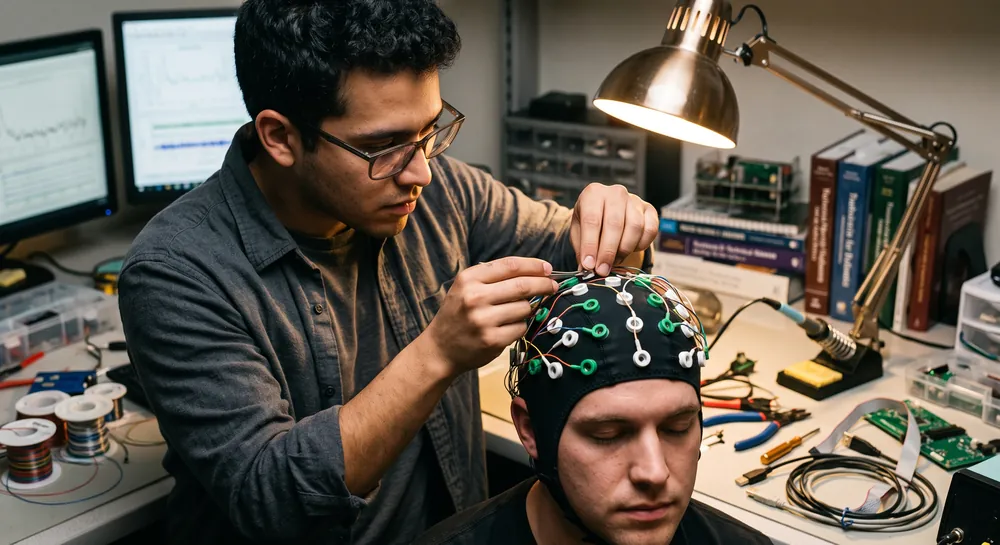
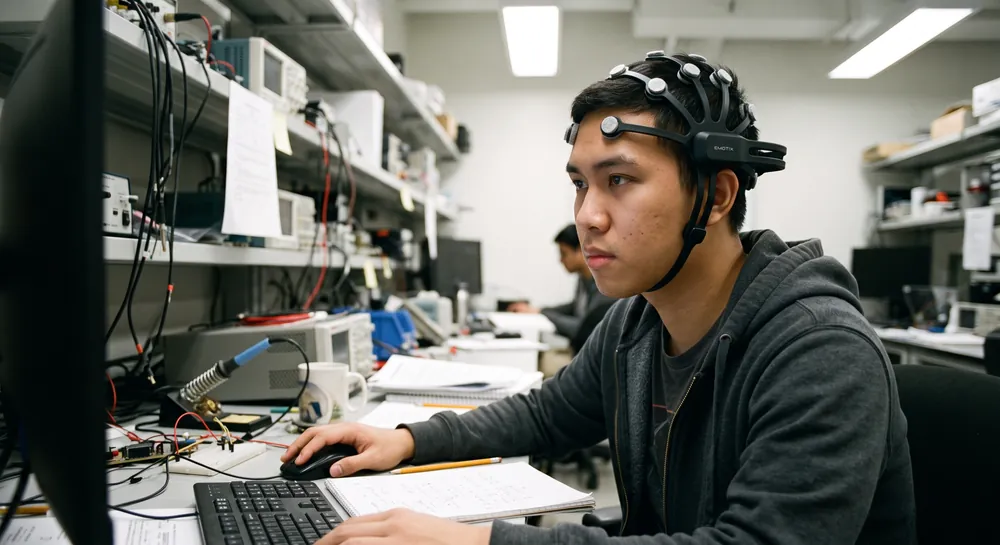
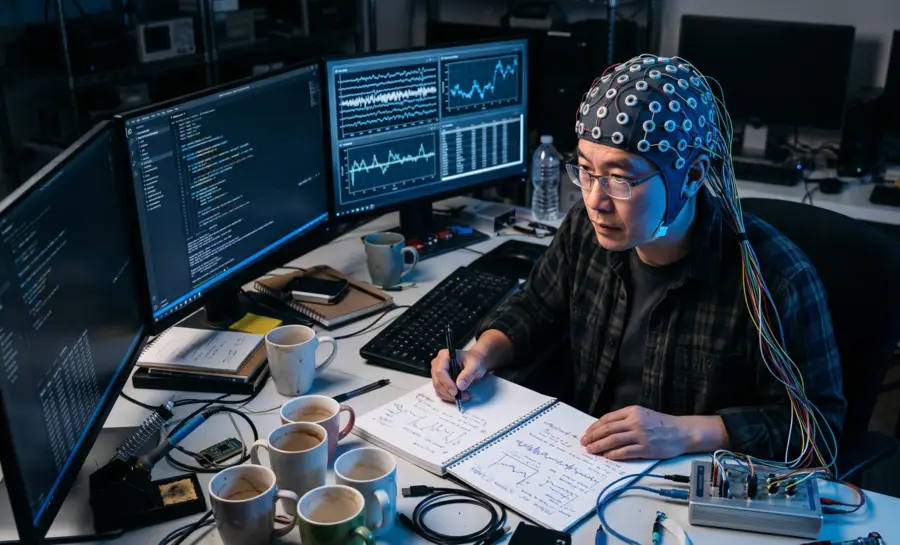
Traditional EEG studies remain largely confined to research centers due to sophisticated hardware requirements, which restricts both testing contexts and repeated longitudinal measures. However, a new generation of portable, research-grade EEG systems now offers the prospect of frequent and remote measurement of human brain activity in natural environments.
What is a Portable EEG?
A portable EEG is an electroencephalography system designed to record electrical activity from the scalp while allowing the participant or patient to move more freely than with a conventional stationary setup. The core measurement remains the same: electrodes detect small voltage changes associated with coordinated neural activity. What changes is the form factor, power arrangement, data transfer, and setting in which the recording can take place.
Portability does not make a recording automatically clinical-grade or suitable for every purpose. Channel count, electrode design, sampling characteristics, reference configuration, environmental noise, and artifact handling all affect the usefulness of the resulting data. The term therefore describes a category of equipment rather than a single performance level.
How Portable EEG Expanded Beyond Traditional Research Labs
Research-grade portable EEG systems generally fall into two broad categories:
The first involves flexible electrode arrays that contour to the body rather than requiring a rigid cap. Commonly a small number of electrodes printed on a flexible sheet and arranged in a C-shape to wrap around the ear.
The second category pairs conventional electrode caps with mobile signal-acquisition platforms, such as smartphones or tablets, enabling real-time processing and data streaming without a desktop computer.
The defining advantage of these systems is temporal endurance and contextual freedom. Traditional laboratory recordings typically last thirty to ninety minutes and require participants to remain nearly motionless.
In contrast, a validation study led by Stopczynski demonstrated that participants could wear two flexible, ear-worn electrode arrays for at least seven hours while going about their daily activities. The electrodes remained concealed behind the ears, causing minimal discomfort and drawing no social attention.
However, the lure of ecological validity, the idea that data collected in natural settings better reflects real-world cognition, should not be overstated. A 2023 review of brain wearables explicitly noted that while EEG wearables provide high-quality data and supporting software exists for remote collection, widespread adoption requires addressing additional challenges.
The promise of unobtrusive, all-day neural measurement is real, but the empirical foundation is still being laid. Therefore, researchers should view these tools as complementary to laboratory systems, not as replacements that automatically confer greater scientific authenticity simply because the recording occurred outside a controlled environment.
Real-World Applications of Earbud EEG Sensors
Versions of the same underlying concept are now available as consumer- and research-facing hardware. The Emotiv MN8 is one example: a 2-channel EEG system built into a set of wireless earbuds, using dry, non-toxic conductive sensors positioned in the left and right ear canal rather than distributed across the scalp.
Because the sensors sit inside the ear rather than under a cap, setup does not require gel or scalp preparation, and the device can be worn and streaming data in under a minute. That kind of setup time is crucial for the naturalistic, all-day recording scenarios, where a lengthy preparation routine would work against the goal of unobtrusive, continuous measurement. Interchangeable ear-tip sizes and an adjustable ear hook address the individual fit variability that any around-the-ear system has to contend with.
The device also reflects a few practical engineering responses to common challenges:
Split referencing between the two channels is used to help reject shared ambient electrical noise, a direct answer to the interference problem described in the signal-fidelity discussion below.
An onboard motion sensor logs head movement alongside the EEG signal, giving downstream analysis a way to flag intervals affected by motion artifacts rather than treating an entire recording as uniformly clean.
Battery life is rated at up to six hours, placing it within the same all-day-use category as the longer ambulatory recordings. Though, as with any wearable EEG system, the actual usable recording duration for a given study should be verified against the specific protocol rather than assumed from a spec sheet.
Moreover, devices in this form factor are explicitly positioned for research, wellness, and human-computer interaction use rather than as diagnostic tools, and a two-channel earbud system is not a substitute for a high-density cap when fine spatial resolution is the goal. Within that scope, though, it illustrates how EEG hardware moves from something a participant visits a lab to use, toward something built into an object people already wear every day.
Hardware Cost and Signal Quality in Portable EEG
One of the most significant barriers to portable EEG adoption has been financial. High-end wearable amplifiers deliver excellent performance but command research-grade prices, which creates an accessibility problem for laboratories operating under constrained budgets. Lower-cost, openly documented hardware has emerged to address this gap, raising a natural question: can more affordable hardware deliver scientifically defensible data?
A 2023 systematic comparison addressed this directly by pairing the same concealed, ear-worn electrode array with two different amplification systems: a premium, research-grade wireless amplifier and a lower-cost, openly documented amplifier board.
The lower-cost system demonstrated highly similar noise performance to the premium amplifier, meaning the background electrical noise introduced by the cheaper hardware was essentially indistinguishable from that of the more expensive system. This is a meaningful finding because noise performance directly determines whether subtle neural signals can be extracted from a raw recording.
The trade-off appeared in timing precision rather than noise. The lower-cost system exhibited slightly lower temporal accuracy than the premium amplifier. For resting-state recordings or sustained cognitive tasks, where researchers analyze broad spectral power changes over seconds or minutes, this timing discrepancy carries minimal practical consequence.
But for paradigms demanding precise temporal synchrony such as certain event-related potential (ERP) studies, or brain-computer interface (BCI) commands relying on millisecond-level latency, the lower precision becomes a legitimate concern. As a consequence, researchers in these domains should either accept the limitation or invest in higher-end hardware.
Furthermore, a separate validation study by Knierim et al. confirmed the practical viability of this kind of lower-cost, ear-worn combination by successfully replicating experimentally induced changes in visual stimulation and mental workload. The system, which combined publicly documented electronic components with 3D-printed parts, proved capable of capturing functional neural responses despite its budget-friendly construction.
For a research environment where grant funding is scarce and equipment costs often dictate feasibility, this kind of democratization of data collection is a meaningful step forward. It allows laboratories in resource-limited settings to pursue research questions that would otherwise remain inaccessible.
How to Handle Signal Fidelity Challenges in Mobile EEG
The transition from laboratory to natural environment introduces a host of signal quality challenges that do not exist, or exist in far smaller magnitude, inside a shielded room.
Motion artifacts caused by muscle activity, eye movements, and electrode displacement.
Ambient electrical interference from power lines and personal electronics.
Reduced signal amplitude when recording around the ear rather than across the scalp.
The aforementioned concealed EEG literature explicitly identifies reduced signal amplitudes as a primary limitation of around-the-ear approaches. The electrical signals generated by cortical neurons attenuate as they travel through bone and tissue to the electrode site, and the smaller spatial coverage of around-the-ear arrays limits the field of view relative to a full high-density cap.
One proposed compensatory strategy involves real-time three-dimensional source reconstruction. A smartphone-based source-reconstruction framework combines an off-the-shelf neuroheadset or EEG cap with a mobile device to perform source-localization algorithms on the fly.
In Stopczynski’s validation experiment involving imagined finger tapping, the system produced activation patterns in the relevant brain region that were qualitatively similar to those obtained with standard laboratory EEG equipment. Noteworthy, the same research explicitly states that the quality of the mobile signal using an off-the-shelf consumer neuroheadset is lower than that obtained with high-density standard EEG equipment.
As a result, the mobile approach does not equalize signal quality; it compensates for some of its deficits through computational methods. Researchers using mobile source reconstruction should expect reduced spatial fidelity relative to high-density systems and should design their analyses accordingly, focusing on broad regional effects rather than fine-grained cortical parcellation.
Can Portable EEG Replicate Established Neuroscientific Findings?
The most persuasive evidence for portable EEG comes from successful replications of well-established neuroscientific phenomena. Across the studies synthesized here, several paradigms have been validated on portable, concealed systems, and these replications provide the strongest scientific foundation for the field.
Resting-State Brain Dynamics in Portable EEG Studies
The eyes-open versus eyes-closed paradigm represents one of the most robust findings in EEG research. Closing the eyes produces a characteristic increase in posterior alpha-band oscillatory activity, a phenomenon linked to reduced visual processing and increased internal attention.
A seven-hour ambulatory study using smartphone-driven stimulus delivery and a flexible, ear-worn electrode array successfully replicated these well-known spectral differences. Participants showed the expected modulation of oscillatory power simply by closing and opening their eyes while wearing concealed electrodes in their daily environment.
This result demonstrates that the hardware captures fundamental brain oscillations with sufficient fidelity to detect established neurophysiological patterns.
Measuring Event-Related Potentials with Portable EEG
The auditory oddball paradigm tests the brain's response to rare, task-relevant stimuli embedded within a stream of frequent, irrelevant tones. The P300 component, a positive deflection occurring approximately 300 milliseconds after stimulus onset, reflects attentional allocation and working memory updating.
In the same seven-hour study, participants completed auditory oddball tasks in the morning and again six to seven hours later in the afternoon. The results confirmed the predicted condition effects, with significantly larger P300 amplitudes for target tones compared to standard tones.
More impressively, the P300 amplitude demonstrated high test-retest reliability across the two sessions, with a correlation coefficient meeting or exceeding 0.74. This statistic indicates that individuals who produced large P300 responses in the morning tended to produce large responses in the afternoon, suggesting that the portable system captures stable individual differences in cognitive processing rather than random noise.
Additionally, a linear classifier trained on data from the morning session achieved classification accuracy above 70 percent for both the morning and afternoon sessions, demonstrating that single-trial neural signals remained discriminable across hours of continuous wear.
Can Mobile EEG Accurately Measure Flow and Mental Workload?
The lower-cost, open-hardware and ear-worn electrode validation study extended the paradigm replications to include experimentally induced changes in mental workload. Participants completed tasks designed to manipulate cognitive demand, and the portable system successfully detected the corresponding neural changes.
More provocatively, the study explored flow experiences, the psychological state of deep absorption and effortless focus, through the lens of temporal Alpha power changes. The analysis found support for a link between temporal Alpha power and intensified flow levels, suggesting an efficient engagement of verbal-analytic reasoning as flow deepens.
Notably, the evidence state for flow-related neural markers is limited, and this study provides preliminary support rather than causal proof. Temporal Alpha power may correlate with flow experiences, but the mechanisms underlying that correlation remain speculative. Thus, researchers should treat this as an emerging hypothesis worthy of further testing, not as an established biomarker that can be deployed without validation.
Paradigm | Portable EEG Finding |
|---|---|
Resting state | Alpha modulation replicated |
Auditory oddball | P300 stable across hours |
Mental workload | Neural changes detected |
Flow state | Alpha linked to flow |
Future Applications and Current Challenges of Portable EEG
The translational potential of portable EEG extends across several domains in clinical and cognitive neuroscience. The review of brain wearables emphasizes the prospect of frequent and remote monitoring for neuropsychiatric disorders, where episodic laboratory visits often fail to capture the temporal dynamics of symptom fluctuations.
A patient with epilepsy, for example, might undergo a normal EEG during a scheduled appointment yet experience seizures at home. Continuous or semi-continuous ambulatory recording offers a pathway to detect these otherwise invisible events.
Similarly, measuring brain plasticity and learning over extended periods becomes feasible when participants can contribute data from home rather than returning to the laboratory for repeated sessions.
Moreover, thought-based digital device control, mediated through brain-computer interfaces, requires hardware that users can wear throughout the day without social stigma or physical discomfort. Concealed, ear-worn EEG systems and mobile processing platforms move this vision closer to practical reality.
Yet significant hurdles remain. The review identifies battery life, data storage, and user comfort as ongoing challenges for EEG wearable research:
A system that requires recharging every two hours cannot support the seven-hour recording sessions that validate the approach.
Storage constraints become acute when researchers collect high-frequency data continuously.
Automated artifact rejection pipelines, which function reasonably well in the laboratory's filtered environment, struggle to maintain accuracy when confronted with the unpredictable noise of daily life.
Current software often relies on human inspection to identify and remove contaminated segments, a process that scales poorly to day-long recordings. Developing robust, automated algorithms that can distinguish neural signals from chewing, walking, or typing artifacts without discarding valuable data remains a critical research priority.
Why Portable EEG Is Changing How Scientists Study the Brain
Portable EEG now makes it possible to observe brain activity during real-life conditions, reproducing established patterns like attention shifts and visual processing outside the laboratory. However, these gains come with measured trade-offs, including reduced signal strength around the ear, lower timing precision in budget hardware, and a validation base that is still growing.
The technology should be seen as a complement to traditional lab setups, not a replacement, and claims of ecological validity must be matched by rigorous study design. The main task ahead is to build stronger evidence so that observations collected in daily environments can support the ambitious questions this new access makes possible.
References
Stopczynski, A., Stahlhut, C., Larsen, J. E., Petersen, M. K., & Hansen, L. K. (2014). The smartphone brain scanner: a portable real-time neuroimaging system. PloS one, 9(2), e86733. https://doi.org/10.1371/journal.pone.0086733
Sugden, R. J., Pham-Kim-Nghiem-Phu, V. L. L., Campbell, I., Leon, A., & Diamandis, P. (2023). Remote collection of electrophysiological data with brain wearables: opportunities and challenges. Bioelectronic Medicine, 9(1), 12. https://doi.org/10.1186/s42234-023-00114-5
Knierim, M. T., Bleichner, M. G., & Reali, P. (2023). A systematic comparison of high-end and low-cost EEG amplifiers for concealed, around-the-ear EEG recordings. Sensors, 23(9), 4559. https://doi.org/10.3390/s23094559
Knierim, M. T., Berger, C., & Reali, P. (2021). Open-source concealed EEG data collection for Brain-computer-interfaces-neural observation through OpenBCI amplifiers with around-the-ear cEEGrid electrodes. Brain-Computer Interfaces, 8(4), 161-179. https://doi.org/10.1080/2326263X.2021.1972633
Debener, S., Emkes, R., De Vos, M., & Bleichner, M. (2015). Unobtrusive ambulatory EEG using a smartphone and flexible printed electrodes around the ear. Scientific reports, 5(1), 16743. https://doi.org/10.1038/srep16743
Frequently Asked Questions
What are the two main categories of research-grade portable EEG systems described in the article?
The first category uses flexible electrode arrays that contour to the body, wrapping around the ear rather than requiring a rigid cap. The second pairs conventional electrode caps with mobile acquisition platforms like smartphones or tablets for real-time processing.
How does lower-cost, open-hardware amplifier equipment compare to premium research-grade amplifiers?
Lower-cost, openly documented amplifier boards have demonstrated nearly identical background noise performance to premium research-grade amplifiers, meaning they can extract subtle neural signals just as effectively. However, they tend to have slightly lower temporal precision, which matters mainly for tasks requiring millisecond-level timing, like certain ERP or brain-computer interface studies.
What are the main signal quality challenges when moving EEG from the lab to natural environments?
Motion artifacts from muscle activity, eye movements, and electrode displacement, plus ambient electrical interference from power lines and devices, contaminate the recording. Around-the-ear electrodes also capture reduced signal amplitudes because the neural signals attenuate through bone and tissue.
Which classic EEG phenomena have been successfully replicated with portable systems in naturalistic settings?
The eyes-open versus eyes-closed paradigm shows increased posterior alpha activity when eyes are closed, and the auditory oddball task reliably produces larger P300 responses to target tones. These replications confirm that portable systems capture fundamental brain oscillations and cognitive processing accurately.
Why might lower-cost portable EEG hardware be acceptable for many research applications?
Because its noise performance is comparable to expensive systems, it can detect the same broad neural changes, like resting-state or sustained cognitive tasks. The main drawback is timing precision, which only becomes critical for experiments demanding exact millisecond synchrony.
What is the role of real-time source reconstruction in portable EEG?
It uses smartphone-based algorithms to estimate where in the brain the signals originate, compensating for reduced signal quality from around-the-ear or consumer headsets. The spatial fidelity is lower than high-density laboratory systems, so analyses should focus on broad regional effects rather than fine-grained brain mapping.
What are some key limitations of current portable EEG technology mentioned in the article?
Battery life, data storage, and user comfort remain ongoing challenges, limiting continuous recording duration. Automated artifact rejection struggles with unpredictable daily-life noise, often requiring human inspection, and validation studies typically involve small sample sizes with limited long-term stability testing.
Why should researchers treat claims of ecological validity for portable EEG with caution?
The empirical validation base is still accumulating, and most studies have small samples and short monitoring periods. Portable systems are complementary to lab setups, not automatic replacements that confer greater authenticity simply because recordings occur outside a controlled environment.
Emotiv is a neurotechnology leader helping advance neuroscience research through accessible EEG and brain data tools.
Medical Disclaimer: The information provided on this website is for educational and informational purposes only and is not intended as medical or health advice. This content may contain errors and should not be relied upon to make life-altering health, medical, or lifestyle choices. Always seek the advice of your physician or other qualified health provider with any questions you may have regarding a medical condition or treatment.
Christian Burgos