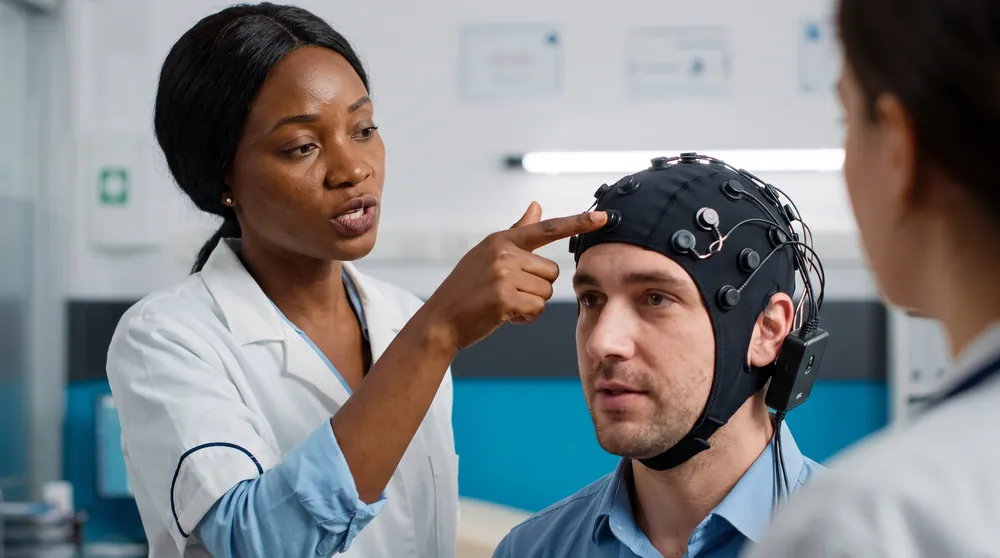
The electroencephalogram (EEG) has been a cornerstone of neuroscience for decades, measuring the brain’s electrical activity through electrodes placed on the scalp. Traditional “wet” electrodes require conductive gel to bridge the gap between skin and sensor, reducing the resistance—impedance—that would otherwise block these tiny voltages. That gel application is messy, time‑consuming, and often uncomfortable for participants.
As EEG moves outside the laboratory—into homes, clinics, and ambulatory settings—the demand for a faster, simpler interface has grown. Dry electrodes, which make direct contact with the skin without gel, promise exactly that: rapid setup and greater comfort.
But this convenience carries a physical cost. The absence of gel introduces higher impedance and a noisier signal, creating a consistent trade‑off between practicality and data fidelity. A body of recent independent research now maps the precise dimensions of that trade‑off, clarifying where dry electrodes perform admirably and where they remain a second choice.
What are Dry EEG Electrodes?
Dry EEG electrodes are sensors used to record electrical activity from the scalp without applying conductive gel or liquid at each electrode site. Like other EEG electrodes, they pick up small voltage differences that an EEG system amplifies and records.
“Dry” describes the contact method, not a different kind of brain signal. The quality and usefulness of a recording still depend on the electrode, its contact with the scalp, the recording system, and the conditions in which data are collected.
How Do Dry EEG Electrodes Work?
An EEG electrode detects voltage at the scalp relative to another electrode or reference. In a dry design, the electrode’s conductive surface makes contact with the scalp directly, or through a structure that presses through the hair, rather than relying on applied gel to improve the interface.
The EEG system then amplifies and digitizes these small voltage changes for display or analysis.
A useful way to understand the range of designs is to compare how each creates contact and what that means in practice. Dry electrodes are not all built alike: materials, shape, spring force, and the way a holder fits the head can differ. These design differences influence the interface and can affect comfort, repeatability, and susceptibility to movement.
Electrode approach | Contact method | Practical consideration |
|---|---|---|
Dry | Conductive sensor contacts the scalp without applied gel | Fit and contact pressure matter |
Wet | Conductive gel is applied between electrode and scalp | Gel application and cleanup add preparation steps |
Semi-dry | A small amount of liquid or electrolyte supports contact | A compromise between dry and wet approaches |
Comb-style dry | Prongs reach through hair toward the scalp | Hair length and electrode positioning can affect contact |
The categories are broad rather than guarantees of performance. Even within a single category, recording quality varies with the device and setup. A grounding in neuroscience can help readers place EEG in context.
Advantages of Dry EEG Electrodes
Dry electrodes remove the need to apply conductive gel at every measurement site, which can make some recording workflows simpler. This can be useful when a quick setup or less involved preparation is valuable. It does not mean that dry electrodes require no fitting or checks, and convenience alone does not establish that a recording is suitable for every purpose. The advantages are best understood alongside the conditions that can limit performance.
Comfort and Ease of Use
Without gel, users avoid the wet sensation and the cleanup that can follow gel-based recording. A well-fitted design may also be easier to place and remove, although comfort depends on the electrode shape, contact pressure, hair, and duration of use.
Some dry designs press against the scalp to maintain contact, and that pressure may be noticeable. The balance between contact and comfort is therefore a central design consideration, rather than an automatic benefit of every dry electrode.
Comfort also involves practical details beyond the sensor itself. A cap or headset needs to fit the wearer, and electrodes must remain in the intended positions during recording. A design that feels convenient in a brief trial may feel different during a longer session.
Reduced Setup Time
Removing gel application can shorten some preparation steps, particularly when several electrode sites would otherwise need individual treatment. Dry electrodes may also reduce post-session cleanup. These changes can make a recording easier to repeat in settings where elaborate preparation is inconvenient, although setup still includes positioning, fitting, and checking the recording.
The time saved is not the same as time eliminated. Hair, electrode placement, skin contact, and the equipment’s recording checks still need attention. For a study or clinical recording, consistent placement and documentation remain important even when the physical setup is quicker. Preparation time is one factor in choosing a system, not a substitute for evaluating the data it produces.
Active Dry EEG Electrodes and Portability
Some dry EEG systems use active electrodes, which incorporate electronics near the electrode to handle the signal before it travels through the rest of the recording system. Performance depends on the complete system and the recording conditions.
Portability can make EEG measurement more practical outside a conventional laboratory, especially for repeated or task-based recordings. At the same time, a smaller system still needs stable electrode contact, appropriate placement, and a way to identify artifacts. Portability changes where a recording can happen; it does not remove the need to interpret the resulting data cautiously.
Disadvantages of Dry EEG Electrodes
Dry EEG electrodes can simplify some parts of setup, but they also face challenges at the scalp-electrode interface. A lack of applied gel may mean that contact is more sensitive to electrode geometry, pressure, hair, and movement. Those factors can affect the stability and interpretability of the recording. Dry designs should therefore be assessed in relation to the intended recording task, rather than assumed to be interchangeable with other electrode types.
Signal Quality Considerations
The scalp-electrode interface influences how consistently a sensor records small voltage changes. Dry electrodes may have higher or less stable contact impedance than a well-prepared wet interface, depending on their construction and how they sit on the scalp. That can contribute to noise or make it harder to obtain a stable recording. The actual effect varies by design and setup, so “dry” alone does not predict signal quality.
Hair can create an additional barrier between the sensor and scalp, and a tight or uneven fit may change contact from one site to another. Signal quality also depends on the amplifier, reference arrangement, placement, and recording environment. Researchers and clinicians distinguish the quality of the measured data from the convenience of the sensor: a fast setup is valuable only if the data are appropriate for the question being studied.
Potential for Artifacts
Artifacts are signals in an EEG recording that do not reflect the brain activity of interest. Movement, muscle activity, eye movements, and changes in electrode contact can all affect recorded data. Because dry electrodes rely on physical contact, movement or pressure changes may alter the interface and contribute to artifacts. Hair or an imperfect fit can make that contact less consistent.
A recording workflow may include several checks to help identify common sources of interference. The following items describe useful categories of attention, not a guarantee that every artifact can be detected or removed:
Check whether electrode positions remain consistent during the recording.
Note movement, facial muscle activity, or other visible disturbances in the session.
Review channels for abrupt changes or patterns inconsistent with the task.
Record relevant setup details so that data quality can be assessed later.
These checks help distinguish measurement issues from signals that may be relevant to the analysis.
The Real World Benefits of Rapid EEG Preparation
A multi‑center evaluation across six countries and 115 volunteers directly quantified the time savings when using a dry EEG machine. The dry multipin EEG cap required 62% less preparation time compared to a standard gel‑based cap.
For busy clinical or research workflows, cutting the per‑participant setup by more than half reduces not only operating costs but also participant dropout due to discomfort. Moreover, this speed opens doors to populations that were previously difficult to record with EEG.
A simulation framework for a low‑cost, portable EEG system designed for neonatal intensive care units demonstrated this directly. The system used dry electrodes to avoid the impracticality of gel application on delicate newborn skin. Placing sensors rapidly, without abrasive preparation or conductive paste, makes brain measurement feasible in sensitive settings where traditional methods are simply not viable.
Comfort extends the possible wear time into hours and beyond. In a sleep protocol, healthy participants recorded full overnight sleep EEG at home using a flat‑type dry electrode system. The electrodes remained comfortable enough for a full night’s wear, and the data enabled sleep staging comparable to gel‑based recordings. This indicates a clear path for at‑home EEG applications, from long‑term sleep tracking to ambulatory brain‑health monitoring.
From the technician’s perspective, dry electrodes consistently earned higher ratings for ease of use. In clinical trial benchmarking, researchers reported that dry‑electrode devices were faster and easier to work with than standard wet electrodes, even though participant comfort ratings varied by device (Study 5). Moreover, dry electrodes are reusable and low‑cost, reducing the per‑recording expense of disposable gel electrodes (Study 3). This practical efficiency, combined with the elimination of consumable gels, makes dry electrodes especially attractive for large‑scale studies and repeated‑measures protocols.
That gain in speed and comfort, however, is the direct result of a fundamental change at the electrode‑skin interface, one that introduces a measurable electrical penalty: higher impedance.
Benefit | Finding |
|---|---|
Setup time | 62% faster than gel |
Comfort | Full overnight wear possible |
Ease of use | Rated higher by technicians |
Cost | Reusable, no gel needed |
The Physical Trade-Offs of Gel Free Sensor Contact
To understand where dry electrodes lose fidelity, it helps to view the electrode‑skin junction as a gateway. Every EEG electrode must allow the brain’s microscopic electrical signals—typically a few millionths of a volt—to pass into the recording system with minimal opposition. The measure of that opposition is impedance.
Wet electrodes use conductive gel to fill microscopic air gaps and gently lower the outer skin layer’s resistance, typically achieving low, stable impedance. Dry electrodes instead rely on a mechanical contact, often through spring‑loaded pins or a flat metal surface, leading to a much higher and less stable impedance.
The impact on the recorded signal is unambiguous. A direct head‑to‑head comparison found that dry active electrodes exhibited very high interelectrode impedance and that this high impedance led to marked increases in single‑trial and average noise levels.
The multi‑center study confirmed the pattern that dry caps consistently showed higher average impedances across all participants. In the neonatal simulation, the higher impedance of dry electrodes directly caused a reduction in signal quality when compared to wet electrodes.
Higher impedance makes the recording more susceptible to contamination because the weak brain signals must compete with a larger background hum. Environmental electrical noise, muscle activity from the jaw or neck, and even subtle movement artifacts become more prominent. For researchers, this means noisier data that must be cleaned extensively or discarded, reducing the usable information.
Yet the story does not end with noise. Despite the electrical handicap, many common EEG measures remain reliably detectable, indicating that the brain’s core rhythms and responses survive the high‑impedance path well enough for numerous applications.
Which Core Brain Signals and Biomarkers Can Dry EEG Accurately Measure?
Across multiple studies, dry electrodes consistently matched wet electrodes on the most frequently used EEG measures. In a classic auditory oddball task, where participants detect rare target tones amid frequent standard tones, the brain produces a characteristic response called the P300—a positive voltage deflection peaking around 300 milliseconds after the stimulus, widely used as a cognitive biomarker.
The dry electrode system could reliably measure EEG spectra (frequency power) and the P300 ERP comparably to traditional wet electrodes, despite the elevated noise floor. The overall spectral profile, which breaks down the EEG into its rhythmic components (delta, theta, alpha, beta), was faithfully captured.
Sleep research provides an especially demanding test, as the brain cycles through dramatically different states and the recording must survive hours of head movement. For instance, the home sleep study found that sleep staging—classifying periods into REM, light sleep, and deep sleep—was feasible and comparable between dry and gel electrodes.
More importantly, microstructural sleep features—slow waves (0.5–4 Hz), the large oscillations that dominate deep sleep, and sleep spindles (10–16 Hz), bursts of activity linked to memory consolidation—showed similar characteristics between the two electrode types. This indicates that even the fine‑grained architecture of sleep can be extracted from a dry recording.
Further, the multi‑center study reported no statistical differences in overall signal characteristics between dry and gel‑based electrodes when analyzing the channels that recorded reliably. And, in a clinical trial context, dry electrodes performed on par with standard EEG for routine resting‑state EEG and P300 evoked activity.
For these broad, standard assessments of brain function, the higher noise floor of dry electrodes does not substantially degrade the ability to detect the most important features.
This general parity, however, masks specific frequency ranges and artifact sources where dry electrodes consistently underperform. Recognizing these hidden weaknesses is critical for selecting the right tool for a given research question.
The Impact of Sweat and Slow Rhythms on Dry Sensors
Not all EEG signals are equally robust against increased impedance. The clinical trial benchmarking study identified the most vulnerable frequency bands: low‑frequency activity below 6 Hz and induced gamma activity between 40 and 80 Hz posed notable challenges for dry electrodes.
Slow cortical potentials, which drift over seconds and are important for states like drowsiness or attention, lose clarity against a noisier baseline. Sweat‑related baseline drifts and movement artifacts, which are more common in dry recordings, can easily mask these low‑frequency components. At the opposite end, induced gamma oscillations—small in amplitude and closely linked to cognitive processing—are easily buried by muscle and electrical noise when impedance is high.
The artifact problem extends beyond frequency contamination. During overnight sleep, sweat artifacts were reported to be significantly more prevalent with flat‑type dry electrodes compared to gel‑based electrodes. Sweat changes the skin’s electrical properties unpredictably, introducing large, slow voltage swings that can overwhelm the brain signal. This requires additional data‑cleaning steps and can reduce the usable recording length.
The increased noise also directly weakens the statistical power of an experiment. The comparison study analysis showed that higher noise levels decreased statistical power, meaning researchers needed to collect more trials to detect a statistically significant effect.
If an experiment requires, for example, 50 trials with wet electrodes to observe a P300 difference, the same experiment might need 70 or more trials with dry electrodes to achieve the same confidence. For studies with limited time or easily fatigued participants, this loss of power is a meaningful constraint.
These frequency‑specific and artifact vulnerabilities make it clear that dry electrodes are not a universal substitute. The crucial question then becomes: can these limitations be managed, and if so, how? The research points to several practical mitigation strategies.
Strategies for Mitigating Dry Electrode Limitations
Proper placement technique, ensuring even pressure across all pins, and careful attention to the cap’s fit can significantly lower impedance and reduce noise. Training becomes the most powerful tool for obtaining high‑quality dry EEG data, far outweighing any inherent electrical difference between electrode types. Correct cap sizing and a consistent application method reduce impedance variation, making the recording more stable.
Hardware design also helps overcome the impedance penalty. In the neonatal simulation, a low‑cost EEG acquisition system combined with optimized dry electrode designs achieved a 25‑decibel signal‑to‑noise ratio (SNR), a level considered usable for clinical monitoring.
Notably, the simulation showed that specific dry electrode designs performed comparably to wet electrodes in certain scalp regions. This suggests that a hybrid approach—using dry electrodes for the scalp areas where they perform best and wet electrodes for more difficult regions—might be an effective compromise.
Furthermore, the context of the recording must match the technology’s strengths. The clinical trial benchmarking emphasizes that dry electrodes can substantially improve EEG applications in trials, but only if the device and its context of use are carefully matched.
If a study targets slow‑wave activity below 6 Hz or high‑gamma oscillations, wet electrodes remain the safer choice. Conversely, for a rapid attentional assessment using the P300 in a quiet clinic room, dry electrodes can deliver comparable results with significantly lower burden.
Ultimately, the decision hinges on a clear‑eyed balancing of constraints. For portable EEG applications where speed and participant comfort are paramount, the evidence strongly supports dry electrodes as a viable option. The trade‑off is not a disqualification; it is a design parameter that researchers can manage with training, appropriate hardware, and a realistic match between the electrode and the experiment’s demands.
Where Emotiv's EEG Sensors Sit on the Dry–Wet Spectrum
The research above suggests that there is no single best electrode, only a better or worse match between the sensor interface and the research question. Emotiv's EEG systems span that whole range, from gel to saline, semi-dry and fully dry sensors, so the choice of system can follow the study rather than the other way around.
Emotiv headsets are intended for research applications and personal use only. They are not medical devices, so the clinical and neonatal monitoring scenarios discussed above fall outside their intended use.
Sensor interface | Emotiv system | Channels | Where it fits | What to keep in mind |
|---|---|---|---|---|
Gel (sintered Ag/AgCl) | Up to 32 | High-density studies where a low, stable impedance matters most, including work on slower rhythms | Conventional gel preparation and cleanup | |
Saline felt | Up to 32 | High-density recording with flexible placement and lighter preparation than gel | A rear refill opening helps keep conductivity consistent during a study | |
Saline felt | 14 | Academic research, BCI development and classroom work, in labs and mobile field studies | Pads are re-wetted before each session and can dry out during extended recordings | |
Semi-dry polymer | 5 | Portable BCI development, demonstrations and education | A few drops of solution and a 1-2 minute setup; five channels limit spatial coverage | |
Dry flat and comb, with active amplification | 16 | Long sessions, studies with many participants, and field recording | Still subject to the dry-electrode factors in this article: fit, pressure, hair and sweat | |
Dry in-ear elastomer | 2 | Everyday use with the Emotiv App, focused on measures such as attention and cognitive stress | Two in-ear channels are not a substitute for a scalp montage |
How EPOC X PRO Approaches the Dry-Electrode Trade-Off
EPOC X PRO is Emotiv's dry-sensor headset, and its design responds to several of the issues raised above. Each sensor has its own active amplifier, which reduces interference from cable movement and electrode impedance. The head-to-head comparison discussed earlier is a useful reminder, though: active dry electrodes can still record more noise than wet ones, so on-sensor electronics narrow the gap rather than remove it.
Acquisition is 24-bit, which gives more headroom for low-frequency drift, electrode offset and sudden movement artifacts. That headroom means these signals can be captured without clipping and handled later through filtering; it does not prevent them from occurring. Since flat dry electrodes showed more sweat artifacts in overnight recordings, long or warm sessions are still worth monitoring for slow drifts.
The sensors also follow the "right electrode for the region" logic suggested by the neonatal simulation. Flat sensors sit on bare skin at the forehead and mastoid reference sites, while comb sensors, available in two lengths, reach through hair.
Any sensor clips into any socket, and the same sockets accept the saline felt pads used with Epoc X, so a protocol can move to a wet interface when a study calls for it. A contact quality indicator light in each sensor housing supports the careful, operator-led placement the research identifies as the biggest single factor in dry EEG quality.
How to Choose Between Wet and Dry EEG Systems
Dry electrodes have expanded where and when brain activity can be recorded, turning setup speed and wear comfort into practical tools for clinics, homes, and newborn care. That convenience, however, is tied to a real electrical trade-off: higher impedance adds noise, weakens statistical power, and blurs the slowest and fastest brain rhythms.
The research shows these limitations do not erase the core value of dry EEG, since resting-state spectra, sleep staging, and the P300 response come through comparably to gel recordings. For many everyday and clinical questions, the key is not choosing the "best" electrode but matching the technology to the task, with trained operators and realistic expectations.
When signal fidelity matters most, particularly for slow waves below 6 Hz or gamma activity above 40 Hz, wet electrodes remain the safer path. When speed, comfort, and access matter more, dry electrodes offer a scientifically valid route, especially when operator skill and careful placement are prioritized.
The larger lesson is that brain monitoring is becoming more portable and humane, and the remaining gap between convenience and fidelity is a manageable design problem rather than a dead end. Choosing well means knowing the specific demands of your project and accepting that every tool brings both strengths and costs.
References
Ng, C. R., Fiedler, P., Kuhlmann, L., Liley, D., Vasconcelos, B., Fonseca, C., ... & Haueisen, J. (2022). Multi-center evaluation of gel-based and dry multipin EEG caps. Sensors, 22(20), 8079. https\://doi.org/10.3390/s22208079
O’Sullivan, M., Temko, A., Bocchino, A., O’Mahony, C., Boylan, G., & Popovici, E. (2019). Analysis of a low-cost EEG monitoring system and dry electrodes toward clinical use in the neonatal ICU. Sensors, 19(11), 2637. https\://doi.org/10.3390/s19112637
Leach, S., Chung, K. Y., Tüshaus, L., Huber, R., & Karlen, W. (2020). A protocol for comparing dry and wet EEG electrodes during sleep. Frontiers in neuroscience, 14, 586. https\://doi.org/10.3389/fnins.2020.00586
Mathewson, K. E., Harrison, T. J., & Kizuk, S. A. (2017). High and dry? Comparing active dry EEG electrodes to active and passive wet electrodes. Psychophysiology, 54(1), 74-82. https\://doi.org/10.1111/psyp.12536
Paillard, J., Bomatter, P., Dubreuil-Vall, L., Hipp, J. F., & Hawellek, D. J. (2025). Benchmarking the utility of dry-electrode electroencephalography for clinical trials. Scientific Reports, 15(1), 33667. https\://doi.org/10.1038/s41598-025-18184-7
Frequently Asked Questions
What are dry EEG electrodes, and how do they differ from wet electrodes?
Dry electrodes make direct contact with the skin without conductive gel, while wet electrodes use gel to bridge the gap between skin and sensor. The lack of gel creates higher impedance and a noisier signal, but allows for much faster and more comfortable setup.
Why do dry electrodes produce noisier signals than wet electrodes?
Without conductive gel, dry electrodes rely on mechanical contact, which leads to higher and less stable impedance at the electrode-skin junction. This higher impedance makes the weak brain signals more vulnerable to contamination from environmental electrical noise, muscle activity, and movement artifacts.
What are the main practical advantages of using dry electrodes?
Dry electrodes dramatically reduce preparation time and are more comfortable, allowing for longer wear times. They are also reusable and eliminate the need for messy conductive gels, making EEG feasible in sensitive settings like neonatal care and at-home sleep monitoring.
Which core brain measures can dry electrodes capture comparably to wet electrodes?
Dry electrodes can reliably measure resting-state EEG spectra, sleep staging, and the P300 brain response. Sleep spindles and slow waves also show similar characteristics, indicating that many standard and fine-grained brain markers survive the high-impedance path.
What are the hidden weaknesses or frequency-specific challenges of dry electrodes?
Dry electrodes struggle with low-frequency activity below 6 Hz and induced gamma oscillations between 40 and 80 Hz. These signals are easily masked by sweat-related baseline drifts, movement artifacts, and higher background noise, which reduces their clarity.
How does the higher noise level from dry electrodes affect an experiment’s statistical power?
Higher noise levels decrease statistical power, meaning researchers need to collect more trials to detect a statistically significant effect. For studies with limited time or easily fatigued participants, this need for extra trials is a meaningful constraint.
How can the limitations of dry electrodes be mitigated?
Operator skill and experience are the most powerful factors in ensuring channel reliability, so proper cap fitting and even pin pressure can lower impedance. Hardware design also helps, and a hybrid approach using dry electrodes on certain scalp regions and wet electrodes elsewhere can be an effective compromise.
When should wet electrodes be chosen over dry electrodes?
Wet electrodes remain the safer choice if a study targets slow-wave activity below 6 Hz or induced gamma oscillations above 40 Hz. For applications demanding the highest signal fidelity with minimal artifacts, the gel-based approach offers lower impedance and a cleaner baseline.
Emotiv is a neurotechnology leader helping advance neuroscience research through accessible EEG and brain data tools.
Medical Disclaimer: The information provided on this website is for educational and informational purposes only and is not intended as medical or health advice. This content may contain errors and should not be relied upon to make life-altering health, medical, or lifestyle choices. Always seek the advice of your physician or other qualified health provider with any questions you may have regarding a medical condition or treatment.
Christian Burgos