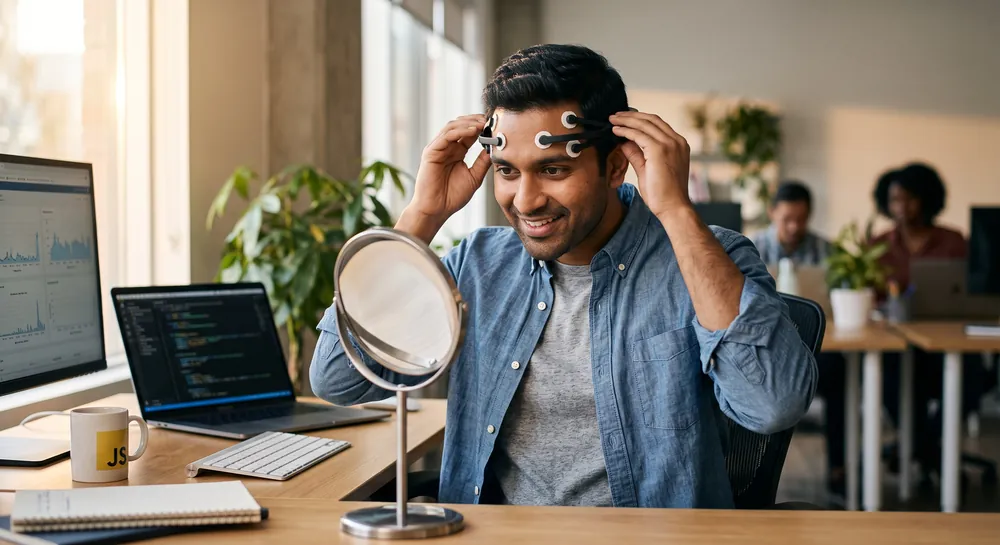
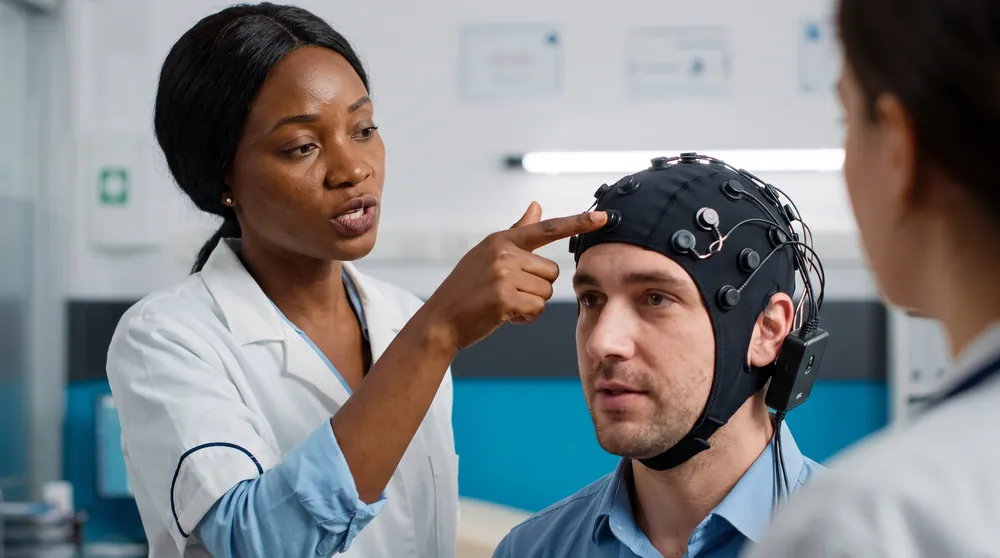
Home EEG are self-administered recordings performed outside any clinical or laboratory setting. It hands the electrode gel, the headset, and the recording software to an untrained user, often with nothing more than a smartphone app for guidance. The concept consists of having brain measurement capabilities that fits into daily life, potentially recording sleep architecture, cognitive focus, or seizure patterns without the logistical burden of a hospital visit.
What is a Home EEG?
A home EEG is an electroencephalogram recorded in a person’s home rather than during a visit or stay in a medical facility. Sensors placed on the scalp detect small changes in electrical potential associated with brain activity.
How Does an At Home EEG Work?
During an EEG, electrodes detect electrical signals at the scalp and send them to a recording device. In a clinical home study, a trained professional may apply the electrodes and explain how the equipment is used; the arrangement varies by service and test. The resulting record is reviewed in context by a qualified clinician, because an EEG tracing alone does not establish a diagnosis.
The signal can be affected by movement, muscle tension, eye blinks, and the quality of contact between an electrode and the scalp. A clear recording depends on context as well as the device: the recording conditions, observed symptoms, and technical quality all shape how useful the information is.
Types of At Home EEG Devices
Home EEG systems differ in who they are designed for, where their sensors are placed, and what questions the recording can address. Clinically supervised ambulatory systems are arranged for medical monitoring, while consumer and research devices may be intended for general measurement or data collection rather than diagnosis.
The following comparison highlights broad distinctions:
System type | Common context | Important distinction |
|---|---|---|
Clinically supervised home EEG | Medical evaluation arranged by a care team | The protocol and interpretation are tied to a clinical question |
Consumer EEG device | Personal or wellness use | It is not automatically equivalent to a clinical diagnostic recording |
Research EEG system | A study or experiment | Data collection follows the study’s methods and governance |
Is Home EEG Feasible in Resource-Limited Settings?
The most pragmatic case for home EEG has nothing to do with self-optimization and everything to do with access.
In many parts of the world, a clinical EEG is effectively unavailable. Specialized equipment is expensive, trained technicians are scarce, and neurology departments cluster in urban teaching hospitals. Therefore, a system that enables inexperienced users to record diagnostic-quality EEG with nothing more than a smartphone and a portable headset could, in principle, bridge that gap.
One research group tested exactly this proposition by developing a 27-channel portable EEG system paired with a smartphone application that provides real-time, automated guidance. The app assessed signal quality moment by moment and gave immediate feedback, directing the user to adjust electrodes that show high impedance or poor contact. Ten participants with no prior EEG experience underwent brief training, then recorded full EEGs independently, following only the prompts from the application.
The results showed that usability, measured by the System Usability Scale, scored an average of 90.3 with a standard deviation of 6.8. For context, a score above 68 is considered above average, and anything exceeding 80 places a system in the top decile of usability benchmarks. The recorded EEGs themselves received an average quality rating of 8.04 from expert reviewers, and critically, none of the recordings were judged insufficient for clinical interpretation.
Noteworthy, this does not mean a layperson can replace a trained technologist across all contexts. The test scenario was structured: the app guided each step, the environment was controlled, and the clinical reviewers were evaluating basic signal adequacy rather than diagnosing complex pathology.
But the results demonstrate that guided, automated EEG acquisition can produce clinically usable data when expert hands are not available, offering a pathway to support neurological diagnosis in resource-limited regions.
How Does Long Term Self Monitoring Support Epilepsy Care?
Beyond one-time diagnostic recordings, home EEG opens the possibility of long-term observation, which carries particular relevance for epilepsy. Seizure forecasting models depend on extended, high-quality data collected in real-life settings, yet the practical tools for such collection have been scarce.
For instance, a 2026 study following 12 patients with drug-resistant epilepsy provides a rare window into what long-term self-administered EEG actually looks like. Participants recorded resting-state EEG twice daily over a median period of 173.5 days, with the longest stretch reaching 235 days. The recordings were done entirely at home using a wearable system designed for self-application.
Therein, two-thirds of the patients produced data that clinical reviewers categorized as either good or moderate quality, and this quality level remained broadly stable across the measurement period. Interictal epileptiform discharges—the characteristic electrical signatures of seizure susceptibility that appear between clinical events—were detected in four patients, and these findings matched the patterns observed during prior in-hospital recordings.
Regarding the limitations of this methodology, the authors noted that the EEG caps required replacement every two to three months due to regular wear, indicating that long-term home measurement is often not a one-time hardware investment but an ongoing process with maintenance requirements. Patient adherence was also essential to the protocol's success, reinforcing that home EEG demands sustained engagement rather than passive data collection.
These results suggest that selected patients can generate clinically relevant information outside the hospital over extended periods, potentially supporting future seizure forecasting strategies. The concordance between home-detected abnormalities and prior hospital findings, while documented in only a subset of patients, points toward a role for home monitoring in tracking known disease markers rather than establishing initial diagnoses.
Pediatric Applications and Home EEG for Special Populations
Children present a unique challenge for EEG. The hospital environment can be distressing, electrode application on a restless child tests the skill of even experienced technologists, and for children with intellectual disabilities or autism spectrum disorders, the sensory demands of a clinical setting can make standard recordings nearly impossible.
A pilot study of 20 children who underwent home video-EEG monitoring elucidated who might benefit most from this approach. The home-based group included a significantly higher proportion of children with intellectual disability and autism with 60 percent versus 25 percent in a comparable hospital-based group. Children with developmental and epileptic encephalopathy, a severe form of epilepsy associated with cognitive regression, were also overrepresented in the cohort.
The reasons for referral followed similar distributions across both settings: seizure localization and classification accounted for about half the cases, paroxysmal event classification for another quarter, and quantification of sleep epileptic activity for the remainder. The clinical questions being asked were not simplified for the home environment, suggesting that referring physicians considered the home data broadly fit for purpose.
Moreover, a counterintuitive finding emerged around data quality. The EEG signal quality at home was actually rated higher than in-hospital recordings, with a median score of 5 on a 5-point scale compared to 4 for the hospital group. The video quality, however, reversed this pattern. Home video recordings received a median score of only 3, significantly lower than the hospital median of 5.
This video limitation is meaningful as seizure diagnosis often depends on correlating electrical changes with behavioral manifestations, and poor video documentation can obscure the very events the recording is designed to capture.
Signal Quality and Aggregation Trade Offs in Unsupervised Settings
The central technical question for home EEG is not whether the devices can measure electrical potentials, but whether the signal fidelity in an unsupervised, artifact-prone environment can match the standards required for cognitive neuroscience or clinical interpretation.
A large-scale study tackled this directly by deploying wireless dry EEG systems to two cohorts: 50 older adults averaging 67.8 years and 30 younger adults averaging 25.6 years. Both groups used tablet-based gamified cognitive tasks—an Oddball task for attention and a Flanker task for inhibitory control—recording sessions five to seven days per week over several weeks.
Therein, the authors found that using conservative criteria for artifact-free data, 50 percent of trials were rejected per at-home session. Movement artifacts, muscle tension, poor electrode contact, and electrical interference all degrade single-trial data far more at home than in a controlled laboratory setting.
However, aggregation changed the picture entirely. By combining data across two to four sessions, the grand-average event-related potentials achieved signal quality comparable to single-session wet EEG data collected by experts in a laboratory.
The characteristic P300 component—a positive voltage deflection appearing roughly 300 milliseconds after a rare target stimulus—was clearly identifiable in the Oddball task. Error-related negativity, a negative deflection following incorrect responses in the Flanker task, was similarly preserved in the aggregated home data.
These results suggest that home EEG can produce valid cognitive neuroscience data, but not on a single-session, single-trial basis. Researchers and potential clinical users must accept either higher trial counts per session or aggregation across multiple recording days. The signal is present, but extracting it requires statistical averaging to overcome the noise floor that home environments introduce.
How Do Users Across Age Groups Adhere to Home EEG?
The most sophisticated EEG system is worthless if people cannot or will not use it consistently. Adherence and usability are crucial determinants of whether home EEG can escape pilot studies and enter routine practice.
The same study tracking older and younger adults provides systematic usability data. Older adults completed 93 percent of requested sessions, generating 1,449 total recordings with a mean of 28.9 sessions per participant. Younger adults completed 96 percent, producing 684 sessions with a mean of 22.87. These adherence rates are remarkably high for any self-administered health protocol, and they held over six weeks for the older cohort and four weeks for the younger cohort.
Furthermore, system Usability Scale scores reinforce the adherence data. Older adults reported a mean score of 84.5, and younger adults reported 88.3—both firmly in the excellent range and only slightly below the 90.3 reported in the guided diagnostic study. Age-related differences in technology adoption, often cited as a barrier for digital health tools, did not meaningfully impair usability in this context.
Two design elements appear to contribute to this success:
The first is structured guidance that reduces cognitive load during setup. When an application can assess electrode impedance in real time and direct the user to adjust specific contacts, the complex, tacit knowledge required for proper electrode placement gets externalized into software instructions.
The second is gamification of the cognitive tasks themselves. Maintaining attention during repetitive oddball detection or flanker interference tasks is demanding, and embedding these paradigms in game-like interfaces with feedback and progression likely sustains engagement across weeks of repeated sessions.
Can Home EEG Replace Inpatient Hospital Monitoring?
Home EEG can capture neural signals. It can characterize event-related potentials in structured cognitive tasks. It can detect interictal epileptiform discharges that match hospital findings. What it cannot do, at least not yet, is substituted for the full diagnostic yield of hospital-based video-EEG monitoring.
A 2024 review of home-based ambulatory video-EEG in Australia clarifies the stakes. Hospital video-EEG monitoring provides synchronized, high-fidelity recordings of brain activity and behavior over days or weeks, with expert technicians troubleshooting electrode issues and neurologists interpreting complex seizure semiology. Meanwhile, home ambulatory video-EEG offers accessibility and cost-effectiveness advantages—particularly for rural patients who face long travel distances and extended waiting lists—but incurs inherent compromises.
Another factor discussed in the review had to do with the video quality deficit documented in the pediatric study. When video resolution is poor, ambient lighting obscures subtle motor features, or the camera angle fails to capture the relevant body region, the behavioral correlation essential for seizure classification can be lost. Expert interpretation of smartphone videos has shown diagnostic accuracy around 89.1 percent, a respectable figure that still leaves a substantial minority of cases misclassified when video data is suboptimal.
The broader pattern is one of clinical equipoise. Home EEG represents a significant advance for specific applications: extending measurement duration beyond what is feasible in a hospital, capturing natural seizure patterns in a familiar environment, and reducing the logistical and financial burden on families.
It is not a complete substitute for inpatient monitoring in complex diagnostic cases, and the interpretation gap means that expert review remains necessary for most clinical applications.
Where Home Brain Recordings Fit in Real-World Care
Home EEG’s real value lies in expanding access and enabling repeated recording. Under guided conditions, untrained people can potentially produce clinically usable brain recordings, and combining multiple sessions can bring signal quality close to laboratory benchmarks. For epilepsy patients tracking known seizure patterns and for children who cannot tolerate hospital settings, this extends neurological care beyond the clinic. But home recordings still carry more noise and weaker video, so neuroscientific expert interpretation remains essential.
The evidence supports specific uses, not broad wellness promises. Focus, meditation, and everyday cognitive enhancement claims are not yet backed by rigorous validation. At best, home EEG is a complementary tool for structured measurement and resource-limited settings, not a replacement for hospital video-EEG.
References
Armand Larsen, S., Klok, L., Lehn‐Schiøler, W., Gatej, R., & Beniczky, S. (2024). Low‐cost portable EEG device for bridging the diagnostic gap in resource‐limited areas. Epileptic Disorders, 26(5), 694-700. https://doi.org/10.1002/epd2.20266
Cousyn, L., Biondi, A., Winston, J. S., McWilliam, M., Viana, P. F., Schreuder, M., ... & Richardson, M. P. (2026). Out of the lab, into real life: Evaluating at‐home EEG self‐monitoring. Epilepsia Open, 11(2), 663-669. https://doi.org/10.1002/epi4.70235
Michaeli, Y., Blumkin, L., Medvedovsky, M., Dalal, I., & Nissenkorn, A. (2024). Home-video EEG monitoring in a pediatric setting. Heliyon, 10(15). https://doi.org/10.1016/j.heliyon.2024.e35108
Barbey, F. M., Farina, F. R., Buick, A. R., Danyeli, L., Dyer, J. F., Islam, M. N., ... & Whelan, R. (2022). Neuroscience from the comfort of your home: Repeated, self-administered wireless dry EEG measures brain function with high fidelity. Frontiers in Digital Health, 4, 944753. https://doi.org/10.3389/fdgth.2022.944753
Seneviratne, U., Gillinder, L., Kraemer, T., Lee, A., & Bower, S. (2024). Home‐based ambulatory video EEG monitoring: a cost‐effective and underutilised diagnostic tool for people with seizure disorders in Australia. Internal medicine journal, 54(12), 2096. https://doi.org/10.1111/imj.16582
Frequently Asked Questions
What is home EEG and how does it differ from a hospital EEG?
Home EEG is a self-administered brain wave recording performed outside a clinical setting, usually with a portable headset and a smartphone app, while a hospital EEG involves a technician applying electrodes and a neurologist interpreting the waveforms. The home approach gives control to an untrained user, trading expert oversight for convenience and accessibility.
Can someone without medical training record a usable EEG at home?
Yes, with structured guidance. In a study, novices following real-time app instructions produced recordings that expert reviewers considered adequate for clinical interpretation, and usability scores were high. This shows that guided home EEG can generate usable data under controlled conditions.
Is home EEG signal quality as good as hospital EEG quality?
Not on a single-trial or single-session basis, because home recordings are more vulnerable to movement, muscle tension, poor electrode contact, and electrical interference. However, when data is combined across multiple sessions or days, the aggregated signals can reach quality comparable to laboratory recordings.
Does home EEG support wellness claims like better focus or meditation?
The scientific evidence currently does not support broad claims about boosting concentration, optimizing meditation, or general wellness tracking. Research has focused on specific clinical and cognitive applications, and rigorous validation for consumer wellness marketing has not yet been performed.
What are the main limitations of home EEG?
Major limitations include high artifact rejection rates, the need to combine data across multiple recording days for lab-grade signal quality, regular replacement of EEG caps, and inferior video quality compared to hospital systems. Expert interpretation is still required for most clinical applications.
How do older adults handle home EEG technology and adherence?
Older adults in studies reported high usability scores and completed most requested sessions, similar to younger adults. Real-time impedance guidance and gamified tasks helped maintain strong adherence across age groups.
Emotiv is a neurotechnology leader helping advance neuroscience research through accessible EEG and brain data tools.
Medical Disclaimer: The information provided on this website is for educational and informational purposes only and is not intended as medical or health advice. This content may contain errors and should not be relied upon to make life-altering health, medical, or lifestyle choices. Always seek the advice of your physician or other qualified health provider with any questions you may have regarding a medical condition or treatment.
Christian Burgos