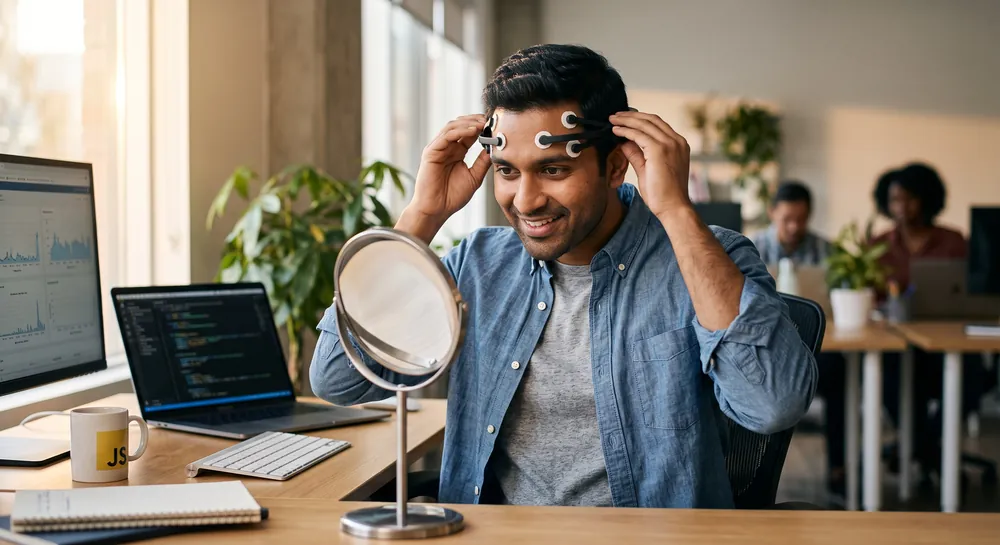
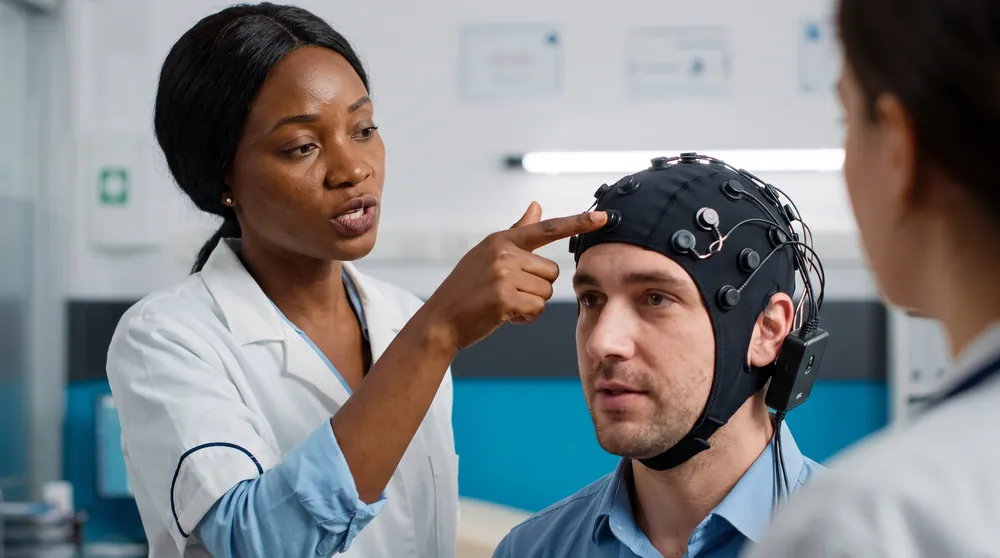
Imagine playing a video game where your controller is invisible—you steer with nothing but your own brainwaves. That idea sits at the core of neurofeedback, a technique that gives you a real‑time window into your brain’s activity and then teaches you to shift it.
A device picks up signals generated by your brain, most often using an electroencephalogram (EEG) that detects electrical patterns on the scalp, or occasionally a functional near‑infrared spectroscopy (fNIRS) sensor that tracks blood flow. Those raw signals are processed and turned into a simple game, a sound, or a moving figure on a screen. Through trial and error, your brain learns to produce the patterns that make the feedback go in the direction you want.
A lot of guides focus on the individual parts—the EEG electrodes, the wires, the software—but a device only succeeds when those pieces form a coherent whole. This introduction examines neurofeedback as an integrated system where signal processing, feedback design, and everyday usability combine to determine whether something genuinely helps.
What is a Neurofeedback Device?
A neurofeedback device measures signals associated with brain activity and presents information about those signals to the user, often as a visual or audio cue. The general aim is to let a person observe changes in their own activity and practice responding to that feedback. Devices differ in what they measure, how they process signals, and how feedback is delivered. A neurofeedback device is not, by itself, a diagnosis or proof that a particular condition is present.
How Does Neurofeedback Work?
In a typical session, sensors collect a signal while a person completes a task, rests, or engages with a feedback program. Software processes the incoming data and changes a display, sound, or other cue according to a defined rule.
The user can then try different mental strategies and notice whether the feedback changes. The procedure is commonly described as a form of biofeedback, though the training protocol and the meaning of its feedback vary.
The cycle of measurement, feedback, and practice is central to the approach. Sensors do not read thoughts, and a feedback display is not a direct account of a person’s mental state. Rather, it represents selected features of a measured signal, which may be affected by movement, electrode contact, and the way the software processes data. Understanding that distinction helps keep claims about a session in proportion.
Types of Neurofeedback Devices
Neurofeedback systems can be distinguished by the signals they measure and by the setting in which they are used. Some rely on electrical activity recorded at the scalp, while others use light-based measures or combine sensors with other forms of feedback. The technology influences what a device can observe, but it does not by itself establish the quality of a training program. A basic comparison makes those differences easier to see.
EEG Neurofeedback
EEG neurofeedback uses electrodes to record electrical activity from the scalp. The device or associated software processes the recording and may present feedback based on selected signal features. Electrode placement, contact, movement, and signal processing all influence the data, which is one reason EEG equipment and protocols vary. A guide to scalp electrode placement offers further context on how setup affects recording and interpretation.
The distinctions below describe broad measurement approaches rather than ratings of effectiveness. A system’s actual capabilities depend on its sensors and software, and devices within a category may differ substantially.
Approach | Signal measured | Feedback context | Practical consideration |
|---|---|---|---|
EEG neurofeedback | Electrical activity recorded at the scalp | Feedback may be tied to selected EEG features | Electrode contact and movement can affect signal quality |
fNIRS neurofeedback | Light-based estimates of changes in blood oxygenation | Feedback may reflect changes in the measured blood-oxygenation signal | The measurement is indirect and differs from EEG |
Other wearable formats | Varies by sensor design | Feedback format depends on the device | Sensor type and intended use require careful review |
These categories are not interchangeable, and a label alone does not explain what data a device displays. Assessment of a system also involves how clearly it describes its measurements, limitations, and intended context.
fNIRS Neurofeedback
Functional near-infrared spectroscopy, or fNIRS, uses light to estimate changes in blood oxygenation in tissue near the surface of the brain. In neurofeedback applications, those estimates may be used to create feedback about changes in the measured signal. This differs from EEG, which records electrical activity at the scalp, so the two methods should not be treated as equivalent or as direct substitutes.
Interpretation depends on the measurement setup and the task being performed. fNIRS signals can also be affected by factors outside the brain, including changes in blood flow near the scalp. For that reason, claims about what a particular signal means should be grounded in the method and its validation rather than inferred from a display alone.
Wearable Neurofeedback Devices and Other Emerging Technologies
Wearable systems may use compact sensors designed for repeated use outside a laboratory or clinic. Their form can make setup more convenient, but portability does not guarantee that a signal is accurate, clinically meaningful, or suitable for every purpose. Some devices present a simplified score or interactive feedback; the user interface is distinct from the underlying measurement method.
Other emerging approaches may combine neurofeedback with additional sensors or forms of feedback. Such combinations make it especially important to identify which signal is being measured and what the software does with it. Clear documentation about sensor placement, data handling, and the limits of interpretation is more informative than broad claims about “brain training.”
Inside a Neurofeedback Device: Signal Processing and Feedback Loops
Every neurofeedback system runs through the same three‑stage pipeline, and the quality of each stage shapes whether a user can actually learn to modulate their brain state:
Signal acquisition captures raw EEG or fNIRS data while contending with noise from eye blinks, muscle tension, and cable movement.
Signal processing filters artifacts and isolates frequency bands like theta, alpha, SMR, and beta that map to different mental states.
Feedback algorithms translate changes in targeted brainwave activity into visual or auditory cues that drive learning.
Signal acquisition is the starting point. Sensors placed against the head pick up electrical fluctuations (EEG) or changes in blood oxygenation (fNIRS). The signal at this stage is tiny and swamped by noise from eye blinks, muscle tension, and even the slight movement of the cables. What you actually record is a mix of brain activity and background garbage.
That mess gets cleaned up in the signal processing stage. The device’s software filters out known artifacts and mathematically separates the raw trace into different frequency bands—theta, alpha, sensorimotor rhythm (SMR), beta, and others.
Each band is loosely associated with mental states: slower theta activity tends to appear when you are drowsy or inwardly focused, while faster beta activity often accompanies active concentration. A neurofeedback device aims to isolate the band that the training protocol targets, such as increasing 12‑15 Hz SMR for calm alertness or boosting 15‑18 Hz beta for sustained attention.
The processed data then enters the feedback algorithm, the part that turns numbers into learning. The software takes the current amplitude or ratio of a chosen frequency band and translates it into a visual or auditory cue. You might see a car accelerate along a road, hear a chime grow louder, or watch a puzzle piece click into place—all driven by whether your brain is moving toward the target state.
The algorithm decides how quickly the feedback responds, how much change triggers a reward, and how forgiving the system is when your attention wavers. A sluggish loop that updates too slowly makes it hard to connect your mental effort to the result, while an overly jumpy one can feel confusing.
A 2023 research review of consumer neurofeedback technologies emphasizes that these devices are designed with usability at the front of mind. Their “clinical appeal” arises partly because the entire pipeline—from artifact removal to the design of the feedback game—has been engineered to work smoothly for someone who has never used a brain‑reading device before.
When the system functions as a seamless whole, even a beginner can start to notice relationships between their inner state and the digital response on the screen.
Evaluating the Scientific Evidence for Neurofeedback
So the engineering logic makes sense, but what happens when researchers actually put neurofeedback devices to the test? The evidence is a patchwork of broad reviews, targeted randomized trials, and case‑based reports. Sorting through it shows both real potential and large gaps.
A survey of consumer‑grade EEG and fNIRS devices for mental health and wellbeing checked the existing literature for conditions such as ADHD, anxiety, depression, and epilepsy. The review notes that there is “evidence suggesting the efficacy of neurofeedback devices,” meaning that some studies do report improvements.
However, the same analysis warns that the overall body of research “lacks rigorously controlled trials.” Without carefully designed comparison groups, it is hard to know how much of the improvement comes from the neurofeedback itself versus the passage of time, the extra attention from participating in a study, or simply sitting quietly while wearing a headset.
A more precise picture comes from a randomized controlled trial (RCT) that examined an automated EEG biofeedback system in a residential treatment center for substance use disorders. All 95 participants had measurable attention deficits at the start, and all received a standard package of group, family, and individual counseling. They were then randomly split into three groups:
AEB group: 15 sessions of automated EEG biofeedback, run by the device itself.
CEB group: 15 sessions of clinician‑guided biofeedback.
AT group: 15 additional standard therapy sessions with no biofeedback.
The outcome was measured with the Test of Variables of Attention (TOVA), a computer‑based task that tracks how well a person can sustain focus and inhibit impulsive responses. The AT group showed no change on any TOVA index. In contrast, both biofeedback groups—automated and clinician‑guided—improved significantly on reaction time variability, omission errors, commission errors, and d‑prime (a measure of attention sensitivity).
All those comparisons reached p‑values below .01, indicating that the changes were very unlikely to be random noise. Crucially, the automated and clinician‑guided groups did not differ from each other. A well‑designed standalone system performed as effectively as the same protocol delivered by a trained professional, at least in this specific population and for attention‑related endpoints.
This finding tells us that a device’s internal algorithms and feedback design can, under controlled conditions, drive statistically meaningful cognitive changes. However, the study targets a narrow group of people (recovering substance users with attention deficits), so we cannot leap to the conclusion that the same automated system will produce identical results for a child with ADHD or a person with general anxiety.
Broader clinical data often come from case studies rather than large trials. For instance, a series of individuals treated with Live Z‑score training (LZT)—a type of neurofeedback that uses a normative database to create moment‑by‑moment feedback reflecting multiple EEG relationships—documented shifts in brainwave patterns that moved toward more typical profiles.
The authors observed that QEEG metrics changed over multiple sessions and that these changes accompanied clinical improvements. Case studies are valuable for generating ideas and demonstrating what can happen in a real‑world clinic. They are not, however, a substitute for controlled research.
Without a group of people who did not receive LZT, there is no way to know whether the same improvements would have occurred on their own or with a different intervention. Therefore, while Live Z‑score reports are encouraging, they remain in the category of “promising anecdote” rather than established evidence.
Evidence Type | Strength | Weakness |
|---|---|---|
Broad reviews | Cautious, mixed results | Lacks controlled trials |
Randomized trial | Significant attention gains | Narrow population |
Case series | Shows real-world change | No control group |
Importance of Reliability in Neurofeedback Devices
A neurofeedback device can have the cleverest algorithms in the world, but if the hardware is inconsistent or the experience feels like operating a broken gadget, any therapeutic potential vanishes. Two aspects of the whole system heavily influence real‑world outcomes: technical reliability and user‑friendly design.
A straightforward equipment study tested whether two different internal computer boards inside the same model of neurofeedback device—the Focused Technology F‑1000—produced matching results. Eight participants were alternately connected to two boards. Finger temperature and EEG readings at two scalp sites were recorded.
The analysis found that the two computers were virtually identical in their measurements. Almost all the variability in the data came from the people themselves, not from the machine. This tells us that at least some standalone neurofeedback devices can deliver repeatable, internally consistent hardware. If a device shows a change in your brainwave pattern across sessions, you can be reasonably confident that the change is happening in you, not because the machine started reading differently.
The second leg is usability. Consumer neurofeedback devices are explicitly built for people to use at home. The review of these technologies points out that factors like intuitive app interfaces, straightforward sensor placement, and clear feedback presentations are what give these tools their “clinical appeal” outside of a lab.
A home device that requires a degree in engineering to operate will end up in a drawer. Even the best feedback algorithm cannot teach anything if nobody wears the headset. So, while usability might seem like a design nicety, it is actually a core part of the device’s effectiveness pipeline. A system that is less frustrating to use keeps people engaged long enough for the learning process to happen.
The Gap Between Neurofeedback Claims and Proof
Type “neurofeedback for ADHD” into a search bar and you will find promises of a drug‑free, permanent fix. Advertisements often speak as if the treatment can reliably erase symptoms of anxiety, sharpen focus, and even improve sleep. It would be convenient if the scientific literature supported those claims across the board, but the reality is more measured.
The devices certainly record real physiological signals, and the randomized trial with the automated system demonstrates that attention can improve in a clinical population. That is a meaningful step. But the broader research picture remains patchy.
The review of consumer neurofeedback technologies explicitly states that the literature is inconclusive when it comes to the mental health conditions most often cited in marketing materials. There are simply not enough tightly controlled experiments that compare a neurofeedback device against a credible sham or an established treatment. Until those studies accumulate, broad claims of curing ADHD or eliminating anxiety sit ahead of the evidence.
The Live Z‑score case series adds interesting texture, but it does not fill the gap. Observing that a handful of individuals saw EEG changes and felt better is not the same as proving the intervention caused those changes above and beyond a placebo.
Similarly, the positive results from the substance‑use residential study are exciting because they come from an RCT, yet they answer a very specific question about attention in a particular population. A teenager struggling with inattention at school might have a very different baseline brain state and a different environment, so the same protocol may not yield identical results.
The appropriate stance is to treat popular claims as unproven promises and to look instead at what controlled data actually show: that some devices can produce measurable attention improvements in defined groups, that the hardware itself can be reliable, and that automated systems can match the effectiveness of clinician‑guided sessions in those settings. The path from “promising signal” to “proven treatment for a broad condition” requires more work.
How Can You Explore Neurofeedback Through Emotiv Tools for Teaching and Research?
Everything above points to the same conclusion: a neurofeedback system is a pipeline, and the best way to understand it is to see each stage working. That is where Emotiv's EEG hardware and software fit. They make it possible to record the signal, inspect the processing and design the feedback yourself, whether in a classroom, a research lab or at a developer's desk.
It helps to be clear about the purpose from the start.
What Emotiv tools are for: teaching how neurofeedback works, researching feedback paradigms, prototyping feedback applications, and exploring focus and calm for personal interest.
What they are not for: Emotiv products are intended for research applications and personal use only. They are not medical devices, and they are not designed or intended to diagnose, treat or manage ADHD, anxiety or any other condition. They are not a substitute for clinician-delivered neurofeedback.
How Can Users Experience Live Neurofeedback Loops Through Interactive Applications?
Emotiv Play is a set of brain-controlled mobile games for the MN8 earbuds and the Insight headband. Each game follows the cycle described earlier: the headset senses brain signals, machine-learning algorithms translate them into in-game commands, and the player sees the result. In Mindful Garden, for example, flowers grow as the player sustains focus and calm.
Players run a short calibration to set a personal baseline and can re-train commands, adjust sensitivity or change difficulty in the settings. Those settings are the feedback-algorithm decisions discussed above: how much change triggers a reward, and how forgiving the system is when attention drifts.
Strictly speaking, games driven by trained mental commands sit closer to a brain-computer interface than to classic band-power neurofeedback. For a beginner, though, they make the core idea concrete: brain activity changes, and the screen responds.
Emotiv BrainViz shows EEG activity as a real-time 3D visualization and connects to Epoc X and Insight. Researchers used BrainViz with an Epoc X headset to deliver alpha-band neurofeedback in a 2024 study discussed below.
How Can Developers Build Custom Neurofeedback Loops Using APIs and Developer Tiers?
For students and developers who want to design the feedback stage themselves, the Cortex API provides real-time access to frequency band data (FFT and band power), performance metrics and motion data, with raw EEG available at higher developer tiers. With a short script, a student can map alpha power to the volume of a tone or the size of a shape on screen, then experiment with the threshold and the update rate. It is the most direct way to discover why a loop that updates too slowly feels disconnected, and why one that reacts too quickly feels confusing.
EmotivPRO covers recording and analysis: raw EEG, event markers to separate training blocks from rest blocks, and Lab Streaming Layer support for synchronizing with tools such as PsychoPy, MATLAB and EEGLAB.
Through EmotivPRO Builder and EmotivLABS, researchers can also build an experiment in the browser and publish it to participants who own Emotiv headsets. A 2023 proof-of-concept study used this approach to collect eyes-open and eyes-closed resting EEG remotely, and observed the expected drop in alpha power when participants opened their eyes. Alpha is the same rhythm that many neurofeedback protocols target.
What Peer-Reviewed Studies Using Emotiv Show
Independent research teams have used Emotiv headsets to study neurofeedback directly. Their results follow the same pattern as the wider literature: changes in the trained signal are measurable, while the behavioral benefits are less certain.
Study | Emotiv system | Design | What it found | What it does not show |
|---|---|---|---|---|
Epoc | 33 healthy adults; single-blind, sham-controlled; four days of upper-alpha training | The primary analysis found no effect on upper alpha or short-term memory; additional analyses showed faster, larger alpha increases than with sham feedback | Any memory benefit; both groups improved over time | |
Epoc X with BrainViz | 40 university students randomized to alpha training or a control group | Alpha amplitude increased, with significant differences on days 2 and 8; self-reported state anxiety fell in the training group | Any working memory improvement; it was not a test of treatment for any clinical condition | |
de Wit et al., 2017, Journal of Undergraduate Neuroscience Education | Epoc+ | Undergraduate teaching laboratory | Students found the labs engaging and reported a better understanding of EEG, course material and neuroscience research | Learning gains measured against a control group; results come from student surveys |
The Naas study is a useful model for this article's central point. It used the sham control that reviews call for, and it found that participants could change the trained signal without that change carrying over to memory performance. A device that changes a signal has not, by that fact alone, changed a behavior.
How Do Portable EEG Headsets Facilitate Hands-On Neuroscience Education?
Clinical neurofeedback systems are built for clinical settings, with the cost and training requirements that come with them. For educators whose goal is to teach the concept, a portable EEG headset is often the more practical choice. The de Wit team described its Emotiv-based lab as cost-effective, scalable and highly portable, and Emotiv offers education packages for hands-on neuroscience and BCI learning.
A teaching sequence can follow the three stages of the pipeline, then close with the evidence question:
Acquisition: Record eyes-open and eyes-closed rest and watch alpha rise when the eyes close. Then ask students to blink and clench their jaw, so they see what artifacts look like before mistaking them for brain activity.
Processing: Look at the same recording as frequency bands in EmotivPRO or BrainViz, and discuss what each band does and does not represent.
Feedback: Use the Cortex API to build a simple alpha-to-sound loop, then change the threshold and update rate and compare how each version feels.
Evidence: Run a small class experiment modeled on the Naas study, with half the group receiving real feedback and half receiving sham feedback, to show why control conditions matter.
Brain data deserves the same care in a classroom as in a lab. Students should know what is being recorded and agree to it, recordings of minors typically require parental consent and school approval, and data should be stored and shared according to institutional policy and Emotiv's data protection practices.
Used this way, Emotiv tools do not promise to change anyone's brain. They make the whole neurofeedback system visible, which is the understanding this article argues every beginner needs.
The Path Forward for Neurofeedback Beginners
When you strip away the hype and look at the whole device, what you find is an engineering workout loop with genuine, though still developing, evidence behind it. A neurofeedback system is more than a set of electrodes; it is an information pipeline that acquires neural signals, cleans them, and turns them into a learning experience.
What the field needs next is clear. More randomized controlled trials must test consumer‑grade standalone devices specifically for ADHD, anxiety, and other conditions that are frequently mentioned in marketing. These studies need to include control groups that allow researchers to separate the specific effect of neurofeedback from general relaxation, expectation, or simply spending time with a novel gadget.
It will also be useful to directly compare different feedback algorithms. If one type of game or reward timing leads to faster learning and longer‑lasting changes, that information would guide both device design and clinical recommendations.
For someone just starting to explore neurofeedback, the most useful question is not “Does this device fix my brain?” but rather “What does the actual science say about this specific system for this specific problem?” Look for evidence of hardware consistency, for trials that included a control condition, and for usability features that will keep you engaged.
The technology is advancing, and the evidence, though limited, points in some interesting directions. Understanding the system as a whole—rather than being dazzled by the idea of brainwave control—is the first step toward recognizing its real potential.
References
Flanagan, K., & Saikia, M. J. (2023). Consumer-grade electroencephalogram and functional near-infrared spectroscopy neurofeedback technologies for mental health and wellbeing. Sensors, 23(20), 8482. https\://doi.org/10.3390/s23208482
Keith, J. R., Rapgay, L., Theodore, D., Schwartz, J. M., & Ross, J. L. (2015). An assessment of an automated EEG biofeedback system for attention deficits in a substance use disorders residential treatment setting. Psychology of Addictive Behaviors, 29(1), 17. https\://psycnet.apa.org/doi/10.1037/adb0000016
Collura, T. F., Guan, J., Tarrant, J., Bailey, J., & Starr, F. (2010). EEG biofeedback case studies using live Z-score training and a normative database. Journal of Neurotherapy, 14(1), 22-46. https\://doi.org/10.1080/10874200903543963
Hamilton, R. J., & Barnes, T. (2000). Neurofeedback Equipment Study One—Focused Technology F-1000 Main Board Investigation. Journal of Neurotherapy, 4(1), 63-70. https\://doi.org/10.1300/J184v04n01_07
Naas, A., Rodrigues, J., Knirsch, J. P., & Sonderegger, A. (2019). Neurofeedback training with a low-priced EEG device leads to faster alpha enhancement but shows no effect on cognitive performance: A single-blind, sham-feedback study. PLoS One, 14(9), e0211668. https\://doi.org/10.1371/journal.pone.0211668
Diotaiuti, P., Valente, G., Corrado, S., Tosti, B., Carissimo, C., Di Libero, T., ... & Mancone, S. (2024). Enhancing working memory and reducing anxiety in university students: A neurofeedback approach. Brain Sciences, 14(6), 578. https\://doi.org/10.3390/brainsci14060578
De Wit, B., Badcock, N. A., Grootswagers, T., Hardwick, K., Teichmann, L., Wehrman, J., ... & Kaplan, D. M. (2017). Neurogaming technology meets neuroscience education: a cost-effective, scalable, and highly portable undergraduate teaching laboratory for neuroscience. Journal of Undergraduate Neuroscience Education, 15(2), A104.
Frequently Asked Questions
What is neurofeedback?
Neurofeedback is a technique that provides real-time feedback on brain activity, allowing a person to learn to shift their brain state. It typically uses EEG to detect electrical patterns or fNIRS to track blood flow, then translates those signals into a game or sound.
How does a neurofeedback device work?
A neurofeedback device goes through three stages: signal acquisition, signal processing, and feedback algorithm. Sensors pick up brain signals, software cleans them and isolates specific frequency bands, then the feedback algorithm turns the processed data into visual or auditory cues that guide learning.
What do different brainwave frequency bands mean?
Different frequency bands are loosely associated with mental states: slower theta activity appears during drowsiness or inward focus, while faster beta activity accompanies active concentration. Neurofeedback isolates target bands, such as sensorimotor rhythm for calm alertness or beta for sustained attention.
What types of sensors do neurofeedback devices use?
Neurofeedback devices most often use EEG sensors, which detect electrical patterns on the scalp, and occasionally use fNIRS sensors, which track blood flow. Both pick up neural signals that are processed into feedback for the user.
Is neurofeedback scientifically proven to treat ADHD or anxiety?
The research literature is still inconclusive, and a recent review of consumer-grade EEG headsets noted a lack of rigorously controlled trials. Some studies report improvements, but broad claims that neurofeedback cures ADHD or eliminates anxiety are ahead of the evidence.
Can an automated neurofeedback device work without a clinician?
Yes, the randomized trial showed that an automated EEG biofeedback system performed as effectively as clinician-guided biofeedback. In that specific study, a well-designed standalone system drove the same improvements as a trained professional.
Are consumer neurofeedback devices reliable?
A hardware study on the Focused Technology F-1000 found that two internal computer boards produced virtually identical measurements, indicating that at least some devices are internally consistent. When a device shows a change across sessions, users can be reasonably confident the change is in them, not the machine.
What is Live Z-score training?
Live Z-score training is a type of neurofeedback that uses a normative database to provide moment-by-moment feedback on multiple EEG relationships. Case studies document shifts toward more typical brainwave profiles, but those reports are promising anecdotes rather than controlled evidence.
What should a beginner look for when choosing a neurofeedback device?
A beginner should ask what the science says about a specific system for a specific problem, rather than believing general marketing promises. Look for evidence of hardware consistency, trials with control conditions, and usability features that will keep you engaged.
Emotiv is a neurotechnology leader helping advance neuroscience research through accessible EEG and brain data tools.
Medical Disclaimer: The information provided on this website is for educational and informational purposes only and is not intended as medical or health advice. This content may contain errors and should not be relied upon to make life-altering health, medical, or lifestyle choices. Always seek the advice of your physician or other qualified health provider with any questions you may have regarding a medical condition or treatment.
Christian Burgos