Event Marking in EEG Research: Why Precise Timing Matters
H.B. Duran
Updated on
Event Marking in EEG Research: Why Precise Timing Matters
H.B. Duran
Updated on
Event Marking in EEG Research: Why Precise Timing Matters
H.B. Duran
Updated on
Electroencephalography (EEG) records continuous electrical activity generated by the brain. While this continuous signal provides valuable information about ongoing neural processes, many research questions require understanding how the brain responds to specific events. Whether participants view an image, hear a sound, press a button, or make a decision, researchers must know exactly when those events occurred within the EEG recording.
Event marking provides this temporal reference. By placing precisely timed markers within the EEG data stream, researchers can align neural activity with experimental events and examine how the brain responds over time. Accurate synchronization is particularly important in event-related potential (ERP) research, where even small timing errors can affect waveform quality and reduce confidence in experimental findings.[1],[2]
This guide explains how event marking works, why timing accuracy matters, common synchronization methods, and best practices for integrating event markers into EEG experiments.
What Is Event Marking?
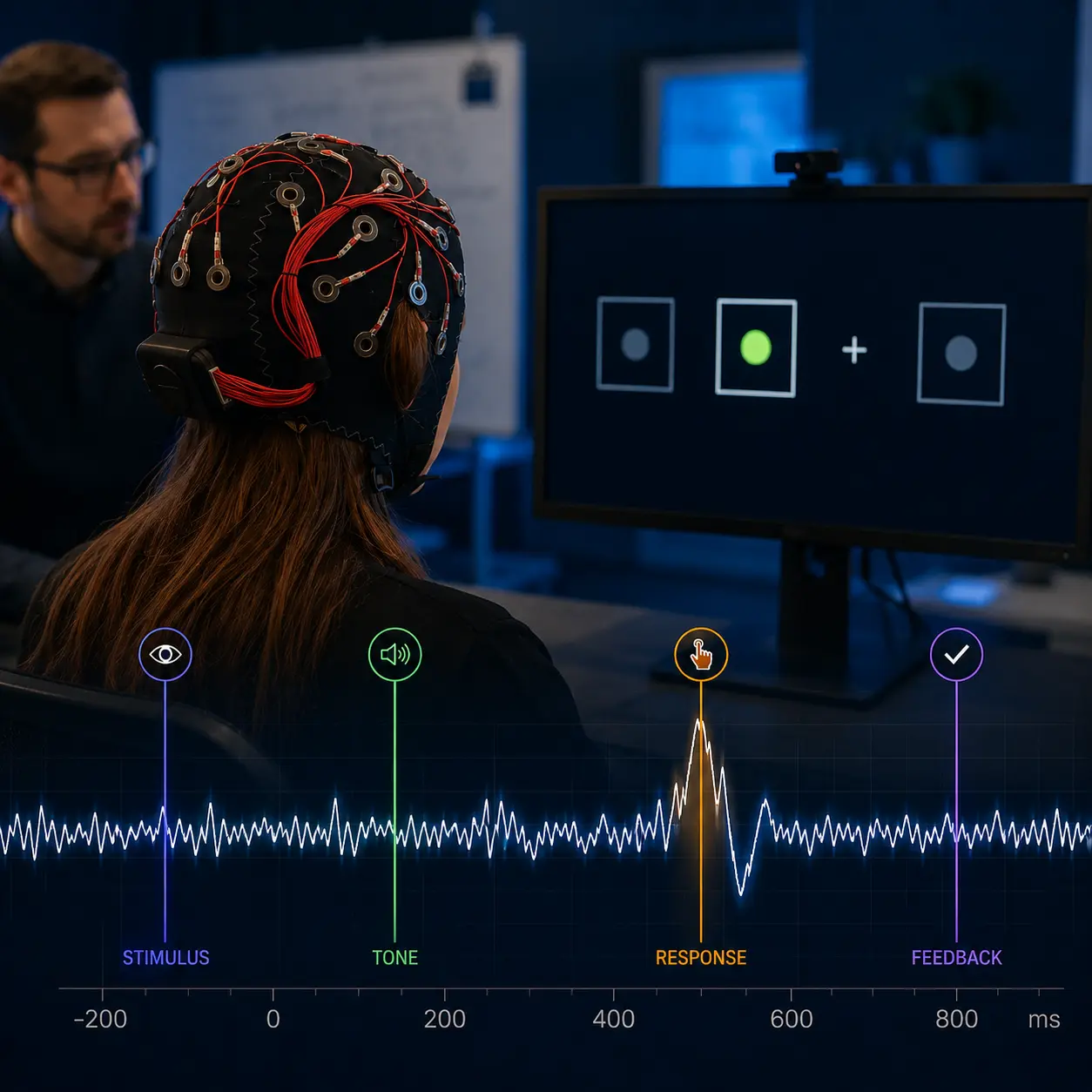
Event marking is the process of inserting time-stamped labels into an EEG recording whenever a meaningful event occurs during an experiment.
These markers identify the precise moment a stimulus is presented, a participant responds, or another experimental event takes place. Rather than representing brain activity themselves, event markers provide reference points that allow researchers to interpret the surrounding neural signals.
Without event markers, an EEG recording consists of a continuous stream of electrical activity with no indication of which portions correspond to specific experimental conditions. Event marking transforms that continuous recording into interpretable experimental data by linking brain activity to precisely defined moments [1].
Why Timing Accuracy Matters
Many neural responses occur within only a few hundred milliseconds after a stimulus appears. Researchers investigating attention, perception, language, decision-making, or sensory processing often rely on these rapid changes in brain activity to answer their scientific questions.
If event markers are delayed or inconsistent, the recorded neural responses become misaligned across repeated trials. Even small timing variations can reduce the clarity of averaged ERP waveforms, making subtle components more difficult to detect [1], [2].
Accurate synchronization therefore supports more reliable measurements while improving the reproducibility of experimental findings. For studies examining rapid cognitive processes, timing precision is not simply a technical consideration but a fundamental component of experimental design.
Event Markers and Event-Related Potentials
Event-related potentials (ERPs) are among the most common applications of event marking.
ERPs are obtained by averaging EEG responses across many repetitions of the same event. Because unrelated brain activity varies from trial to trial while stimulus-related activity remains consistent, averaging reveals characteristic neural responses that might otherwise remain hidden within the ongoing EEG signal [1].
This process depends on accurate synchronization. If stimulus timing varies between trials, corresponding neural responses no longer align correctly, reducing waveform amplitude and increasing measurement variability [1], [2].
For this reason, precise event marking forms the foundation of reliable ERP research.
Common Experimental Events
Event markers can represent nearly any meaningful event occurring during an experiment.
Examples include:
Visual stimulus presentation
Auditory stimulus presentation
Participant button presses
Motor responses
Trial onset and completion
Feedback presentation
Changes in experimental condition
Rest periods
Synchronization with other physiological sensors
Selecting appropriate event markers depends on the research question and experimental design. Researchers should identify all important experimental events during the planning stage before data collection begins.
Hardware and Software Synchronization
Modern EEG research uses several approaches for synchronizing experimental events with neural recordings.
Traditional laboratory systems often rely on dedicated hardware trigger devices that transmit digital signals directly to the EEG acquisition system. These hardware triggers provide highly reliable synchronization and remain common in laboratory ERP studies [1].
Software-based event marking has also become increasingly common. Experimental platforms can generate event markers that are transmitted directly to EEG recording software, reducing hardware complexity while supporting a wide variety of experimental paradigms [2].
The appropriate synchronization method depends on the required timing precision, experimental software, and overall study design.
Event Marking with Wireless EEG
Advances in wireless EEG technology have expanded opportunities for mobile and naturalistic research while maintaining timing accuracy suitable for many experimental applications.
Independent validation studies have demonstrated that modern wireless EEG systems can achieve event-marking accuracy appropriate for ERP research when proper synchronization procedures are implemented [2]. This allows researchers to investigate cognition in classrooms, workplaces, clinical environments, and other real-world settings without sacrificing precise temporal alignment.
As wireless EEG continues to evolve, accurate event synchronization remains essential regardless of whether data are collected inside or outside a traditional laboratory.
Best Practices for Event Marking
Reliable event timing begins during experimental planning rather than after data collection.
Researchers should:
Define all experimental events before programming the study.
Use consistent synchronization methods throughout the experiment.
Validate timing accuracy before collecting participant data.
Record pilot datasets to verify event alignment.
Document synchronization procedures within the study protocol.
Minimize unnecessary delays between stimulus presentation and event transmission.
Careful planning helps ensure that event markers accurately represent the experimental timeline while supporting reproducible research [1].
Common Challenges
Several factors can influence event timing accuracy during EEG experiments.
Software latency, display refresh rates, display refresh synchronization, operating system scheduling, network communication, and hardware interfaces may all introduce small delays between the intended experimental event and its recorded marker. While many delays remain consistent and predictable, variable timing differences, often referred to as jitter, can reduce measurement precision if not accounted for during experimental design [1], [2].
Understanding these potential sources of timing variability allows researchers to select synchronization methods appropriate for their scientific objectives.
References
[1] S. J. Luck, An Introduction to the Event-Related Potential Technique, 2nd ed. Cambridge, MA, USA: MIT Press, 2014.
[2] N. S. Williams, M. McArthur, A. de Wit, et al., ?The Emotiv EPOC Flex saline EEG system and event marking validation for event-related potential research,? Behavior Research Methods, 2021.
Electroencephalography (EEG) records continuous electrical activity generated by the brain. While this continuous signal provides valuable information about ongoing neural processes, many research questions require understanding how the brain responds to specific events. Whether participants view an image, hear a sound, press a button, or make a decision, researchers must know exactly when those events occurred within the EEG recording.
Event marking provides this temporal reference. By placing precisely timed markers within the EEG data stream, researchers can align neural activity with experimental events and examine how the brain responds over time. Accurate synchronization is particularly important in event-related potential (ERP) research, where even small timing errors can affect waveform quality and reduce confidence in experimental findings.[1],[2]
This guide explains how event marking works, why timing accuracy matters, common synchronization methods, and best practices for integrating event markers into EEG experiments.
What Is Event Marking?
Event marking is the process of inserting time-stamped labels into an EEG recording whenever a meaningful event occurs during an experiment.
These markers identify the precise moment a stimulus is presented, a participant responds, or another experimental event takes place. Rather than representing brain activity themselves, event markers provide reference points that allow researchers to interpret the surrounding neural signals.
Without event markers, an EEG recording consists of a continuous stream of electrical activity with no indication of which portions correspond to specific experimental conditions. Event marking transforms that continuous recording into interpretable experimental data by linking brain activity to precisely defined moments [1].
Why Timing Accuracy Matters
Many neural responses occur within only a few hundred milliseconds after a stimulus appears. Researchers investigating attention, perception, language, decision-making, or sensory processing often rely on these rapid changes in brain activity to answer their scientific questions.
If event markers are delayed or inconsistent, the recorded neural responses become misaligned across repeated trials. Even small timing variations can reduce the clarity of averaged ERP waveforms, making subtle components more difficult to detect [1], [2].
Accurate synchronization therefore supports more reliable measurements while improving the reproducibility of experimental findings. For studies examining rapid cognitive processes, timing precision is not simply a technical consideration but a fundamental component of experimental design.
Event Markers and Event-Related Potentials
Event-related potentials (ERPs) are among the most common applications of event marking.
ERPs are obtained by averaging EEG responses across many repetitions of the same event. Because unrelated brain activity varies from trial to trial while stimulus-related activity remains consistent, averaging reveals characteristic neural responses that might otherwise remain hidden within the ongoing EEG signal [1].
This process depends on accurate synchronization. If stimulus timing varies between trials, corresponding neural responses no longer align correctly, reducing waveform amplitude and increasing measurement variability [1], [2].
For this reason, precise event marking forms the foundation of reliable ERP research.
Common Experimental Events
Event markers can represent nearly any meaningful event occurring during an experiment.
Examples include:
Visual stimulus presentation
Auditory stimulus presentation
Participant button presses
Motor responses
Trial onset and completion
Feedback presentation
Changes in experimental condition
Rest periods
Synchronization with other physiological sensors
Selecting appropriate event markers depends on the research question and experimental design. Researchers should identify all important experimental events during the planning stage before data collection begins.
Hardware and Software Synchronization
Modern EEG research uses several approaches for synchronizing experimental events with neural recordings.
Traditional laboratory systems often rely on dedicated hardware trigger devices that transmit digital signals directly to the EEG acquisition system. These hardware triggers provide highly reliable synchronization and remain common in laboratory ERP studies [1].
Software-based event marking has also become increasingly common. Experimental platforms can generate event markers that are transmitted directly to EEG recording software, reducing hardware complexity while supporting a wide variety of experimental paradigms [2].
The appropriate synchronization method depends on the required timing precision, experimental software, and overall study design.
Event Marking with Wireless EEG
Advances in wireless EEG technology have expanded opportunities for mobile and naturalistic research while maintaining timing accuracy suitable for many experimental applications.
Independent validation studies have demonstrated that modern wireless EEG systems can achieve event-marking accuracy appropriate for ERP research when proper synchronization procedures are implemented [2]. This allows researchers to investigate cognition in classrooms, workplaces, clinical environments, and other real-world settings without sacrificing precise temporal alignment.
As wireless EEG continues to evolve, accurate event synchronization remains essential regardless of whether data are collected inside or outside a traditional laboratory.
Best Practices for Event Marking
Reliable event timing begins during experimental planning rather than after data collection.
Researchers should:
Define all experimental events before programming the study.
Use consistent synchronization methods throughout the experiment.
Validate timing accuracy before collecting participant data.
Record pilot datasets to verify event alignment.
Document synchronization procedures within the study protocol.
Minimize unnecessary delays between stimulus presentation and event transmission.
Careful planning helps ensure that event markers accurately represent the experimental timeline while supporting reproducible research [1].
Common Challenges
Several factors can influence event timing accuracy during EEG experiments.
Software latency, display refresh rates, display refresh synchronization, operating system scheduling, network communication, and hardware interfaces may all introduce small delays between the intended experimental event and its recorded marker. While many delays remain consistent and predictable, variable timing differences, often referred to as jitter, can reduce measurement precision if not accounted for during experimental design [1], [2].
Understanding these potential sources of timing variability allows researchers to select synchronization methods appropriate for their scientific objectives.
References
[1] S. J. Luck, An Introduction to the Event-Related Potential Technique, 2nd ed. Cambridge, MA, USA: MIT Press, 2014.
[2] N. S. Williams, M. McArthur, A. de Wit, et al., ?The Emotiv EPOC Flex saline EEG system and event marking validation for event-related potential research,? Behavior Research Methods, 2021.
Electroencephalography (EEG) records continuous electrical activity generated by the brain. While this continuous signal provides valuable information about ongoing neural processes, many research questions require understanding how the brain responds to specific events. Whether participants view an image, hear a sound, press a button, or make a decision, researchers must know exactly when those events occurred within the EEG recording.
Event marking provides this temporal reference. By placing precisely timed markers within the EEG data stream, researchers can align neural activity with experimental events and examine how the brain responds over time. Accurate synchronization is particularly important in event-related potential (ERP) research, where even small timing errors can affect waveform quality and reduce confidence in experimental findings.[1],[2]
This guide explains how event marking works, why timing accuracy matters, common synchronization methods, and best practices for integrating event markers into EEG experiments.
What Is Event Marking?
Event marking is the process of inserting time-stamped labels into an EEG recording whenever a meaningful event occurs during an experiment.
These markers identify the precise moment a stimulus is presented, a participant responds, or another experimental event takes place. Rather than representing brain activity themselves, event markers provide reference points that allow researchers to interpret the surrounding neural signals.
Without event markers, an EEG recording consists of a continuous stream of electrical activity with no indication of which portions correspond to specific experimental conditions. Event marking transforms that continuous recording into interpretable experimental data by linking brain activity to precisely defined moments [1].
Why Timing Accuracy Matters
Many neural responses occur within only a few hundred milliseconds after a stimulus appears. Researchers investigating attention, perception, language, decision-making, or sensory processing often rely on these rapid changes in brain activity to answer their scientific questions.
If event markers are delayed or inconsistent, the recorded neural responses become misaligned across repeated trials. Even small timing variations can reduce the clarity of averaged ERP waveforms, making subtle components more difficult to detect [1], [2].
Accurate synchronization therefore supports more reliable measurements while improving the reproducibility of experimental findings. For studies examining rapid cognitive processes, timing precision is not simply a technical consideration but a fundamental component of experimental design.
Event Markers and Event-Related Potentials
Event-related potentials (ERPs) are among the most common applications of event marking.
ERPs are obtained by averaging EEG responses across many repetitions of the same event. Because unrelated brain activity varies from trial to trial while stimulus-related activity remains consistent, averaging reveals characteristic neural responses that might otherwise remain hidden within the ongoing EEG signal [1].
This process depends on accurate synchronization. If stimulus timing varies between trials, corresponding neural responses no longer align correctly, reducing waveform amplitude and increasing measurement variability [1], [2].
For this reason, precise event marking forms the foundation of reliable ERP research.
Common Experimental Events
Event markers can represent nearly any meaningful event occurring during an experiment.
Examples include:
Visual stimulus presentation
Auditory stimulus presentation
Participant button presses
Motor responses
Trial onset and completion
Feedback presentation
Changes in experimental condition
Rest periods
Synchronization with other physiological sensors
Selecting appropriate event markers depends on the research question and experimental design. Researchers should identify all important experimental events during the planning stage before data collection begins.
Hardware and Software Synchronization
Modern EEG research uses several approaches for synchronizing experimental events with neural recordings.
Traditional laboratory systems often rely on dedicated hardware trigger devices that transmit digital signals directly to the EEG acquisition system. These hardware triggers provide highly reliable synchronization and remain common in laboratory ERP studies [1].
Software-based event marking has also become increasingly common. Experimental platforms can generate event markers that are transmitted directly to EEG recording software, reducing hardware complexity while supporting a wide variety of experimental paradigms [2].
The appropriate synchronization method depends on the required timing precision, experimental software, and overall study design.
Event Marking with Wireless EEG
Advances in wireless EEG technology have expanded opportunities for mobile and naturalistic research while maintaining timing accuracy suitable for many experimental applications.
Independent validation studies have demonstrated that modern wireless EEG systems can achieve event-marking accuracy appropriate for ERP research when proper synchronization procedures are implemented [2]. This allows researchers to investigate cognition in classrooms, workplaces, clinical environments, and other real-world settings without sacrificing precise temporal alignment.
As wireless EEG continues to evolve, accurate event synchronization remains essential regardless of whether data are collected inside or outside a traditional laboratory.
Best Practices for Event Marking
Reliable event timing begins during experimental planning rather than after data collection.
Researchers should:
Define all experimental events before programming the study.
Use consistent synchronization methods throughout the experiment.
Validate timing accuracy before collecting participant data.
Record pilot datasets to verify event alignment.
Document synchronization procedures within the study protocol.
Minimize unnecessary delays between stimulus presentation and event transmission.
Careful planning helps ensure that event markers accurately represent the experimental timeline while supporting reproducible research [1].
Common Challenges
Several factors can influence event timing accuracy during EEG experiments.
Software latency, display refresh rates, display refresh synchronization, operating system scheduling, network communication, and hardware interfaces may all introduce small delays between the intended experimental event and its recorded marker. While many delays remain consistent and predictable, variable timing differences, often referred to as jitter, can reduce measurement precision if not accounted for during experimental design [1], [2].
Understanding these potential sources of timing variability allows researchers to select synchronization methods appropriate for their scientific objectives.
References
[1] S. J. Luck, An Introduction to the Event-Related Potential Technique, 2nd ed. Cambridge, MA, USA: MIT Press, 2014.
[2] N. S. Williams, M. McArthur, A. de Wit, et al., ?The Emotiv EPOC Flex saline EEG system and event marking validation for event-related potential research,? Behavior Research Methods, 2021.

Continue reading