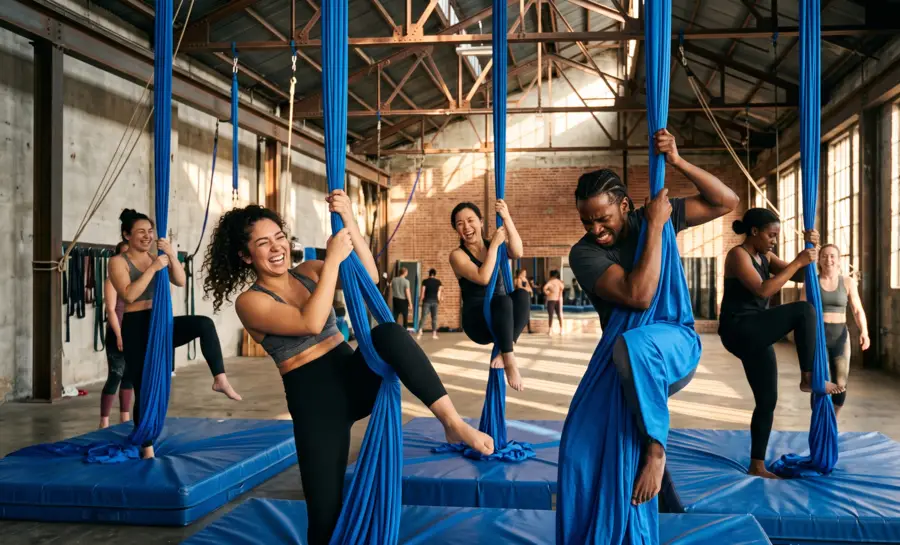
Aerial yoga represents a blend of traditional movement and suspension, offering a unique approach to physical and mental wellness. This practice utilizes specialized equipment to facilitate movement while providing support for complex postures.
What is Aerial Yoga?
Aerial yoga integrates traditional yoga poses with an aerial hammock to create a unique exercise modality. By using a suspended fabric, practitioners gain support that facilitates deeper stretching and inverted postures that might otherwise be difficult to achieve on a mat.
This method has evolved over the last several decades, drawing inspiration from both modern performance arts and historical movement traditions.
The History and Origins of Aerial Yoga
The origins of this practice trace back to the mid-2000s, building upon the foundations of aerial performance and physical conditioning.
Notable contributions include the development of AntiGravity Fitness by Christopher Harrison, which reframed acrobatic techniques for the yoga studio environment. Concurrently, other innovators such as those behind Fly Yoga in France and the architects of AeroYoga began tailoring these aerial movements to improve body alignment and accessibility.
These systems shifted the focus from purely aesthetic performance to internal wellness and biomechanical adjustment.
How Aerial Yoga Works
The primary component of an aerial setup is a high-tensile strength silk hammock, which serves as a supportive tool for both restorative and active postures.
The fabric is suspended from ceiling anchors, allowing it to act as a weight-bearing cradle that holds the body in various orientations, including inversions. This suspension apparatus allows for the weight of the body to be distributed evenly, rather than concentrated on joints like the wrists or knees.
This unique interaction between the fabric and gravity creates a truly unique training experience for those seeking to enhance their range of movement.
Benefits of Practicing Aerial Yoga
Practicing in a suspended state offers distinct advantages that differentiate it from ground-based exercises. Practitioners often find that the support of the hammock allows for a deeper release in muscular tissues, which aids in recovery and structural alignment.
By incorporating elements of foundational practices like Hatha Yoga, the aerial approach maintains a focus on breath and intentional movement.
Physical Benefits of Aerial Yoga
Aerial yoga helps build core stability and muscular endurance while simultaneously providing targeted spinal decompression. The following table highlights the physical impact of common aerial poses and their respective benefits for the body.
Posture Type | Primary Benefit | Targeted Area |
|---|---|---|
Inverted Hangs | Spinal Decompression | Lumbar and Thoracic Spine |
Fabric Wraps | Increased Flexibility | Hips and Hamstrings |
Assisted Scaling | Core Engagement | Abdominal and Latissimus |
These postures encourage lengthened muscle fibers and increased joint space, contributing to improved physical resilience. Users typically experience a reduction in compressive forces that the spine usually endures during vertical standing exercises.
Mental and Emotional Benefits of Aerial Yoga
The shift in perspective achieved while hanging suspended encourages a profound sense of mindfulness and mental tranquility.
Being off the ground necessitates focus, which effectively anchors the person in the present moment, similar to traditional deep-breathing techniques. This heightened internal awareness allows for the release of habitual tension and the development of emotional regulation skills that translate into daily life.
Is Aerial Yoga Right for You?
Determining suitability for this practice involves understanding one's current physical comfort levels and ensuring a safe environment is maintained. While the hammock provides extensive support, it is important for people to assess their readiness for inverted postures and suspended movement.
A professional environment will always prioritize participant safety above all else.
Who Can Practice Aerial Yoga?
This practice is widely considered accessible for healthy adults across various fitness levels due to the ability to customize the height and support of the hammock. It often appeals to those looking to supplement their existing training with a low-impact challenge, as well as individuals interested in unconventional forms of movement.
To ensure a safe experience, practitioners should remain mindful of the following considerations:
Disclose any medical conditions involving blood pressure or inner ear equilibrium to the instructor.
Ensure all equipment is installed by qualified professionals to prevent structural failure.
Begin with introductory movements that maintain a low center of gravity.
Communicate clearly with the instructor about any personal limitations before starting.
Following these guidelines helps create a secure and beneficial practice session for everyone involved.
Safety Considerations and Precautions
Safety is the foundational element of any aerial session, particularly concerning weight limits, anchor integrity, and proper technique. Practitioners must ensure that the equipment is rated appropriately for their body weight and that they have undergone a demonstration of how to exit the hammock securely.
Avoiding sudden movements while inverted is essential for maintaining control and preventing strain, effectively utilizing the equipment as an extension of the body rather than a source of imbalance.
Getting Started with Aerial Yoga
Initiating a new aerial practice requires a willingness to adapt to unaccustomed sensations and a patient approach to skill acquisition.
Most introductory sessions focus on building trust with the hammock by engaging with the fabric in close proximity to the floor before attempting higher-altitude movements.
What to Expect in Your First Aerial Yoga Class
A typical beginner session begins with an explanation of the equipment and basic safety protocols designed to build confidence. The class will often lead students through a sequence of movements that establish stability, followed by gentle, guided stretches using the hammock to hold segments of the body.
As the class progresses, participants might perform light inversions, which rely on the supporting fabric to alleviate pressure on the neck and head. The experience is intentionally designed to foster a gradual, supported transition into a suspended state.
How Does Aerial Yoga Challenge the Proprioceptive and Vestibular Systems?
Aerial movement engages the systems responsible for balance and spatial awareness, offering a robust workout for the internal equilibrium. This interaction with neuroscience helps clarify why consistent practice can enhance one’s sense of orientation and physical coordination.
How Does the Brain Process Spatial Orientation in a Suspended State?
The brain coordinates information regarding position in space through the integration of input from visual, somatosensory, and vestibular components. When suspended, the brain must recalibrate these inputs because the standard cues (such as a fixed relationship with the floor) are altered.
This active process requires significant attention to brain health, as navigating these shifts helps refine the brain's ability to maintain equilibrium in dynamic, non-standard environments.
What Is the Connection Between Vestibular Input and Sensations Like Dizziness?
Sensations of dizziness or vertigo within an aerial context often occur when the signals sent to the brain by the vestibular system conflict with visual feedback.
When the body rotates or inverts, the fluid within the inner ear canals moves, signaling a change in position; if this does not harmonize with external visual data, the brain may interpret this as a mild sensory mismatch.
Practicing slowly allows these systems to become accustomed to the new range of movement, reducing the likelihood of disequilibrium over time.
Can EEG Provide Objective Measures of Brain Activity During Aerial Yoga's Sensory Challenges?
At present, there is no published scientific literature utilizing electroencephalography (EEG) to measure brain activity directly during an active aerial yoga practice.
The primary barrier to real-time data collection stems from severe technical and movement limitations. Standard EEG equipment, and even modern wireless mobile systems, are highly vulnerable to gross motor movement artifacts and intense electromyographic (EMG) contamination caused by the muscle activation required for suspension and core stabilization.
Furthermore, the inversion dynamics and physical contact with the silk hammock create mechanical pressure and electrode displacement, making it exceptionally difficult to isolate clean cortical signals while a practitioner is in motion. Because of these constraints, directly mapping the millisecond-by-millisecond brain activity during fluid, aerial transitions remains an unfeasible task within current research paradigms.
To investigate the neural impacts of aerial yoga's intense vestibular and proprioceptive demands, a realistic experimental design must instead focus on capturing resting-state baseline data immediately before and after a structured session.
By eliminating active motion artifacts, researchers can examine distinct post-exercise electrophysiological biomarkers to evaluate how the central nervous system adapts to suspension. Potential metrics for exploration include changes in frontoparietal alpha power (8–12 Hz) and localized theta power (4–8 Hz) during eyes-closed rest, which serve as established markers for sensory gating, spatial orientation processing, and autonomic nervous system shifts.
Analyzing shifts in these low-frequency bands before and after a practice could offer exploratory insight into how the brain recalibrates its spatial boundaries and transitions into a restored state following deep sensory challenges.
Conclusion
Aerial yoga provides a creative and effective method for improving strength, flexibility, and spatial awareness by utilizing the support of a silk hammock to explore new movement potentials. By maintaining a focus on safety and personal pacing, practitioners engage in a practice that blends physical conditioning with internal meditation, offering a balanced approach to overall wellness.
Frequently Asked Questions
What should I wear for an aerial yoga class?
It is recommended to wear form-fitting apparel to prevent fabric snagging, along with shirts that cover the underarms.
Is aerial yoga dangerous for the spine?
When performed correctly with proper technique and supervision, it often serves to decompress and lengthen the spine rather than cause injury.
Can aerial yoga help with vertigo?
While it challenges the vestibular system, it is recommended to speak with a healthcare provider regarding specific balance or medical conditions.
How many calories does an aerial session burn?
Energy expenditure varies significantly based on the intensity of the class and the specific movements performed during the session.
Emotiv is a neurotechnology leader helping advance neuroscience research through accessible EEG and brain data tools.
Medical Disclaimer: The information provided on this website is for educational and informational purposes only and is not intended as medical or health advice. This content may contain errors and should not be relied upon to make life-altering health, medical, or lifestyle choices. Always seek the advice of your physician or other qualified health provider with any questions you may have regarding a medical condition or treatment.
Christian Burgos