Creating a consistent home practice is a powerful and life-changing way to improve self-regulation and foster personal growth. To make this process successful and lasting, there are five key elements essential for building a truly sustainable and effective approach that will support you over time during your yoga practice.
What You Need for Your Yoga Practice
Establishing a personal yoga practice requires minimal initial preparation to ensure stability and comfort. By curating a simple kit, you create a dedicated environment that encourages frequent engagement. The focus remains on steady progression rather than acquiring expensive accessories.
Essential Yoga Gear
High-quality equipment acts as a support system during initial training. A standard non-slip mat provides necessary traction for standing poses, while props assist in aligning the body safely. In addition, consider these common items for your space:
High-density PVC or rubber mat
Two supportive cork or foam blocks
A cotton strap for extending reach
A folded blanket for joint padding
These physical tools allow practitioners to modify postures according to their current flexibility and strength. Proper equipment maintains the integrity of the shape, preventing strain that often arises from improper alignment.
Choosing the Right Space
A suitable area for practice promotes mental clarity and minimizes external disruptions. Select a spot with sufficient room to extend limbs fully in all four directions. If possible, prioritize natural lighting and avoid areas prone to heavy foot traffic.
Understanding Basic Yoga Poses (Asanas)
Mastering fundamental movements creates a baseline for long-term health. These physical postures, often categorized by their orientation to gravity, build necessary physiological awareness.
Engaging with yoga invites a deeper exploration of the body's mechanics through systematic practice.
Standing Poses for Stability
Standing postures serve as the bedrock of physical strength and groundedness. They emphasize active engagement of the legs and base of the spine, which translates to improved balance in daily life. Most sequences integrate these poses early to activate heat and focus.
Seated Poses for Flexibility
These movements focus on deep muscle release through sustained tension. Practitioners often utilize these during the latter half of a session to settle the body and reduce latent tension. They offer a stable platform for monitoring internal sensations.
Restorative Poses for Relaxation
Restorative poses involve passive holding with external support to calm the nervous system. By emphasizing ease over effort, these postures promote structural recovery and mental quietude.
Practitioners might compare the physical intensity of standing poses versus the passive nature of restorative work in the table below.
Pose Category | Primary Goal | Intensity Level |
|---|---|---|
Standing | Core Stability | Moderate-High |
Seated | Deep Flexibility | Low-Moderate |
Restorative | Nervous System Ease | Very Low |
Furthermore, using supportive pillows or bolsters helps maintain these shapes for extended periods. This approach is critical for Restorative Yoga practitioners observing how their bodies respond to stillness after periods of high activity.
The Importance of Breathwork (Pranayama)
Breath acts as a bridge between active mindfulness and physical posture. It influences the nervous system significantly, providing a physiological mechanism for managing arousal levels.
Consistent work in this area informs one's understanding of neuroscience and how specific respiratory patterns shift the brain's internal state.
How Do You Properly Execute Ujjayi Pranayama (Victorious Breath)?
Ujjayi involves a controlled, audible contraction that narrows the passage of air, creating a gentle, oceanic sound.
Keep the lips sealed while drawing air through the nostrils, ensuring a smooth and continuous inhalation. Ensure the chest remains relatively quiet while the throat produces a subtle 'hissing' resonance, a sound often described as the ocean's whisper, which helps to calm the nervous system and deepen the breath.
This deliberate narrowing of the glottis is the key to Ujjayi's unique qualities.
What Is the Correct Way to Achieve the Glottal Constriction?
Achieving this constriction requires subtle and precise engagement of the tiny, often overlooked muscles located at the very back of the throat. To better understand this sensation, consider the gentle effort involved when fogging a mirror with your mouth open, and then replicate that feeling with your mouth closed, maintaining a soft palate.
The key is to cultivate a gentle, consistent, and sustained sensation throughout the exhalation, avoiding any sense of aggressive force or strain. This mindful approach ensures the breath remains smooth and controlled, facilitating the desired Ujjayi effect without compromising relaxation.
When Is It Appropriate to Use Ujjayi During an Asana Practice?
Many practitioners, particularly those engaged in demanding physical disciplines such as yoga, martial arts, or intense athletic training, often find themselves relying on this specific breath technique, often referred to as Ujjayi or victorious breath, exclusively during the most challenging physical segments of their practice.
This strategic application is primarily aimed at maintaining optimal internal body temperature, preventing overheating during strenuous exertion. Furthermore, it plays a crucial role in building sustainable thermal energy, a vital component for prolonged physical output.
Beyond its physiological benefits, the rhythmic and controlled nature of this breath profoundly helps in grounding the mind, fostering a state of focused awareness and mental clarity, which is especially invaluable during complex balance work or intricate sequences that demand unwavering concentration.
However, it is equally important to recognize when this technique is not suitable. Practitioners are strongly advised to avoid using it during recovery phases or periods of rest, where a natural, soft, and unforced breath is not only preferable but essential for allowing the body and mind to return to a state of equilibrium and deep relaxation.
What Is the Step-by-Step Method for Nadi Shodhana (Alternate Nostril Breathing)?
Begin by placing the ring finger and thumb on either side of the nose, gently applying pressure to create a seal.
Close the right nostril with your thumb and inhale deeply and steadily through the left, drawing the breath in until your lungs are comfortably full.
Pause momentarily at the peak of the breath, holding it for a brief, controlled duration.
Then, use the ring finger to close the left nostril, release the thumb from the right, and exhale slowly and completely through the right, allowing all the air to leave your lungs in a smooth, unhurried manner.
How Can You Progressively Lengthen the Breath Ratios Safely?
Begin by establishing a 1:1 ratio, where the duration of your inhale is precisely matched by the duration of your exhale. This foundational rhythm should feel completely natural and effortless before you even contemplate incorporating any subtle pauses, whether they occur at the peak of your inhalation or at the very end of your exhalation.
Remember, the paramount consideration at all times is the seamless, fluid quality of your breath, rather than striving for the absolute maximum lung capacity.
How Do You Perform an Energizing but Safe Bhastrika (Bellows Breath)?
Bhastrika, often referred to as Bellows Breath, is a powerful pranayama technique that involves forceful, rapid inhalations and exhalations, with the primary focus and movement centered in the diaphragm.
To perform this invigorating breath, sit in a comfortable, tall position, maintaining an upright spine. As you execute the sharp, decisive exhale, consciously ensure that your abdomen moves inward, drawing the navel towards the spine.
It is crucial to limit the duration of this practice, especially when you are beginning, as it significantly and rapidly shifts metabolic activity, generating considerable internal heat and energy.
What Do EEG Studies Reveal About the Neural Impact of Pranayama?
Electrophysiological research evaluating specialized breathing control techniques, such as Bhramari Pranayama (BhPr), reveals unique real-time cortical dynamics that expand our understanding of how breath modulation impacts the central nervous system.
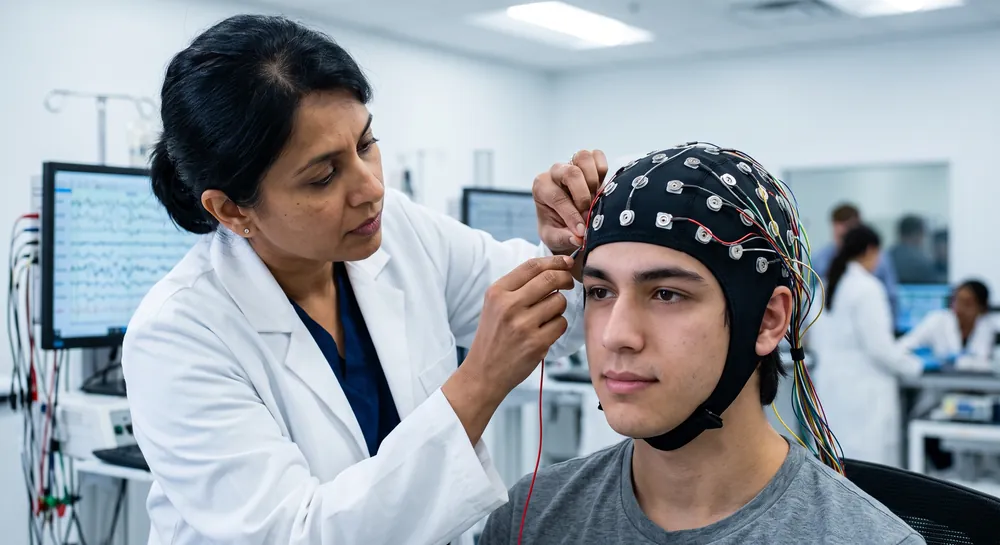
BhPr is characterized by a rhythmic breathing pattern involving highly elongated exhalations and brief inhalations, combined with a repetitive, acoustic component that closely mirrors mantra recitation. When monitored via high-density array EEG, practitioners across various experience levels—including beginners and those with several months of training—exhibit a distinct and dramatic emergence of high-frequency electrical activity visible in the raw EEG trace.
Specifically, advanced time-frequency representations (TFR) demonstrate that this practice generates controlled, paroxysmal gamma waves (PGW) that manifest structurally as high-frequency biphasic ripples.
The discovery of these high-frequency bursts has driven significant discussion within contemplative neuroscience regarding their underlying mechanisms and safety. While intense surges in the gamma band during deep meditation have historically led some investigators to hypothesize a relationship with localized epileptic activity, advanced signal processing methods indicate that this pranayama-induced gamma activity is most probably non-epileptic.
Instead, these unique neurocorrelates serve as the objective central markers for the profound states of mind refreshment, deep concentration, and blissfulness reported by practitioners.
Noteworthy, given the nascent nature of high-density EEG research and the small sample sizes typical of these intensive protocols, these paroxysmal gamma signatures are framed as exploratory indicators of specialized breath-induced states rather than standardized or universally applicable clinical metrics.
How Do You Choose an Appropriate Yoga Style for Your Home Practice?
Selecting a style depends on individual needs, such as whether one desires strength-building or deep brain health support. Practitioners often begin by experimenting with various modalities to see which aligns with their current vitality. It is often productive to rotate through different intensities to keep the nervous system responsive to new stimuli.
For instance, styles that emphasize Hatha Yoga principles offer a balanced overview of physical alignment and rhythmic breathing. These traditions foster patience and help build a foundational knowledge of how the body moves in space. By focusing on steady, deliberate transitions, one can gauge how much physical exertion is appropriate for their specific goals.
It is beneficial to consider the time of day and the intended mental outcome when selecting a practice routine. High-energy mornings might favor dynamic patterns, whereas evening sessions may lean toward softer, cooling modalities. Aligning the practice with one's natural rhythm ensures that the home routine remains sustainable over the long term without causing burnout.
How Can You Structure a Balanced Yoga Sequence?
Structuring a sequence involves grouping movements logically to maximize safety and efficiency. Most sequences follow a narrative path that moves from initial ground-setting to activation, followed by a cooling transition. Logic dictates that we avoid placing extreme exertion before the body has been prepared.
What Are the Foundational Principles for Arranging Pose Categories?
Sequencing generally starts with accessible movements before introducing more complex structural load. One might list the progression as follows:
Centering and breath-based awareness.
Warming the joints and warming large muscle groups.
Standing sequences for sustained engagement.
Seated work for deep focused stretching.
Closing with quiet inversion or lying support.
This logical progression prepares the connective tissues and nervous system for increasingly intense demands.
What Is the Purpose of Centering and Warm-Up Movements?
Centering activities shift the mind from daily activities to the immediate requirements of the practice. By initiating with low-impact movements, you gradually increase systemic blood flow and joint lubrication.
This preparation is essential to prevent injury and allows the practitioner to monitor their physical threshold before adding greater intensity.
Conclusion
Designing a personal yoga practice is an iterative process that relies on patience and self-observation. By integrating breathwork with deliberate movement, you create a sustainable foundation that supports physical strength and mental consistency for years to come.
References
Vialatte, F. B., Bakardjian, H., Prasad, R., & Cichocki, A. (2009). EEG paroxysmal gamma waves during Bhramari Pranayama: a yoga breathing technique. Consciousness and cognition, 18(4), 977–988. https://doi.org/10.1016/j.concog.2008.01.004
Frequently Asked Questions
How often should a beginner practice yoga each week?
Most practitioners find that starting with two or three sessions per week establishes a reliable habit without overwhelming the body.
Can I practice yoga if I am not very flexible?
Flexibility is a potential outcome of consistent training, not a requirement for beginning, as modifications exist for every posture.
How long should a typical morning session last?
Sessions can be as brief as ten minutes to be effective, provided you maintain consistent focus on breath and alignment throughout.
Is it safe to practice on an empty stomach?
Practicing on an empty stomach is generally recommended to ensure comfort during inversions and abdominal engagement.
What should I do if a pose causes sharp pain?
If a movement produces sharp or localized pain, immediately release the tension and move to a more supported variation.
How do I maintain motivation when practicing alone?
Setting a specific, achievable goal for each session can help maintain focus and interest, making the practice feel rewarding.
Is there a specific time of day that is best for yoga?
While early morning practice is a popular tradition, the best time is ultimately when you can reliably commit to the duration without interruption.
Emotiv is a neurotechnology leader helping advance neuroscience research through accessible EEG and brain data tools.
Medical Disclaimer: The information provided on this website is for educational and informational purposes only and is not intended as medical or health advice. This content may contain errors and should not be relied upon to make life-altering health, medical, or lifestyle choices. Always seek the advice of your physician or other qualified health provider with any questions you may have regarding a medical condition or treatment.
Christian Burgos