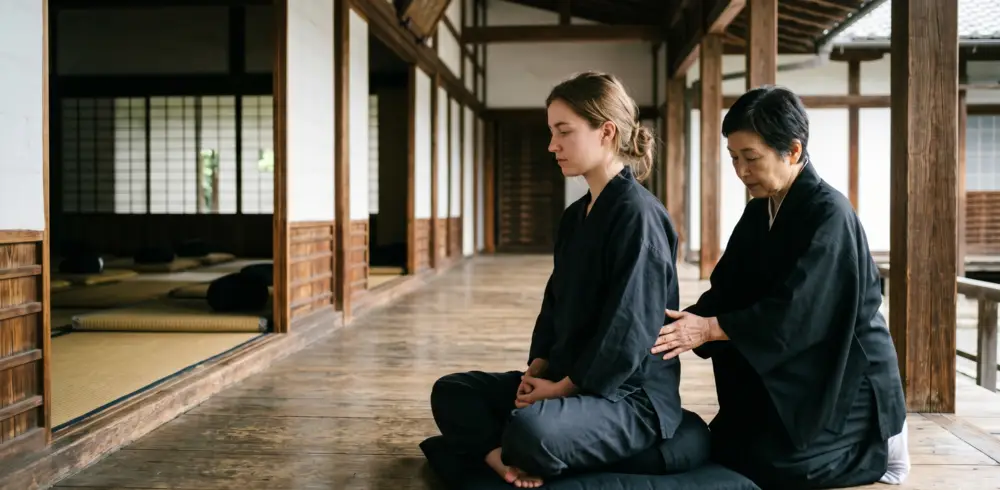
Zazen, the seated meditation practice at the core of Zen Buddhism, is a disciplined cognitive training regimen that, practiced consistently, appears to reorganize the brain. Where most meditative practices ask practitioners to anchor attention to a single object, Zazen in its mature form asks something more demanding: a complete, non-reactive awareness of present experience without preferring any of it.
Understanding Zazen
Zazen, a term originating from ancient Chinese Buddhist texts, translates directly to ‘sitting meditation.’ It forms the bedrock of practice within the Zen Buddhist tradition.
While the general Japanese word for meditation is 'meisō,' zazen specifically refers to seated meditation and is considered the heart of Zen practice. It's not about achieving a specific state or emptying the mind, but rather about being present, observing thoughts and feelings without judgment as they arise and pass.
Think of it as a way to directly engage with life as it is, moment by moment. This practice aims to suspend judgmental thinking, allowing thoughts, images, and ideas to simply move through awareness without attachment.
As the Zen master Dogen stated, "Sitting fixedly, think of not thinking. How do you think of not thinking? Nonthinking." This points to the art of zazen as a practice of non-doing, of simply allowing things to be.
Different schools within Zen may emphasize slightly different approaches to zazen:
Sōtō Zen: Often emphasizes 'shikantaza,' or 'just sitting,' where the focus is on open awareness without a specific object of meditation.
Rinzai Zen: Frequently incorporates the study of koans, which are paradoxical riddles or questions used to challenge the intellect and provoke insight.
Chan Buddhism (Chinese origin): May involve repeating a 'huatou,' a short meditative phrase, or 'nianfo,' silently reciting the name of Buddha Amitabha.
How Does Zazen Practice Alter Brain Structure and Neuroplasticity?
Neuroplasticity, the brain's capacity to physically remodel itself in response to repeated experience, is not a metaphor. Neurons that fire together wire together, and this principle scales all the way up to visible, measurable changes in cortical volume.
Research on long-term Zen practitioners has consistently identified structural differences compared to age-matched non-meditators. A landmark study by Lazar and colleagues found that experienced meditators showed greater cortical thickness in the right anterior insula, the somatosensory cortex, and the prefrontal cortex.
These are not arbitrary regions. For instance, a thicker anterior insula means a more refined capacity to sense what is happening inside you, moment to moment. This maps precisely onto the Zazen emphasis on attending to bodily sensation, posture, and breathing without conceptualizing the experience.
A separate study by Pagnoni and Cekic, specifically targeting Zen practitioners, found that while gray matter volume across the whole brain typically declines with age, Zen meditators showed no such age-related decline in gray matter. Crucially, this preservation was correlated with sustained meditative experience, not simply with age or education.
These structural changes are consistent with what is understood about brain health across the lifespan: the brain remains sensitive to the demands placed on it, and Zazen places very specific, very consistent demands on circuits governing attention, body awareness, and cognitive regulation.
What Happens to the Default Mode Network During Zazen?
The default mode network, or DMN, is a constellation of interconnected brain regions that activate reliably when a person is not engaged in goal-directed tasks. When your mind wanders to a memory, plans tomorrow's agenda, or rehearses a conversation that hasn't happened yet, the DMN is doing the driving.
It is the neural substrate of self-referential thought, and its baseline activity level correlates directly with how much time the mind spends narrating a story about "me."
Zazen, particularly in its advanced form, directly targets this narrative function. Practitioners describe the goal not as suppressing thought but as ceasing to follow thought, to let mental events arise and pass without identification. From a neural perspective, this corresponds to a decoupling between DMN activity and its usual dominance over attentional networks.
EEG studies on Zen meditators show reduced functional connectivity within the DMN during meditation, particularly between the posterior cingulate cortex and the insula. The posterior cingulate cortex is considered the DMN's integrative hub, and its deactivation during Zazen is one of the most replicated findings in contemplative neuroscience.
How Does Zazen Influence Autonomic Nervous System Regulation?
The autonomic nervous system operates below conscious awareness to regulate heart rate, breathing, digestion, and the stress response. It divides into two branches:
The sympathetic system, which mobilizes the body for threat response
The parasympathetic system, which promotes recovery, digestion, and rest.
Chronic psychological stress tilts the system toward sympathetic dominance, which over time contributes to cardiovascular disease, immune suppression, and neurological inflammation.
Zazen seems to produce measurable, consistent shifts toward parasympathetic dominance during and following practice. The specific posture of Zazen, with its emphasis on upright spinal alignment and diaphragmatic breathing, can stimulate the vagus nerve, the primary efferent pathway of the parasympathetic system.
Slow, rhythmic breathing patterns used in Zazen increase vagal tone, the functional strength of parasympathetic signaling, in ways that are measurable on cardiovascular instruments.
What Is the Impact on Heart Rate Variability?
Heart rate variability, HRV, refers to the natural beat-to-beat variation in the interval between heartbeats. Despite the name, higher variability is the healthy state. A rigid, metronome-like heart rate is a marker of poor autonomic flexibility, whereas a heart that can rapidly adjust its timing in response to changing physiological demands is a healthy one.
HRV is considered one of the best non-invasive proxies for autonomic nervous system health, emotional regulation capacity, and even cognitive performance.
Studies comparing Zen practitioners to controls have found significantly elevated resting HRV in meditators. During Zazen itself, some studies report acute increases in high-frequency HRV, which specifically reflects parasympathetic activity.
The clinical significance of this finding is substantial. Low resting HRV is an independent predictor of cardiovascular events, depression, anxiety, and impaired emotional regulation. The consistent finding that Zazen can elevate HRV suggests the practice is not merely calming in a subjective sense but is producing measurable improvements in a biomarker with well-established health associations.
Does Zazen Affect Cortisol Levels and the HPA Axis?
Cortisol is the primary glucocorticoid hormone released by the adrenal glands in response to stress signals from the hypothalamic-pituitary-adrenal axis, a three-tier endocrine cascade that governs the body's stress response.
When a threat is perceived, the hypothalamus signals the pituitary gland, which in turn signals the adrenal glands to release cortisol. This is adaptive in acute situations but becomes pathological when chronically activated.
Evidence suggests that regular Zazen practice modulates this axis in two distinct ways.
First, practitioners show a blunted cortisol response to acute stressors, meaning the HPA axis activates less intensely in response to challenges that would produce a sharp cortisol spike in non-meditators.
Second, the diurnal cortisol profile, the natural rise in cortisol after waking and its decline across the day, shows more regulated patterns in long-term practitioners.
One proposed mechanism involves the prefrontal cortex's inhibitory influence on the amygdala. The amygdala is the brain's primary threat-detection organ and a major driver of HPA axis activation.
Repeated Zazen practice appears to have the potential to strengthen prefrontal inhibitory control over amygdala reactivity, which means the threshold for triggering a full stress response increases. The brain becomes, in functional terms, less easily alarmed.
How Do Researchers Distinguish Zazen from Focused Attention Meditation?
Not all meditation is neurologically identical. This is one of the most important and frequently misunderstood points in contemplative neuroscience. The broad category of meditation encompasses radically different attentional strategies, and these strategies recruit distinct brain networks.
Focused attention practices, such as breath-focused concentration or mantra repetition, require the practitioner to maintain a deliberate attentional anchor and to notice and redirect the mind when it wanders. The neural signature of this involves sustained activation of the dorsolateral prefrontal cortex and anterior cingulate cortex, regions associated with executive control and error-monitoring. These practices train the voluntary direction of attention.
Zazen, in its mature form, is classified as an open monitoring practice. Rather than directing attention to a single object, it cultivates a wide, undirected awareness that registers all experience equally without latching onto any of it. The neural differences are measurable.
Open monitoring practices usually produce stronger activation in the insula and somatosensory cortices, the brain regions associated with interoceptive awareness and broad sensory monitoring. They also produce greater deactivation of the anterior cingulate cortex compared to focused attention practices, which makes sense since you are not managing an attentional target, so you need less active error-monitoring.
What Does EEG Research Tell Us About the Real-Time Brain Dynamics of Zazen?
How Do Alpha and Theta Power Change During Zazen?
EEG studies measuring the real-time neurodynamics of Zazen meditation consistently show prominent shifts in lower-frequency bands, specifically alpha (8–12 Hz) and theta (4–8 Hz) oscillations.
In the context of Zazen, these concurrent spectral power shifts illustrate a state of concentrated yet open awareness, though researchers maintain proper scientific caution due to the relatively small sample sizes and high individual variability characteristic of early electrophysiological meditation literature.
Are There Distinct Gamma Band Signatures in Long-Term Practitioners?
Investigating high-frequency cortical activity reveals that long-term Zen practitioners often exhibit distinct electrophysiological signatures in the gamma band (>30 Hz), patterns that are rarely observed with the same intensity or spatial distribution in novice meditators.
Electrophysiological data report that experienced individuals display enhanced long-range gamma synchrony and increased spectral power across widely distributed frontoparietal networks during formal practice. This high-frequency synchronization is theorized to index large-scale neural integration and the binding of sensory, emotional, and cognitive information streams into a unified conscious experience.
However, because high-density, research-grade EEG data is required to isolate true cortical gamma from peripheral muscle artifacts, these findings remain an active area of exploratory research rather than a definitive diagnostic biomarker for meditative proficiency.
Basic Steps to Practice Zazen
The journey into zazen typically begins with establishing the right conditions and adopting a suitable posture.
Creating the Right Environment
Finding a suitable space is the first step. Ideally, this is a quiet place where you are unlikely to be disturbed. Many practitioners use a dedicated meditation cushion, known as a zafu, which is often placed on a mat called a zabuton. These provide support and help maintain the correct posture.
In traditional settings, zazen is practiced in a meditation hall, or zendo, but a quiet corner at home can also serve the purpose. The environment should be conducive to stillness and inward focus.
Proper Posture and Breathing
Posture is key to sustained sitting. The spine should be kept erect, allowing for natural breathing.
Common leg positions include:
Full lotus (kekkafuza)
Half lotus (hankafuza)
Burmese style
Kneeling using a bench or cushion (seiza)
For those who find these positions challenging, sitting in a chair is also an accepted modern adaptation, sometimes with a cushion to tilt the pelvis forward or support the lower back.
The hands are often placed in a specific mudra, typically the cosmic mudra where the thumbs lightly touch, resting at the level of the navel. The eyes are usually kept half-open, with a soft gaze directed downwards, neither fully closed nor wide open, to maintain awareness without being overly distracted by the surroundings.
Breathing is generally natural and deep, originating from the abdomen, often referred to as the hara or tanden. The aim is to sit with a stable, grounded presence.
Zazen in Modern Life
In today's fast-paced world, finding moments of stillness can feel like a challenge. Yet, the practice of zazen, or sitting meditation, offers a way to connect with ourselves amidst the constant demands of modern living. Many people find that incorporating zazen into their routine can help manage stress and improve focus, even with busy schedules.
Here are a few ways zazen is being integrated into contemporary life:
Workplace wellness programs: Some companies are introducing meditation sessions, including zazen, to help employees cope with workplace pressures.
Mental health support: Therapists and counselors sometimes suggest zazen as a complementary practice for managing anxiety and depression.
Personal development: Individuals are using zazen to cultivate self-awareness, improve concentration, and develop a more balanced perspective on life's ups and downs.
While the origins of zazen are deeply rooted in Buddhist tradition, its principles of mindfulness and present-moment awareness are proving to be universally applicable. It's a practice that encourages us to be fully present, no matter what our modern lives throw at us.
Wrapping Up
Zazen is a straightforward but powerful practice at the heart of Zen Buddhism. Its focus on sitting and being present makes it different from other types of meditation. While it can seem simple, zazen asks for patience and regular effort.
Anyone can start, and you don’t need special skills or equipment. Over time, zazen can help bring more calm and awareness into daily life.
References
Lazar, S. W., Kerr, C. E., Wasserman, R. H., Gray, J. R., Greve, D. N., Treadway, M. T., McGarvey, M., Quinn, B. T., Dusek, J. A., Benson, H., Rauch, S. L., Moore, C. I., & Fischl, B. (2005). Meditation experience is associated with increased cortical thickness. Neuroreport, 16(17), 1893–1897. https://doi.org/10.1097/01.wnr.0000186598.66243.19
Pagnoni, G., & Cekic, M. (2007). Age effects on gray matter volume and attentional performance in Zen meditation. Neurobiology of aging, 28(10), 1623–1627. https://doi.org/10.1016/j.neurobiolaging.2007.06.008
Faber, P. L., Lehmann, D., Gianotti, L. R., Milz, P., Pascual-Marqui, R. D., Held, M., & Kochi, K. (2015). Zazen meditation and no-task resting EEG compared with LORETA intracortical source localization. Cognitive processing, 16(1), 87–96. https://doi.org/10.1007/s10339-014-0637-x
Lehrer, P., Sasaki, Y., & Saito, Y. (1999). Zazen and cardiac variability. Psychosomatic medicine, 61(6), 812–821. https://doi.org/10.1097/00006842-199911000-00014
Sudsuang, R., Chentanez, V., & Veluvan, K. (1991). Effect of Buddhist meditation on serum cortisol and total protein levels, blood pressure, pulse rate, lung volume and reaction time. Physiology & behavior, 50(3), 543-548. https://doi.org/10.1016/0031-9384(91)90543-W
Kasamatsu, A., & Hirai, T. (1969). AN ELECTROENCEPHALOGRAPIDC STUDY ON THE ZEN MEDITATION (ZAZEN). Psychologia, 12(3-4), 205-225. https://doi.org/10.1111/j.1440-1819.1966.tb02646.x
Kurek, M., Różycka-Tran, J., Radoń, S., Kania, A., Orlińska, K., Tùng, T. T., & Suffczynski, P. (2025). Electrophysiological correlates of zen meditation: An investigation using in-monastery EEG acquisition. Biological Psychology, 109133. https://doi.org/10.1016/j.biopsycho.2025.109133
Frequently Asked Questions
How does Zazen practice alter brain structure?
Zazen practice leads to measurable increases in cortical thickness in regions like the right insula and prefrontal cortex. The anterior insula enhances interoceptive awareness, while a thicker prefrontal cortex supports attention and emotional regulation, potentially slowing age-related thinning.
What happens to the default mode network during Zazen?
The default mode network, active during self-referential thought and mind-wandering, shows reduced connectivity during Zazen, especially between the posterior cingulate cortex and medial prefrontal cortex. This suppression corresponds to clearer sensory experience with less autobiographical commentary, a state often called "no-mind."
How does Zazen influence the autonomic nervous system?
Zazen shifts the autonomic nervous system toward parasympathetic dominance, promoting rest and recovery over stress responses. The upright posture and slow diaphragmatic breathing stimulate the vagus nerve, increasing vagal tone and reducing sympathetic activation.
What is the impact of Zazen on heart rate variability?
Zazen increases heart rate variability (HRV), the healthy variation between heartbeats that reflects autonomic flexibility. Higher HRV indicates better emotional regulation and resilience, and studies show acute increases in parasympathetic-related HRV during practice.
Does Zazen affect cortisol levels and the stress response?
Regular Zazen blunts the cortisol response to acute stress and promotes healthier daily cortisol rhythms. This likely results from strengthened prefrontal control over the amygdala, raising the threshold for triggering the body's fight-or-flight reaction.
How do researchers distinguish Zazen from focused attention meditation?
Zazen is an open monitoring practice that cultivates broad, undirected awareness, while focused attention meditation narrows attention onto a single anchor. Neurologically, Zazen activates insula and somatosensory regions more, and produces greater deactivation of the anterior cingulate cortex, consistent with reduced effortful monitoring.
Can Zazen help preserve brain health during aging?
Long-term Zazen practitioners show preserved gray matter volume in areas like the prefrontal cortex and insula compared to typical age-related decline. This structural maintenance suggests the practice may help sustain attention and executive function later in life.
Emotiv is a neurotechnology leader helping advance neuroscience research through accessible EEG and brain data tools.
Medical Disclaimer: The information provided on this website is for educational and informational purposes only and is not intended as medical or health advice. This content may contain errors and should not be relied upon to make life-altering health, medical, or lifestyle choices. Always seek the advice of your physician or other qualified health provider with any questions you may have regarding a medical condition or treatment.
Christian Burgos