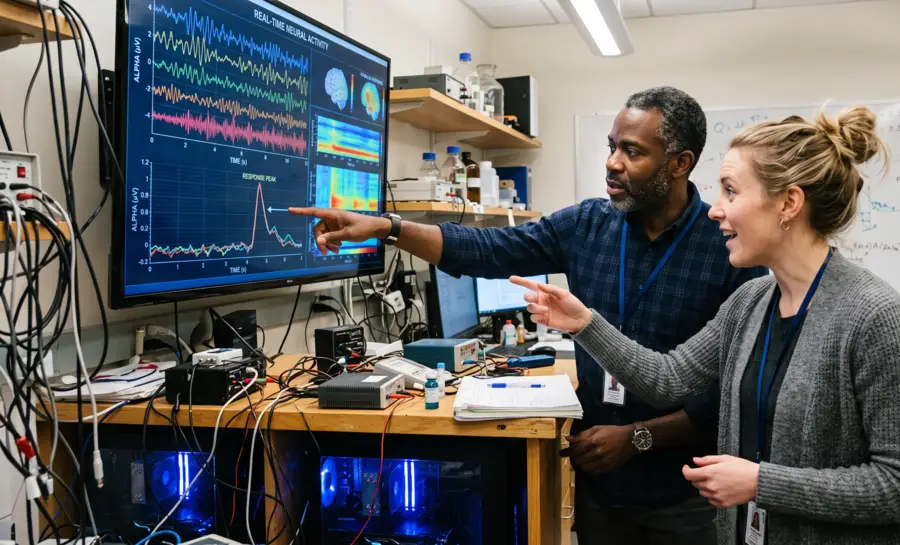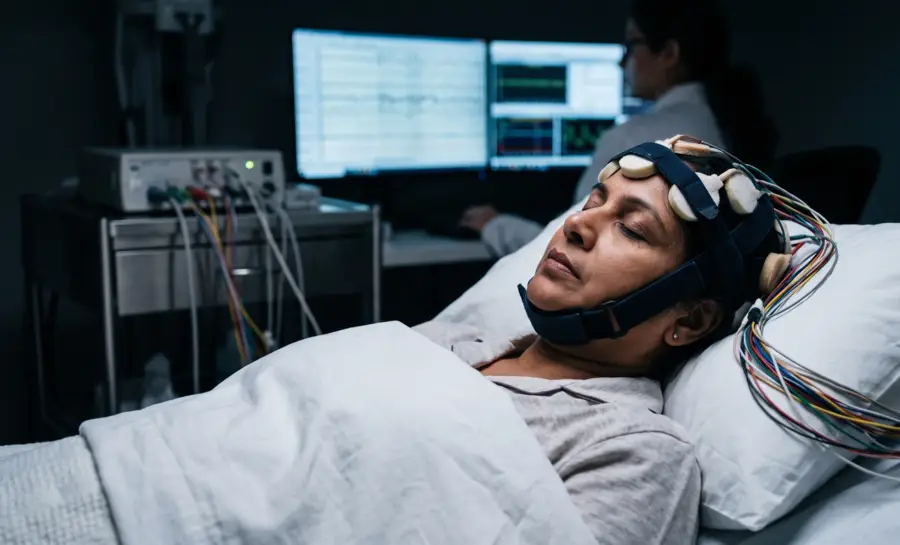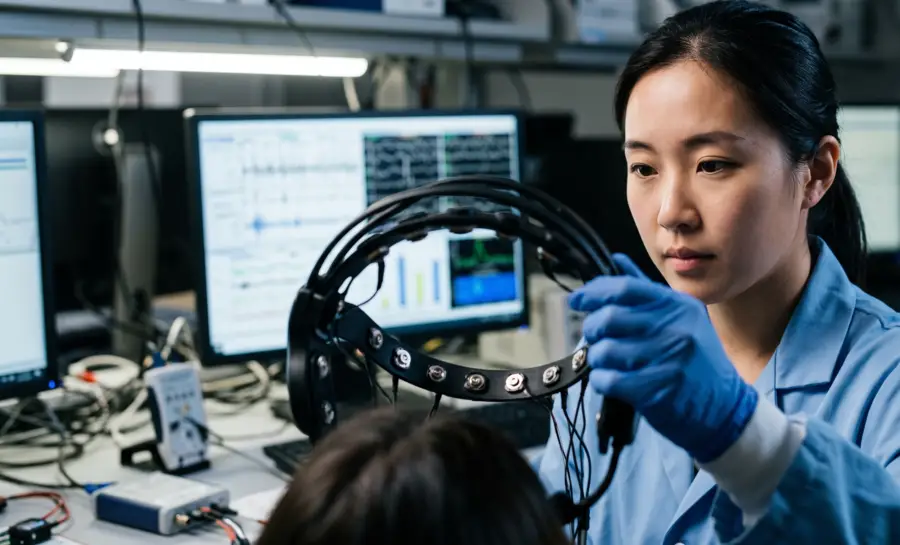
The theta state describes a functional condition in which theta-band activity becomes the dominant mode of communication across widespread brain networks, not just a transient electrical blip in a single region.
This article examines how a theta-dominant brain organizes itself during meditation, hypnosis, and memory encoding.
What Is Theta State?
The phrase theta state generally refers to a mental condition in which theta-range electrical activity becomes more prominent. Brain rhythms are not separate switches that turn consciousness from one mode to another; they overlap, change with context, and vary across people. For that reason, the term is best understood as a descriptive shorthand rather than a precise clinical category.
The Characteristics of the Theta Brainwave
From a neuroscience standpoint, theta activity is often described as slower and more rhythmic than the patterns associated with ordinary alert concentration. In practice, its appearance depends on electrode placement, age, movement, arousal, and the analytical method used. The following overview is therefore a general guide, not a diagnostic reference.
Context | Common subjective description | Important qualification |
|---|---|---|
Drowsiness | Drifting attention or heaviness | Theta may overlap with other sleep-related rhythms |
Dreaming | Vivid imagery or unusual associations | Dream experience cannot be inferred from theta alone |
Meditation | Quiet inward focus | Meditation styles and individual responses differ |
Memory tasks | Retrieval, encoding, or mental organization | The relationship depends on the task and brain region |
This table illustrates why the theta state should not be treated as a single psychological outcome. The same broad frequency range may occur alongside different forms of cognition, and similar feelings of calm may arise without a dominant theta pattern.
Research on theta rhythms in memory and navigation further emphasizes their functional diversity.
Context Matters for Resting vs. Task Theta
A central tension in theta research is what can be called the "theta paradox”. The paradox is that the same frequency band can correlate with opposing cognitive profiles depending entirely on the condition in which it is measured. During an awake, resting state, with no specific cognitive task at hand, elevated theta power in the EEG has the potential to tell a story of developmental difficulty.
A 2024 review integrating developmental EEG research found that higher resting-state theta power is correlated with lower executive functioning, poorer attentional abilities, reduced language skills, and lower IQ in children and adolescents. In this context, the authors argued that a dominant theta rhythm can be a biomarker of cortical inefficiency or maturational lag.
The same review detailed that theta power increases during tasks involving memory encoding, sustained attention, and cognitive control. In these active conditions, that task-related surge in theta power is correlated with better performance, not worse.
A theta state, therefore, carries no inherent value judgment. Its functional meaning is entirely context-dependent. A brain idling in theta at rest is in a profoundly different physiological condition than a brain actively recruiting theta rhythms to support the cognitive work of learning.
Theta Activity During Nondirective Meditation
Meditation offers a clear view into a voluntarily induced theta state, one that differs significantly from simple relaxation.
Research suggests that meditation is a family of practices with its own neurophysiological signature. A review by Rael & John about meditation studies using EEG and neuroimaging reported an overall slowing of the EEG after meditation, with theta and alpha activation linked directly to the proficiency of the practitioner. The neural changes appear to involve shifts in the anterior cingulate cortex and dorsolateral prefrontal areas, regions critical for attention regulation and self-awareness, suggesting that a meditative theta state is an active, engaged process of cognitive reconfiguration.
A study by Lagopoulos et al. on nondirective meditation, a technique where attention is gently and effortlessly held on a repeated sound without forceful concentration, provides concrete evidence of this shift. The study compared 20 minutes of meditation to 20 minutes of simple, quiet rest with eyes closed.
The results reported that theta power was significantly greater during meditation when averaged across the entire brain. Specifically, theta power was significantly higher in the frontal and temporal-central regions compared to the posterior region. Simultaneously, alpha power increased globally but was most pronounced in the posterior region.
This pattern suggests that a nondirective meditation technique can shift the brain into a theta-related state that goes far beyond ordinary relaxation, producing a distinct fronto-central theta dominance that quiet rest, even with eyes closed, does not replicate.
Hypnosis and Theta-Band Connectivity Shifts
The hypnotic state presents a highly instructive model for understanding that a theta state is not always a power problem and that it can be a connectivity problem.
A research study by Jamierson & Burgess investigating the EEG correlates of a hypnotic induction compared individuals with high hypnotic susceptibility to those with low susceptibility. The results showed that the spectral band amplitude did not change significantly between the pre-hypnosis and hypnosis conditions for any frequency band. Instead, the hallmark of the hypnotic state was a reorganization of how brain regions communicated with one another.
Using a precise measure of functional connectivity called the imaginary component of coherence (iCOH), which is less sensitive to volume conduction artifacts, researchers observed that hypnotic induction triggered an increase in theta-band connectivity specifically in the highly susceptible participants. This increase was centered on a central-parietal hub, indicating a core network shift.
Simultaneously, these highly susceptible individuals showed a decrease in connectivity within the beta1 frequency band, focused on fronto-central and occipital hubs. The low-susceptibility participants did not show these connectivity reconfigurations.
These findings suggest that the neurophysiological signature of the “hypnotic state” is a qualitative shift in the functional organization of brain networks, creating a unique pattern of theta-band synchrony alongside a suppression of fast-wave connectivity.
Memory Encoding and Theta State Induction
The theta state can be actively induced from the outside, with direct consequences for memory. A study using transcranial slow oscillation stimulation (tSOS) at a very slow frequency of 0.75 Hz demonstrated a context-dependent brain response.
When this stimulation was applied during deep sleep, it enhanced slow oscillations and the consolidation of memories. When the identical stimulation was applied to an awake brain, the brain reacted differently.
The waking brain responded with a restricted increase in endogenous slow oscillations but exhibited a marked and widespread increase in EEG theta activity. The awake brain effectively transposed the slow external signal into an internal theta state.
On the other hand, applying tSOS during wakefulness after a learning task did not enhance the consolidation of those memories. However, applying tSOS during the learning task itself improved the encoding of hippocampus-dependent memories. It appears as if the induced theta state facilitated the active acquisition of new information. This demonstrates that a brain state characterized by widespread theta activity has the potential to create a functional window for encoding, turning the awake cortex into a receptive medium for hippocampal input.
The Functional Nature of a Theta State
Synthesizing these distinct research threads reveals a consistent, unified concept. A theta state is a global brain condition, an emergent network phenomenon that can be recruited through internal attention as in nondirective meditation, external suggestion as in hypnosis, or direct cortical stimulation. It is not a single waveform event but a mode of distributed neural communication. Its signature can be read in either raw spectral power, as seen in meditation's fronto-central theta increase, or in functional connectivity, as evidenced by the central-parietal theta synchrony of hypnosis, without a change in amplitude.
The functional role of this state is not fixed. It is a platform that is repurposed by the brain depending on its immediate goal. The developmental paradox underscores this: a pervasive resting theta state can correlate with lower cognitive function, suggesting a noisy or immature system. Yet, task-related and induced theta states correlate with better memory encoding and a profound internal focus. The brain in nondirective meditation, the highly susceptible brain in hypnosis, and the waking brain receiving tSOS all converge on a similar theta-dominated configuration, but they use it to different ends: deep passive absorption in one, a receptive network for suggestion in another, and a hippocampal encoding mode in a third.
Individual variation is an inescapable component of this picture. The hypnotic induction did not produce a theta connectivity shift in everyone, only in those with high pre-existing susceptibility. Meditation research associated theta activation with practice proficiency, implying that a reliable theta state is a trainable neurophysiological skill, not a universal reflex. The evidence does not support a blanket claim that all theta states are beneficial. It supports specific associations between context-dependent theta states and specific cognitive or clinical processes. Future research must continue to disentangle theta power from theta connectivity and must clearly distinguish resting theta states from active, task-engaged theta states. A theta-dominant brain is not simply awake or asleep; it is a brain configured for a specific set of internal and mnemonic operations, a distinct mode of cognitive being rather than a single electrical note.
Why Brain-Wide Theta Activity Shapes Learning and Focus
Theta activity can be seen as a brain-wide mode of communication whose meaning shifts with context. The same frequency pattern can mark cortical inefficiency at rest or support memory encoding and deep focus during active tasks.
Meditation, hypnosis, and external stimulation all converge on this state, yet the brain repurposes it toward different cognitive outcomes, from passive absorption to a receptive network for suggestion to a hippocampal encoding mode. Therefore, the functional value of a theta state depends entirely on the conditions that produce it.
Individual variation adds a key layer to this picture, with evidence showing that a reliable theta state is a trainable neurophysiological skill rather than a universal response. A person's ability to shift into theta-dominated configurations hinges on practice proficiency and pre-existing susceptibility.
Treating the theta state as a flexible platform of distributed communication helps explain how one brain rhythm can serve such distinct purposes, while future progress will depend on separating theta power from theta connectivity and resting states from task-engaged ones.
References
Tan, E., Troller-Renfree, S. V., Morales, S., Buzzell, G. A., McSweeney, M., Antúnez, M., & Fox, N. A. (2024). Theta activity and cognitive functioning: Integrating evidence from resting-state and task-related developmental electroencephalography (EEG) research. Developmental Cognitive Neuroscience, 67, 101404. https://doi.org/10.1016/j.dcn.2024.101404
Cahn, B. R., & Polich, J. (2013). Meditation states and traits: EEG, ERP, and neuroimaging studies. https://psycnet.apa.org/doi/10.1037/0033-2909.132.2.180
Lagopoulos, J., Xu, J., Rasmussen, I., Vik, A., Malhi, G. S., Eliassen, C. F., ... & Ellingsen, Ø. (2009). Increased theta and alpha EEG activity during nondirective meditation. The Journal of Alternative and Complementary Medicine: Paradigm, Practice, and Policy Advancing Integrative Health, 15(11), 1187-1192. https://doi.org/10.1089/acm.2009.0113
Jamieson, G. A., & Burgess, A. P. (2014). Hypnotic induction is followed by state-like changes in the organization of EEG functional connectivity in the theta and beta frequency bands in high-hypnotically susceptible individuals. Frontiers in human neuroscience, 8, 528. https://doi.org/10.3389/fnhum.2014.00528
Kirov, R., Weiss, C., Siebner, H. R., Born, J., & Marshall, L. (2009). Slow oscillation electrical brain stimulation during waking promotes EEG theta activity and memory encoding. Proceedings of the National Academy of Sciences, 106(36), 15460-15465. https://doi.org/10.1073/pnas.0904438106
Frequently Asked Questions
What is the difference between a theta wave and a theta state?
A theta wave is a single oscillation in a specific EEG frequency band, while a theta state is a global condition where theta-band activity becomes the dominant communication mode across widespread brain networks. The state can appear as increased theta power or as increased theta-band connectivity between distant regions, even without a power change.
Why is theta sometimes linked to poor cognition and sometimes to better performance?
This is the theta paradox: the same frequency band has opposite meanings depending on context. At rest, elevated theta power is associated with lower executive function and attention in children, but during tasks involving memory encoding and attention, increases in theta are associated with better performance.
How does theta activity during nondirective meditation differ from simple rest?
Meditation produces a distinct fronto-central theta dominance that quiet rest with eyes closed does not replicate. Compared to rest, meditation shows greater theta power overall, especially in frontal and temporal-central regions, while alpha power is more posterior.
Does hypnosis involve an increase in theta power?
No, the hallmark of hypnosis is not a raw increase in theta power; spectral amplitude did not change. Instead, hypnotic induction increases theta-band connectivity among brain regions in highly susceptible people, centered on a central-parietal hub, while decreasing beta connectivity.
What is the functional role of a theta state?
A theta state is a flexible platform that the brain repurposes depending on the immediate goal. It can support deep passive absorption in meditation, a receptive network for suggestion in hypnosis, or a hippocampal encoding mode during learning, rather than having a single fixed function.
Why do some people show a theta-state response to hypnosis and others do not?
Individual variation, such as pre-existing hypnotic susceptibility, determines whether a person's brain reconfigures its theta connectivity during induction. Meditation research similarly links theta activation to practice proficiency, suggesting that a reliable theta state is a trainable neurophysiological skill rather than a universal reflex.
Emotiv is a neurotechnology leader helping advance neuroscience research through accessible EEG and brain data tools.
Medical Disclaimer: The information provided on this website is for educational and informational purposes only and is not intended as medical or health advice. This content may contain errors and should not be relied upon to make life-altering health, medical, or lifestyle choices. Always seek the advice of your physician or other qualified health provider with any questions you may have regarding a medical condition or treatment.
Christian Burgos