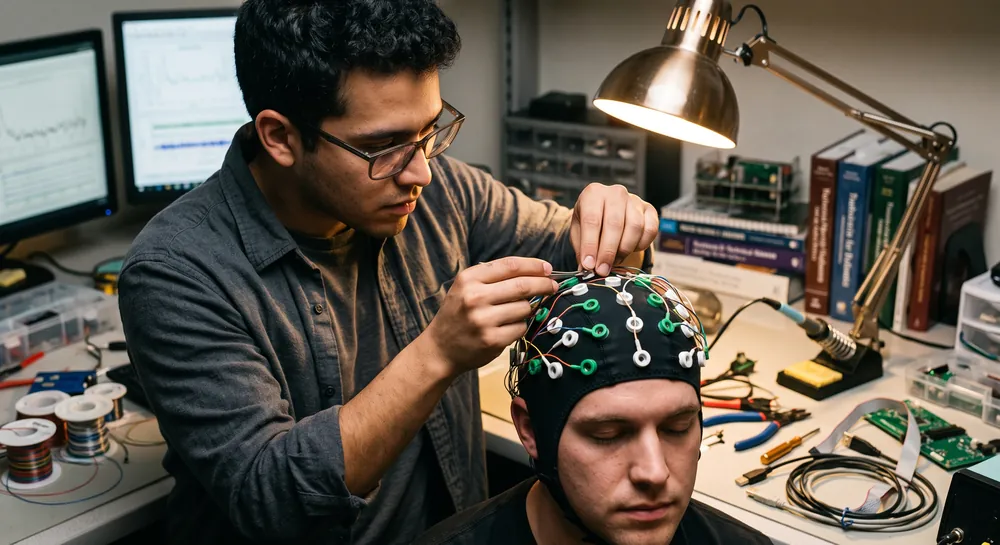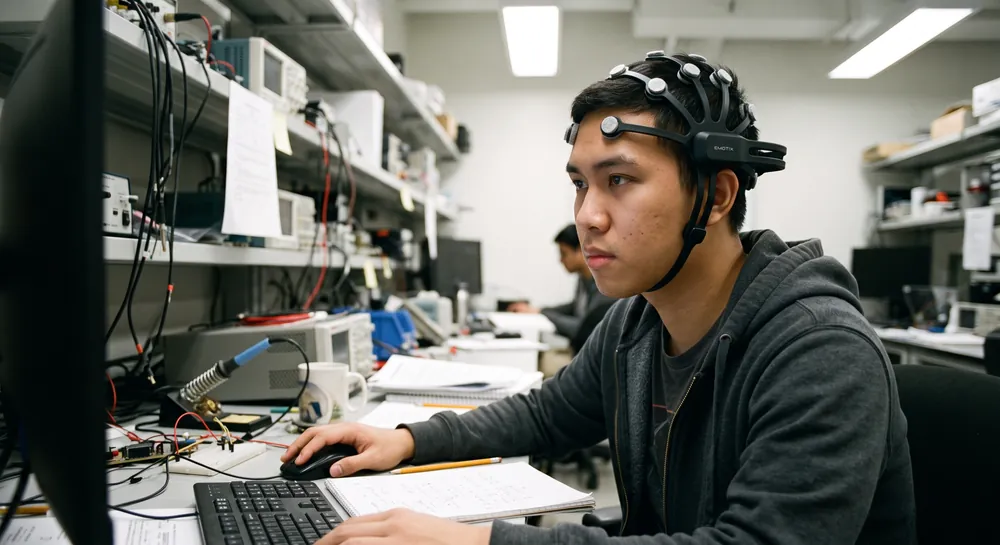
A PCI data acquisition (DAQ) controller is the interface that samples analog biosignals, such as EEG, at high speed, converts them into digital values, and in some designs performs a first pass of digital processing before the data ever reaches analysis software.
This article stays at that hardware layer. It covers sampling rate, amplitude resolution, bus communication latency, and onboard preprocessing capability.
What is a PCI Data Acquisition and Signal Processing Controller?
This specialized hardware component functions as a critical bridge between internal computer components and external electrical signal sources. It translates the high-speed data streams required in modern computing into a format that the central processor understands and can manipulate effectively.
By managing the flow of electrical pulses, this controller ensures that raw, unfiltered input does not overwhelm system memory or compromise data integrity, allowing for precise control in specialized diagnostic or industrial environments.
Understanding Data Acquisition (DAQ)
Data acquisition involves the scientific process of sampling signals from the real world and converting them into numerical representations that a computer can store and analyze.
In the realm of neuroscience, this requires high-fidelity capture of extremely subtle voltage fluctuations. Dedicated boards or integrated subsystems perform this task by sampling inputs at specific, high-frequency intervals, ensuring that the captured information accurately reflects the original electrical activity without introducing significant noise or distortion.
Understanding Signal Processing
Signal processing encompasses the mathematical and computational operations applied to raw acquired data to extract meaningful patterns or reduce unwanted artifacts. Once a signal is digitized, the controller or its associated software may apply filters to strip away electrical interference.
This stage is vital for the clarity of an EEG, as it separates genuine brain activity from background environmental noise, thereby enhancing the interpretability of the results for clinicians and researchers.
The Role of the PCI Interface
Peripheral Component Interconnect (PCI) technology provides a standardized, high-speed communication path between hardware peripherals and the computer motherboard. This bus architecture ensures low latency and high bandwidth, which are non-negotiable requirements for systems handling large volumes of incoming electrical data.
By providing direct access to the system memory and processing architecture, the PCI interface minimizes the delays that would otherwise hinder the rapid analysis required in real-time monitoring applications.
How a PCI DAQ Controller Converts Analog Brain Signals to Digital Data
Neural signals recorded at the scalp are tiny. EEG voltage fluctuations sit in the microvolt range, thousands of times smaller than the voltage running through a household battery.
Before any of that signal can become usable data, it has to be amplified, filtered to remove obvious noise, and then digitized, meaning converted from a continuously varying voltage into a sequence of discrete numeric values a computer can store and manipulate.
A PCI slot gives the acquisition card a direct, high-speed path into the computer's own internal bus system, the set of electrical pathways that the chipset uses to move data between components. This is different from plugging in an external USB or Ethernet-based recorder, which has to package data into serial packets and pass it through additional software layers before it reaches memory. The PCI route is popularly claimed to reduce timing jitter, small unpredictable delays in when each sample actually gets timestamped and stored, because the data moves with less software mediation.
Whether that theoretical advantage always translates into a measurable difference is a separate question. For instance, a 2020 study describes OpBox, an open-source acquisition system that uses standard off-the-shelf components and a MATLAB-based interface to record EEG and EMG simultaneously from multiple rodent subjects. When directly compared against two commercial amplifiers, OpBox performed comparably in signal-to-noise ratio, noise floor, and common-mode rejection (a measure of how well a system cancels out electrical noise that affects all channels equally).
This is a useful data point precisely because it shows that carefully engineered acquisition hardware can reach lab-grade quality without relying on proprietary PCI-specific validation. The conversion from analog to digital, in other words, can be executed well through more than one architectural path.
Sampling Rate: Capturing Rapid Brain Dynamics
Sampling rate describes how many times per second the DAQ controller measures the incoming voltage and records it as a number.
The Nyquist criterion, a fundamental principle in signal processing, dictates that to accurately capture a signal without distortion, the sampling rate must be at least twice the frequency of the fastest oscillation of interest. Undersample a signal and you get aliasing, where fast oscillations get misrepresented as slower, false patterns in the recorded data.
Most EEG activity of research interest falls below 100 Hz, though some specialized work looks at higher-frequency oscillations. In practice, sampling rates between 250 and 1000 samples per second are standard in research-grade EEG systems. Higher sampling rates are generally claimed to better preserve fast transient events and high-frequency rhythms, since a denser stream of samples leaves less room for information to fall between measurement points.
Amplitude Resolution: The Fineness of Voltage Measurement
Sampling rate governs timing. Resolution governs how finely each sample's voltage value is measured.
An analog-to-digital converter with a bit-depth of N divides the full voltage range it can measure into 2^N discrete steps. A 16-bit converter offers 65,536 possible levels; a 24-bit converter offers over 16 million. Common EEG acquisition cards use one of these two standards.
Moreover, higher resolution reduces quantization noise, the small rounding error introduced whenever a continuous signal gets forced into a fixed number of discrete steps. This becomes particularly relevant when a recording contains both large baseline voltage shifts and small, meaningful signal features riding on top of them, since higher resolution helps preserve those smaller details without them being swallowed by rounding error.
That said, the practical benefit of higher resolution in typical EEG work is debated, because the dominant source of noise in a real recording is frequently physiological (muscle activity, eye movement) or environmental (electrical interference from nearby equipment) rather than a limitation of the converter itself.
A study by Juárez-Aguirre et al. offers a relevant, though indirect, illustration. It describes a DAQ card paired with digital filtering used to extract respiratory magnetograms from a MEMS-based magnetic field sensor, producing signal traces that resembled EMG recordings.
This demonstrates that adequate resolution, combined with appropriate filtering, can successfully extract meaningful physiological detail from a weak biosignal.
Bus Communication and Latency: Why the PCI Interface Matters
The PCI bus operates as a high-bandwidth, low-latency parallel communication channel governed directly by the computer's chipset. Contrast this with serial protocols like USB or Ethernet, which typically buffer data, meaning they hold small batches of samples temporarily before sending them, introducing delay that can be small but is often less predictable.
In closed-loop experiments, where a stimulus or corrective signal must be delivered within milliseconds of detecting a specific brain event, this kind of unpredictable delay can undermine the entire protocol.
Low and deterministic latency (delay that is both small and consistent, rather than variable) is frequently cited by hardware manufacturers and researchers as essential infrastructure for this kind of work. A study testing a RTXI platform stated that it was explicitly built to achieve “hard real-time” closed-loop control, a category of system design where missing a timing deadline is treated as a failure condition rather than a minor inconvenience. Its architecture assumes that the DAQ hardware feeding it data can deliver samples with minimal and predictable delay.
Furthermore, a 2013 research study provided a working example of a closed-loop system in action: an assisted SSVEP-based brain-computer interface that adapts its stimulus flicker frequencies in real time based on the subject's ongoing brain response. This protocol significantly outperformed classic, non-adaptive control paradigms across 18 subjects.
Real-Time Preprocessing on the Controller
Some PCI DAQ boards include onboard digital signal processors (DSPs) or field-programmable gate arrays (FPGAs), specialized chips capable of running filtering, decimation (reducing the sample rate after initial high-speed capture), or basic feature extraction directly on the card, before data ever reaches the host computer's main processor.
The claimed advantage is twofold: reducing the workload on the host CPU, and tightening the timing of closed-loop systems by handling simple computations closer to the point of data collection.
A study published in the journal of Computational and Mathematical Methods in Medicine offers a concrete demonstration of real-time digital processing feasibility, though at the host software level rather than on a dedicated onboard chip.
Researchers built a DAQ-device-based functional near-infrared spectroscopy (fNIRS) system, a neuroimaging method that tracks blood oxygen changes linked to brain activity using light rather than electrical signals. The system used digital in-phase and quadrature demodulation, a signal processing technique for separating overlapping light source signals, implemented in LabVIEW software.
When measured against a commercial fNIRS instrument during a physiological stress test (the Valsalva maneuver), the custom system's output correlated strongly with the commercial device: r \= 0.92 for the lower wavelength and r \= 0.84 for the higher wavelength, both statistically significant (P \< 0.01). In a separate mental arithmetic task, the system detected significant activation in the prefrontal cortex in the majority of nine participants.
Additionally, Juárez-Aguirre's magnetic field sensor system similarly applied digital infinite impulse response (IIR) filtering, a standard filter design implemented through software-based “virtual instrumentation,” to suppress electromagnetic interference in real time and produce clean physiological traces.
Both studies confirm that real-time digital processing, executed through standard DAQ hardware and host software, can replicate or approach commercial-grade performance.
Putting It Together: A Typical EEG Acquisition Chain
A full signal path through this system typically runs as follows:
Electrodes capture microvolt‑level signals; an amplifier boosts the weak signal to a measurable range.
An anti‑aliasing filter strips out frequencies beyond the Nyquist limit to prevent digitization artifacts.
The PCI DAQ controller converts the continuous analog signal into discrete numeric values at a set sampling rate and bit‑depth.
Optional onboard DSP or FPGA can perform real‑time preprocessing such as filtering or feature extraction before data reaches the host.
Data moves via direct memory access across the PCI bus into the host computer’s memory, where downstream analysis software takes over.
Why PCI Hardware Remains a Hypothesis, Not a Guarantee
The PCI data acquisition and signal processing controller functions as the engine that converts fragile analog brain signals into a stable digital data stream. Its core specifications, sampling rate, bit-depth, bus latency, and onboard processing capacity, form the physical foundation that every later stage of EEG analysis and closed-loop neurotechnology depends on.
The studies reviewed here confirm that DAQ-based systems can achieve high-quality recordings, as shown by OpBox's amplifier performance and the fNIRS system's strong correlation with a commercial instrument, and that they can support responsive real-time experiments, as shown by RTXI's closed-loop architecture and the adaptive SSVEP-BCI's improved performance over classic paradigms. None of these studies, however, directly test the marginal benefit of PCI-specific bus architecture over alternative interfaces such as USB or Ethernet-based acquisition.
For anyone approaching this topic for the first time, the practical lesson is one of calibrated confidence. PCI controllers represent a genuinely enabling technology behind modern electrophysiology research and EEG-based applications. Their specific advantages, though, should be treated as engineering hypotheses that guide reasonable design choices, not as settled facts.
Closing that gap will require studies that isolate individual hardware variables directly, rather than evaluating complete systems as a whole.
How Hardware Fidelity Supports a Fuller Picture of the Brain
The quiet work of a PCI controller reveals a central truth in brain measurement: the richness of the final picture depends directly on the integrity of the initial translation from biology to bits.
A high sampling rate and fine voltage resolution serve as the scaffolding that allows fast rhythms and tiny signals to survive the journey from scalp to screen, meaning researchers can trust that the data they analyze still carries the texture of real neural activity. The direct bus connection further supports this by shrinking the unpredictable delays that would otherwise blur the timeline of a thought. These hardware choices form a foundational support system, elevating a raw, fragile signal into a stable stream that complex studies can safely build upon.
The bigger insight is that excellent brain data is achievable through more than one design philosophy, as shown by open-source systems matching commercial benchmarks without proprietary hardware. This shifts the conversation from a narrow focus on one superior component to a broader appreciation for engineering integrity, where the entire chain works in concert to respect the signal’s original form.
For the wider world of health and human performance, this means expanding access to reliable neurotechnology becomes a question of practical design optimization, not an exclusive reliance on a single hardware path. The controller’s performance, then, is less a final answer and more a critical, supportive pathway for exploring the body’s most complex conversation.
References
Kimchi, E. Y., Coughlin, B. F., Shanahan, B. E., Piantoni, G., Pezaris, J., & Cash, S. S. (2020). OpBox: Open source tools for simultaneous EEG and EMG acquisition from multiple subjects. Eneuro, 7(5). https://doi.org/10.1523/ENEURO.0212-20.2020
Juárez-Aguirre, R., Domínguez-Nicolás, S. M., Manjarrez, E., Tapia, J. A., Figueras, E., Vázquez-Leal, H., ... & Herrera-May, A. L. (2013). Digital signal processing by virtual instrumentation of a MEMS magnetic field sensor for biomedical applications. Sensors, 13(11), 15068-15084. https://doi.org/10.3390/s131115068
Patel, Y. A., George, A., Dorval, A. D., White, J. A., Christini, D. J., & Butera, R. J. (2017). Hard real-time closed-loop electrophysiology with the Real-Time eXperiment Interface (RTXI). PLoS computational biology, 13(5), e1005430. https://doi.org/10.1371/journal.pcbi.1005430
Fernandez-Vargas, J., Pfaff, H. U., Rodríguez, F. B., & Varona, P. (2013). Assisted closed-loop optimization of SSVEP-BCI efficiency. Frontiers in neural circuits, 7, 27. https://doi.org/10.3389/fncir.2013.00027
Xu, G., Li, X., Li, D., & Liu, X. (2014). A DAQ-device-based continuous wave near-infrared spectroscopy system for measuring human functional brain activity. Computational and mathematical methods in medicine, 2014, 107320. https://doi.org/10.1155/2014/107320
Frequently Asked Questions
What does a PCI data acquisition controller do?
It samples analog brain signals, like EEG, at high speed and converts them into digital numbers. It may also perform initial digital processing before the data reaches analysis software.
Why choose a PCI connection over USB or Ethernet for brain signal recording?
A PCI slot provides a direct, high-speed internal path to the computer’s bus, potentially reducing timing jitter and unpredictable delays. This can matter for experiments demanding precise, real-time reactions.
How does sampling rate affect EEG data quality?
Sampling rate determines how often the voltage is measured; insufficient rates can cause fast oscillations to be misrepresented as false slower patterns. Standard EEG research uses rates from 250 to 1000 samples per second to capture relevant brain dynamics.
What is amplitude resolution and why is bit-depth important?
Amplitude resolution is how finely each voltage sample is divided into discrete steps, determined by bit-depth. Higher bit-depth reduces quantization noise, but real-world recordings are often limited more by physiological or environmental noise.
How does bus latency impact closed-loop brain-computer interfaces?
Low and predictable latency ensures the system can react within milliseconds of detecting a brain event, which is critical for real-time feedback. The PCI bus’s direct architecture helps minimize variable delays compared to buffered serial connections.
Can a PCI controller process signals in real-time on the card itself?
Some cards include onboard processors or FPGAs that can filter or extract features directly, reducing the load on the computer’s main processor. However, real-time processing done on the host computer can also achieve comparable results.
Emotiv is a neurotechnology leader helping advance neuroscience research through accessible EEG and brain data tools.
Medical Disclaimer: The information provided on this website is for educational and informational purposes only and is not intended as medical or health advice. This content may contain errors and should not be relied upon to make life-altering health, medical, or lifestyle choices. Always seek the advice of your physician or other qualified health provider with any questions you may have regarding a medical condition or treatment.
Christian Burgos