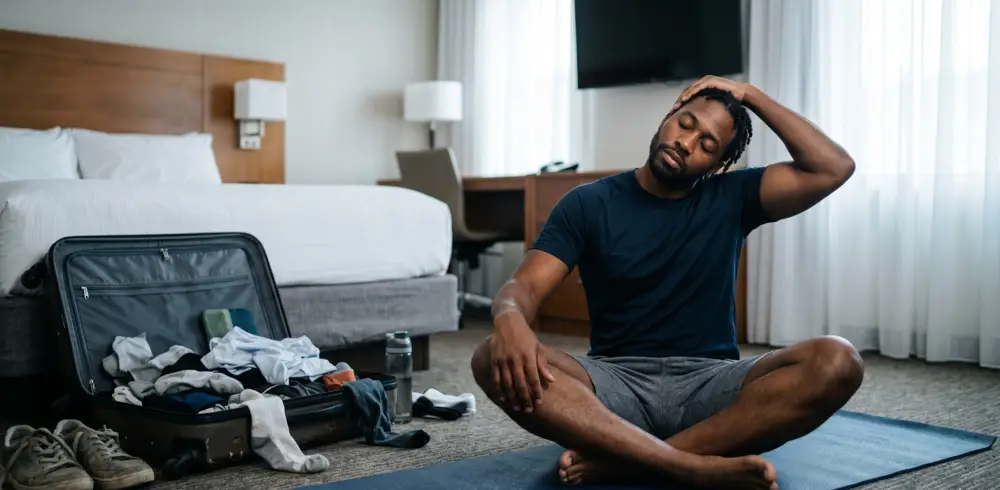
Yoga can be a powerful tool for managing everyday stress. By focusing on movement, breath, and awareness, you can cultivate a sense of calm and well-being.
How Yoga Helps Relieve Stress
Yoga offers a multifaceted approach to managing stress by integrating physical movement, breath control, and mental focus. This practice works on several levels to counteract the body's stress response.
The Mind-Body Connection
Stress often manifests physically, leading to muscle tension and discomfort. Yoga encourages a heightened awareness of the body, allowing people to notice where tension is held.
By moving through poses, practitioners can gently release this tightness, particularly in areas like the neck, shoulders, and back, which commonly store stress. This increased body awareness can lead to a more compassionate response to one's own physical sensations.
The practice also promotes the release of endorphins, which are natural mood boosters that can positively influence how stress is managed.
Breathing Techniques (Pranayama)
Controlled breathing, or pranayama, is a core component of yoga that directly impacts the nervous system.
Slow, deep breaths can help shift the body from a state of heightened alert (sympathetic nervous system activation) to a state of rest and digestion (parasympathetic nervous system activation). Focusing on the breath during practice can also serve as an anchor, drawing attention away from stressful thoughts and into the present moment.
This practice can be applied off the mat, too; using breath awareness during challenging situations can help in managing reactions.
Physical Poses (Asanas)
Yoga poses, or asanas, are designed to stretch and strengthen the body. Beyond the physical benefits of increased flexibility and mobility, the deliberate movements in yoga help to release stored physical tension.
When performed with mindful attention to the breath and body, these postures can help to calm the mind. The physical exertion, combined with focused breathing, can lead to a sense of physical and mental release.
Meditation and Mindfulness
Yoga inherently cultivates mindfulness by encouraging practitioners to stay present with their physical sensations, breath, and thoughts without judgment. This focus on the 'here and now' helps to interrupt cycles of worry about the past or future, which are common drivers of stress.
Regular practice can improve concentration and the ability to observe thoughts and feelings as temporary experiences, making it easier to let go of attachments and cultivate a greater sense of inner calm and emotional balance.
Which Style of Yoga Is Most Effective for Your Type of Stress?
The person grinding through a high-pressure work week, vibrating with mental restlessness and unable to sit still, is experiencing a fundamentally different physiological state than the person who has hit month four of exhaustion so deep they can barely get off the couch.
Both might be told to "try yoga." Both might walk into the wrong class and feel worse for it.
This is the problem with treating yoga as a monolithic prescription. The term covers an enormous range of practices, from sweat-drenched, fast-paced flows to practices where you lie draped over bolsters for forty-five minutes without moving.
Each style acts on the nervous system through a different mechanism. Matching that mechanism to your specific stress profile is not just a matter of preference. It is the difference between a practice that genuinely recalibrates your system and one that either bores you into inaction or pushes you further into dysregulation.
How Do Active, Dynamic Yoga Practices Address Stress?
There is a category of yoga student who sits down to meditate and finds the stillness genuinely unbearable. The anxiety does not quiet when the body stops moving. It amplifies.
For this person, a passive, gentle class is generally not the therapeutic entry point, at least not initially.
Yang-style practices like Vinyasa and Ashtanga work with the body's stress energy rather than against it. When the sympathetic nervous system is chronically activated, cortisol and adrenaline build up in the bloodstream with nowhere productive to go.
Sustained, rhythmic physical effort has the potential to metabolize these stress hormones. The cardiovascular demand of a vigorous Vinyasa sequence, for instance, gives the body the physical output that its biochemistry was preparing for.
When Is a Vinyasa Flow Best for Processing Agitation and Restlessness?
Vinyasa is distinguished by the direct synchronization of breath with movement. Every transition is anchored to either an inhale or an exhale, which forces the prefrontal cortex, the brain's executive control region, to stay engaged with the present moment.
You cannot plan tomorrow's to-do list when your attention must track breath, balance, and body position simultaneously.
This is why Vinyasa functions as a form of active meditation. The mental chatter that thrives in the background of ordinary activity has no bandwidth left to run. The restlessness that makes sitting still feel impossible is channeled into movement that is purposeful and sequenced, which transforms scattered, anxious energy into directed, focused effort.
For someone experiencing the jittery, high-frequency stress of acute anxiety or deadline pressure, this absorption of cognitive resources is often what the nervous system needs.
When Are Passive, Meditative Yoga Practices More Appropriate for Stress?
For this stress profile, adding more intensity is counterproductive. Vigorous exercise can feel like a punishment, and even mild exertion may spike cortisol in a system that is already running on empty.
Usually, the appropriate intervention targets the parasympathetic nervous system directly, not by demanding physical output but by creating the precise conditions under which the body's own recovery systems can activate without obstruction.
Yin and Restorative yoga are designed to do exactly this.
Why Is Yin Yoga Suited for Unraveling Deep-Seated Physical Tension?
Yin Yoga operates on a different tissue system than most movement practices. Where yang-style yoga primarily engages muscle tissue, which is elastic and responds to dynamic loading, Yin targets the body's connective tissue network: the fascia, ligaments, tendons, and joint capsules that provide structural integrity to the skeleton.
These tend to require long, sustained, low-intensity loading rather than short, repetitive contractions. Yin poses are held for three to seven minutes each in a completely passive, relaxed state. The muscle is allowed to release so that the underlying connective tissue can receive the gentle compressive or tensile load.
The prolonged holds of Yin Yoga apply the specific mechanical stimulus needed to initiate a remodeling response in this connective tissue, gradually releasing tensions that ordinary movement never touches.
Moreover, the meditative dimension of Yin is inseparable from the physical. Holding a pose for five minutes in a non-effortful way forces a direct encounter with physical sensation and psychological discomfort.
Learning to remain present with intensity without reacting, without fidgeting or contracting, trains the same capacity that underpins mindfulness: equanimity in the face of difficulty. This quality is among the most transferable skills in stress management.
How Does Restorative Yoga Support Recovery From Neurological Burnout?
Restorative Yoga removes effort from the equation entirely. Poses are constructed using an extensive array of props, bolsters, blankets, blocks, and straps, so that every part of the body is fully supported and no muscular engagement is required to maintain position. The practitioner's only task is to remain still and breathe.
This matters neurologically because any residual muscular effort maintains a low-level activation of the sympathetic nervous system. The body interprets sustained muscle tone as readiness, a signal that the environment may still require action. By eliminating that tone through complete physical support, Restorative Yoga has the potential to remove the final layer of physiological holding that prevents deep parasympathetic activation.
The result is often a measurable shift toward the rest-and-digest state:
Heart rate slows
Respiratory rate deepens and lengthens
Blood is redirected from the limbs toward the digestive and immune systems
The release of the neurotransmitter acetylcholine, the primary signaling molecule of the parasympathetic system, increases.
Restorative Yoga is one of the most direct interventions available for the kind of neurological exhaustion that characterizes burnout, and it connects directly to the broader evidence base for brain health through adequate nervous system recovery.
What Is the Role of Somatic Yoga in Releasing Trauma-Related Stress?
Somatic Yoga is organized entirely around internal sensory awareness. The movement is slow, often barely visible, and guided entirely by the practitioner's felt sense of what is happening inside the body.
The foundational theory is that traumatic stress, whether from a single acute event or accumulated across a lifetime of chronic threat, is held in the neuromuscular system as habitual, unconscious contraction patterns.
Somatic approaches address these patterns through a process called pandiculation, the conscious contraction and slow, controlled release of muscle groups, which resets the sensory-motor feedback loop between the muscles and the brain's motor cortex.
Unlike stretching, which works against muscular tension from the outside, pandiculation works with the contraction first before releasing it. This re-teaches the neuromuscular system what voluntary, full release actually feels like.
Critically, Somatic Yoga is designed to stay beneath the threshold of reactivation. Moving too quickly, too deeply, or too intensely into traumatically held tissues can trigger a flood of stress hormones, replicating the original overwhelm response.
How Can a Hatha Practice Offer a Balanced Approach for General Stress Management?
When the stress is neither acute crisis nor chronic depletion but the grinding, pervasive pressure of ordinary life, Hatha yoga occupies a useful middle position in the spectrum.
Classical Hatha moves through individual poses held for several breaths each, with deliberate attention to alignment and breath. The pace is slower than Vinyasa but more physically active than Yin or Restorative.
This moderate intensity creates a physiological state that supports both muscular engagement and genuine nervous system settling within a single session. The body is asked to work, but not so hard that recovery becomes the dominant need afterward.
For someone managing general, everyday stress without a specific diagnosis of anxiety disorder, trauma history, or clinical burnout, a consistent Hatha practice is among the most sustainable starting points.
The moderate physical challenge maintains engagement and builds genuine strength, while the structural emphasis and breath focus deliver the autonomic benefits that more passive practices provide in other ways.
How Should You Blend Styles for a Comprehensive Stress Management Strategy?
No single yoga style addresses every dimension of stress simultaneously.
Vinyasa processes acute sympathetic activation but does little for fascial tension.
Yin releases deep tissue holding but does not build the resilience that comes from challenging physical effort.
Restorative drops the nervous system into deep recovery but offers no metabolic benefit.
Using multiple styles across a week, deliberately chosen to address different aspects of your stress load, can be more effective than any single practice pursued in isolation.
A functional weekly structure might anchor dynamic, yang-style practice to the days when sympathetic arousal is highest and cognitive focus is needed, typically midweek during peak work demands, and schedule Yin or Restorative sessions on recovery days, evenings, or the end of the week when the nervous system needs the most restoration. Hatha can fill transitional days, offering a moderate bridge between intensity and recovery.
Practice Type | Primary Purpose | Best Timing |
|---|---|---|
Active (Yang) | Process stress energy | High arousal, workdays |
Passive (Yin) | Activate recovery | Evenings, rest days |
Hatha | Build balanced resilience | Transitional days |
Summary
Yoga offers a holistic approach to managing stress by connecting the body, mind, and breath. By incorporating simple poses, mindful breathing, and moments of quiet reflection into your routine, you can build resilience against daily pressures.
Explore different techniques to find what best suits your needs, and enjoy the journey toward a more balanced and peaceful life.
References
Miyoshi, Y. (2019). Restorative yoga for occupational stress among Japanese female nurses working night shift: Randomized crossover trial. Journal of occupational health, 61(6), 508-516. https://doi.org/10.1002/1348-9585.12080
Criswell Hanna, E. (2026). Somatic psychotherapy. https://doi.org/10.1037/0000432-016
Frequently Asked Questions
Which style of yoga is best if I feel too restless and anxious to sit still?
Vinyasa yoga works well for this state because it channels scattered, anxious energy into purposeful movement synchronized with breath. The mental focus required to track breath, balance, and body position leaves no bandwidth for racing thoughts, effectively transforming agitated energy into focused effort.
Why does a physically intense class help some types of stress but not others?
Active practices like Vinyasa work by helping your body physically complete the stress response, metabolizing built-up cortisol and adrenaline through sustained effort. However, if your stress has already progressed into deep exhaustion and burnout, adding more intensity can be counterproductive and push a depleted system further into dysregulation.
When should I choose a completely passive practice like Restorative yoga?
Restorative yoga is the most direct intervention for the kind of neurological exhaustion that defines burnout, where you feel profoundly fatigued and emotionally numb. By using props to completely support the body and eliminate all muscular effort, it removes the final layer of physical holding that prevents deep nervous system recovery.
How does Yin Yoga release stress differently from a stretching class?
Yin Yoga targets the body’s connective tissue network, like fascia, which stores chronic tension and emotional armoring in the form of physical restriction. The practice releases these deep-seated tensions by applying long, sustained, passive holds to poses for several minutes, a stimulus that initiates a remodeling response in tissues that ordinary movement never reaches.
What makes Somatic Yoga a unique tool for trauma-related stress?
Somatic Yoga is organized around internal sensory awareness and uses a process called pandiculation to reset the brain’s feedback loop with chronically contracted muscles. Crucially, its deliberate slowness is designed to keep the nervous system within a safe window of tolerance, allowing tension to be released without triggering a new flood of stress hormones.
Is there a balanced yoga style for managing general, everyday life pressure?
Hatha yoga occupies a useful middle ground, with a moderate pace and held poses that support both muscular engagement and nervous system settling. Its focus on postural alignment builds awareness of where you habitually hold tension, offering a sustainable and cumulative approach to loosening these default patterns over time.
Can I just do one style of yoga every day for all my stress?
No single style addresses every dimension of stress, and exclusively using one can break down essential recovery cycles by either depleting your system or reducing your resilience to challenge. A more effective strategy blends different practices across your week, deliberately alternating between active, resilience-building sessions and passive, restorative ones.
Emotiv is a neurotechnology leader helping advance neuroscience research through accessible EEG and brain data tools.
Medical Disclaimer: The information provided on this website is for educational and informational purposes only and is not intended as medical or health advice. This content may contain errors and should not be relied upon to make life-altering health, medical, or lifestyle choices. Always seek the advice of your physician or other qualified health provider with any questions you may have regarding a medical condition or treatment.
Christian Burgos