The human capacity to attribute mental states—beliefs, desires, intentions, emotions, and knowledge—to oneself and others represents one of the most sophisticated achievements of cognitive development. This ability, known as Theory of Mind (ToM), forms the foundation of social interaction, moral reasoning, and complex communication.
Unlike other cognitive abilities that emerge gradually, ToM follows a remarkably consistent developmental trajectory across cultures, suggesting deep biological constraints on its emergence.
How Does the Human Brain Develop the Capacity to Understand Other Minds?
The neuroscience underlying the capacity to understand other minds reveals a distributed network of brain health systems that mature at different rates throughout childhood and adolescence.
Recent research has identified specific neural circuits that support different components of social understanding, from basic gaze-following in infancy to sophisticated perspective-taking in adulthood.
These findings reveal that ToM is a combination of related capacities that emerge through the interplay of genetic programming and social experience.
What Are the Key Developmental Milestones for Theory of Mind in Childhood?
The developmental trajectory of Theory of Mind unfolds through a series of predictable milestones that reflect the maturation of underlying neural systems.
This progression begins in the first months of life with basic social orienting behaviors and culminates in adolescence with the full capacity for complex social reasoning.
How Do Infants First Begin to Discern Intentionality and Gaze?
The earliest precursors to Theory of Mind appear within the first year of life through joint attention behaviors and the perception of goal-directed actions.
Infants as young as three months demonstrate preferential looking toward faces and eyes, suggesting an innate bias toward socially relevant stimuli. By six months, babies begin to follow adult gaze direction, marking the emergence of shared attention—a foundational skill for later social cognition.
The capacity to perceive intentionality in others' actions emerges around nine to twelve months. Landmark studies by Amanda Woodward demonstrated that infants at this age can distinguish between goal-directed reaching movements and accidental contact with objects.
When habituated to an actor reaching for a specific toy, infants show renewed interest when the actor reaches for a different object in the same location, but not when the same object appears in a new location. This pattern suggests that infants understand actions in terms of goals rather than mere physical movements.
At What Stage Do Children Typically Master First-Order False-Belief Tasks?
The most dramatic transition in Theory of Mind development occurs around age four, when children master first-order false-belief understanding. This cognitive leap represents the ability to predict behavior based on what someone else believes to be true, even when that belief contradicts reality.
The classic "Sally-Anne" task illustrates this milestone: Sally places a marble in her basket and leaves the room. While she is gone, Anne moves the marble to her box. When Sally returns, children must predict where she will look for her marble.
Three-year-olds consistently predict that Sally will look in the correct location (Anne's box), demonstrating their difficulty understanding that Sally's outdated belief will guide her behavior. Four-year-olds reliably predict that Sally will look in the original location, showing they can represent Sally's false belief about the marble's location.
This developmental shift occurs with remarkable consistency across cultures and languages, despite variations in social practices and child-rearing approaches. The universality of this timing suggests that biological constraints, rather than simply cultural learning, drive this cognitive transition.
When Does Second-Order ToM and Understanding of Complex Social Norms Emerge?
The capacity for second-order Theory of Mind—understanding nested mental states like "John thinks that Mary believes the toy is in the box"—typically emerges between ages five and six.
This advanced form of perspective-taking requires children to track multiple layers of mental representation simultaneously, placing significant demands on working memory and executive control systems.
Children's growing facility with second-order ToM enables them to understand more sophisticated social phenomena, including deception, white lies, and social conventions. The ability to recognize that people can hold beliefs about beliefs allows children to navigate complex social hierarchies and understand concepts like reputation, gossip, and alliance formation.
Age Range | Milestone | Key Skill |
|---|---|---|
3-12 months | Gaze following, pointing | Basic intentionality |
~4 years | First-order false-belief | Understanding false beliefs |
5-6 years | Second-order ToM | Nested mental states |
Which Neural Networks Are Considered the Core of the 'Social Brain'?
Neuroscientific research has identified a distributed network of brain regions that collectively support Theory of Mind abilities. This "social brain" network includes areas involved in attention, memory, language, and executive control, reflecting the complex cognitive demands of social reasoning.
What Is the Specific Role of the Temporoparietal Junction (TPJ) in Perspective-Taking?
The temporoparietal junction, particularly in the right hemisphere, serves as a central hub for Theory of Mind processing. This brain region shows consistent activation across different types of mentalizing tasks and appears to be specifically involved in distinguishing between self and other perspectives.
Neuroimaging studies consistently demonstrate TPJ activation when participants reason about others' beliefs, regardless of whether those beliefs are true or false. The region responds more strongly to false-belief scenarios than true-belief scenarios, suggesting specialized involvement in situations requiring perspective-taking rather than simple knowledge tracking.
This connectivity pattern suggests the TPJ serves as a critical node linking different cognitive systems required for social understanding.
How Do the Medial Prefrontal Cortex (mPFC) and Precuneus Contribute to ToM?
Research suggests that the medial prefrontal cortex may play a complementary role to the TPJ in supporting Theory of Mind abilities. Different subregions of the mPFC have shown distinct activation patterns during social cognition tasks.
On the other hand, the precuneus, located in the posterior medial cortex, contributes to Theory of Mind through its involvement in self-awareness and mental imagery. This region activates when people reflect on their own mental states and when they imagine others' perspectives. The precuneus shows strong connectivity with both the TPJ and mPFC during social reasoning tasks, suggesting it helps integrate information about self and others.
What Can EEG and ERPs Reveal About the Timing of Social Cognition?
While functional MRI is exceptional at identifying the specific anatomical hubs of the "social brain" it primarily provides spatial data regarding where social reasoning occurs.
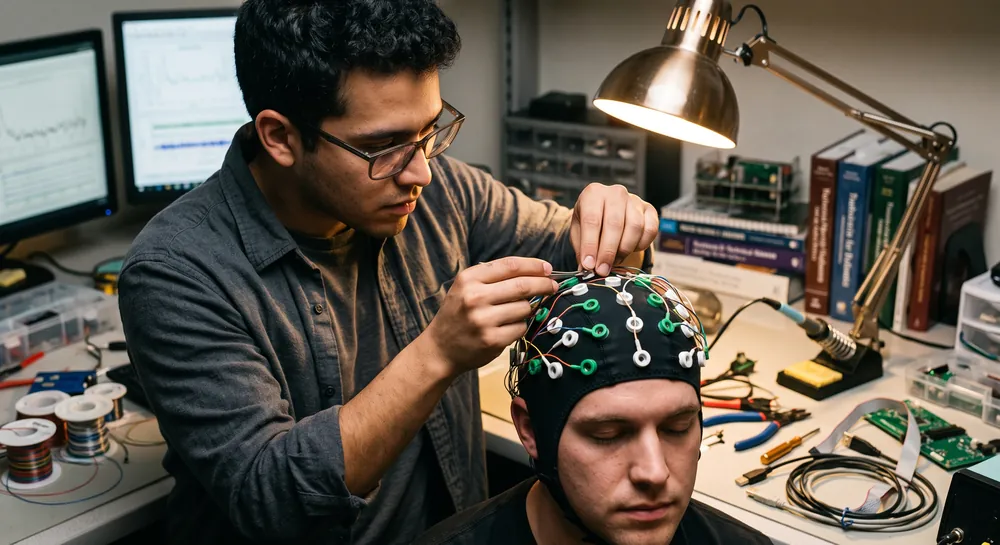
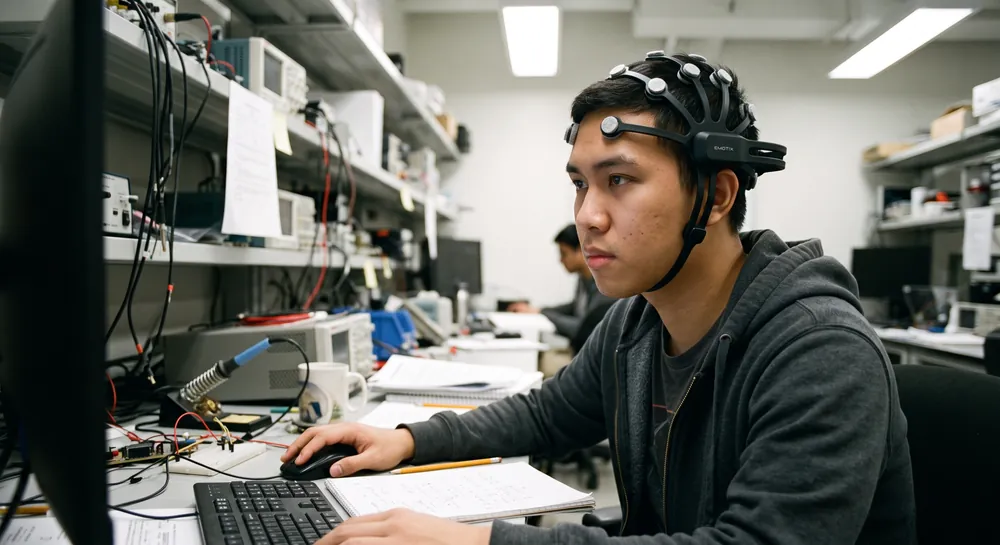
Electroencephalography (EEG) and event-related potentials (ERPs) complement these spatial strengths by providing millisecond-level temporal resolution, allowing researchers to observe the rapid, real-time sequence of neural events involved in social reasoning. This precision is essential for tracking the distinct stages of perspective-taking, from the early sensory processing of social cues to the later cognitive integration required to understand a false belief.
Because EEG is highly non-invasive and does not require the strict physical restraint necessitated by MRI, it is frequently used to measure the emergence of joint attention and gaze-following as early as six months of age.
Moreover, researchers utilize ERP components to identify neural signatures that precede the verbal mastery of milestones like first-order false-belief understanding. By observing these early electrical patterns, scientists can better understand the biological constraints that guide the consistent developmental trajectory of social cognition across cultures.
How Do Cognitive and Affective Theory of Mind Differ Mechanistically?
Research has revealed that Theory of Mind comprises distinct but interrelated components that can be dissociated both behaviorally and neurally. Cognitive Theory of Mind involves reasoning about others' thoughts, beliefs, and knowledge states, while affective Theory of Mind involves understanding others' emotions and feelings.
What Brain Systems Support the Inference of Another Person's Emotional State?
Affective Theory of Mind relies on brain networks that overlap with but are partially distinct from those supporting cognitive Theory of Mind. The ability to infer others' emotional states engages regions involved in emotional processing, including the amygdala, anterior insula, and inferior frontal cortex.
Amygdala: vital for recognizing facial expressions of emotion and for inferring how others feel
Anterior insula: activates during both personal emotional experience and observation of others’ emotions, supporting empathic resonance
Mirror neuron systems (inferior parietal lobule, ventral premotor cortex): enable understanding through embodied simulation
Conclusion: The Architecture of Human Connection
Theory of Mind represents a meticulously timed orchestration between biological maturation and social experience.
The journey toward social intelligence begins with simple shared gazes in infancy and culminates in the sophisticated navigation of nested mental states, such as mindfulness, and complex social norms in early childhood.
Ultimately, recognizing the mechanical dissociation between cognitive reasoning (understanding what others think) and affective empathy (sensing what others feel) clarifies the profound complexities of human interaction.
By understanding these neural and developmental milestones, we gain a deeper appreciation for the cognitive bridge that allows us to move from isolated observers into active, empathic participants in a shared social reality.
References
Woodward A. L. (1998). Infants selectively encode the goal object of an actor's reach. Cognition, 69(1), 1–34. https://doi.org/10.1016/s0010-0277(98)00058-4
Martin, A. K., Kessler, K., Cooke, S., Huang, J., & Meinzer, M. (2020). The right temporoparietal junction is causally associated with embodied perspective-taking. Journal of Neuroscience, 40(15), 3089-3095. https://doi.org/10.1523/JNEUROSCI.2637-19.2020
Bardi, L., Desmet, C., Nijhof, A., Wiersema, J. R., & Brass, M. (2017). Brain activation for spontaneous and explicit false belief tasks overlaps: new fMRI evidence on belief processing and violation of expectation. Social cognitive and affective neuroscience, 12(3), 391–400. https://doi.org/10.1093/scan/nsw143
Otti, A., Wohlschlaeger, A. M., & Noll-Hussong, M. (2015). Is the Medial Prefrontal Cortex Necessary for Theory of Mind?. PloS one, 10(8), e0135912. https://doi.org/10.1371/journal.pone.0135912
Frequently Asked Questions
What exactly is Theory of Mind?
Theory of Mind is the human capacity to attribute mental states such as beliefs, desires, and intentions to oneself and others. It forms the foundation for social interaction, moral reasoning, and complex communication, and emerges through a mix of genetic programming and social experience.
At what age do children typically understand that others can hold false beliefs?
Children master first-order false-belief understanding around age four, as shown by their ability to predict behavior based on someone’s mistaken belief in tasks like the Sally-Anne scenario. This developmental shift occurs with remarkable consistency across cultures, pointing to strong biological constraints.
Which brain region is considered the hub for perspective-taking?
The temporoparietal junction (TPJ), especially in the right hemisphere, serves as a central hub for Theory of Mind processing and is specifically involved in distinguishing self from other perspectives. Temporarily disrupting TPJ activity impairs false-belief reasoning while leaving similar non-social reasoning intact.
How do cognitive and affective Theory of Mind differ?
Cognitive Theory of Mind involves reasoning about others’ thoughts, beliefs, and knowledge, while affective Theory of Mind deals with understanding their emotions and feelings. These two components rely on partially distinct brain networks and can be selectively impaired, as seen in certain clinical conditions.
How do infants demonstrate the earliest signs of Theory of Mind?
Infants as young as three months prefer looking at faces and eyes, and by six months they follow an adult’s gaze, establishing shared attention. Around nine to twelve months, they perceive goal-directed actions and begin pointing to share attention, showing early recognition that others have different visual perspectives.
When do children develop the ability to understand second-order mental states?
Second-order Theory of Mind—the ability to represent nested beliefs like “John thinks that Mary believes…”—typically emerges between ages five and six. This advancement allows children to grasp deception, white lies, and concepts such as reputation and social alliances.
Emotiv is a neurotechnology leader helping advance neuroscience research through accessible EEG and brain data tools.
Medical Disclaimer: The information provided on this website is for educational and informational purposes only and is not intended as medical or health advice. This content may contain errors and should not be relied upon to make life-altering health, medical, or lifestyle choices. Always seek the advice of your physician or other qualified health provider with any questions you may have regarding a medical condition or treatment.
Christian Burgos