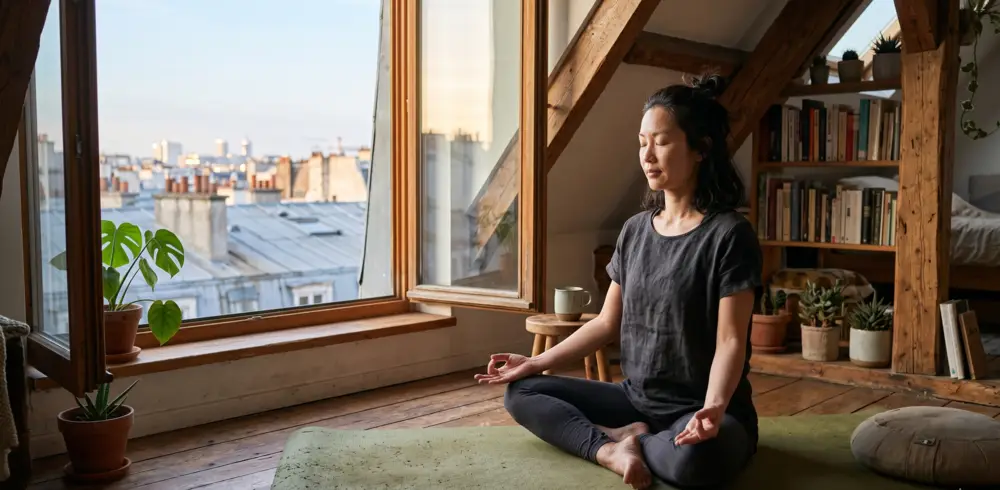
A functional yoga meditation practice is built on preparation, progressive technique, and a working understanding of how each element affects the nervous system. When these pieces assemble correctly, the practice stops feeling like a chore and starts functioning as a reliable tool for mental regulation.
This guide walks through every foundational layer, from physical setup to advanced silent practice, giving you the technical grounding to build a routine that actually holds.
What is Yoga Meditation?
Yoga meditation is a practice that combines physical postures, breathing techniques, and focused attention to cultivate a state of mental stillness and self-awareness.
It's not just about striking a pose; it's about using the body as a tool to quiet the mind and connect with a deeper sense of self.
Think of it as a way to harmonize the mind and body, using movement and breath to prepare for a more profound state of meditation.
The Connection Between Yoga and Meditation
Yoga and meditation have been intertwined for centuries, originating from ancient Indian traditions. While many people associate yoga primarily with physical postures (asanas), these poses are traditionally seen as a preparation for seated meditation. The physical practice helps to:
Release physical tension: Holding poses can work out knots and stiffness, making it easier to sit comfortably for longer periods.
Improve focus: Concentrating on alignment and breath during yoga builds the mental discipline needed for meditation.
Calm the nervous system: The combination of movement and breathwork can have a soothing effect on the body's stress response.
Essentially, yoga creates a stable and calm foundation upon which meditation can flourish. Meditation, in turn, deepens the benefits of yoga by bringing awareness to the internal experience. It's a reciprocal relationship where each practice supports and amplifies the other, leading to a more integrated and peaceful state of being.
What Foundational Elements Must Be Prepared for Yoga Meditation Practice?
The environment you meditate in sends direct signals to your autonomic nervous system before you've taken a single conscious breath. Sensory input, temperature, lighting, and noise all influence whether your nervous system reads the situation as safe enough to downregulate.
This is why experienced practitioners are specific about their setup, not because of ritual preference, but because the brain responds to context.
Choose a location with minimal unpredictable interruptions. A closed room, early morning timing, or late evening hours tend to reduce this variable significantly.
Moreover, physical comfort requires equal attention. The most common beginner error is attempting to sit cross-legged on a hard floor without support, then spending the entire session managing hip and lower back discomfort instead of meditating.
Instead, sit on a folded blanket or a firm meditation cushion called a zafu to elevate the pelvis above the knees. This pelvic tilt allows the lumbar spine to maintain its natural curve rather than collapsing into flexion.
Before beginning any session, you may also set a clear and specific intention. The intention functions as a mental anchor, giving the mind a reference point to return to when attention wanders.
It might be as simple as "I am here to observe my breath" or "I will remain present for the next twenty minutes." State it internally, once, with full attention, before closing your eyes.
How Does Pranayama Function as a Gateway to Meditation?
Pranayama, the system of conscious breath regulation drawn from classical yoga, provides a direct and measurable route between a calm and an aroused state.
Slow, controlled exhalations specifically stimulate the vagus nerve, the primary neural highway of the parasympathetic nervous system. This vagal activation lowers heart rate, reduces the stress hormone cortisol, and can shift the brain toward the slower alpha and theta brainwave frequencies associated with relaxed, inward attention.
Within neuroscience, breathwork is now one of the most studied voluntary methods of top-down autonomic regulation. Its value as a precursor to meditation isn't metaphorical; it's mechanistic.
What Is the Technique for Ujjayi Breath Control?
Ujjayi breath, sometimes called victorious breath, produces a distinctive soft auditory quality by introducing gentle friction at the glottis, the opening between the vocal cords. This sound gives the mind an immediate sensory anchor that is wholly internal, cutting through external distraction more effectively than silent breathing alone.
To practice it, it is usually recommended to begin with your mouth open. Exhale and make a fogging sound, as though you're trying to fog a mirror. Notice the slight constriction at the back of the throat that produces this sound.
Now close your mouth and attempt to recreate that same subtle constriction while breathing through the nose. Both the inhale and exhale should produce a continuous, ocean-like sound, audible to you but not to someone standing across the room.
Once you've located the physical sensation, apply a count. Inhale for four counts, then exhale for six counts.
The longer exhale is critical as it extends vagal stimulation and reinforces parasympathetic dominance. As comfort increases over days of practice, you can extend these counts, reaching a 6:8 or even 6:10 ratio.
The breath should never feel forced or strained. If you feel breathless, shorten the counts and prioritize the quality of the throat engagement over the duration.
How Do You Correctly Execute Nadi Shodhana?
Nadi Shodhana, or Alternate Nostril Breathing, works through a different mechanism than Ujjayi. Rather than generating a sensory anchor, it works by alternating airflow between the left and right nasal passages.
Each nostril is believed to connect to distinct neural pathways:
Right nostril breathing activates the sympathetic system and corresponds to left-hemisphere activity
Left nostril breathing activates the parasympathetic system and corresponds to right-hemisphere processing.
Alternating between them in a structured pattern has been shown to support a more balanced autonomic state.
The hand position used is called Vishnu Mudra. Bring your right hand up and fold the index and middle fingers toward your palm, leaving the thumb, ring finger, and pinky extended. The right thumb controls the right nostril; the ring finger controls the left nostril.
The basic pattern follows four steps in sequence:
Close the right nostril with the thumb. Inhale through the left nostril for four counts.
At the top of the inhale, close both nostrils briefly. Hold for one to two seconds.
Release the thumb and exhale fully through the right nostril for six counts.
Without switching, inhale through the right nostril for four counts.
Close both nostrils briefly at the top.
Release the ring finger and exhale through the left nostril for six counts.
That completes one full cycle. Some people practice six to eight cycles, maintaining smooth, unforced breath throughout.
Essential Steps for a Guided Yoga Nidra Session
Yoga Nidra occupies a specific and unusual neurological territory. Unlike active meditation, where the practitioner exerts some degree of mental effort to maintain focus, Yoga Nidra is a state of guided receptivity.
The practitioner often lies in Savasana, flat on the back with the body fully supported by the floor, and follows auditory instructions while remaining at the threshold between waking consciousness and sleep.
This threshold, called the hypnagogic state, features theta-dominant brainwave activity. Theta rhythms are linked to deep creativity, emotional processing, and memory consolidation. Entering this state consciously, while remaining aware, is precisely what distinguishes Yoga Nidra from simply napping.
Research into brain health suggests that this state of conscious rest may offer restoration comparable to a light sleep cycle in a fraction of the time, making it particularly valuable for individuals with high cognitive loads.
You may begin by finding a fully supported lying position.
Place a bolster or rolled blanket under the knees to release lumbar tension, use a thin pillow under the head, and cover yourself with a blanket if temperature drop is likely.
Remove distractions, start an audio recording from a qualified guide, and commit to remaining awake and receptive rather than sleeping.
Conclusion: Embrace the Journey of Yoga Meditation
Starting a yoga meditation practice is the beginning of a mindfulness journey. It's not about reaching a perfect pose or a completely silent mind overnight. Instead, it's about showing up, being present, and observing what unfolds.
The benefits, from a calmer mind to a more aware body, develop gradually with consistent effort. Even short, regular sessions can make a difference.
The key is to be patient with yourself and celebrate the small victories along the way. This practice offers a path to greater self-awareness and a more balanced approach to life's challenges.
References
Kachera, V., Patel, D., Mishra, S., Mishra, A., Gomes, J., & Garg, R. (2026). The Effects of Yoga Nidra Practice on EEG Oscillations: A Systematic Review. Advances in Integrative Medicine, 100683. https://doi.org/10.1016/j.aimed.2026.100683
Frequently Asked Questions
What exactly is yoga meditation?
Yoga meditation is a practice that combines physical yoga poses with focused breathing and a quiet mind. It's about using movement and breath to help you relax and pay attention to what's happening right now, both in your body and your thoughts.
What are the main benefits of yoga meditation?
The biggest benefits include feeling less stressed, having a clearer mind, and feeling more emotionally balanced. It can also help your body feel better, making you more flexible and aware of your physical self.
Why does the environment and timing matter so much for meditation?
The sensory environment signals safety to the nervous system, while unpredictable sounds trigger an orienting reflex that pulls the brain out of internal focus. Consistent timing pairs location and posture into a conditioned cue, helping the brain transition into a focused state more rapidly.
What is the purpose of setting an intention before practice?
The intention gives the prefrontal cortex a specific directive, reducing aimless mind-wandering by keeping the default mode network less active. It provides a mental reference point to return to whenever attention drifts.
How does Ujjayi breath help with concentration?
The soft throat sound acts as an internal sensory anchor, so when the mind wanders and the sound fades, distraction becomes immediately obvious. The extended exhale also stimulates the vagus nerve, shifting the body toward a relaxed, inward state.
What is Yoga Nidra and how is it different from sleep?
Yoga Nidra is a guided state of conscious rest on the threshold of sleep, marked by theta brainwaves linked to creativity and emotional processing. Unlike napping, you remain aware, so the nervous system recovers while attention stays lightly engaged.
Emotiv is a neurotechnology leader helping advance neuroscience research through accessible EEG and brain data tools.
Medical Disclaimer: The information provided on this website is for educational and informational purposes only and is not intended as medical or health advice. This content may contain errors and should not be relied upon to make life-altering health, medical, or lifestyle choices. Always seek the advice of your physician or other qualified health provider with any questions you may have regarding a medical condition or treatment.
Christian Burgos