Huntington's disease is a condition that affects people differently as it progresses. It's a genetic disorder, meaning it's inherited, and it causes changes in the brain over time. These changes lead to a variety of symptoms that typically get more noticeable and impactful as the years go by.
Understanding these stages can help families and caregivers prepare for what might come next and how to best support someone living with Huntington's disease.
How Do Huntington's Symptoms Progress and Change Over Time?
Huntington's disease (HD) is a genetic condition that affects the brain. It's a progressive disorder, meaning symptoms start small and get worse over time.
HD symptoms don't usually appear all at once. There's often a period before formal diagnosis where subtle changes might be noticed. This is sometimes called the prodromal phase.
Even before obvious motor signs, some people might experience shifts in mood or thinking. These early signs can be easy to overlook or attribute to other causes.
Once symptoms become more apparent, the disease is typically categorized into stages. These stages are based on how much the motor, cognitive, and behavioral changes impact a person's daily life and independence.
Generally, the progression moves from early stages, where people can manage most activities, through middle stages with increasing needs for support, to late stages where significant care is required.
Early Stage: Motor symptoms like involuntary movements (chorea) may begin. Thinking and mood changes can also start to show. People in this stage can usually still live independently.
Mid-Stage: Symptoms become more pronounced. Movement, thinking, and behavior challenges increase, often affecting work and daily tasks. Swallowing and speech difficulties may also emerge.
Late Stage: Motor symptoms can change, sometimes leading to rigidity. Communication becomes very difficult, and cognitive decline is significant. The focus shifts towards comfort and advanced care.
What Are the Subtle Warning Signs of Huntington's Prodromal Phase?
Even before the more obvious signs of Huntington's disease appear, there can be a period where subtle changes begin to emerge. This phase, sometimes called the prodromal stage, can occur years before a formal diagnosis is made.
It's a time when people might notice slight shifts in their thinking or behavior that, in retrospect, might be linked to the brain disease. These early indicators are often so mild that they can be easily overlooked or attributed to other causes.
How Can Minor Irritability and Focus Issues Signal Early Cognitive Decline?
During the prodromal phase, people may experience subtle changes in their emotional state and cognitive abilities. These can include a general increase in irritability or a tendency to become frustrated more easily than usual.
Concentration can also become more challenging, making it difficult to focus on tasks that were once manageable. These changes are not typically severe enough to interfere significantly with daily life but represent a departure from a person's baseline functioning.
What Are "Soft Motor Signs" and How Do They Precede Chorea?
Alongside cognitive and emotional shifts, some individuals may notice minor changes in their motor control. These are often referred to as soft motor signs.
They might manifest as increased fidgeting, a subtle lack of coordination, or a slight clumsiness that wasn't present before. These movements are not the pronounced, involuntary chorea characteristic of later stages but are more like small, uncharacteristic movements or a general feeling of being less graceful.
For example, someone might find themselves dropping things more often or feeling a bit unsteady on their feet without a clear reason.
When Do Huntington's Symptoms Become Clearly Apparent in the Early Stage?
How Does the Emergence of Chorea Impact Initial Movement Coordination?
In the early stages of HD, motor symptoms begin to surface more noticeably. This is often when a formal diagnosis is made.
Chorea, characterized by involuntary, jerky movements, starts to appear, typically affecting the limbs, face, or trunk. While these movements might initially be subtle, they can lead to a general sense of clumsiness or unsteadiness.
People may find themselves fidgeting more than usual or experiencing slight coordination problems that can result in stumbling. These motor changes, while not yet severely debilitating, mark a significant shift from the prodromal phase and indicate the disease is progressing.
What Cognitive Hurdles Are Typically Faced in Early Thinking and Planning?
Alongside motor changes, cognitive functions also start to show signs of impairment. Individuals may notice increased difficulty with concentration and focus.
Complex problem-solving, planning, and organizing tasks can become more challenging. While daily activities might still be manageable, the mental effort required to complete them may increase.
This stage often involves a noticeable decline in the ability to process information as quickly as before.
Which Psychiatric and Emotional Shifts Are Common in the Early Years?
Psychiatric and behavioral changes are also common during early-stage Huntington's. Mood swings can become more pronounced, with increased irritability, anxiety, or periods of depression.
Some people might experience impulsivity or a general lack of motivation. These emotional and behavioral shifts can be distressing for both the individual and their loved ones, adding another layer of complexity to this stage of the disease.
Why Does Mid-Stage Huntington's Require a Significant Increase in Support?
As Huntington's disease moves into its middle stages, the changes become more noticeable and require more attention. This period, often occurring several years after the initial symptoms appear, marks a time when daily life can become significantly more challenging.
People in this phase may find they can no longer manage work or complex tasks independently, and their need for assistance with everyday activities increases.
How Do Evolving Motor Symptoms Affect Long-Term Mobility and Safety?
Motor symptoms, which may have been subtle earlier, often become more pronounced. The involuntary movements, known as chorea, can become more frequent and severe, impacting balance and coordination. This can lead to an increased risk of falls, making mobility a concern.
Alongside chorea, some people might experience increased muscle rigidity or slowness of movement, which can further complicate physical tasks. Getting around the house or performing routine physical activities may start to require help.
What Challenges Arise When Worsening Cognitive Function Impacts Daily Tasks?
Cognitive abilities also continue to change. Tasks that require planning, organization, and memory become more difficult.
Following multi-step instructions, managing finances, or even remembering appointments can present challenges. Problem-solving skills may decline, and processing information might take longer.
This can affect a person's ability to manage their own affairs and may necessitate support in decision-making.
How Are More Significant Behavioral and Psychiatric Challenges Managed?
Psychiatric and behavioral symptoms can also become more prominent during mid-stage Huntington's. Changes in mood, such as increased irritability, anxiety, or periods of depression, are common.
Some individuals may experience impulsivity, or in some cases, develop delusions or hallucinations. These changes can affect relationships and require careful management and support.
Why Do Speech and Swallowing Difficulties Typically Worsen During This Phase?
Communication and eating can become increasingly difficult. Speech may become slurred or difficult to understand, a condition known as dysarthria.
Similarly, swallowing can become impaired (dysphagia), raising concerns about nutrition and the risk of choking. These issues often require adaptations in how people communicate and eat, and may need professional guidance to manage safely.
What Are the Primary Goals for Care During Late-Stage Huntington's?
Why Might Severe Rigidity and Dystonia Eventually Replace Chorea?
In the later stages of Huntington's disease, the prominent involuntary movements, known as chorea, often lessen. Instead, people may experience increased muscle stiffness, or rigidity, and abnormal muscle contractions that cause twisting or repetitive movements, called dystonia.
These motor changes can make movement very difficult and may lead to a more hunched posture. Getting around becomes a significant challenge, and many individuals require assistance with nearly all daily activities.
How Does the Loss of Verbal Communication Impact Social Interaction?
As the disease progresses, speaking clearly (dysarthria) becomes increasingly difficult. Muscles involved in speech production may become stiff or move uncontrollably, making it hard for others to understand.
Eventually, verbal communication may become impossible. In these situations, non-verbal methods of communication become important. These can include gestures, facial expressions, or using communication boards or devices, allowing for some level of connection and expression.
What Is Known About Awareness Levels During Advanced Cognitive Decline?
Cognitive abilities continue to decline significantly in late-stage Huntington's. A person may have profound difficulty with thinking, memory, and understanding their surroundings.
Awareness of their brain health condition and the world around them may diminish. This stage often requires constant supervision and care to ensure safety and well-being.
Why Is the Transition Toward Palliative and End-of-Life Care Important?
The primary goal in late-stage Huntington's disease shifts to providing comfort and maintaining the best possible quality of life. This involves managing symptoms that cause distress, such as pain or discomfort, and addressing nutritional needs.
Palliative care specialists play a key role, working with families and caregivers to create a care plan that respects the individual's wishes and focuses on dignity. This phase emphasizes compassionate support for both the individual with Huntington's and their loved ones.
How Is Neuroscience Using EEG to Track Huntington's Disease Progression?
Can Quantitative EEG Identify Early Biological 'Signatures' of Brain Change?
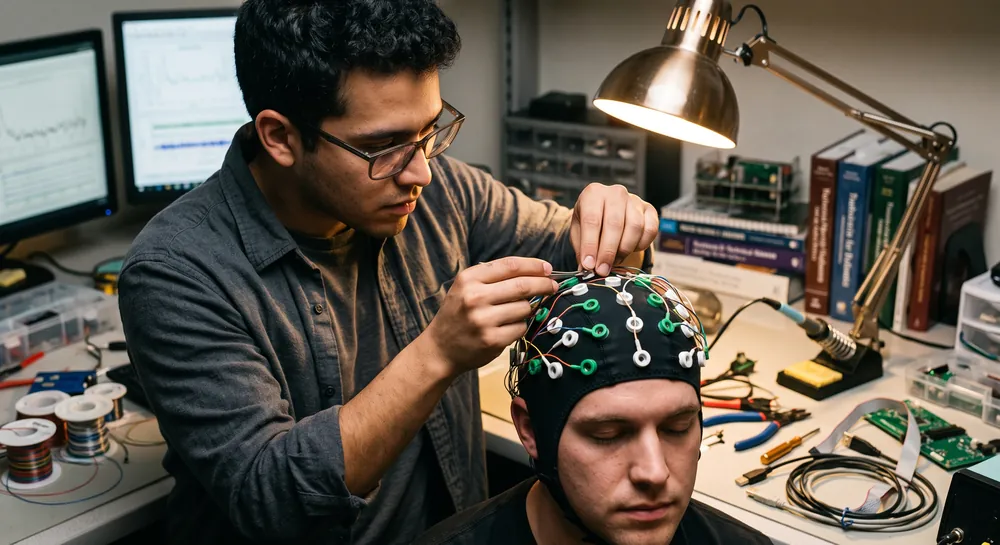
While clinicians primarily track the progression of Huntington's disease through observable cognitive, psychiatric, and motor changes, researchers utilize electroencephalography (EEG) to identify objective, measurable biological markers that map directly to the disease's timeline.
Instead of looking for generic electrical anomalies, neuroscientists focus on highly specific neurophysiological metrics, such as Quantitative EEG (qEEG) and Event-Related Potentials (ERPs).
For example, qEEG studies of individuals with Huntington's consistently reveal "cortical slowing"—a quantifiable shift where healthy, high-frequency alpha brainwaves progressively diminish and are replaced by slower theta and delta waves. This electrical slowing strongly correlates with the physical atrophy of the cerebral cortex and basal ganglia.
Furthermore, researchers closely track the P300 wave, a specific electrical signal tied to working memory and executive function. In individuals carrying the Huntington's genetic mutation, the P300 signal frequently demonstrates a delayed latency (taking milliseconds longer to fire) and reduced amplitude well before hallmark physical symptoms like chorea ever appear, providing researchers with a concrete biological signature of early cognitive decline.
What Are the Current Capabilities and Limitations of EEG in Huntington's Care?
Despite the precision of these electrophysiological markers in a research setting, it is critical to understand their current limitations in everyday clinical care. EEG is highly effective for helping scientists map broad, group-level changes in neural connectivity to test the efficacy of experimental neuroprotective drugs, but it is not currently utilized as a diagnostic "clock" for the disease.
A single EEG scan cannot definitively forecast an individual patient's timeline, such as predicting the exact year motor symptoms will emerge or how rapidly their specific cognitive decline will occur. In standard neurological practice, an EEG for a patient diagnosed with Huntington's disease is generally only ordered to investigate distinct, secondary complications that might arise, such as identifying the root cause of uncharacteristic myoclonic jerks or ruling out co-occurring epileptic seizure activity, rather than to stage the progression of the primary disease.
Understanding the Progression of Huntington's Disease
Huntington's disease is a complex condition that unfolds over time, impacting people differently at each stage. While there's currently no cure, understanding the typical progression—from early motor and cognitive changes to later stages requiring significant care—can help families and patients prepare.
Recognizing the signs and symptoms associated with each phase allows for better planning, access to support services, and informed discussions with healthcare providers.
Continued research into treatments that may slow or halt the disease's progress offers hope for the future. For those affected, staying informed and connected with resources is key to managing the challenges Huntington's disease presents.
References
Chmiel, J., Nadobnik, J., Smerdel, S., & Niedzielska, M. (2025). Neural Correlates of Huntington’s Disease Based on Electroencephalography (EEG): A Mechanistic Review and Discussion of Excitation and Inhibition (E/I) Imbalance. Journal of Clinical Medicine, 14(14), 5010. https://doi.org/10.3390/jcm14145010
Hart, E. P., Dumas, E. M., Reijntjes, R. H. A. M., Van Der Hiele, K., Van Den Bogaard, S. J. A., Middelkoop, H. A. M., ... & Van Dijk, J. G. (2012). Deficient sustained attention to response task and P300 characteristics in early Huntington’s disease. Journal of neurology, 259(6), 1191-1198. https://doi.org/10.1007/s00415-011-6334-0
Frequently Asked Questions
What are the first signs of Huntington's disease?
Sometimes, people might notice small changes in their mood, like feeling more irritable, or have a bit of trouble focusing. There might also be slight clumsiness or fidgeting that happens before bigger movement problems start.
What is chorea?
Chorea refers to sudden, jerky, and uncontrolled movements that can happen in different parts of the body. It's one of the most noticeable signs of Huntington's disease.
How does Huntington's disease affect thinking?
As the disease progresses, people may find it harder to plan, organize tasks, remember things, or process information quickly. This can make daily activities more challenging.
Are there mood or behavior changes with Huntington's disease?
Yes, mood and behavior changes are common. These can include feeling depressed, anxious, irritable, or sometimes experiencing more serious issues like delusions or hallucinations.
What happens to speech and swallowing in later stages?
In the later stages, speaking clearly (called dysarthria) and swallowing food and liquids (called dysphagia) can become very difficult. This often requires special care and feeding methods.
Do movement problems change over time?
Yes, while chorea is common early on, some people may develop stiffness and slow movements (rigidity and dystonia) in the later stages of the disease.
What does 'late-stage' Huntington's disease mean?
Late-stage means the disease has advanced significantly. People in this stage often need constant help with all daily activities and may spend most of their time in bed or a chair. Communication can become very limited.
How quickly does Huntington's disease progress?
The speed at which Huntington's disease progresses can vary greatly from person to person. Some people experience changes more rapidly than others.
Is there a way to predict the stages of Huntington's disease?
While doctors use staging systems to describe the general progression, everyone's journey with Huntington's disease is unique. It's important to talk with a healthcare team about individual expectations and care plans.
Emotiv is a neurotechnology leader helping advance neuroscience research through accessible EEG and brain data tools.
Medical Disclaimer: The information provided on this website is for educational and informational purposes only and is not intended as medical or health advice. This content may contain errors and should not be relied upon to make life-altering health, medical, or lifestyle choices. Always seek the advice of your physician or other qualified health provider with any questions you may have regarding a medical condition or treatment.
Christian Burgos