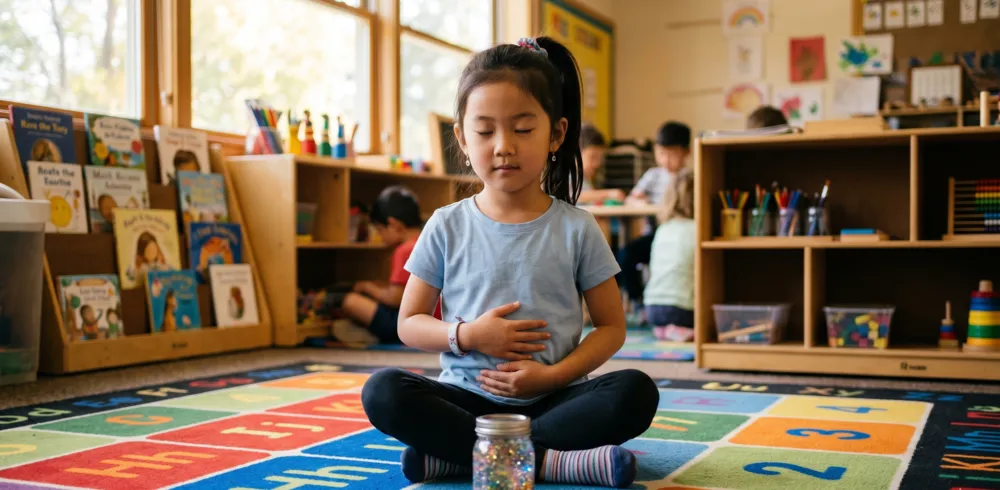
The human brain undergoes its most dramatic transformation during childhood and adolescence, with neural pathways forming, strengthening, and pruning at extraordinary rates. This period of intense neuroplasticity presents both vulnerability and opportunity.
Recent neuroscience research suggests that mindfulness practices may serve as a powerful tool for optimizing this developmental process, with measurable effects on cognitive function, emotional regulation, and social competence.

Key Points
Mindfulness training thickens prefrontal cortex, boosting executive function.
Mindfulness strengthens prefrontal-amygdala connections to dampen excessive stress responses.
Regular practice enhances attention networks, sharpening alerting, orienting, and executive control.
Mindfulness reduces mind-wandering, freeing working memory for academic tasks.
Practicing mindfulness cultivates interoceptive awareness, helping children label emotions early.
Mindfulness practice fosters empathy by strengthening temporoparietal junction activity.
How Does Mindfulness Practice Influence a Child's Developing Brain?
The developing brain's remarkable plasticity means that experiences during childhood create lasting changes in neural architecture. Mindfulness practices appear to enhance this natural neuroplasticity in specific, beneficial ways.
These neurological changes occur through multiple mechanisms:
Strengthening of neural networks for focused attention
Reduction of the default mode network activity to curb mind-wandering
Creation of more efficient information processing
Enhancement of overall cognitive control
How Does It Impact the Prefrontal Cortex and Executive Function?
The prefrontal cortex serves as the brain's executive control center, orchestrating complex cognitive processes including working memory, cognitive flexibility, and inhibitory control. This region undergoes extensive development throughout childhood and doesn't fully mature until the mid-twenties. Mindfulness training appears to accelerate and optimize this developmental process.
Neuroimaging studies reveal that children who practice mindfulness show increased activation in the prefrontal cortex, particularly in areas responsible for attention regulation and cognitive control.
This functional enhancement correlates with improved performance on tasks measuring executive function, including the ability to switch between different mental tasks, maintain information in working memory, and resist impulsive responses.
What Insights Does EEG Research Offer on Mindfulness in the Developing Brain?
EEG serves as a research tool for observing the real-time electrical activity of the developing brain, offering a quantifiable perspective on how mindfulness practices may influence neural function. Unlike structural scans that map anatomy, EEG captures brain wave oscillations, which represent the synchronized firing of large groups of neurons.
Research involving children who engage in mindfulness training often identifies shifts in specific frequency bands, most notably alpha and theta waves. Alpha waves are generally associated with a state of relaxed, alert wakefulness, while theta waves are frequently linked to sustained attention and internal cognitive processing.
In developmental contexts, the modulation of these patterns is interpreted as a neural correlate of a child’s emerging ability to regulate their internal state and manage environmental stressors.
However, it is essential to frame these findings as indicators of neural activity rather than direct evidence of specific clinical outcomes. While EEG provides a sophisticated neuroscientific view of the brain's "electrical landscape," these patterns are currently viewed in research settings as exploratory markers of development rather than as a standardized diagnostic tool or a guaranteed indicator of treatment success.
What Cognitive Benefits Does Mindfulness Offer for School-Aged Children?
The cognitive demands of modern education require sustained attention, flexible thinking, and effective information processing. Children must deal with increasingly complex academic material while managing multiple competing demands on their attention.
Mindfulness training provides specific cognitive advantages that directly support academic success. These cognitive benefits arise from fundamental changes in how the brain processes information.
Mindfulness practice strengthens neural networks responsible for sustained attention while reducing interference from distracting thoughts and emotions. Children develop enhanced metacognitive awareness, becoming more skilled at monitoring their own thinking processes and redirecting attention when it wanders.
The improvements extend beyond simple attention skills to encompass higher-order cognitive abilities including problem-solving, creative thinking, and analytical reasoning. Children who practice mindfulness show enhanced:
Problem-solving and creative thinking
Analytical reasoning
Enhanced cognitive flexibility
Ability to adapt strategies and shift perspectives
What Is the Link Between Mindfulness and Social-Emotional Learning (SEL)?
Social-emotional learning frameworks recognize that academic success depends on children's ability to understand and manage emotions, set goals, show empathy, and maintain positive relationships. Mindfulness training appears to provide foundational skills that support all major SEL competencies, creating synergistic effects when combined with traditional SEL curricula.
The connection between mindfulness and SEL operates through several mechanisms. Both approaches emphasize present-moment awareness, emotional recognition, and skillful responding to challenging situations. Mindfulness provides the attentional stability and emotional regulation that make other SEL skills more accessible and effective.
How Does Mindfulness Cultivate Empathy and Perspective-Taking?
Empathy requires the ability to accurately perceive others' emotional states while maintaining awareness of one's own emotional responses. This complex social-cognitive skill develops throughout childhood and serves as a foundation for positive relationships and prosocial behavior.
Studies measuring empathic responding show that children who practice mindfulness demonstrate increased ability to recognize emotions in others and respond with appropriate compassion.
The neurological basis for enhanced empathy involves strengthening brain networks associated with social cognition. Mindfulness practice increases activity in regions like the temporoparietal junction and medial prefrontal cortex, areas crucial for understanding others' mental states. Children develop enhanced ability to separate their own emotional responses from those of others, reducing emotional contagion while maintaining empathic connection.
What Role Does It Play in Improving Peer Relationships?
Peer relationships during childhood serve crucial developmental functions, providing opportunities to practice social skills, develop identity, and gain emotional support. Children who struggle with peer relationships often experience academic difficulties, behavioral problems, and mental health challenges.
Studies tracking children's social interactions reveal that mindfulness training reduces relational aggression, increases cooperative behavior, and enhances conflict resolution skills. Children develop greater ability to navigate social challenges without resorting to hostile or avoidant responses.
The improvement mechanism involves enhanced emotional regulation and perspective-taking abilities. When children can manage their own emotional reactions more skillfully, they create space for understanding others' perspectives and responding with greater flexibility. They become less reactive to social slights and more capable of repairing relationship ruptures.
Can Mindfulness Practices Help Children With Attentional Challenges?
Children diagnosed with attention-deficit/hyperactivity disorder (ADHD) face significant challenges in academic and social settings due to difficulties with sustained attention, impulse control, and hyperactivity.
Traditional treatments typically involve medication and behavioral interventions. Emerging research suggests that mindfulness training may provide additional benefits for these children.
Studies specifically examining mindfulness interventions for children with ADHD show promising results. Children demonstrate improved attention span, reduced hyperactivity, and enhanced emotional regulation following mindfulness training. These improvements often complement rather than replace traditional treatments, providing additional tools for managing attentional challenges.
Reshaping the Developing Mind
The implementation of mindfulness during the peak neuroplasticity of childhood and adolescence offers a systematic method for optimizing the brain's developmental trajectory.
Children develop a heightened metacognitive awareness that reduces mind-wandering, thereby freeing working memory for complex tasks like analytical reasoning and creative problem-solving.
Moreover, by activating networks tied to social cognition mindfulness helps children cultivate the empathy and perspective-taking necessary for healthy peer relationships and collaborative conflict resolution.
References
Xie, S., Gong, C., Lu, J., Li, H., Wu, D., Chi, X., & Chang, C. (2022). Enhancing Chinese preschoolers’ executive function via mindfulness training: An fNIRS study. Frontiers in Behavioral Neuroscience, 16, 961797. https://doi.org/10.3389/fnbeh.2022.961797
Shanok, N. A., Saldias-Manieu, C., Mize, K. D., Chassin, V., & Jones, N. A. (2023). Mindfulness-training in preadolescents in school: The role of emotionality, EEG in theta/beta bands, creativity and attention. Child Psychiatry & Human Development, 54(4), 1152-1166. https://doi.org/10.1007/s10578-022-01318-7
Murphy, S., Donma, A. J., Kohut, S. A., Weisbaum, E., Chan, J. H., Plenert, E., & Tomlinson, D. (2022). Mindfulness Practices for Children and Adolescents Receiving Cancer Therapies. Journal of pediatric hematology/oncology nursing, 39(1), 40–48. https://doi.org/10.1177/27527530211056514
Franco, C., Amutio, A., López-González, L., Oriol, X., & Martínez-Taboada, C. (2016). Effect of a Mindfulness Training Program on the Impulsivity and Aggression Levels of Adolescents with Behavioral Problems in the Classroom. Frontiers in psychology, 7, 1385. https://doi.org/10.3389/fpsyg.2016.01385
Chimiklis, A. L., Dahl, V., Spears, A. P., Goss, K., Fogarty, K., & Chacko, A. (2018). Yoga, mindfulness, and meditation interventions for youth with ADHD: Systematic review and meta-analysis. Journal of Child and Family Studies, 27(10), 3155-3168. https://doi.org/10.1007/s10826-018-1148-7
Frequently Asked Questions
How does mindfulness practice affect a child's developing brain?
Mindfulness practice strengthens neural networks for focused attention and reduces activity in the default mode network, which is linked to mind-wandering. This shift creates more efficient information processing and supports lasting improvements in brain structure and function.
In what way does mindfulness help children handle stress and the amygdala?
Mindfulness reduces amygdala reactivity to stressful stimuli, resulting in calmer and more measured stress responses. By strengthening prefrontal-amygdala connections, it allows the brain to better assess threats and dampen unnecessary alarm signals.
What cognitive benefits, like better attention, does mindfulness bring to school-aged kids?
Mindfulness practice improves all three attention systems—alerting, orienting, and executive attention—by increasing activity in brain regions that coordinate focus. This helps children sustain attention on tasks and filter out distractions more effectively.
Can mindfulness improve working memory and academic performance?
Mindfulness training enhances working memory by reducing mind-wandering, which frees up mental resources for learning tasks. As a result, children show better reading comprehension and mathematical problem-solving.
Can mindfulness reduce impulsive or dysregulated behaviors?
Mindfulness creates a pause between an emotional trigger and a reaction, giving children time to engage the prefrontal cortex to choose a better response. This helps reduce aggressive outbursts and improves classroom behavior.
How does mindfulness cultivate empathy and perspective-taking?
Mindfulness increases activity in social cognition brain regions like the temporoparietal junction, helping children better recognize others' emotions. It also enables them to separate their own feelings from those of others, promoting compassionate responses while reducing emotional contagion.
Is there evidence that mindfulness helps children with attention-deficit/hyperactivity disorder (ADHD)?
Research shows mindfulness strengthens the underactive prefrontal networks in ADHD, improving attention span and reducing hyperactivity. Children also develop greater metacognitive awareness, recognizing when their mind wanders and re-focusing more easily.
Emotiv is a neurotechnology leader helping advance neuroscience research through accessible EEG and brain data tools.
Christian Burgos