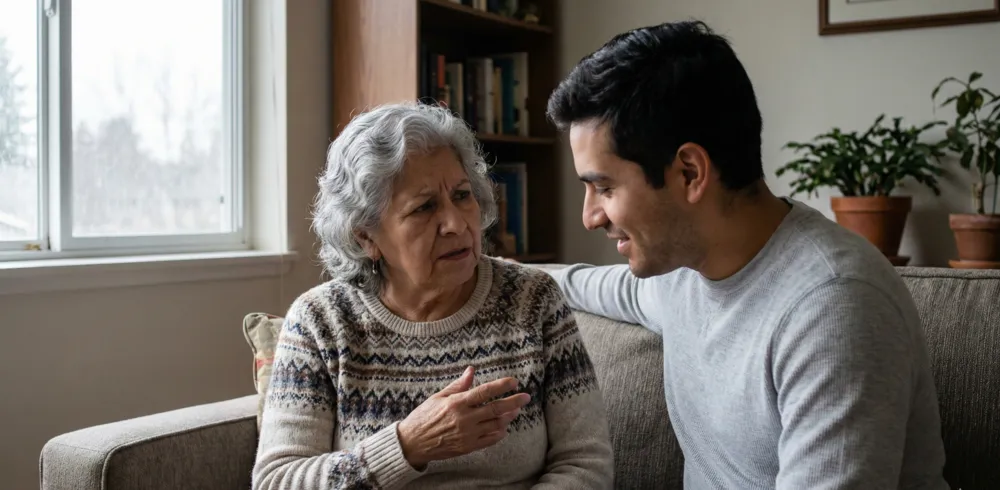
It can be pretty unsettling when someone you care about gets a dementia diagnosis. Suddenly, you're thinking about what the future holds, how life will change, and what kind of help they'll need.
A big question that often pops up is whether dementia is hereditary. Will you or your kids end up facing the same thing down the road?
The answer isn't a simple yes or no. While most things that put you at risk for dementia have more to do with how you live and your surroundings, there are some rare cases where genetics really does play a part.
So, is dementia hereditary? Let's break it down.
The Role of Genetics in Dementia
When we talk about dementia, it's natural to wonder about the role genetics plays. It's a complex topic, and the answer isn't a simple yes or no.
While many factors contribute to dementia, including lifestyle and environment, inherited genes can indeed influence a person's risk.
Genes That Increase Dementia Risk
For the most common form of dementia, Alzheimer's disease, researchers have identified numerous genes that can increase a person's susceptibility. These are often referred to as risk genes. Having one or more of these genes doesn't guarantee someone will develop the condition, but it does raise their likelihood.
The APOE-e4 gene is one such example, and it's estimated that a significant percentage of people diagnosed with Alzheimer's carry this gene. It's important to note that the impact of APOE-e4 can vary across different ethnic and racial groups.
Genes That Cause Dementia (Rare Forms)
In a smaller number of cases, specific gene mutations can directly cause dementia. These are known as deterministic genes.
When these mutations are present, they almost certainly lead to the development of the disease. These genes are most commonly associated with rare, early-onset forms of dementia, which can appear before the age of 65.
For instance, mutations in genes like PSEN1, PSEN2, and APP are linked to early-onset Alzheimer's. If a parent carries one of these deterministic gene mutations, their child has a high chance of inheriting it and developing the condition.
Other rare inherited dementias include certain forms of familial prion disease and Creutzfeldt-Jakob disease.
Common Types of Dementia and Their Genetic Links
When we talk about dementia, it's important to remember it's not a single disease but an umbrella term for a range of conditions that affect memory, thinking, and social abilities. While many factors contribute to dementia, genetics plays a role in some types, though often a small one.
Vascular Dementia and Genetic Factors
Vascular dementia arises from conditions that damage blood vessels in the brain, affecting blood flow. This can include strokes or other issues impacting brain circulation.
While lifestyle factors like high blood pressure and diabetes are significant contributors, certain genetic predispositions can also increase the risk of developing blood vessel problems that lead to vascular dementia.
However, unlike some rare forms of Alzheimer's, there aren't specific genes identified that directly cause vascular dementia in a straightforward hereditary manner.
Frontotemporal Dementia (FTD): Stronger Hereditary Links
Frontotemporal dementia (FTD) is a group of disorders affecting the frontal and temporal lobes of the brain, impacting personality, behavior, and language.
Compared to Alzheimer's, FTD has a more significant hereditary component. Specific gene mutations, such as those in the C9orf72, MAPT, and GRN genes, are known to cause familial FTD. If a parent carries one of these mutations, their children have a substantial chance of inheriting it and developing FTD.
Lewy Body Dementia (LBD) and Genetics
Lewy body dementia (LBD) involves abnormal protein deposits, called Lewy bodies, in the brain. Symptoms can include visual hallucinations, fluctuations in attention, and parkinsonian movement issues.
While LBD can sometimes occur alongside Alzheimer's or Parkinson's disease, its direct hereditary link is less clear than in FTD. Some genetic factors, like variations in the SNCA gene, have been associated with an increased risk of LBD, but it's not typically considered a purely hereditary condition in the way some rare forms of Alzheimer's or FTD are.
Beyond Genetics: Other Risk Factors for Dementia
While genetics can play a role in dementia, it's far from the only factor. Many aspects of our lives and health can influence our risk.
For instance, age is a significant factor; the likelihood of developing dementia generally increases as people get older, particularly after age 65. However, it's important to remember that dementia is not a normal part of aging and can affect younger people too.
Lifestyle choices also have a considerable impact. Research suggests that maintaining a healthy lifestyle can lower the risk of cognitive decline. This includes dietary habits, such as following a Mediterranean-style diet rich in fruits, vegetables, whole grains, olive oil, nuts, and fish, while limiting dairy and red meat.
Regular physical activity is also beneficial. Engaging in mentally stimulating activities, like learning new skills or hobbies, and maintaining social connections are also thought to be protective.
Certain health conditions are linked to an increased risk of dementia. Cardiovascular health is particularly important.
Conditions like high blood pressure, high cholesterol, obesity, and diabetes, especially when poorly managed, can affect brain health. Smoking and excessive alcohol consumption have also been associated with a higher risk.
Furthermore, untreated hearing loss and vision loss have been identified as potential risk factors, with some studies indicating that addressing these sensory impairments might reduce dementia risk.
Environmental factors may also contribute. Emerging research points to air pollution, particularly from traffic and burning wood, as a potential risk factor for dementia. Depression, especially in midlife, has also been noted as a risk factor for developing dementia later on.
It's a complex picture, and these factors often interact. For example, managing cardiovascular risk factors can have a positive effect on brain health. While we cannot change our age or our genetic predispositions, many of these other risk factors can be modified through lifestyle changes and medical management.
When to Consider Genetic Testing for Dementia
Thinking about genetic testing for dementia is a big step, and it's not something to rush into. While some genetic tests are available directly to consumers, it's generally advised to approach these tests with caution, especially when they relate to complex conditions like dementia.
Several factors warrant careful consideration before pursuing genetic testing:
Family History: A strong family history of dementia, particularly early-onset forms or multiple affected relatives, might prompt questions about genetic risk.
Specific Dementia Types: For certain rare, inherited forms of dementia, like some types of Frontotemporal Dementia or early-onset Alzheimer's disease caused by specific gene mutations (APP, PSEN1, PSEN2), genetic testing might be considered.
Research Participation: Many individuals consider genetic testing as part of participation in research studies aimed at understanding dementia better. These studies often provide genetic counseling as part of the process.
It is highly recommended that anyone considering genetic testing for dementia undergo genetic counseling both before the test is ordered and after results are received. A genetic counselor can help you understand the potential implications of testing, interpret complex results, and discuss how this information might affect you and your family. They can also guide you on available support and resources.
It's also important to be aware of potential implications regarding health insurance, life insurance, and long-term care insurance, as genetic information can sometimes be a factor in these areas. While treatments are emerging for some types of dementia, such as amyloid-clearing therapies for early Alzheimer's, genetic testing is primarily an informational tool at this stage and does not directly dictate treatment decisions for most people.
The Takeaway on Dementia and Heredity
So, when we look at whether dementia runs in families from a neuroscience perspective, the answer isn't a simple yes or no. For most people, lifestyle and environmental factors play a bigger part than genetics.
But, it's true that some specific types of dementia, especially early-onset Alzheimer's and certain forms of frontotemporal dementia, can be passed down through genes. These genetic forms are quite rare, though.
Having a family history might increase your risk, but it doesn't guarantee you'll develop the condition. It's a complex picture, and while we can't change our genes, focusing on a healthy lifestyle remains a key way to support brain health for everyone.
References
Ayyubova, G. (2024). APOE4 is a risk factor and potential therapeutic target for Alzheimer's disease. CNS & Neurological Disorders-Drug Targets-CNS & Neurological Disorders), 23(3), 342-352. https://doi.org/10.2174/1871527322666230303114425
Nan, H., Chu, M., Jiang, D., Liang, W., Li, Y., Wu, Y., ... & Wu, L. (2025). Identification and characterization of variants in PSEN1, PSEN2, and APP genes in Chinese patients with early-onset Alzheimer's disease. Alzheimer's Research & Therapy, 17(1), 54. https://doi.org/10.1186/s13195-025-01702-0
Ondaro Ezkurra, J. (2024). Unveiling pathophysiological mechanisms and early transcriptomic biomarkers in hereditary progranulin-related frontotemporal dementia: a comprehensive study. http://hdl.handle.net/10810/69158
Nishioka, K., Wider, C., Vilariño-Güell, C., Soto-Ortolaza, A. I., Lincoln, S. J., Kachergus, J. M., ... & Farrer, M. J. (2010). Association of α-, β-, and γ-synuclein with diffuse Lewy body disease. Archives of neurology, 67(8), 970-975.
Kivipelto, M., Mangialasche, F., & Ngandu, T. (2018). Lifestyle interventions to prevent cognitive impairment, dementia and Alzheimer disease. Nature Reviews Neurology, 14(11), 653-666. https://doi.org/10.1038/s41582-018-0070-3
Oudin, A., Segersson, D., Adolfsson, R., & Forsberg, B. (2018). Association between air pollution from residential wood burning and dementia incidence in a longitudinal study in Northern Sweden. PloS one, 13(6), e0198283. https://doi.org/10.1371/journal.pone.0198283
Frequently Asked Questions
Is dementia always passed down through families?
No, dementia is not always passed down through families. While some rare types of dementia have a strong genetic link, most cases are influenced by a mix of factors like aging, lifestyle, and environmental influences. Having a family member with dementia doesn't guarantee you will develop it.
What does it mean if dementia is hereditary?
If dementia is hereditary, it means that certain gene changes passed down from parents to children can increase the chance of developing the condition. These genetic changes are often linked to rare, early-onset forms of dementia.
Which types of dementia are more likely to be hereditary?
Some forms of frontotemporal dementia (FTD) and certain rare types of early-onset Alzheimer's disease have stronger hereditary links. These specific genetic forms are uncommon compared to the overall number of dementia cases.
How common are the gene changes that cause dementia?
The gene changes that directly cause dementia are quite rare. For example, only a small percentage of Alzheimer's disease cases are caused by specific inherited gene mutations. Most genes associated with dementia act as risk factors, increasing the likelihood but not guaranteeing the disease.
What is the APOE-e4 gene and how does it relate to dementia?
The APOE-e4 gene is a common risk factor for late-onset Alzheimer's disease, which typically affects people over 65. Having one or two copies of this gene increases your risk, but it doesn't mean you will definitely develop Alzheimer's. Many people with this gene never get the disease.
Can other health conditions that run in families increase dementia risk?
Yes, conditions like high blood pressure, diabetes, and heart disease can be hereditary and can also increase the risk of developing certain types of dementia, such as vascular dementia. Managing these conditions is important for brain health.
If my parents have dementia, what are my chances of getting it?
It depends on the type of dementia and whether there's a known genetic cause. For very rare, early-onset forms caused by specific gene mutations, the chance can be high. However, for most common forms of dementia, having a parent with the condition increases your risk, but it's not a certainty.
Are there genetic tests for dementia risk?
Yes, genetic tests are available that can identify certain gene variations, like APOE-e4, that may increase your risk for dementia. However, these tests cannot definitively predict if you will develop dementia. They provide information about potential risk.
What should I do if I'm worried about dementia in my family?
If you have concerns about a family history of dementia, it's advisable to speak with your doctor. They can discuss your personal risk factors and may suggest consulting with a genetic counselor or specialist for more personalized advice and potential testing.
Besides genetics, what other factors influence dementia risk?
Many other factors can influence dementia risk, including age, lifestyle choices (like diet and exercise), education level, sleep patterns, smoking, and overall cardiovascular health. These factors play a significant role for most people.
Can I reduce my risk of developing dementia even if it runs in my family?
Absolutely. While you can't change your genes, you can significantly lower your risk by adopting a healthy lifestyle. This includes eating nutritious foods, staying physically active, challenging your brain with new activities, managing chronic health conditions, and getting enough sleep.
What is the difference between a risk gene and a deterministic gene for dementia?
A risk gene, like APOE-e4, increases your chances of developing dementia but doesn't guarantee it. A deterministic gene, found in very rare cases, almost certainly means you will develop the condition, often at an earlier age. These deterministic genes are responsible for a very small fraction of all dementia cases.
Emotiv is a neurotechnology leader helping advance neuroscience research through accessible EEG and brain data tools.
Medical Disclaimer: The information provided on this website is for educational and informational purposes only and is not intended as medical or health advice. This content may contain errors and should not be relied upon to make life-altering health, medical, or lifestyle choices. Always seek the advice of your physician or other qualified health provider with any questions you may have regarding a medical condition or treatment.
Christian Burgos