Price increase for Epoc X and Flex on May 1st. Stock up now and save!
Price increase for Epoc X and Flex on May 1st. Stock up now and save!
Price increase for Epoc X and Flex on May 1st. Stock up now and save!
Single-Trial Cognitive Stress Classification Using Portable Wireless Electroencephalography
Single-Trial Cognitive Stress Classification Using Portable Wireless Electroencephalography
Updated on
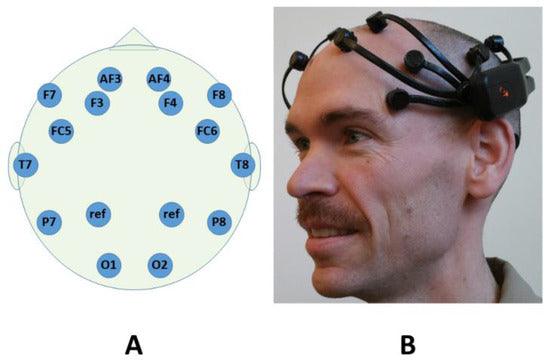
This work used low-cost wireless electroencephalography (EEG) headset to quantify the human response to different cognitive stress states on a single-trial basis. We used a Stroop-type colour–word interference test to elicit mild stress responses in 18 subjects while recording scalp EEG. Signals recorded from thirteen scalp locations were analyzed using an algorithm that computes the root mean square voltages in the theta (4–8 Hz), alpha (8–13 Hz), and beta (13–30 Hz) bands immediately following the initiation of Stroop stimuli; the mean of the Teager energy in each of these three bands; and the wideband EEG signal line-length and number of peaks. These computational features were extracted from the EEG signals on thirteen electrodes during each stimulus presentation and used as inputs to logistic regression, quadratic discriminant analysis, and k-nearest neighbour classifiers.
This work used low-cost wireless electroencephalography (EEG) headset to quantify the human response to different cognitive stress states on a single-trial basis. We used a Stroop-type colour–word interference test to elicit mild stress responses in 18 subjects while recording scalp EEG. Signals recorded from thirteen scalp locations were analyzed using an algorithm that computes the root mean square voltages in the theta (4–8 Hz), alpha (8–13 Hz), and beta (13–30 Hz) bands immediately following the initiation of Stroop stimuli; the mean of the Teager energy in each of these three bands; and the wideband EEG signal line-length and number of peaks. These computational features were extracted from the EEG signals on thirteen electrodes during each stimulus presentation and used as inputs to logistic regression, quadratic discriminant analysis, and k-nearest neighbour classifiers.
This work used low-cost wireless electroencephalography (EEG) headset to quantify the human response to different cognitive stress states on a single-trial basis. We used a Stroop-type colour–word interference test to elicit mild stress responses in 18 subjects while recording scalp EEG. Signals recorded from thirteen scalp locations were analyzed using an algorithm that computes the root mean square voltages in the theta (4–8 Hz), alpha (8–13 Hz), and beta (13–30 Hz) bands immediately following the initiation of Stroop stimuli; the mean of the Teager energy in each of these three bands; and the wideband EEG signal line-length and number of peaks. These computational features were extracted from the EEG signals on thirteen electrodes during each stimulus presentation and used as inputs to logistic regression, quadratic discriminant analysis, and k-nearest neighbour classifiers.