Wearables for Focus and Attention: What Can They Actually Measure?
H.B. Duran
Updated on
Aug 26, 2026
Wearables for Focus and Attention: What Can They Actually Measure?
H.B. Duran
Updated on
Aug 26, 2026
Wearables for Focus and Attention: What Can They Actually Measure?
H.B. Duran
Updated on
Aug 26, 2026
Wearables designed to provide information about focus and attention use different types of physiological data to help users understand what is happening during a task. Some measure movement, heart rate, or other physical signals. EEG wearables measure electrical brain activity, providing data that can be used to estimate cognitive metrics such as attention and focus.
For people interested in their own brain activity, wearable EEG can make these measurements accessible outside a traditional laboratory. Researchers and developers can also use wearable EEG to study attention in controlled experiments or real-world environments.
What Is a Focus Wearable?
A focus wearable is a device that measures physiological or behavioral signals associated with attention and presents that information to the user or researcher.
The term covers several different technologies. Some devices use movement, heart rate, breathing, or other physiological measurements as indirect indicators of attention. Others, like Emotiv Brainwear, use electroencephalography (EEG) to measure electrical brain activity directly from sensors positioned on or around the head.
That distinction is important when choosing a device. A wearable that measures movement is providing different information from one that measures EEG, even if both describe their output as “focus.”
Can EEG Measure Focus and Attention?
EEG measures electrical activity generated by populations of neurons in the brain. Researchers can analyze patterns within those signals to investigate cognitive processes associated with attention.
Attention itself is complex rather than a single electrical signal that an EEG sensor can simply detect. EEG measurements must be processed and interpreted using algorithms developed to identify patterns associated with particular cognitive states.
Emotiv's performance metrics use EEG measurements to provide defined cognitive metrics, including attention, focus, cognitive stress, engagement, excitement, interest, and relaxation. These metrics provide information about patterns in brain activity within the context of a particular experience or task.
They do not reveal what a person is thinking or explain why their attention changed.
How Do EEG Wearables Measure Attention?
EEG wearables use sensors positioned against the skin to detect small changes in electrical potential associated with brain activity. Those signals are amplified, digitized, and processed by software.
Algorithms can then analyze characteristics within the EEG data to estimate defined cognitive metrics. Depending on the system, those results may be displayed in real time or examined after a recording.
This makes it possible to compare cognitive activity across tasks, experiences, or periods of time. A user might explore how their measured attention changes while completing different activities, while a researcher might examine patterns across participants or experimental conditions.
The measurement provides context. It does not determine whether a particular level of attention is inherently “good” or “bad.”
What Is the Difference Between Attention and Focus?
Although the terms are often used interchangeably, attention and focus can describe different aspects of cognitive activity.
Attention generally refers to allocating cognitive resources toward relevant stimuli or information. Focus describes sustained concentration on a particular task or activity over time.
Both are influenced by context. Task difficulty, fatigue, distractions, motivation, environment, and many other factors can affect measured cognitive activity.
For this reason, EEG metrics are most useful when interpreted alongside information about what the person was doing at the time.
What Should You Look for in a Wearable for Focus and Attention?
Choosing a wearable starts with understanding what it actually measures. If you want information derived from brain activity, look for a device that uses EEG rather than relying exclusively on behavioral or physiological proxies.
Several other factors can help determine which type of EEG wearable fits your needs.
EEG Channel Count
An EEG channel represents a measurement location. More channels provide measurements across more areas of the scalp, which can be important for research requiring greater spatial coverage.
Fewer channels can be appropriate when portability, simplicity, and personal use are more important than broad scalp coverage. For individuals, two-channel EEG earbuds provide convenience and discreet wear.
Sensor Placement
Where EEG sensors are positioned determines which areas contribute to the recorded signal. In-ear systems and traditional scalp EEG headsets therefore provide different kinds of coverage.
The appropriate configuration depends on what you want to measure or investigate.
Signal Quality
EEG signals are small and can be affected by movement, muscle activity, and poor sensor contact. A useful EEG wearable should provide a way to evaluate sensor contact and signal quality so users can identify problems before interpreting the data.
Software
Hardware measures the signal, but software determines how users interact with the resulting data. Researchers may need access to raw EEG, data export, event marking, visualization, and analysis tools. Personal users generally benefit from software that presents defined cognitive metrics without requiring them to interpret raw EEG.
Comfort and Portability
The appropriate form factor depends on how and where the device will be used. A compact in-ear system may suit personal exploration or applications where mobility matters, while a multi-channel headset may be more appropriate when a study requires broader EEG coverage.
Using Emotiv MN8 to Explore Focus
Emotiv MN8 is a two-channel wireless EEG device built into an earbud form factor. Dry sensors positioned around the ears measure EEG without requiring conductive gel or saline.
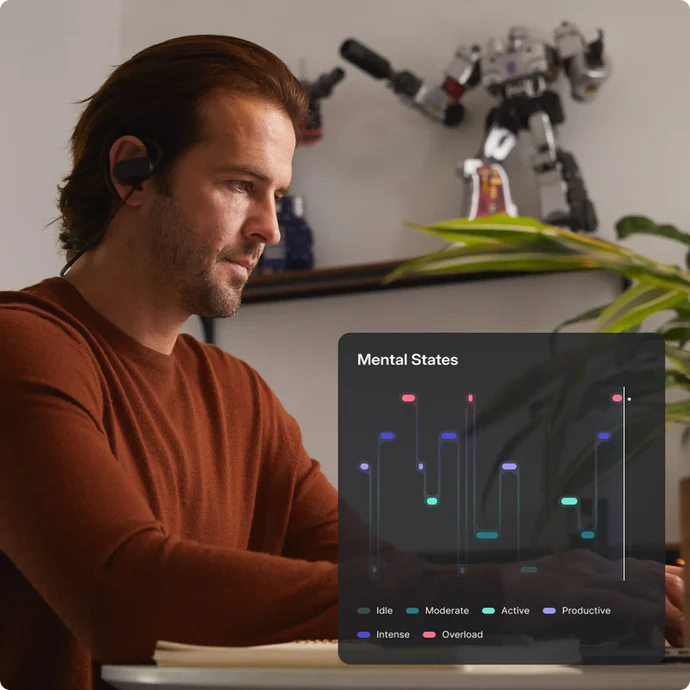
For personal use, MN8 pairs with Brainwear, Emotiv's app for exploring your own brain data. Brainwear uses EEG measurements to provide cognitive metrics that help users observe patterns associated with states including attention, focus, cognitive stress, and relaxation.
Rather than telling you whether you are focusing “correctly,” these measurements provide another source of information about your experience. You can explore how your cognitive patterns differ across activities and contexts and begin building a clearer picture of your own brain data over time.
MN8's compact design also makes it possible to collect these measurements without the setup required by a traditional multi-channel EEG headset.
Wearable EEG for Attention Research
Researchers studying attention often need more than a single cognitive metric. They may need raw EEG data, precise event timing, broader scalp coverage, or the ability to analyze neural responses associated with specific tasks.
Multi-channel systems such as Emotiv Insight, Emotiv Epoc X, and Emotiv Flex provide different levels of EEG coverage for research and development. The appropriate system depends on the experimental question, required electrode locations, recording environment, and analysis methodology.
Wearable EEG can also allow researchers to collect data in environments beyond the traditional laboratory. This can be valuable when the context of an activity is itself part of the research question.
Wearable EEG for Developers
Developers may approach attention measurement differently. Rather than studying attention as an experimental outcome, they may want to use EEG data as an input for an application.
Access to EEG data streams, cognitive metrics, APIs, and software development tools can support applications that respond to defined patterns of brain activity. These might include interactive experiences, brain-computer interfaces, adaptive applications, or research tools.
The application should be designed around what the underlying EEG measurement can reliably support rather than assuming that a wearable has direct access to a user's thoughts or intentions.
Can a Wearable Improve Your Focus?
A wearable can provide information about patterns associated with attention, but wearing an EEG device does not inherently improve focus. Understanding patterns and practice do.
For personal users, the value lies in measurement and self-observation. Seeing how attention or focus metrics change across activities may help users recognize patterns they had not previously noticed.
Research into neurofeedback and attention training continues to investigate whether particular feedback protocols can produce measurable changes in attention. Results depend on the population, methodology, feedback system, and outcome being studied, so these findings should not be generalized into a promise that any focus wearable will improve concentration.
This distinction is important: measurement is not the same as intervention.
Choosing the Right EEG Wearable
The right EEG wearable depends on what you want to learn from the data.
For personal exploration, a compact device such as Emotiv MN8 paired with Brainwear provides a straightforward way to explore cognitive metrics derived from your own EEG.
For research requiring additional channels or greater scalp coverage, systems such as Insight, Epoc X, or Flex provide different configurations for experimental EEG collection.
Developers should also consider access to raw data, APIs, SDKs, and compatible software when selecting hardware for an application.
Rather than choosing based on which device promises to make you more focused, start with a simpler question: What do I want to measure?
Understanding Focus Through Brain Data
Focus and attention are dynamic cognitive processes influenced by what we are doing and the environment around us. Wearable EEG provides one way to measure the brain activity associated with those experiences.
For personal users, MN8 and Brainwear make cognitive metrics easier to explore in everyday contexts. For researchers and developers, wearable EEG provides access to brain data that can support controlled studies, real-world research, and new applications.
The goal is not to reduce attention to a single score. It is to provide another source of information for understanding how brain activity changes across experiences.
Explore Your Brain Data With MN8
Emotiv MN8 combines two-channel EEG with a wireless earbud form factor, while Brainwear turns those measurements into cognitive metrics you can explore over time.
Frequently Asked Questions
What Is a Wearable for Focus and Attention?
A focus wearable measures physiological, behavioral, or brain signals associated with attention. EEG wearables specifically measure electrical brain activity and can use those measurements to derive defined cognitive metrics.
Can EEG Measure Attention?
EEG can measure patterns of brain activity associated with attentional processes. Algorithms can analyze those signals to estimate attention-related cognitive metrics, but EEG does not directly observe a person's thoughts or determine why attention changes.
Does Emotiv MN8 Measure Focus?
MN8 measures two channels of EEG around the ears. Brainwear can use those EEG measurements to provide cognitive metrics including attention and focus.
Can a Wearable Make Me More Focused?
Simply wearing a device does not improve attention. A wearable can provide measurements that help users observe patterns in their cognitive activity. Research into specific neurofeedback and attention-training approaches is a separate field and should not be interpreted as evidence that every focus wearable improves concentration.
Does EEG Read Your Thoughts?
No. EEG measures electrical brain activity from sensors placed against the skin. It can identify patterns associated with defined cognitive processes, but it does not reveal the content of a person's thoughts.
How Many EEG Channels Do I Need?
That depends on the application. A low-channel system can support personal brain data experiences and applications where portability matters. Research requiring measurements across multiple scalp locations generally benefits from additional channels and appropriate electrode coverage.
Wearables designed to provide information about focus and attention use different types of physiological data to help users understand what is happening during a task. Some measure movement, heart rate, or other physical signals. EEG wearables measure electrical brain activity, providing data that can be used to estimate cognitive metrics such as attention and focus.
For people interested in their own brain activity, wearable EEG can make these measurements accessible outside a traditional laboratory. Researchers and developers can also use wearable EEG to study attention in controlled experiments or real-world environments.
What Is a Focus Wearable?
A focus wearable is a device that measures physiological or behavioral signals associated with attention and presents that information to the user or researcher.
The term covers several different technologies. Some devices use movement, heart rate, breathing, or other physiological measurements as indirect indicators of attention. Others, like Emotiv Brainwear, use electroencephalography (EEG) to measure electrical brain activity directly from sensors positioned on or around the head.
That distinction is important when choosing a device. A wearable that measures movement is providing different information from one that measures EEG, even if both describe their output as “focus.”
Can EEG Measure Focus and Attention?
EEG measures electrical activity generated by populations of neurons in the brain. Researchers can analyze patterns within those signals to investigate cognitive processes associated with attention.
Attention itself is complex rather than a single electrical signal that an EEG sensor can simply detect. EEG measurements must be processed and interpreted using algorithms developed to identify patterns associated with particular cognitive states.
Emotiv's performance metrics use EEG measurements to provide defined cognitive metrics, including attention, focus, cognitive stress, engagement, excitement, interest, and relaxation. These metrics provide information about patterns in brain activity within the context of a particular experience or task.
They do not reveal what a person is thinking or explain why their attention changed.
How Do EEG Wearables Measure Attention?
EEG wearables use sensors positioned against the skin to detect small changes in electrical potential associated with brain activity. Those signals are amplified, digitized, and processed by software.
Algorithms can then analyze characteristics within the EEG data to estimate defined cognitive metrics. Depending on the system, those results may be displayed in real time or examined after a recording.
This makes it possible to compare cognitive activity across tasks, experiences, or periods of time. A user might explore how their measured attention changes while completing different activities, while a researcher might examine patterns across participants or experimental conditions.
The measurement provides context. It does not determine whether a particular level of attention is inherently “good” or “bad.”
What Is the Difference Between Attention and Focus?
Although the terms are often used interchangeably, attention and focus can describe different aspects of cognitive activity.
Attention generally refers to allocating cognitive resources toward relevant stimuli or information. Focus describes sustained concentration on a particular task or activity over time.
Both are influenced by context. Task difficulty, fatigue, distractions, motivation, environment, and many other factors can affect measured cognitive activity.
For this reason, EEG metrics are most useful when interpreted alongside information about what the person was doing at the time.
What Should You Look for in a Wearable for Focus and Attention?
Choosing a wearable starts with understanding what it actually measures. If you want information derived from brain activity, look for a device that uses EEG rather than relying exclusively on behavioral or physiological proxies.
Several other factors can help determine which type of EEG wearable fits your needs.
EEG Channel Count
An EEG channel represents a measurement location. More channels provide measurements across more areas of the scalp, which can be important for research requiring greater spatial coverage.
Fewer channels can be appropriate when portability, simplicity, and personal use are more important than broad scalp coverage. For individuals, two-channel EEG earbuds provide convenience and discreet wear.
Sensor Placement
Where EEG sensors are positioned determines which areas contribute to the recorded signal. In-ear systems and traditional scalp EEG headsets therefore provide different kinds of coverage.
The appropriate configuration depends on what you want to measure or investigate.
Signal Quality
EEG signals are small and can be affected by movement, muscle activity, and poor sensor contact. A useful EEG wearable should provide a way to evaluate sensor contact and signal quality so users can identify problems before interpreting the data.
Software
Hardware measures the signal, but software determines how users interact with the resulting data. Researchers may need access to raw EEG, data export, event marking, visualization, and analysis tools. Personal users generally benefit from software that presents defined cognitive metrics without requiring them to interpret raw EEG.
Comfort and Portability
The appropriate form factor depends on how and where the device will be used. A compact in-ear system may suit personal exploration or applications where mobility matters, while a multi-channel headset may be more appropriate when a study requires broader EEG coverage.
Using Emotiv MN8 to Explore Focus
Emotiv MN8 is a two-channel wireless EEG device built into an earbud form factor. Dry sensors positioned around the ears measure EEG without requiring conductive gel or saline.
For personal use, MN8 pairs with Brainwear, Emotiv's app for exploring your own brain data. Brainwear uses EEG measurements to provide cognitive metrics that help users observe patterns associated with states including attention, focus, cognitive stress, and relaxation.
Rather than telling you whether you are focusing “correctly,” these measurements provide another source of information about your experience. You can explore how your cognitive patterns differ across activities and contexts and begin building a clearer picture of your own brain data over time.
MN8's compact design also makes it possible to collect these measurements without the setup required by a traditional multi-channel EEG headset.
Wearable EEG for Attention Research
Researchers studying attention often need more than a single cognitive metric. They may need raw EEG data, precise event timing, broader scalp coverage, or the ability to analyze neural responses associated with specific tasks.
Multi-channel systems such as Emotiv Insight, Emotiv Epoc X, and Emotiv Flex provide different levels of EEG coverage for research and development. The appropriate system depends on the experimental question, required electrode locations, recording environment, and analysis methodology.
Wearable EEG can also allow researchers to collect data in environments beyond the traditional laboratory. This can be valuable when the context of an activity is itself part of the research question.
Wearable EEG for Developers
Developers may approach attention measurement differently. Rather than studying attention as an experimental outcome, they may want to use EEG data as an input for an application.
Access to EEG data streams, cognitive metrics, APIs, and software development tools can support applications that respond to defined patterns of brain activity. These might include interactive experiences, brain-computer interfaces, adaptive applications, or research tools.
The application should be designed around what the underlying EEG measurement can reliably support rather than assuming that a wearable has direct access to a user's thoughts or intentions.
Can a Wearable Improve Your Focus?
A wearable can provide information about patterns associated with attention, but wearing an EEG device does not inherently improve focus. Understanding patterns and practice do.
For personal users, the value lies in measurement and self-observation. Seeing how attention or focus metrics change across activities may help users recognize patterns they had not previously noticed.
Research into neurofeedback and attention training continues to investigate whether particular feedback protocols can produce measurable changes in attention. Results depend on the population, methodology, feedback system, and outcome being studied, so these findings should not be generalized into a promise that any focus wearable will improve concentration.
This distinction is important: measurement is not the same as intervention.
Choosing the Right EEG Wearable
The right EEG wearable depends on what you want to learn from the data.
For personal exploration, a compact device such as Emotiv MN8 paired with Brainwear provides a straightforward way to explore cognitive metrics derived from your own EEG.
For research requiring additional channels or greater scalp coverage, systems such as Insight, Epoc X, or Flex provide different configurations for experimental EEG collection.
Developers should also consider access to raw data, APIs, SDKs, and compatible software when selecting hardware for an application.
Rather than choosing based on which device promises to make you more focused, start with a simpler question: What do I want to measure?
Understanding Focus Through Brain Data
Focus and attention are dynamic cognitive processes influenced by what we are doing and the environment around us. Wearable EEG provides one way to measure the brain activity associated with those experiences.
For personal users, MN8 and Brainwear make cognitive metrics easier to explore in everyday contexts. For researchers and developers, wearable EEG provides access to brain data that can support controlled studies, real-world research, and new applications.
The goal is not to reduce attention to a single score. It is to provide another source of information for understanding how brain activity changes across experiences.
Explore Your Brain Data With MN8
Emotiv MN8 combines two-channel EEG with a wireless earbud form factor, while Brainwear turns those measurements into cognitive metrics you can explore over time.
Frequently Asked Questions
What Is a Wearable for Focus and Attention?
A focus wearable measures physiological, behavioral, or brain signals associated with attention. EEG wearables specifically measure electrical brain activity and can use those measurements to derive defined cognitive metrics.
Can EEG Measure Attention?
EEG can measure patterns of brain activity associated with attentional processes. Algorithms can analyze those signals to estimate attention-related cognitive metrics, but EEG does not directly observe a person's thoughts or determine why attention changes.
Does Emotiv MN8 Measure Focus?
MN8 measures two channels of EEG around the ears. Brainwear can use those EEG measurements to provide cognitive metrics including attention and focus.
Can a Wearable Make Me More Focused?
Simply wearing a device does not improve attention. A wearable can provide measurements that help users observe patterns in their cognitive activity. Research into specific neurofeedback and attention-training approaches is a separate field and should not be interpreted as evidence that every focus wearable improves concentration.
Does EEG Read Your Thoughts?
No. EEG measures electrical brain activity from sensors placed against the skin. It can identify patterns associated with defined cognitive processes, but it does not reveal the content of a person's thoughts.
How Many EEG Channels Do I Need?
That depends on the application. A low-channel system can support personal brain data experiences and applications where portability matters. Research requiring measurements across multiple scalp locations generally benefits from additional channels and appropriate electrode coverage.
Wearables designed to provide information about focus and attention use different types of physiological data to help users understand what is happening during a task. Some measure movement, heart rate, or other physical signals. EEG wearables measure electrical brain activity, providing data that can be used to estimate cognitive metrics such as attention and focus.
For people interested in their own brain activity, wearable EEG can make these measurements accessible outside a traditional laboratory. Researchers and developers can also use wearable EEG to study attention in controlled experiments or real-world environments.
What Is a Focus Wearable?
A focus wearable is a device that measures physiological or behavioral signals associated with attention and presents that information to the user or researcher.
The term covers several different technologies. Some devices use movement, heart rate, breathing, or other physiological measurements as indirect indicators of attention. Others, like Emotiv Brainwear, use electroencephalography (EEG) to measure electrical brain activity directly from sensors positioned on or around the head.
That distinction is important when choosing a device. A wearable that measures movement is providing different information from one that measures EEG, even if both describe their output as “focus.”
Can EEG Measure Focus and Attention?
EEG measures electrical activity generated by populations of neurons in the brain. Researchers can analyze patterns within those signals to investigate cognitive processes associated with attention.
Attention itself is complex rather than a single electrical signal that an EEG sensor can simply detect. EEG measurements must be processed and interpreted using algorithms developed to identify patterns associated with particular cognitive states.
Emotiv's performance metrics use EEG measurements to provide defined cognitive metrics, including attention, focus, cognitive stress, engagement, excitement, interest, and relaxation. These metrics provide information about patterns in brain activity within the context of a particular experience or task.
They do not reveal what a person is thinking or explain why their attention changed.
How Do EEG Wearables Measure Attention?
EEG wearables use sensors positioned against the skin to detect small changes in electrical potential associated with brain activity. Those signals are amplified, digitized, and processed by software.
Algorithms can then analyze characteristics within the EEG data to estimate defined cognitive metrics. Depending on the system, those results may be displayed in real time or examined after a recording.
This makes it possible to compare cognitive activity across tasks, experiences, or periods of time. A user might explore how their measured attention changes while completing different activities, while a researcher might examine patterns across participants or experimental conditions.
The measurement provides context. It does not determine whether a particular level of attention is inherently “good” or “bad.”
What Is the Difference Between Attention and Focus?
Although the terms are often used interchangeably, attention and focus can describe different aspects of cognitive activity.
Attention generally refers to allocating cognitive resources toward relevant stimuli or information. Focus describes sustained concentration on a particular task or activity over time.
Both are influenced by context. Task difficulty, fatigue, distractions, motivation, environment, and many other factors can affect measured cognitive activity.
For this reason, EEG metrics are most useful when interpreted alongside information about what the person was doing at the time.
What Should You Look for in a Wearable for Focus and Attention?
Choosing a wearable starts with understanding what it actually measures. If you want information derived from brain activity, look for a device that uses EEG rather than relying exclusively on behavioral or physiological proxies.
Several other factors can help determine which type of EEG wearable fits your needs.
EEG Channel Count
An EEG channel represents a measurement location. More channels provide measurements across more areas of the scalp, which can be important for research requiring greater spatial coverage.
Fewer channels can be appropriate when portability, simplicity, and personal use are more important than broad scalp coverage. For individuals, two-channel EEG earbuds provide convenience and discreet wear.
Sensor Placement
Where EEG sensors are positioned determines which areas contribute to the recorded signal. In-ear systems and traditional scalp EEG headsets therefore provide different kinds of coverage.
The appropriate configuration depends on what you want to measure or investigate.
Signal Quality
EEG signals are small and can be affected by movement, muscle activity, and poor sensor contact. A useful EEG wearable should provide a way to evaluate sensor contact and signal quality so users can identify problems before interpreting the data.
Software
Hardware measures the signal, but software determines how users interact with the resulting data. Researchers may need access to raw EEG, data export, event marking, visualization, and analysis tools. Personal users generally benefit from software that presents defined cognitive metrics without requiring them to interpret raw EEG.
Comfort and Portability
The appropriate form factor depends on how and where the device will be used. A compact in-ear system may suit personal exploration or applications where mobility matters, while a multi-channel headset may be more appropriate when a study requires broader EEG coverage.
Using Emotiv MN8 to Explore Focus
Emotiv MN8 is a two-channel wireless EEG device built into an earbud form factor. Dry sensors positioned around the ears measure EEG without requiring conductive gel or saline.
For personal use, MN8 pairs with Brainwear, Emotiv's app for exploring your own brain data. Brainwear uses EEG measurements to provide cognitive metrics that help users observe patterns associated with states including attention, focus, cognitive stress, and relaxation.
Rather than telling you whether you are focusing “correctly,” these measurements provide another source of information about your experience. You can explore how your cognitive patterns differ across activities and contexts and begin building a clearer picture of your own brain data over time.
MN8's compact design also makes it possible to collect these measurements without the setup required by a traditional multi-channel EEG headset.
Wearable EEG for Attention Research
Researchers studying attention often need more than a single cognitive metric. They may need raw EEG data, precise event timing, broader scalp coverage, or the ability to analyze neural responses associated with specific tasks.
Multi-channel systems such as Emotiv Insight, Emotiv Epoc X, and Emotiv Flex provide different levels of EEG coverage for research and development. The appropriate system depends on the experimental question, required electrode locations, recording environment, and analysis methodology.
Wearable EEG can also allow researchers to collect data in environments beyond the traditional laboratory. This can be valuable when the context of an activity is itself part of the research question.
Wearable EEG for Developers
Developers may approach attention measurement differently. Rather than studying attention as an experimental outcome, they may want to use EEG data as an input for an application.
Access to EEG data streams, cognitive metrics, APIs, and software development tools can support applications that respond to defined patterns of brain activity. These might include interactive experiences, brain-computer interfaces, adaptive applications, or research tools.
The application should be designed around what the underlying EEG measurement can reliably support rather than assuming that a wearable has direct access to a user's thoughts or intentions.
Can a Wearable Improve Your Focus?
A wearable can provide information about patterns associated with attention, but wearing an EEG device does not inherently improve focus. Understanding patterns and practice do.
For personal users, the value lies in measurement and self-observation. Seeing how attention or focus metrics change across activities may help users recognize patterns they had not previously noticed.
Research into neurofeedback and attention training continues to investigate whether particular feedback protocols can produce measurable changes in attention. Results depend on the population, methodology, feedback system, and outcome being studied, so these findings should not be generalized into a promise that any focus wearable will improve concentration.
This distinction is important: measurement is not the same as intervention.
Choosing the Right EEG Wearable
The right EEG wearable depends on what you want to learn from the data.
For personal exploration, a compact device such as Emotiv MN8 paired with Brainwear provides a straightforward way to explore cognitive metrics derived from your own EEG.
For research requiring additional channels or greater scalp coverage, systems such as Insight, Epoc X, or Flex provide different configurations for experimental EEG collection.
Developers should also consider access to raw data, APIs, SDKs, and compatible software when selecting hardware for an application.
Rather than choosing based on which device promises to make you more focused, start with a simpler question: What do I want to measure?
Understanding Focus Through Brain Data
Focus and attention are dynamic cognitive processes influenced by what we are doing and the environment around us. Wearable EEG provides one way to measure the brain activity associated with those experiences.
For personal users, MN8 and Brainwear make cognitive metrics easier to explore in everyday contexts. For researchers and developers, wearable EEG provides access to brain data that can support controlled studies, real-world research, and new applications.
The goal is not to reduce attention to a single score. It is to provide another source of information for understanding how brain activity changes across experiences.
Explore Your Brain Data With MN8
Emotiv MN8 combines two-channel EEG with a wireless earbud form factor, while Brainwear turns those measurements into cognitive metrics you can explore over time.
Frequently Asked Questions
What Is a Wearable for Focus and Attention?
A focus wearable measures physiological, behavioral, or brain signals associated with attention. EEG wearables specifically measure electrical brain activity and can use those measurements to derive defined cognitive metrics.
Can EEG Measure Attention?
EEG can measure patterns of brain activity associated with attentional processes. Algorithms can analyze those signals to estimate attention-related cognitive metrics, but EEG does not directly observe a person's thoughts or determine why attention changes.
Does Emotiv MN8 Measure Focus?
MN8 measures two channels of EEG around the ears. Brainwear can use those EEG measurements to provide cognitive metrics including attention and focus.
Can a Wearable Make Me More Focused?
Simply wearing a device does not improve attention. A wearable can provide measurements that help users observe patterns in their cognitive activity. Research into specific neurofeedback and attention-training approaches is a separate field and should not be interpreted as evidence that every focus wearable improves concentration.
Does EEG Read Your Thoughts?
No. EEG measures electrical brain activity from sensors placed against the skin. It can identify patterns associated with defined cognitive processes, but it does not reveal the content of a person's thoughts.
How Many EEG Channels Do I Need?
That depends on the application. A low-channel system can support personal brain data experiences and applications where portability matters. Research requiring measurements across multiple scalp locations generally benefits from additional channels and appropriate electrode coverage.

Continue reading