Testing TV Advertising with EEG for Better Campaign Performance
H.B. Duran
Updated on
Jun 9, 2026
Testing TV Advertising with EEG for Better Campaign Performance
H.B. Duran
Updated on
Jun 9, 2026
Testing TV Advertising with EEG for Better Campaign Performance
H.B. Duran
Updated on
Jun 9, 2026
For marketing agencies managing high-budget media investments, the challenge is rarely creating more TV advertising. The challenge is determining which creative executions are most likely to capture attention, sustain engagement, and drive meaningful audience response before a campaign reaches millions of viewers. Traditional evaluation methods such as surveys, focus groups, and recall studies provide useful feedback, but they often depend on conscious reporting after exposure rather than capturing audience reactions as they occur.
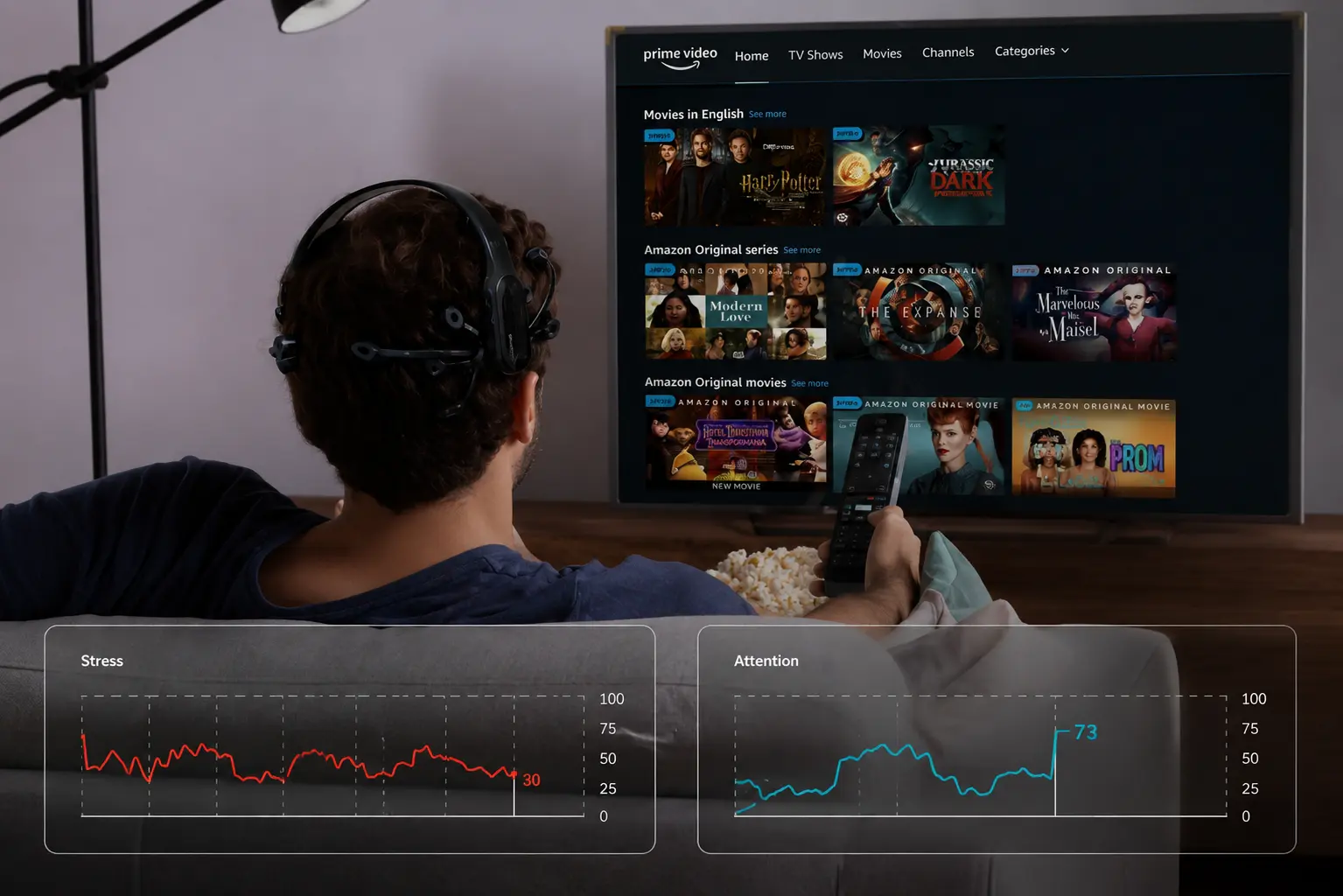
As media fragmentation increases and viewer attention becomes more difficult to earn, agencies are looking for more precise ways to evaluate creative effectiveness. EEG-based testing provides an additional layer of insight by measuring neural indicators associated with attention, engagement, cognitive workload, and memory-related processing throughout an advertisement. Rather than replacing existing research methods, EEG helps contextualize behavioral and attitudinal data, allowing teams to identify which moments resonate, where attention drops, and how creative elements influence audience response. For agencies responsible for maximizing advertising performance, these insights can support more confident creative decisions before launch.
Key Takeaways
EEG testing helps identify moment-by-moment audience responses during TV commercials.
Neural engagement metrics can reveal attention shifts that traditional surveys may miss.
Agencies can optimize creative assets before media spend is committed.
EEG data adds context to recall, preference, and brand lift measurements.
Testing helps prioritize creative versions with stronger audience engagement potential.
Why TV Advertising Optimization Remains Difficult
Even experienced agencies face uncertainty when evaluating television creative. Consumers may report that they enjoyed an advertisement, yet the campaign underperforms. Conversely, advertisements that generate mixed survey responses sometimes deliver strong market results.
This disconnect exists because audience reactions unfold in milliseconds. Attention fluctuates throughout a commercial, emotional intensity changes across scenes, and memory formation is influenced by both creative execution and contextual factors. Traditional methodologies often capture only a summary of the experience rather than the experience itself.
For agencies comparing multiple concepts, edits, or campaign variants, understanding where engagement increases or declines can be more valuable than measuring overall preference alone. The ability to pinpoint these moments allows teams to refine pacing, storytelling, branding placement, and messaging before launch.
What EEG Adds to TV Advertising Research
Electroencephalography (EEG) provides a direct measure of electrical brain activity with millisecond-level temporal resolution. This makes it particularly useful for evaluating video-based media where audience responses change continuously throughout exposure.
Research reviewed by Bazzani et al. (2020) found that EEG is especially effective for studying reactions to advertisements and other dynamic media because it captures rapid neural responses that are difficult to observe through self-report methods alone. Similarly, a comprehensive review by Khondakar et al. (2024) highlighted advertising as one of the most prominent applications of EEG within consumer neuroscience, reflecting its value for understanding audience behavior and campaign effectiveness.
For agencies testing TV advertising, EEG can contribute insights related to:
Attention allocation during specific scenes
Engagement fluctuations across the advertisement
Cognitive effort associated with processing messages
Memory-related neural activity
Audience response to branding and calls-to-action
When combined with survey responses, behavioral metrics, and qualitative feedback, these measures create a more comprehensive view of advertisement performance.
Identifying the Moments That Matter Most
One of the most valuable applications of EEG testing is identifying critical moments within a commercial. Agencies frequently invest significant resources in optimizing opening sequences, brand reveals, product demonstrations, and closing calls-to-action. Yet determining whether these moments actually maintain audience engagement can be difficult using conventional methodologies.
EEG allows researchers to map audience responses across the timeline of an advertisement. Rather than receiving a single overall score, teams can examine which scenes generate sustained attention and which moments correspond with reduced engagement.
This level of granularity is particularly useful when comparing alternate edits. A minor change in pacing, narrative structure, or visual presentation may produce meaningful differences in audience response that are not fully captured through post-exposure surveys.
Real-World Example: Predicting Audience Engagement
A notable example comes from research by Shestyuk et al. (2019), which examined whether EEG measures of attention, memory, and motivation could predict audience behavior related to television content. The researchers found significant relationships between neural measures and real-world indicators such as TV viewership and social engagement.
For agencies, the implication is important. Neural indicators collected during media exposure may provide early signals about audience response that extend beyond what viewers can verbally articulate. While EEG should not be viewed as a standalone predictor of campaign success, it can contribute meaningful context during creative evaluation.
Real-World Example: Consumer Neuroscience in Ad Testing
Consumer neuroscience applications have also been explored extensively within advertising effectiveness research. According to Nielsen (2013), EEG-based methodologies have been used to understand how viewers respond to advertising at a granular level, capturing reactions in fractions of a second throughout exposure.
Nielsen's work demonstrated that neural measurements can complement traditional copy testing by revealing how audience attention and engagement evolve across an advertisement. For agencies evaluating television campaigns, this creates opportunities to refine storytelling structures, optimize message sequencing, and improve creative execution before launch.
How Agencies Can Use EEG Testing in Creative Development
EEG testing is most valuable when integrated into existing research workflows rather than treated as a separate exercise. Agencies can use neuroscience-informed testing during multiple stages of campaign development.
During concept evaluation, EEG can help compare different creative directions. During production, it can assess rough cuts and identify potential engagement issues. Before launch, it can support validation of final creative assets alongside survey-based measures and behavioral testing.
Many organizations are also incorporating EEG into broader audience research programs. This reduce reliance on self-reported responses alone by providing objective measures of audience engagement and cognitive response.
The result is a richer understanding of how viewers experience content in real time, enabling more informed optimization decisions.
Moving Beyond Recall-Based Evaluation
Recall remains an important advertising metric, but it does not explain why a message was memorable or how viewers experienced the advertisement along the way. By combining traditional research approaches with EEG-based measurements, agencies gain visibility into the mechanisms that contribute to audience engagement.
This additional layer of insight can help teams answer practical questions such as:
Which scenes sustain attention most effectively?
Where does audience engagement decline?
Are branding elements introduced at optimal moments?
How do different creative versions compare?
Which execution produces the strongest overall audience response?
As media investments become increasingly scrutinized, having greater confidence in creative decisions before launch can significantly improve campaign efficiency and effectiveness.
Conclusion
TV advertising remains one of the most influential channels for brand communication, but evaluating creative effectiveness requires more than post-exposure feedback alone. EEG testing provides agencies with a detailed view of audience attention, engagement, and cognitive response throughout an advertisement, helping teams identify strengths and opportunities for optimization before media budgets are committed.
By integrating neuroscience-informed insights with established research methodologies, agencies can make more informed decisions about creative development, campaign refinement, and audience testing strategies.
Teams looking to evaluate attention, engagement, and audience response before launch can explore the capabilities of Emotiv Studio to support neuroscience-informed TV advertising research workflows.
Sources
Bazzani, A., et al. (2020). Is EEG Suitable for Marketing Research? A Systematic Review. Frontiers in Human Neuroscience. https://pmc.ncbi.nlm.nih.gov/articles/PMC7779633/
Khondakar, M. F. K., et al. (2024). A Systematic Review on EEG-Based Neuromarketing. Cognitive Research: Principles and Implications. https://link.springer.com/article/10.1186/s40708-024-00229-8
Nielsen. (2013). Consumer Neuroscience-Based Advertising: Making 15s the New 30. https://www.nielsen.com/insights/2013/consumer-neuroscience-based-advertising-making-15s-the-new-30/
Shestyuk, A. Y., et al. (2019). Individual EEG Measures of Attention, Memory, and Motivation Predict Population-Level TV Viewership and Twitter Engagement. PLOS ONE. https://journals.plos.org/plosone/article?id=10.1371/journal.pone.0214507
Emotiv. Consumer Research Using EEG. https://www.emotiv.com/pages/consumer-research
For marketing agencies managing high-budget media investments, the challenge is rarely creating more TV advertising. The challenge is determining which creative executions are most likely to capture attention, sustain engagement, and drive meaningful audience response before a campaign reaches millions of viewers. Traditional evaluation methods such as surveys, focus groups, and recall studies provide useful feedback, but they often depend on conscious reporting after exposure rather than capturing audience reactions as they occur.
As media fragmentation increases and viewer attention becomes more difficult to earn, agencies are looking for more precise ways to evaluate creative effectiveness. EEG-based testing provides an additional layer of insight by measuring neural indicators associated with attention, engagement, cognitive workload, and memory-related processing throughout an advertisement. Rather than replacing existing research methods, EEG helps contextualize behavioral and attitudinal data, allowing teams to identify which moments resonate, where attention drops, and how creative elements influence audience response. For agencies responsible for maximizing advertising performance, these insights can support more confident creative decisions before launch.
Key Takeaways
EEG testing helps identify moment-by-moment audience responses during TV commercials.
Neural engagement metrics can reveal attention shifts that traditional surveys may miss.
Agencies can optimize creative assets before media spend is committed.
EEG data adds context to recall, preference, and brand lift measurements.
Testing helps prioritize creative versions with stronger audience engagement potential.
Why TV Advertising Optimization Remains Difficult
Even experienced agencies face uncertainty when evaluating television creative. Consumers may report that they enjoyed an advertisement, yet the campaign underperforms. Conversely, advertisements that generate mixed survey responses sometimes deliver strong market results.
This disconnect exists because audience reactions unfold in milliseconds. Attention fluctuates throughout a commercial, emotional intensity changes across scenes, and memory formation is influenced by both creative execution and contextual factors. Traditional methodologies often capture only a summary of the experience rather than the experience itself.
For agencies comparing multiple concepts, edits, or campaign variants, understanding where engagement increases or declines can be more valuable than measuring overall preference alone. The ability to pinpoint these moments allows teams to refine pacing, storytelling, branding placement, and messaging before launch.
What EEG Adds to TV Advertising Research
Electroencephalography (EEG) provides a direct measure of electrical brain activity with millisecond-level temporal resolution. This makes it particularly useful for evaluating video-based media where audience responses change continuously throughout exposure.
Research reviewed by Bazzani et al. (2020) found that EEG is especially effective for studying reactions to advertisements and other dynamic media because it captures rapid neural responses that are difficult to observe through self-report methods alone. Similarly, a comprehensive review by Khondakar et al. (2024) highlighted advertising as one of the most prominent applications of EEG within consumer neuroscience, reflecting its value for understanding audience behavior and campaign effectiveness.
For agencies testing TV advertising, EEG can contribute insights related to:
Attention allocation during specific scenes
Engagement fluctuations across the advertisement
Cognitive effort associated with processing messages
Memory-related neural activity
Audience response to branding and calls-to-action
When combined with survey responses, behavioral metrics, and qualitative feedback, these measures create a more comprehensive view of advertisement performance.
Identifying the Moments That Matter Most
One of the most valuable applications of EEG testing is identifying critical moments within a commercial. Agencies frequently invest significant resources in optimizing opening sequences, brand reveals, product demonstrations, and closing calls-to-action. Yet determining whether these moments actually maintain audience engagement can be difficult using conventional methodologies.
EEG allows researchers to map audience responses across the timeline of an advertisement. Rather than receiving a single overall score, teams can examine which scenes generate sustained attention and which moments correspond with reduced engagement.
This level of granularity is particularly useful when comparing alternate edits. A minor change in pacing, narrative structure, or visual presentation may produce meaningful differences in audience response that are not fully captured through post-exposure surveys.
Real-World Example: Predicting Audience Engagement
A notable example comes from research by Shestyuk et al. (2019), which examined whether EEG measures of attention, memory, and motivation could predict audience behavior related to television content. The researchers found significant relationships between neural measures and real-world indicators such as TV viewership and social engagement.
For agencies, the implication is important. Neural indicators collected during media exposure may provide early signals about audience response that extend beyond what viewers can verbally articulate. While EEG should not be viewed as a standalone predictor of campaign success, it can contribute meaningful context during creative evaluation.
Real-World Example: Consumer Neuroscience in Ad Testing
Consumer neuroscience applications have also been explored extensively within advertising effectiveness research. According to Nielsen (2013), EEG-based methodologies have been used to understand how viewers respond to advertising at a granular level, capturing reactions in fractions of a second throughout exposure.
Nielsen's work demonstrated that neural measurements can complement traditional copy testing by revealing how audience attention and engagement evolve across an advertisement. For agencies evaluating television campaigns, this creates opportunities to refine storytelling structures, optimize message sequencing, and improve creative execution before launch.
How Agencies Can Use EEG Testing in Creative Development
EEG testing is most valuable when integrated into existing research workflows rather than treated as a separate exercise. Agencies can use neuroscience-informed testing during multiple stages of campaign development.
During concept evaluation, EEG can help compare different creative directions. During production, it can assess rough cuts and identify potential engagement issues. Before launch, it can support validation of final creative assets alongside survey-based measures and behavioral testing.
Many organizations are also incorporating EEG into broader audience research programs. This reduce reliance on self-reported responses alone by providing objective measures of audience engagement and cognitive response.
The result is a richer understanding of how viewers experience content in real time, enabling more informed optimization decisions.
Moving Beyond Recall-Based Evaluation
Recall remains an important advertising metric, but it does not explain why a message was memorable or how viewers experienced the advertisement along the way. By combining traditional research approaches with EEG-based measurements, agencies gain visibility into the mechanisms that contribute to audience engagement.
This additional layer of insight can help teams answer practical questions such as:
Which scenes sustain attention most effectively?
Where does audience engagement decline?
Are branding elements introduced at optimal moments?
How do different creative versions compare?
Which execution produces the strongest overall audience response?
As media investments become increasingly scrutinized, having greater confidence in creative decisions before launch can significantly improve campaign efficiency and effectiveness.
Conclusion
TV advertising remains one of the most influential channels for brand communication, but evaluating creative effectiveness requires more than post-exposure feedback alone. EEG testing provides agencies with a detailed view of audience attention, engagement, and cognitive response throughout an advertisement, helping teams identify strengths and opportunities for optimization before media budgets are committed.
By integrating neuroscience-informed insights with established research methodologies, agencies can make more informed decisions about creative development, campaign refinement, and audience testing strategies.
Teams looking to evaluate attention, engagement, and audience response before launch can explore the capabilities of Emotiv Studio to support neuroscience-informed TV advertising research workflows.
Sources
Bazzani, A., et al. (2020). Is EEG Suitable for Marketing Research? A Systematic Review. Frontiers in Human Neuroscience. https://pmc.ncbi.nlm.nih.gov/articles/PMC7779633/
Khondakar, M. F. K., et al. (2024). A Systematic Review on EEG-Based Neuromarketing. Cognitive Research: Principles and Implications. https://link.springer.com/article/10.1186/s40708-024-00229-8
Nielsen. (2013). Consumer Neuroscience-Based Advertising: Making 15s the New 30. https://www.nielsen.com/insights/2013/consumer-neuroscience-based-advertising-making-15s-the-new-30/
Shestyuk, A. Y., et al. (2019). Individual EEG Measures of Attention, Memory, and Motivation Predict Population-Level TV Viewership and Twitter Engagement. PLOS ONE. https://journals.plos.org/plosone/article?id=10.1371/journal.pone.0214507
Emotiv. Consumer Research Using EEG. https://www.emotiv.com/pages/consumer-research
For marketing agencies managing high-budget media investments, the challenge is rarely creating more TV advertising. The challenge is determining which creative executions are most likely to capture attention, sustain engagement, and drive meaningful audience response before a campaign reaches millions of viewers. Traditional evaluation methods such as surveys, focus groups, and recall studies provide useful feedback, but they often depend on conscious reporting after exposure rather than capturing audience reactions as they occur.
As media fragmentation increases and viewer attention becomes more difficult to earn, agencies are looking for more precise ways to evaluate creative effectiveness. EEG-based testing provides an additional layer of insight by measuring neural indicators associated with attention, engagement, cognitive workload, and memory-related processing throughout an advertisement. Rather than replacing existing research methods, EEG helps contextualize behavioral and attitudinal data, allowing teams to identify which moments resonate, where attention drops, and how creative elements influence audience response. For agencies responsible for maximizing advertising performance, these insights can support more confident creative decisions before launch.
Key Takeaways
EEG testing helps identify moment-by-moment audience responses during TV commercials.
Neural engagement metrics can reveal attention shifts that traditional surveys may miss.
Agencies can optimize creative assets before media spend is committed.
EEG data adds context to recall, preference, and brand lift measurements.
Testing helps prioritize creative versions with stronger audience engagement potential.
Why TV Advertising Optimization Remains Difficult
Even experienced agencies face uncertainty when evaluating television creative. Consumers may report that they enjoyed an advertisement, yet the campaign underperforms. Conversely, advertisements that generate mixed survey responses sometimes deliver strong market results.
This disconnect exists because audience reactions unfold in milliseconds. Attention fluctuates throughout a commercial, emotional intensity changes across scenes, and memory formation is influenced by both creative execution and contextual factors. Traditional methodologies often capture only a summary of the experience rather than the experience itself.
For agencies comparing multiple concepts, edits, or campaign variants, understanding where engagement increases or declines can be more valuable than measuring overall preference alone. The ability to pinpoint these moments allows teams to refine pacing, storytelling, branding placement, and messaging before launch.
What EEG Adds to TV Advertising Research
Electroencephalography (EEG) provides a direct measure of electrical brain activity with millisecond-level temporal resolution. This makes it particularly useful for evaluating video-based media where audience responses change continuously throughout exposure.
Research reviewed by Bazzani et al. (2020) found that EEG is especially effective for studying reactions to advertisements and other dynamic media because it captures rapid neural responses that are difficult to observe through self-report methods alone. Similarly, a comprehensive review by Khondakar et al. (2024) highlighted advertising as one of the most prominent applications of EEG within consumer neuroscience, reflecting its value for understanding audience behavior and campaign effectiveness.
For agencies testing TV advertising, EEG can contribute insights related to:
Attention allocation during specific scenes
Engagement fluctuations across the advertisement
Cognitive effort associated with processing messages
Memory-related neural activity
Audience response to branding and calls-to-action
When combined with survey responses, behavioral metrics, and qualitative feedback, these measures create a more comprehensive view of advertisement performance.
Identifying the Moments That Matter Most
One of the most valuable applications of EEG testing is identifying critical moments within a commercial. Agencies frequently invest significant resources in optimizing opening sequences, brand reveals, product demonstrations, and closing calls-to-action. Yet determining whether these moments actually maintain audience engagement can be difficult using conventional methodologies.
EEG allows researchers to map audience responses across the timeline of an advertisement. Rather than receiving a single overall score, teams can examine which scenes generate sustained attention and which moments correspond with reduced engagement.
This level of granularity is particularly useful when comparing alternate edits. A minor change in pacing, narrative structure, or visual presentation may produce meaningful differences in audience response that are not fully captured through post-exposure surveys.
Real-World Example: Predicting Audience Engagement
A notable example comes from research by Shestyuk et al. (2019), which examined whether EEG measures of attention, memory, and motivation could predict audience behavior related to television content. The researchers found significant relationships between neural measures and real-world indicators such as TV viewership and social engagement.
For agencies, the implication is important. Neural indicators collected during media exposure may provide early signals about audience response that extend beyond what viewers can verbally articulate. While EEG should not be viewed as a standalone predictor of campaign success, it can contribute meaningful context during creative evaluation.
Real-World Example: Consumer Neuroscience in Ad Testing
Consumer neuroscience applications have also been explored extensively within advertising effectiveness research. According to Nielsen (2013), EEG-based methodologies have been used to understand how viewers respond to advertising at a granular level, capturing reactions in fractions of a second throughout exposure.
Nielsen's work demonstrated that neural measurements can complement traditional copy testing by revealing how audience attention and engagement evolve across an advertisement. For agencies evaluating television campaigns, this creates opportunities to refine storytelling structures, optimize message sequencing, and improve creative execution before launch.
How Agencies Can Use EEG Testing in Creative Development
EEG testing is most valuable when integrated into existing research workflows rather than treated as a separate exercise. Agencies can use neuroscience-informed testing during multiple stages of campaign development.
During concept evaluation, EEG can help compare different creative directions. During production, it can assess rough cuts and identify potential engagement issues. Before launch, it can support validation of final creative assets alongside survey-based measures and behavioral testing.
Many organizations are also incorporating EEG into broader audience research programs. This reduce reliance on self-reported responses alone by providing objective measures of audience engagement and cognitive response.
The result is a richer understanding of how viewers experience content in real time, enabling more informed optimization decisions.
Moving Beyond Recall-Based Evaluation
Recall remains an important advertising metric, but it does not explain why a message was memorable or how viewers experienced the advertisement along the way. By combining traditional research approaches with EEG-based measurements, agencies gain visibility into the mechanisms that contribute to audience engagement.
This additional layer of insight can help teams answer practical questions such as:
Which scenes sustain attention most effectively?
Where does audience engagement decline?
Are branding elements introduced at optimal moments?
How do different creative versions compare?
Which execution produces the strongest overall audience response?
As media investments become increasingly scrutinized, having greater confidence in creative decisions before launch can significantly improve campaign efficiency and effectiveness.
Conclusion
TV advertising remains one of the most influential channels for brand communication, but evaluating creative effectiveness requires more than post-exposure feedback alone. EEG testing provides agencies with a detailed view of audience attention, engagement, and cognitive response throughout an advertisement, helping teams identify strengths and opportunities for optimization before media budgets are committed.
By integrating neuroscience-informed insights with established research methodologies, agencies can make more informed decisions about creative development, campaign refinement, and audience testing strategies.
Teams looking to evaluate attention, engagement, and audience response before launch can explore the capabilities of Emotiv Studio to support neuroscience-informed TV advertising research workflows.
Sources
Bazzani, A., et al. (2020). Is EEG Suitable for Marketing Research? A Systematic Review. Frontiers in Human Neuroscience. https://pmc.ncbi.nlm.nih.gov/articles/PMC7779633/
Khondakar, M. F. K., et al. (2024). A Systematic Review on EEG-Based Neuromarketing. Cognitive Research: Principles and Implications. https://link.springer.com/article/10.1186/s40708-024-00229-8
Nielsen. (2013). Consumer Neuroscience-Based Advertising: Making 15s the New 30. https://www.nielsen.com/insights/2013/consumer-neuroscience-based-advertising-making-15s-the-new-30/
Shestyuk, A. Y., et al. (2019). Individual EEG Measures of Attention, Memory, and Motivation Predict Population-Level TV Viewership and Twitter Engagement. PLOS ONE. https://journals.plos.org/plosone/article?id=10.1371/journal.pone.0214507
Emotiv. Consumer Research Using EEG. https://www.emotiv.com/pages/consumer-research