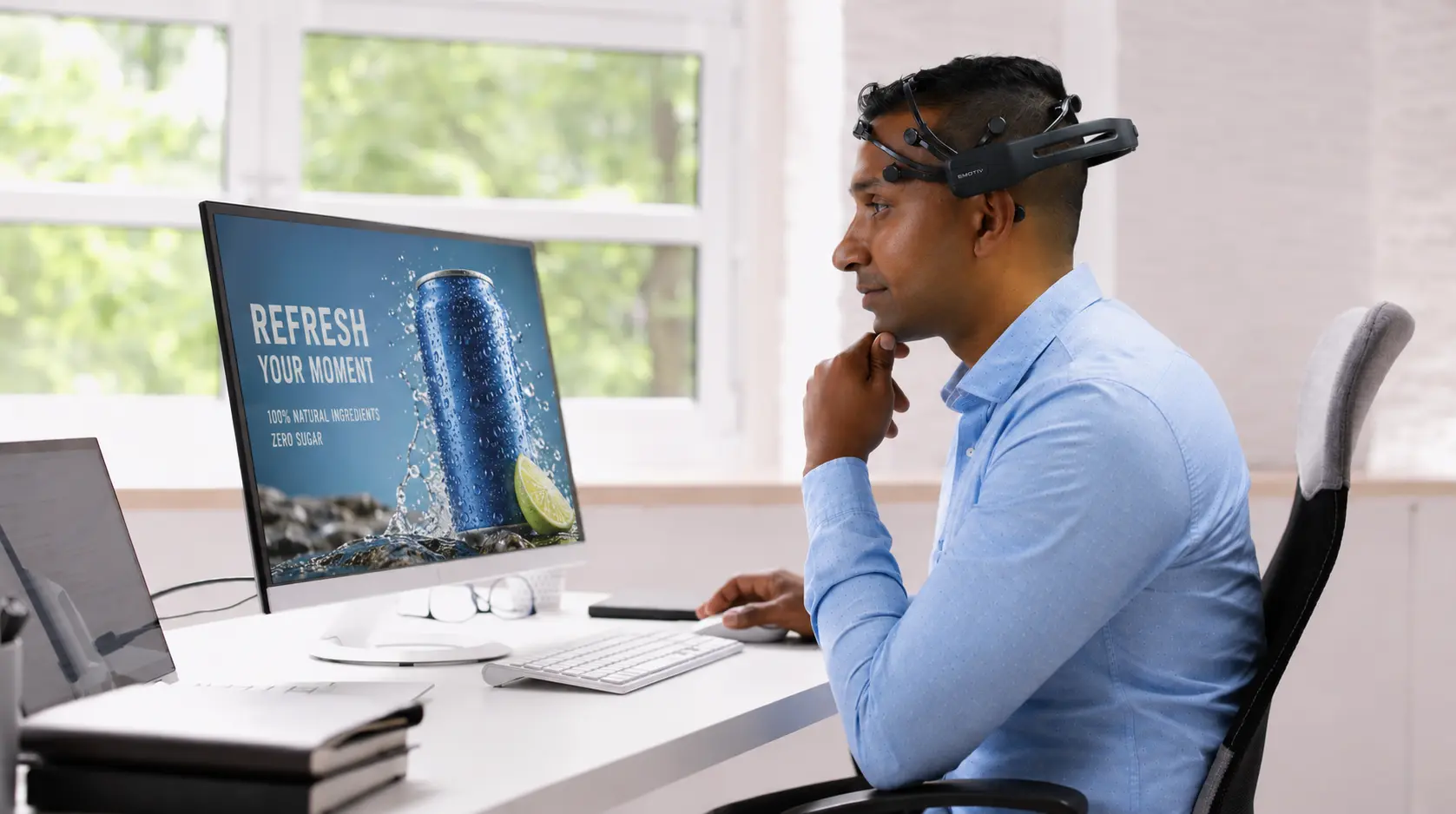
How Music Marketers Use EEG to Measure Engagement
H.B. Duran
Updated on
Jun 8, 2026
How Music Marketers Use EEG to Measure Engagement
H.B. Duran
Updated on
Jun 8, 2026
How Music Marketers Use EEG to Measure Engagement
H.B. Duran
Updated on
Jun 8, 2026
Music marketers have no shortage of data. Streaming platforms report plays, saves, skips, shares, and completion rates. Social platforms provide views, engagement metrics, and audience demographics. Ticketing systems reveal conversion behavior.
What these metrics rarely reveal is what happened before the click, stream, or purchase.
A music video may generate millions of views while losing audience attention before the chorus. A festival trailer may attract curiosity but fail to create anticipation. A teaser may earn engagement on social media while generating little emotional connection to the artist or release.
For music marketers, understanding how audiences respond during the experience itself can be just as valuable as measuring what they do afterward.
Why Music Marketing Is Different
Unlike many forms of marketing, music campaigns often depend on emotional engagement rather than information delivery. The goal is not simply to communicate a message. It is to create anticipation, excitement, nostalgia, belonging, curiosity, or emotional connection.
Whether promoting an artist, album, playlist, festival, tour, or brand partnership, marketers are often trying to influence audience response in the moment.
This makes music uniquely suited for neuroscience-based audience testing. Music unfolds over time. Attention rises and falls. Emotional engagement changes from verse to chorus. Audience interest can strengthen, weaken, or recover as creative elements interact with the music itself.
What EEG Research Reveals About Music Engagement
Over the last decade, researchers have increasingly used EEG to study how audiences respond to music in real time.
One of the most significant findings comes from research published in Frontiers in Psychology, where researchers measured neural synchrony, or the degree to which listeners' brain activity aligned while hearing unreleased music. The study found that EEG-based neural synchrony predicted Spotify streaming performance both three weeks and ten months after release. Remarkably, the neural measures outperformed traditional self-reported preferences in forecasting which songs would become more successful with the broader public (Leeuwis et al., 2021).
For music marketers, this finding is important because it suggests that audience engagement can sometimes be measured more effectively through neural response than through surveys alone. People may struggle to explain why they like a song, but their brains may reveal meaningful signals about future popularity.
Additional research published in NeuroImage found that natural music evokes correlated EEG responses across listeners, reflecting musical structure and beat. The researchers concluded that neural correlates of engagement may be distinct from simple enjoyment, suggesting that audiences can be deeply engaged by music even when they do not consciously describe the experience as their favorite (Kaneshiro et al., 2020).
Together, these findings support an idea familiar to many music marketers: audience engagement is dynamic, emotional, and often difficult to capture through traditional feedback alone.
Using EEG-Based Audience Testing
EEG-based audience testing allows music marketers to measure audience response as listeners experience creative assets in real time. Instead of relying solely on post-exposure surveys, marketers can identify moment-by-moment changes in attention, engagement, excitement, interest, relaxation, and cognitive stress.
This approach is especially useful when teams need to make decisions before launch. A campaign may require choosing between teaser edits, testing whether an artist intro should come earlier, deciding whether a chorus or verse should anchor a paid cutdown, or evaluating whether a brand integration feels natural.
Instead of relying only on stakeholder preference, music marketers can measure audience attention, engagement, and emotional response in real time.
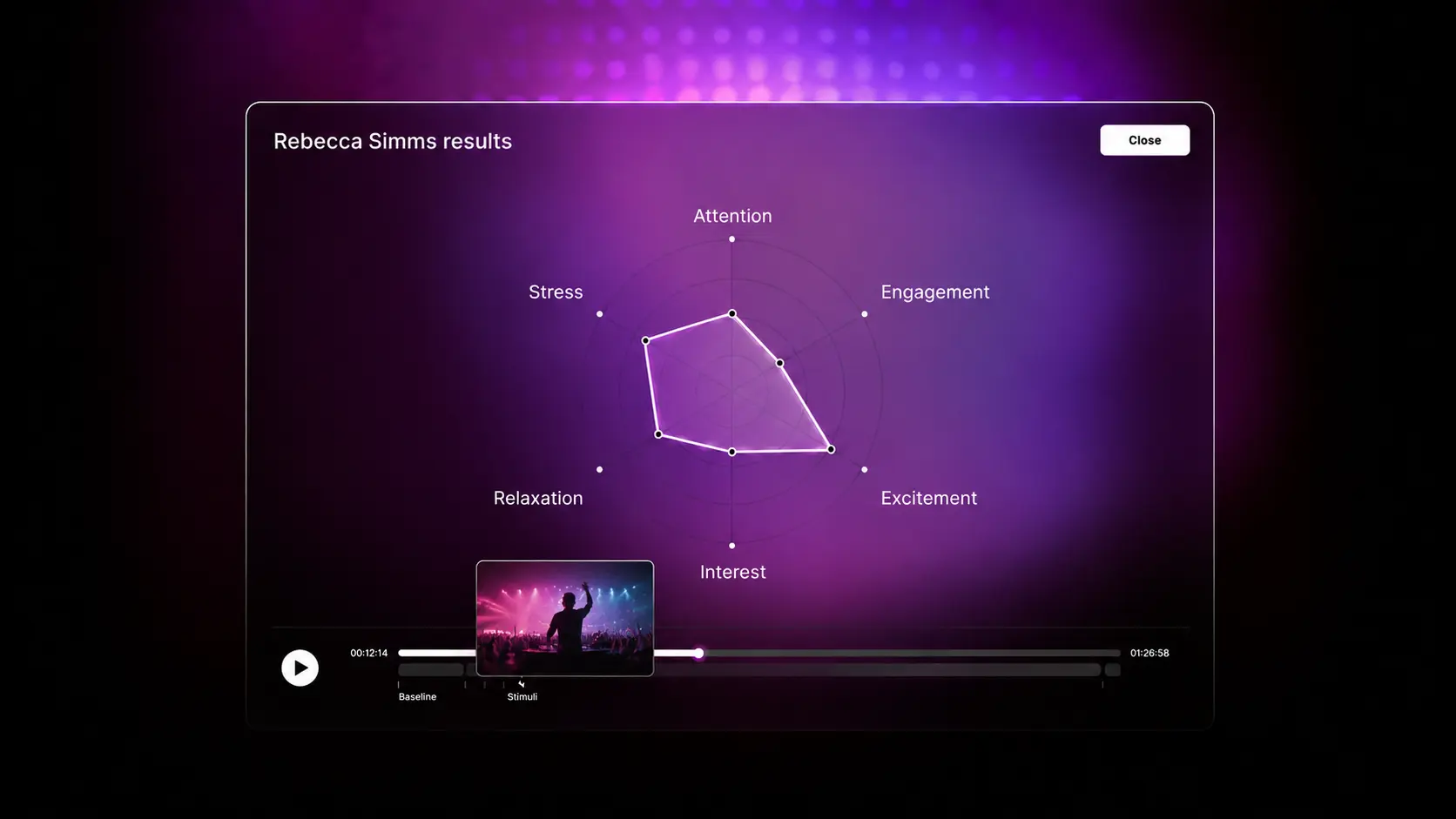
Example Emotiv Studio music marketing analysis showing audience attention, engagement, and emotional response during a music video testing session.
Testing Music Videos Before Release
Music videos provide an ideal environment for moment-by-moment audience testing.
Audience engagement rarely remains constant throughout a video. Attention may spike during an artist reveal, a chorus, a dramatic visual transition, or a performance sequence. It may decline during slower narrative moments or sections where the visual pacing no longer matches the music.
Consider a label deciding between two music video edits. One version begins with cinematic storytelling before introducing the artist. Another opens immediately with the hook and performance footage.
Traditional focus groups may indicate that audiences enjoy both versions. EEG-based testing can reveal whether one version captures attention more quickly, sustains engagement longer, or creates stronger emotional response during key moments.
These insights can help marketers determine which edit is most suitable for YouTube, paid social placements, streaming platform promotion, or artist-owned channels.
More recently, researchers demonstrated that EEG-based neural synchrony could predict audience engagement with music videos on YouTube, even after controlling for viewers' explicit liking ratings. The findings suggest that neural measures may help forecast the performance of audiovisual music content before large-scale distribution (Leeuwis & van Bommel, 2023).
Optimizing Short-Form Music Content
Short-form platforms such as TikTok, Instagram Reels, and YouTube Shorts have compressed audience attention windows dramatically.
In many cases, marketers have only a few seconds to communicate artist identity, musical style, mood, and relevance.
Small creative decisions can have an outsized impact. An artist introduction may outperform a visual effects sequence. A lyric moment may create stronger engagement than a dramatic visual. A chorus-first approach may generate attention quickly but fatigue faster than a slower narrative build.
EEG-based testing allows teams to compare multiple versions before launch and identify which moments create attention, engagement, and emotional response rather than relying solely on post-campaign metrics.
Festival and Live Event Marketing
Festival campaigns, tour announcements, and venue promotions face a different challenge. They must sell an experience.
Creative assets often need to communicate excitement, community, exclusivity, anticipation, and trust within a limited amount of time.
Audience-response testing can help marketers understand whether a lineup reveal creates excitement, whether crowd footage strengthens emotional connection, or whether sponsor integrations support or distract from the overall experience.
When media budgets and partnership investments are significant, these insights can help reduce uncertainty before launch.
Music and Brand Partnerships
Music is frequently used to shape emotional tone in advertising campaigns. Brands partner with artists, license tracks, and build campaigns around music-driven experiences because music can influence attention and emotional response quickly.
However, not every partnership creates the intended outcome.
A song may attract attention while distracting from the brand message. An artist partnership may resonate with one audience segment while creating weaker engagement among another. A soundtrack may feel memorable without strengthening brand recall.
EEG-based audience testing helps marketers evaluate the combined impact of music, visuals, messaging, branding, and pacing rather than treating each element independently.
Using EEG to Complement Music Analytics
Streaming data, ticket sales, social engagement, and campaign analytics remain essential. They reveal what audiences did after exposure.
EEG-based research adds another layer by helping marketers understand how audiences responded while experiencing the content itself.
For teams choosing between teaser edits, evaluating music videos, testing artist storytelling, optimizing festival promotions, or refining brand partnerships, this can provide valuable guidance before campaigns scale.
Rather than relying exclusively on preference surveys or internal opinion, marketers gain access to measurable audience-response data tied to attention, engagement, and emotional reaction.
Conclusion
The most successful music marketing campaigns do more than generate impressions. They create experiences audiences remember, share, and return to.
Research increasingly suggests that EEG can reveal meaningful signals about audience engagement, music popularity, and future campaign performance. Studies have shown that neural synchrony can predict Spotify streaming success, YouTube engagement metrics, and other indicators of audience response before content reaches the market (Leeuwis et al., 2021; Leeuwis & van Bommel, 2023).
Emotiv Studio helps marketers measure attention, engagement, cognitive response, and emotional impact across music videos, artist campaigns, festival promotions, and branded content.
Explore Emotiv Studio to learn how neuroscience-based audience testing can help optimize music marketing before launch.
References
Kaneshiro, B., Nguyen, D. T., Norcia, A. M., Berger, J., & Dmochowski, J. P. (2020). Natural music evokes correlated EEG responses reflecting temporal structure and beat. NeuroImage, 214, 116559. https://pubmed.ncbi.nlm.nih.gov/31978543/
Leeuwis, N., Paas, F., van Maanen, L., & Boksem, M. A. S. (2021). A sound prediction: EEG-based neural synchrony predicts online music streams. Frontiers in Psychology, 12, 672980. https://www.frontiersin.org/journals/psychology/articles/10.3389/fpsyg.2021.672980/full
Leeuwis, N., & van Bommel, T. (2023). EEG-based neural synchrony predicts evaluative engagement with music videos. Proceedings, 39(1), 50. https://www.mdpi.com/2673-4591/39/1/50
Music marketers have no shortage of data. Streaming platforms report plays, saves, skips, shares, and completion rates. Social platforms provide views, engagement metrics, and audience demographics. Ticketing systems reveal conversion behavior.
What these metrics rarely reveal is what happened before the click, stream, or purchase.
A music video may generate millions of views while losing audience attention before the chorus. A festival trailer may attract curiosity but fail to create anticipation. A teaser may earn engagement on social media while generating little emotional connection to the artist or release.
For music marketers, understanding how audiences respond during the experience itself can be just as valuable as measuring what they do afterward.
Why Music Marketing Is Different
Unlike many forms of marketing, music campaigns often depend on emotional engagement rather than information delivery. The goal is not simply to communicate a message. It is to create anticipation, excitement, nostalgia, belonging, curiosity, or emotional connection.
Whether promoting an artist, album, playlist, festival, tour, or brand partnership, marketers are often trying to influence audience response in the moment.
This makes music uniquely suited for neuroscience-based audience testing. Music unfolds over time. Attention rises and falls. Emotional engagement changes from verse to chorus. Audience interest can strengthen, weaken, or recover as creative elements interact with the music itself.
What EEG Research Reveals About Music Engagement
Over the last decade, researchers have increasingly used EEG to study how audiences respond to music in real time.
One of the most significant findings comes from research published in Frontiers in Psychology, where researchers measured neural synchrony, or the degree to which listeners' brain activity aligned while hearing unreleased music. The study found that EEG-based neural synchrony predicted Spotify streaming performance both three weeks and ten months after release. Remarkably, the neural measures outperformed traditional self-reported preferences in forecasting which songs would become more successful with the broader public (Leeuwis et al., 2021).
For music marketers, this finding is important because it suggests that audience engagement can sometimes be measured more effectively through neural response than through surveys alone. People may struggle to explain why they like a song, but their brains may reveal meaningful signals about future popularity.
Additional research published in NeuroImage found that natural music evokes correlated EEG responses across listeners, reflecting musical structure and beat. The researchers concluded that neural correlates of engagement may be distinct from simple enjoyment, suggesting that audiences can be deeply engaged by music even when they do not consciously describe the experience as their favorite (Kaneshiro et al., 2020).
Together, these findings support an idea familiar to many music marketers: audience engagement is dynamic, emotional, and often difficult to capture through traditional feedback alone.
Using EEG-Based Audience Testing
EEG-based audience testing allows music marketers to measure audience response as listeners experience creative assets in real time. Instead of relying solely on post-exposure surveys, marketers can identify moment-by-moment changes in attention, engagement, excitement, interest, relaxation, and cognitive stress.
This approach is especially useful when teams need to make decisions before launch. A campaign may require choosing between teaser edits, testing whether an artist intro should come earlier, deciding whether a chorus or verse should anchor a paid cutdown, or evaluating whether a brand integration feels natural.
Instead of relying only on stakeholder preference, music marketers can measure audience attention, engagement, and emotional response in real time.
Example Emotiv Studio music marketing analysis showing audience attention, engagement, and emotional response during a music video testing session.
Testing Music Videos Before Release
Music videos provide an ideal environment for moment-by-moment audience testing.
Audience engagement rarely remains constant throughout a video. Attention may spike during an artist reveal, a chorus, a dramatic visual transition, or a performance sequence. It may decline during slower narrative moments or sections where the visual pacing no longer matches the music.
Consider a label deciding between two music video edits. One version begins with cinematic storytelling before introducing the artist. Another opens immediately with the hook and performance footage.
Traditional focus groups may indicate that audiences enjoy both versions. EEG-based testing can reveal whether one version captures attention more quickly, sustains engagement longer, or creates stronger emotional response during key moments.
These insights can help marketers determine which edit is most suitable for YouTube, paid social placements, streaming platform promotion, or artist-owned channels.
More recently, researchers demonstrated that EEG-based neural synchrony could predict audience engagement with music videos on YouTube, even after controlling for viewers' explicit liking ratings. The findings suggest that neural measures may help forecast the performance of audiovisual music content before large-scale distribution (Leeuwis & van Bommel, 2023).
Optimizing Short-Form Music Content
Short-form platforms such as TikTok, Instagram Reels, and YouTube Shorts have compressed audience attention windows dramatically.
In many cases, marketers have only a few seconds to communicate artist identity, musical style, mood, and relevance.
Small creative decisions can have an outsized impact. An artist introduction may outperform a visual effects sequence. A lyric moment may create stronger engagement than a dramatic visual. A chorus-first approach may generate attention quickly but fatigue faster than a slower narrative build.
EEG-based testing allows teams to compare multiple versions before launch and identify which moments create attention, engagement, and emotional response rather than relying solely on post-campaign metrics.
Festival and Live Event Marketing
Festival campaigns, tour announcements, and venue promotions face a different challenge. They must sell an experience.
Creative assets often need to communicate excitement, community, exclusivity, anticipation, and trust within a limited amount of time.
Audience-response testing can help marketers understand whether a lineup reveal creates excitement, whether crowd footage strengthens emotional connection, or whether sponsor integrations support or distract from the overall experience.
When media budgets and partnership investments are significant, these insights can help reduce uncertainty before launch.
Music and Brand Partnerships
Music is frequently used to shape emotional tone in advertising campaigns. Brands partner with artists, license tracks, and build campaigns around music-driven experiences because music can influence attention and emotional response quickly.
However, not every partnership creates the intended outcome.
A song may attract attention while distracting from the brand message. An artist partnership may resonate with one audience segment while creating weaker engagement among another. A soundtrack may feel memorable without strengthening brand recall.
EEG-based audience testing helps marketers evaluate the combined impact of music, visuals, messaging, branding, and pacing rather than treating each element independently.
Using EEG to Complement Music Analytics
Streaming data, ticket sales, social engagement, and campaign analytics remain essential. They reveal what audiences did after exposure.
EEG-based research adds another layer by helping marketers understand how audiences responded while experiencing the content itself.
For teams choosing between teaser edits, evaluating music videos, testing artist storytelling, optimizing festival promotions, or refining brand partnerships, this can provide valuable guidance before campaigns scale.
Rather than relying exclusively on preference surveys or internal opinion, marketers gain access to measurable audience-response data tied to attention, engagement, and emotional reaction.
Conclusion
The most successful music marketing campaigns do more than generate impressions. They create experiences audiences remember, share, and return to.
Research increasingly suggests that EEG can reveal meaningful signals about audience engagement, music popularity, and future campaign performance. Studies have shown that neural synchrony can predict Spotify streaming success, YouTube engagement metrics, and other indicators of audience response before content reaches the market (Leeuwis et al., 2021; Leeuwis & van Bommel, 2023).
Emotiv Studio helps marketers measure attention, engagement, cognitive response, and emotional impact across music videos, artist campaigns, festival promotions, and branded content.
Explore Emotiv Studio to learn how neuroscience-based audience testing can help optimize music marketing before launch.
References
Kaneshiro, B., Nguyen, D. T., Norcia, A. M., Berger, J., & Dmochowski, J. P. (2020). Natural music evokes correlated EEG responses reflecting temporal structure and beat. NeuroImage, 214, 116559. https://pubmed.ncbi.nlm.nih.gov/31978543/
Leeuwis, N., Paas, F., van Maanen, L., & Boksem, M. A. S. (2021). A sound prediction: EEG-based neural synchrony predicts online music streams. Frontiers in Psychology, 12, 672980. https://www.frontiersin.org/journals/psychology/articles/10.3389/fpsyg.2021.672980/full
Leeuwis, N., & van Bommel, T. (2023). EEG-based neural synchrony predicts evaluative engagement with music videos. Proceedings, 39(1), 50. https://www.mdpi.com/2673-4591/39/1/50
Music marketers have no shortage of data. Streaming platforms report plays, saves, skips, shares, and completion rates. Social platforms provide views, engagement metrics, and audience demographics. Ticketing systems reveal conversion behavior.
What these metrics rarely reveal is what happened before the click, stream, or purchase.
A music video may generate millions of views while losing audience attention before the chorus. A festival trailer may attract curiosity but fail to create anticipation. A teaser may earn engagement on social media while generating little emotional connection to the artist or release.
For music marketers, understanding how audiences respond during the experience itself can be just as valuable as measuring what they do afterward.
Why Music Marketing Is Different
Unlike many forms of marketing, music campaigns often depend on emotional engagement rather than information delivery. The goal is not simply to communicate a message. It is to create anticipation, excitement, nostalgia, belonging, curiosity, or emotional connection.
Whether promoting an artist, album, playlist, festival, tour, or brand partnership, marketers are often trying to influence audience response in the moment.
This makes music uniquely suited for neuroscience-based audience testing. Music unfolds over time. Attention rises and falls. Emotional engagement changes from verse to chorus. Audience interest can strengthen, weaken, or recover as creative elements interact with the music itself.
What EEG Research Reveals About Music Engagement
Over the last decade, researchers have increasingly used EEG to study how audiences respond to music in real time.
One of the most significant findings comes from research published in Frontiers in Psychology, where researchers measured neural synchrony, or the degree to which listeners' brain activity aligned while hearing unreleased music. The study found that EEG-based neural synchrony predicted Spotify streaming performance both three weeks and ten months after release. Remarkably, the neural measures outperformed traditional self-reported preferences in forecasting which songs would become more successful with the broader public (Leeuwis et al., 2021).
For music marketers, this finding is important because it suggests that audience engagement can sometimes be measured more effectively through neural response than through surveys alone. People may struggle to explain why they like a song, but their brains may reveal meaningful signals about future popularity.
Additional research published in NeuroImage found that natural music evokes correlated EEG responses across listeners, reflecting musical structure and beat. The researchers concluded that neural correlates of engagement may be distinct from simple enjoyment, suggesting that audiences can be deeply engaged by music even when they do not consciously describe the experience as their favorite (Kaneshiro et al., 2020).
Together, these findings support an idea familiar to many music marketers: audience engagement is dynamic, emotional, and often difficult to capture through traditional feedback alone.
Using EEG-Based Audience Testing
EEG-based audience testing allows music marketers to measure audience response as listeners experience creative assets in real time. Instead of relying solely on post-exposure surveys, marketers can identify moment-by-moment changes in attention, engagement, excitement, interest, relaxation, and cognitive stress.
This approach is especially useful when teams need to make decisions before launch. A campaign may require choosing between teaser edits, testing whether an artist intro should come earlier, deciding whether a chorus or verse should anchor a paid cutdown, or evaluating whether a brand integration feels natural.
Instead of relying only on stakeholder preference, music marketers can measure audience attention, engagement, and emotional response in real time.
Example Emotiv Studio music marketing analysis showing audience attention, engagement, and emotional response during a music video testing session.
Testing Music Videos Before Release
Music videos provide an ideal environment for moment-by-moment audience testing.
Audience engagement rarely remains constant throughout a video. Attention may spike during an artist reveal, a chorus, a dramatic visual transition, or a performance sequence. It may decline during slower narrative moments or sections where the visual pacing no longer matches the music.
Consider a label deciding between two music video edits. One version begins with cinematic storytelling before introducing the artist. Another opens immediately with the hook and performance footage.
Traditional focus groups may indicate that audiences enjoy both versions. EEG-based testing can reveal whether one version captures attention more quickly, sustains engagement longer, or creates stronger emotional response during key moments.
These insights can help marketers determine which edit is most suitable for YouTube, paid social placements, streaming platform promotion, or artist-owned channels.
More recently, researchers demonstrated that EEG-based neural synchrony could predict audience engagement with music videos on YouTube, even after controlling for viewers' explicit liking ratings. The findings suggest that neural measures may help forecast the performance of audiovisual music content before large-scale distribution (Leeuwis & van Bommel, 2023).
Optimizing Short-Form Music Content
Short-form platforms such as TikTok, Instagram Reels, and YouTube Shorts have compressed audience attention windows dramatically.
In many cases, marketers have only a few seconds to communicate artist identity, musical style, mood, and relevance.
Small creative decisions can have an outsized impact. An artist introduction may outperform a visual effects sequence. A lyric moment may create stronger engagement than a dramatic visual. A chorus-first approach may generate attention quickly but fatigue faster than a slower narrative build.
EEG-based testing allows teams to compare multiple versions before launch and identify which moments create attention, engagement, and emotional response rather than relying solely on post-campaign metrics.
Festival and Live Event Marketing
Festival campaigns, tour announcements, and venue promotions face a different challenge. They must sell an experience.
Creative assets often need to communicate excitement, community, exclusivity, anticipation, and trust within a limited amount of time.
Audience-response testing can help marketers understand whether a lineup reveal creates excitement, whether crowd footage strengthens emotional connection, or whether sponsor integrations support or distract from the overall experience.
When media budgets and partnership investments are significant, these insights can help reduce uncertainty before launch.
Music and Brand Partnerships
Music is frequently used to shape emotional tone in advertising campaigns. Brands partner with artists, license tracks, and build campaigns around music-driven experiences because music can influence attention and emotional response quickly.
However, not every partnership creates the intended outcome.
A song may attract attention while distracting from the brand message. An artist partnership may resonate with one audience segment while creating weaker engagement among another. A soundtrack may feel memorable without strengthening brand recall.
EEG-based audience testing helps marketers evaluate the combined impact of music, visuals, messaging, branding, and pacing rather than treating each element independently.
Using EEG to Complement Music Analytics
Streaming data, ticket sales, social engagement, and campaign analytics remain essential. They reveal what audiences did after exposure.
EEG-based research adds another layer by helping marketers understand how audiences responded while experiencing the content itself.
For teams choosing between teaser edits, evaluating music videos, testing artist storytelling, optimizing festival promotions, or refining brand partnerships, this can provide valuable guidance before campaigns scale.
Rather than relying exclusively on preference surveys or internal opinion, marketers gain access to measurable audience-response data tied to attention, engagement, and emotional reaction.
Conclusion
The most successful music marketing campaigns do more than generate impressions. They create experiences audiences remember, share, and return to.
Research increasingly suggests that EEG can reveal meaningful signals about audience engagement, music popularity, and future campaign performance. Studies have shown that neural synchrony can predict Spotify streaming success, YouTube engagement metrics, and other indicators of audience response before content reaches the market (Leeuwis et al., 2021; Leeuwis & van Bommel, 2023).
Emotiv Studio helps marketers measure attention, engagement, cognitive response, and emotional impact across music videos, artist campaigns, festival promotions, and branded content.
Explore Emotiv Studio to learn how neuroscience-based audience testing can help optimize music marketing before launch.
References
Kaneshiro, B., Nguyen, D. T., Norcia, A. M., Berger, J., & Dmochowski, J. P. (2020). Natural music evokes correlated EEG responses reflecting temporal structure and beat. NeuroImage, 214, 116559. https://pubmed.ncbi.nlm.nih.gov/31978543/
Leeuwis, N., Paas, F., van Maanen, L., & Boksem, M. A. S. (2021). A sound prediction: EEG-based neural synchrony predicts online music streams. Frontiers in Psychology, 12, 672980. https://www.frontiersin.org/journals/psychology/articles/10.3389/fpsyg.2021.672980/full
Leeuwis, N., & van Bommel, T. (2023). EEG-based neural synchrony predicts evaluative engagement with music videos. Proceedings, 39(1), 50. https://www.mdpi.com/2673-4591/39/1/50