
Pharmaceutical Marketing Campaign Testing for HCP and Healthcare Audiences
H.B. Duran
Updated on
Jun 2, 2026
Pharmaceutical Marketing Campaign Testing for HCP and Healthcare Audiences
H.B. Duran
Updated on
Jun 2, 2026
Pharmaceutical Marketing Campaign Testing for HCP and Healthcare Audiences
H.B. Duran
Updated on
Jun 2, 2026
Pharmaceutical marketing campaigns face a unique challenge. They must communicate complex scientific information while competing for attention in crowded digital environments. Whether the audience includes healthcare professionals (HCPs), patients, caregivers, or payer stakeholders, campaigns need to be informative, compliant, and engaging without becoming overwhelming.
As pharmaceutical organizations invest more heavily in omnichannel marketing, the stakes continue to rise. Email programs, digital advertising, educational websites, webinars, conference materials, and patient support campaigns all compete for limited attention. A campaign that is technically accurate may still fail if audiences disengage before reaching key messages.
For this reason, leading pharmaceutical companies increasingly test campaign assets before launch. Beyond measuring recall, modern audience testing can help teams understand how people experience messaging, creative, and digital content in real time.
Why Recall Alone Is No Longer Enough
For decades, campaign effectiveness was often measured through brand recall and message recall studies. While these metrics remain valuable, they provide only part of the picture.
An audience may remember a campaign while still finding it confusing, overly dense, or emotionally disconnected.
This challenge becomes especially important in healthcare, where campaigns frequently need to communicate multiple layers of information simultaneously. A single asset may need to introduce a disease state, explain treatment considerations, provide safety information, and direct audiences toward additional resources.
The pharmaceutical industry has seen numerous examples of how communication quality can affect outcomes. Organizations such as Pfizer and Novartis routinely invest in disease-awareness campaigns that simplify complex medical concepts for broader audiences. Success often depends not only on what information is presented, but on whether audiences can process and retain it.
Campaign testing helps teams evaluate whether communication is being understood as intended rather than simply remembered.
The Attention Challenge in HCP Marketing
Healthcare professionals operate under significant time pressure.
Research published by the American Medical Association (AMA) has repeatedly highlighted the growing administrative and informational demands placed on physicians. As a result, pharmaceutical communications often have only a brief window to establish relevance and communicate value.
This creates unique challenges for HCP marketing.
Clinical claims may be scientifically robust but difficult to locate within a crowded visual layout. Supporting data may be available but overlooked because of presentation choices. Calls to action may be present but fail to stand out among competing messages.
Pre-launch testing can help identify whether healthcare professionals actually notice and engage with critical information, including:
Clinical differentiators
Supporting efficacy data
Safety information
Patient population details
Next-step actions
Understanding where attention rises and falls allows marketers to refine campaigns before broader deployment.
Learning from Successful Healthcare Campaigns
Many of the most effective pharmaceutical campaigns combine scientific rigor with strong storytelling.
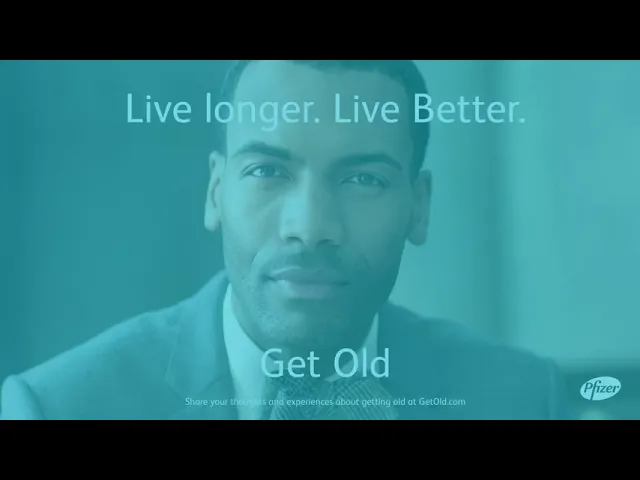
For example, the long-running "Get Old" campaign from Pfizer focused on healthy aging by using relatable stories rather than leading with clinical information alone. Similarly, disease-awareness campaigns developed by organizations such as Biogen often blend patient experiences with educational resources to create stronger audience engagement.
These campaigns succeed because they recognize a fundamental truth: information alone does not guarantee attention.
Campaign testing can help identify which combinations of narrative, data, visuals, and educational content create stronger engagement across different audience segments.
Using EEG Insights in Pharmaceutical Campaign Testing
Modern audience testing increasingly incorporates neuroscience-based research methods.
EEG-based testing allows researchers to evaluate audience response while individuals interact with campaign content. Instead of relying exclusively on post-exposure surveys, teams can examine attention, engagement, emotional response, and cognitive stress as experiences unfold.
For pharmaceutical marketers, this can help answer questions such as:
Which sections of a campaign hold attention most effectively?
Where do audiences become disengaged?
Which creative version generates stronger engagement?
Does the campaign feel clear or cognitively demanding?
How do different audience segments respond to the same content?
These insights can reveal opportunities that traditional analytics may miss.
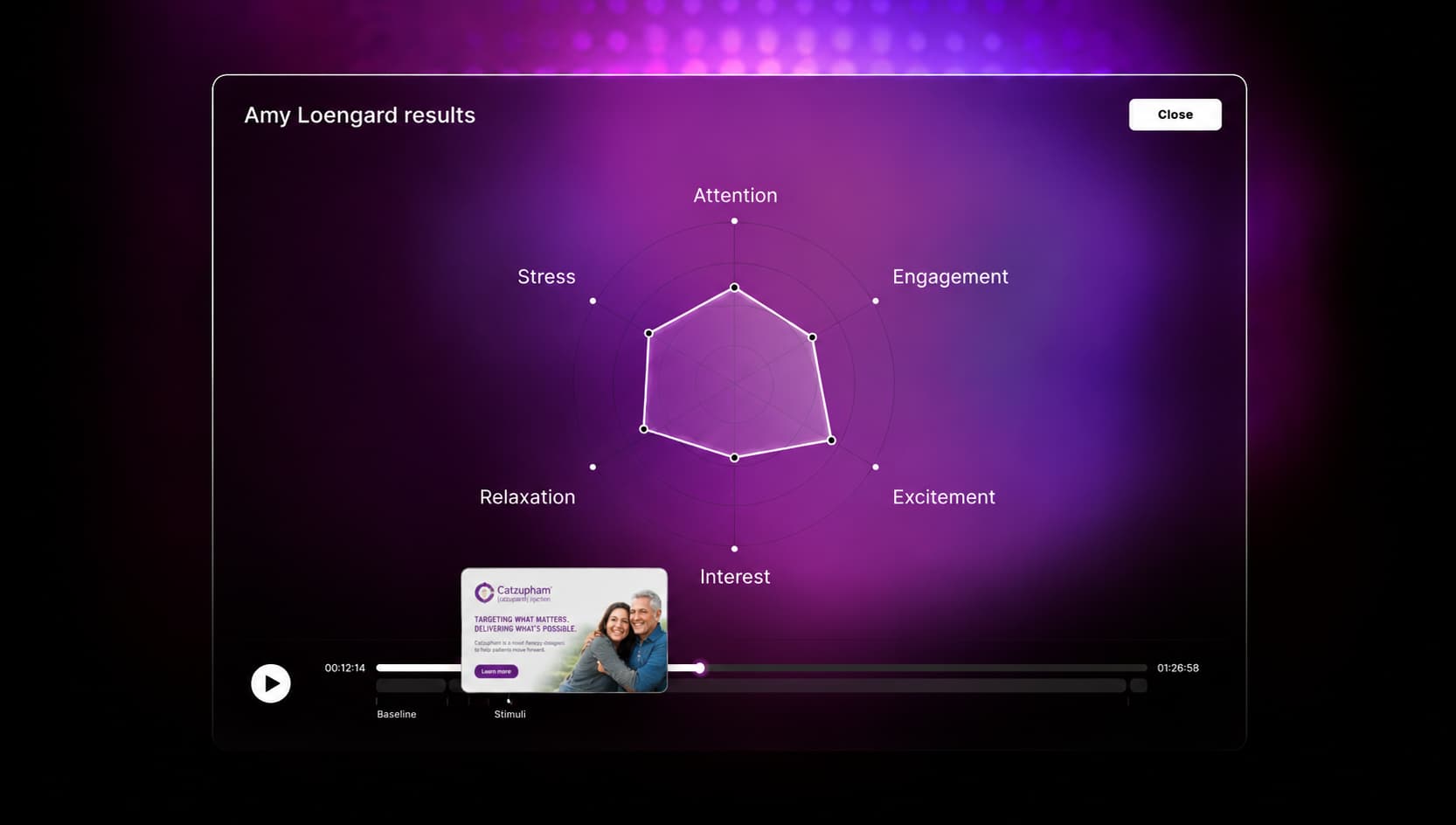
Above: A results screen inside Emotiv Studio displays moment-by-moment cognitive reactions to pharmaceutical marketing creative.
Message Clarity and Cognitive Stress
One of the biggest challenges in pharmaceutical communication is balancing completeness with clarity.
Regulatory requirements often necessitate significant amounts of information. However, when content becomes too dense, audiences may struggle to process it efficiently.
This issue extends beyond copywriting.
Complex layouts, competing visual elements, inconsistent hierarchy, and information overload can all increase cognitive stress. Audiences may not consciously recognize why an experience feels difficult. They may simply disengage.
Testing can help identify where communication becomes harder to process and where refinements may improve understanding.
For example, a campaign landing page might achieve strong traffic performance while creating confusion around its primary message. A webinar invitation may contain all necessary information but require too much effort to interpret quickly. Audience-response testing can help uncover these friction points before campaigns scale.
Comparing Campaign Variations
Most pharmaceutical campaigns involve multiple creative routes before launch.
Teams frequently evaluate different headlines, visual systems, educational approaches, and calls to action. Historically, these decisions were often based on internal preference or limited focus-group feedback.
Modern campaign testing provides a more evidence-based approach.
Organizations can compare how audiences respond to different approaches, including:
Data-driven versus story-driven messaging
HCP-focused versus patient-focused language
Static creative versus video content
Short-form versus long-form educational assets
Alternative visual hierarchies and layouts
Understanding which approach generates stronger attention and engagement can help reduce uncertainty before significant media investments are made.
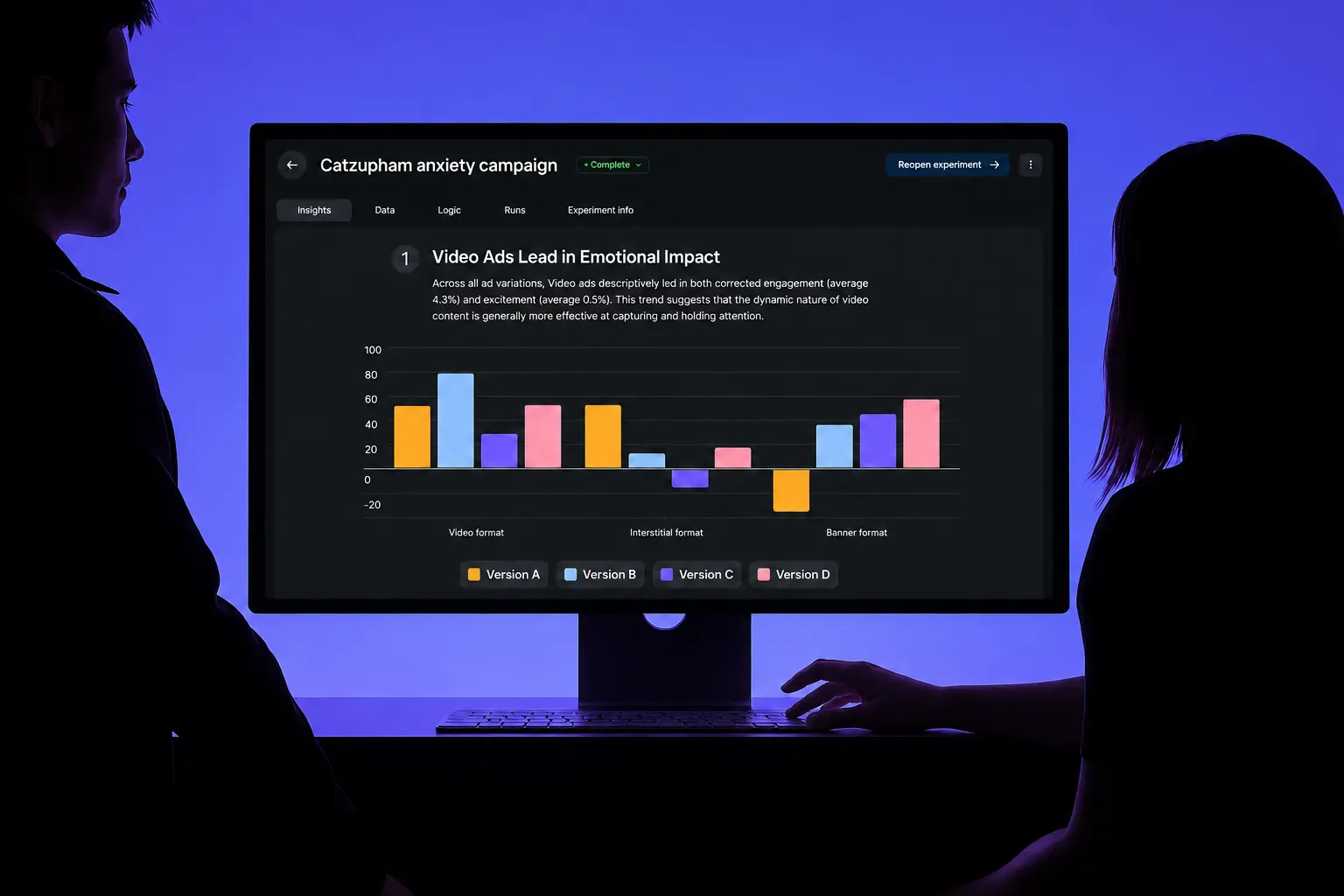
Above: An Emotiv Studio experiment results screen quantifies which versions and formats of marketing creative performed best based on neural engagement.
Evaluating the Full Digital Journey
Today's pharmaceutical campaigns rarely consist of a single asset.
A healthcare professional may encounter a digital advertisement, visit a landing page, download a clinical resource, attend a webinar, and later engage with follow-up content. Patients may move through educational hubs, support programs, and enrollment experiences before taking action.
Every step in that journey presents opportunities for engagement or disengagement.
Testing individual assets is valuable, but evaluating the broader experience often provides deeper insight. Audience-response research can help identify where users encounter friction, where engagement increases, and which parts of the journey support stronger understanding.
This perspective allows pharmaceutical marketers to optimize not only individual assets but entire campaign ecosystems.
Why Campaign Testing Is Becoming a Competitive Advantage
Healthcare communication continues to become more complex while audience attention becomes more limited.
Pharmaceutical organizations are under increasing pressure to demonstrate campaign effectiveness, improve educational outcomes, and maximize marketing efficiency. At the same time, healthcare audiences expect experiences that are intuitive, relevant, and easy to navigate.
Pre-launch campaign testing helps reduce uncertainty by providing a clearer picture of how audiences experience content before large-scale deployment.
Rather than relying solely on assumptions or post-launch performance data, teams can evaluate audience response earlier and make more confident decisions about messaging, creative strategy, and digital experience design.
Conclusion
Successful pharmaceutical marketing campaigns do more than communicate information. They help healthcare professionals, patients, and caregivers understand complex topics while maintaining attention and engagement.
As healthcare communication becomes increasingly digital, organizations need better ways to evaluate how audiences respond to messaging, creative assets, and campaign experiences before launch.
Audience-response testing can help pharmaceutical marketers identify opportunities to improve clarity, engagement, and campaign effectiveness across the full customer journey.
See how Emotiv Studio helps teams measure audience attention, engagement, and cognitive response across healthcare marketing campaigns before they go live.
Pharmaceutical marketing campaigns face a unique challenge. They must communicate complex scientific information while competing for attention in crowded digital environments. Whether the audience includes healthcare professionals (HCPs), patients, caregivers, or payer stakeholders, campaigns need to be informative, compliant, and engaging without becoming overwhelming.
As pharmaceutical organizations invest more heavily in omnichannel marketing, the stakes continue to rise. Email programs, digital advertising, educational websites, webinars, conference materials, and patient support campaigns all compete for limited attention. A campaign that is technically accurate may still fail if audiences disengage before reaching key messages.
For this reason, leading pharmaceutical companies increasingly test campaign assets before launch. Beyond measuring recall, modern audience testing can help teams understand how people experience messaging, creative, and digital content in real time.
Why Recall Alone Is No Longer Enough
For decades, campaign effectiveness was often measured through brand recall and message recall studies. While these metrics remain valuable, they provide only part of the picture.
An audience may remember a campaign while still finding it confusing, overly dense, or emotionally disconnected.
This challenge becomes especially important in healthcare, where campaigns frequently need to communicate multiple layers of information simultaneously. A single asset may need to introduce a disease state, explain treatment considerations, provide safety information, and direct audiences toward additional resources.
The pharmaceutical industry has seen numerous examples of how communication quality can affect outcomes. Organizations such as Pfizer and Novartis routinely invest in disease-awareness campaigns that simplify complex medical concepts for broader audiences. Success often depends not only on what information is presented, but on whether audiences can process and retain it.
Campaign testing helps teams evaluate whether communication is being understood as intended rather than simply remembered.
The Attention Challenge in HCP Marketing
Healthcare professionals operate under significant time pressure.
Research published by the American Medical Association (AMA) has repeatedly highlighted the growing administrative and informational demands placed on physicians. As a result, pharmaceutical communications often have only a brief window to establish relevance and communicate value.
This creates unique challenges for HCP marketing.
Clinical claims may be scientifically robust but difficult to locate within a crowded visual layout. Supporting data may be available but overlooked because of presentation choices. Calls to action may be present but fail to stand out among competing messages.
Pre-launch testing can help identify whether healthcare professionals actually notice and engage with critical information, including:
Clinical differentiators
Supporting efficacy data
Safety information
Patient population details
Next-step actions
Understanding where attention rises and falls allows marketers to refine campaigns before broader deployment.
Learning from Successful Healthcare Campaigns
Many of the most effective pharmaceutical campaigns combine scientific rigor with strong storytelling.
For example, the long-running "Get Old" campaign from Pfizer focused on healthy aging by using relatable stories rather than leading with clinical information alone. Similarly, disease-awareness campaigns developed by organizations such as Biogen often blend patient experiences with educational resources to create stronger audience engagement.
These campaigns succeed because they recognize a fundamental truth: information alone does not guarantee attention.
Campaign testing can help identify which combinations of narrative, data, visuals, and educational content create stronger engagement across different audience segments.
Using EEG Insights in Pharmaceutical Campaign Testing
Modern audience testing increasingly incorporates neuroscience-based research methods.
EEG-based testing allows researchers to evaluate audience response while individuals interact with campaign content. Instead of relying exclusively on post-exposure surveys, teams can examine attention, engagement, emotional response, and cognitive stress as experiences unfold.
For pharmaceutical marketers, this can help answer questions such as:
Which sections of a campaign hold attention most effectively?
Where do audiences become disengaged?
Which creative version generates stronger engagement?
Does the campaign feel clear or cognitively demanding?
How do different audience segments respond to the same content?
These insights can reveal opportunities that traditional analytics may miss.
Above: A results screen inside Emotiv Studio displays moment-by-moment cognitive reactions to pharmaceutical marketing creative.
Message Clarity and Cognitive Stress
One of the biggest challenges in pharmaceutical communication is balancing completeness with clarity.
Regulatory requirements often necessitate significant amounts of information. However, when content becomes too dense, audiences may struggle to process it efficiently.
This issue extends beyond copywriting.
Complex layouts, competing visual elements, inconsistent hierarchy, and information overload can all increase cognitive stress. Audiences may not consciously recognize why an experience feels difficult. They may simply disengage.
Testing can help identify where communication becomes harder to process and where refinements may improve understanding.
For example, a campaign landing page might achieve strong traffic performance while creating confusion around its primary message. A webinar invitation may contain all necessary information but require too much effort to interpret quickly. Audience-response testing can help uncover these friction points before campaigns scale.
Comparing Campaign Variations
Most pharmaceutical campaigns involve multiple creative routes before launch.
Teams frequently evaluate different headlines, visual systems, educational approaches, and calls to action. Historically, these decisions were often based on internal preference or limited focus-group feedback.
Modern campaign testing provides a more evidence-based approach.
Organizations can compare how audiences respond to different approaches, including:
Data-driven versus story-driven messaging
HCP-focused versus patient-focused language
Static creative versus video content
Short-form versus long-form educational assets
Alternative visual hierarchies and layouts
Understanding which approach generates stronger attention and engagement can help reduce uncertainty before significant media investments are made.
Above: An Emotiv Studio experiment results screen quantifies which versions and formats of marketing creative performed best based on neural engagement.
Evaluating the Full Digital Journey
Today's pharmaceutical campaigns rarely consist of a single asset.
A healthcare professional may encounter a digital advertisement, visit a landing page, download a clinical resource, attend a webinar, and later engage with follow-up content. Patients may move through educational hubs, support programs, and enrollment experiences before taking action.
Every step in that journey presents opportunities for engagement or disengagement.
Testing individual assets is valuable, but evaluating the broader experience often provides deeper insight. Audience-response research can help identify where users encounter friction, where engagement increases, and which parts of the journey support stronger understanding.
This perspective allows pharmaceutical marketers to optimize not only individual assets but entire campaign ecosystems.
Why Campaign Testing Is Becoming a Competitive Advantage
Healthcare communication continues to become more complex while audience attention becomes more limited.
Pharmaceutical organizations are under increasing pressure to demonstrate campaign effectiveness, improve educational outcomes, and maximize marketing efficiency. At the same time, healthcare audiences expect experiences that are intuitive, relevant, and easy to navigate.
Pre-launch campaign testing helps reduce uncertainty by providing a clearer picture of how audiences experience content before large-scale deployment.
Rather than relying solely on assumptions or post-launch performance data, teams can evaluate audience response earlier and make more confident decisions about messaging, creative strategy, and digital experience design.
Conclusion
Successful pharmaceutical marketing campaigns do more than communicate information. They help healthcare professionals, patients, and caregivers understand complex topics while maintaining attention and engagement.
As healthcare communication becomes increasingly digital, organizations need better ways to evaluate how audiences respond to messaging, creative assets, and campaign experiences before launch.
Audience-response testing can help pharmaceutical marketers identify opportunities to improve clarity, engagement, and campaign effectiveness across the full customer journey.
See how Emotiv Studio helps teams measure audience attention, engagement, and cognitive response across healthcare marketing campaigns before they go live.
Pharmaceutical marketing campaigns face a unique challenge. They must communicate complex scientific information while competing for attention in crowded digital environments. Whether the audience includes healthcare professionals (HCPs), patients, caregivers, or payer stakeholders, campaigns need to be informative, compliant, and engaging without becoming overwhelming.
As pharmaceutical organizations invest more heavily in omnichannel marketing, the stakes continue to rise. Email programs, digital advertising, educational websites, webinars, conference materials, and patient support campaigns all compete for limited attention. A campaign that is technically accurate may still fail if audiences disengage before reaching key messages.
For this reason, leading pharmaceutical companies increasingly test campaign assets before launch. Beyond measuring recall, modern audience testing can help teams understand how people experience messaging, creative, and digital content in real time.
Why Recall Alone Is No Longer Enough
For decades, campaign effectiveness was often measured through brand recall and message recall studies. While these metrics remain valuable, they provide only part of the picture.
An audience may remember a campaign while still finding it confusing, overly dense, or emotionally disconnected.
This challenge becomes especially important in healthcare, where campaigns frequently need to communicate multiple layers of information simultaneously. A single asset may need to introduce a disease state, explain treatment considerations, provide safety information, and direct audiences toward additional resources.
The pharmaceutical industry has seen numerous examples of how communication quality can affect outcomes. Organizations such as Pfizer and Novartis routinely invest in disease-awareness campaigns that simplify complex medical concepts for broader audiences. Success often depends not only on what information is presented, but on whether audiences can process and retain it.
Campaign testing helps teams evaluate whether communication is being understood as intended rather than simply remembered.
The Attention Challenge in HCP Marketing
Healthcare professionals operate under significant time pressure.
Research published by the American Medical Association (AMA) has repeatedly highlighted the growing administrative and informational demands placed on physicians. As a result, pharmaceutical communications often have only a brief window to establish relevance and communicate value.
This creates unique challenges for HCP marketing.
Clinical claims may be scientifically robust but difficult to locate within a crowded visual layout. Supporting data may be available but overlooked because of presentation choices. Calls to action may be present but fail to stand out among competing messages.
Pre-launch testing can help identify whether healthcare professionals actually notice and engage with critical information, including:
Clinical differentiators
Supporting efficacy data
Safety information
Patient population details
Next-step actions
Understanding where attention rises and falls allows marketers to refine campaigns before broader deployment.
Learning from Successful Healthcare Campaigns
Many of the most effective pharmaceutical campaigns combine scientific rigor with strong storytelling.
For example, the long-running "Get Old" campaign from Pfizer focused on healthy aging by using relatable stories rather than leading with clinical information alone. Similarly, disease-awareness campaigns developed by organizations such as Biogen often blend patient experiences with educational resources to create stronger audience engagement.
These campaigns succeed because they recognize a fundamental truth: information alone does not guarantee attention.
Campaign testing can help identify which combinations of narrative, data, visuals, and educational content create stronger engagement across different audience segments.
Using EEG Insights in Pharmaceutical Campaign Testing
Modern audience testing increasingly incorporates neuroscience-based research methods.
EEG-based testing allows researchers to evaluate audience response while individuals interact with campaign content. Instead of relying exclusively on post-exposure surveys, teams can examine attention, engagement, emotional response, and cognitive stress as experiences unfold.
For pharmaceutical marketers, this can help answer questions such as:
Which sections of a campaign hold attention most effectively?
Where do audiences become disengaged?
Which creative version generates stronger engagement?
Does the campaign feel clear or cognitively demanding?
How do different audience segments respond to the same content?
These insights can reveal opportunities that traditional analytics may miss.
Above: A results screen inside Emotiv Studio displays moment-by-moment cognitive reactions to pharmaceutical marketing creative.
Message Clarity and Cognitive Stress
One of the biggest challenges in pharmaceutical communication is balancing completeness with clarity.
Regulatory requirements often necessitate significant amounts of information. However, when content becomes too dense, audiences may struggle to process it efficiently.
This issue extends beyond copywriting.
Complex layouts, competing visual elements, inconsistent hierarchy, and information overload can all increase cognitive stress. Audiences may not consciously recognize why an experience feels difficult. They may simply disengage.
Testing can help identify where communication becomes harder to process and where refinements may improve understanding.
For example, a campaign landing page might achieve strong traffic performance while creating confusion around its primary message. A webinar invitation may contain all necessary information but require too much effort to interpret quickly. Audience-response testing can help uncover these friction points before campaigns scale.
Comparing Campaign Variations
Most pharmaceutical campaigns involve multiple creative routes before launch.
Teams frequently evaluate different headlines, visual systems, educational approaches, and calls to action. Historically, these decisions were often based on internal preference or limited focus-group feedback.
Modern campaign testing provides a more evidence-based approach.
Organizations can compare how audiences respond to different approaches, including:
Data-driven versus story-driven messaging
HCP-focused versus patient-focused language
Static creative versus video content
Short-form versus long-form educational assets
Alternative visual hierarchies and layouts
Understanding which approach generates stronger attention and engagement can help reduce uncertainty before significant media investments are made.
Above: An Emotiv Studio experiment results screen quantifies which versions and formats of marketing creative performed best based on neural engagement.
Evaluating the Full Digital Journey
Today's pharmaceutical campaigns rarely consist of a single asset.
A healthcare professional may encounter a digital advertisement, visit a landing page, download a clinical resource, attend a webinar, and later engage with follow-up content. Patients may move through educational hubs, support programs, and enrollment experiences before taking action.
Every step in that journey presents opportunities for engagement or disengagement.
Testing individual assets is valuable, but evaluating the broader experience often provides deeper insight. Audience-response research can help identify where users encounter friction, where engagement increases, and which parts of the journey support stronger understanding.
This perspective allows pharmaceutical marketers to optimize not only individual assets but entire campaign ecosystems.
Why Campaign Testing Is Becoming a Competitive Advantage
Healthcare communication continues to become more complex while audience attention becomes more limited.
Pharmaceutical organizations are under increasing pressure to demonstrate campaign effectiveness, improve educational outcomes, and maximize marketing efficiency. At the same time, healthcare audiences expect experiences that are intuitive, relevant, and easy to navigate.
Pre-launch campaign testing helps reduce uncertainty by providing a clearer picture of how audiences experience content before large-scale deployment.
Rather than relying solely on assumptions or post-launch performance data, teams can evaluate audience response earlier and make more confident decisions about messaging, creative strategy, and digital experience design.
Conclusion
Successful pharmaceutical marketing campaigns do more than communicate information. They help healthcare professionals, patients, and caregivers understand complex topics while maintaining attention and engagement.
As healthcare communication becomes increasingly digital, organizations need better ways to evaluate how audiences respond to messaging, creative assets, and campaign experiences before launch.
Audience-response testing can help pharmaceutical marketers identify opportunities to improve clarity, engagement, and campaign effectiveness across the full customer journey.
See how Emotiv Studio helps teams measure audience attention, engagement, and cognitive response across healthcare marketing campaigns before they go live.