
Brand Recall Measurement: Advanced Strategies for Measuring Audience Memory and Engagement
H.B. Duran
Updated on
May 8, 2026
Brand Recall Measurement: Advanced Strategies for Measuring Audience Memory and Engagement
H.B. Duran
Updated on
May 8, 2026
Brand Recall Measurement: Advanced Strategies for Measuring Audience Memory and Engagement
H.B. Duran
Updated on
May 8, 2026
Brand recall is not simply an awareness metric. For modern marketing and research teams, it is a performance signal tied to attention quality, emotional engagement, cognitive processing, and long-term brand association. Until now, the reason for a lack of brand recall has been guesswork from lack of exposure, over-exposure, design effectiveness, etc. That's why top agencies and in-house marketing teams implement neurotechnology to get unbiased insights into brand messaging.
Why Brand Recall Matters Beyond Awareness
In competitive digital environments, audiences are exposed to enormous volumes of advertising, content, products, and messaging every day. Many campaigns generate impressions or short-term engagement without creating durable memory. Others create emotional resonance that influences future purchase behavior long after exposure ends.
For organizations investing heavily in advertising, UX, ecommerce, packaging, video content, or brand storytelling, understanding recall potential before launch has become increasingly important. Modern brand recall measurement now extends beyond surveys and focus groups into behavioral analytics, eye tracking, and EEG-based audience research that evaluates how audiences cognitively and emotionally process experiences in real time.
Strong brand recall influences purchase consideration, competitive differentiation, brand preference, long-term customer retention, and campaign efficiency. In many categories, consumers make decisions from memory before actively comparing products or researching options.
This is especially true in environments shaped by mobile browsing, streaming platforms, retail overload, social media feeds, short-form video, and algorithmic content delivery. When audiences cannot retrieve a brand from memory quickly, competitors often capture attention first.
For enterprise marketing teams, recall strength increasingly functions as a leading indicator of long-term brand performance rather than a secondary awareness metric.
The Gap Between Visibility and Memorability
High visibility does not guarantee strong memory formation.
A campaign may generate impressions without retention, produce engagement without association, or create entertainment value while weakening actual brand linkage. This is one of the biggest challenges in modern advertising environments.
Audiences frequently remember a scene, visual style, soundtrack, creator, or emotional moment but fail to remember the brand attached to the experience. This disconnect often occurs when branding appears too late, emotional peaks are disconnected from brand cues, or cognitive stress interrupts audience processing.
Modern recall analysis helps organizations identify these issues before campaigns scale.
Why Traditional Brand Recall Studies Have Limitations
Traditional recall measurement often relies on surveys, interviews, focus groups, and post-campaign questionnaires. While useful, these methods primarily capture retrospective interpretation rather than real-time audience processing.
Participants may rationalize experiences after exposure, overestimate attention, misremember engagement, or struggle to explain subconscious emotional reactions. Many important memory and emotional processing events occur before audiences consciously articulate them.
This creates limitations when teams rely exclusively on stated feedback to evaluate memorability.

Attention as a Predictor of Recall
Attention is one of the strongest contributors to memory encoding.
If audiences do not meaningfully process a moment, recall potential decreases significantly. However, modern attention research shows that visibility and exposure alone are not enough. The quality and sustainability of attention matter.
Organizations increasingly evaluate:
Sustained attention
Attention drop-off
Engagement consistency
Visual distraction
Cognitive stress
Emotional intensity
These signals help explain whether audiences are cognitively processing experiences deeply enough to form lasting memory associations.
Emotional Engagement and Memory Formation
Emotion significantly influences recall strength.
Campaigns that generate emotional activation are often easier to remember because emotionally meaningful moments receive stronger cognitive processing. This applies across advertising campaigns, product launches, UX experiences, ecommerce interactions, social campaigns, and branded storytelling.
Importantly, emotional engagement does not always require dramatic storytelling. Curiosity, aspiration, humor, surprise, sensory appeal, trust, and identity alignment can all strengthen memory formation when used effectively.
Organizations increasingly test emotional engagement during exposure itself rather than relying entirely on post-campaign recall surveys.
Using Behavioral Analytics for Recall Analysis
Behavioral analytics can help organizations identify indirect indicators of recall strength.
Teams may analyze repeat visits, navigation return patterns, repeat engagement behavior, content completion, and brand-specific search activity to better understand whether audiences continue interacting with a brand after initial exposure.
These signals provide useful evidence that memory association may be forming over time. However, behavioral analytics alone rarely explain why certain moments became memorable while others disappeared quickly.
This is why organizations increasingly combine behavioral analysis with neuroscience-informed audience research methods.
Eye Tracking and Visual Memory Research
Eye tracking helps researchers evaluate whether audiences visually process critical brand elements during exposure.
Testing may analyze:
Logo visibility
Packaging prominence
Product placement
CTA hierarchy
Message visibility
Visual competition
Banner blindness
This helps teams identify whether important brand cues are clearly seen, visually ignored, introduced too late, or competing against distracting elements in the experience.
Eye tracking is especially valuable for ecommerce testing, packaging design, video advertising, landing pages, retail displays, and social creative. However, visual attention alone does not fully explain emotional engagement or memory encoding.
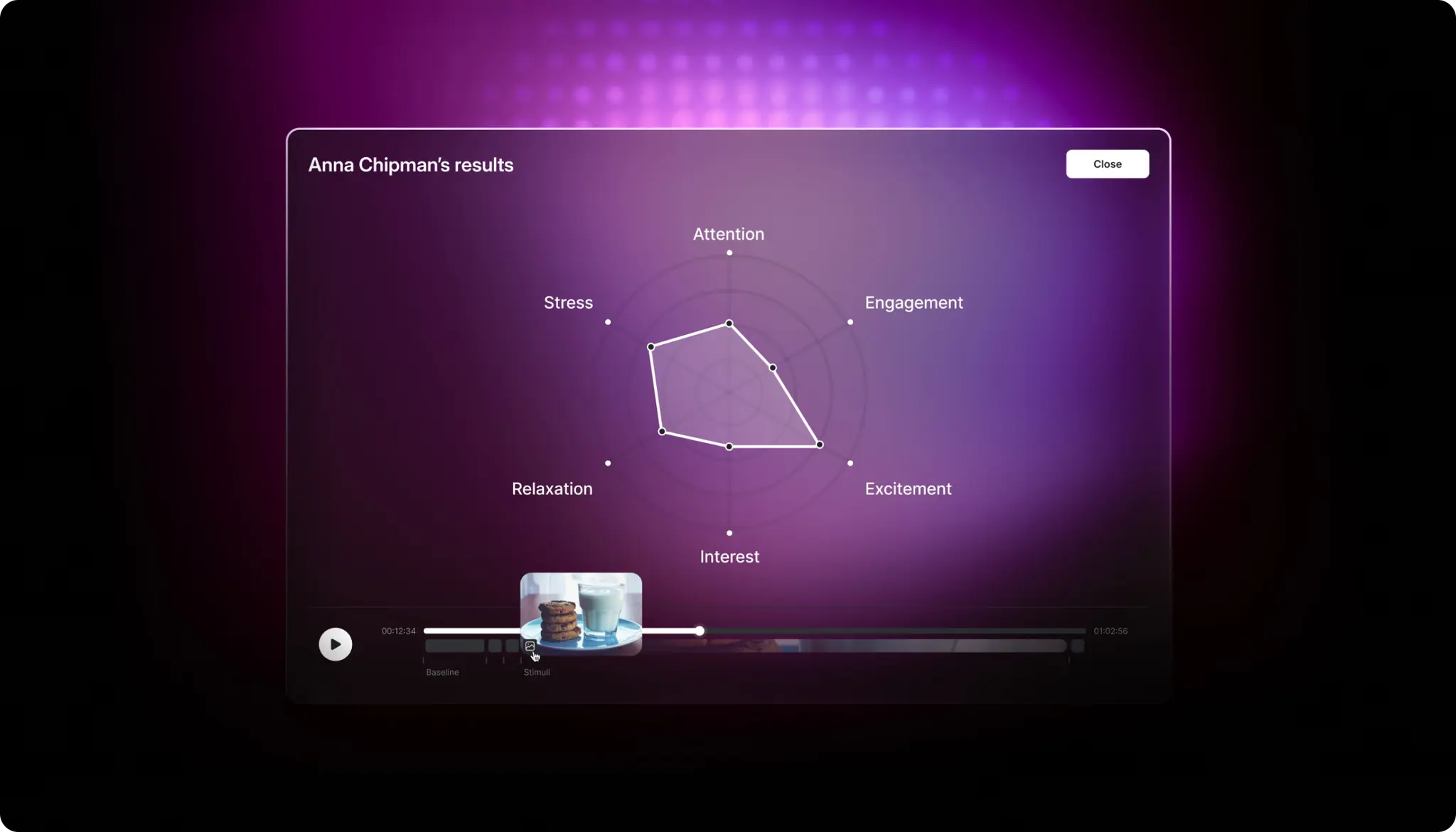
Above: a results screen in Emotiv Studio that illustrates real-time cognitive states from test participants.
How EEG-Based Research Supports Brand Recall Analysis
EEG-based audience research adds another layer by evaluating how audiences cognitively and emotionally process experiences during exposure.
Organizations may measure attention, engagement, cognitive stress, emotional activation, mental fatigue, and interest patterns to better understand how memory formation develops in real time.
This allows teams to identify:
Which scenes sustain engagement
Where attention declines
Which moments create stronger emotional response
Whether branding aligns with peak engagement moments
Which creative variant produces stronger sustained attention
Instead of relying entirely on retrospective feedback, EEG-based testing helps teams evaluate recall potential earlier in the creative process.
Brand Recall Across Digital Experiences
Brand recall is increasingly shaped across interconnected digital touchpoints rather than isolated advertisements.
Memory associations may develop through advertising exposure, social campaigns, product pages, creator collaborations, packaging interactions, UX flows, customer support experiences, and ecommerce environments.
This means recall strategy now intersects with UX research, ecommerce optimization, audience segmentation, product marketing, and omnichannel experience design.
Organizations increasingly evaluate how memory develops across the full customer journey rather than treating recall as a standalone campaign metric.
Common Issues That Reduce Brand Recall
Several factors can weaken memorability even when campaigns generate strong media performance.
Weak brand hierarchy, delayed logo placement, overly complex messaging, emotional disconnect, inconsistent branding, creative fatigue, and cognitive stress can all reduce memory retention.
In some cases, audiences remember the advertisement itself but incorrectly attribute it to a competitor. This is especially risky in categories where campaigns share similar aesthetics, pacing, or storytelling conventions.
Understanding where recall breaks down helps organizations refine creative before launch rather than reacting after performance declines.
Applying Neuroscience to Recall Optimization
Modern recall optimization increasingly combines behavioral analytics, eye tracking, EEG-based neuroanalytics, UX testing, and creative comparison analysis.
This multimodal approach helps organizations evaluate:
Attention quality
Emotional resonance
Brand association strength
Memory formation potential
Cognitive friction
Audience engagement sustainability
Rather than replacing traditional brand research, neuroscience-informed methods provide deeper visibility into how audiences experience creative work during exposure itself.
How Emotiv Studio Supports Brand Recall Research
Emotiv Studio helps organizations integrate EEG-based audience analysis into modern marketing and research workflows.
Using wireless EEG technology and AI-supported analysis, teams can evaluate audience response across advertising campaigns, product launches, UX testing, ecommerce experiences, packaging research, video content, and brand storytelling.
EmotivIQ™ aligns neural signals with moment-by-moment audience experiences, helping teams identify attention peaks, engagement decline, emotional activation, and cognitive stress patterns associated with stronger memory formation.
This helps organizations refine creative decisions before launch and improve long-term audience recall potential across digital experiences.
The Future of Brand Recall Measurement
Brand recall measurement is evolving from static awareness tracking toward dynamic audience-response analysis.
Organizations increasingly want to understand:
Which moments audiences truly remember
How emotion influences memory
Why attention drops during exposure
Which experiences create long-term association
How digital environments shape memory retention
Behavioral analytics, eye tracking, and EEG-based audience research provide deeper visibility into these questions than traditional surveys alone.
As competition for audience attention continues to intensify, understanding how memory forms during exposure will become increasingly important for modern marketing, UX, and creative teams.
Conclusion
Brand recall is not simply about awareness. It reflects whether audiences cognitively and emotionally retain a brand experience strongly enough to retrieve it later during real-world decision-making.
Modern organizations increasingly combine behavioral analytics, eye tracking, and EEG-based audience research to better understand how attention, emotional engagement, cognitive stress, and memory formation interact across digital experiences.
By measuring audience response earlier in the creative process, teams can strengthen campaign effectiveness, improve emotional resonance, and build stronger long-term brand association before media investment scales.
Teams exploring neuroscience-powered audience research and EEG-based brand testing workflows can learn more through Emotiv Studio.
Brand recall is not simply an awareness metric. For modern marketing and research teams, it is a performance signal tied to attention quality, emotional engagement, cognitive processing, and long-term brand association. Until now, the reason for a lack of brand recall has been guesswork from lack of exposure, over-exposure, design effectiveness, etc. That's why top agencies and in-house marketing teams implement neurotechnology to get unbiased insights into brand messaging.
Why Brand Recall Matters Beyond Awareness
In competitive digital environments, audiences are exposed to enormous volumes of advertising, content, products, and messaging every day. Many campaigns generate impressions or short-term engagement without creating durable memory. Others create emotional resonance that influences future purchase behavior long after exposure ends.
For organizations investing heavily in advertising, UX, ecommerce, packaging, video content, or brand storytelling, understanding recall potential before launch has become increasingly important. Modern brand recall measurement now extends beyond surveys and focus groups into behavioral analytics, eye tracking, and EEG-based audience research that evaluates how audiences cognitively and emotionally process experiences in real time.
Strong brand recall influences purchase consideration, competitive differentiation, brand preference, long-term customer retention, and campaign efficiency. In many categories, consumers make decisions from memory before actively comparing products or researching options.
This is especially true in environments shaped by mobile browsing, streaming platforms, retail overload, social media feeds, short-form video, and algorithmic content delivery. When audiences cannot retrieve a brand from memory quickly, competitors often capture attention first.
For enterprise marketing teams, recall strength increasingly functions as a leading indicator of long-term brand performance rather than a secondary awareness metric.
The Gap Between Visibility and Memorability
High visibility does not guarantee strong memory formation.
A campaign may generate impressions without retention, produce engagement without association, or create entertainment value while weakening actual brand linkage. This is one of the biggest challenges in modern advertising environments.
Audiences frequently remember a scene, visual style, soundtrack, creator, or emotional moment but fail to remember the brand attached to the experience. This disconnect often occurs when branding appears too late, emotional peaks are disconnected from brand cues, or cognitive stress interrupts audience processing.
Modern recall analysis helps organizations identify these issues before campaigns scale.
Why Traditional Brand Recall Studies Have Limitations
Traditional recall measurement often relies on surveys, interviews, focus groups, and post-campaign questionnaires. While useful, these methods primarily capture retrospective interpretation rather than real-time audience processing.
Participants may rationalize experiences after exposure, overestimate attention, misremember engagement, or struggle to explain subconscious emotional reactions. Many important memory and emotional processing events occur before audiences consciously articulate them.
This creates limitations when teams rely exclusively on stated feedback to evaluate memorability.
Attention as a Predictor of Recall
Attention is one of the strongest contributors to memory encoding.
If audiences do not meaningfully process a moment, recall potential decreases significantly. However, modern attention research shows that visibility and exposure alone are not enough. The quality and sustainability of attention matter.
Organizations increasingly evaluate:
Sustained attention
Attention drop-off
Engagement consistency
Visual distraction
Cognitive stress
Emotional intensity
These signals help explain whether audiences are cognitively processing experiences deeply enough to form lasting memory associations.
Emotional Engagement and Memory Formation
Emotion significantly influences recall strength.
Campaigns that generate emotional activation are often easier to remember because emotionally meaningful moments receive stronger cognitive processing. This applies across advertising campaigns, product launches, UX experiences, ecommerce interactions, social campaigns, and branded storytelling.
Importantly, emotional engagement does not always require dramatic storytelling. Curiosity, aspiration, humor, surprise, sensory appeal, trust, and identity alignment can all strengthen memory formation when used effectively.
Organizations increasingly test emotional engagement during exposure itself rather than relying entirely on post-campaign recall surveys.
Using Behavioral Analytics for Recall Analysis
Behavioral analytics can help organizations identify indirect indicators of recall strength.
Teams may analyze repeat visits, navigation return patterns, repeat engagement behavior, content completion, and brand-specific search activity to better understand whether audiences continue interacting with a brand after initial exposure.
These signals provide useful evidence that memory association may be forming over time. However, behavioral analytics alone rarely explain why certain moments became memorable while others disappeared quickly.
This is why organizations increasingly combine behavioral analysis with neuroscience-informed audience research methods.
Eye Tracking and Visual Memory Research
Eye tracking helps researchers evaluate whether audiences visually process critical brand elements during exposure.
Testing may analyze:
Logo visibility
Packaging prominence
Product placement
CTA hierarchy
Message visibility
Visual competition
Banner blindness
This helps teams identify whether important brand cues are clearly seen, visually ignored, introduced too late, or competing against distracting elements in the experience.
Eye tracking is especially valuable for ecommerce testing, packaging design, video advertising, landing pages, retail displays, and social creative. However, visual attention alone does not fully explain emotional engagement or memory encoding.
Above: a results screen in Emotiv Studio that illustrates real-time cognitive states from test participants.
How EEG-Based Research Supports Brand Recall Analysis
EEG-based audience research adds another layer by evaluating how audiences cognitively and emotionally process experiences during exposure.
Organizations may measure attention, engagement, cognitive stress, emotional activation, mental fatigue, and interest patterns to better understand how memory formation develops in real time.
This allows teams to identify:
Which scenes sustain engagement
Where attention declines
Which moments create stronger emotional response
Whether branding aligns with peak engagement moments
Which creative variant produces stronger sustained attention
Instead of relying entirely on retrospective feedback, EEG-based testing helps teams evaluate recall potential earlier in the creative process.
Brand Recall Across Digital Experiences
Brand recall is increasingly shaped across interconnected digital touchpoints rather than isolated advertisements.
Memory associations may develop through advertising exposure, social campaigns, product pages, creator collaborations, packaging interactions, UX flows, customer support experiences, and ecommerce environments.
This means recall strategy now intersects with UX research, ecommerce optimization, audience segmentation, product marketing, and omnichannel experience design.
Organizations increasingly evaluate how memory develops across the full customer journey rather than treating recall as a standalone campaign metric.
Common Issues That Reduce Brand Recall
Several factors can weaken memorability even when campaigns generate strong media performance.
Weak brand hierarchy, delayed logo placement, overly complex messaging, emotional disconnect, inconsistent branding, creative fatigue, and cognitive stress can all reduce memory retention.
In some cases, audiences remember the advertisement itself but incorrectly attribute it to a competitor. This is especially risky in categories where campaigns share similar aesthetics, pacing, or storytelling conventions.
Understanding where recall breaks down helps organizations refine creative before launch rather than reacting after performance declines.
Applying Neuroscience to Recall Optimization
Modern recall optimization increasingly combines behavioral analytics, eye tracking, EEG-based neuroanalytics, UX testing, and creative comparison analysis.
This multimodal approach helps organizations evaluate:
Attention quality
Emotional resonance
Brand association strength
Memory formation potential
Cognitive friction
Audience engagement sustainability
Rather than replacing traditional brand research, neuroscience-informed methods provide deeper visibility into how audiences experience creative work during exposure itself.
How Emotiv Studio Supports Brand Recall Research
Emotiv Studio helps organizations integrate EEG-based audience analysis into modern marketing and research workflows.
Using wireless EEG technology and AI-supported analysis, teams can evaluate audience response across advertising campaigns, product launches, UX testing, ecommerce experiences, packaging research, video content, and brand storytelling.
EmotivIQ™ aligns neural signals with moment-by-moment audience experiences, helping teams identify attention peaks, engagement decline, emotional activation, and cognitive stress patterns associated with stronger memory formation.
This helps organizations refine creative decisions before launch and improve long-term audience recall potential across digital experiences.
The Future of Brand Recall Measurement
Brand recall measurement is evolving from static awareness tracking toward dynamic audience-response analysis.
Organizations increasingly want to understand:
Which moments audiences truly remember
How emotion influences memory
Why attention drops during exposure
Which experiences create long-term association
How digital environments shape memory retention
Behavioral analytics, eye tracking, and EEG-based audience research provide deeper visibility into these questions than traditional surveys alone.
As competition for audience attention continues to intensify, understanding how memory forms during exposure will become increasingly important for modern marketing, UX, and creative teams.
Conclusion
Brand recall is not simply about awareness. It reflects whether audiences cognitively and emotionally retain a brand experience strongly enough to retrieve it later during real-world decision-making.
Modern organizations increasingly combine behavioral analytics, eye tracking, and EEG-based audience research to better understand how attention, emotional engagement, cognitive stress, and memory formation interact across digital experiences.
By measuring audience response earlier in the creative process, teams can strengthen campaign effectiveness, improve emotional resonance, and build stronger long-term brand association before media investment scales.
Teams exploring neuroscience-powered audience research and EEG-based brand testing workflows can learn more through Emotiv Studio.
Brand recall is not simply an awareness metric. For modern marketing and research teams, it is a performance signal tied to attention quality, emotional engagement, cognitive processing, and long-term brand association. Until now, the reason for a lack of brand recall has been guesswork from lack of exposure, over-exposure, design effectiveness, etc. That's why top agencies and in-house marketing teams implement neurotechnology to get unbiased insights into brand messaging.
Why Brand Recall Matters Beyond Awareness
In competitive digital environments, audiences are exposed to enormous volumes of advertising, content, products, and messaging every day. Many campaigns generate impressions or short-term engagement without creating durable memory. Others create emotional resonance that influences future purchase behavior long after exposure ends.
For organizations investing heavily in advertising, UX, ecommerce, packaging, video content, or brand storytelling, understanding recall potential before launch has become increasingly important. Modern brand recall measurement now extends beyond surveys and focus groups into behavioral analytics, eye tracking, and EEG-based audience research that evaluates how audiences cognitively and emotionally process experiences in real time.
Strong brand recall influences purchase consideration, competitive differentiation, brand preference, long-term customer retention, and campaign efficiency. In many categories, consumers make decisions from memory before actively comparing products or researching options.
This is especially true in environments shaped by mobile browsing, streaming platforms, retail overload, social media feeds, short-form video, and algorithmic content delivery. When audiences cannot retrieve a brand from memory quickly, competitors often capture attention first.
For enterprise marketing teams, recall strength increasingly functions as a leading indicator of long-term brand performance rather than a secondary awareness metric.
The Gap Between Visibility and Memorability
High visibility does not guarantee strong memory formation.
A campaign may generate impressions without retention, produce engagement without association, or create entertainment value while weakening actual brand linkage. This is one of the biggest challenges in modern advertising environments.
Audiences frequently remember a scene, visual style, soundtrack, creator, or emotional moment but fail to remember the brand attached to the experience. This disconnect often occurs when branding appears too late, emotional peaks are disconnected from brand cues, or cognitive stress interrupts audience processing.
Modern recall analysis helps organizations identify these issues before campaigns scale.
Why Traditional Brand Recall Studies Have Limitations
Traditional recall measurement often relies on surveys, interviews, focus groups, and post-campaign questionnaires. While useful, these methods primarily capture retrospective interpretation rather than real-time audience processing.
Participants may rationalize experiences after exposure, overestimate attention, misremember engagement, or struggle to explain subconscious emotional reactions. Many important memory and emotional processing events occur before audiences consciously articulate them.
This creates limitations when teams rely exclusively on stated feedback to evaluate memorability.
Attention as a Predictor of Recall
Attention is one of the strongest contributors to memory encoding.
If audiences do not meaningfully process a moment, recall potential decreases significantly. However, modern attention research shows that visibility and exposure alone are not enough. The quality and sustainability of attention matter.
Organizations increasingly evaluate:
Sustained attention
Attention drop-off
Engagement consistency
Visual distraction
Cognitive stress
Emotional intensity
These signals help explain whether audiences are cognitively processing experiences deeply enough to form lasting memory associations.
Emotional Engagement and Memory Formation
Emotion significantly influences recall strength.
Campaigns that generate emotional activation are often easier to remember because emotionally meaningful moments receive stronger cognitive processing. This applies across advertising campaigns, product launches, UX experiences, ecommerce interactions, social campaigns, and branded storytelling.
Importantly, emotional engagement does not always require dramatic storytelling. Curiosity, aspiration, humor, surprise, sensory appeal, trust, and identity alignment can all strengthen memory formation when used effectively.
Organizations increasingly test emotional engagement during exposure itself rather than relying entirely on post-campaign recall surveys.
Using Behavioral Analytics for Recall Analysis
Behavioral analytics can help organizations identify indirect indicators of recall strength.
Teams may analyze repeat visits, navigation return patterns, repeat engagement behavior, content completion, and brand-specific search activity to better understand whether audiences continue interacting with a brand after initial exposure.
These signals provide useful evidence that memory association may be forming over time. However, behavioral analytics alone rarely explain why certain moments became memorable while others disappeared quickly.
This is why organizations increasingly combine behavioral analysis with neuroscience-informed audience research methods.
Eye Tracking and Visual Memory Research
Eye tracking helps researchers evaluate whether audiences visually process critical brand elements during exposure.
Testing may analyze:
Logo visibility
Packaging prominence
Product placement
CTA hierarchy
Message visibility
Visual competition
Banner blindness
This helps teams identify whether important brand cues are clearly seen, visually ignored, introduced too late, or competing against distracting elements in the experience.
Eye tracking is especially valuable for ecommerce testing, packaging design, video advertising, landing pages, retail displays, and social creative. However, visual attention alone does not fully explain emotional engagement or memory encoding.
Above: a results screen in Emotiv Studio that illustrates real-time cognitive states from test participants.
How EEG-Based Research Supports Brand Recall Analysis
EEG-based audience research adds another layer by evaluating how audiences cognitively and emotionally process experiences during exposure.
Organizations may measure attention, engagement, cognitive stress, emotional activation, mental fatigue, and interest patterns to better understand how memory formation develops in real time.
This allows teams to identify:
Which scenes sustain engagement
Where attention declines
Which moments create stronger emotional response
Whether branding aligns with peak engagement moments
Which creative variant produces stronger sustained attention
Instead of relying entirely on retrospective feedback, EEG-based testing helps teams evaluate recall potential earlier in the creative process.
Brand Recall Across Digital Experiences
Brand recall is increasingly shaped across interconnected digital touchpoints rather than isolated advertisements.
Memory associations may develop through advertising exposure, social campaigns, product pages, creator collaborations, packaging interactions, UX flows, customer support experiences, and ecommerce environments.
This means recall strategy now intersects with UX research, ecommerce optimization, audience segmentation, product marketing, and omnichannel experience design.
Organizations increasingly evaluate how memory develops across the full customer journey rather than treating recall as a standalone campaign metric.
Common Issues That Reduce Brand Recall
Several factors can weaken memorability even when campaigns generate strong media performance.
Weak brand hierarchy, delayed logo placement, overly complex messaging, emotional disconnect, inconsistent branding, creative fatigue, and cognitive stress can all reduce memory retention.
In some cases, audiences remember the advertisement itself but incorrectly attribute it to a competitor. This is especially risky in categories where campaigns share similar aesthetics, pacing, or storytelling conventions.
Understanding where recall breaks down helps organizations refine creative before launch rather than reacting after performance declines.
Applying Neuroscience to Recall Optimization
Modern recall optimization increasingly combines behavioral analytics, eye tracking, EEG-based neuroanalytics, UX testing, and creative comparison analysis.
This multimodal approach helps organizations evaluate:
Attention quality
Emotional resonance
Brand association strength
Memory formation potential
Cognitive friction
Audience engagement sustainability
Rather than replacing traditional brand research, neuroscience-informed methods provide deeper visibility into how audiences experience creative work during exposure itself.
How Emotiv Studio Supports Brand Recall Research
Emotiv Studio helps organizations integrate EEG-based audience analysis into modern marketing and research workflows.
Using wireless EEG technology and AI-supported analysis, teams can evaluate audience response across advertising campaigns, product launches, UX testing, ecommerce experiences, packaging research, video content, and brand storytelling.
EmotivIQ™ aligns neural signals with moment-by-moment audience experiences, helping teams identify attention peaks, engagement decline, emotional activation, and cognitive stress patterns associated with stronger memory formation.
This helps organizations refine creative decisions before launch and improve long-term audience recall potential across digital experiences.
The Future of Brand Recall Measurement
Brand recall measurement is evolving from static awareness tracking toward dynamic audience-response analysis.
Organizations increasingly want to understand:
Which moments audiences truly remember
How emotion influences memory
Why attention drops during exposure
Which experiences create long-term association
How digital environments shape memory retention
Behavioral analytics, eye tracking, and EEG-based audience research provide deeper visibility into these questions than traditional surveys alone.
As competition for audience attention continues to intensify, understanding how memory forms during exposure will become increasingly important for modern marketing, UX, and creative teams.
Conclusion
Brand recall is not simply about awareness. It reflects whether audiences cognitively and emotionally retain a brand experience strongly enough to retrieve it later during real-world decision-making.
Modern organizations increasingly combine behavioral analytics, eye tracking, and EEG-based audience research to better understand how attention, emotional engagement, cognitive stress, and memory formation interact across digital experiences.
By measuring audience response earlier in the creative process, teams can strengthen campaign effectiveness, improve emotional resonance, and build stronger long-term brand association before media investment scales.
Teams exploring neuroscience-powered audience research and EEG-based brand testing workflows can learn more through Emotiv Studio.