
Beverage Ad Testing: Measuring Attention, Emotion, and Purchase Motivation
H.B. Duran
Updated on
May 22, 2026
Beverage Ad Testing: Measuring Attention, Emotion, and Purchase Motivation
H.B. Duran
Updated on
May 22, 2026
Beverage Ad Testing: Measuring Attention, Emotion, and Purchase Motivation
H.B. Duran
Updated on
May 22, 2026
Beverage advertising has always been about more than the product itself.
Consumers rarely buy a soft drink, energy drink, bottled water, coffee, or sports beverage based solely on ingredients. They buy the feeling associated with the product. Refreshment. Energy. Celebration. Relaxation. Performance. Social connection. That's why Neuroscience-based audience research can help measure attention, emotional engagement, cognitive stress, and audience response while viewers experience creative in real time.
Why Beverage Advertising Is Emotionally Competitive
The beverage industry is one of the most crowded advertising categories in the world.
Consumers regularly choose between products with similar functional benefits, price points, and availability. As a result, emotional positioning often becomes the primary differentiator.
Coca-Cola has spent decades associating its products with happiness, connection, and shared experiences. Campaigns such as "Share a Coke" transformed packaging into a social experience, creating emotional engagement that extended beyond the beverage itself.
Red Bull built an entirely different identity. Rather than focusing on taste, the brand became synonymous with adventure, extreme sports, and high performance. Events like the Red Bull Stratos jump helped reinforce that positioning on a global scale.
Liquid Death took yet another approach, using irreverent humor and heavy-metal-inspired branding to stand out in the bottled water category.
Each of these brands sells a beverage. Yet each creates a completely different emotional response.
That is why beverage marketers need to understand not only whether consumers notice an ad, but also how they feel while experiencing it.
The Limits of Traditional Beverage Ad Testing
The challenge for beverage marketers is understanding whether an advertisement creates those intended emotions before it reaches the market.
A campaign may generate strong visual appeal while failing to create desire. A product shot may look beautiful but be forgotten moments later. A celebrity endorsement may attract attention without strengthening purchase motivation.
For beverage brands, effective ad testing increasingly requires more than surveys, focus groups, and post-campaign analytics. Traditional research methods remain valuable. Surveys, interviews, focus groups, and brand-lift studies can provide useful information about recall, preference, and purchase intent.
However, beverage advertising often relies on emotional and sensory cues that consumers struggle to articulate.
A viewer may feel thirsty after watching a cold-pour sequence without consciously understanding why. A packaging shot may create positive emotional associations that influence preference later. An energetic soundtrack may increase engagement even if viewers never mention it during a survey.
Post-campaign analytics present another challenge. Metrics such as impressions, video views, click-through rates, and conversions show what happened after launch. They rarely explain which creative moments generated engagement or where audience attention began to decline.
For beverage marketers, that missing layer of insight can make the difference between a campaign that performs adequately and one that becomes iconic.
Why Sensory Cues Matter
Unlike many product categories, beverage advertising frequently sells an experience consumers cannot physically taste during exposure.
Instead, marketers rely on visual and auditory cues to trigger sensory expectations.
Think about how often beverage commercials feature condensation rolling down a can, ice cubes crashing into a glass, carbonation bubbles rising to the surface, or slow-motion pour shots designed to emphasize refreshment.
Coca-Cola, Pepsi, and Sprite have all used these techniques extensively throughout their advertising history. Energy-drink brands often pair product imagery with fast pacing, dynamic camera movement, and high-energy soundtracks to create excitement and anticipation.
These sensory signals influence audience perception long before consumers ever take a sip.
The challenge is understanding which cues actually drive engagement and which simply blend into the background.
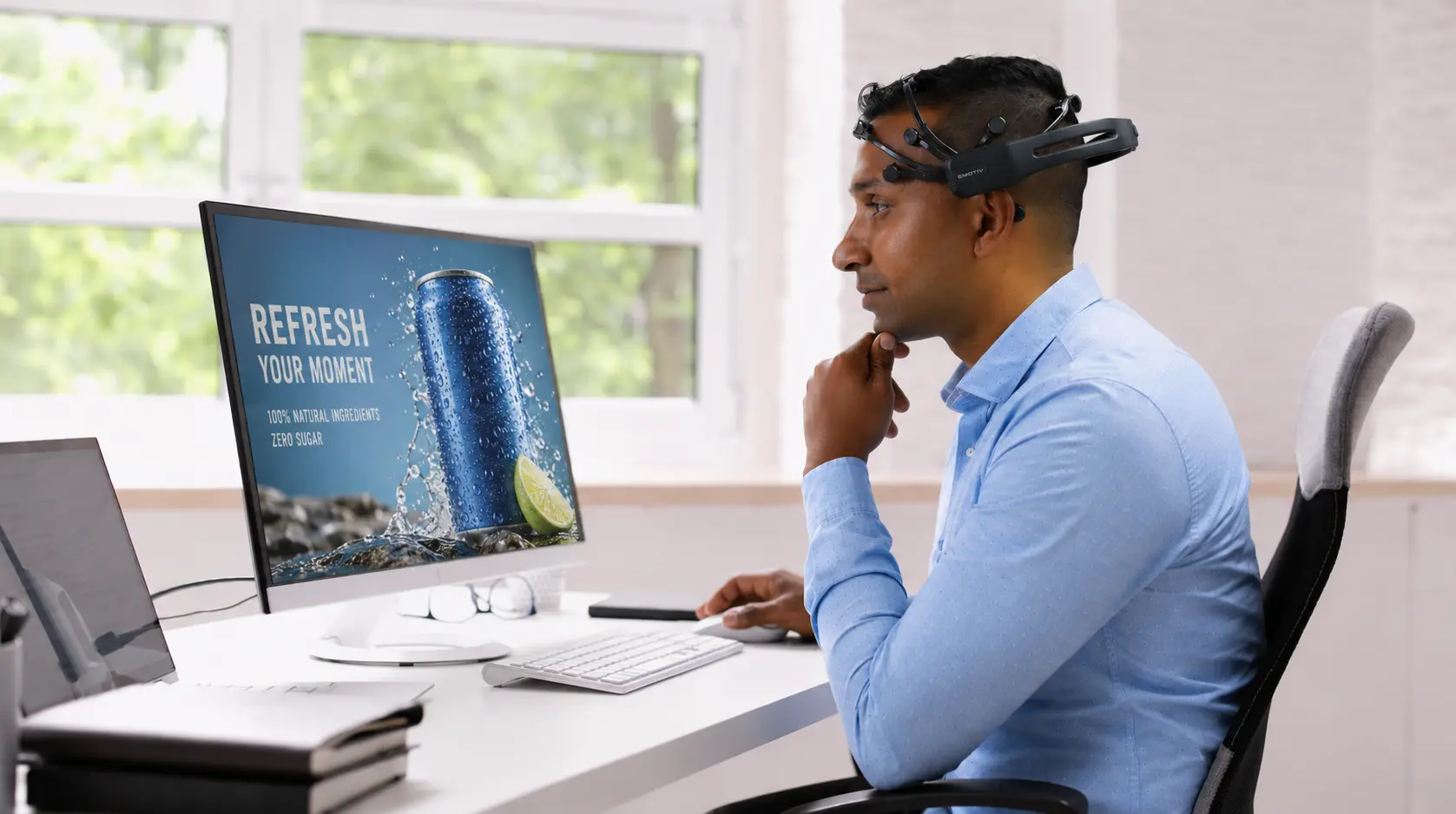
Above: A consumer research test participant wears an Emotiv Epoc X EEG headset while observing beverage marketing creative inside Emotiv Studio.
Using EEG Insights for Beverage Creative Testing
EEG-based audience testing helps marketers evaluate how consumers respond during exposure to advertising content.
Rather than asking viewers to remember how they felt after an ad ends, researchers can analyze audience response as it happens.
This allows teams to measure:
Attention sustainability
Emotional engagement
Interest
Cognitive stress
Response to product moments
For example, a beverage brand may discover that attention peaks during a product reveal but drops significantly during a lengthy lifestyle sequence. Another campaign may generate strong emotional engagement throughout the story but fail to maintain attention long enough for viewers to absorb the brand message.
These insights help teams understand whether creative assets are generating meaningful engagement or simply achieving visibility.
Testing Beverage Campaign Variations
Most beverage campaigns are not produced as a single asset.
Brands often create multiple versions for different audiences, platforms, and marketing objectives. Social media ads, streaming video placements, retail media campaigns, and television spots may all require different creative approaches.
Consider how Celsius frequently tailors creative around fitness, performance, and active lifestyles, while brands like Starbucks often emphasize ritual, comfort, and personal moments.
Testing variations before launch can help marketers evaluate whether different creative directions generate different audience responses.
Teams may compare emotional versus functional messaging, product-first versus lifestyle-first openings, different soundtrack options, alternative product shots, or varying call-to-action placements.
Rather than relying on assumptions, marketers can identify which version sustains attention and emotional engagement most effectively.
Understanding Creative Fatigue
Even successful beverage campaigns eventually experience creative fatigue.
Repeated exposure can reduce novelty and weaken engagement over time. Audiences begin filtering out familiar content, even when media delivery remains strong.
This challenge is especially important in digital advertising environments where consumers encounter the same assets repeatedly across social media, streaming platforms, retail media networks, and video advertising.
Audience-response testing can help identify whether creative assets maintain engagement across repeated exposures or begin losing effectiveness.
Understanding these patterns helps brands make better decisions about creative rotation, campaign refresh timing, and media sequencing.
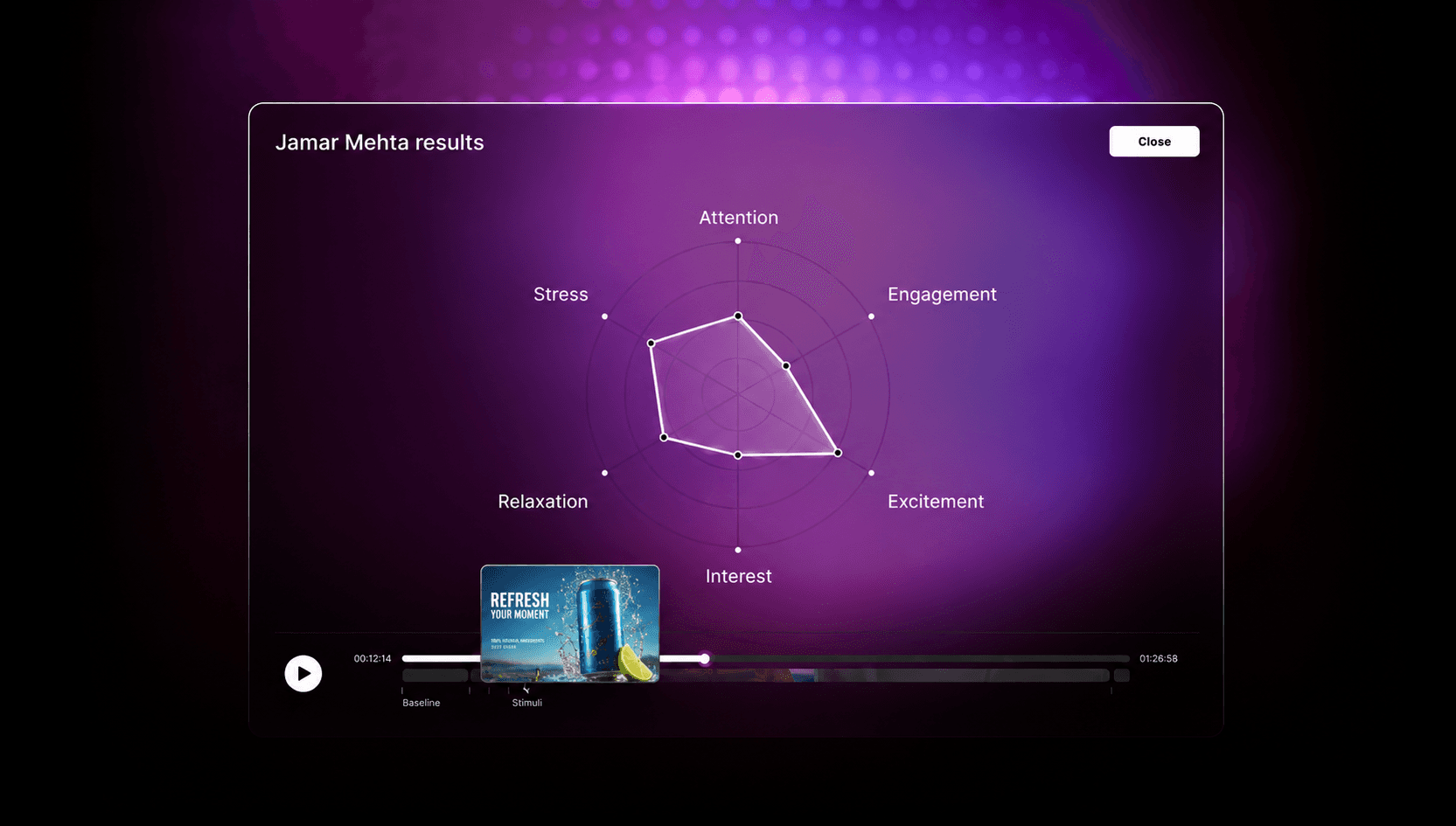
Above: An Emotiv Studio results screen displays a research participant's moment-by-moment cognitive reaction to a beverage marketing creative.
Video Attention Analysis for Beverage Brands
Video remains one of the most important formats in beverage marketing because it combines storytelling, sensory cues, motion, sound, and branding into a single experience.
However, audience engagement changes continuously throughout a video.
A strong opening may capture attention immediately, while a weak middle section causes viewers to disengage before the key message appears.
Neuroanalytics can help beverage marketers evaluate opening-hook effectiveness, emotional response peaks, product visibility timing, attention drop-off points, and CTA performance throughout an advertisement.
This provides a more detailed understanding of audience experience than completion rates alone.
Why Leading Beverage Brands Are Investing in Better Measurement
As media costs continue rising, brands face increasing pressure to maximize creative effectiveness before launch.
Every campaign represents a significant investment in production, distribution, and optimization. Waiting until after launch to understand audience response can be expensive.
This is one reason marketers are increasingly combining traditional research methods with neuroscience-informed audience testing.
Rather than relying exclusively on stated preference, organizations can evaluate how consumers cognitively and emotionally respond to advertising as they experience it.
The result is a more complete understanding of what drives attention, engagement, and purchase motivation.
Applying Neuroscience to Beverage Advertising
Beverage advertising succeeds when consumers do more than notice a product. It succeeds when they feel something.
Whether a campaign is designed to communicate refreshment, excitement, comfort, energy, or social connection, understanding audience response before launch creates a significant competitive advantage.
By combining behavioral analytics, creative testing, and EEG-based neuroanalytics, beverage brands can better understand how consumers respond to advertising in real time.
This supports stronger creative decisions, more effective campaign optimization, and deeper insight into the emotional drivers that influence purchase behavior.
Conclusion
Beverage advertising operates in one of the most emotionally competitive categories in marketing. Brands such as Coca-Cola, Red Bull, Liquid Death, Celsius, and Starbucks have demonstrated the power of creating emotional associations that extend far beyond the product itself.
The challenge is measuring whether those associations are actually being created before campaigns reach the market.
Neuroscience-based audience testing adds a deeper layer of insight by helping marketers evaluate attention, engagement, emotional response, and creative effectiveness while consumers experience advertising.
Explore how neuroscience-powered audience testing can support beverage ad optimization with Emotiv Studio.
Beverage advertising has always been about more than the product itself.
Consumers rarely buy a soft drink, energy drink, bottled water, coffee, or sports beverage based solely on ingredients. They buy the feeling associated with the product. Refreshment. Energy. Celebration. Relaxation. Performance. Social connection. That's why Neuroscience-based audience research can help measure attention, emotional engagement, cognitive stress, and audience response while viewers experience creative in real time.
Why Beverage Advertising Is Emotionally Competitive
The beverage industry is one of the most crowded advertising categories in the world.
Consumers regularly choose between products with similar functional benefits, price points, and availability. As a result, emotional positioning often becomes the primary differentiator.
Coca-Cola has spent decades associating its products with happiness, connection, and shared experiences. Campaigns such as "Share a Coke" transformed packaging into a social experience, creating emotional engagement that extended beyond the beverage itself.
Red Bull built an entirely different identity. Rather than focusing on taste, the brand became synonymous with adventure, extreme sports, and high performance. Events like the Red Bull Stratos jump helped reinforce that positioning on a global scale.
Liquid Death took yet another approach, using irreverent humor and heavy-metal-inspired branding to stand out in the bottled water category.
Each of these brands sells a beverage. Yet each creates a completely different emotional response.
That is why beverage marketers need to understand not only whether consumers notice an ad, but also how they feel while experiencing it.
The Limits of Traditional Beverage Ad Testing
The challenge for beverage marketers is understanding whether an advertisement creates those intended emotions before it reaches the market.
A campaign may generate strong visual appeal while failing to create desire. A product shot may look beautiful but be forgotten moments later. A celebrity endorsement may attract attention without strengthening purchase motivation.
For beverage brands, effective ad testing increasingly requires more than surveys, focus groups, and post-campaign analytics. Traditional research methods remain valuable. Surveys, interviews, focus groups, and brand-lift studies can provide useful information about recall, preference, and purchase intent.
However, beverage advertising often relies on emotional and sensory cues that consumers struggle to articulate.
A viewer may feel thirsty after watching a cold-pour sequence without consciously understanding why. A packaging shot may create positive emotional associations that influence preference later. An energetic soundtrack may increase engagement even if viewers never mention it during a survey.
Post-campaign analytics present another challenge. Metrics such as impressions, video views, click-through rates, and conversions show what happened after launch. They rarely explain which creative moments generated engagement or where audience attention began to decline.
For beverage marketers, that missing layer of insight can make the difference between a campaign that performs adequately and one that becomes iconic.
Why Sensory Cues Matter
Unlike many product categories, beverage advertising frequently sells an experience consumers cannot physically taste during exposure.
Instead, marketers rely on visual and auditory cues to trigger sensory expectations.
Think about how often beverage commercials feature condensation rolling down a can, ice cubes crashing into a glass, carbonation bubbles rising to the surface, or slow-motion pour shots designed to emphasize refreshment.
Coca-Cola, Pepsi, and Sprite have all used these techniques extensively throughout their advertising history. Energy-drink brands often pair product imagery with fast pacing, dynamic camera movement, and high-energy soundtracks to create excitement and anticipation.
These sensory signals influence audience perception long before consumers ever take a sip.
The challenge is understanding which cues actually drive engagement and which simply blend into the background.
Above: A consumer research test participant wears an Emotiv Epoc X EEG headset while observing beverage marketing creative inside Emotiv Studio.
Using EEG Insights for Beverage Creative Testing
EEG-based audience testing helps marketers evaluate how consumers respond during exposure to advertising content.
Rather than asking viewers to remember how they felt after an ad ends, researchers can analyze audience response as it happens.
This allows teams to measure:
Attention sustainability
Emotional engagement
Interest
Cognitive stress
Response to product moments
For example, a beverage brand may discover that attention peaks during a product reveal but drops significantly during a lengthy lifestyle sequence. Another campaign may generate strong emotional engagement throughout the story but fail to maintain attention long enough for viewers to absorb the brand message.
These insights help teams understand whether creative assets are generating meaningful engagement or simply achieving visibility.
Testing Beverage Campaign Variations
Most beverage campaigns are not produced as a single asset.
Brands often create multiple versions for different audiences, platforms, and marketing objectives. Social media ads, streaming video placements, retail media campaigns, and television spots may all require different creative approaches.
Consider how Celsius frequently tailors creative around fitness, performance, and active lifestyles, while brands like Starbucks often emphasize ritual, comfort, and personal moments.
Testing variations before launch can help marketers evaluate whether different creative directions generate different audience responses.
Teams may compare emotional versus functional messaging, product-first versus lifestyle-first openings, different soundtrack options, alternative product shots, or varying call-to-action placements.
Rather than relying on assumptions, marketers can identify which version sustains attention and emotional engagement most effectively.
Understanding Creative Fatigue
Even successful beverage campaigns eventually experience creative fatigue.
Repeated exposure can reduce novelty and weaken engagement over time. Audiences begin filtering out familiar content, even when media delivery remains strong.
This challenge is especially important in digital advertising environments where consumers encounter the same assets repeatedly across social media, streaming platforms, retail media networks, and video advertising.
Audience-response testing can help identify whether creative assets maintain engagement across repeated exposures or begin losing effectiveness.
Understanding these patterns helps brands make better decisions about creative rotation, campaign refresh timing, and media sequencing.
Above: An Emotiv Studio results screen displays a research participant's moment-by-moment cognitive reaction to a beverage marketing creative.
Video Attention Analysis for Beverage Brands
Video remains one of the most important formats in beverage marketing because it combines storytelling, sensory cues, motion, sound, and branding into a single experience.
However, audience engagement changes continuously throughout a video.
A strong opening may capture attention immediately, while a weak middle section causes viewers to disengage before the key message appears.
Neuroanalytics can help beverage marketers evaluate opening-hook effectiveness, emotional response peaks, product visibility timing, attention drop-off points, and CTA performance throughout an advertisement.
This provides a more detailed understanding of audience experience than completion rates alone.
Why Leading Beverage Brands Are Investing in Better Measurement
As media costs continue rising, brands face increasing pressure to maximize creative effectiveness before launch.
Every campaign represents a significant investment in production, distribution, and optimization. Waiting until after launch to understand audience response can be expensive.
This is one reason marketers are increasingly combining traditional research methods with neuroscience-informed audience testing.
Rather than relying exclusively on stated preference, organizations can evaluate how consumers cognitively and emotionally respond to advertising as they experience it.
The result is a more complete understanding of what drives attention, engagement, and purchase motivation.
Applying Neuroscience to Beverage Advertising
Beverage advertising succeeds when consumers do more than notice a product. It succeeds when they feel something.
Whether a campaign is designed to communicate refreshment, excitement, comfort, energy, or social connection, understanding audience response before launch creates a significant competitive advantage.
By combining behavioral analytics, creative testing, and EEG-based neuroanalytics, beverage brands can better understand how consumers respond to advertising in real time.
This supports stronger creative decisions, more effective campaign optimization, and deeper insight into the emotional drivers that influence purchase behavior.
Conclusion
Beverage advertising operates in one of the most emotionally competitive categories in marketing. Brands such as Coca-Cola, Red Bull, Liquid Death, Celsius, and Starbucks have demonstrated the power of creating emotional associations that extend far beyond the product itself.
The challenge is measuring whether those associations are actually being created before campaigns reach the market.
Neuroscience-based audience testing adds a deeper layer of insight by helping marketers evaluate attention, engagement, emotional response, and creative effectiveness while consumers experience advertising.
Explore how neuroscience-powered audience testing can support beverage ad optimization with Emotiv Studio.
Beverage advertising has always been about more than the product itself.
Consumers rarely buy a soft drink, energy drink, bottled water, coffee, or sports beverage based solely on ingredients. They buy the feeling associated with the product. Refreshment. Energy. Celebration. Relaxation. Performance. Social connection. That's why Neuroscience-based audience research can help measure attention, emotional engagement, cognitive stress, and audience response while viewers experience creative in real time.
Why Beverage Advertising Is Emotionally Competitive
The beverage industry is one of the most crowded advertising categories in the world.
Consumers regularly choose between products with similar functional benefits, price points, and availability. As a result, emotional positioning often becomes the primary differentiator.
Coca-Cola has spent decades associating its products with happiness, connection, and shared experiences. Campaigns such as "Share a Coke" transformed packaging into a social experience, creating emotional engagement that extended beyond the beverage itself.
Red Bull built an entirely different identity. Rather than focusing on taste, the brand became synonymous with adventure, extreme sports, and high performance. Events like the Red Bull Stratos jump helped reinforce that positioning on a global scale.
Liquid Death took yet another approach, using irreverent humor and heavy-metal-inspired branding to stand out in the bottled water category.
Each of these brands sells a beverage. Yet each creates a completely different emotional response.
That is why beverage marketers need to understand not only whether consumers notice an ad, but also how they feel while experiencing it.
The Limits of Traditional Beverage Ad Testing
The challenge for beverage marketers is understanding whether an advertisement creates those intended emotions before it reaches the market.
A campaign may generate strong visual appeal while failing to create desire. A product shot may look beautiful but be forgotten moments later. A celebrity endorsement may attract attention without strengthening purchase motivation.
For beverage brands, effective ad testing increasingly requires more than surveys, focus groups, and post-campaign analytics. Traditional research methods remain valuable. Surveys, interviews, focus groups, and brand-lift studies can provide useful information about recall, preference, and purchase intent.
However, beverage advertising often relies on emotional and sensory cues that consumers struggle to articulate.
A viewer may feel thirsty after watching a cold-pour sequence without consciously understanding why. A packaging shot may create positive emotional associations that influence preference later. An energetic soundtrack may increase engagement even if viewers never mention it during a survey.
Post-campaign analytics present another challenge. Metrics such as impressions, video views, click-through rates, and conversions show what happened after launch. They rarely explain which creative moments generated engagement or where audience attention began to decline.
For beverage marketers, that missing layer of insight can make the difference between a campaign that performs adequately and one that becomes iconic.
Why Sensory Cues Matter
Unlike many product categories, beverage advertising frequently sells an experience consumers cannot physically taste during exposure.
Instead, marketers rely on visual and auditory cues to trigger sensory expectations.
Think about how often beverage commercials feature condensation rolling down a can, ice cubes crashing into a glass, carbonation bubbles rising to the surface, or slow-motion pour shots designed to emphasize refreshment.
Coca-Cola, Pepsi, and Sprite have all used these techniques extensively throughout their advertising history. Energy-drink brands often pair product imagery with fast pacing, dynamic camera movement, and high-energy soundtracks to create excitement and anticipation.
These sensory signals influence audience perception long before consumers ever take a sip.
The challenge is understanding which cues actually drive engagement and which simply blend into the background.
Above: A consumer research test participant wears an Emotiv Epoc X EEG headset while observing beverage marketing creative inside Emotiv Studio.
Using EEG Insights for Beverage Creative Testing
EEG-based audience testing helps marketers evaluate how consumers respond during exposure to advertising content.
Rather than asking viewers to remember how they felt after an ad ends, researchers can analyze audience response as it happens.
This allows teams to measure:
Attention sustainability
Emotional engagement
Interest
Cognitive stress
Response to product moments
For example, a beverage brand may discover that attention peaks during a product reveal but drops significantly during a lengthy lifestyle sequence. Another campaign may generate strong emotional engagement throughout the story but fail to maintain attention long enough for viewers to absorb the brand message.
These insights help teams understand whether creative assets are generating meaningful engagement or simply achieving visibility.
Testing Beverage Campaign Variations
Most beverage campaigns are not produced as a single asset.
Brands often create multiple versions for different audiences, platforms, and marketing objectives. Social media ads, streaming video placements, retail media campaigns, and television spots may all require different creative approaches.
Consider how Celsius frequently tailors creative around fitness, performance, and active lifestyles, while brands like Starbucks often emphasize ritual, comfort, and personal moments.
Testing variations before launch can help marketers evaluate whether different creative directions generate different audience responses.
Teams may compare emotional versus functional messaging, product-first versus lifestyle-first openings, different soundtrack options, alternative product shots, or varying call-to-action placements.
Rather than relying on assumptions, marketers can identify which version sustains attention and emotional engagement most effectively.
Understanding Creative Fatigue
Even successful beverage campaigns eventually experience creative fatigue.
Repeated exposure can reduce novelty and weaken engagement over time. Audiences begin filtering out familiar content, even when media delivery remains strong.
This challenge is especially important in digital advertising environments where consumers encounter the same assets repeatedly across social media, streaming platforms, retail media networks, and video advertising.
Audience-response testing can help identify whether creative assets maintain engagement across repeated exposures or begin losing effectiveness.
Understanding these patterns helps brands make better decisions about creative rotation, campaign refresh timing, and media sequencing.
Above: An Emotiv Studio results screen displays a research participant's moment-by-moment cognitive reaction to a beverage marketing creative.
Video Attention Analysis for Beverage Brands
Video remains one of the most important formats in beverage marketing because it combines storytelling, sensory cues, motion, sound, and branding into a single experience.
However, audience engagement changes continuously throughout a video.
A strong opening may capture attention immediately, while a weak middle section causes viewers to disengage before the key message appears.
Neuroanalytics can help beverage marketers evaluate opening-hook effectiveness, emotional response peaks, product visibility timing, attention drop-off points, and CTA performance throughout an advertisement.
This provides a more detailed understanding of audience experience than completion rates alone.
Why Leading Beverage Brands Are Investing in Better Measurement
As media costs continue rising, brands face increasing pressure to maximize creative effectiveness before launch.
Every campaign represents a significant investment in production, distribution, and optimization. Waiting until after launch to understand audience response can be expensive.
This is one reason marketers are increasingly combining traditional research methods with neuroscience-informed audience testing.
Rather than relying exclusively on stated preference, organizations can evaluate how consumers cognitively and emotionally respond to advertising as they experience it.
The result is a more complete understanding of what drives attention, engagement, and purchase motivation.
Applying Neuroscience to Beverage Advertising
Beverage advertising succeeds when consumers do more than notice a product. It succeeds when they feel something.
Whether a campaign is designed to communicate refreshment, excitement, comfort, energy, or social connection, understanding audience response before launch creates a significant competitive advantage.
By combining behavioral analytics, creative testing, and EEG-based neuroanalytics, beverage brands can better understand how consumers respond to advertising in real time.
This supports stronger creative decisions, more effective campaign optimization, and deeper insight into the emotional drivers that influence purchase behavior.
Conclusion
Beverage advertising operates in one of the most emotionally competitive categories in marketing. Brands such as Coca-Cola, Red Bull, Liquid Death, Celsius, and Starbucks have demonstrated the power of creating emotional associations that extend far beyond the product itself.
The challenge is measuring whether those associations are actually being created before campaigns reach the market.
Neuroscience-based audience testing adds a deeper layer of insight by helping marketers evaluate attention, engagement, emotional response, and creative effectiveness while consumers experience advertising.
Explore how neuroscience-powered audience testing can support beverage ad optimization with Emotiv Studio.