Validation of the Emotiv EPOC® EEG gaming system for measuring research quality auditory ERPs
Nuri Djavit
Updated on
Dec 2, 2012
Validation of the Emotiv EPOC® EEG gaming system for measuring research quality auditory ERPs
Nuri Djavit
Updated on
Dec 2, 2012
Validation of the Emotiv EPOC® EEG gaming system for measuring research quality auditory ERPs
Nuri Djavit
Updated on
Dec 2, 2012
Nicholas A. Badcock, Petroula Mousikou, Yatin Mahajan, Peter de Lissa, Johnson Thie, Genevieve McArthur. ARC Centre of Excellence in Cognition and its Disorders, Macquarie University, Sydney, NSW, Australia. Department of Psychology, Royal Holloway, University of London, London, United Kingdom. School of Electrical and Information Engineering, University of Sydney, Sydney, NSW, Australia
Abstract
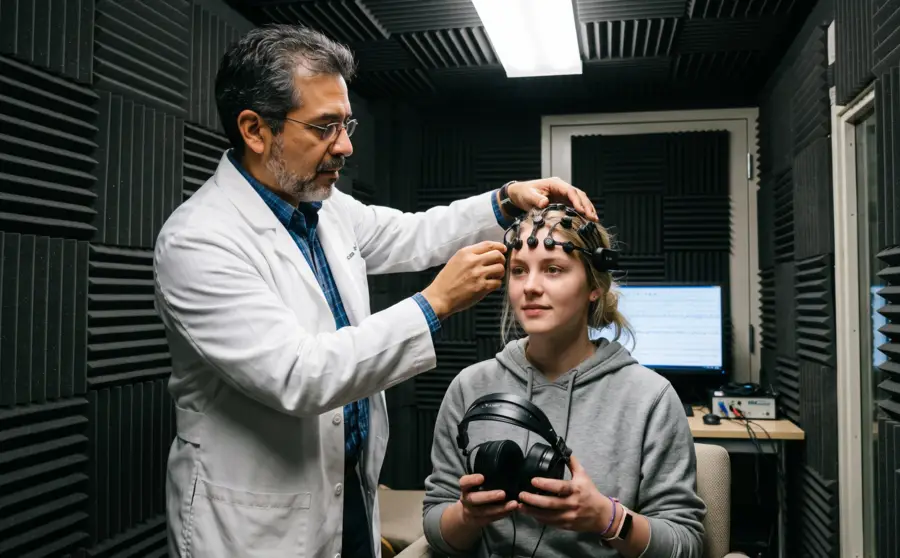
Auditory event-related potentials (ERPs) have proved useful in investigating the role of auditory processing in cognitive disorders such as developmental dyslexia, specific language impairment (SLI), attention deficit hyperactivity disorder (ADHD), schizophrenia, and autism. However, laboratory recordings of auditory ERPs can be lengthy, uncomfortable, or threatening for some participants – particularly children. Recently, a commercial gaming EEG (electroencephalography) system has been developed that is portable, inexpensive, and easy to set up. In this study we tested if auditory ERPs measured using a gaming EEG system (Emotiv EPOC) were equivalent to those measured by a widely-used, laboratory-based, research EEG system (Neuroscan).Click here to read the full report
Nicholas A. Badcock, Petroula Mousikou, Yatin Mahajan, Peter de Lissa, Johnson Thie, Genevieve McArthur. ARC Centre of Excellence in Cognition and its Disorders, Macquarie University, Sydney, NSW, Australia. Department of Psychology, Royal Holloway, University of London, London, United Kingdom. School of Electrical and Information Engineering, University of Sydney, Sydney, NSW, Australia
Abstract
Auditory event-related potentials (ERPs) have proved useful in investigating the role of auditory processing in cognitive disorders such as developmental dyslexia, specific language impairment (SLI), attention deficit hyperactivity disorder (ADHD), schizophrenia, and autism. However, laboratory recordings of auditory ERPs can be lengthy, uncomfortable, or threatening for some participants – particularly children. Recently, a commercial gaming EEG (electroencephalography) system has been developed that is portable, inexpensive, and easy to set up. In this study we tested if auditory ERPs measured using a gaming EEG system (Emotiv EPOC) were equivalent to those measured by a widely-used, laboratory-based, research EEG system (Neuroscan).Click here to read the full report
Nicholas A. Badcock, Petroula Mousikou, Yatin Mahajan, Peter de Lissa, Johnson Thie, Genevieve McArthur. ARC Centre of Excellence in Cognition and its Disorders, Macquarie University, Sydney, NSW, Australia. Department of Psychology, Royal Holloway, University of London, London, United Kingdom. School of Electrical and Information Engineering, University of Sydney, Sydney, NSW, Australia
Abstract
Auditory event-related potentials (ERPs) have proved useful in investigating the role of auditory processing in cognitive disorders such as developmental dyslexia, specific language impairment (SLI), attention deficit hyperactivity disorder (ADHD), schizophrenia, and autism. However, laboratory recordings of auditory ERPs can be lengthy, uncomfortable, or threatening for some participants – particularly children. Recently, a commercial gaming EEG (electroencephalography) system has been developed that is portable, inexpensive, and easy to set up. In this study we tested if auditory ERPs measured using a gaming EEG system (Emotiv EPOC) were equivalent to those measured by a widely-used, laboratory-based, research EEG system (Neuroscan).Click here to read the full report

Continue reading