Best Neurofeedback Headsets for Home Training and Research
H.B. Duran
Updated on
Feb 9, 2026
Best Neurofeedback Headsets for Home Training and Research
H.B. Duran
Updated on
Feb 9, 2026
Best Neurofeedback Headsets for Home Training and Research
H.B. Duran
Updated on
Feb 9, 2026
Neurofeedback uses real-time information about brain activity to create a feedback loop. EEG sensors measure electrical activity from the brain, software processes those signals, and the resulting feedback may be presented through a visualization, sound, game, or other experience. Choosing a neurofeedback headset starts with understanding what you want to do with that information.
A researcher studying attention may need access to multi-channel raw EEG. A developer building a brain-computer interface may prioritize APIs and real-time data streams. Someone exploring their own cognitive patterns may prefer a simpler wearable and guided software experience. There is no single "best" neurofeedback headset for every application. The right system depends on the brain data you need, how you plan to use it, and the software required to turn that data into meaningful feedback.
Key Takeaways
Neurofeedback combines brain sensing, software, and real-time feedback.
EEG channel count and sensor placement determine what brain activity a system can measure.
More channels are not automatically better. The right coverage depends on your application.
Software matters as much as hardware, particularly if you need raw EEG, cognitive metrics, APIs, or custom applications.
Comfort and setup requirements become increasingly important for repeated sessions.
Emotiv offers EEG systems ranging from discreet 2-channel earbuds to configurable 32-channel research systems.
What Is a Neurofeedback Headset?
A neurofeedback headset uses sensors to measure brain activity and provide information derived from that activity back to the user in real time.
Many neurofeedback systems use electroencephalography (EEG), a non-invasive method of measuring electrical activity from the brain.
A typical EEG neurofeedback system has three components:
EEG Hardware
Sensors detect electrical activity at specific locations around the head. The number and placement of those sensors determine what signals are available to the system.
Software
Software receives and processes the EEG signal. Depending on the platform, it may provide access to raw EEG, frequency bands, cognitive metrics, visualizations, or other derived information.
Feedback
Information derived from the EEG is presented back to the user. Feedback can take many forms, including visualizations, audio, interactive experiences, or changes within an application.
Together, these components create a feedback loop between measured brain activity and the experience presented to the user.
How Does EEG Neurofeedback Work?
EEG sensors passively measure voltage fluctuations generated by electrical activity in the brain. They record signals rather than sending electrical stimulation into the brain.
Software processes those signals and identifies the EEG features or patterns required by the application. The system can then translate that information into feedback as the activity occurs.
For example, an application designed around attention could respond to changes in EEG patterns associated with focus. A research application might instead provide researchers with continuous data for studying how neural activity changes throughout a task.
This distinction matters because neurofeedback is not defined by a particular headset or exercise. It is the feedback loop created between brain activity, signal processing, and the resulting experience.
What Should You Look for in a Neurofeedback Headset?
Before comparing individual devices, start with the requirements of your application.
EEG Channel Count and Coverage
An EEG channel represents brain activity measured from a particular sensor location.
Systems with fewer channels can be appropriate when the application requires signals from specific areas. Higher-channel systems provide broader spatial coverage and may be necessary for research questions involving activity across multiple brain regions.
The goal is not simply to choose the highest channel count available. It is to select enough coverage for the signals you need to measure.
Signal Quality
EEG signals are small and susceptible to interference from movement, muscle activity, poor sensor contact, and electrical noise.
Sensor design, electrode contact, participant preparation, recording environment, and data quality monitoring all influence the resulting EEG signal.
For research applications, signal quality should be considered alongside channel count rather than treating either specification in isolation.
Sensor Type and Setup
Different EEG systems use different sensor technologies.
Saline and gel systems can support high-quality research recordings but require participant preparation. Dry and semi-dry systems may reduce setup requirements for applications where rapid or repeated use is important.
Consider who will use the system, how often recordings will occur, and how much setup your application can accommodate.
Software and Data Access
The headset is only one part of an EEG system.
Ask what you need the software to provide:
Raw EEG
Frequency-band data
Cognitive metrics
Real-time visualization
Recording and export
Event marking
API or SDK access
Integration with research software
Custom application development
A system that provides the right hardware but cannot support your intended data workflow may not be the right choice.
Real-Time Performance
Neurofeedback depends on receiving and processing information quickly enough to create a meaningful relationship between brain activity and feedback.
For interactive applications, developers should consider the complete data pipeline, including EEG acquisition, signal processing, wireless communication, software, and the feedback experience itself.
Comfort and Form Factor
The ideal form factor depends heavily on context.
A configurable EEG cap may make sense for a controlled research study but not an everyday application. A lightweight headset or ear-based EEG system may provide less spatial coverage while making repeated or real-world measurement easier.
Consider the tradeoff between coverage, setup, portability, and the experience of the participant.
Brain Data Privacy
Brain data is deeply personal.
Before choosing any neurotechnology platform, understand how brain data is collected, processed, stored, and shared. Researchers, developers, and users should know what information is being collected and maintain appropriate control over how that information is used.
Privacy, transparency, consent, and user agency should be considered part of the technology itself rather than an afterthought.
Which Emotiv EEG System Is Right for Neurofeedback?
Emotiv offers several EEG form factors designed for different levels of coverage, portability, and technical complexity.
MN8: Discreet Brain Sensing
2 EEG channels
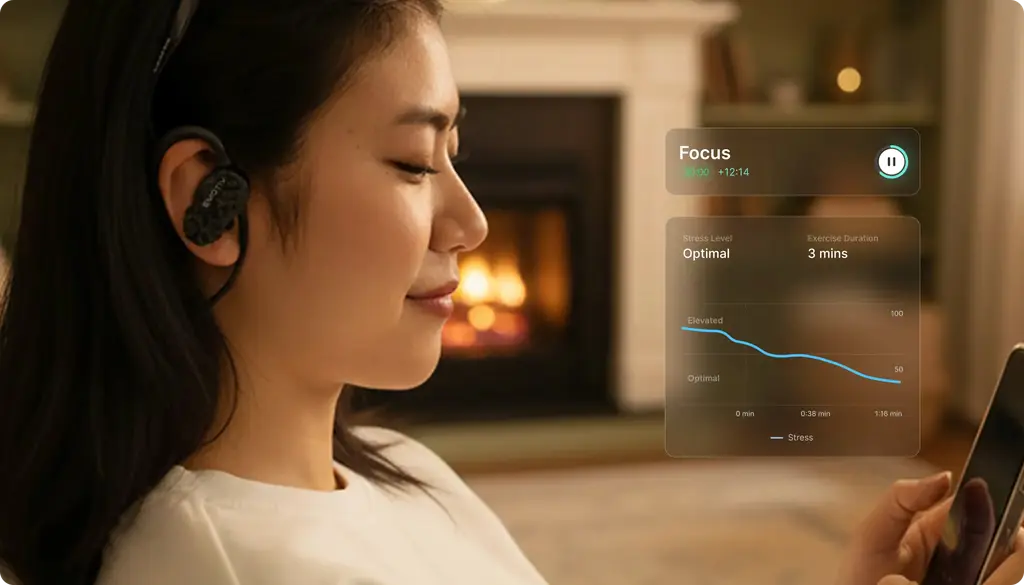
MN8 integrates EEG sensors into an earbud form factor, providing brain sensing through a wearable designed for lower-friction use.
Paired with Brainwear, MN8 can provide insights into patterns associated with attention, cognitive load, and cognitive stress while supporting guided focus experiences and cognitive challenges.
Consider MN8 when you prioritize:
Simple setup
Short, intentional sessions
Personal brain insights
Focus and cognitive awareness
A familiar earbud form factor
Insight: Lightweight Multi-Channel EEG
5 EEG channels
Insight provides multi-channel EEG in a lightweight headset with semi-dry polymer sensors.
Its balance of portability and broader EEG coverage makes it suitable for research, BCI development, interactive experiences, and applications where a full research system is unnecessary.
Consider Insight when you need:
Five-channel EEG
Rapid setup
Semi-dry sensors
BCI development
Lightweight research or interactive applications
Epoc X: Professional Wireless EEG
14 EEG channels
Epoc X provides 14-channel wireless EEG with saline sensors and broad coverage across the scalp.
Designed for research and development, Epoc X supports raw EEG acquisition, cognitive metrics, BCI applications, and integration with Emotiv's research software and developer tools.
Consider Epoc X when you need:
Broad EEG coverage
Research-grade brain data
Raw EEG access
Cognitive research
BCI development
Mobile or real-world studies
Flex 2.0: Configurable High-Density EEG
Up to 32 EEG channels
Flex 2.0 is designed for researchers who need greater control over electrode placement and channel configuration.
With up to 32 channels, Flex supports advanced neuroscience studies where researchers need higher-density EEG and the ability to configure sensor locations around a specific experimental design.
Consider Flex 2.0 when you need:
Up to 32 EEG channels
Configurable electrode placement
Advanced neuroscience research
ERP studies
Greater spatial coverage
Custom experimental configurations
Comparing Emotiv EEG Systems
MN8 (Brainwear) | Insight | Epoc X | Flex 2.0 | |
|---|---|---|---|---|
EEG channels | 2 | 5 | 14 | Up to 32 |
Form factor | Earbuds | Lightweight headband | Wireless EEG headset | Configurable EEG cap |
Sensor approach | Dry | Semi-dry | Saline | Saline or gel |
Best suited for | Personal brain insights and focus sessions | Lightweight research and BCI | Research, BCI and applied studies | Advanced and configurable EEG research |
Raw EEG access | Yes | Yes | Yes | Yes |
Neurofeedback for Personal Use vs. Research
The term "neurofeedback headset" covers very different applications.
For personal use, simplicity and consistency may matter more than extensive scalp coverage. Someone interested in observing their own attention patterns may not need a 32-channel research system.
Research presents different requirements. Experimental design may determine sensor placement, channel count, sampling requirements, access to raw EEG, event timing, and compatibility with analysis tools.
Developers occupy another category. A BCI application may require real-time EEG streams, APIs, cognitive metrics, or the ability to translate specific neural patterns into commands.
Start with the application, then choose the hardware.
Is More EEG Channels Always Better?
No.
More channels provide measurements from more locations across the scalp, which can be valuable for studies requiring broader spatial information.
But additional channels can also increase setup time, data complexity, and processing requirements.
A two-channel system can be appropriate for an application designed around signals measurable from those locations. A 32-channel system may be appropriate when a research question requires considerably broader coverage.
The best channel count is the one that provides the information required by your application.
Can You Build Your Own Neurofeedback Application?
Yes. EEG hardware can also serve as the sensing layer for custom neurofeedback and BCI applications.
Emotiv's software ecosystem provides different levels of access depending on the application. EmotivPRO supports EEG recording, visualization, data export, and research workflows, while Cortex API enables developers to access Emotiv data streams for custom applications.
This allows developers and researchers to determine what EEG information matters to their application and design the feedback experience around it.
Choosing the Right Neurofeedback Headset
Start by asking five questions:
What brain activity do I need to measure?
How much EEG coverage does my application require?
Will this be used occasionally, repeatedly, or in real-world environments?
What data and software access do I need?
Am I using an existing feedback experience or building my own?
Those answers will tell you far more than a generic ranking of the "best" neurofeedback headsets.
For personal brain insights and guided focus experiences, MN8 and Brainwear provide a streamlined starting point.
For lightweight multi-channel EEG and BCI applications, consider Insight.
For professional research requiring broader scalp coverage, Epoc X provides 14-channel wireless EEG.
For advanced studies requiring configurable, high-density recordings, Flex 2.0 supports up to 32 channels.
The best neurofeedback headset is ultimately the one that provides the brain data, software access, and form factor your application actually requires.
Frequently Asked Questions
What is a neurofeedback headset?
A neurofeedback headset measures brain activity, typically using EEG, as part of a system that provides information derived from that activity back to the user in real time.
Does an EEG headset send electricity into your brain?
No. EEG sensors are passive. They measure electrical activity generated by the brain rather than electrically stimulating it.
How many EEG channels do I need for neurofeedback?
It depends on the application. Fewer channels may be sufficient for applications targeting signals from specific locations, while research requiring broader scalp coverage may benefit from 14, 32, or more channels.
Can EEG neurofeedback be used outside a laboratory?
Wireless and wearable EEG systems can support brain data collection in real-world environments. The appropriate system depends on the required signal coverage, movement conditions, setup requirements, and research or application goals.
Can I access raw EEG data with Emotiv headsets?
Raw EEG is available from Emotiv devices with EmotivPRO licensing. Researchers and developers should choose their software based on the data streams and functionality required for their application.
Are Emotiv EEG headsets medical devices?
Emotiv's general-purpose EEG systems are designed for research, development, BCI, and cognitive applications. They should not be used to diagnose, treat, cure, or prevent medical conditions unless a specific product and application have the appropriate regulatory authorization.
Explore EEG for Neurofeedback and BCI
From personal brain insights to advanced neuroscience research, Emotiv provides EEG hardware, software, and developer tools for measuring brain activity and building real-time applications.
Neurofeedback uses real-time information about brain activity to create a feedback loop. EEG sensors measure electrical activity from the brain, software processes those signals, and the resulting feedback may be presented through a visualization, sound, game, or other experience. Choosing a neurofeedback headset starts with understanding what you want to do with that information.
A researcher studying attention may need access to multi-channel raw EEG. A developer building a brain-computer interface may prioritize APIs and real-time data streams. Someone exploring their own cognitive patterns may prefer a simpler wearable and guided software experience. There is no single "best" neurofeedback headset for every application. The right system depends on the brain data you need, how you plan to use it, and the software required to turn that data into meaningful feedback.
Key Takeaways
Neurofeedback combines brain sensing, software, and real-time feedback.
EEG channel count and sensor placement determine what brain activity a system can measure.
More channels are not automatically better. The right coverage depends on your application.
Software matters as much as hardware, particularly if you need raw EEG, cognitive metrics, APIs, or custom applications.
Comfort and setup requirements become increasingly important for repeated sessions.
Emotiv offers EEG systems ranging from discreet 2-channel earbuds to configurable 32-channel research systems.
What Is a Neurofeedback Headset?
A neurofeedback headset uses sensors to measure brain activity and provide information derived from that activity back to the user in real time.
Many neurofeedback systems use electroencephalography (EEG), a non-invasive method of measuring electrical activity from the brain.
A typical EEG neurofeedback system has three components:
EEG Hardware
Sensors detect electrical activity at specific locations around the head. The number and placement of those sensors determine what signals are available to the system.
Software
Software receives and processes the EEG signal. Depending on the platform, it may provide access to raw EEG, frequency bands, cognitive metrics, visualizations, or other derived information.
Feedback
Information derived from the EEG is presented back to the user. Feedback can take many forms, including visualizations, audio, interactive experiences, or changes within an application.
Together, these components create a feedback loop between measured brain activity and the experience presented to the user.
How Does EEG Neurofeedback Work?
EEG sensors passively measure voltage fluctuations generated by electrical activity in the brain. They record signals rather than sending electrical stimulation into the brain.
Software processes those signals and identifies the EEG features or patterns required by the application. The system can then translate that information into feedback as the activity occurs.
For example, an application designed around attention could respond to changes in EEG patterns associated with focus. A research application might instead provide researchers with continuous data for studying how neural activity changes throughout a task.
This distinction matters because neurofeedback is not defined by a particular headset or exercise. It is the feedback loop created between brain activity, signal processing, and the resulting experience.
What Should You Look for in a Neurofeedback Headset?
Before comparing individual devices, start with the requirements of your application.
EEG Channel Count and Coverage
An EEG channel represents brain activity measured from a particular sensor location.
Systems with fewer channels can be appropriate when the application requires signals from specific areas. Higher-channel systems provide broader spatial coverage and may be necessary for research questions involving activity across multiple brain regions.
The goal is not simply to choose the highest channel count available. It is to select enough coverage for the signals you need to measure.
Signal Quality
EEG signals are small and susceptible to interference from movement, muscle activity, poor sensor contact, and electrical noise.
Sensor design, electrode contact, participant preparation, recording environment, and data quality monitoring all influence the resulting EEG signal.
For research applications, signal quality should be considered alongside channel count rather than treating either specification in isolation.
Sensor Type and Setup
Different EEG systems use different sensor technologies.
Saline and gel systems can support high-quality research recordings but require participant preparation. Dry and semi-dry systems may reduce setup requirements for applications where rapid or repeated use is important.
Consider who will use the system, how often recordings will occur, and how much setup your application can accommodate.
Software and Data Access
The headset is only one part of an EEG system.
Ask what you need the software to provide:
Raw EEG
Frequency-band data
Cognitive metrics
Real-time visualization
Recording and export
Event marking
API or SDK access
Integration with research software
Custom application development
A system that provides the right hardware but cannot support your intended data workflow may not be the right choice.
Real-Time Performance
Neurofeedback depends on receiving and processing information quickly enough to create a meaningful relationship between brain activity and feedback.
For interactive applications, developers should consider the complete data pipeline, including EEG acquisition, signal processing, wireless communication, software, and the feedback experience itself.
Comfort and Form Factor
The ideal form factor depends heavily on context.
A configurable EEG cap may make sense for a controlled research study but not an everyday application. A lightweight headset or ear-based EEG system may provide less spatial coverage while making repeated or real-world measurement easier.
Consider the tradeoff between coverage, setup, portability, and the experience of the participant.
Brain Data Privacy
Brain data is deeply personal.
Before choosing any neurotechnology platform, understand how brain data is collected, processed, stored, and shared. Researchers, developers, and users should know what information is being collected and maintain appropriate control over how that information is used.
Privacy, transparency, consent, and user agency should be considered part of the technology itself rather than an afterthought.
Which Emotiv EEG System Is Right for Neurofeedback?
Emotiv offers several EEG form factors designed for different levels of coverage, portability, and technical complexity.
MN8: Discreet Brain Sensing
2 EEG channels
MN8 integrates EEG sensors into an earbud form factor, providing brain sensing through a wearable designed for lower-friction use.
Paired with Brainwear, MN8 can provide insights into patterns associated with attention, cognitive load, and cognitive stress while supporting guided focus experiences and cognitive challenges.
Consider MN8 when you prioritize:
Simple setup
Short, intentional sessions
Personal brain insights
Focus and cognitive awareness
A familiar earbud form factor
Insight: Lightweight Multi-Channel EEG
5 EEG channels
Insight provides multi-channel EEG in a lightweight headset with semi-dry polymer sensors.
Its balance of portability and broader EEG coverage makes it suitable for research, BCI development, interactive experiences, and applications where a full research system is unnecessary.
Consider Insight when you need:
Five-channel EEG
Rapid setup
Semi-dry sensors
BCI development
Lightweight research or interactive applications
Epoc X: Professional Wireless EEG
14 EEG channels
Epoc X provides 14-channel wireless EEG with saline sensors and broad coverage across the scalp.
Designed for research and development, Epoc X supports raw EEG acquisition, cognitive metrics, BCI applications, and integration with Emotiv's research software and developer tools.
Consider Epoc X when you need:
Broad EEG coverage
Research-grade brain data
Raw EEG access
Cognitive research
BCI development
Mobile or real-world studies
Flex 2.0: Configurable High-Density EEG
Up to 32 EEG channels
Flex 2.0 is designed for researchers who need greater control over electrode placement and channel configuration.
With up to 32 channels, Flex supports advanced neuroscience studies where researchers need higher-density EEG and the ability to configure sensor locations around a specific experimental design.
Consider Flex 2.0 when you need:
Up to 32 EEG channels
Configurable electrode placement
Advanced neuroscience research
ERP studies
Greater spatial coverage
Custom experimental configurations
Comparing Emotiv EEG Systems
MN8 (Brainwear) | Insight | Epoc X | Flex 2.0 | |
|---|---|---|---|---|
EEG channels | 2 | 5 | 14 | Up to 32 |
Form factor | Earbuds | Lightweight headband | Wireless EEG headset | Configurable EEG cap |
Sensor approach | Dry | Semi-dry | Saline | Saline or gel |
Best suited for | Personal brain insights and focus sessions | Lightweight research and BCI | Research, BCI and applied studies | Advanced and configurable EEG research |
Raw EEG access | Yes | Yes | Yes | Yes |
Neurofeedback for Personal Use vs. Research
The term "neurofeedback headset" covers very different applications.
For personal use, simplicity and consistency may matter more than extensive scalp coverage. Someone interested in observing their own attention patterns may not need a 32-channel research system.
Research presents different requirements. Experimental design may determine sensor placement, channel count, sampling requirements, access to raw EEG, event timing, and compatibility with analysis tools.
Developers occupy another category. A BCI application may require real-time EEG streams, APIs, cognitive metrics, or the ability to translate specific neural patterns into commands.
Start with the application, then choose the hardware.
Is More EEG Channels Always Better?
No.
More channels provide measurements from more locations across the scalp, which can be valuable for studies requiring broader spatial information.
But additional channels can also increase setup time, data complexity, and processing requirements.
A two-channel system can be appropriate for an application designed around signals measurable from those locations. A 32-channel system may be appropriate when a research question requires considerably broader coverage.
The best channel count is the one that provides the information required by your application.
Can You Build Your Own Neurofeedback Application?
Yes. EEG hardware can also serve as the sensing layer for custom neurofeedback and BCI applications.
Emotiv's software ecosystem provides different levels of access depending on the application. EmotivPRO supports EEG recording, visualization, data export, and research workflows, while Cortex API enables developers to access Emotiv data streams for custom applications.
This allows developers and researchers to determine what EEG information matters to their application and design the feedback experience around it.
Choosing the Right Neurofeedback Headset
Start by asking five questions:
What brain activity do I need to measure?
How much EEG coverage does my application require?
Will this be used occasionally, repeatedly, or in real-world environments?
What data and software access do I need?
Am I using an existing feedback experience or building my own?
Those answers will tell you far more than a generic ranking of the "best" neurofeedback headsets.
For personal brain insights and guided focus experiences, MN8 and Brainwear provide a streamlined starting point.
For lightweight multi-channel EEG and BCI applications, consider Insight.
For professional research requiring broader scalp coverage, Epoc X provides 14-channel wireless EEG.
For advanced studies requiring configurable, high-density recordings, Flex 2.0 supports up to 32 channels.
The best neurofeedback headset is ultimately the one that provides the brain data, software access, and form factor your application actually requires.
Frequently Asked Questions
What is a neurofeedback headset?
A neurofeedback headset measures brain activity, typically using EEG, as part of a system that provides information derived from that activity back to the user in real time.
Does an EEG headset send electricity into your brain?
No. EEG sensors are passive. They measure electrical activity generated by the brain rather than electrically stimulating it.
How many EEG channels do I need for neurofeedback?
It depends on the application. Fewer channels may be sufficient for applications targeting signals from specific locations, while research requiring broader scalp coverage may benefit from 14, 32, or more channels.
Can EEG neurofeedback be used outside a laboratory?
Wireless and wearable EEG systems can support brain data collection in real-world environments. The appropriate system depends on the required signal coverage, movement conditions, setup requirements, and research or application goals.
Can I access raw EEG data with Emotiv headsets?
Raw EEG is available from Emotiv devices with EmotivPRO licensing. Researchers and developers should choose their software based on the data streams and functionality required for their application.
Are Emotiv EEG headsets medical devices?
Emotiv's general-purpose EEG systems are designed for research, development, BCI, and cognitive applications. They should not be used to diagnose, treat, cure, or prevent medical conditions unless a specific product and application have the appropriate regulatory authorization.
Explore EEG for Neurofeedback and BCI
From personal brain insights to advanced neuroscience research, Emotiv provides EEG hardware, software, and developer tools for measuring brain activity and building real-time applications.
Neurofeedback uses real-time information about brain activity to create a feedback loop. EEG sensors measure electrical activity from the brain, software processes those signals, and the resulting feedback may be presented through a visualization, sound, game, or other experience. Choosing a neurofeedback headset starts with understanding what you want to do with that information.
A researcher studying attention may need access to multi-channel raw EEG. A developer building a brain-computer interface may prioritize APIs and real-time data streams. Someone exploring their own cognitive patterns may prefer a simpler wearable and guided software experience. There is no single "best" neurofeedback headset for every application. The right system depends on the brain data you need, how you plan to use it, and the software required to turn that data into meaningful feedback.
Key Takeaways
Neurofeedback combines brain sensing, software, and real-time feedback.
EEG channel count and sensor placement determine what brain activity a system can measure.
More channels are not automatically better. The right coverage depends on your application.
Software matters as much as hardware, particularly if you need raw EEG, cognitive metrics, APIs, or custom applications.
Comfort and setup requirements become increasingly important for repeated sessions.
Emotiv offers EEG systems ranging from discreet 2-channel earbuds to configurable 32-channel research systems.
What Is a Neurofeedback Headset?
A neurofeedback headset uses sensors to measure brain activity and provide information derived from that activity back to the user in real time.
Many neurofeedback systems use electroencephalography (EEG), a non-invasive method of measuring electrical activity from the brain.
A typical EEG neurofeedback system has three components:
EEG Hardware
Sensors detect electrical activity at specific locations around the head. The number and placement of those sensors determine what signals are available to the system.
Software
Software receives and processes the EEG signal. Depending on the platform, it may provide access to raw EEG, frequency bands, cognitive metrics, visualizations, or other derived information.
Feedback
Information derived from the EEG is presented back to the user. Feedback can take many forms, including visualizations, audio, interactive experiences, or changes within an application.
Together, these components create a feedback loop between measured brain activity and the experience presented to the user.
How Does EEG Neurofeedback Work?
EEG sensors passively measure voltage fluctuations generated by electrical activity in the brain. They record signals rather than sending electrical stimulation into the brain.
Software processes those signals and identifies the EEG features or patterns required by the application. The system can then translate that information into feedback as the activity occurs.
For example, an application designed around attention could respond to changes in EEG patterns associated with focus. A research application might instead provide researchers with continuous data for studying how neural activity changes throughout a task.
This distinction matters because neurofeedback is not defined by a particular headset or exercise. It is the feedback loop created between brain activity, signal processing, and the resulting experience.
What Should You Look for in a Neurofeedback Headset?
Before comparing individual devices, start with the requirements of your application.
EEG Channel Count and Coverage
An EEG channel represents brain activity measured from a particular sensor location.
Systems with fewer channels can be appropriate when the application requires signals from specific areas. Higher-channel systems provide broader spatial coverage and may be necessary for research questions involving activity across multiple brain regions.
The goal is not simply to choose the highest channel count available. It is to select enough coverage for the signals you need to measure.
Signal Quality
EEG signals are small and susceptible to interference from movement, muscle activity, poor sensor contact, and electrical noise.
Sensor design, electrode contact, participant preparation, recording environment, and data quality monitoring all influence the resulting EEG signal.
For research applications, signal quality should be considered alongside channel count rather than treating either specification in isolation.
Sensor Type and Setup
Different EEG systems use different sensor technologies.
Saline and gel systems can support high-quality research recordings but require participant preparation. Dry and semi-dry systems may reduce setup requirements for applications where rapid or repeated use is important.
Consider who will use the system, how often recordings will occur, and how much setup your application can accommodate.
Software and Data Access
The headset is only one part of an EEG system.
Ask what you need the software to provide:
Raw EEG
Frequency-band data
Cognitive metrics
Real-time visualization
Recording and export
Event marking
API or SDK access
Integration with research software
Custom application development
A system that provides the right hardware but cannot support your intended data workflow may not be the right choice.
Real-Time Performance
Neurofeedback depends on receiving and processing information quickly enough to create a meaningful relationship between brain activity and feedback.
For interactive applications, developers should consider the complete data pipeline, including EEG acquisition, signal processing, wireless communication, software, and the feedback experience itself.
Comfort and Form Factor
The ideal form factor depends heavily on context.
A configurable EEG cap may make sense for a controlled research study but not an everyday application. A lightweight headset or ear-based EEG system may provide less spatial coverage while making repeated or real-world measurement easier.
Consider the tradeoff between coverage, setup, portability, and the experience of the participant.
Brain Data Privacy
Brain data is deeply personal.
Before choosing any neurotechnology platform, understand how brain data is collected, processed, stored, and shared. Researchers, developers, and users should know what information is being collected and maintain appropriate control over how that information is used.
Privacy, transparency, consent, and user agency should be considered part of the technology itself rather than an afterthought.
Which Emotiv EEG System Is Right for Neurofeedback?
Emotiv offers several EEG form factors designed for different levels of coverage, portability, and technical complexity.
MN8: Discreet Brain Sensing
2 EEG channels
MN8 integrates EEG sensors into an earbud form factor, providing brain sensing through a wearable designed for lower-friction use.
Paired with Brainwear, MN8 can provide insights into patterns associated with attention, cognitive load, and cognitive stress while supporting guided focus experiences and cognitive challenges.
Consider MN8 when you prioritize:
Simple setup
Short, intentional sessions
Personal brain insights
Focus and cognitive awareness
A familiar earbud form factor
Insight: Lightweight Multi-Channel EEG
5 EEG channels
Insight provides multi-channel EEG in a lightweight headset with semi-dry polymer sensors.
Its balance of portability and broader EEG coverage makes it suitable for research, BCI development, interactive experiences, and applications where a full research system is unnecessary.
Consider Insight when you need:
Five-channel EEG
Rapid setup
Semi-dry sensors
BCI development
Lightweight research or interactive applications
Epoc X: Professional Wireless EEG
14 EEG channels
Epoc X provides 14-channel wireless EEG with saline sensors and broad coverage across the scalp.
Designed for research and development, Epoc X supports raw EEG acquisition, cognitive metrics, BCI applications, and integration with Emotiv's research software and developer tools.
Consider Epoc X when you need:
Broad EEG coverage
Research-grade brain data
Raw EEG access
Cognitive research
BCI development
Mobile or real-world studies
Flex 2.0: Configurable High-Density EEG
Up to 32 EEG channels
Flex 2.0 is designed for researchers who need greater control over electrode placement and channel configuration.
With up to 32 channels, Flex supports advanced neuroscience studies where researchers need higher-density EEG and the ability to configure sensor locations around a specific experimental design.
Consider Flex 2.0 when you need:
Up to 32 EEG channels
Configurable electrode placement
Advanced neuroscience research
ERP studies
Greater spatial coverage
Custom experimental configurations
Comparing Emotiv EEG Systems
MN8 (Brainwear) | Insight | Epoc X | Flex 2.0 | |
|---|---|---|---|---|
EEG channels | 2 | 5 | 14 | Up to 32 |
Form factor | Earbuds | Lightweight headband | Wireless EEG headset | Configurable EEG cap |
Sensor approach | Dry | Semi-dry | Saline | Saline or gel |
Best suited for | Personal brain insights and focus sessions | Lightweight research and BCI | Research, BCI and applied studies | Advanced and configurable EEG research |
Raw EEG access | Yes | Yes | Yes | Yes |
Neurofeedback for Personal Use vs. Research
The term "neurofeedback headset" covers very different applications.
For personal use, simplicity and consistency may matter more than extensive scalp coverage. Someone interested in observing their own attention patterns may not need a 32-channel research system.
Research presents different requirements. Experimental design may determine sensor placement, channel count, sampling requirements, access to raw EEG, event timing, and compatibility with analysis tools.
Developers occupy another category. A BCI application may require real-time EEG streams, APIs, cognitive metrics, or the ability to translate specific neural patterns into commands.
Start with the application, then choose the hardware.
Is More EEG Channels Always Better?
No.
More channels provide measurements from more locations across the scalp, which can be valuable for studies requiring broader spatial information.
But additional channels can also increase setup time, data complexity, and processing requirements.
A two-channel system can be appropriate for an application designed around signals measurable from those locations. A 32-channel system may be appropriate when a research question requires considerably broader coverage.
The best channel count is the one that provides the information required by your application.
Can You Build Your Own Neurofeedback Application?
Yes. EEG hardware can also serve as the sensing layer for custom neurofeedback and BCI applications.
Emotiv's software ecosystem provides different levels of access depending on the application. EmotivPRO supports EEG recording, visualization, data export, and research workflows, while Cortex API enables developers to access Emotiv data streams for custom applications.
This allows developers and researchers to determine what EEG information matters to their application and design the feedback experience around it.
Choosing the Right Neurofeedback Headset
Start by asking five questions:
What brain activity do I need to measure?
How much EEG coverage does my application require?
Will this be used occasionally, repeatedly, or in real-world environments?
What data and software access do I need?
Am I using an existing feedback experience or building my own?
Those answers will tell you far more than a generic ranking of the "best" neurofeedback headsets.
For personal brain insights and guided focus experiences, MN8 and Brainwear provide a streamlined starting point.
For lightweight multi-channel EEG and BCI applications, consider Insight.
For professional research requiring broader scalp coverage, Epoc X provides 14-channel wireless EEG.
For advanced studies requiring configurable, high-density recordings, Flex 2.0 supports up to 32 channels.
The best neurofeedback headset is ultimately the one that provides the brain data, software access, and form factor your application actually requires.
Frequently Asked Questions
What is a neurofeedback headset?
A neurofeedback headset measures brain activity, typically using EEG, as part of a system that provides information derived from that activity back to the user in real time.
Does an EEG headset send electricity into your brain?
No. EEG sensors are passive. They measure electrical activity generated by the brain rather than electrically stimulating it.
How many EEG channels do I need for neurofeedback?
It depends on the application. Fewer channels may be sufficient for applications targeting signals from specific locations, while research requiring broader scalp coverage may benefit from 14, 32, or more channels.
Can EEG neurofeedback be used outside a laboratory?
Wireless and wearable EEG systems can support brain data collection in real-world environments. The appropriate system depends on the required signal coverage, movement conditions, setup requirements, and research or application goals.
Can I access raw EEG data with Emotiv headsets?
Raw EEG is available from Emotiv devices with EmotivPRO licensing. Researchers and developers should choose their software based on the data streams and functionality required for their application.
Are Emotiv EEG headsets medical devices?
Emotiv's general-purpose EEG systems are designed for research, development, BCI, and cognitive applications. They should not be used to diagnose, treat, cure, or prevent medical conditions unless a specific product and application have the appropriate regulatory authorization.
Explore EEG for Neurofeedback and BCI
From personal brain insights to advanced neuroscience research, Emotiv provides EEG hardware, software, and developer tools for measuring brain activity and building real-time applications.

Continue reading