
EEG Electrode Caps: Gel vs. Saline and How to Choose the Right System
H.B. Duran
Updated on
Feb 5, 2026
EEG Electrode Caps: Gel vs. Saline and How to Choose the Right System
H.B. Duran
Updated on
Feb 5, 2026
EEG Electrode Caps: Gel vs. Saline and How to Choose the Right System
H.B. Duran
Updated on
Feb 5, 2026
The quality of EEG data begins with reliable electrode contact. Whether you're conducting cognitive neuroscience research, developing a brain-computer interface (BCI), or studying human behavior in real-world environments, the right EEG electrode cap can improve setup efficiency, participant experience, and data collection consistency.
Today's researchers need more than reliable signal acquisition. They need systems that adapt to different study designs, participant populations, and research environments. From traditional laboratory studies to mobile field research, the choice of EEG cap can influence how efficiently data is collected and how easily studies scale.
This guide explains how EEG electrode caps work, the differences between gel and saline-based systems, and the key factors to consider when selecting a cap-based EEG solution.
What Is an EEG Electrode Cap?
An EEG electrode cap is a wearable cap that positions electrodes at standardized locations across the scalp to record electrical activity generated by the brain.
Most EEG caps follow the International 10-20 System, helping researchers maintain consistent sensor placement across participants and study sessions. Standardized placement improves reproducibility and supports more reliable comparisons across datasets.
Compared to individually placing electrodes, cap-based systems simplify setup while reducing variability introduced by manual sensor positioning.
How EEG Electrode Caps Work
EEG measures electrical activity generated by populations of neurons in the brain. To capture these signals accurately, electrodes must maintain reliable contact with the scalp throughout the recording session.
EEG caps help achieve this by securing electrodes in predetermined locations while conductive materials reduce impedance between the sensor and scalp.
Depending on the system, conductivity is established using:
Conductive gel
Saline-moistened sensors
Both approaches support reliable EEG acquisition. The best choice depends on study requirements, workflow preferences, and participant considerations.
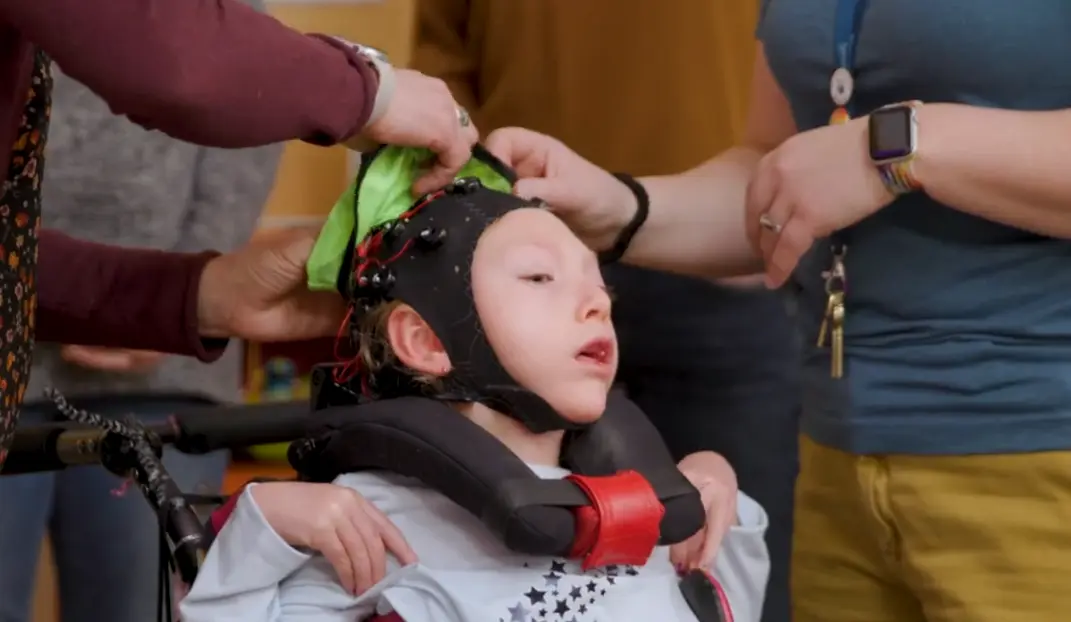
Above: A child is fitted with an Emotiv Flex Saline EEG cap before creating art with her brainwaves as part of the BCI4Kids program. Saline offers a comfortable solution with minimum clean-up. Source: Alberta Children's Hospital Foundation
Gel vs. Saline EEG Caps
For most researchers, selecting an EEG cap comes down to choosing the workflow that best supports the goals of the study.
Gel-Based EEG Caps
Gel-based EEG caps use conductive gel to establish a stable connection between electrodes and the scalp.
Researchers often choose gel-based systems when low impedance and traditional EEG acquisition workflows are priorities.
Benefits include:
Stable electrode-to-scalp contact
Low impedance recordings
Well suited for longer recording sessions
Considerations include:
Longer setup times
Additional preparation requirements
Post-session cleanup
Saline-Based EEG Caps
Saline-based EEG caps use sensors moistened with saline solution rather than conductive gel.
This approach simplifies preparation while maintaining reliable EEG acquisition, making saline systems popular across academic research, consumer neuroscience, human factors research, and usability studies.
Benefits include:
Faster setup than traditional gel systems
Minimal cleanup
Reliable EEG acquisition
Ability to rehydrate sensors during recording sessions
The ability to refresh sensor hydration without removing the cap helps reduce interruptions during longer studies and supports efficient participant workflows.
Flex Gel and Flex Saline
Flex Gel and Flex Saline are wireless EEG cap systems designed to support a wide range of research applications while giving researchers the freedom to configure studies around their specific objectives.
Both systems support up to 32 EEG channels, allowing researchers to position as many or as few sensors as required for the study. Rather than working within a fixed sensor layout, researchers can tailor electrode placement to target specific brain regions, experimental paradigms, and research questions.
Because Flex systems support wireless EEG acquisition, researchers can collect data without tethering participants to a computer, expanding opportunities for research in classrooms, workplaces, retail environments, laboratories, and other real-world settings.
Flex Gel
Flex Gel supports configurable electrode placement with up to 32 channels and is designed for researchers who prefer traditional gel-based EEG workflows.
Integrated refill openings allow researchers to replenish conductive gel during recording sessions without removing the cap. This helps maintain electrode contact and recording quality throughout longer studies while minimizing disruptions to participants and data collection.
Explore Flex Gel
Flex Saline
Flex Saline combines configurable electrode placement with saline-based sensors designed for efficient setup and cleanup.
Integrated refill openings allow researchers to rehydrate sensors during recording sessions without removing the cap. This helps maintain sensor contact quality throughout longer studies while supporting efficient participant workflows.
For research teams running multiple participants or conducting studies outside traditional laboratory environments, Flex Saline provides an effective balance between recording quality and operational efficiency.
Explore Flex Saline
Choosing the Right Cap for Your Participants
Participant populations can influence cap selection, sizing requirements, and overall study design.
Flex electrode caps are available in three sizes:
54 cm
56 cm
58 cm
Multiple sizing options help researchers achieve appropriate fit, maintain sensor contact quality, and support consistent electrode placement across a broad range of participant populations.
Flex has also been validated for EEG data collection in children, demonstrating its suitability for developmental neuroscience, education research, and other pediatric research applications. In a 2025 study published in Frontiers in Human Neuroscience, researchers successfully used Flex to collect EEG data from children, supporting its use across diverse participant populations.
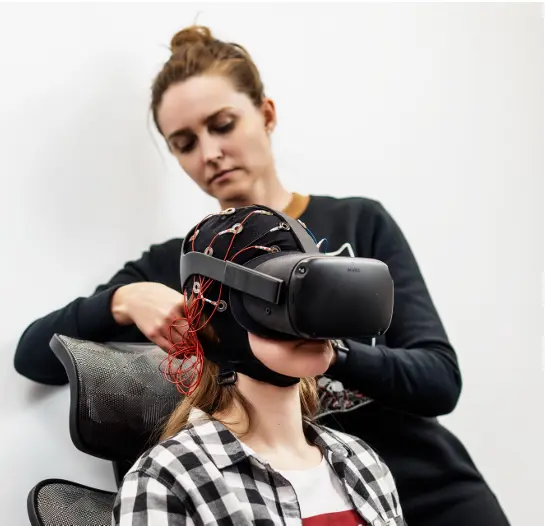
Above: A research study participant is fitted with an Emotiv Flex Gel electrode cap to measure emotions inside a VR simulation. Refillable gel sensors offer reliable data collection over extended sessions. Source: Kamińska et al. (2021)
How to Choose the Right EEG Electrode Cap
Define Your Research Objectives
The most effective EEG system is the one that aligns with the goals of the study.
Before selecting a cap, consider:
Target brain regions
Required channel count
Session duration
Research environment
Participant population
These factors often determine whether a gel-based or saline-based workflow is the better fit.
Consider Where Research Will Take Place
Not all EEG studies occur in controlled laboratory environments.
Wireless EEG systems make it possible to conduct research in classrooms, workplaces, public spaces, consumer testing environments, and other real-world settings. If mobility and portability are important, these factors should be considered during system selection.
Evaluate Workflow Efficiency
Setup time, participant turnover, and study logistics can have a significant impact on project timelines.
Research teams running large participant pools or repeated testing sessions may benefit from systems that simplify preparation and minimize interruptions during data collection.
Prioritize Participant Experience
Participant comfort plays an important role in successful EEG studies.
A properly fitted cap helps maintain stable sensor contact while reducing movement-related artifacts. Comfortable participants are also more likely to remain engaged throughout longer recording sessions.
EEG Caps, Headsets, and Headbands
EEG electrode caps are one option for acquiring brain data, but they are not the only form factor available.
Researchers who require flexible electrode placement and configurable channel layouts often choose cap-based systems such as Flex Gel and Flex Saline.
For applications that prioritize portability and rapid deployment, alternative wearable designs may be more appropriate.
The Emotiv Epoc X is a 14-channel wireless EEG headset designed for research, BCI development, and mobile data collection.
The Emotiv Insight is a lightweight 5-channel wireless EEG headband designed for rapid setup, portability, and ease of use across research, wellness, and educational applications.
Choosing between a cap, headset, or headband depends on the goals of the project, desired channel count, and operational workflow. For example, consider the headset or headband's fixed sensor placement when adding elements such as VR headsets.
Common Applications for EEG Electrode Caps
Cognitive and Academic Research
Researchers use EEG caps to investigate attention, memory, learning, decision-making, workload, and other cognitive processes across neuroscience, psychology, and education.
Brain-Computer Interface Development
Configurable electrode placement allows researchers and developers to optimize sensor coverage for BCI applications and experimental paradigms.
Human Factors and Real-World Research
Wireless EEG caps allow researchers to study behavior and cognitive processes outside traditional laboratory environments, supporting investigations in classrooms, retail settings, and other naturalistic environments.
Frequently Asked Questions
What is the difference between gel and saline EEG caps?
Gel-based systems use conductive gel to establish contact with the scalp, while saline-based systems use saline-moistened sensors. Both support reliable EEG acquisition, but saline systems generally reduce setup and cleanup requirements.
Can sensors be refreshed during longer recording sessions?
Yes. Both Flex Gel and Flex Saline feature integrated refill openings that allow researchers to replenish gel or rehydrate saline sensors without removing the cap.
Can EEG caps be used with children?
Yes. Flex caps are available in multiple sizes and have been validated for use in pediatric EEG research.
What cap sizes are available for Flex?
Flex electrode caps are available in 54 cm, 56 cm, and 58 cm sizes, helping researchers achieve appropriate fit across a wide range of participant populations.
How many EEG channels do I need?
Channel requirements depend on the goals of the study. Flex systems support up to 32 channels, allowing researchers to configure sensor placement based on the needs of the project.
Why choose a wireless EEG cap?
Wireless systems allow participants to move more naturally and enable data collection in environments where traditional tethered EEG systems may be impractical.
Sources
Alberta Children’s Hospital Foundation. (2025, December 22). Everything Possible: Brain-Computer Interface [Video]. YouTube. https://www.youtube.com/watch?v=0sEKJRNg130
Hammond, L., Rowley, D., Tuck, C., Floreani, E. D., Wieler, A., Kim, V. S., Bahari, H., Andersen, J., Kirton, A., & Kinney-Lang, E. (2025). BCI move: exploring pediatric BCI-controlled power mobility. Frontiers in Human Neuroscience, 19, 1456692. https://doi.org/10.3389/fnhum.2025.1456692
Kamińska, D., Smółka, K., & Zwoliński, G. (2021). Detection of Mental Stress through EEG Signal in Virtual Reality Environment. Electronics, 10(22), 2840. https://doi.org/10.3390/electronics10222840
The quality of EEG data begins with reliable electrode contact. Whether you're conducting cognitive neuroscience research, developing a brain-computer interface (BCI), or studying human behavior in real-world environments, the right EEG electrode cap can improve setup efficiency, participant experience, and data collection consistency.
Today's researchers need more than reliable signal acquisition. They need systems that adapt to different study designs, participant populations, and research environments. From traditional laboratory studies to mobile field research, the choice of EEG cap can influence how efficiently data is collected and how easily studies scale.
This guide explains how EEG electrode caps work, the differences between gel and saline-based systems, and the key factors to consider when selecting a cap-based EEG solution.
What Is an EEG Electrode Cap?
An EEG electrode cap is a wearable cap that positions electrodes at standardized locations across the scalp to record electrical activity generated by the brain.
Most EEG caps follow the International 10-20 System, helping researchers maintain consistent sensor placement across participants and study sessions. Standardized placement improves reproducibility and supports more reliable comparisons across datasets.
Compared to individually placing electrodes, cap-based systems simplify setup while reducing variability introduced by manual sensor positioning.
How EEG Electrode Caps Work
EEG measures electrical activity generated by populations of neurons in the brain. To capture these signals accurately, electrodes must maintain reliable contact with the scalp throughout the recording session.
EEG caps help achieve this by securing electrodes in predetermined locations while conductive materials reduce impedance between the sensor and scalp.
Depending on the system, conductivity is established using:
Conductive gel
Saline-moistened sensors
Both approaches support reliable EEG acquisition. The best choice depends on study requirements, workflow preferences, and participant considerations.
Above: A child is fitted with an Emotiv Flex Saline EEG cap before creating art with her brainwaves as part of the BCI4Kids program. Saline offers a comfortable solution with minimum clean-up. Source: Alberta Children's Hospital Foundation
Gel vs. Saline EEG Caps
For most researchers, selecting an EEG cap comes down to choosing the workflow that best supports the goals of the study.
Gel-Based EEG Caps
Gel-based EEG caps use conductive gel to establish a stable connection between electrodes and the scalp.
Researchers often choose gel-based systems when low impedance and traditional EEG acquisition workflows are priorities.
Benefits include:
Stable electrode-to-scalp contact
Low impedance recordings
Well suited for longer recording sessions
Considerations include:
Longer setup times
Additional preparation requirements
Post-session cleanup
Saline-Based EEG Caps
Saline-based EEG caps use sensors moistened with saline solution rather than conductive gel.
This approach simplifies preparation while maintaining reliable EEG acquisition, making saline systems popular across academic research, consumer neuroscience, human factors research, and usability studies.
Benefits include:
Faster setup than traditional gel systems
Minimal cleanup
Reliable EEG acquisition
Ability to rehydrate sensors during recording sessions
The ability to refresh sensor hydration without removing the cap helps reduce interruptions during longer studies and supports efficient participant workflows.
Flex Gel and Flex Saline
Flex Gel and Flex Saline are wireless EEG cap systems designed to support a wide range of research applications while giving researchers the freedom to configure studies around their specific objectives.
Both systems support up to 32 EEG channels, allowing researchers to position as many or as few sensors as required for the study. Rather than working within a fixed sensor layout, researchers can tailor electrode placement to target specific brain regions, experimental paradigms, and research questions.
Because Flex systems support wireless EEG acquisition, researchers can collect data without tethering participants to a computer, expanding opportunities for research in classrooms, workplaces, retail environments, laboratories, and other real-world settings.
Flex Gel
Flex Gel supports configurable electrode placement with up to 32 channels and is designed for researchers who prefer traditional gel-based EEG workflows.
Integrated refill openings allow researchers to replenish conductive gel during recording sessions without removing the cap. This helps maintain electrode contact and recording quality throughout longer studies while minimizing disruptions to participants and data collection.
Explore Flex Gel
Flex Saline
Flex Saline combines configurable electrode placement with saline-based sensors designed for efficient setup and cleanup.
Integrated refill openings allow researchers to rehydrate sensors during recording sessions without removing the cap. This helps maintain sensor contact quality throughout longer studies while supporting efficient participant workflows.
For research teams running multiple participants or conducting studies outside traditional laboratory environments, Flex Saline provides an effective balance between recording quality and operational efficiency.
Explore Flex Saline
Choosing the Right Cap for Your Participants
Participant populations can influence cap selection, sizing requirements, and overall study design.
Flex electrode caps are available in three sizes:
54 cm
56 cm
58 cm
Multiple sizing options help researchers achieve appropriate fit, maintain sensor contact quality, and support consistent electrode placement across a broad range of participant populations.
Flex has also been validated for EEG data collection in children, demonstrating its suitability for developmental neuroscience, education research, and other pediatric research applications. In a 2025 study published in Frontiers in Human Neuroscience, researchers successfully used Flex to collect EEG data from children, supporting its use across diverse participant populations.
Above: A research study participant is fitted with an Emotiv Flex Gel electrode cap to measure emotions inside a VR simulation. Refillable gel sensors offer reliable data collection over extended sessions. Source: Kamińska et al. (2021)
How to Choose the Right EEG Electrode Cap
Define Your Research Objectives
The most effective EEG system is the one that aligns with the goals of the study.
Before selecting a cap, consider:
Target brain regions
Required channel count
Session duration
Research environment
Participant population
These factors often determine whether a gel-based or saline-based workflow is the better fit.
Consider Where Research Will Take Place
Not all EEG studies occur in controlled laboratory environments.
Wireless EEG systems make it possible to conduct research in classrooms, workplaces, public spaces, consumer testing environments, and other real-world settings. If mobility and portability are important, these factors should be considered during system selection.
Evaluate Workflow Efficiency
Setup time, participant turnover, and study logistics can have a significant impact on project timelines.
Research teams running large participant pools or repeated testing sessions may benefit from systems that simplify preparation and minimize interruptions during data collection.
Prioritize Participant Experience
Participant comfort plays an important role in successful EEG studies.
A properly fitted cap helps maintain stable sensor contact while reducing movement-related artifacts. Comfortable participants are also more likely to remain engaged throughout longer recording sessions.
EEG Caps, Headsets, and Headbands
EEG electrode caps are one option for acquiring brain data, but they are not the only form factor available.
Researchers who require flexible electrode placement and configurable channel layouts often choose cap-based systems such as Flex Gel and Flex Saline.
For applications that prioritize portability and rapid deployment, alternative wearable designs may be more appropriate.
The Emotiv Epoc X is a 14-channel wireless EEG headset designed for research, BCI development, and mobile data collection.
The Emotiv Insight is a lightweight 5-channel wireless EEG headband designed for rapid setup, portability, and ease of use across research, wellness, and educational applications.
Choosing between a cap, headset, or headband depends on the goals of the project, desired channel count, and operational workflow. For example, consider the headset or headband's fixed sensor placement when adding elements such as VR headsets.
Common Applications for EEG Electrode Caps
Cognitive and Academic Research
Researchers use EEG caps to investigate attention, memory, learning, decision-making, workload, and other cognitive processes across neuroscience, psychology, and education.
Brain-Computer Interface Development
Configurable electrode placement allows researchers and developers to optimize sensor coverage for BCI applications and experimental paradigms.
Human Factors and Real-World Research
Wireless EEG caps allow researchers to study behavior and cognitive processes outside traditional laboratory environments, supporting investigations in classrooms, retail settings, and other naturalistic environments.
Frequently Asked Questions
What is the difference between gel and saline EEG caps?
Gel-based systems use conductive gel to establish contact with the scalp, while saline-based systems use saline-moistened sensors. Both support reliable EEG acquisition, but saline systems generally reduce setup and cleanup requirements.
Can sensors be refreshed during longer recording sessions?
Yes. Both Flex Gel and Flex Saline feature integrated refill openings that allow researchers to replenish gel or rehydrate saline sensors without removing the cap.
Can EEG caps be used with children?
Yes. Flex caps are available in multiple sizes and have been validated for use in pediatric EEG research.
What cap sizes are available for Flex?
Flex electrode caps are available in 54 cm, 56 cm, and 58 cm sizes, helping researchers achieve appropriate fit across a wide range of participant populations.
How many EEG channels do I need?
Channel requirements depend on the goals of the study. Flex systems support up to 32 channels, allowing researchers to configure sensor placement based on the needs of the project.
Why choose a wireless EEG cap?
Wireless systems allow participants to move more naturally and enable data collection in environments where traditional tethered EEG systems may be impractical.
Sources
Alberta Children’s Hospital Foundation. (2025, December 22). Everything Possible: Brain-Computer Interface [Video]. YouTube. https://www.youtube.com/watch?v=0sEKJRNg130
Hammond, L., Rowley, D., Tuck, C., Floreani, E. D., Wieler, A., Kim, V. S., Bahari, H., Andersen, J., Kirton, A., & Kinney-Lang, E. (2025). BCI move: exploring pediatric BCI-controlled power mobility. Frontiers in Human Neuroscience, 19, 1456692. https://doi.org/10.3389/fnhum.2025.1456692
Kamińska, D., Smółka, K., & Zwoliński, G. (2021). Detection of Mental Stress through EEG Signal in Virtual Reality Environment. Electronics, 10(22), 2840. https://doi.org/10.3390/electronics10222840
The quality of EEG data begins with reliable electrode contact. Whether you're conducting cognitive neuroscience research, developing a brain-computer interface (BCI), or studying human behavior in real-world environments, the right EEG electrode cap can improve setup efficiency, participant experience, and data collection consistency.
Today's researchers need more than reliable signal acquisition. They need systems that adapt to different study designs, participant populations, and research environments. From traditional laboratory studies to mobile field research, the choice of EEG cap can influence how efficiently data is collected and how easily studies scale.
This guide explains how EEG electrode caps work, the differences between gel and saline-based systems, and the key factors to consider when selecting a cap-based EEG solution.
What Is an EEG Electrode Cap?
An EEG electrode cap is a wearable cap that positions electrodes at standardized locations across the scalp to record electrical activity generated by the brain.
Most EEG caps follow the International 10-20 System, helping researchers maintain consistent sensor placement across participants and study sessions. Standardized placement improves reproducibility and supports more reliable comparisons across datasets.
Compared to individually placing electrodes, cap-based systems simplify setup while reducing variability introduced by manual sensor positioning.
How EEG Electrode Caps Work
EEG measures electrical activity generated by populations of neurons in the brain. To capture these signals accurately, electrodes must maintain reliable contact with the scalp throughout the recording session.
EEG caps help achieve this by securing electrodes in predetermined locations while conductive materials reduce impedance between the sensor and scalp.
Depending on the system, conductivity is established using:
Conductive gel
Saline-moistened sensors
Both approaches support reliable EEG acquisition. The best choice depends on study requirements, workflow preferences, and participant considerations.
Above: A child is fitted with an Emotiv Flex Saline EEG cap before creating art with her brainwaves as part of the BCI4Kids program. Saline offers a comfortable solution with minimum clean-up. Source: Alberta Children's Hospital Foundation
Gel vs. Saline EEG Caps
For most researchers, selecting an EEG cap comes down to choosing the workflow that best supports the goals of the study.
Gel-Based EEG Caps
Gel-based EEG caps use conductive gel to establish a stable connection between electrodes and the scalp.
Researchers often choose gel-based systems when low impedance and traditional EEG acquisition workflows are priorities.
Benefits include:
Stable electrode-to-scalp contact
Low impedance recordings
Well suited for longer recording sessions
Considerations include:
Longer setup times
Additional preparation requirements
Post-session cleanup
Saline-Based EEG Caps
Saline-based EEG caps use sensors moistened with saline solution rather than conductive gel.
This approach simplifies preparation while maintaining reliable EEG acquisition, making saline systems popular across academic research, consumer neuroscience, human factors research, and usability studies.
Benefits include:
Faster setup than traditional gel systems
Minimal cleanup
Reliable EEG acquisition
Ability to rehydrate sensors during recording sessions
The ability to refresh sensor hydration without removing the cap helps reduce interruptions during longer studies and supports efficient participant workflows.
Flex Gel and Flex Saline
Flex Gel and Flex Saline are wireless EEG cap systems designed to support a wide range of research applications while giving researchers the freedom to configure studies around their specific objectives.
Both systems support up to 32 EEG channels, allowing researchers to position as many or as few sensors as required for the study. Rather than working within a fixed sensor layout, researchers can tailor electrode placement to target specific brain regions, experimental paradigms, and research questions.
Because Flex systems support wireless EEG acquisition, researchers can collect data without tethering participants to a computer, expanding opportunities for research in classrooms, workplaces, retail environments, laboratories, and other real-world settings.
Flex Gel
Flex Gel supports configurable electrode placement with up to 32 channels and is designed for researchers who prefer traditional gel-based EEG workflows.
Integrated refill openings allow researchers to replenish conductive gel during recording sessions without removing the cap. This helps maintain electrode contact and recording quality throughout longer studies while minimizing disruptions to participants and data collection.
Explore Flex Gel
Flex Saline
Flex Saline combines configurable electrode placement with saline-based sensors designed for efficient setup and cleanup.
Integrated refill openings allow researchers to rehydrate sensors during recording sessions without removing the cap. This helps maintain sensor contact quality throughout longer studies while supporting efficient participant workflows.
For research teams running multiple participants or conducting studies outside traditional laboratory environments, Flex Saline provides an effective balance between recording quality and operational efficiency.
Explore Flex Saline
Choosing the Right Cap for Your Participants
Participant populations can influence cap selection, sizing requirements, and overall study design.
Flex electrode caps are available in three sizes:
54 cm
56 cm
58 cm
Multiple sizing options help researchers achieve appropriate fit, maintain sensor contact quality, and support consistent electrode placement across a broad range of participant populations.
Flex has also been validated for EEG data collection in children, demonstrating its suitability for developmental neuroscience, education research, and other pediatric research applications. In a 2025 study published in Frontiers in Human Neuroscience, researchers successfully used Flex to collect EEG data from children, supporting its use across diverse participant populations.
Above: A research study participant is fitted with an Emotiv Flex Gel electrode cap to measure emotions inside a VR simulation. Refillable gel sensors offer reliable data collection over extended sessions. Source: Kamińska et al. (2021)
How to Choose the Right EEG Electrode Cap
Define Your Research Objectives
The most effective EEG system is the one that aligns with the goals of the study.
Before selecting a cap, consider:
Target brain regions
Required channel count
Session duration
Research environment
Participant population
These factors often determine whether a gel-based or saline-based workflow is the better fit.
Consider Where Research Will Take Place
Not all EEG studies occur in controlled laboratory environments.
Wireless EEG systems make it possible to conduct research in classrooms, workplaces, public spaces, consumer testing environments, and other real-world settings. If mobility and portability are important, these factors should be considered during system selection.
Evaluate Workflow Efficiency
Setup time, participant turnover, and study logistics can have a significant impact on project timelines.
Research teams running large participant pools or repeated testing sessions may benefit from systems that simplify preparation and minimize interruptions during data collection.
Prioritize Participant Experience
Participant comfort plays an important role in successful EEG studies.
A properly fitted cap helps maintain stable sensor contact while reducing movement-related artifacts. Comfortable participants are also more likely to remain engaged throughout longer recording sessions.
EEG Caps, Headsets, and Headbands
EEG electrode caps are one option for acquiring brain data, but they are not the only form factor available.
Researchers who require flexible electrode placement and configurable channel layouts often choose cap-based systems such as Flex Gel and Flex Saline.
For applications that prioritize portability and rapid deployment, alternative wearable designs may be more appropriate.
The Emotiv Epoc X is a 14-channel wireless EEG headset designed for research, BCI development, and mobile data collection.
The Emotiv Insight is a lightweight 5-channel wireless EEG headband designed for rapid setup, portability, and ease of use across research, wellness, and educational applications.
Choosing between a cap, headset, or headband depends on the goals of the project, desired channel count, and operational workflow. For example, consider the headset or headband's fixed sensor placement when adding elements such as VR headsets.
Common Applications for EEG Electrode Caps
Cognitive and Academic Research
Researchers use EEG caps to investigate attention, memory, learning, decision-making, workload, and other cognitive processes across neuroscience, psychology, and education.
Brain-Computer Interface Development
Configurable electrode placement allows researchers and developers to optimize sensor coverage for BCI applications and experimental paradigms.
Human Factors and Real-World Research
Wireless EEG caps allow researchers to study behavior and cognitive processes outside traditional laboratory environments, supporting investigations in classrooms, retail settings, and other naturalistic environments.
Frequently Asked Questions
What is the difference between gel and saline EEG caps?
Gel-based systems use conductive gel to establish contact with the scalp, while saline-based systems use saline-moistened sensors. Both support reliable EEG acquisition, but saline systems generally reduce setup and cleanup requirements.
Can sensors be refreshed during longer recording sessions?
Yes. Both Flex Gel and Flex Saline feature integrated refill openings that allow researchers to replenish gel or rehydrate saline sensors without removing the cap.
Can EEG caps be used with children?
Yes. Flex caps are available in multiple sizes and have been validated for use in pediatric EEG research.
What cap sizes are available for Flex?
Flex electrode caps are available in 54 cm, 56 cm, and 58 cm sizes, helping researchers achieve appropriate fit across a wide range of participant populations.
How many EEG channels do I need?
Channel requirements depend on the goals of the study. Flex systems support up to 32 channels, allowing researchers to configure sensor placement based on the needs of the project.
Why choose a wireless EEG cap?
Wireless systems allow participants to move more naturally and enable data collection in environments where traditional tethered EEG systems may be impractical.
Sources
Alberta Children’s Hospital Foundation. (2025, December 22). Everything Possible: Brain-Computer Interface [Video]. YouTube. https://www.youtube.com/watch?v=0sEKJRNg130
Hammond, L., Rowley, D., Tuck, C., Floreani, E. D., Wieler, A., Kim, V. S., Bahari, H., Andersen, J., Kirton, A., & Kinney-Lang, E. (2025). BCI move: exploring pediatric BCI-controlled power mobility. Frontiers in Human Neuroscience, 19, 1456692. https://doi.org/10.3389/fnhum.2025.1456692
Kamińska, D., Smółka, K., & Zwoliński, G. (2021). Detection of Mental Stress through EEG Signal in Virtual Reality Environment. Electronics, 10(22), 2840. https://doi.org/10.3390/electronics10222840

Continue reading