
What Is Neuroergonomics? Understanding the Brain at Work
H.B. Duran
Updated on
Sep 24, 2026
What Is Neuroergonomics? Understanding the Brain at Work
H.B. Duran
Updated on
Sep 24, 2026
What Is Neuroergonomics? Understanding the Brain at Work
H.B. Duran
Updated on
Sep 24, 2026
The Brain Doesn't Work in a Laboratory
Imagine a pilot navigating turbulent weather.
A student concentrating during a difficult exam.
An assembly worker performing the same task hundreds of times throughout a shift.
Although these situations appear very different, they all depend on the brain's ability to process information, adapt to changing demands, and make decisions under real-world conditions.
For many years, cognitive neuroscience investigated these processes primarily in controlled laboratory environments. Those studies established much of what we know about attention, memory, perception, and decision-making.
Today, researchers are asking a broader question.
How do these cognitive processes operate in the environments where people actually live, learn, and work?
That question lies at the heart of neuroergonomics.
What Is Neuroergonomics?
Neuroergonomics is the study of brain function during real-world activities.
The field combines cognitive neuroscience, human factors, ergonomics, and engineering to better understand how people interact with technology, environments, and complex tasks.
Rather than investigating cognition in isolation, neuroergonomics examines how attention, mental workload, decision-making, and perception change as people perform meaningful activities.
The goal is not simply to understand how the brain works.
It is to understand how the brain works in context.
Why Context Matters
Human cognition is remarkably adaptable.
Attention changes as distractions increase.
Mental workload rises as tasks become more demanding.
Decision-making shifts when time is limited.
These changes are difficult to understand without considering the environment in which they occur.
Researchers increasingly emphasize ecological validity, recognizing that many questions about human performance are best investigated under conditions that resemble everyday life rather than highly controlled laboratory settings.
What Research Tells Us
Human performance is shaped by the environment.
Studies in neuroergonomics consistently demonstrate that cognitive performance cannot be fully understood without considering context. Environmental demands, task complexity, and interaction with technology all influence how people think and perform [1]-[4].
Real-world research is expanding.
Wireless EEG has enabled researchers to investigate cognition during activities that were once difficult to study outside the laboratory. Recent work has explored mental workload during driving, cognitive demands across different phases of flight, repetitive industrial tasks, and authentic educational environments [1]-[4].
Together, these studies reflect a broader shift in neuroscience. Rather than bringing every research question into the laboratory, investigators are increasingly bringing neuroscience into the real world.
Human-centered design benefits from cognitive insight.
Neuroergonomics extends beyond measuring performance. Researchers are also investigating how product design, workplace ergonomics, and human-machine interaction influence attention, comfort, and decision-making. Recent studies examining seating design and repetitive assembly tasks demonstrate how physiological measurements can complement traditional ergonomic assessments by providing additional insight into user experience [1], [3].
Where Neuroergonomics Is Applied
Neuroergonomics supports research across many disciplines.
Transportation
Researchers investigate driver attention, mental workload, and decision-making to better understand how cognitive demands change throughout real-world driving.
Aviation
Studies examine pilot workload and situational awareness across different phases of flight, helping researchers investigate performance in complex operational environments.
Education
Educational neuroscience increasingly applies neuroergonomic principles by studying attention and learning within authentic classroom settings rather than only controlled laboratory experiments.
Human-Centered Design
Researchers investigate how product design, workplace environments, and technology influence human experience, supporting evidence-informed approaches to ergonomics and usability.
Why Wireless EEG Matters
Studying cognition outside the laboratory presents practical challenges.
Researchers need equipment that allows participants to move naturally while maintaining reliable physiological recordings.
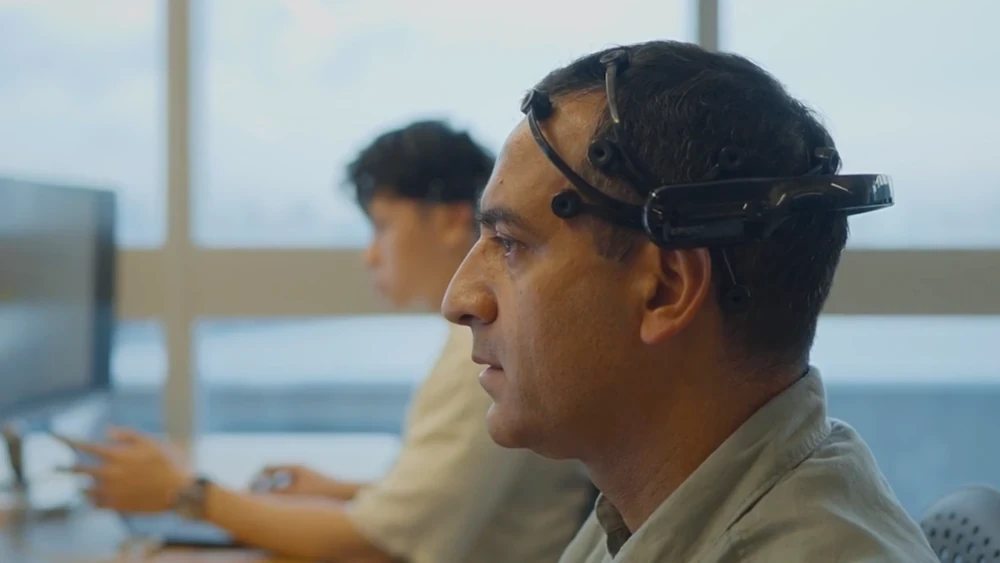
Wireless EEG has helped make this possible by supporting investigations in classrooms, vehicles, workplaces, and other real-world environments where traditional laboratory systems may be impractical.
Rather than replacing laboratory research, portable EEG expands the types of questions researchers can investigate.
Selecting an EEG System for Neuroergonomics Research
Different neuroergonomics studies require different recording configurations depending on the research question and environment.
Flex Gel and Flex Saline
Flex supports configurable electrode placement with up to 32 EEG channels, making it well suited for advanced human factors and neuroergonomics research.
Epoc X
Epoc X is a 14-channel wireless EEG headset designed for cognitive neuroscience and mobile research. Its balance of portability and research-quality EEG makes it suitable for studies conducted both inside and outside the laboratory.
Insight
Insight is a lightweight 5-channel wireless EEG headband appropriate for education research, usability studies, and investigations where rapid deployment is important.
The Future of Neuroergonomics
As technology becomes increasingly integrated into everyday life, understanding human cognition in real-world environments will continue to grow in importance.
Neuroergonomics is helping researchers investigate how people interact with increasingly complex systems while preserving the context in which those interactions naturally occur.
By combining advances in wearable EEG with carefully designed behavioral research, scientists are building a more complete understanding of human performance than either laboratory studies or observational methods could achieve alone.
Frequently Asked Questions
What is neuroergonomics?
Neuroergonomics is the study of brain function during real-world activities, combining neuroscience with ergonomics and human factors research.
How is neuroergonomics different from cognitive neuroscience?
Cognitive neuroscience investigates how the brain supports cognition, often under controlled experimental conditions. Neuroergonomics applies those principles to understanding human performance in natural environments.
Why is EEG used in neuroergonomics?
EEG allows researchers to investigate changes in brain activity during complex tasks, providing insight into attention, mental workload, and decision-making as activities unfold.
What industries use neuroergonomics?
Neuroergonomics research spans transportation, aviation, education, manufacturing, human-computer interaction, and product design.
Can portable EEG be used outside the laboratory?
Yes. Modern wireless EEG systems support research in classrooms, workplaces, vehicles, and other environments where understanding cognition in context is important.
Continue Exploring
References
[1] García-Acosta, A., De La Riva-Rodríguez, J., Sánchez-Leal, J., & Reyes-Martínez, R. M. (2021). Neuroergonomic Stress Assessment with Two Different Methodologies in a Manual Repetitive Task Product Assembly.
[2] Neuroscience Based Design: Fundamentals and Applications. IEEE Conference Publication, 2016.
[3] Mahdiyeh, J. S., Jahromi, Z., Hassan, S. N., et al. (2024). Ergonomics and Aesthetics of Seats Based on Users' Preferences: Neuroergonomics and EEG Approach.
[4] García-Monge, A., Rodríguez-Navarro, H., Bores-García, D., & González-Calvo, G. (2024). Electroencephalography in Naturalistic and Semi-Naturalistic Educational Contexts: A Systematic Review.
The Brain Doesn't Work in a Laboratory
Imagine a pilot navigating turbulent weather.
A student concentrating during a difficult exam.
An assembly worker performing the same task hundreds of times throughout a shift.
Although these situations appear very different, they all depend on the brain's ability to process information, adapt to changing demands, and make decisions under real-world conditions.
For many years, cognitive neuroscience investigated these processes primarily in controlled laboratory environments. Those studies established much of what we know about attention, memory, perception, and decision-making.
Today, researchers are asking a broader question.
How do these cognitive processes operate in the environments where people actually live, learn, and work?
That question lies at the heart of neuroergonomics.
What Is Neuroergonomics?
Neuroergonomics is the study of brain function during real-world activities.
The field combines cognitive neuroscience, human factors, ergonomics, and engineering to better understand how people interact with technology, environments, and complex tasks.
Rather than investigating cognition in isolation, neuroergonomics examines how attention, mental workload, decision-making, and perception change as people perform meaningful activities.
The goal is not simply to understand how the brain works.
It is to understand how the brain works in context.
Why Context Matters
Human cognition is remarkably adaptable.
Attention changes as distractions increase.
Mental workload rises as tasks become more demanding.
Decision-making shifts when time is limited.
These changes are difficult to understand without considering the environment in which they occur.
Researchers increasingly emphasize ecological validity, recognizing that many questions about human performance are best investigated under conditions that resemble everyday life rather than highly controlled laboratory settings.
What Research Tells Us
Human performance is shaped by the environment.
Studies in neuroergonomics consistently demonstrate that cognitive performance cannot be fully understood without considering context. Environmental demands, task complexity, and interaction with technology all influence how people think and perform [1]-[4].
Real-world research is expanding.
Wireless EEG has enabled researchers to investigate cognition during activities that were once difficult to study outside the laboratory. Recent work has explored mental workload during driving, cognitive demands across different phases of flight, repetitive industrial tasks, and authentic educational environments [1]-[4].
Together, these studies reflect a broader shift in neuroscience. Rather than bringing every research question into the laboratory, investigators are increasingly bringing neuroscience into the real world.
Human-centered design benefits from cognitive insight.
Neuroergonomics extends beyond measuring performance. Researchers are also investigating how product design, workplace ergonomics, and human-machine interaction influence attention, comfort, and decision-making. Recent studies examining seating design and repetitive assembly tasks demonstrate how physiological measurements can complement traditional ergonomic assessments by providing additional insight into user experience [1], [3].
Where Neuroergonomics Is Applied
Neuroergonomics supports research across many disciplines.
Transportation
Researchers investigate driver attention, mental workload, and decision-making to better understand how cognitive demands change throughout real-world driving.
Aviation
Studies examine pilot workload and situational awareness across different phases of flight, helping researchers investigate performance in complex operational environments.
Education
Educational neuroscience increasingly applies neuroergonomic principles by studying attention and learning within authentic classroom settings rather than only controlled laboratory experiments.
Human-Centered Design
Researchers investigate how product design, workplace environments, and technology influence human experience, supporting evidence-informed approaches to ergonomics and usability.
Why Wireless EEG Matters
Studying cognition outside the laboratory presents practical challenges.
Researchers need equipment that allows participants to move naturally while maintaining reliable physiological recordings.
Wireless EEG has helped make this possible by supporting investigations in classrooms, vehicles, workplaces, and other real-world environments where traditional laboratory systems may be impractical.
Rather than replacing laboratory research, portable EEG expands the types of questions researchers can investigate.
Selecting an EEG System for Neuroergonomics Research
Different neuroergonomics studies require different recording configurations depending on the research question and environment.
Flex Gel and Flex Saline
Flex supports configurable electrode placement with up to 32 EEG channels, making it well suited for advanced human factors and neuroergonomics research.
Epoc X
Epoc X is a 14-channel wireless EEG headset designed for cognitive neuroscience and mobile research. Its balance of portability and research-quality EEG makes it suitable for studies conducted both inside and outside the laboratory.
Insight
Insight is a lightweight 5-channel wireless EEG headband appropriate for education research, usability studies, and investigations where rapid deployment is important.
The Future of Neuroergonomics
As technology becomes increasingly integrated into everyday life, understanding human cognition in real-world environments will continue to grow in importance.
Neuroergonomics is helping researchers investigate how people interact with increasingly complex systems while preserving the context in which those interactions naturally occur.
By combining advances in wearable EEG with carefully designed behavioral research, scientists are building a more complete understanding of human performance than either laboratory studies or observational methods could achieve alone.
Frequently Asked Questions
What is neuroergonomics?
Neuroergonomics is the study of brain function during real-world activities, combining neuroscience with ergonomics and human factors research.
How is neuroergonomics different from cognitive neuroscience?
Cognitive neuroscience investigates how the brain supports cognition, often under controlled experimental conditions. Neuroergonomics applies those principles to understanding human performance in natural environments.
Why is EEG used in neuroergonomics?
EEG allows researchers to investigate changes in brain activity during complex tasks, providing insight into attention, mental workload, and decision-making as activities unfold.
What industries use neuroergonomics?
Neuroergonomics research spans transportation, aviation, education, manufacturing, human-computer interaction, and product design.
Can portable EEG be used outside the laboratory?
Yes. Modern wireless EEG systems support research in classrooms, workplaces, vehicles, and other environments where understanding cognition in context is important.
Continue Exploring
References
[1] García-Acosta, A., De La Riva-Rodríguez, J., Sánchez-Leal, J., & Reyes-Martínez, R. M. (2021). Neuroergonomic Stress Assessment with Two Different Methodologies in a Manual Repetitive Task Product Assembly.
[2] Neuroscience Based Design: Fundamentals and Applications. IEEE Conference Publication, 2016.
[3] Mahdiyeh, J. S., Jahromi, Z., Hassan, S. N., et al. (2024). Ergonomics and Aesthetics of Seats Based on Users' Preferences: Neuroergonomics and EEG Approach.
[4] García-Monge, A., Rodríguez-Navarro, H., Bores-García, D., & González-Calvo, G. (2024). Electroencephalography in Naturalistic and Semi-Naturalistic Educational Contexts: A Systematic Review.
The Brain Doesn't Work in a Laboratory
Imagine a pilot navigating turbulent weather.
A student concentrating during a difficult exam.
An assembly worker performing the same task hundreds of times throughout a shift.
Although these situations appear very different, they all depend on the brain's ability to process information, adapt to changing demands, and make decisions under real-world conditions.
For many years, cognitive neuroscience investigated these processes primarily in controlled laboratory environments. Those studies established much of what we know about attention, memory, perception, and decision-making.
Today, researchers are asking a broader question.
How do these cognitive processes operate in the environments where people actually live, learn, and work?
That question lies at the heart of neuroergonomics.
What Is Neuroergonomics?
Neuroergonomics is the study of brain function during real-world activities.
The field combines cognitive neuroscience, human factors, ergonomics, and engineering to better understand how people interact with technology, environments, and complex tasks.
Rather than investigating cognition in isolation, neuroergonomics examines how attention, mental workload, decision-making, and perception change as people perform meaningful activities.
The goal is not simply to understand how the brain works.
It is to understand how the brain works in context.
Why Context Matters
Human cognition is remarkably adaptable.
Attention changes as distractions increase.
Mental workload rises as tasks become more demanding.
Decision-making shifts when time is limited.
These changes are difficult to understand without considering the environment in which they occur.
Researchers increasingly emphasize ecological validity, recognizing that many questions about human performance are best investigated under conditions that resemble everyday life rather than highly controlled laboratory settings.
What Research Tells Us
Human performance is shaped by the environment.
Studies in neuroergonomics consistently demonstrate that cognitive performance cannot be fully understood without considering context. Environmental demands, task complexity, and interaction with technology all influence how people think and perform [1]-[4].
Real-world research is expanding.
Wireless EEG has enabled researchers to investigate cognition during activities that were once difficult to study outside the laboratory. Recent work has explored mental workload during driving, cognitive demands across different phases of flight, repetitive industrial tasks, and authentic educational environments [1]-[4].
Together, these studies reflect a broader shift in neuroscience. Rather than bringing every research question into the laboratory, investigators are increasingly bringing neuroscience into the real world.
Human-centered design benefits from cognitive insight.
Neuroergonomics extends beyond measuring performance. Researchers are also investigating how product design, workplace ergonomics, and human-machine interaction influence attention, comfort, and decision-making. Recent studies examining seating design and repetitive assembly tasks demonstrate how physiological measurements can complement traditional ergonomic assessments by providing additional insight into user experience [1], [3].
Where Neuroergonomics Is Applied
Neuroergonomics supports research across many disciplines.
Transportation
Researchers investigate driver attention, mental workload, and decision-making to better understand how cognitive demands change throughout real-world driving.
Aviation
Studies examine pilot workload and situational awareness across different phases of flight, helping researchers investigate performance in complex operational environments.
Education
Educational neuroscience increasingly applies neuroergonomic principles by studying attention and learning within authentic classroom settings rather than only controlled laboratory experiments.
Human-Centered Design
Researchers investigate how product design, workplace environments, and technology influence human experience, supporting evidence-informed approaches to ergonomics and usability.
Why Wireless EEG Matters
Studying cognition outside the laboratory presents practical challenges.
Researchers need equipment that allows participants to move naturally while maintaining reliable physiological recordings.
Wireless EEG has helped make this possible by supporting investigations in classrooms, vehicles, workplaces, and other real-world environments where traditional laboratory systems may be impractical.
Rather than replacing laboratory research, portable EEG expands the types of questions researchers can investigate.
Selecting an EEG System for Neuroergonomics Research
Different neuroergonomics studies require different recording configurations depending on the research question and environment.
Flex Gel and Flex Saline
Flex supports configurable electrode placement with up to 32 EEG channels, making it well suited for advanced human factors and neuroergonomics research.
Epoc X
Epoc X is a 14-channel wireless EEG headset designed for cognitive neuroscience and mobile research. Its balance of portability and research-quality EEG makes it suitable for studies conducted both inside and outside the laboratory.
Insight
Insight is a lightweight 5-channel wireless EEG headband appropriate for education research, usability studies, and investigations where rapid deployment is important.
The Future of Neuroergonomics
As technology becomes increasingly integrated into everyday life, understanding human cognition in real-world environments will continue to grow in importance.
Neuroergonomics is helping researchers investigate how people interact with increasingly complex systems while preserving the context in which those interactions naturally occur.
By combining advances in wearable EEG with carefully designed behavioral research, scientists are building a more complete understanding of human performance than either laboratory studies or observational methods could achieve alone.
Frequently Asked Questions
What is neuroergonomics?
Neuroergonomics is the study of brain function during real-world activities, combining neuroscience with ergonomics and human factors research.
How is neuroergonomics different from cognitive neuroscience?
Cognitive neuroscience investigates how the brain supports cognition, often under controlled experimental conditions. Neuroergonomics applies those principles to understanding human performance in natural environments.
Why is EEG used in neuroergonomics?
EEG allows researchers to investigate changes in brain activity during complex tasks, providing insight into attention, mental workload, and decision-making as activities unfold.
What industries use neuroergonomics?
Neuroergonomics research spans transportation, aviation, education, manufacturing, human-computer interaction, and product design.
Can portable EEG be used outside the laboratory?
Yes. Modern wireless EEG systems support research in classrooms, workplaces, vehicles, and other environments where understanding cognition in context is important.
Continue Exploring
References
[1] García-Acosta, A., De La Riva-Rodríguez, J., Sánchez-Leal, J., & Reyes-Martínez, R. M. (2021). Neuroergonomic Stress Assessment with Two Different Methodologies in a Manual Repetitive Task Product Assembly.
[2] Neuroscience Based Design: Fundamentals and Applications. IEEE Conference Publication, 2016.
[3] Mahdiyeh, J. S., Jahromi, Z., Hassan, S. N., et al. (2024). Ergonomics and Aesthetics of Seats Based on Users' Preferences: Neuroergonomics and EEG Approach.
[4] García-Monge, A., Rodríguez-Navarro, H., Bores-García, D., & González-Calvo, G. (2024). Electroencephalography in Naturalistic and Semi-Naturalistic Educational Contexts: A Systematic Review.
Continue reading