The Neuroscience of Beauty Packaging in Ecommerce
H.B. Duran
Updated on
May 19, 2026
The Neuroscience of Beauty Packaging in Ecommerce
H.B. Duran
Updated on
May 19, 2026
The Neuroscience of Beauty Packaging in Ecommerce
H.B. Duran
Updated on
May 19, 2026
The Neuroscience of Beauty Packaging in Ecommerce
Beauty packaging has always shaped product perception, but ecommerce has changed the way packaging needs to perform. On a digital shelf, skincare and beauty products compete through thumbnails, ingredient claims, brand cues, price signals, reviews, and product detail pages. For beauty brands, packaging design testing is no longer only about whether a bottle, tube, or box looks beautiful in isolation. It is about whether consumers notice it, understand it, trust it, and feel confident enough to continue toward purchase. By combining behavioral analytics, eye tracking, UX research, and EEG-based neuroanalytics, beauty brands can better evaluate packaging performance before launch and optimize for attention, emotional engagement, and purchase confidence.
Why Beauty Packaging Needs More Than Aesthetic Review
Beauty packaging sits at the intersection of identity, trust, efficacy, and desire. Consumers use packaging to make fast assumptions about product quality, ingredient credibility, safety, price tier, and whether a formula fits their needs.
In ecommerce, those judgments happen even faster. A consumer may first encounter a product as a small image in a search result, social ad, recommendation carousel, or mobile product grid. If the packaging does not communicate quickly, it may never earn a closer look.
This creates a challenge for beauty marketers, product teams, and packaging designers. A design that looks strong in a creative review may underperform in a real shopping environment. The typography may be too small in a mobile thumbnail. The ingredient benefit may not stand out. The visual system may look premium but fail to differentiate from competitors. The packaging may attract attention but create uncertainty during product comparison.
Packaging design testing helps brands evaluate these risks before launch.
Packaging as a Digital Decision Interface
In beauty ecommerce, packaging functions as more than a visual identity system. It acts as a decision interface.
Consumers rely on packaging to answer questions quickly:
What does this product do?
Is this formula right for my skin, hair, or routine?
Does this brand feel trustworthy?
Is the product clinical, natural, luxury, playful, or accessible?
Can I understand the key benefit without reading the full product page?
When packaging creates clarity, consumers can move forward with confidence. When packaging creates friction, they may hesitate, compare alternatives, or abandon the product entirely.
This is why packaging design testing should measure more than preference. It should evaluate attention, comprehension, emotional response, and cognitive load.
How to Test Packaging Design to Predict Impact on Sales
No single research method can perfectly predict sales, but brands can evaluate signals that strongly influence commercial performance.
Packaging design testing can help teams understand whether a design supports:
Product discovery
Brand recall
Benefit comprehension
Purchase confidence
Competitive differentiation
Reduced comparison fatigue
For beauty brands, these factors are especially important because consumers often compare multiple similar products. A shopper may be choosing between several serums, moisturizers, cleansers, sunscreens, or hair treatments with overlapping claims. Packaging that simplifies the decision can directly support conversion.
Testing packaging before launch allows teams to identify whether the design communicates the right message quickly enough to influence purchase behavior.
Using EEG Data to Evaluate Emotional Response
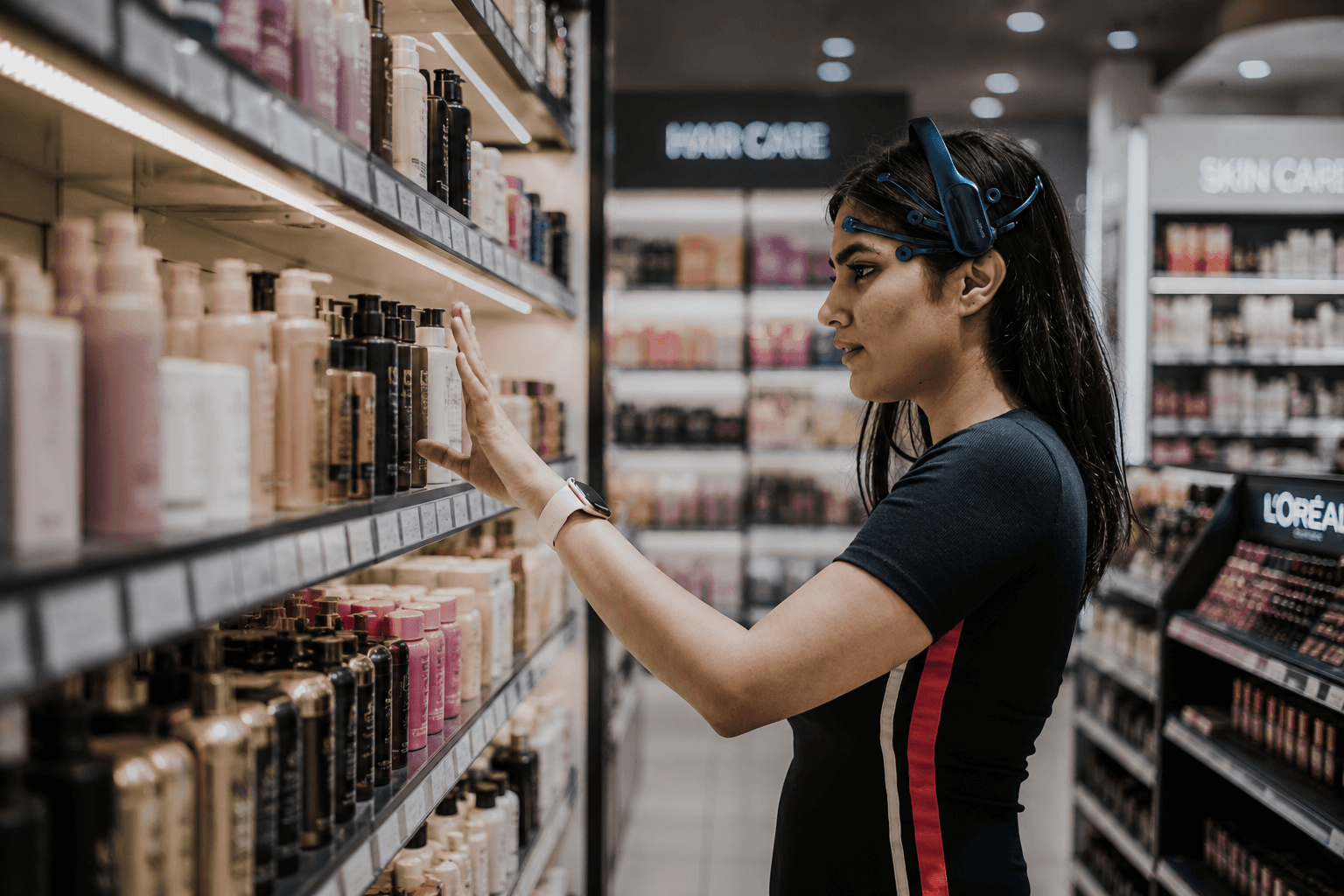
Eye tracking can show where consumers look, but it does not fully explain how they respond. EEG-based neuroanalytics can add insight into cognitive and emotional engagement during packaging exposure.
For beauty packaging research, EEG data can help evaluate:
Sustained attention
Emotional engagement
Interest
Cognitive load
Stress or friction during comparison
Attention drop-off
This matters because beauty purchasing is often emotionally loaded. Consumers may be evaluating products tied to confidence, aging, skin sensitivity, self-expression, wellness, or identity. Packaging that feels trustworthy and emotionally aligned can strengthen purchase confidence.
Neuroanalytics helps brands understand whether packaging creates meaningful engagement or simply visual exposure.
Testing Ingredient Communication and Trust
Ingredient transparency is central to modern beauty marketing. Consumers increasingly compare active ingredients, concentrations, claims, and product compatibility across routines.
However, ingredient-forward packaging can easily become cognitively dense. A design may communicate scientific credibility while also overwhelming the shopper.
Packaging design testing can help brands evaluate whether ingredient messaging feels:
Clear
Credible
Relevant
Differentiated
Easy to compare
For example, a serum package may highlight an active ingredient but fail to make the benefit immediately clear. A minimalist design may feel premium but under-communicate the product use case. A clinical design may feel trustworthy to one audience segment and intimidating to another.
Testing helps teams identify these differences before packaging decisions reach production.
Reducing Cognitive Load in Beauty Shopping
Beauty consumers often face decision-heavy journeys. They may compare products by concern, ingredient, skin type, routine step, texture, price, reviews, and brand philosophy.
Packaging can either reduce or increase cognitive load during this process.
Common sources of packaging-related cognitive friction include:
Unclear product naming systems
Too many similar variants
Small or low-contrast typography
Dense claims hierarchy
Inconsistent visual systems across product lines
Unclear usage context
When cognitive load rises, consumers may delay action or choose a more familiar option. Testing helps brands identify where packaging creates unnecessary effort and where clearer hierarchy could improve decision confidence.
Testing Packaging Across Mobile and Desktop
Beauty ecommerce often begins on mobile. This makes packaging visibility especially important because product images may appear small, compressed, or surrounded by competing visual content.
A package that performs well on desktop may lose clarity on mobile. Ingredient names, concentration details, and variant labels may become difficult to read. Color differences between products may become less obvious. Key benefits may disappear at thumbnail size.
Packaging design testing should evaluate performance across:
Mobile product grids
Desktop product pages
Social commerce placements
Retailer search results
Recommendation modules
Paid ads
This ensures that packaging works across the full digital shelf, not only in ideal presentation environments.
Comparing Packaging Variants Before Launch
Packaging redesigns often involve multiple strong options. Internal teams may debate which direction feels more premium, more clinical, more accessible, or more differentiated.
Neuroanalytics and eye tracking can support more objective comparison between variants.
Teams can test:
Color systems
Typography treatments
Ingredient hierarchy
Benefit messaging
Logo placement
Minimalist vs. information-rich layouts
Clinical vs. emotional design cues
Instead of relying only on stakeholder preference, brands can evaluate which design produces stronger attention, lower cognitive load, and higher emotional engagement.
Applying Neuroanalytics to Beauty Packaging Research
Modern beauty brands need packaging that performs across physical retail, ecommerce, mobile, social, and paid media environments. That requires a more complete view of consumer response.
By combining behavioral analytics, eye tracking, UX research, and EEG-based neuroanalytics, teams can evaluate how packaging captures attention, communicates product value, and supports purchase confidence.
This approach can support packaging redesigns, product launches, digital shelf optimization, campaign testing, and broader beauty ecommerce strategy.
Teams exploring advanced packaging design testing, beauty ecommerce research, and consumer attention analysis can gain deeper, unbiased insights through Emotiv User and Product Research Solutions.
Conclusion
Beauty packaging has to do more than look polished. It must attract attention, communicate clearly, reduce cognitive friction, and create emotional confidence across crowded ecommerce environments.
Packaging design testing gives beauty brands a stronger way to evaluate performance before launch. By using eye tracking and neuroanalytics, teams can better understand how consumers notice, process, and emotionally respond to packaging in real shopping contexts.
For brands competing in skincare, cosmetics, haircare, and personal care, these insights can help improve digital shelf impact, product discovery, and confidence throughout the purchase journey.
The Neuroscience of Beauty Packaging in Ecommerce
Beauty packaging has always shaped product perception, but ecommerce has changed the way packaging needs to perform. On a digital shelf, skincare and beauty products compete through thumbnails, ingredient claims, brand cues, price signals, reviews, and product detail pages. For beauty brands, packaging design testing is no longer only about whether a bottle, tube, or box looks beautiful in isolation. It is about whether consumers notice it, understand it, trust it, and feel confident enough to continue toward purchase. By combining behavioral analytics, eye tracking, UX research, and EEG-based neuroanalytics, beauty brands can better evaluate packaging performance before launch and optimize for attention, emotional engagement, and purchase confidence.
Why Beauty Packaging Needs More Than Aesthetic Review
Beauty packaging sits at the intersection of identity, trust, efficacy, and desire. Consumers use packaging to make fast assumptions about product quality, ingredient credibility, safety, price tier, and whether a formula fits their needs.
In ecommerce, those judgments happen even faster. A consumer may first encounter a product as a small image in a search result, social ad, recommendation carousel, or mobile product grid. If the packaging does not communicate quickly, it may never earn a closer look.
This creates a challenge for beauty marketers, product teams, and packaging designers. A design that looks strong in a creative review may underperform in a real shopping environment. The typography may be too small in a mobile thumbnail. The ingredient benefit may not stand out. The visual system may look premium but fail to differentiate from competitors. The packaging may attract attention but create uncertainty during product comparison.
Packaging design testing helps brands evaluate these risks before launch.
Packaging as a Digital Decision Interface
In beauty ecommerce, packaging functions as more than a visual identity system. It acts as a decision interface.
Consumers rely on packaging to answer questions quickly:
What does this product do?
Is this formula right for my skin, hair, or routine?
Does this brand feel trustworthy?
Is the product clinical, natural, luxury, playful, or accessible?
Can I understand the key benefit without reading the full product page?
When packaging creates clarity, consumers can move forward with confidence. When packaging creates friction, they may hesitate, compare alternatives, or abandon the product entirely.
This is why packaging design testing should measure more than preference. It should evaluate attention, comprehension, emotional response, and cognitive load.
How to Test Packaging Design to Predict Impact on Sales
No single research method can perfectly predict sales, but brands can evaluate signals that strongly influence commercial performance.
Packaging design testing can help teams understand whether a design supports:
Product discovery
Brand recall
Benefit comprehension
Purchase confidence
Competitive differentiation
Reduced comparison fatigue
For beauty brands, these factors are especially important because consumers often compare multiple similar products. A shopper may be choosing between several serums, moisturizers, cleansers, sunscreens, or hair treatments with overlapping claims. Packaging that simplifies the decision can directly support conversion.
Testing packaging before launch allows teams to identify whether the design communicates the right message quickly enough to influence purchase behavior.
Using EEG Data to Evaluate Emotional Response
Eye tracking can show where consumers look, but it does not fully explain how they respond. EEG-based neuroanalytics can add insight into cognitive and emotional engagement during packaging exposure.
For beauty packaging research, EEG data can help evaluate:
Sustained attention
Emotional engagement
Interest
Cognitive load
Stress or friction during comparison
Attention drop-off
This matters because beauty purchasing is often emotionally loaded. Consumers may be evaluating products tied to confidence, aging, skin sensitivity, self-expression, wellness, or identity. Packaging that feels trustworthy and emotionally aligned can strengthen purchase confidence.
Neuroanalytics helps brands understand whether packaging creates meaningful engagement or simply visual exposure.
Testing Ingredient Communication and Trust
Ingredient transparency is central to modern beauty marketing. Consumers increasingly compare active ingredients, concentrations, claims, and product compatibility across routines.
However, ingredient-forward packaging can easily become cognitively dense. A design may communicate scientific credibility while also overwhelming the shopper.
Packaging design testing can help brands evaluate whether ingredient messaging feels:
Clear
Credible
Relevant
Differentiated
Easy to compare
For example, a serum package may highlight an active ingredient but fail to make the benefit immediately clear. A minimalist design may feel premium but under-communicate the product use case. A clinical design may feel trustworthy to one audience segment and intimidating to another.
Testing helps teams identify these differences before packaging decisions reach production.
Reducing Cognitive Load in Beauty Shopping
Beauty consumers often face decision-heavy journeys. They may compare products by concern, ingredient, skin type, routine step, texture, price, reviews, and brand philosophy.
Packaging can either reduce or increase cognitive load during this process.
Common sources of packaging-related cognitive friction include:
Unclear product naming systems
Too many similar variants
Small or low-contrast typography
Dense claims hierarchy
Inconsistent visual systems across product lines
Unclear usage context
When cognitive load rises, consumers may delay action or choose a more familiar option. Testing helps brands identify where packaging creates unnecessary effort and where clearer hierarchy could improve decision confidence.
Testing Packaging Across Mobile and Desktop
Beauty ecommerce often begins on mobile. This makes packaging visibility especially important because product images may appear small, compressed, or surrounded by competing visual content.
A package that performs well on desktop may lose clarity on mobile. Ingredient names, concentration details, and variant labels may become difficult to read. Color differences between products may become less obvious. Key benefits may disappear at thumbnail size.
Packaging design testing should evaluate performance across:
Mobile product grids
Desktop product pages
Social commerce placements
Retailer search results
Recommendation modules
Paid ads
This ensures that packaging works across the full digital shelf, not only in ideal presentation environments.
Comparing Packaging Variants Before Launch
Packaging redesigns often involve multiple strong options. Internal teams may debate which direction feels more premium, more clinical, more accessible, or more differentiated.
Neuroanalytics and eye tracking can support more objective comparison between variants.
Teams can test:
Color systems
Typography treatments
Ingredient hierarchy
Benefit messaging
Logo placement
Minimalist vs. information-rich layouts
Clinical vs. emotional design cues
Instead of relying only on stakeholder preference, brands can evaluate which design produces stronger attention, lower cognitive load, and higher emotional engagement.
Applying Neuroanalytics to Beauty Packaging Research
Modern beauty brands need packaging that performs across physical retail, ecommerce, mobile, social, and paid media environments. That requires a more complete view of consumer response.
By combining behavioral analytics, eye tracking, UX research, and EEG-based neuroanalytics, teams can evaluate how packaging captures attention, communicates product value, and supports purchase confidence.
This approach can support packaging redesigns, product launches, digital shelf optimization, campaign testing, and broader beauty ecommerce strategy.
Teams exploring advanced packaging design testing, beauty ecommerce research, and consumer attention analysis can gain deeper, unbiased insights through Emotiv User and Product Research Solutions.
Conclusion
Beauty packaging has to do more than look polished. It must attract attention, communicate clearly, reduce cognitive friction, and create emotional confidence across crowded ecommerce environments.
Packaging design testing gives beauty brands a stronger way to evaluate performance before launch. By using eye tracking and neuroanalytics, teams can better understand how consumers notice, process, and emotionally respond to packaging in real shopping contexts.
For brands competing in skincare, cosmetics, haircare, and personal care, these insights can help improve digital shelf impact, product discovery, and confidence throughout the purchase journey.
The Neuroscience of Beauty Packaging in Ecommerce
Beauty packaging has always shaped product perception, but ecommerce has changed the way packaging needs to perform. On a digital shelf, skincare and beauty products compete through thumbnails, ingredient claims, brand cues, price signals, reviews, and product detail pages. For beauty brands, packaging design testing is no longer only about whether a bottle, tube, or box looks beautiful in isolation. It is about whether consumers notice it, understand it, trust it, and feel confident enough to continue toward purchase. By combining behavioral analytics, eye tracking, UX research, and EEG-based neuroanalytics, beauty brands can better evaluate packaging performance before launch and optimize for attention, emotional engagement, and purchase confidence.
Why Beauty Packaging Needs More Than Aesthetic Review
Beauty packaging sits at the intersection of identity, trust, efficacy, and desire. Consumers use packaging to make fast assumptions about product quality, ingredient credibility, safety, price tier, and whether a formula fits their needs.
In ecommerce, those judgments happen even faster. A consumer may first encounter a product as a small image in a search result, social ad, recommendation carousel, or mobile product grid. If the packaging does not communicate quickly, it may never earn a closer look.
This creates a challenge for beauty marketers, product teams, and packaging designers. A design that looks strong in a creative review may underperform in a real shopping environment. The typography may be too small in a mobile thumbnail. The ingredient benefit may not stand out. The visual system may look premium but fail to differentiate from competitors. The packaging may attract attention but create uncertainty during product comparison.
Packaging design testing helps brands evaluate these risks before launch.
Packaging as a Digital Decision Interface
In beauty ecommerce, packaging functions as more than a visual identity system. It acts as a decision interface.
Consumers rely on packaging to answer questions quickly:
What does this product do?
Is this formula right for my skin, hair, or routine?
Does this brand feel trustworthy?
Is the product clinical, natural, luxury, playful, or accessible?
Can I understand the key benefit without reading the full product page?
When packaging creates clarity, consumers can move forward with confidence. When packaging creates friction, they may hesitate, compare alternatives, or abandon the product entirely.
This is why packaging design testing should measure more than preference. It should evaluate attention, comprehension, emotional response, and cognitive load.
How to Test Packaging Design to Predict Impact on Sales
No single research method can perfectly predict sales, but brands can evaluate signals that strongly influence commercial performance.
Packaging design testing can help teams understand whether a design supports:
Product discovery
Brand recall
Benefit comprehension
Purchase confidence
Competitive differentiation
Reduced comparison fatigue
For beauty brands, these factors are especially important because consumers often compare multiple similar products. A shopper may be choosing between several serums, moisturizers, cleansers, sunscreens, or hair treatments with overlapping claims. Packaging that simplifies the decision can directly support conversion.
Testing packaging before launch allows teams to identify whether the design communicates the right message quickly enough to influence purchase behavior.
Using EEG Data to Evaluate Emotional Response
Eye tracking can show where consumers look, but it does not fully explain how they respond. EEG-based neuroanalytics can add insight into cognitive and emotional engagement during packaging exposure.
For beauty packaging research, EEG data can help evaluate:
Sustained attention
Emotional engagement
Interest
Cognitive load
Stress or friction during comparison
Attention drop-off
This matters because beauty purchasing is often emotionally loaded. Consumers may be evaluating products tied to confidence, aging, skin sensitivity, self-expression, wellness, or identity. Packaging that feels trustworthy and emotionally aligned can strengthen purchase confidence.
Neuroanalytics helps brands understand whether packaging creates meaningful engagement or simply visual exposure.
Testing Ingredient Communication and Trust
Ingredient transparency is central to modern beauty marketing. Consumers increasingly compare active ingredients, concentrations, claims, and product compatibility across routines.
However, ingredient-forward packaging can easily become cognitively dense. A design may communicate scientific credibility while also overwhelming the shopper.
Packaging design testing can help brands evaluate whether ingredient messaging feels:
Clear
Credible
Relevant
Differentiated
Easy to compare
For example, a serum package may highlight an active ingredient but fail to make the benefit immediately clear. A minimalist design may feel premium but under-communicate the product use case. A clinical design may feel trustworthy to one audience segment and intimidating to another.
Testing helps teams identify these differences before packaging decisions reach production.
Reducing Cognitive Load in Beauty Shopping
Beauty consumers often face decision-heavy journeys. They may compare products by concern, ingredient, skin type, routine step, texture, price, reviews, and brand philosophy.
Packaging can either reduce or increase cognitive load during this process.
Common sources of packaging-related cognitive friction include:
Unclear product naming systems
Too many similar variants
Small or low-contrast typography
Dense claims hierarchy
Inconsistent visual systems across product lines
Unclear usage context
When cognitive load rises, consumers may delay action or choose a more familiar option. Testing helps brands identify where packaging creates unnecessary effort and where clearer hierarchy could improve decision confidence.
Testing Packaging Across Mobile and Desktop
Beauty ecommerce often begins on mobile. This makes packaging visibility especially important because product images may appear small, compressed, or surrounded by competing visual content.
A package that performs well on desktop may lose clarity on mobile. Ingredient names, concentration details, and variant labels may become difficult to read. Color differences between products may become less obvious. Key benefits may disappear at thumbnail size.
Packaging design testing should evaluate performance across:
Mobile product grids
Desktop product pages
Social commerce placements
Retailer search results
Recommendation modules
Paid ads
This ensures that packaging works across the full digital shelf, not only in ideal presentation environments.
Comparing Packaging Variants Before Launch
Packaging redesigns often involve multiple strong options. Internal teams may debate which direction feels more premium, more clinical, more accessible, or more differentiated.
Neuroanalytics and eye tracking can support more objective comparison between variants.
Teams can test:
Color systems
Typography treatments
Ingredient hierarchy
Benefit messaging
Logo placement
Minimalist vs. information-rich layouts
Clinical vs. emotional design cues
Instead of relying only on stakeholder preference, brands can evaluate which design produces stronger attention, lower cognitive load, and higher emotional engagement.
Applying Neuroanalytics to Beauty Packaging Research
Modern beauty brands need packaging that performs across physical retail, ecommerce, mobile, social, and paid media environments. That requires a more complete view of consumer response.
By combining behavioral analytics, eye tracking, UX research, and EEG-based neuroanalytics, teams can evaluate how packaging captures attention, communicates product value, and supports purchase confidence.
This approach can support packaging redesigns, product launches, digital shelf optimization, campaign testing, and broader beauty ecommerce strategy.
Teams exploring advanced packaging design testing, beauty ecommerce research, and consumer attention analysis can gain deeper, unbiased insights through Emotiv User and Product Research Solutions.
Conclusion
Beauty packaging has to do more than look polished. It must attract attention, communicate clearly, reduce cognitive friction, and create emotional confidence across crowded ecommerce environments.
Packaging design testing gives beauty brands a stronger way to evaluate performance before launch. By using eye tracking and neuroanalytics, teams can better understand how consumers notice, process, and emotionally respond to packaging in real shopping contexts.
For brands competing in skincare, cosmetics, haircare, and personal care, these insights can help improve digital shelf impact, product discovery, and confidence throughout the purchase journey.