
How Real-Time EEG Helps Reduce Confirmation Bias in Marketing Research
H.B. Duran
Updated on
Jun 10, 2026
How Real-Time EEG Helps Reduce Confirmation Bias in Marketing Research
H.B. Duran
Updated on
Jun 10, 2026
How Real-Time EEG Helps Reduce Confirmation Bias in Marketing Research
H.B. Duran
Updated on
Jun 10, 2026
Marketing teams invest significant resources into research to improve campaign performance, optimize customer experiences, and guide strategic decisions. Yet even the most sophisticated studies can be influenced by a persistent challenge: confirmation bias. When researchers, stakeholders, or decision-makers unconsciously favor information that supports existing assumptions, valuable insights can be overlooked and research outcomes can become skewed.
For user and product researchers working within agencies or in-house marketing teams, confirmation bias often appears long before data analysis begins. It can influence hypothesis development, survey design, participant questioning, and even the interpretation of results. The consequence is a research process that validates expectations rather than uncovering genuine audience responses.
As organizations increasingly seek more reliable evidence for creative testing, product development, and customer experience optimization, many are incorporating real-time EEG alongside traditional methodologies. By measuring audience reactions as they occur, researchers gain access to objective signals that can help challenge assumptions and strengthen decision-making.
Key Takeaways
Confirmation bias can affect every stage of marketing research, from study design to data interpretation.
Self-reported feedback alone may reinforce existing assumptions rather than reveal actual audience responses.
Real-time EEG provides objective measures of attention, engagement, and cognitive workload.
Combining EEG with traditional methods helps validate findings and reduce interpretation bias.
Multi-method research frameworks support more confident marketing and product decisions.
The Hidden Cost of Confirmation Bias in Marketing Research
Confirmation bias occurs when researchers place greater emphasis on information that aligns with their expectations while discounting contradictory evidence. In marketing research, this can lead teams to favor concepts, messages, or experiences they already believe will perform well.
Consider a creative testing project where stakeholders expect a specific advertisement to outperform alternatives. Researchers may unintentionally focus on participant comments that support this expectation while giving less weight to conflicting feedback. Even when using structured surveys, question framing and interpretation choices can influence outcomes.
The challenge becomes particularly problematic when research findings are used to justify significant investments in advertising, product development, or customer experience initiatives. A biased interpretation of audience feedback can result in missed opportunities and ineffective optimization efforts.
According to research by Harvard Business Review (2017), decision-makers frequently seek evidence that confirms existing beliefs, making structured processes for identifying contradictory information essential to effective decision-making.
Why Self-Reported Data Can Reinforce Existing Assumptions
Traditional marketing research methods remain valuable, but they have inherent limitations when used in isolation. Surveys, interviews, and focus groups rely on participants accurately recalling and articulating their experiences. In reality, consumers often reconstruct explanations after the fact.
Participants may express positive opinions toward a campaign or product because it aligns with social expectations, appears familiar, or sounds appealing in theory. However, these responses do not always reflect actual levels of attention, engagement, or interest experienced during exposure.
This creates an environment where confirmation bias can thrive. If researchers already expect a positive outcome, favorable survey responses may be interpreted as validation even when underlying audience engagement was relatively weak.
Research published by Vecchiato et al. (2014) found that neurophysiological measures can reveal aspects of audience response that are not fully captured through self-report methodologies, highlighting the value of combining multiple forms of evidence.
How Real-Time EEG Introduces an Independent Data Source
One of the most effective ways to reduce confirmation bias is to introduce objective measurements that operate independently of participant opinions and researcher expectations.
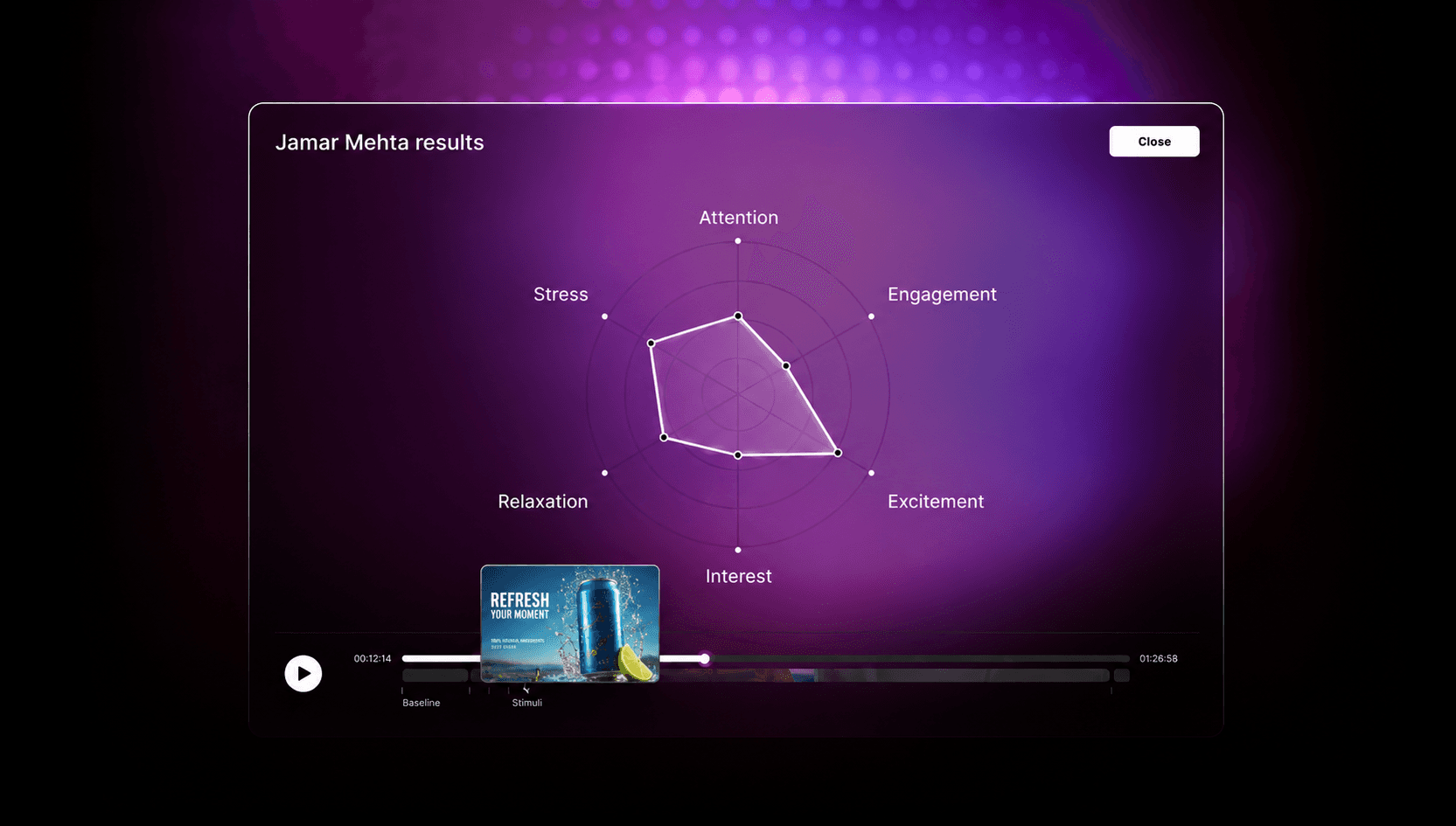
Real-time EEG provides continuous insights into neural activity associated with attention, engagement, cognitive workload, and emotional response while participants interact with advertisements, websites, videos, products, or digital experiences.
Unlike post-exposure questionnaires, EEG captures audience reactions in the moment. Researchers can observe fluctuations in engagement as they occur rather than relying exclusively on participant recollection afterward.
This independent layer of evidence helps create a more balanced research framework. When survey findings align with EEG-derived measures, confidence in the results increases. When discrepancies emerge, researchers gain an opportunity to investigate assumptions and identify potential sources of bias.
Real-World Example: Advertising Performance Beyond Stated Preference
A common challenge in advertising research occurs when multiple concepts receive similar survey scores despite generating different levels of audience engagement.
Research within the neuromarketing field has repeatedly demonstrated that advertisements producing stronger attention and engagement signals often achieve better marketplace performance than would be predicted by self-reported ratings alone. As discussed by Vecchiato et al. (2014), EEG can reveal meaningful differences in audience processing that traditional feedback mechanisms may miss.
For marketing teams, these insights help prevent confirmation bias from favoring creative concepts based solely on stated preferences. Instead, decisions can incorporate objective evidence regarding how audiences actually responded during exposure.
Real-World Example: Identifying Hidden Friction in User Experience Research
User experience studies provide another illustration of how confirmation bias can influence research conclusions.
Participants frequently report that digital experiences are intuitive and easy to navigate. However, EEG-based usability research has shown that elevated cognitive workload and cognitive stress can occur even when users verbally describe experiences as positive.
Research by Leeuwis et al. (2021) demonstrated how neurophysiological measures provide additional insight into cognitive demands during task performance. These findings can help researchers identify friction points that might otherwise remain hidden when relying exclusively on participant interviews.
In practice, this allows product teams to validate assumptions about usability and uncover opportunities for optimization before launch.
Building Research Processes That Actively Challenge Assumptions
Technology alone cannot eliminate confirmation bias. Researchers must also establish processes that encourage objective evaluation.
Effective practices include:
Pre-registering research hypotheses when possible.
Defining success metrics before reviewing results.
Randomizing stimulus presentation order.
Using neutral questioning techniques.
Reviewing contradictory evidence alongside supporting findings.
Combining self-report, behavioral, and neurophysiological measures.
When EEG is integrated into this framework, it serves as a complementary data source that helps researchers test assumptions rather than reinforce them. The result is a more comprehensive understanding of audience behavior and decision-making.
From Validation to Better Decision-Making
The ultimate goal of marketing research is not simply to collect data but to improve decisions. Confirmation bias undermines this objective by narrowing the range of evidence considered during evaluation.
Organizations that incorporate real-time EEG alongside traditional research methodologies gain access to richer insights into attention, engagement, and cognitive response. By comparing objective physiological measures with survey feedback and behavioral outcomes, teams can identify inconsistencies earlier and make decisions with greater confidence.
This multi-method approach is especially valuable in creative testing, user experience research, product innovation, and campaign optimization, where understanding actual audience response is often more important than understanding what audiences believe they experienced.
Conclusion
Confirmation bias remains one of the most significant threats to research quality in marketing organizations. Left unchecked, it can influence study design, interpretation, and strategic decision-making, leading teams toward conclusions that reflect expectations rather than reality.
Combining rigorous research methodologies with real-time EEG measurement provides a practical way to challenge assumptions and validate findings. By incorporating objective indicators of attention, engagement, and cognitive workload alongside traditional metrics, researchers can create a more reliable foundation for decision-making.
Teams seeking to strengthen audience testing and reduce confirmation bias in their research workflows can explore how Emotiv Studio supports neuroscience-informed measurement and analysis.
Sources
Harvard Business Review. (2017). Confirmation Bias and the Power of Disconfirming Evidence. https://hbr.org/2017/05/confirmation-bias-and-the-power-of-disconfirming-evidence
Leeuwis, N., Paas, F., & van Merriënboer, J. (2021). Cognitive load and neurophysiological measures in learning and usability research. Frontiers in Human Neuroscience. https://www.frontiersin.org/articles/10.3389/fnhum.2021.651401/full
Vecchiato, G., Astolfi, L., De Vico Fallani, F., et al. (2014). On the use of EEG or MEG brain imaging tools in neuromarketing research. Frontiers in Human Neuroscience. https://www.frontiersin.org/articles/10.3389/fnhum.2014.00853/full
Emotiv. Neuromarketing and audience research applications. https://www.emotiv.com/neuromarketing
Marketing teams invest significant resources into research to improve campaign performance, optimize customer experiences, and guide strategic decisions. Yet even the most sophisticated studies can be influenced by a persistent challenge: confirmation bias. When researchers, stakeholders, or decision-makers unconsciously favor information that supports existing assumptions, valuable insights can be overlooked and research outcomes can become skewed.
For user and product researchers working within agencies or in-house marketing teams, confirmation bias often appears long before data analysis begins. It can influence hypothesis development, survey design, participant questioning, and even the interpretation of results. The consequence is a research process that validates expectations rather than uncovering genuine audience responses.
As organizations increasingly seek more reliable evidence for creative testing, product development, and customer experience optimization, many are incorporating real-time EEG alongside traditional methodologies. By measuring audience reactions as they occur, researchers gain access to objective signals that can help challenge assumptions and strengthen decision-making.
Key Takeaways
Confirmation bias can affect every stage of marketing research, from study design to data interpretation.
Self-reported feedback alone may reinforce existing assumptions rather than reveal actual audience responses.
Real-time EEG provides objective measures of attention, engagement, and cognitive workload.
Combining EEG with traditional methods helps validate findings and reduce interpretation bias.
Multi-method research frameworks support more confident marketing and product decisions.
The Hidden Cost of Confirmation Bias in Marketing Research
Confirmation bias occurs when researchers place greater emphasis on information that aligns with their expectations while discounting contradictory evidence. In marketing research, this can lead teams to favor concepts, messages, or experiences they already believe will perform well.
Consider a creative testing project where stakeholders expect a specific advertisement to outperform alternatives. Researchers may unintentionally focus on participant comments that support this expectation while giving less weight to conflicting feedback. Even when using structured surveys, question framing and interpretation choices can influence outcomes.
The challenge becomes particularly problematic when research findings are used to justify significant investments in advertising, product development, or customer experience initiatives. A biased interpretation of audience feedback can result in missed opportunities and ineffective optimization efforts.
According to research by Harvard Business Review (2017), decision-makers frequently seek evidence that confirms existing beliefs, making structured processes for identifying contradictory information essential to effective decision-making.
Why Self-Reported Data Can Reinforce Existing Assumptions
Traditional marketing research methods remain valuable, but they have inherent limitations when used in isolation. Surveys, interviews, and focus groups rely on participants accurately recalling and articulating their experiences. In reality, consumers often reconstruct explanations after the fact.
Participants may express positive opinions toward a campaign or product because it aligns with social expectations, appears familiar, or sounds appealing in theory. However, these responses do not always reflect actual levels of attention, engagement, or interest experienced during exposure.
This creates an environment where confirmation bias can thrive. If researchers already expect a positive outcome, favorable survey responses may be interpreted as validation even when underlying audience engagement was relatively weak.
Research published by Vecchiato et al. (2014) found that neurophysiological measures can reveal aspects of audience response that are not fully captured through self-report methodologies, highlighting the value of combining multiple forms of evidence.
How Real-Time EEG Introduces an Independent Data Source
One of the most effective ways to reduce confirmation bias is to introduce objective measurements that operate independently of participant opinions and researcher expectations.
Real-time EEG provides continuous insights into neural activity associated with attention, engagement, cognitive workload, and emotional response while participants interact with advertisements, websites, videos, products, or digital experiences.
Unlike post-exposure questionnaires, EEG captures audience reactions in the moment. Researchers can observe fluctuations in engagement as they occur rather than relying exclusively on participant recollection afterward.
This independent layer of evidence helps create a more balanced research framework. When survey findings align with EEG-derived measures, confidence in the results increases. When discrepancies emerge, researchers gain an opportunity to investigate assumptions and identify potential sources of bias.
Real-World Example: Advertising Performance Beyond Stated Preference
A common challenge in advertising research occurs when multiple concepts receive similar survey scores despite generating different levels of audience engagement.
Research within the neuromarketing field has repeatedly demonstrated that advertisements producing stronger attention and engagement signals often achieve better marketplace performance than would be predicted by self-reported ratings alone. As discussed by Vecchiato et al. (2014), EEG can reveal meaningful differences in audience processing that traditional feedback mechanisms may miss.
For marketing teams, these insights help prevent confirmation bias from favoring creative concepts based solely on stated preferences. Instead, decisions can incorporate objective evidence regarding how audiences actually responded during exposure.
Real-World Example: Identifying Hidden Friction in User Experience Research
User experience studies provide another illustration of how confirmation bias can influence research conclusions.
Participants frequently report that digital experiences are intuitive and easy to navigate. However, EEG-based usability research has shown that elevated cognitive workload and cognitive stress can occur even when users verbally describe experiences as positive.
Research by Leeuwis et al. (2021) demonstrated how neurophysiological measures provide additional insight into cognitive demands during task performance. These findings can help researchers identify friction points that might otherwise remain hidden when relying exclusively on participant interviews.
In practice, this allows product teams to validate assumptions about usability and uncover opportunities for optimization before launch.
Building Research Processes That Actively Challenge Assumptions
Technology alone cannot eliminate confirmation bias. Researchers must also establish processes that encourage objective evaluation.
Effective practices include:
Pre-registering research hypotheses when possible.
Defining success metrics before reviewing results.
Randomizing stimulus presentation order.
Using neutral questioning techniques.
Reviewing contradictory evidence alongside supporting findings.
Combining self-report, behavioral, and neurophysiological measures.
When EEG is integrated into this framework, it serves as a complementary data source that helps researchers test assumptions rather than reinforce them. The result is a more comprehensive understanding of audience behavior and decision-making.
From Validation to Better Decision-Making
The ultimate goal of marketing research is not simply to collect data but to improve decisions. Confirmation bias undermines this objective by narrowing the range of evidence considered during evaluation.
Organizations that incorporate real-time EEG alongside traditional research methodologies gain access to richer insights into attention, engagement, and cognitive response. By comparing objective physiological measures with survey feedback and behavioral outcomes, teams can identify inconsistencies earlier and make decisions with greater confidence.
This multi-method approach is especially valuable in creative testing, user experience research, product innovation, and campaign optimization, where understanding actual audience response is often more important than understanding what audiences believe they experienced.
Conclusion
Confirmation bias remains one of the most significant threats to research quality in marketing organizations. Left unchecked, it can influence study design, interpretation, and strategic decision-making, leading teams toward conclusions that reflect expectations rather than reality.
Combining rigorous research methodologies with real-time EEG measurement provides a practical way to challenge assumptions and validate findings. By incorporating objective indicators of attention, engagement, and cognitive workload alongside traditional metrics, researchers can create a more reliable foundation for decision-making.
Teams seeking to strengthen audience testing and reduce confirmation bias in their research workflows can explore how Emotiv Studio supports neuroscience-informed measurement and analysis.
Sources
Harvard Business Review. (2017). Confirmation Bias and the Power of Disconfirming Evidence. https://hbr.org/2017/05/confirmation-bias-and-the-power-of-disconfirming-evidence
Leeuwis, N., Paas, F., & van Merriënboer, J. (2021). Cognitive load and neurophysiological measures in learning and usability research. Frontiers in Human Neuroscience. https://www.frontiersin.org/articles/10.3389/fnhum.2021.651401/full
Vecchiato, G., Astolfi, L., De Vico Fallani, F., et al. (2014). On the use of EEG or MEG brain imaging tools in neuromarketing research. Frontiers in Human Neuroscience. https://www.frontiersin.org/articles/10.3389/fnhum.2014.00853/full
Emotiv. Neuromarketing and audience research applications. https://www.emotiv.com/neuromarketing
Marketing teams invest significant resources into research to improve campaign performance, optimize customer experiences, and guide strategic decisions. Yet even the most sophisticated studies can be influenced by a persistent challenge: confirmation bias. When researchers, stakeholders, or decision-makers unconsciously favor information that supports existing assumptions, valuable insights can be overlooked and research outcomes can become skewed.
For user and product researchers working within agencies or in-house marketing teams, confirmation bias often appears long before data analysis begins. It can influence hypothesis development, survey design, participant questioning, and even the interpretation of results. The consequence is a research process that validates expectations rather than uncovering genuine audience responses.
As organizations increasingly seek more reliable evidence for creative testing, product development, and customer experience optimization, many are incorporating real-time EEG alongside traditional methodologies. By measuring audience reactions as they occur, researchers gain access to objective signals that can help challenge assumptions and strengthen decision-making.
Key Takeaways
Confirmation bias can affect every stage of marketing research, from study design to data interpretation.
Self-reported feedback alone may reinforce existing assumptions rather than reveal actual audience responses.
Real-time EEG provides objective measures of attention, engagement, and cognitive workload.
Combining EEG with traditional methods helps validate findings and reduce interpretation bias.
Multi-method research frameworks support more confident marketing and product decisions.
The Hidden Cost of Confirmation Bias in Marketing Research
Confirmation bias occurs when researchers place greater emphasis on information that aligns with their expectations while discounting contradictory evidence. In marketing research, this can lead teams to favor concepts, messages, or experiences they already believe will perform well.
Consider a creative testing project where stakeholders expect a specific advertisement to outperform alternatives. Researchers may unintentionally focus on participant comments that support this expectation while giving less weight to conflicting feedback. Even when using structured surveys, question framing and interpretation choices can influence outcomes.
The challenge becomes particularly problematic when research findings are used to justify significant investments in advertising, product development, or customer experience initiatives. A biased interpretation of audience feedback can result in missed opportunities and ineffective optimization efforts.
According to research by Harvard Business Review (2017), decision-makers frequently seek evidence that confirms existing beliefs, making structured processes for identifying contradictory information essential to effective decision-making.
Why Self-Reported Data Can Reinforce Existing Assumptions
Traditional marketing research methods remain valuable, but they have inherent limitations when used in isolation. Surveys, interviews, and focus groups rely on participants accurately recalling and articulating their experiences. In reality, consumers often reconstruct explanations after the fact.
Participants may express positive opinions toward a campaign or product because it aligns with social expectations, appears familiar, or sounds appealing in theory. However, these responses do not always reflect actual levels of attention, engagement, or interest experienced during exposure.
This creates an environment where confirmation bias can thrive. If researchers already expect a positive outcome, favorable survey responses may be interpreted as validation even when underlying audience engagement was relatively weak.
Research published by Vecchiato et al. (2014) found that neurophysiological measures can reveal aspects of audience response that are not fully captured through self-report methodologies, highlighting the value of combining multiple forms of evidence.
How Real-Time EEG Introduces an Independent Data Source
One of the most effective ways to reduce confirmation bias is to introduce objective measurements that operate independently of participant opinions and researcher expectations.
Real-time EEG provides continuous insights into neural activity associated with attention, engagement, cognitive workload, and emotional response while participants interact with advertisements, websites, videos, products, or digital experiences.
Unlike post-exposure questionnaires, EEG captures audience reactions in the moment. Researchers can observe fluctuations in engagement as they occur rather than relying exclusively on participant recollection afterward.
This independent layer of evidence helps create a more balanced research framework. When survey findings align with EEG-derived measures, confidence in the results increases. When discrepancies emerge, researchers gain an opportunity to investigate assumptions and identify potential sources of bias.
Real-World Example: Advertising Performance Beyond Stated Preference
A common challenge in advertising research occurs when multiple concepts receive similar survey scores despite generating different levels of audience engagement.
Research within the neuromarketing field has repeatedly demonstrated that advertisements producing stronger attention and engagement signals often achieve better marketplace performance than would be predicted by self-reported ratings alone. As discussed by Vecchiato et al. (2014), EEG can reveal meaningful differences in audience processing that traditional feedback mechanisms may miss.
For marketing teams, these insights help prevent confirmation bias from favoring creative concepts based solely on stated preferences. Instead, decisions can incorporate objective evidence regarding how audiences actually responded during exposure.
Real-World Example: Identifying Hidden Friction in User Experience Research
User experience studies provide another illustration of how confirmation bias can influence research conclusions.
Participants frequently report that digital experiences are intuitive and easy to navigate. However, EEG-based usability research has shown that elevated cognitive workload and cognitive stress can occur even when users verbally describe experiences as positive.
Research by Leeuwis et al. (2021) demonstrated how neurophysiological measures provide additional insight into cognitive demands during task performance. These findings can help researchers identify friction points that might otherwise remain hidden when relying exclusively on participant interviews.
In practice, this allows product teams to validate assumptions about usability and uncover opportunities for optimization before launch.
Building Research Processes That Actively Challenge Assumptions
Technology alone cannot eliminate confirmation bias. Researchers must also establish processes that encourage objective evaluation.
Effective practices include:
Pre-registering research hypotheses when possible.
Defining success metrics before reviewing results.
Randomizing stimulus presentation order.
Using neutral questioning techniques.
Reviewing contradictory evidence alongside supporting findings.
Combining self-report, behavioral, and neurophysiological measures.
When EEG is integrated into this framework, it serves as a complementary data source that helps researchers test assumptions rather than reinforce them. The result is a more comprehensive understanding of audience behavior and decision-making.
From Validation to Better Decision-Making
The ultimate goal of marketing research is not simply to collect data but to improve decisions. Confirmation bias undermines this objective by narrowing the range of evidence considered during evaluation.
Organizations that incorporate real-time EEG alongside traditional research methodologies gain access to richer insights into attention, engagement, and cognitive response. By comparing objective physiological measures with survey feedback and behavioral outcomes, teams can identify inconsistencies earlier and make decisions with greater confidence.
This multi-method approach is especially valuable in creative testing, user experience research, product innovation, and campaign optimization, where understanding actual audience response is often more important than understanding what audiences believe they experienced.
Conclusion
Confirmation bias remains one of the most significant threats to research quality in marketing organizations. Left unchecked, it can influence study design, interpretation, and strategic decision-making, leading teams toward conclusions that reflect expectations rather than reality.
Combining rigorous research methodologies with real-time EEG measurement provides a practical way to challenge assumptions and validate findings. By incorporating objective indicators of attention, engagement, and cognitive workload alongside traditional metrics, researchers can create a more reliable foundation for decision-making.
Teams seeking to strengthen audience testing and reduce confirmation bias in their research workflows can explore how Emotiv Studio supports neuroscience-informed measurement and analysis.
Sources
Harvard Business Review. (2017). Confirmation Bias and the Power of Disconfirming Evidence. https://hbr.org/2017/05/confirmation-bias-and-the-power-of-disconfirming-evidence
Leeuwis, N., Paas, F., & van Merriënboer, J. (2021). Cognitive load and neurophysiological measures in learning and usability research. Frontiers in Human Neuroscience. https://www.frontiersin.org/articles/10.3389/fnhum.2021.651401/full
Vecchiato, G., Astolfi, L., De Vico Fallani, F., et al. (2014). On the use of EEG or MEG brain imaging tools in neuromarketing research. Frontiers in Human Neuroscience. https://www.frontiersin.org/articles/10.3389/fnhum.2014.00853/full
Emotiv. Neuromarketing and audience research applications. https://www.emotiv.com/neuromarketing