
How EEG Measures Real-Time Reactions to Outdoor Advertising
H.B. Duran
Updated on
Jun 10, 2026
How EEG Measures Real-Time Reactions to Outdoor Advertising
H.B. Duran
Updated on
Jun 10, 2026
How EEG Measures Real-Time Reactions to Outdoor Advertising
H.B. Duran
Updated on
Jun 10, 2026
Outdoor campaigns operate in one of the most competitive attention environments in marketing. Consumers encounter billboards, transit ads, digital out-of-home displays, and street-level placements while navigating crowded physical spaces filled with distractions. For marketing agencies and in-house marketing teams, the challenge is not simply creating visually appealing campaigns—it is determining whether an outdoor advertising concept captures attention, generates engagement, and creates a meaningful emotional response within a matter of seconds.
Traditional research methods such as surveys and focus groups provide valuable feedback, but they often rely on participant recall after exposure has already occurred. By that point, memory biases, rationalization, and social desirability effects can influence responses. As a result, marketers may struggle to understand how audiences actually reacted in the moment.
Real-time EEG offers a different perspective. By measuring neural activity during ad exposure, researchers can evaluate attention, engagement, cognitive workload, and emotional response as they occur. This provides a more objective view of audience reactions and helps teams make more informed decisions about creative effectiveness before investing in media placement.
Key Takeaways
Outdoor advertising has only seconds to capture audience attention.
Self-reported feedback may not fully reflect real-time audience reactions.
EEG provides objective measures of attention, engagement, and cognitive response.
Real-time testing can identify which creative elements drive stronger audience impact.
Combining EEG with traditional research improves campaign optimization decisions.
The Measurement Challenge in Outdoor Advertising
Unlike digital experiences where marketers can track clicks, scrolls, and conversions, outdoor advertising often provides fewer direct indicators of audience engagement. While impression estimates and traffic data help evaluate reach, they reveal little about how viewers actually process creative content.
This creates a significant challenge during campaign development. A billboard concept may appear effective in a focus group yet fail to attract attention in a real-world environment. Conversely, a design that receives mixed verbal feedback may generate strong audience engagement when viewed naturally.
The gap between what people say and what they experience is particularly relevant in outdoor advertising because exposure durations are typically brief. Small differences in visual hierarchy, messaging, imagery, or layout can dramatically influence effectiveness.
Research by Vecchiato et al. (2014) highlights how neurophysiological measures can provide valuable insights into audience processing that may not be fully captured through traditional self-report methodologies.
Why Traditional Feedback Can Miss Emotional Reactions
When participants are asked to evaluate advertising after exposure, they often reconstruct their responses based on memory rather than describing their actual moment-to-moment experience.
Several factors can influence the accuracy of post-exposure feedback:
Recall limitations.
Social desirability bias.
Rationalization of preferences.
Difficulty articulating emotional reactions.
Influence from group discussion environments.
These challenges do not make traditional research ineffective. Rather, they highlight the importance of incorporating additional forms of measurement that capture audience response as it unfolds.
For outdoor advertising, where first impressions often determine effectiveness, understanding immediate reactions can be especially valuable.
How Real-Time EEG Captures Audience Response
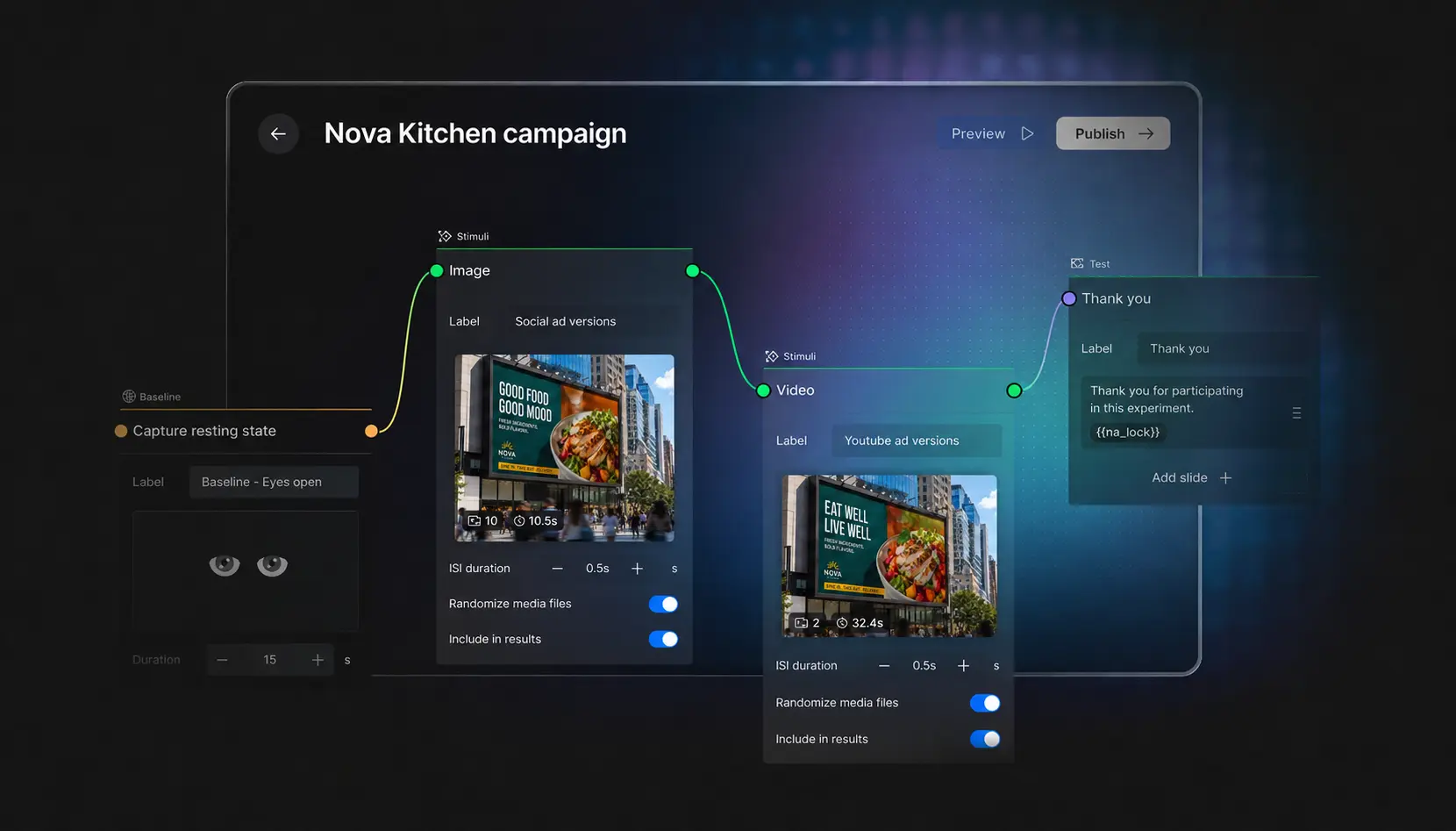
EEG measures electrical activity generated by the brain through sensors positioned on the scalp. During advertising research, participants can view creative concepts while EEG records neural responses associated with attention, engagement, cognitive workload, and emotional processing.
Unlike retrospective surveys, EEG captures reactions in real time. Researchers can identify precisely when attention increases, where engagement declines, and which creative elements generate stronger responses.
This moment-by-moment visibility provides insights that are difficult to obtain through self-report methods alone. Instead of asking participants what they remember about an advertisement, researchers can observe how viewers responded during exposure.
Organizations conducting audience research through Emotiv's neuromarketing solutions often combine EEG-derived metrics with traditional surveys and behavioral measures to create a more complete understanding of audience response.
Real-World Example: Comparing Outdoor Creative Variations
One of the most common applications of EEG in outdoor advertising involves A/B testing creative concepts before launch.
Imagine two billboard designs promoting the same product. Survey results may indicate that both concepts are equally appealing. However, real-time EEG data could reveal meaningful differences in audience engagement during exposure.
One concept may sustain attention longer, while another generates higher cognitive workload due to a complex layout or excessive information density. These insights help creative teams move beyond subjective opinions and evaluate which design is more likely to perform effectively in a real-world environment.
Because outdoor advertising is often consumed quickly, identifying these differences before deployment can significantly improve campaign outcomes.
Real-World Example: Evaluating Digital Out-of-Home Experiences
Digital out-of-home advertising introduces additional complexity through motion, animation, and dynamic content. While these elements can increase engagement, they can also create cognitive overload if not carefully designed.
Research involving neurophysiological measurement has shown that attention and engagement fluctuate significantly depending on visual complexity and information presentation. According to Leeuwis et al. (2021), neurophysiological measures provide valuable insight into cognitive workload and processing demands during user interactions.
For digital outdoor campaigns, these findings allow researchers to identify moments where messaging becomes difficult to process or where audience engagement declines. Such insights can guide refinements to creative structure, pacing, and visual hierarchy before large-scale deployment.
Moving Beyond Attention Metrics Alone
Capturing attention is important, but effective outdoor advertising requires more than visibility. Marketers must also understand whether audiences remain engaged and whether the experience supports positive brand perception.
EEG provides additional context by helping researchers evaluate:
Attention throughout ad exposure.
Levels of audience engagement.
Cognitive workload associated with processing information.
Emotional response patterns.
Potential moments of disengagement.
When combined with traditional feedback, these measures create a richer picture of campaign effectiveness and help reduce reliance on assumptions or subjective interpretation.
Applying EEG Insights to Campaign Optimization
Marketing agencies and in-house marketing teams increasingly face pressure to justify creative decisions before media investments are made. Outdoor campaigns often require significant production and placement budgets, making early validation especially valuable.
Real-time EEG enables researchers to test concepts prior to launch, identify performance differences between creative variations, and optimize campaigns based on objective audience response data. Rather than relying exclusively on stated preferences, teams can evaluate how viewers actually respond to messaging, imagery, and design choices.
This approach supports more confident decision-making while helping reduce the uncertainty that often accompanies creative evaluation.
Conclusion
Outdoor advertising succeeds when it captures attention and generates meaningful audience engagement within a limited window of exposure. Traditional research methods remain important, but they can struggle to fully capture emotional and cognitive responses that occur in real time.
By incorporating EEG into the research process, marketing agencies and in-house marketing teams can gain objective insights into attention, engagement, cognitive workload, and emotional response during ad exposure. These additional insights help teams evaluate creative effectiveness more accurately and optimize campaigns before launch.
Organizations looking to strengthen outdoor advertising research can explore how Emotiv Studio supports real-time EEG data collection and neuroscience-informed audience testing.
Sources
Vecchiato, G., Astolfi, L., De Vico Fallani, F., et al. (2014). On the use of EEG or MEG brain imaging tools in neuromarketing research. Frontiers in Human Neuroscience. https://www.frontiersin.org/articles/10.3389/fnhum.2014.00853/full
Leeuwis, N., Paas, F., & van Merriënboer, J. (2021). Cognitive load and neurophysiological measures in learning and usability research. Frontiers in Human Neuroscience. https://www.frontiersin.org/articles/10.3389/fnhum.2021.651401/full
Emotiv. Neuromarketing and audience research applications. https://www.emotiv.com/neuromarketing
Nielsen. Neuroscience and advertising effectiveness research. https://www.nielsen.com
Outdoor campaigns operate in one of the most competitive attention environments in marketing. Consumers encounter billboards, transit ads, digital out-of-home displays, and street-level placements while navigating crowded physical spaces filled with distractions. For marketing agencies and in-house marketing teams, the challenge is not simply creating visually appealing campaigns—it is determining whether an outdoor advertising concept captures attention, generates engagement, and creates a meaningful emotional response within a matter of seconds.
Traditional research methods such as surveys and focus groups provide valuable feedback, but they often rely on participant recall after exposure has already occurred. By that point, memory biases, rationalization, and social desirability effects can influence responses. As a result, marketers may struggle to understand how audiences actually reacted in the moment.
Real-time EEG offers a different perspective. By measuring neural activity during ad exposure, researchers can evaluate attention, engagement, cognitive workload, and emotional response as they occur. This provides a more objective view of audience reactions and helps teams make more informed decisions about creative effectiveness before investing in media placement.
Key Takeaways
Outdoor advertising has only seconds to capture audience attention.
Self-reported feedback may not fully reflect real-time audience reactions.
EEG provides objective measures of attention, engagement, and cognitive response.
Real-time testing can identify which creative elements drive stronger audience impact.
Combining EEG with traditional research improves campaign optimization decisions.
The Measurement Challenge in Outdoor Advertising
Unlike digital experiences where marketers can track clicks, scrolls, and conversions, outdoor advertising often provides fewer direct indicators of audience engagement. While impression estimates and traffic data help evaluate reach, they reveal little about how viewers actually process creative content.
This creates a significant challenge during campaign development. A billboard concept may appear effective in a focus group yet fail to attract attention in a real-world environment. Conversely, a design that receives mixed verbal feedback may generate strong audience engagement when viewed naturally.
The gap between what people say and what they experience is particularly relevant in outdoor advertising because exposure durations are typically brief. Small differences in visual hierarchy, messaging, imagery, or layout can dramatically influence effectiveness.
Research by Vecchiato et al. (2014) highlights how neurophysiological measures can provide valuable insights into audience processing that may not be fully captured through traditional self-report methodologies.
Why Traditional Feedback Can Miss Emotional Reactions
When participants are asked to evaluate advertising after exposure, they often reconstruct their responses based on memory rather than describing their actual moment-to-moment experience.
Several factors can influence the accuracy of post-exposure feedback:
Recall limitations.
Social desirability bias.
Rationalization of preferences.
Difficulty articulating emotional reactions.
Influence from group discussion environments.
These challenges do not make traditional research ineffective. Rather, they highlight the importance of incorporating additional forms of measurement that capture audience response as it unfolds.
For outdoor advertising, where first impressions often determine effectiveness, understanding immediate reactions can be especially valuable.
How Real-Time EEG Captures Audience Response
EEG measures electrical activity generated by the brain through sensors positioned on the scalp. During advertising research, participants can view creative concepts while EEG records neural responses associated with attention, engagement, cognitive workload, and emotional processing.
Unlike retrospective surveys, EEG captures reactions in real time. Researchers can identify precisely when attention increases, where engagement declines, and which creative elements generate stronger responses.
This moment-by-moment visibility provides insights that are difficult to obtain through self-report methods alone. Instead of asking participants what they remember about an advertisement, researchers can observe how viewers responded during exposure.
Organizations conducting audience research through Emotiv's neuromarketing solutions often combine EEG-derived metrics with traditional surveys and behavioral measures to create a more complete understanding of audience response.
Real-World Example: Comparing Outdoor Creative Variations
One of the most common applications of EEG in outdoor advertising involves A/B testing creative concepts before launch.
Imagine two billboard designs promoting the same product. Survey results may indicate that both concepts are equally appealing. However, real-time EEG data could reveal meaningful differences in audience engagement during exposure.
One concept may sustain attention longer, while another generates higher cognitive workload due to a complex layout or excessive information density. These insights help creative teams move beyond subjective opinions and evaluate which design is more likely to perform effectively in a real-world environment.
Because outdoor advertising is often consumed quickly, identifying these differences before deployment can significantly improve campaign outcomes.
Real-World Example: Evaluating Digital Out-of-Home Experiences
Digital out-of-home advertising introduces additional complexity through motion, animation, and dynamic content. While these elements can increase engagement, they can also create cognitive overload if not carefully designed.
Research involving neurophysiological measurement has shown that attention and engagement fluctuate significantly depending on visual complexity and information presentation. According to Leeuwis et al. (2021), neurophysiological measures provide valuable insight into cognitive workload and processing demands during user interactions.
For digital outdoor campaigns, these findings allow researchers to identify moments where messaging becomes difficult to process or where audience engagement declines. Such insights can guide refinements to creative structure, pacing, and visual hierarchy before large-scale deployment.
Moving Beyond Attention Metrics Alone
Capturing attention is important, but effective outdoor advertising requires more than visibility. Marketers must also understand whether audiences remain engaged and whether the experience supports positive brand perception.
EEG provides additional context by helping researchers evaluate:
Attention throughout ad exposure.
Levels of audience engagement.
Cognitive workload associated with processing information.
Emotional response patterns.
Potential moments of disengagement.
When combined with traditional feedback, these measures create a richer picture of campaign effectiveness and help reduce reliance on assumptions or subjective interpretation.
Applying EEG Insights to Campaign Optimization
Marketing agencies and in-house marketing teams increasingly face pressure to justify creative decisions before media investments are made. Outdoor campaigns often require significant production and placement budgets, making early validation especially valuable.
Real-time EEG enables researchers to test concepts prior to launch, identify performance differences between creative variations, and optimize campaigns based on objective audience response data. Rather than relying exclusively on stated preferences, teams can evaluate how viewers actually respond to messaging, imagery, and design choices.
This approach supports more confident decision-making while helping reduce the uncertainty that often accompanies creative evaluation.
Conclusion
Outdoor advertising succeeds when it captures attention and generates meaningful audience engagement within a limited window of exposure. Traditional research methods remain important, but they can struggle to fully capture emotional and cognitive responses that occur in real time.
By incorporating EEG into the research process, marketing agencies and in-house marketing teams can gain objective insights into attention, engagement, cognitive workload, and emotional response during ad exposure. These additional insights help teams evaluate creative effectiveness more accurately and optimize campaigns before launch.
Organizations looking to strengthen outdoor advertising research can explore how Emotiv Studio supports real-time EEG data collection and neuroscience-informed audience testing.
Sources
Vecchiato, G., Astolfi, L., De Vico Fallani, F., et al. (2014). On the use of EEG or MEG brain imaging tools in neuromarketing research. Frontiers in Human Neuroscience. https://www.frontiersin.org/articles/10.3389/fnhum.2014.00853/full
Leeuwis, N., Paas, F., & van Merriënboer, J. (2021). Cognitive load and neurophysiological measures in learning and usability research. Frontiers in Human Neuroscience. https://www.frontiersin.org/articles/10.3389/fnhum.2021.651401/full
Emotiv. Neuromarketing and audience research applications. https://www.emotiv.com/neuromarketing
Nielsen. Neuroscience and advertising effectiveness research. https://www.nielsen.com
Outdoor campaigns operate in one of the most competitive attention environments in marketing. Consumers encounter billboards, transit ads, digital out-of-home displays, and street-level placements while navigating crowded physical spaces filled with distractions. For marketing agencies and in-house marketing teams, the challenge is not simply creating visually appealing campaigns—it is determining whether an outdoor advertising concept captures attention, generates engagement, and creates a meaningful emotional response within a matter of seconds.
Traditional research methods such as surveys and focus groups provide valuable feedback, but they often rely on participant recall after exposure has already occurred. By that point, memory biases, rationalization, and social desirability effects can influence responses. As a result, marketers may struggle to understand how audiences actually reacted in the moment.
Real-time EEG offers a different perspective. By measuring neural activity during ad exposure, researchers can evaluate attention, engagement, cognitive workload, and emotional response as they occur. This provides a more objective view of audience reactions and helps teams make more informed decisions about creative effectiveness before investing in media placement.
Key Takeaways
Outdoor advertising has only seconds to capture audience attention.
Self-reported feedback may not fully reflect real-time audience reactions.
EEG provides objective measures of attention, engagement, and cognitive response.
Real-time testing can identify which creative elements drive stronger audience impact.
Combining EEG with traditional research improves campaign optimization decisions.
The Measurement Challenge in Outdoor Advertising
Unlike digital experiences where marketers can track clicks, scrolls, and conversions, outdoor advertising often provides fewer direct indicators of audience engagement. While impression estimates and traffic data help evaluate reach, they reveal little about how viewers actually process creative content.
This creates a significant challenge during campaign development. A billboard concept may appear effective in a focus group yet fail to attract attention in a real-world environment. Conversely, a design that receives mixed verbal feedback may generate strong audience engagement when viewed naturally.
The gap between what people say and what they experience is particularly relevant in outdoor advertising because exposure durations are typically brief. Small differences in visual hierarchy, messaging, imagery, or layout can dramatically influence effectiveness.
Research by Vecchiato et al. (2014) highlights how neurophysiological measures can provide valuable insights into audience processing that may not be fully captured through traditional self-report methodologies.
Why Traditional Feedback Can Miss Emotional Reactions
When participants are asked to evaluate advertising after exposure, they often reconstruct their responses based on memory rather than describing their actual moment-to-moment experience.
Several factors can influence the accuracy of post-exposure feedback:
Recall limitations.
Social desirability bias.
Rationalization of preferences.
Difficulty articulating emotional reactions.
Influence from group discussion environments.
These challenges do not make traditional research ineffective. Rather, they highlight the importance of incorporating additional forms of measurement that capture audience response as it unfolds.
For outdoor advertising, where first impressions often determine effectiveness, understanding immediate reactions can be especially valuable.
How Real-Time EEG Captures Audience Response
EEG measures electrical activity generated by the brain through sensors positioned on the scalp. During advertising research, participants can view creative concepts while EEG records neural responses associated with attention, engagement, cognitive workload, and emotional processing.
Unlike retrospective surveys, EEG captures reactions in real time. Researchers can identify precisely when attention increases, where engagement declines, and which creative elements generate stronger responses.
This moment-by-moment visibility provides insights that are difficult to obtain through self-report methods alone. Instead of asking participants what they remember about an advertisement, researchers can observe how viewers responded during exposure.
Organizations conducting audience research through Emotiv's neuromarketing solutions often combine EEG-derived metrics with traditional surveys and behavioral measures to create a more complete understanding of audience response.
Real-World Example: Comparing Outdoor Creative Variations
One of the most common applications of EEG in outdoor advertising involves A/B testing creative concepts before launch.
Imagine two billboard designs promoting the same product. Survey results may indicate that both concepts are equally appealing. However, real-time EEG data could reveal meaningful differences in audience engagement during exposure.
One concept may sustain attention longer, while another generates higher cognitive workload due to a complex layout or excessive information density. These insights help creative teams move beyond subjective opinions and evaluate which design is more likely to perform effectively in a real-world environment.
Because outdoor advertising is often consumed quickly, identifying these differences before deployment can significantly improve campaign outcomes.
Real-World Example: Evaluating Digital Out-of-Home Experiences
Digital out-of-home advertising introduces additional complexity through motion, animation, and dynamic content. While these elements can increase engagement, they can also create cognitive overload if not carefully designed.
Research involving neurophysiological measurement has shown that attention and engagement fluctuate significantly depending on visual complexity and information presentation. According to Leeuwis et al. (2021), neurophysiological measures provide valuable insight into cognitive workload and processing demands during user interactions.
For digital outdoor campaigns, these findings allow researchers to identify moments where messaging becomes difficult to process or where audience engagement declines. Such insights can guide refinements to creative structure, pacing, and visual hierarchy before large-scale deployment.
Moving Beyond Attention Metrics Alone
Capturing attention is important, but effective outdoor advertising requires more than visibility. Marketers must also understand whether audiences remain engaged and whether the experience supports positive brand perception.
EEG provides additional context by helping researchers evaluate:
Attention throughout ad exposure.
Levels of audience engagement.
Cognitive workload associated with processing information.
Emotional response patterns.
Potential moments of disengagement.
When combined with traditional feedback, these measures create a richer picture of campaign effectiveness and help reduce reliance on assumptions or subjective interpretation.
Applying EEG Insights to Campaign Optimization
Marketing agencies and in-house marketing teams increasingly face pressure to justify creative decisions before media investments are made. Outdoor campaigns often require significant production and placement budgets, making early validation especially valuable.
Real-time EEG enables researchers to test concepts prior to launch, identify performance differences between creative variations, and optimize campaigns based on objective audience response data. Rather than relying exclusively on stated preferences, teams can evaluate how viewers actually respond to messaging, imagery, and design choices.
This approach supports more confident decision-making while helping reduce the uncertainty that often accompanies creative evaluation.
Conclusion
Outdoor advertising succeeds when it captures attention and generates meaningful audience engagement within a limited window of exposure. Traditional research methods remain important, but they can struggle to fully capture emotional and cognitive responses that occur in real time.
By incorporating EEG into the research process, marketing agencies and in-house marketing teams can gain objective insights into attention, engagement, cognitive workload, and emotional response during ad exposure. These additional insights help teams evaluate creative effectiveness more accurately and optimize campaigns before launch.
Organizations looking to strengthen outdoor advertising research can explore how Emotiv Studio supports real-time EEG data collection and neuroscience-informed audience testing.
Sources
Vecchiato, G., Astolfi, L., De Vico Fallani, F., et al. (2014). On the use of EEG or MEG brain imaging tools in neuromarketing research. Frontiers in Human Neuroscience. https://www.frontiersin.org/articles/10.3389/fnhum.2014.00853/full
Leeuwis, N., Paas, F., & van Merriënboer, J. (2021). Cognitive load and neurophysiological measures in learning and usability research. Frontiers in Human Neuroscience. https://www.frontiersin.org/articles/10.3389/fnhum.2021.651401/full
Emotiv. Neuromarketing and audience research applications. https://www.emotiv.com/neuromarketing
Nielsen. Neuroscience and advertising effectiveness research. https://www.nielsen.com