
What Cognitive Load Research Can Teach Us About Learning
H.B. Duran
Updated on
Jul 9, 2026
What Cognitive Load Research Can Teach Us About Learning
H.B. Duran
Updated on
Jul 9, 2026
What Cognitive Load Research Can Teach Us About Learning
H.B. Duran
Updated on
Jul 9, 2026
Understanding Cognitive Load
Every learning experience places demands on the brain. Whether students are solving mathematical problems, learning a new language, or participating in collaborative classroom activities, they continuously allocate mental resources to process, organize, and retain information.
Researchers describe this mental effort as cognitive load. Understanding how cognitive load changes throughout the learning process helps educators, instructional designers, and cognitive scientists move beyond measuring outcomes to understanding the learning experience itself.
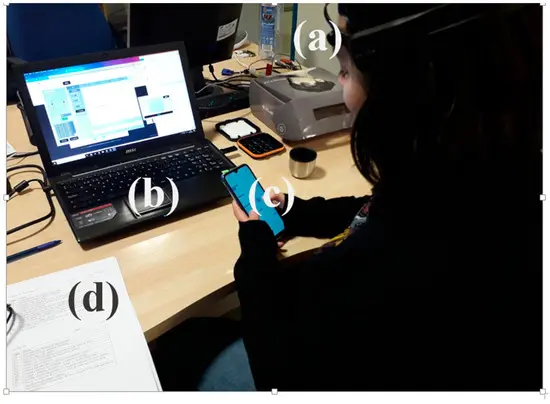
Figure 1. Typical EEG research setup illustrating the equipment and participant materials used to collect and analyze brain activity during cognitive tasks.
Source: Adapted from García et al., Proceedings, 2019.
Looking Beyond Performance
Traditional assessments remain valuable for measuring learning outcomes such as accuracy, completion time, or examination scores. However, they rarely explain how learners experienced a task while it was taking place. Two students may achieve identical results while experiencing very different levels of mental effort. One may solve problems efficiently, while another approaches cognitive overload despite achieving the same score.
This distinction has encouraged researchers to combine behavioral assessments with physiological measures such as electroencephalography (EEG), providing additional insight into attention, mental effort, and cognitive load throughout the learning process [1], [2].
EEG allows researchers to observe changes in brain activity while participants engage with learning activities. Rather than measuring only the final outcome, EEG provides continuous physiological data that complements traditional assessments. Recent research has expanded the use of EEG beyond controlled laboratory environments, allowing investigators to study learning within classrooms, collaborative settings, and other authentic educational contexts [3], [4].
What Is Cognitive Load?
Cognitive load refers to the mental effort required to process information while completing a task.
As learners encounter unfamiliar concepts, solve problems, or rely on working memory, cognitive demand naturally fluctuates. Understanding these fluctuations helps researchers investigate how instructional design, task complexity, and learning environments influence learning outcomes.
Rather than viewing cognitive load as a barrier, education researchers increasingly study it as an important indicator of how learners interact with instructional materials and educational experiences [1].
Why Cognitive Load Matters
Learning is a dynamic process in which attention shifts, mental effort rises and falls, and working memory becomes more or less taxed depending on the complexity of the material. These moment-to-moment changes are often difficult to capture using performance scores alone.
Researchers investigate cognitive load to answer questions such as:
Which learning activities require the greatest mental effort?
How does instructional design influence cognitive demand?
When do students begin to experience cognitive overload?
Which teaching strategies reduce unnecessary mental effort?
How do different learning environments influence attention?
Answering these questions can help improve instructional design while supporting more effective learning experiences.
What Recent Research Is Teaching Us
Recent studies using Emotiv EEG technology have shown that cognitive load can be investigated alongside emotional state, short-term memory performance, and instructional design [1], [2].
These studies reinforce an important principle: learning cannot always be understood through outcomes alone. Continuous physiological measurements provide researchers with additional context about how mental effort changes throughout a task, complementing traditional behavioral assessments.
At the same time, systematic reviews of EEG in educational settings highlight a growing shift toward studying cognition in authentic learning environments rather than limiting investigations to highly controlled laboratory conditions [3]. Wireless EEG systems have expanded opportunities to investigate classrooms, collaborative learning, and other naturalistic educational settings [4].
Together, these findings reflect an important evolution in education research. Rather than asking only whether students learned, researchers are increasingly investigating how learners allocate attention and mental resources throughout the learning process.
Why Researchers Combine Behavioral Assessments with EEG
Behavioral assessments remain an essential component of education research because they measure observable learning outcomes. EEG contributes a complementary perspective by providing continuous physiological data throughout the learning experience.
Together, these approaches allow researchers to investigate relationships between:
Cognitive load
Attention
Mental effort
Working memory
Learning performance
Combining behavioral and physiological measures provides a richer understanding of learning than either method alone.
Choosing an EEG System for Education Research
Education research spans controlled laboratory studies, classroom investigations, usability research, and real-world learning environments. Selecting the appropriate EEG system depends on study objectives, participant populations, and experimental design.
Flex Gel and Flex Saline
Flex supports configurable electrode placement with up to 32 EEG channels, making it well suited for advanced education research and cognitive neuroscience studies requiring customized sensor configurations. Wireless acquisition allows researchers to collect EEG data without tethering participants to a computer.
Epoc X
Epoc X is a 14-channel wireless EEG headset designed for cognitive neuroscience, education research, and mobile EEG studies that require research-grade data collection with streamlined deployment.
Insight
Insight is a lightweight 5-channel wireless EEG headset designed for rapid deployment in education research where portability and ease of use are priorities.
Looking Ahead
Education research continues to move beyond measuring learning outcomes alone. As researchers investigate increasingly complex questions about attention, cognitive load, and learning environments, EEG offers an objective way to study cognitive processes as they unfold.
Figure 1. Typical EEG research setup illustrating the equipment and participant materials used to collect and analyze brain activity during cognitive tasks.
Source: Adapted from García et al., Proceedings, 2019.
Combined with behavioral assessments, EEG supports a more complete understanding of learning while expanding opportunities to conduct research in authentic educational settings.
Key Takeaways
Cognitive load describes the mental effort required to process information during learning.
Behavioral assessments explain learning outcomes, while EEG helps researchers investigate the learning process itself.
Cognitive load changes continuously as task complexity, attention, and working memory demands fluctuate.
Wireless EEG is expanding education research beyond traditional laboratories into authentic learning environments.
Selecting an EEG system begins with the research question and study design.
Put Your Framework Into Practice
You've explored how researchers investigate cognitive load by combining behavioral assessments with continuous physiological measurements. Compare Emotiv EEG systems to identify the channel configurations, mobility, and research capabilities that best support your education research objectives.
Suggested Reading
References
F. Ungureanu, C. Cimpanu, and T. Dumitriu, "The Impact of Learning Through Cognitive Load Assessment and Emotional State Evaluation," eLearning and Software for Education, vol. 2, pp. 261-268, 2020.
F. Ungureanu, T. Dumitriu, V. I. Manta, and C. Cimpanu, "Cognitive Load and Short Term Memory Evaluation Based on EEG Techniques," eLearning and Software for Education, vol. 2, pp. 217-224, 2017.
A. García-Monge, H. Rodríguez-Navarro, D. Bores-García, and G. González-Calvo, "Electroencephalography in Naturalistic and Semi-Naturalistic Educational Contexts: A Systematic Review," Review of Education, vol. 12, no. 3, 2024.
Advantages of EEG Monitoring in Education. Eszterházy Károly Catholic University, 2023.
Understanding Cognitive Load
Every learning experience places demands on the brain. Whether students are solving mathematical problems, learning a new language, or participating in collaborative classroom activities, they continuously allocate mental resources to process, organize, and retain information.
Researchers describe this mental effort as cognitive load. Understanding how cognitive load changes throughout the learning process helps educators, instructional designers, and cognitive scientists move beyond measuring outcomes to understanding the learning experience itself.
Figure 1. Typical EEG research setup illustrating the equipment and participant materials used to collect and analyze brain activity during cognitive tasks.
Source: Adapted from García et al., Proceedings, 2019.
Looking Beyond Performance
Traditional assessments remain valuable for measuring learning outcomes such as accuracy, completion time, or examination scores. However, they rarely explain how learners experienced a task while it was taking place. Two students may achieve identical results while experiencing very different levels of mental effort. One may solve problems efficiently, while another approaches cognitive overload despite achieving the same score.
This distinction has encouraged researchers to combine behavioral assessments with physiological measures such as electroencephalography (EEG), providing additional insight into attention, mental effort, and cognitive load throughout the learning process [1], [2].
EEG allows researchers to observe changes in brain activity while participants engage with learning activities. Rather than measuring only the final outcome, EEG provides continuous physiological data that complements traditional assessments. Recent research has expanded the use of EEG beyond controlled laboratory environments, allowing investigators to study learning within classrooms, collaborative settings, and other authentic educational contexts [3], [4].
What Is Cognitive Load?
Cognitive load refers to the mental effort required to process information while completing a task.
As learners encounter unfamiliar concepts, solve problems, or rely on working memory, cognitive demand naturally fluctuates. Understanding these fluctuations helps researchers investigate how instructional design, task complexity, and learning environments influence learning outcomes.
Rather than viewing cognitive load as a barrier, education researchers increasingly study it as an important indicator of how learners interact with instructional materials and educational experiences [1].
Why Cognitive Load Matters
Learning is a dynamic process in which attention shifts, mental effort rises and falls, and working memory becomes more or less taxed depending on the complexity of the material. These moment-to-moment changes are often difficult to capture using performance scores alone.
Researchers investigate cognitive load to answer questions such as:
Which learning activities require the greatest mental effort?
How does instructional design influence cognitive demand?
When do students begin to experience cognitive overload?
Which teaching strategies reduce unnecessary mental effort?
How do different learning environments influence attention?
Answering these questions can help improve instructional design while supporting more effective learning experiences.
What Recent Research Is Teaching Us
Recent studies using Emotiv EEG technology have shown that cognitive load can be investigated alongside emotional state, short-term memory performance, and instructional design [1], [2].
These studies reinforce an important principle: learning cannot always be understood through outcomes alone. Continuous physiological measurements provide researchers with additional context about how mental effort changes throughout a task, complementing traditional behavioral assessments.
At the same time, systematic reviews of EEG in educational settings highlight a growing shift toward studying cognition in authentic learning environments rather than limiting investigations to highly controlled laboratory conditions [3]. Wireless EEG systems have expanded opportunities to investigate classrooms, collaborative learning, and other naturalistic educational settings [4].
Together, these findings reflect an important evolution in education research. Rather than asking only whether students learned, researchers are increasingly investigating how learners allocate attention and mental resources throughout the learning process.
Why Researchers Combine Behavioral Assessments with EEG
Behavioral assessments remain an essential component of education research because they measure observable learning outcomes. EEG contributes a complementary perspective by providing continuous physiological data throughout the learning experience.
Together, these approaches allow researchers to investigate relationships between:
Cognitive load
Attention
Mental effort
Working memory
Learning performance
Combining behavioral and physiological measures provides a richer understanding of learning than either method alone.
Choosing an EEG System for Education Research
Education research spans controlled laboratory studies, classroom investigations, usability research, and real-world learning environments. Selecting the appropriate EEG system depends on study objectives, participant populations, and experimental design.
Flex Gel and Flex Saline
Flex supports configurable electrode placement with up to 32 EEG channels, making it well suited for advanced education research and cognitive neuroscience studies requiring customized sensor configurations. Wireless acquisition allows researchers to collect EEG data without tethering participants to a computer.
Epoc X
Epoc X is a 14-channel wireless EEG headset designed for cognitive neuroscience, education research, and mobile EEG studies that require research-grade data collection with streamlined deployment.
Insight
Insight is a lightweight 5-channel wireless EEG headset designed for rapid deployment in education research where portability and ease of use are priorities.
Looking Ahead
Education research continues to move beyond measuring learning outcomes alone. As researchers investigate increasingly complex questions about attention, cognitive load, and learning environments, EEG offers an objective way to study cognitive processes as they unfold.
Figure 1. Typical EEG research setup illustrating the equipment and participant materials used to collect and analyze brain activity during cognitive tasks.
Source: Adapted from García et al., Proceedings, 2019.
Combined with behavioral assessments, EEG supports a more complete understanding of learning while expanding opportunities to conduct research in authentic educational settings.
Key Takeaways
Cognitive load describes the mental effort required to process information during learning.
Behavioral assessments explain learning outcomes, while EEG helps researchers investigate the learning process itself.
Cognitive load changes continuously as task complexity, attention, and working memory demands fluctuate.
Wireless EEG is expanding education research beyond traditional laboratories into authentic learning environments.
Selecting an EEG system begins with the research question and study design.
Put Your Framework Into Practice
You've explored how researchers investigate cognitive load by combining behavioral assessments with continuous physiological measurements. Compare Emotiv EEG systems to identify the channel configurations, mobility, and research capabilities that best support your education research objectives.
Suggested Reading
References
F. Ungureanu, C. Cimpanu, and T. Dumitriu, "The Impact of Learning Through Cognitive Load Assessment and Emotional State Evaluation," eLearning and Software for Education, vol. 2, pp. 261-268, 2020.
F. Ungureanu, T. Dumitriu, V. I. Manta, and C. Cimpanu, "Cognitive Load and Short Term Memory Evaluation Based on EEG Techniques," eLearning and Software for Education, vol. 2, pp. 217-224, 2017.
A. García-Monge, H. Rodríguez-Navarro, D. Bores-García, and G. González-Calvo, "Electroencephalography in Naturalistic and Semi-Naturalistic Educational Contexts: A Systematic Review," Review of Education, vol. 12, no. 3, 2024.
Advantages of EEG Monitoring in Education. Eszterházy Károly Catholic University, 2023.
Understanding Cognitive Load
Every learning experience places demands on the brain. Whether students are solving mathematical problems, learning a new language, or participating in collaborative classroom activities, they continuously allocate mental resources to process, organize, and retain information.
Researchers describe this mental effort as cognitive load. Understanding how cognitive load changes throughout the learning process helps educators, instructional designers, and cognitive scientists move beyond measuring outcomes to understanding the learning experience itself.
Figure 1. Typical EEG research setup illustrating the equipment and participant materials used to collect and analyze brain activity during cognitive tasks.
Source: Adapted from García et al., Proceedings, 2019.
Looking Beyond Performance
Traditional assessments remain valuable for measuring learning outcomes such as accuracy, completion time, or examination scores. However, they rarely explain how learners experienced a task while it was taking place. Two students may achieve identical results while experiencing very different levels of mental effort. One may solve problems efficiently, while another approaches cognitive overload despite achieving the same score.
This distinction has encouraged researchers to combine behavioral assessments with physiological measures such as electroencephalography (EEG), providing additional insight into attention, mental effort, and cognitive load throughout the learning process [1], [2].
EEG allows researchers to observe changes in brain activity while participants engage with learning activities. Rather than measuring only the final outcome, EEG provides continuous physiological data that complements traditional assessments. Recent research has expanded the use of EEG beyond controlled laboratory environments, allowing investigators to study learning within classrooms, collaborative settings, and other authentic educational contexts [3], [4].
What Is Cognitive Load?
Cognitive load refers to the mental effort required to process information while completing a task.
As learners encounter unfamiliar concepts, solve problems, or rely on working memory, cognitive demand naturally fluctuates. Understanding these fluctuations helps researchers investigate how instructional design, task complexity, and learning environments influence learning outcomes.
Rather than viewing cognitive load as a barrier, education researchers increasingly study it as an important indicator of how learners interact with instructional materials and educational experiences [1].
Why Cognitive Load Matters
Learning is a dynamic process in which attention shifts, mental effort rises and falls, and working memory becomes more or less taxed depending on the complexity of the material. These moment-to-moment changes are often difficult to capture using performance scores alone.
Researchers investigate cognitive load to answer questions such as:
Which learning activities require the greatest mental effort?
How does instructional design influence cognitive demand?
When do students begin to experience cognitive overload?
Which teaching strategies reduce unnecessary mental effort?
How do different learning environments influence attention?
Answering these questions can help improve instructional design while supporting more effective learning experiences.
What Recent Research Is Teaching Us
Recent studies using Emotiv EEG technology have shown that cognitive load can be investigated alongside emotional state, short-term memory performance, and instructional design [1], [2].
These studies reinforce an important principle: learning cannot always be understood through outcomes alone. Continuous physiological measurements provide researchers with additional context about how mental effort changes throughout a task, complementing traditional behavioral assessments.
At the same time, systematic reviews of EEG in educational settings highlight a growing shift toward studying cognition in authentic learning environments rather than limiting investigations to highly controlled laboratory conditions [3]. Wireless EEG systems have expanded opportunities to investigate classrooms, collaborative learning, and other naturalistic educational settings [4].
Together, these findings reflect an important evolution in education research. Rather than asking only whether students learned, researchers are increasingly investigating how learners allocate attention and mental resources throughout the learning process.
Why Researchers Combine Behavioral Assessments with EEG
Behavioral assessments remain an essential component of education research because they measure observable learning outcomes. EEG contributes a complementary perspective by providing continuous physiological data throughout the learning experience.
Together, these approaches allow researchers to investigate relationships between:
Cognitive load
Attention
Mental effort
Working memory
Learning performance
Combining behavioral and physiological measures provides a richer understanding of learning than either method alone.
Choosing an EEG System for Education Research
Education research spans controlled laboratory studies, classroom investigations, usability research, and real-world learning environments. Selecting the appropriate EEG system depends on study objectives, participant populations, and experimental design.
Flex Gel and Flex Saline
Flex supports configurable electrode placement with up to 32 EEG channels, making it well suited for advanced education research and cognitive neuroscience studies requiring customized sensor configurations. Wireless acquisition allows researchers to collect EEG data without tethering participants to a computer.
Epoc X
Epoc X is a 14-channel wireless EEG headset designed for cognitive neuroscience, education research, and mobile EEG studies that require research-grade data collection with streamlined deployment.
Insight
Insight is a lightweight 5-channel wireless EEG headset designed for rapid deployment in education research where portability and ease of use are priorities.
Looking Ahead
Education research continues to move beyond measuring learning outcomes alone. As researchers investigate increasingly complex questions about attention, cognitive load, and learning environments, EEG offers an objective way to study cognitive processes as they unfold.
Figure 1. Typical EEG research setup illustrating the equipment and participant materials used to collect and analyze brain activity during cognitive tasks.
Source: Adapted from García et al., Proceedings, 2019.
Combined with behavioral assessments, EEG supports a more complete understanding of learning while expanding opportunities to conduct research in authentic educational settings.
Key Takeaways
Cognitive load describes the mental effort required to process information during learning.
Behavioral assessments explain learning outcomes, while EEG helps researchers investigate the learning process itself.
Cognitive load changes continuously as task complexity, attention, and working memory demands fluctuate.
Wireless EEG is expanding education research beyond traditional laboratories into authentic learning environments.
Selecting an EEG system begins with the research question and study design.
Put Your Framework Into Practice
You've explored how researchers investigate cognitive load by combining behavioral assessments with continuous physiological measurements. Compare Emotiv EEG systems to identify the channel configurations, mobility, and research capabilities that best support your education research objectives.
Suggested Reading
References
F. Ungureanu, C. Cimpanu, and T. Dumitriu, "The Impact of Learning Through Cognitive Load Assessment and Emotional State Evaluation," eLearning and Software for Education, vol. 2, pp. 261-268, 2020.
F. Ungureanu, T. Dumitriu, V. I. Manta, and C. Cimpanu, "Cognitive Load and Short Term Memory Evaluation Based on EEG Techniques," eLearning and Software for Education, vol. 2, pp. 217-224, 2017.
A. García-Monge, H. Rodríguez-Navarro, D. Bores-García, and G. González-Calvo, "Electroencephalography in Naturalistic and Semi-Naturalistic Educational Contexts: A Systematic Review," Review of Education, vol. 12, no. 3, 2024.
Advantages of EEG Monitoring in Education. Eszterházy Károly Catholic University, 2023.
Continue reading