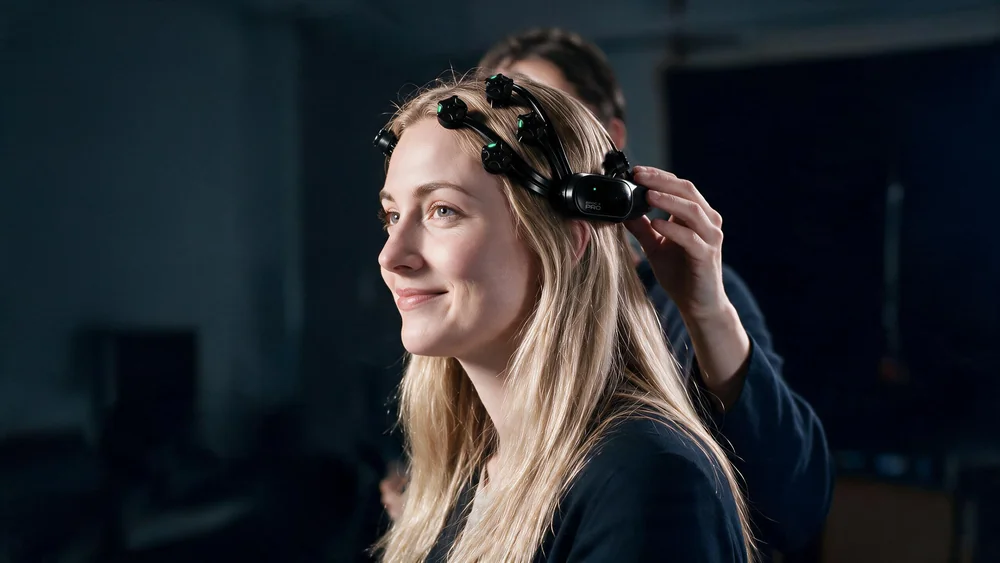
EPOC X PRO vs Other Dry Sensor EEG Systems
Christian Burgos
Updated on
Oct 23, 2026
EPOC X PRO vs Other Dry Sensor EEG Systems
Christian Burgos
Updated on
Oct 23, 2026
EPOC X PRO vs Other Dry Sensor EEG Systems
Christian Burgos
Updated on
Oct 23, 2026
Picture a study that runs from morning to evening, in the field or across sites, with a different person fitting the headset each time. Dry sensors make that practical: there is no saline to prepare, and with EPOC X PRO setup takes a few minutes. The question is which dry system fits the study you are running.
This guide compares EPOC X PRO with four other dry-sensor systems: the Wearable Sensing DSI-24, the CGX Quick-20r v2, the g.tec Unicorn Hybrid Black and the OpenBCI Ultracortex Mark IV.
Key Takeaways
EPOC X PRO records 16 sites, including P3 and P4, but not the midline sites (Fz, Cz and Pz). The DSI-24 and Quick-20r v2 record the standard 10-20 montage, and the DSI-24 adds auxiliary inputs.
EPOC X PRO offers Bluetooth 6 and Wi-Fi 6 and can record more than 8 hours at 256 Hz without a connected computer. The other four systems connect over Bluetooth or Bluetooth Low Energy, and the DSI-24 and Ultracortex also offer ways to record without a computer.
EPOC X PRO's flat and comb sensors can be mixed by site, and CGX and OpenBCI offer a similar choice between flat and through-hair sensors by position.
EPOC X PRO amplifies the signal at every sensor and records at 24-bit. The Quick-20r v2 and DSI-24 also amplify at the sensor, and the DSI-24 records at 16-bit.
EPOC X PRO syncs timestamps to within about 1 millisecond. CGX, Wearable Sensing and OpenBCI offer trigger hardware for timing as a separate add-on.
EPOC X PRO is our premium instrument, currently in pre-order. The Unicorn and Ultracortex list at lower prices.
Epoc X data can continue alongside EPOC X PRO sessions, and EPOC X PRO works with EmotivPRO and the Cortex API and SDK.
What Should You Look for When Choosing a Dry EEG System?
Look at six things: channel coverage, connection and recording, sensor design, setup and contact quality, signal quality, and timing. Start with coverage, because a system that doesn't record the sites your protocol needs can't support it, whatever else it offers.
1. How Do Channel Counts and Montage Coverage Compare Across Dry EEG Systems?
EPOC X PRO records 16 sites, including P3 and P4 over the parietal and visual regions, but not the midline sites (Fz, Cz and Pz). The DSI-24 and Quick-20r v2 record the standard 10-20 montage, which includes the midline sites, the Unicorn records 8 sites, and the Ultracortex accepts up to 16 channels across 35 positions.
EPOC X PRO's sites are AF3, F7, F3, FC5, T7, P7, O1, O2, P8, T8, FC6, F4, F8 and AF4, plus P3 and P4. The references sit permanently at the mastoids, with CMS on the left and DRL on the right, which frees P3 and P4 to record EEG. The extra coverage is useful for SSVEP and VEP paradigms, for attention and working memory research grounded in parietal activity, and for any study that benefits from denser spatial sampling.
The DSI-24 also adds three auxiliary inputs, and the Quick-20r v2 adds two variable ExG channels.
2. How Do Dry EEG Systems Compare on Wi-Fi, Bluetooth and Recording Without a Computer?
EPOC X PRO offers Bluetooth 6 and Wi-Fi 6 and can record more than 8 hours at 256 Hz without a connected computer. The DSI-24, Quick-20r v2, Unicorn and Ultracortex connect over Bluetooth or Bluetooth Low Energy, and the DSI-24 also offers wired USB.
Wi-Fi 6 is designed to hold up better in the busy 2.4 GHz conditions common in real-world research settings. Anyone who has recorded EEG outside a quiet lab knows why that matters. Dozens of devices share the same 2.4 GHz band, a Bluetooth link that held up in testing starts to stumble, and the session pays for it. And if the wireless connection drops anyway, the recording keeps going. That makes field recording and long sessions possible without a laptop in tow. EPOC X PRO no longer uses a proprietary USB receiver.
For recording without a computer, Wearable Sensing offers optional internal storage for the DSI-24, and OpenBCI's Cyton board has a micro SD slot.
3. How Do Dry Sensor Designs and Fit Options Compare?
EPOC X PRO lets you mix flat and comb sensors by site, and CGX and OpenBCI offer a similar choice between flat and through-hair sensors by position. Wearable Sensing's DSI-24 uses spring-loaded dry sensors built to work through hair, and g.tec's Unicorn uses hybrid electrodes with pins that record dry or with gel.
EPOC X PRO's sensors are dry by default, interchangeable, and finished with a non-polarizable coating, so you can match each sensor to the participant and the site. Flat sensors sit on bare skin, like the forehead and the mastoid reference sites, while comb sensors, available in two lengths, reach through hair.
All sensor types clip into any headset socket and can be mixed and matched by site, so you can put a comb sensor where there's hair and a flat sensor where there isn't, rather than compromising with one geometry across the whole scalp. Every participant is different, and so is every site on the scalp. The headset's expandable design adapts to different head sizes, and the sockets also accept standard saline felt pads if a protocol calls for them.
CGX's options are Drypad, Flex and Long Flex sensors, and OpenBCI's are flat and spikey units.
4. How Do Setup Time and Contact-Quality Feedback Differ?
EPOC X PRO setup takes a few minutes, with no saline to prepare. For contact quality, EPOC X PRO has an indicator light in each sensor housing and CGX an LED on each pod, while Wearable Sensing and OpenBCI show it on screen.
Then there is the question of who fits the headset. The indicator light in the EPOC X PRO gives immediate, real-time feedback directly at the sensor, without switching attention to a remote screen, and helps maintain consistent fit quality across operators and study sessions, including on-board recordings where a host device may not be connected.
5. How Do Amplification and Signal Quality Compare in Dry EEG?
EPOC X PRO amplifies the signal at every sensor and records at 24-bit. The Quick-20r v2 and DSI-24 also amplify at the sensor, and the DSI-24 records at 16-bit. The Unicorn records at 24-bit, and the Ultracortex pairs passive dry electrodes with a 24-bit front end on its Cyton board.
In Emotiv's design, amplifying at the sensor is intended to minimize interference from cable movement and electrode impedance, so that EPOC X PRO's dry sensors are designed to deliver signal quality comparable to wet sensors.
The 24-bit acquisition adds dynamic range, which allows low-frequency drift, electrode offset, and sudden movement artifacts to be captured without clipping and gives software filtering more flexibility. The hardware also supports EEG sampling up to 512 Hz.
6. How Do Dry EEG Systems Synchronize With Eye Tracking and Other Data Streams?
Timestamps on EPOC X PRO sync to within about 1 millisecond, and a built-in real-time clock keeps timing accurate in on-board recordings. CGX, Wearable Sensing and OpenBCI each offer trigger hardware for timing as a separate add-on.
That makes it easier to align EEG with other data streams like eye tracking or behavioral logs, and it protects timing precision in event-related research, like ERP latency. CGX describes its StimTrigger as millisecond-precision wireless triggering.
How Do Dry Sensor EEG Systems Compare?
Specs | EPOC X PRO | Wearable Sensing DSI-24 | CGX Quick-20r v2 | g.tec Unicorn Hybrid Black | OpenBCI Ultracortex Mark IV |
|---|---|---|---|---|---|
EEG channels | 16 | 21 | 20 | 8 | 8 (Cyton) or 16 (CytonDaisy) |
Montage | 16 listed sites, including P3 and P4; no midline sites (Fz, Cz, Pz) | Standard 10-20 (19 head electrodes and 2 earclips), including midline sites | Standard 10-20, including midline sites | Fz, C3, Cz, C4, Pz, PO7, Oz, PO8 | Positions chosen from 35 |
Auxiliary inputs | Not listed | 3 | 2 variable ExG | Not listed | Not listed |
Sensors | Dry flat and comb (two lengths), mixed by site; saline pads also fit | Spring-loaded dry sensors | Drypad, Flex and Long Flex | Hybrid, dry or with gel | Dry comb; flat units in build docs |
Resolution | 24-bit | 16-bit | 24-bit | 24-bit | 24-bit |
Amplification | At every sensor | At each electrode tip | At each electrode | Central amplifier on the cap | Passive electrodes; amplifier on Cyton board |
Contact quality | Indicator light in each sensor housing | On screen | LED on each pod and on screen | Not listed | On screen |
On-board recording (no computer needed) | More than 8 hours at 256 Hz | Optional internal storage | Not listed | Not listed | Micro SD slot |
Wireless | Bluetooth 6 and Wi-Fi 6 | Bluetooth, wired USB | Bluetooth Low Energy | Bluetooth | Bluetooth Low Energy |
Timing | Timestamps within about 1 ms; built-in real-time clock | Trigger input; optional Wireless Trigger Hub | Optional StimTrigger | Not listed | Optional trigger kit |
Price | \$10,000 pre-order, then \$15,000 | Quote on request | Quote on request | \$1,518 | \$2,999 (8-channel), \$4,499 (16-channel) |
Which Dry EEG System Should You Choose?
EPOC X PRO vs Wearable Sensing DSI-24
The key trade-off is EPOC X PRO's interchangeable sensor geometries and indicator light at every sensor against the DSI-24's full 10-20 coverage and auxiliary inputs. The Wearable Sensing DSI-24 is a wireless dry-electrode headset with 19 head electrodes, two earclip sensors and three auxiliary inputs on the 10-20 system.
Choose EPOC X PRO if:
You want the added dynamic range of 24-bit acquisition.
You want sensors matched to each participant's hair and head on the same headset.
Several people will fit the headset, and you want contact quality visible at every sensor.
Consider the DSI-24 if:
You need the midline sites or the full 10-20 montage.
You need auxiliary inputs for signals such as ECG, EMG, EOG or GSR.
You need a child-size version.
Need the standard 10-20 positions with saline or gel sensors? Emotiv's Flex 2 Saline and Flex 2 Gel wireless cap systems offer 74 openings in those positions and up to 32 channels.
EPOC X PRO vs CGX Quick-20r v2
The key trade-off is EPOC X PRO's Wi-Fi 6 and on-board recording against the Quick-20r v2's full 10-20 montage and 500 Hz sampling. The CGX Quick-20r v2 is a wireless dry-sensor headset covering the 10-20 montage plus two variable ExG channels, and it is the closest design match to EPOC X PRO.
Choose EPOC X PRO if:
You need to record without a connected computer.
You work in busy wireless environments and want Wi-Fi 6.
You want timestamp sync built into the headset, so EEG lines up with eye tracking or behavioral logs.
You want the option of saline pads in the same sockets when a protocol calls for them.
Consider the Quick-20r v2 if:
You need the full 10-20 montage.
You need 500 Hz sampling or two variable ExG channels.
You want a manufacturer that also offers an FDA-cleared headset (the Quick-20m) or a 30-channel option (the Quick-32r).
Need the 10-20 positions and a higher channel count with saline or gel sensors? Flex 2 Saline and Flex 2 Gel record up to 32 channels across the standard 10-20 positions.
EPOC X PRO vs g.tec Unicorn Hybrid Black
The key trade-off is EPOC X PRO's 16 channels, on-board recording and built-in timing against the Unicorn's hybrid dry-or-gel electrodes. The g.tec Unicorn Hybrid Black is an 8-channel wearable EEG headset that records dry or with gel, and it comes with the Unicorn Suite, which includes Unicorn Recorder, a C API and a .NET API, with the Python API, Simulink interface and Speller sold separately.
Choose EPOC X PRO if:
You need 16 channels, including P3 and P4.
You want active amplification at every sensor.
You want on-board recording and built-in timing in the same headset.
You want to mix flat and comb sensors by site.
Consider the Unicorn if:
Eight channels cover your paradigm and you are prototyping a BCI.
You want gel as an option for harder-to-contact sites.
Prototyping a BCI with a saline sensor system? Emotiv's Epoc X is a common starting point for BCI development, and Flex 2 Gel is our gel-sensor option.
EPOC X PRO vs OpenBCI Ultracortex Mark IV
The key trade-off is an integrated headset against open, configurable hardware. EPOC X PRO is a single integrated system, while the OpenBCI Ultracortex Mark IV is an open-source, 3D-printable headset that holds up to 16 channels across 35 positions, used here with the Cyton or CytonDaisy board and dry electrodes.
Choose EPOC X PRO if:
You want one integrated headset instead of configuring an open system.
You want a direct path into EmotivPRO and the Cortex API.
You want to carry existing Epoc X work forward.
Consider the Ultracortex if:
You value open hardware and software.
You want custom electrode placement across 35 positions.
You are comfortable configuring an open system.
Want flexible electrode placement with saline or gel sensors? Flex 2 Saline and Flex 2 Gel let you position up to 32 sensors across a cap with 74 openings in the standard 10-20 positions.
How Much Does EPOC X PRO Cost, and What Does It Include?
EPOC X PRO is currently in pre-order at \$10,000 USD, with a price of \$15,000 USD to follow. It is our premium instrument, built for researchers whose primary bottlenecks are data fidelity and testing logistics rather than hardware limitations.
The price covers a headset designed around the sessions researchers can't afford to lose: amplification at every sensor, 24-bit acquisition, on-board recording that continues if the wireless connection drops, and an indicator light in every sensor housing.
It also covers a place in the Emotiv ecosystem. EPOC X PRO works with EmotivPRO for recording, analysis and Lab Streaming Layer streaming, with EmotivBCI for brain-computer interface applications, and with the Cortex API and SDK for real-time data, with support for MATLAB, Python, Unity, and custom pipelines. That ecosystem rests on more than 15 years of Emotiv EEG work and a corpus of real-world EEG spanning 197.5 million channel-minutes, which is also the foundation of Emotiv's Large Brain Model.
Other dry systems are priced for other priorities, and each has its place. The g.tec Unicorn lists at \$1,518 and the OpenBCI Ultracortex at \$2,999 for 8 channels or \$4,499 for 16. Wearable Sensing and CGX quote on request.
Can I Use My Epoc X Data With EPOC X PRO?
Yes, on the 14 channels the two headsets share. EPOC X PRO shares Epoc X's 14 core recording sites and adds two more, and both headsets run on the same EmotivPRO and Cortex software, so moving between them doesn't mean rebuilding your analysis pipeline.
Recordings you have already made on Epoc X can continue alongside new EPOC X PRO sessions. For the full picture of how the two headsets differ, see our Epoc X vs EPOC X PRO guide.
The Bottom Line
Start with what your study needs. EPOC X PRO fits studies that run outside a quiet lab, move between sites, need timing they can line up with other instruments, and benefit from sensors matched to each participant.
Frequently Asked Questions
Can EPOC X PRO use saline felt pads?
Yes. EPOC X PRO's sockets are compatible with standard saline-soaked felt pads, although the sensors are dry by default.
Does EPOC X PRO record from the midline sites?
No. EPOC X PRO's 16 sites do not include the midline sites (Fz, Cz and Pz).
Does EPOC X PRO need a USB receiver?
No. EPOC X PRO no longer supports the 15-year-old proprietary USB receiver and connects over Bluetooth 6 or Wi-Fi 6.
Which software works with EPOC X PRO?
EPOC X PRO works with EmotivPRO for recording, analysis and Lab Streaming Layer streaming, with EmotivBCI for brain-computer interface applications, and with the Cortex API and SDK for real-time data, with support for MATLAB, Python, Unity, and custom pipelines.
Is EPOC X PRO available to order?
EPOC X PRO is currently in pre-order.
What is EPOC X PRO intended for?
Emotiv products, including EPOC X PRO, are intended for research applications and personal use only. They are not sold as medical devices under MDR 2017/745 and are not intended to diagnose or treat disease.