
Reducing Decision Fatigue in Beauty Ecommerce Experiences
H.B. Duran
Updated on
May 19, 2026
Reducing Decision Fatigue in Beauty Ecommerce Experiences
H.B. Duran
Updated on
May 19, 2026
Reducing Decision Fatigue in Beauty Ecommerce Experiences
H.B. Duran
Updated on
May 19, 2026
Beauty ecommerce experiences often ask consumers to make complex decisions across ingredients, skin concerns, product categories, routines, shades, textures, claims, reviews, and bundles. While choice can increase personalization, too much choice can create decision fatigue and ecommerce customer fatigue. For beauty brands, this can reduce confidence, slow product discovery, and increase abandonment.
By combining UX research, behavioral analytics, eye tracking, and EEG-based neuroanalytics, brands can better understand where cognitive overload occurs and design shopping experiences that help consumers choose with greater clarity.
Why Decision Fatigue Is a Beauty Ecommerce Problem
Beauty shoppers often arrive with a goal, but not always with a clear product decision. They may know they want smoother skin, better hydration, less frizz, more glow, or a simpler routine. Translating that goal into a product choice can require significant mental effort.
Consumers frequently compare ingredients, concentrations, product formats, skin or hair types, routines, reviews, bundles, certifications, and price points before feeling confident enough to purchase. When the experience becomes too demanding, shoppers may delay the decision, abandon the session, or default to a more familiar brand.
This makes decision fatigue both a UX challenge and a conversion challenge.
Decision Fatigue vs. Personalization
Personalization is valuable in beauty ecommerce, but it can also increase cognitive complexity.
Quizzes, recommendation engines, filters, comparison tools, and routine builders are designed to simplify decision-making. However, if these systems ask too many questions, surface too many options, or fail to explain recommendations clearly, they can create additional friction rather than reducing it.
Effective personalization reduces decision effort and increases confidence. Ineffective personalization creates more decisions and increases uncertainty.
Beauty brands should evaluate whether recommendation experiences genuinely simplify the path to purchase or simply add another layer of interaction.
Where Beauty Shoppers Experience Cognitive Overload
Decision fatigue often accumulates gradually across the ecommerce journey rather than appearing in a single moment.
Common friction points include:
Large product catalogs without clear hierarchy
Too many similar products
Dense product detail pages
Unclear ingredient differences
Confusing routine guidance
Overloaded filters
Competing promotional messages
Unclear shade selection
Long checkout flows
Each issue may seem relatively small on its own, but together they can create significant ecommerce customer fatigue that weakens confidence and increases abandonment.
Using Behavioral Analytics to Identify Fatigue Signals
Behavioral analytics can help identify where consumers struggle during product discovery and evaluation.
Signals such as repeated product page visits, back-and-forth comparison behavior, search refinement loops, filter resets, cart hesitation, and long sessions without conversion may indicate interest, but they may also signal confusion or decision paralysis.
Behavioral data alone cannot always distinguish between high engagement and cognitive overload. This is why brands increasingly combine analytics with attention testing and neuroscience-informed research methods.
Understanding why consumers hesitate is often more valuable than simply measuring where they exit.
Using Eye Tracking to Improve Product Discovery
Eye tracking helps brands understand how consumers visually navigate ecommerce experiences.
In beauty ecommerce, teams may evaluate whether shoppers notice product benefits, ingredient claims, variant differences, promotional messages, filters, and calls to action during the decision-making process.
Testing can also reveal whether:
Promotional banners distract from evaluation
Filters support or interrupt discovery
Product hierarchy is visually clear
CTA placement aligns with decision moments
Ingredient communication is easy to locate
These insights help reduce unnecessary visual effort and improve product discovery clarity.
Using Neuroanalytics to Measure Cognitive Stress
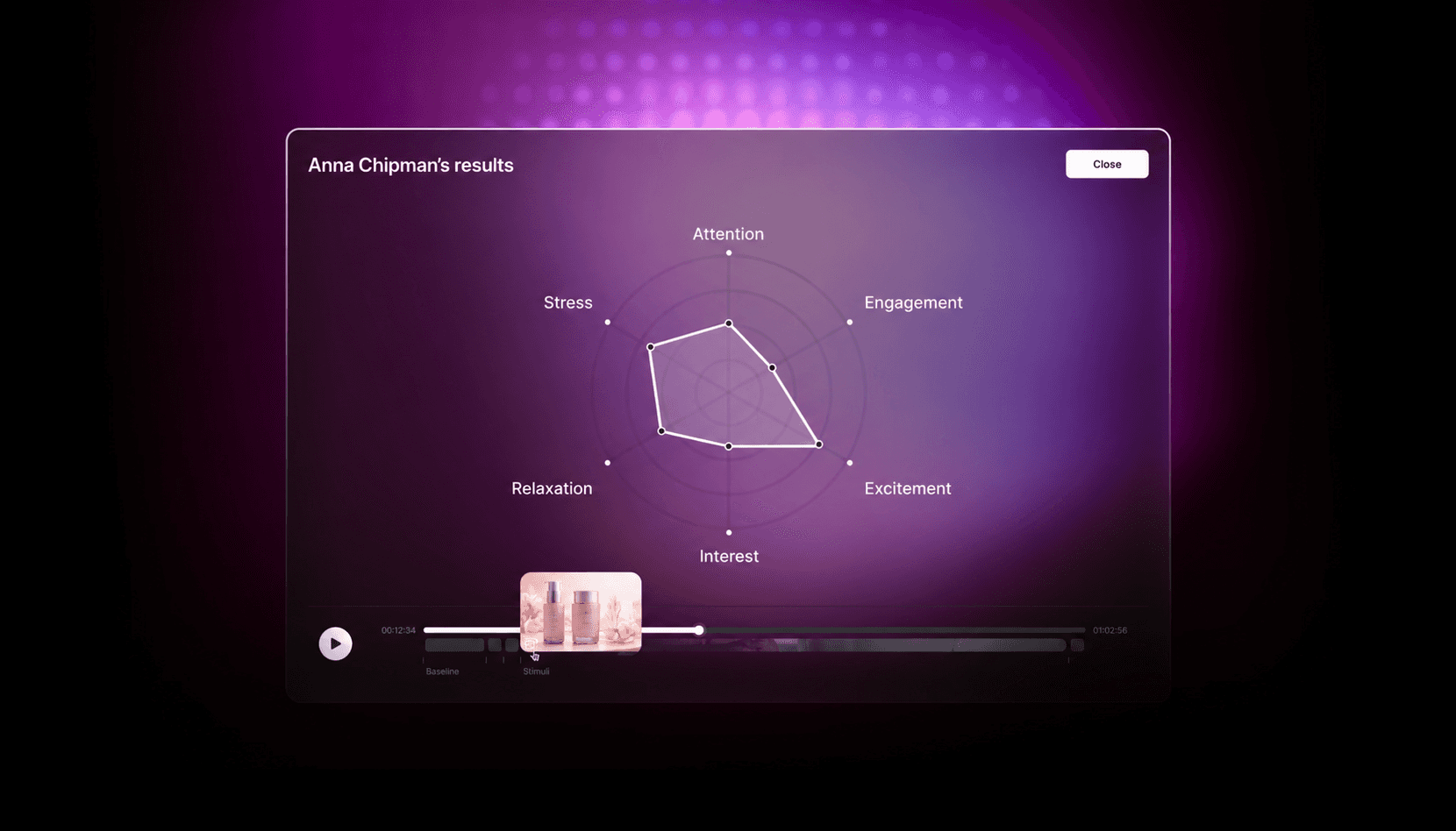
EEG-based neuroanalytics can help teams evaluate how mentally demanding a beauty ecommerce experience feels during interaction.
Researchers may analyze cognitive stress, attention sustainability, emotional engagement, mental fatigue, and engagement decline patterns across shopping flows.
This is especially useful because consumers may not consciously recognize why a shopping experience feels exhausting. They may simply leave, postpone the purchase, or default to a familiar product instead.
Neuroanalytics can help identify where overload begins before abandonment occurs, giving brands earlier visibility into friction that traditional analytics may miss.
Ingredient Communication and Decision Confidence
Ingredient communication is one of the largest cognitive challenges in beauty ecommerce.
Consumers increasingly want evidence-based information, but they also need clear translation into benefits, routines, compatibility, and expected outcomes.
Decision fatigue increases when product pages overwhelm shoppers with technical detail without clearly explaining:
What the product does
Who it is for
How it fits into a routine
How to use it
What results to expect
What combinations to avoid
Testing can help brands balance scientific credibility with clarity and usability.
Routine Builders and Recommendation UX
Routine builders can reduce decision fatigue when they provide focused, relevant guidance. They can increase fatigue when they feel overly complex or uncertain.
Effective recommendation UX should:
Ask only necessary questions
Explain recommendations clearly
Limit unnecessary alternatives
Connect products to shopper goals
Reinforce confidence before checkout
Beauty brands can test recommendation flows to identify where consumers lose attention, question recommendations, or experience overload during the personalization process.
Mobile Beauty Shopping and Attention Fragmentation
Mobile beauty shopping introduces additional fatigue risks because consumers navigate smaller screens within more distracted environments.
On mobile devices, decision fatigue may increase due to long product pages, overloaded navigation, sticky banners, pop-ups, difficult-to-scan reviews, and compressed comparison details.
Testing mobile attention patterns helps brands optimize discovery, readability, and product evaluation for real-world consumer behavior rather than desktop assumptions.
As mobile shopping becomes dominant in beauty ecommerce, reducing cognitive effort on smaller screens becomes increasingly important.
Reducing Checkout Friction
Checkout friction can become the final trigger for abandonment after an already demanding shopping experience.
Common beauty ecommerce checkout issues include:
Unexpected shipping thresholds
Promotion code distractions
Subscription uncertainty
Excessive upsells
Account creation requirements
Unclear return policies
Reducing checkout fatigue means simplifying the final decision environment while reinforcing confidence and clarity.
Even small reductions in friction can significantly improve completion rates after cognitively demanding product discovery experiences.
Building a Beauty Ecommerce Fatigue Testing Framework
A strong testing framework combines multiple research methods to understand both visible behavior and underlying cognitive response.
Teams may use:
Behavioral analytics to locate friction
Eye tracking to evaluate visual attention
UX testing to observe task completion
Neuroanalytics to measure cognitive stress and emotional engagement
Together, these approaches support:
Product discovery optimization
Ingredient communication refinement
Recommendation UX testing
Mobile experience optimization
Checkout improvement
Customer fatigue analysis
The goal is not simply reducing effort. It is increasing confidence while simplifying decision-making.
Applying Neuroanalytics to Beauty Ecommerce UX
Beauty ecommerce experiences must educate, persuade, reassure, and simplify at the same time. That makes cognitive stress, emotional engagement, and attention quality critical performance factors.
By combining behavioral analytics, eye tracking, UX research, and EEG-based neuroanalytics, brands can evaluate where consumers experience decision fatigue and where design improvements can create clearer, more confident shopping journeys.
This approach supports product page optimization, recommendation UX, mobile shopping research, product discovery refinement, and conversion strategy development.
Teams exploring advanced ecommerce UX research, beauty customer experience optimization, and decision fatigue analysis can learn more through Emotiv User and Product Research Solutions.
Conclusion
Decision fatigue is a major challenge in beauty ecommerce because consumers often face complex choices across ingredients, routines, product types, and product claims.
When shopping experiences become mentally demanding, consumers may hesitate or abandon the journey even when they remain interested in the product itself.
By combining UX research, eye tracking, behavioral analytics, and neuroanalytics, beauty brands can reduce cognitive overload, improve product discovery, and help consumers make more confident purchase decisions.
Beauty ecommerce experiences often ask consumers to make complex decisions across ingredients, skin concerns, product categories, routines, shades, textures, claims, reviews, and bundles. While choice can increase personalization, too much choice can create decision fatigue and ecommerce customer fatigue. For beauty brands, this can reduce confidence, slow product discovery, and increase abandonment.
By combining UX research, behavioral analytics, eye tracking, and EEG-based neuroanalytics, brands can better understand where cognitive overload occurs and design shopping experiences that help consumers choose with greater clarity.
Why Decision Fatigue Is a Beauty Ecommerce Problem
Beauty shoppers often arrive with a goal, but not always with a clear product decision. They may know they want smoother skin, better hydration, less frizz, more glow, or a simpler routine. Translating that goal into a product choice can require significant mental effort.
Consumers frequently compare ingredients, concentrations, product formats, skin or hair types, routines, reviews, bundles, certifications, and price points before feeling confident enough to purchase. When the experience becomes too demanding, shoppers may delay the decision, abandon the session, or default to a more familiar brand.
This makes decision fatigue both a UX challenge and a conversion challenge.
Decision Fatigue vs. Personalization
Personalization is valuable in beauty ecommerce, but it can also increase cognitive complexity.
Quizzes, recommendation engines, filters, comparison tools, and routine builders are designed to simplify decision-making. However, if these systems ask too many questions, surface too many options, or fail to explain recommendations clearly, they can create additional friction rather than reducing it.
Effective personalization reduces decision effort and increases confidence. Ineffective personalization creates more decisions and increases uncertainty.
Beauty brands should evaluate whether recommendation experiences genuinely simplify the path to purchase or simply add another layer of interaction.
Where Beauty Shoppers Experience Cognitive Overload
Decision fatigue often accumulates gradually across the ecommerce journey rather than appearing in a single moment.
Common friction points include:
Large product catalogs without clear hierarchy
Too many similar products
Dense product detail pages
Unclear ingredient differences
Confusing routine guidance
Overloaded filters
Competing promotional messages
Unclear shade selection
Long checkout flows
Each issue may seem relatively small on its own, but together they can create significant ecommerce customer fatigue that weakens confidence and increases abandonment.
Using Behavioral Analytics to Identify Fatigue Signals
Behavioral analytics can help identify where consumers struggle during product discovery and evaluation.
Signals such as repeated product page visits, back-and-forth comparison behavior, search refinement loops, filter resets, cart hesitation, and long sessions without conversion may indicate interest, but they may also signal confusion or decision paralysis.
Behavioral data alone cannot always distinguish between high engagement and cognitive overload. This is why brands increasingly combine analytics with attention testing and neuroscience-informed research methods.
Understanding why consumers hesitate is often more valuable than simply measuring where they exit.
Using Eye Tracking to Improve Product Discovery
Eye tracking helps brands understand how consumers visually navigate ecommerce experiences.
In beauty ecommerce, teams may evaluate whether shoppers notice product benefits, ingredient claims, variant differences, promotional messages, filters, and calls to action during the decision-making process.
Testing can also reveal whether:
Promotional banners distract from evaluation
Filters support or interrupt discovery
Product hierarchy is visually clear
CTA placement aligns with decision moments
Ingredient communication is easy to locate
These insights help reduce unnecessary visual effort and improve product discovery clarity.
Using Neuroanalytics to Measure Cognitive Stress
EEG-based neuroanalytics can help teams evaluate how mentally demanding a beauty ecommerce experience feels during interaction.
Researchers may analyze cognitive stress, attention sustainability, emotional engagement, mental fatigue, and engagement decline patterns across shopping flows.
This is especially useful because consumers may not consciously recognize why a shopping experience feels exhausting. They may simply leave, postpone the purchase, or default to a familiar product instead.
Neuroanalytics can help identify where overload begins before abandonment occurs, giving brands earlier visibility into friction that traditional analytics may miss.
Ingredient Communication and Decision Confidence
Ingredient communication is one of the largest cognitive challenges in beauty ecommerce.
Consumers increasingly want evidence-based information, but they also need clear translation into benefits, routines, compatibility, and expected outcomes.
Decision fatigue increases when product pages overwhelm shoppers with technical detail without clearly explaining:
What the product does
Who it is for
How it fits into a routine
How to use it
What results to expect
What combinations to avoid
Testing can help brands balance scientific credibility with clarity and usability.
Routine Builders and Recommendation UX
Routine builders can reduce decision fatigue when they provide focused, relevant guidance. They can increase fatigue when they feel overly complex or uncertain.
Effective recommendation UX should:
Ask only necessary questions
Explain recommendations clearly
Limit unnecessary alternatives
Connect products to shopper goals
Reinforce confidence before checkout
Beauty brands can test recommendation flows to identify where consumers lose attention, question recommendations, or experience overload during the personalization process.
Mobile Beauty Shopping and Attention Fragmentation
Mobile beauty shopping introduces additional fatigue risks because consumers navigate smaller screens within more distracted environments.
On mobile devices, decision fatigue may increase due to long product pages, overloaded navigation, sticky banners, pop-ups, difficult-to-scan reviews, and compressed comparison details.
Testing mobile attention patterns helps brands optimize discovery, readability, and product evaluation for real-world consumer behavior rather than desktop assumptions.
As mobile shopping becomes dominant in beauty ecommerce, reducing cognitive effort on smaller screens becomes increasingly important.
Reducing Checkout Friction
Checkout friction can become the final trigger for abandonment after an already demanding shopping experience.
Common beauty ecommerce checkout issues include:
Unexpected shipping thresholds
Promotion code distractions
Subscription uncertainty
Excessive upsells
Account creation requirements
Unclear return policies
Reducing checkout fatigue means simplifying the final decision environment while reinforcing confidence and clarity.
Even small reductions in friction can significantly improve completion rates after cognitively demanding product discovery experiences.
Building a Beauty Ecommerce Fatigue Testing Framework
A strong testing framework combines multiple research methods to understand both visible behavior and underlying cognitive response.
Teams may use:
Behavioral analytics to locate friction
Eye tracking to evaluate visual attention
UX testing to observe task completion
Neuroanalytics to measure cognitive stress and emotional engagement
Together, these approaches support:
Product discovery optimization
Ingredient communication refinement
Recommendation UX testing
Mobile experience optimization
Checkout improvement
Customer fatigue analysis
The goal is not simply reducing effort. It is increasing confidence while simplifying decision-making.
Applying Neuroanalytics to Beauty Ecommerce UX
Beauty ecommerce experiences must educate, persuade, reassure, and simplify at the same time. That makes cognitive stress, emotional engagement, and attention quality critical performance factors.
By combining behavioral analytics, eye tracking, UX research, and EEG-based neuroanalytics, brands can evaluate where consumers experience decision fatigue and where design improvements can create clearer, more confident shopping journeys.
This approach supports product page optimization, recommendation UX, mobile shopping research, product discovery refinement, and conversion strategy development.
Teams exploring advanced ecommerce UX research, beauty customer experience optimization, and decision fatigue analysis can learn more through Emotiv User and Product Research Solutions.
Conclusion
Decision fatigue is a major challenge in beauty ecommerce because consumers often face complex choices across ingredients, routines, product types, and product claims.
When shopping experiences become mentally demanding, consumers may hesitate or abandon the journey even when they remain interested in the product itself.
By combining UX research, eye tracking, behavioral analytics, and neuroanalytics, beauty brands can reduce cognitive overload, improve product discovery, and help consumers make more confident purchase decisions.
Beauty ecommerce experiences often ask consumers to make complex decisions across ingredients, skin concerns, product categories, routines, shades, textures, claims, reviews, and bundles. While choice can increase personalization, too much choice can create decision fatigue and ecommerce customer fatigue. For beauty brands, this can reduce confidence, slow product discovery, and increase abandonment.
By combining UX research, behavioral analytics, eye tracking, and EEG-based neuroanalytics, brands can better understand where cognitive overload occurs and design shopping experiences that help consumers choose with greater clarity.
Why Decision Fatigue Is a Beauty Ecommerce Problem
Beauty shoppers often arrive with a goal, but not always with a clear product decision. They may know they want smoother skin, better hydration, less frizz, more glow, or a simpler routine. Translating that goal into a product choice can require significant mental effort.
Consumers frequently compare ingredients, concentrations, product formats, skin or hair types, routines, reviews, bundles, certifications, and price points before feeling confident enough to purchase. When the experience becomes too demanding, shoppers may delay the decision, abandon the session, or default to a more familiar brand.
This makes decision fatigue both a UX challenge and a conversion challenge.
Decision Fatigue vs. Personalization
Personalization is valuable in beauty ecommerce, but it can also increase cognitive complexity.
Quizzes, recommendation engines, filters, comparison tools, and routine builders are designed to simplify decision-making. However, if these systems ask too many questions, surface too many options, or fail to explain recommendations clearly, they can create additional friction rather than reducing it.
Effective personalization reduces decision effort and increases confidence. Ineffective personalization creates more decisions and increases uncertainty.
Beauty brands should evaluate whether recommendation experiences genuinely simplify the path to purchase or simply add another layer of interaction.
Where Beauty Shoppers Experience Cognitive Overload
Decision fatigue often accumulates gradually across the ecommerce journey rather than appearing in a single moment.
Common friction points include:
Large product catalogs without clear hierarchy
Too many similar products
Dense product detail pages
Unclear ingredient differences
Confusing routine guidance
Overloaded filters
Competing promotional messages
Unclear shade selection
Long checkout flows
Each issue may seem relatively small on its own, but together they can create significant ecommerce customer fatigue that weakens confidence and increases abandonment.
Using Behavioral Analytics to Identify Fatigue Signals
Behavioral analytics can help identify where consumers struggle during product discovery and evaluation.
Signals such as repeated product page visits, back-and-forth comparison behavior, search refinement loops, filter resets, cart hesitation, and long sessions without conversion may indicate interest, but they may also signal confusion or decision paralysis.
Behavioral data alone cannot always distinguish between high engagement and cognitive overload. This is why brands increasingly combine analytics with attention testing and neuroscience-informed research methods.
Understanding why consumers hesitate is often more valuable than simply measuring where they exit.
Using Eye Tracking to Improve Product Discovery
Eye tracking helps brands understand how consumers visually navigate ecommerce experiences.
In beauty ecommerce, teams may evaluate whether shoppers notice product benefits, ingredient claims, variant differences, promotional messages, filters, and calls to action during the decision-making process.
Testing can also reveal whether:
Promotional banners distract from evaluation
Filters support or interrupt discovery
Product hierarchy is visually clear
CTA placement aligns with decision moments
Ingredient communication is easy to locate
These insights help reduce unnecessary visual effort and improve product discovery clarity.
Using Neuroanalytics to Measure Cognitive Stress
EEG-based neuroanalytics can help teams evaluate how mentally demanding a beauty ecommerce experience feels during interaction.
Researchers may analyze cognitive stress, attention sustainability, emotional engagement, mental fatigue, and engagement decline patterns across shopping flows.
This is especially useful because consumers may not consciously recognize why a shopping experience feels exhausting. They may simply leave, postpone the purchase, or default to a familiar product instead.
Neuroanalytics can help identify where overload begins before abandonment occurs, giving brands earlier visibility into friction that traditional analytics may miss.
Ingredient Communication and Decision Confidence
Ingredient communication is one of the largest cognitive challenges in beauty ecommerce.
Consumers increasingly want evidence-based information, but they also need clear translation into benefits, routines, compatibility, and expected outcomes.
Decision fatigue increases when product pages overwhelm shoppers with technical detail without clearly explaining:
What the product does
Who it is for
How it fits into a routine
How to use it
What results to expect
What combinations to avoid
Testing can help brands balance scientific credibility with clarity and usability.
Routine Builders and Recommendation UX
Routine builders can reduce decision fatigue when they provide focused, relevant guidance. They can increase fatigue when they feel overly complex or uncertain.
Effective recommendation UX should:
Ask only necessary questions
Explain recommendations clearly
Limit unnecessary alternatives
Connect products to shopper goals
Reinforce confidence before checkout
Beauty brands can test recommendation flows to identify where consumers lose attention, question recommendations, or experience overload during the personalization process.
Mobile Beauty Shopping and Attention Fragmentation
Mobile beauty shopping introduces additional fatigue risks because consumers navigate smaller screens within more distracted environments.
On mobile devices, decision fatigue may increase due to long product pages, overloaded navigation, sticky banners, pop-ups, difficult-to-scan reviews, and compressed comparison details.
Testing mobile attention patterns helps brands optimize discovery, readability, and product evaluation for real-world consumer behavior rather than desktop assumptions.
As mobile shopping becomes dominant in beauty ecommerce, reducing cognitive effort on smaller screens becomes increasingly important.
Reducing Checkout Friction
Checkout friction can become the final trigger for abandonment after an already demanding shopping experience.
Common beauty ecommerce checkout issues include:
Unexpected shipping thresholds
Promotion code distractions
Subscription uncertainty
Excessive upsells
Account creation requirements
Unclear return policies
Reducing checkout fatigue means simplifying the final decision environment while reinforcing confidence and clarity.
Even small reductions in friction can significantly improve completion rates after cognitively demanding product discovery experiences.
Building a Beauty Ecommerce Fatigue Testing Framework
A strong testing framework combines multiple research methods to understand both visible behavior and underlying cognitive response.
Teams may use:
Behavioral analytics to locate friction
Eye tracking to evaluate visual attention
UX testing to observe task completion
Neuroanalytics to measure cognitive stress and emotional engagement
Together, these approaches support:
Product discovery optimization
Ingredient communication refinement
Recommendation UX testing
Mobile experience optimization
Checkout improvement
Customer fatigue analysis
The goal is not simply reducing effort. It is increasing confidence while simplifying decision-making.
Applying Neuroanalytics to Beauty Ecommerce UX
Beauty ecommerce experiences must educate, persuade, reassure, and simplify at the same time. That makes cognitive stress, emotional engagement, and attention quality critical performance factors.
By combining behavioral analytics, eye tracking, UX research, and EEG-based neuroanalytics, brands can evaluate where consumers experience decision fatigue and where design improvements can create clearer, more confident shopping journeys.
This approach supports product page optimization, recommendation UX, mobile shopping research, product discovery refinement, and conversion strategy development.
Teams exploring advanced ecommerce UX research, beauty customer experience optimization, and decision fatigue analysis can learn more through Emotiv User and Product Research Solutions.
Conclusion
Decision fatigue is a major challenge in beauty ecommerce because consumers often face complex choices across ingredients, routines, product types, and product claims.
When shopping experiences become mentally demanding, consumers may hesitate or abandon the journey even when they remain interested in the product itself.
By combining UX research, eye tracking, behavioral analytics, and neuroanalytics, beauty brands can reduce cognitive overload, improve product discovery, and help consumers make more confident purchase decisions.