Neurofeedback for Focus: Can Brain Training Help?
Emotiv
Updated on
May 26, 2026
Neurofeedback for Focus: Can Brain Training Help?
Emotiv
Updated on
May 26, 2026
Neurofeedback for Focus: Can Brain Training Help?
Emotiv
Updated on
May 26, 2026
Neurofeedback for focus sounds simple: watch your brain activity, get real-time feedback, and practice steering your attention. The idea is not magic. It is a feedback loop built on EEG, biofeedback, and repeated practice.
Explore Emotiv MN8 if you want a lightweight EEG option for building a repeatable focus training routine.
The evidence is also more mixed than many headlines suggest. Some studies show promise for attention training, especially in ADHD and cognitive performance research. Other studies point out hard questions about placebo effects, protocol quality, and how long benefits last. That makes the real answer practical: neurofeedback may help some people train attention skills, but it should be used with clear goals and realistic expectations.
This guide explains how focus works, what neurofeedback trains, what the research says, and how to try it with an EEG headset such as Emotiv MN8 or Insight.
What is neurofeedback for focus?
Neurofeedback for focus is EEG biofeedback used to practice attention self-regulation. Sensors measure brain activity, software turns that activity into feedback, and the user repeats short sessions to learn which strategies support a focused state.
A feedback loop for attention
Neurofeedback for focus is a form of EEG biofeedback. Sensors read electrical patterns from the scalp, software turns those signals into simple cues, and the user practices reaching a target brain state. The cue may be a sound, graph, game, or focus score.
The training does not force the brain to do anything. It shows the brain what is happening in real time. When the target pattern appears, the system gives feedback. Over repeated sessions, users learn what focused attention feels like and how to return to it.
What it is not
Neurofeedback is not a quick fix for distraction. It is not a medical treatment by itself, and it should not replace care from a licensed professional when attention problems affect school, work, sleep, mood, or safety. Think of it as structured practice for self-regulation.
It also is not the same as a focus playlist or a productivity app. The core difference is measurement. EEG-based training uses brain signals as the feedback source, which makes the practice more specific than guessing whether you feel focused.
Why EEG matters
EEG measures brain activity through sensors on the scalp. It is widely used in neuroscience because it captures fast changes in brain state. For focus training, that speed matters. A delayed score is less useful than feedback that appears close to the moment your attention changes.
If you are new to the method, Emotiv software and education resources can help you understand the signal behind the session. Start with our EEG neurofeedback beginner guide, then compare related concepts in our neuroplasticity glossary.
The science of focus: what your brain is training
Focus is not a single switch. It is a working state that combines alertness, selective attention, task control, and recovery from distraction. Neurofeedback is useful only when the training target matches one of those real attention behaviors.
Focus is a state, not a switch
Focus is not one single brain signal. It includes alertness, selective attention, working memory, error control, and the ability to ignore distractions. That is why a strong neurofeedback plan starts with a clear goal. Reading for longer, staying on task, and switching less often are different targets.
EEG research often discusses attention in terms of frequency bands such as theta, alpha, sensorimotor rhythm, and beta. These bands are not good or bad on their own. Their meaning depends on the task, the person, the sensors, and the training design. For a broader explanation of these patterns, see our guide to EEG headsets.
Self-regulation and practice
The main training idea is self-regulation. You see a signal tied to attention, try a mental strategy, and notice what changes. The system rewards a target pattern. Over time, the brain may learn to reach that state with less effort.
This learning process is linked to neuroplasticity, the brain's ability to adapt through experience. Repetition matters because focus training is closer to skill practice than one-time measurement. Our EEG neurofeedback article explains how this closed-loop approach developed from early brain training research.
Why distraction feels hard to control
Modern work asks the brain to switch often. Notifications, tabs, meetings, and stress can keep attention moving before a task is complete. Neurofeedback does not remove those demands. It gives you a way to practice noticing attention shifts earlier.
How neurofeedback targets focus during training
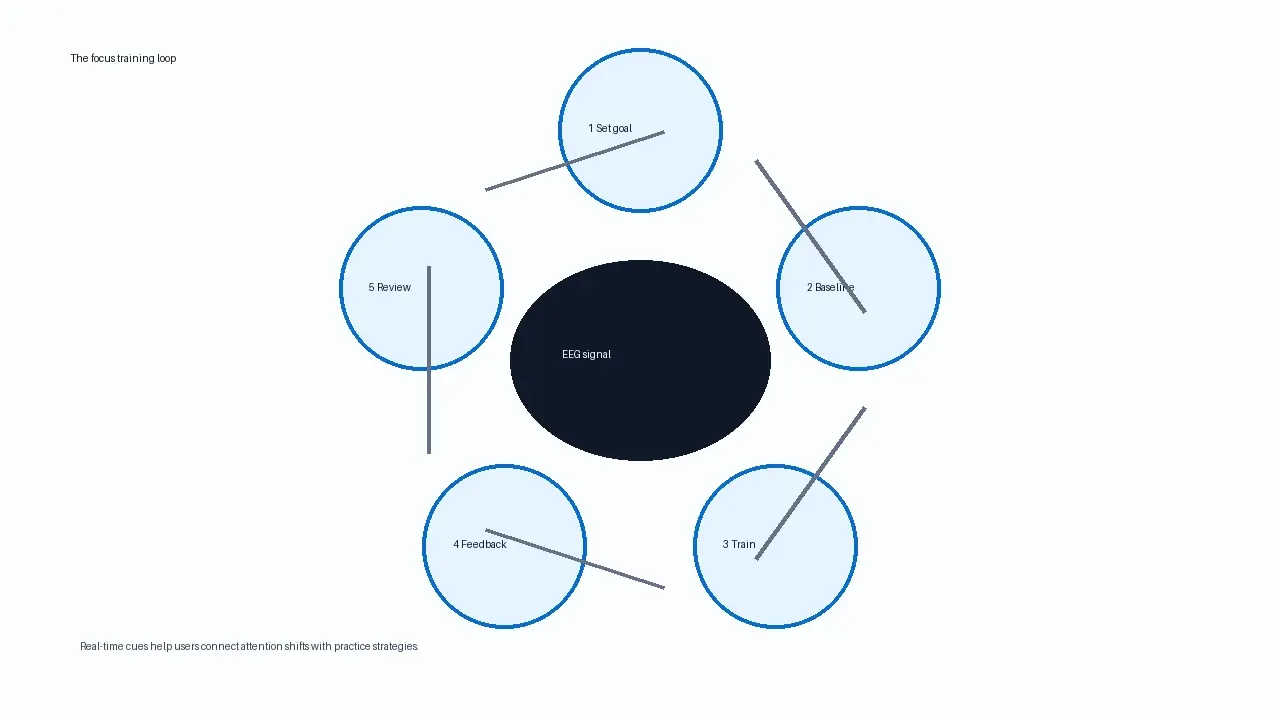
A focus protocol should make the training loop explicit: define the goal, record a baseline, practice a task, receive feedback, adjust, and review trends. Without that structure, a session can feel interesting but still fail to teach a repeatable skill.
The basic training sequence
A focus session usually follows a simple pattern. The details vary by device and protocol, but the learning loop is similar across systems.
Set a goal. Decide what focus means for the session, such as sustained reading, task readiness, or fewer lapses.
Collect a baseline. The system records a short sample so the feedback can be compared with your starting state.
Run the task. You complete a focus exercise, breathing practice, game, or work-like task while the EEG headset reads signals.
Receive feedback. The app changes a sound, visual, score, or reward when your brain activity moves toward the target.
Adjust and repeat. You try small mental shifts and learn which strategies help you return to the target state.
Review the session. You compare notes, trends, and task performance instead of judging one session as success or failure.
What feedback teaches
The value of feedback is timing. If you only know that you were distracted after a session ends, the lesson is vague. Real-time feedback narrows the gap between the state and the cue. That makes the practice more like skill training.
The cue also makes invisible activity easier to understand. A beginner may not know what mental calm, task readiness, or over-effort feels like. Feedback gives the brain a mirror.
See MN8 EEG earbuds for an everyday headset option built around lightweight cognitive performance practice.
Why consistency beats intensity
Short, repeated sessions are often more useful than rare marathon sessions. Focus training asks the brain to learn a pattern, and learning needs repetition. A practical schedule might use brief sessions several times per week, paired with notes about sleep, caffeine, stress, and task type.
What does published research say about neurofeedback and attention?
Published research supports the closed-loop logic behind neurofeedback, but it does not support blanket promises. The strongest interpretation is careful: neurofeedback can be a serious attention training method when the protocol, outcomes, and expectations are clear.
Promising areas
Research on neurofeedback and attention has a long history. A review in the National Library of Medicine describes neurofeedback as a closed-loop system that measures brain activity and returns feedback to the user in real time. That closed loop is the foundation of focus training.
Many studies have looked at ADHD, sustained attention, and cognitive performance. Some report gains in attention measures after training. Others suggest that protocol design, user engagement, and number of sessions can influence outcomes. This supports a careful view: neurofeedback is a serious research area, but results are not guaranteed.
Limits in the evidence
The research also has limits. Neurofeedback studies can be hard to blind because people may know if they receive real feedback. Control groups vary. Some studies use different EEG targets, session counts, and outcome tests, which makes results hard to compare.
For readers, that means one study should not carry the whole decision. Look for repeated findings, clear methods, and realistic outcomes. Strong evidence should show more than a short-term boost after a novel task.
What to expect as a user
If you have ADHD, anxiety, sleep issues, or a medical condition, speak with a qualified clinician before using neurofeedback as part of a care plan. EEG headsets can support learning, but they do not replace diagnosis or treatment.
Protocols and device options for focus training
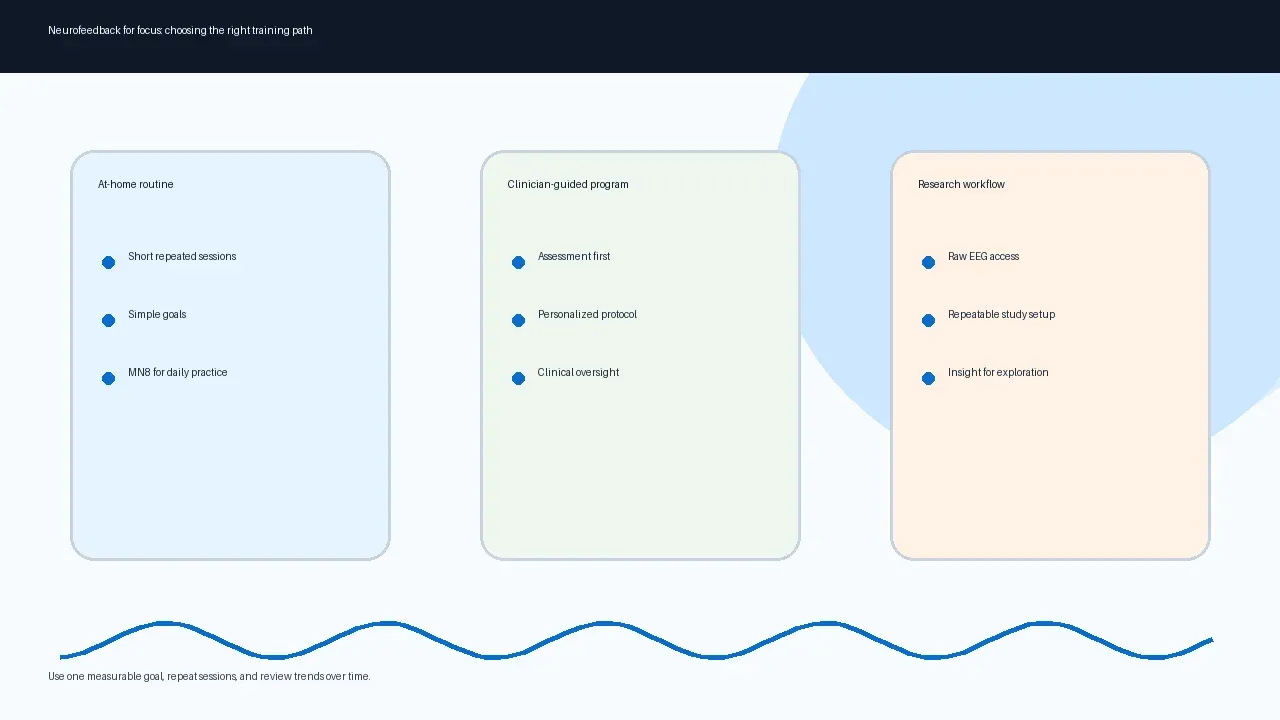
The right neurofeedback path depends on the use case. At-home users usually need repeatability and comfort. Clinicians need assessment and oversight. Researchers need data access, repeatable settings, and tools that fit their study design.
Common paths
There is no single best setup for everyone. A clinic may use qEEG mapping, clinician-guided protocols, and longer programs. A home user may prefer an EEG headset and app that supports regular practice. Researchers may need raw EEG access, export tools, and repeatable study settings.
Training path | Best fit | What to prioritize |
|---|---|---|
At-home routine | Users building a regular focus practice | Comfort, simple goals, short repeatable sessions, and trend review |
Clinician-guided program | People with clinical attention concerns or complex symptoms | Assessment, professional oversight, and protocol personalization |
Research workflow | Labs, developers, and advanced learners | Raw EEG access, repeatable settings, documentation, and export options |
Where Emotiv fits
Emotiv makes EEG tools for people who want to work with brain data outside a traditional lab. MN8 EEG earbuds are the clearest fit for focus-oriented daily use because they are lightweight and built around cognitive performance. Emotiv Insight is better for users who want a multi-sensor EEG headset for broader exploration.
The right choice depends on your goal. If you want a simple way to build a repeatable focus routine, start with MN8. If you need a wider EEG setup for experiments, research, or advanced software use, Insight may be a better fit. Readers comparing broader device categories can also review our EEG headset collection.
Protocol fit matters
Device choice is only part of the plan. The protocol should match the outcome you care about. Training calm attention, alert focus, and task switching may require different exercises. A good plan defines the target, records baseline data, repeats sessions, and reviews trends without overstating what the data proves.
How to try neurofeedback for focus safely
Start with one narrow behavior, keep the setup stable, and compare EEG feedback with what happens in real tasks. This keeps the practice grounded in useful outcomes instead of chasing a single score.
Start with one measurable goal
Pick one focus problem before you begin. Examples include reading for 20 minutes, finishing one work block, or noticing when attention drifts. A narrow goal makes results easier to judge. It also keeps the session from becoming another vague productivity habit.
Write down your goal before each session. Afterward, note what you did, how long you trained, and what helped. Track your real task behavior, not only the app score.
Build a routine
Choose a quiet time, use the same setup, and keep sessions short at first. A stable routine reduces noise in the data. If you change the room, task, caffeine, and session length every time, you will not know what caused a better score.
Use neurofeedback as one part of focus hygiene. Sleep, breaks, task design, and environment still matter. Brain training works best when the rest of the system supports attention.
Know when to get help
If focus problems are severe, long-running, or tied to distress, get professional support. A clinician can help rule out sleep problems, anxiety, depression, ADHD, medication effects, and other factors. Neurofeedback can be part of a broader plan, but it should not be the only plan when symptoms affect daily life.
Which Emotiv headset fits your focus goal?
MN8 and Insight serve different focus training needs. MN8 is the simpler fit for everyday practice. Insight is the stronger choice when users need more EEG channels for exploration, development, or research-style workflows.
MN8 for everyday focus practice
MN8 is designed for people who want lightweight EEG in an everyday form. The earbud format makes it easier to build a routine around work sessions, study blocks, or focused practice. For most readers exploring neurofeedback for focus, MN8 is the most direct starting point.
Insight for deeper EEG exploration
Insight is a stronger match for users who want more EEG channels and broader experimentation. Researchers, developers, and advanced learners may prefer its flexibility. It can support projects that need more than a simple focus routine.
Choose by outcome
If your main goal is a repeatable focus habit, choose the tool that you will use often. If your goal is data exploration, choose the tool that gives you the data depth you need. In both cases, the headset is only useful when paired with a clear plan and consistent practice.
Explore Emotiv MN8 to compare fit, form factor, and everyday focus use cases.
Frequently asked questions about neurofeedback for focus
Does neurofeedback really help with focus?
Neurofeedback may help some people build attention self-regulation, especially when training is consistent and goals are clear. The evidence is promising but mixed. It is best viewed as a training method, not a guaranteed fix.
How long does neurofeedback take to work?
There is no universal timeline. Some users notice changes in awareness within a few sessions, while stronger habit changes may take weeks of repeated practice. Session count, protocol quality, sleep, stress, and baseline attention can all affect results.
Can I do neurofeedback at home?
Yes, many people use EEG headsets and guided apps at home. Home training works best when you use a stable routine, track real task outcomes, and avoid treating one score as proof. If you have clinical concerns, involve a qualified professional.
Is neurofeedback the same as meditation?
No. Meditation trains attention through practice and awareness. Neurofeedback adds EEG-based feedback so you can see or hear a signal tied to brain activity. The two methods can support each other, but they are not the same.
What is the best headset for focus training?
The best headset depends on your goal. Emotiv MN8 is built for everyday cognitive performance and focus-oriented routines. Emotiv Insight is better for broader EEG exploration and advanced projects.
Ready to explore neurofeedback for focus?
If you want a practical way to bring EEG-based focus training into your day, start with a goal you can repeat and measure. Emotiv MN8 is built for everyday cognitive performance practice in a lightweight earbud form, while Insight gives researchers and advanced users more EEG channels for deeper exploration.
Explore Emotiv MN8 to see how wearable EEG can support your next focus training routine.
Neurofeedback for focus sounds simple: watch your brain activity, get real-time feedback, and practice steering your attention. The idea is not magic. It is a feedback loop built on EEG, biofeedback, and repeated practice.
Explore Emotiv MN8 if you want a lightweight EEG option for building a repeatable focus training routine.
The evidence is also more mixed than many headlines suggest. Some studies show promise for attention training, especially in ADHD and cognitive performance research. Other studies point out hard questions about placebo effects, protocol quality, and how long benefits last. That makes the real answer practical: neurofeedback may help some people train attention skills, but it should be used with clear goals and realistic expectations.
This guide explains how focus works, what neurofeedback trains, what the research says, and how to try it with an EEG headset such as Emotiv MN8 or Insight.
What is neurofeedback for focus?
Neurofeedback for focus is EEG biofeedback used to practice attention self-regulation. Sensors measure brain activity, software turns that activity into feedback, and the user repeats short sessions to learn which strategies support a focused state.
A feedback loop for attention
Neurofeedback for focus is a form of EEG biofeedback. Sensors read electrical patterns from the scalp, software turns those signals into simple cues, and the user practices reaching a target brain state. The cue may be a sound, graph, game, or focus score.
The training does not force the brain to do anything. It shows the brain what is happening in real time. When the target pattern appears, the system gives feedback. Over repeated sessions, users learn what focused attention feels like and how to return to it.
What it is not
Neurofeedback is not a quick fix for distraction. It is not a medical treatment by itself, and it should not replace care from a licensed professional when attention problems affect school, work, sleep, mood, or safety. Think of it as structured practice for self-regulation.
It also is not the same as a focus playlist or a productivity app. The core difference is measurement. EEG-based training uses brain signals as the feedback source, which makes the practice more specific than guessing whether you feel focused.
Why EEG matters
EEG measures brain activity through sensors on the scalp. It is widely used in neuroscience because it captures fast changes in brain state. For focus training, that speed matters. A delayed score is less useful than feedback that appears close to the moment your attention changes.
If you are new to the method, Emotiv software and education resources can help you understand the signal behind the session. Start with our EEG neurofeedback beginner guide, then compare related concepts in our neuroplasticity glossary.
The science of focus: what your brain is training
Focus is not a single switch. It is a working state that combines alertness, selective attention, task control, and recovery from distraction. Neurofeedback is useful only when the training target matches one of those real attention behaviors.
Focus is a state, not a switch
Focus is not one single brain signal. It includes alertness, selective attention, working memory, error control, and the ability to ignore distractions. That is why a strong neurofeedback plan starts with a clear goal. Reading for longer, staying on task, and switching less often are different targets.
EEG research often discusses attention in terms of frequency bands such as theta, alpha, sensorimotor rhythm, and beta. These bands are not good or bad on their own. Their meaning depends on the task, the person, the sensors, and the training design. For a broader explanation of these patterns, see our guide to EEG headsets.
Self-regulation and practice
The main training idea is self-regulation. You see a signal tied to attention, try a mental strategy, and notice what changes. The system rewards a target pattern. Over time, the brain may learn to reach that state with less effort.
This learning process is linked to neuroplasticity, the brain's ability to adapt through experience. Repetition matters because focus training is closer to skill practice than one-time measurement. Our EEG neurofeedback article explains how this closed-loop approach developed from early brain training research.
Why distraction feels hard to control
Modern work asks the brain to switch often. Notifications, tabs, meetings, and stress can keep attention moving before a task is complete. Neurofeedback does not remove those demands. It gives you a way to practice noticing attention shifts earlier.
How neurofeedback targets focus during training
A focus protocol should make the training loop explicit: define the goal, record a baseline, practice a task, receive feedback, adjust, and review trends. Without that structure, a session can feel interesting but still fail to teach a repeatable skill.
The basic training sequence
A focus session usually follows a simple pattern. The details vary by device and protocol, but the learning loop is similar across systems.
Set a goal. Decide what focus means for the session, such as sustained reading, task readiness, or fewer lapses.
Collect a baseline. The system records a short sample so the feedback can be compared with your starting state.
Run the task. You complete a focus exercise, breathing practice, game, or work-like task while the EEG headset reads signals.
Receive feedback. The app changes a sound, visual, score, or reward when your brain activity moves toward the target.
Adjust and repeat. You try small mental shifts and learn which strategies help you return to the target state.
Review the session. You compare notes, trends, and task performance instead of judging one session as success or failure.
What feedback teaches
The value of feedback is timing. If you only know that you were distracted after a session ends, the lesson is vague. Real-time feedback narrows the gap between the state and the cue. That makes the practice more like skill training.
The cue also makes invisible activity easier to understand. A beginner may not know what mental calm, task readiness, or over-effort feels like. Feedback gives the brain a mirror.
See MN8 EEG earbuds for an everyday headset option built around lightweight cognitive performance practice.
Why consistency beats intensity
Short, repeated sessions are often more useful than rare marathon sessions. Focus training asks the brain to learn a pattern, and learning needs repetition. A practical schedule might use brief sessions several times per week, paired with notes about sleep, caffeine, stress, and task type.
What does published research say about neurofeedback and attention?
Published research supports the closed-loop logic behind neurofeedback, but it does not support blanket promises. The strongest interpretation is careful: neurofeedback can be a serious attention training method when the protocol, outcomes, and expectations are clear.
Promising areas
Research on neurofeedback and attention has a long history. A review in the National Library of Medicine describes neurofeedback as a closed-loop system that measures brain activity and returns feedback to the user in real time. That closed loop is the foundation of focus training.
Many studies have looked at ADHD, sustained attention, and cognitive performance. Some report gains in attention measures after training. Others suggest that protocol design, user engagement, and number of sessions can influence outcomes. This supports a careful view: neurofeedback is a serious research area, but results are not guaranteed.
Limits in the evidence
The research also has limits. Neurofeedback studies can be hard to blind because people may know if they receive real feedback. Control groups vary. Some studies use different EEG targets, session counts, and outcome tests, which makes results hard to compare.
For readers, that means one study should not carry the whole decision. Look for repeated findings, clear methods, and realistic outcomes. Strong evidence should show more than a short-term boost after a novel task.
What to expect as a user
If you have ADHD, anxiety, sleep issues, or a medical condition, speak with a qualified clinician before using neurofeedback as part of a care plan. EEG headsets can support learning, but they do not replace diagnosis or treatment.
Protocols and device options for focus training
The right neurofeedback path depends on the use case. At-home users usually need repeatability and comfort. Clinicians need assessment and oversight. Researchers need data access, repeatable settings, and tools that fit their study design.
Common paths
There is no single best setup for everyone. A clinic may use qEEG mapping, clinician-guided protocols, and longer programs. A home user may prefer an EEG headset and app that supports regular practice. Researchers may need raw EEG access, export tools, and repeatable study settings.
Training path | Best fit | What to prioritize |
|---|---|---|
At-home routine | Users building a regular focus practice | Comfort, simple goals, short repeatable sessions, and trend review |
Clinician-guided program | People with clinical attention concerns or complex symptoms | Assessment, professional oversight, and protocol personalization |
Research workflow | Labs, developers, and advanced learners | Raw EEG access, repeatable settings, documentation, and export options |
Where Emotiv fits
Emotiv makes EEG tools for people who want to work with brain data outside a traditional lab. MN8 EEG earbuds are the clearest fit for focus-oriented daily use because they are lightweight and built around cognitive performance. Emotiv Insight is better for users who want a multi-sensor EEG headset for broader exploration.
The right choice depends on your goal. If you want a simple way to build a repeatable focus routine, start with MN8. If you need a wider EEG setup for experiments, research, or advanced software use, Insight may be a better fit. Readers comparing broader device categories can also review our EEG headset collection.
Protocol fit matters
Device choice is only part of the plan. The protocol should match the outcome you care about. Training calm attention, alert focus, and task switching may require different exercises. A good plan defines the target, records baseline data, repeats sessions, and reviews trends without overstating what the data proves.
How to try neurofeedback for focus safely
Start with one narrow behavior, keep the setup stable, and compare EEG feedback with what happens in real tasks. This keeps the practice grounded in useful outcomes instead of chasing a single score.
Start with one measurable goal
Pick one focus problem before you begin. Examples include reading for 20 minutes, finishing one work block, or noticing when attention drifts. A narrow goal makes results easier to judge. It also keeps the session from becoming another vague productivity habit.
Write down your goal before each session. Afterward, note what you did, how long you trained, and what helped. Track your real task behavior, not only the app score.
Build a routine
Choose a quiet time, use the same setup, and keep sessions short at first. A stable routine reduces noise in the data. If you change the room, task, caffeine, and session length every time, you will not know what caused a better score.
Use neurofeedback as one part of focus hygiene. Sleep, breaks, task design, and environment still matter. Brain training works best when the rest of the system supports attention.
Know when to get help
If focus problems are severe, long-running, or tied to distress, get professional support. A clinician can help rule out sleep problems, anxiety, depression, ADHD, medication effects, and other factors. Neurofeedback can be part of a broader plan, but it should not be the only plan when symptoms affect daily life.
Which Emotiv headset fits your focus goal?
MN8 and Insight serve different focus training needs. MN8 is the simpler fit for everyday practice. Insight is the stronger choice when users need more EEG channels for exploration, development, or research-style workflows.
MN8 for everyday focus practice
MN8 is designed for people who want lightweight EEG in an everyday form. The earbud format makes it easier to build a routine around work sessions, study blocks, or focused practice. For most readers exploring neurofeedback for focus, MN8 is the most direct starting point.
Insight for deeper EEG exploration
Insight is a stronger match for users who want more EEG channels and broader experimentation. Researchers, developers, and advanced learners may prefer its flexibility. It can support projects that need more than a simple focus routine.
Choose by outcome
If your main goal is a repeatable focus habit, choose the tool that you will use often. If your goal is data exploration, choose the tool that gives you the data depth you need. In both cases, the headset is only useful when paired with a clear plan and consistent practice.
Explore Emotiv MN8 to compare fit, form factor, and everyday focus use cases.
Frequently asked questions about neurofeedback for focus
Does neurofeedback really help with focus?
Neurofeedback may help some people build attention self-regulation, especially when training is consistent and goals are clear. The evidence is promising but mixed. It is best viewed as a training method, not a guaranteed fix.
How long does neurofeedback take to work?
There is no universal timeline. Some users notice changes in awareness within a few sessions, while stronger habit changes may take weeks of repeated practice. Session count, protocol quality, sleep, stress, and baseline attention can all affect results.
Can I do neurofeedback at home?
Yes, many people use EEG headsets and guided apps at home. Home training works best when you use a stable routine, track real task outcomes, and avoid treating one score as proof. If you have clinical concerns, involve a qualified professional.
Is neurofeedback the same as meditation?
No. Meditation trains attention through practice and awareness. Neurofeedback adds EEG-based feedback so you can see or hear a signal tied to brain activity. The two methods can support each other, but they are not the same.
What is the best headset for focus training?
The best headset depends on your goal. Emotiv MN8 is built for everyday cognitive performance and focus-oriented routines. Emotiv Insight is better for broader EEG exploration and advanced projects.
Ready to explore neurofeedback for focus?
If you want a practical way to bring EEG-based focus training into your day, start with a goal you can repeat and measure. Emotiv MN8 is built for everyday cognitive performance practice in a lightweight earbud form, while Insight gives researchers and advanced users more EEG channels for deeper exploration.
Explore Emotiv MN8 to see how wearable EEG can support your next focus training routine.
Neurofeedback for focus sounds simple: watch your brain activity, get real-time feedback, and practice steering your attention. The idea is not magic. It is a feedback loop built on EEG, biofeedback, and repeated practice.
Explore Emotiv MN8 if you want a lightweight EEG option for building a repeatable focus training routine.
The evidence is also more mixed than many headlines suggest. Some studies show promise for attention training, especially in ADHD and cognitive performance research. Other studies point out hard questions about placebo effects, protocol quality, and how long benefits last. That makes the real answer practical: neurofeedback may help some people train attention skills, but it should be used with clear goals and realistic expectations.
This guide explains how focus works, what neurofeedback trains, what the research says, and how to try it with an EEG headset such as Emotiv MN8 or Insight.
What is neurofeedback for focus?
Neurofeedback for focus is EEG biofeedback used to practice attention self-regulation. Sensors measure brain activity, software turns that activity into feedback, and the user repeats short sessions to learn which strategies support a focused state.
A feedback loop for attention
Neurofeedback for focus is a form of EEG biofeedback. Sensors read electrical patterns from the scalp, software turns those signals into simple cues, and the user practices reaching a target brain state. The cue may be a sound, graph, game, or focus score.
The training does not force the brain to do anything. It shows the brain what is happening in real time. When the target pattern appears, the system gives feedback. Over repeated sessions, users learn what focused attention feels like and how to return to it.
What it is not
Neurofeedback is not a quick fix for distraction. It is not a medical treatment by itself, and it should not replace care from a licensed professional when attention problems affect school, work, sleep, mood, or safety. Think of it as structured practice for self-regulation.
It also is not the same as a focus playlist or a productivity app. The core difference is measurement. EEG-based training uses brain signals as the feedback source, which makes the practice more specific than guessing whether you feel focused.
Why EEG matters
EEG measures brain activity through sensors on the scalp. It is widely used in neuroscience because it captures fast changes in brain state. For focus training, that speed matters. A delayed score is less useful than feedback that appears close to the moment your attention changes.
If you are new to the method, Emotiv software and education resources can help you understand the signal behind the session. Start with our EEG neurofeedback beginner guide, then compare related concepts in our neuroplasticity glossary.
The science of focus: what your brain is training
Focus is not a single switch. It is a working state that combines alertness, selective attention, task control, and recovery from distraction. Neurofeedback is useful only when the training target matches one of those real attention behaviors.
Focus is a state, not a switch
Focus is not one single brain signal. It includes alertness, selective attention, working memory, error control, and the ability to ignore distractions. That is why a strong neurofeedback plan starts with a clear goal. Reading for longer, staying on task, and switching less often are different targets.
EEG research often discusses attention in terms of frequency bands such as theta, alpha, sensorimotor rhythm, and beta. These bands are not good or bad on their own. Their meaning depends on the task, the person, the sensors, and the training design. For a broader explanation of these patterns, see our guide to EEG headsets.
Self-regulation and practice
The main training idea is self-regulation. You see a signal tied to attention, try a mental strategy, and notice what changes. The system rewards a target pattern. Over time, the brain may learn to reach that state with less effort.
This learning process is linked to neuroplasticity, the brain's ability to adapt through experience. Repetition matters because focus training is closer to skill practice than one-time measurement. Our EEG neurofeedback article explains how this closed-loop approach developed from early brain training research.
Why distraction feels hard to control
Modern work asks the brain to switch often. Notifications, tabs, meetings, and stress can keep attention moving before a task is complete. Neurofeedback does not remove those demands. It gives you a way to practice noticing attention shifts earlier.
How neurofeedback targets focus during training
A focus protocol should make the training loop explicit: define the goal, record a baseline, practice a task, receive feedback, adjust, and review trends. Without that structure, a session can feel interesting but still fail to teach a repeatable skill.
The basic training sequence
A focus session usually follows a simple pattern. The details vary by device and protocol, but the learning loop is similar across systems.
Set a goal. Decide what focus means for the session, such as sustained reading, task readiness, or fewer lapses.
Collect a baseline. The system records a short sample so the feedback can be compared with your starting state.
Run the task. You complete a focus exercise, breathing practice, game, or work-like task while the EEG headset reads signals.
Receive feedback. The app changes a sound, visual, score, or reward when your brain activity moves toward the target.
Adjust and repeat. You try small mental shifts and learn which strategies help you return to the target state.
Review the session. You compare notes, trends, and task performance instead of judging one session as success or failure.
What feedback teaches
The value of feedback is timing. If you only know that you were distracted after a session ends, the lesson is vague. Real-time feedback narrows the gap between the state and the cue. That makes the practice more like skill training.
The cue also makes invisible activity easier to understand. A beginner may not know what mental calm, task readiness, or over-effort feels like. Feedback gives the brain a mirror.
See MN8 EEG earbuds for an everyday headset option built around lightweight cognitive performance practice.
Why consistency beats intensity
Short, repeated sessions are often more useful than rare marathon sessions. Focus training asks the brain to learn a pattern, and learning needs repetition. A practical schedule might use brief sessions several times per week, paired with notes about sleep, caffeine, stress, and task type.
What does published research say about neurofeedback and attention?
Published research supports the closed-loop logic behind neurofeedback, but it does not support blanket promises. The strongest interpretation is careful: neurofeedback can be a serious attention training method when the protocol, outcomes, and expectations are clear.
Promising areas
Research on neurofeedback and attention has a long history. A review in the National Library of Medicine describes neurofeedback as a closed-loop system that measures brain activity and returns feedback to the user in real time. That closed loop is the foundation of focus training.
Many studies have looked at ADHD, sustained attention, and cognitive performance. Some report gains in attention measures after training. Others suggest that protocol design, user engagement, and number of sessions can influence outcomes. This supports a careful view: neurofeedback is a serious research area, but results are not guaranteed.
Limits in the evidence
The research also has limits. Neurofeedback studies can be hard to blind because people may know if they receive real feedback. Control groups vary. Some studies use different EEG targets, session counts, and outcome tests, which makes results hard to compare.
For readers, that means one study should not carry the whole decision. Look for repeated findings, clear methods, and realistic outcomes. Strong evidence should show more than a short-term boost after a novel task.
What to expect as a user
If you have ADHD, anxiety, sleep issues, or a medical condition, speak with a qualified clinician before using neurofeedback as part of a care plan. EEG headsets can support learning, but they do not replace diagnosis or treatment.
Protocols and device options for focus training
The right neurofeedback path depends on the use case. At-home users usually need repeatability and comfort. Clinicians need assessment and oversight. Researchers need data access, repeatable settings, and tools that fit their study design.
Common paths
There is no single best setup for everyone. A clinic may use qEEG mapping, clinician-guided protocols, and longer programs. A home user may prefer an EEG headset and app that supports regular practice. Researchers may need raw EEG access, export tools, and repeatable study settings.
Training path | Best fit | What to prioritize |
|---|---|---|
At-home routine | Users building a regular focus practice | Comfort, simple goals, short repeatable sessions, and trend review |
Clinician-guided program | People with clinical attention concerns or complex symptoms | Assessment, professional oversight, and protocol personalization |
Research workflow | Labs, developers, and advanced learners | Raw EEG access, repeatable settings, documentation, and export options |
Where Emotiv fits
Emotiv makes EEG tools for people who want to work with brain data outside a traditional lab. MN8 EEG earbuds are the clearest fit for focus-oriented daily use because they are lightweight and built around cognitive performance. Emotiv Insight is better for users who want a multi-sensor EEG headset for broader exploration.
The right choice depends on your goal. If you want a simple way to build a repeatable focus routine, start with MN8. If you need a wider EEG setup for experiments, research, or advanced software use, Insight may be a better fit. Readers comparing broader device categories can also review our EEG headset collection.
Protocol fit matters
Device choice is only part of the plan. The protocol should match the outcome you care about. Training calm attention, alert focus, and task switching may require different exercises. A good plan defines the target, records baseline data, repeats sessions, and reviews trends without overstating what the data proves.
How to try neurofeedback for focus safely
Start with one narrow behavior, keep the setup stable, and compare EEG feedback with what happens in real tasks. This keeps the practice grounded in useful outcomes instead of chasing a single score.
Start with one measurable goal
Pick one focus problem before you begin. Examples include reading for 20 minutes, finishing one work block, or noticing when attention drifts. A narrow goal makes results easier to judge. It also keeps the session from becoming another vague productivity habit.
Write down your goal before each session. Afterward, note what you did, how long you trained, and what helped. Track your real task behavior, not only the app score.
Build a routine
Choose a quiet time, use the same setup, and keep sessions short at first. A stable routine reduces noise in the data. If you change the room, task, caffeine, and session length every time, you will not know what caused a better score.
Use neurofeedback as one part of focus hygiene. Sleep, breaks, task design, and environment still matter. Brain training works best when the rest of the system supports attention.
Know when to get help
If focus problems are severe, long-running, or tied to distress, get professional support. A clinician can help rule out sleep problems, anxiety, depression, ADHD, medication effects, and other factors. Neurofeedback can be part of a broader plan, but it should not be the only plan when symptoms affect daily life.
Which Emotiv headset fits your focus goal?
MN8 and Insight serve different focus training needs. MN8 is the simpler fit for everyday practice. Insight is the stronger choice when users need more EEG channels for exploration, development, or research-style workflows.
MN8 for everyday focus practice
MN8 is designed for people who want lightweight EEG in an everyday form. The earbud format makes it easier to build a routine around work sessions, study blocks, or focused practice. For most readers exploring neurofeedback for focus, MN8 is the most direct starting point.
Insight for deeper EEG exploration
Insight is a stronger match for users who want more EEG channels and broader experimentation. Researchers, developers, and advanced learners may prefer its flexibility. It can support projects that need more than a simple focus routine.
Choose by outcome
If your main goal is a repeatable focus habit, choose the tool that you will use often. If your goal is data exploration, choose the tool that gives you the data depth you need. In both cases, the headset is only useful when paired with a clear plan and consistent practice.
Explore Emotiv MN8 to compare fit, form factor, and everyday focus use cases.
Frequently asked questions about neurofeedback for focus
Does neurofeedback really help with focus?
Neurofeedback may help some people build attention self-regulation, especially when training is consistent and goals are clear. The evidence is promising but mixed. It is best viewed as a training method, not a guaranteed fix.
How long does neurofeedback take to work?
There is no universal timeline. Some users notice changes in awareness within a few sessions, while stronger habit changes may take weeks of repeated practice. Session count, protocol quality, sleep, stress, and baseline attention can all affect results.
Can I do neurofeedback at home?
Yes, many people use EEG headsets and guided apps at home. Home training works best when you use a stable routine, track real task outcomes, and avoid treating one score as proof. If you have clinical concerns, involve a qualified professional.
Is neurofeedback the same as meditation?
No. Meditation trains attention through practice and awareness. Neurofeedback adds EEG-based feedback so you can see or hear a signal tied to brain activity. The two methods can support each other, but they are not the same.
What is the best headset for focus training?
The best headset depends on your goal. Emotiv MN8 is built for everyday cognitive performance and focus-oriented routines. Emotiv Insight is better for broader EEG exploration and advanced projects.
Ready to explore neurofeedback for focus?
If you want a practical way to bring EEG-based focus training into your day, start with a goal you can repeat and measure. Emotiv MN8 is built for everyday cognitive performance practice in a lightweight earbud form, while Insight gives researchers and advanced users more EEG channels for deeper exploration.
Explore Emotiv MN8 to see how wearable EEG can support your next focus training routine.