
Beyond Focus Groups: Better Ways to Understand Consumer Behavior
H.B. Duran
Updated on
May 8, 2026
Beyond Focus Groups: Better Ways to Understand Consumer Behavior
H.B. Duran
Updated on
May 8, 2026
Beyond Focus Groups: Better Ways to Understand Consumer Behavior
H.B. Duran
Updated on
May 8, 2026
For decades, focus groups have been a foundational tool in consumer research. Brands have used them to evaluate products, advertising campaigns, packaging concepts, messaging, and customer sentiment. While focus groups still offer value in certain contexts, modern organizations increasingly recognize their limitations when trying to understand how consumers actually think, feel, and behave in real-world environments.
Today’s audiences interact with brands across fragmented digital ecosystems shaped by algorithms, mobile experiences, short attention windows, and emotionally driven decision-making. In these environments, stated opinions alone often fail to capture the subconscious drivers behind consumer behavior.
As a result, organizations are increasingly exploring behavioral research methods, neuroscience tools, and EEG-based audience analysis to move beyond traditional focus groups and gain deeper insight into attention, engagement, cognitive stress, and emotional response.
Why Traditional Focus Groups Have Limitations
Focus groups can provide useful qualitative feedback, but they are influenced by several structural challenges.
Participants may:
Give socially desirable answers
Be influenced by dominant personalities in the room
Struggle to explain subconscious reactions
Rationalize decisions after the fact
Misremember emotional experiences
In many cases, consumers cannot fully articulate why they responded positively or negatively to a product, advertisement, or digital experience.
This gap matters because many purchasing decisions occur quickly and emotionally before conscious reasoning fully develops.
Consumers may say one thing in a discussion setting while behaving differently in real-world environments.
The Difference Between Stated Preference and Actual Behavior
One of the biggest challenges in traditional consumer research is the disconnect between stated preference and observed behavior.
For example:
A consumer may claim an ad was memorable but fail to recall the brand later
A focus group participant may describe a website as “easy to use” while struggling during navigation
A shopper may say packaging feels premium while visually overlooking it on a crowded shelf
A user may express interest in a product concept while showing low emotional engagement during exposure
Behavioral and neuroscience-based research methods help organizations analyze what audiences actually do and experience during interaction rather than relying entirely on retrospective explanation.
Why Consumer Behavior Is Increasingly Complex
Modern digital environments place significant pressure on consumer attention.
Audiences navigate:
Constant notifications
Algorithmic feeds
Competing advertisements
Dense ecommerce environments
Multi-device experiences
Short-form video ecosystems
As attention becomes more fragmented, understanding cognitive and emotional response becomes increasingly important.
Traditional surveys and focus groups often fail to capture:
Attention sustainability
Cognitive stress
Emotional engagement
Decision fatigue
Subconscious response patterns
This has pushed organizations toward more observational and neuroscience-driven approaches.
Behavioral Research Alternatives to Focus Groups
Modern consumer research increasingly combines multiple methodologies to build a more complete understanding of audience behavior.
Common alternatives and complementary methods include:
Behavioral analytics
Session replay analysis
A/B testing
Eye tracking
UX usability testing
Mobile ethnography
Social listening
EEG-based neuroanalytics
Each method provides different forms of insight into how consumers experience products, content, interfaces, and campaigns.
Using Eye Tracking to Measure Visual Attention
Eye tracking helps researchers evaluate where users look, how long they focus, and which elements attract or lose attention.
This method is valuable for testing:
Landing pages
Advertising creative
Packaging design
Ecommerce interfaces
Product pages
Mobile experiences
Eye tracking can reveal whether consumers actually notice key information or visually ignore critical areas of the experience.
However, eye tracking alone does not fully explain how users cognitively or emotionally process what they see.
This is why organizations increasingly combine eye tracking with EEG-based neuroscience methods.
How EEG Helps Measure Consumer Response
EEG, or electroencephalography, measures electrical brain activity during interaction.
In consumer research environments, EEG-based neuroanalytics can help evaluate:
Attention
Engagement
Cognitive stress
Stress response
Mental fatigue
Emotional activation
These signals provide insight into how consumers experience products, advertisements, and digital environments in real time.
Unlike traditional focus groups, EEG-based testing does not rely entirely on verbal explanation after exposure.
Instead, researchers can evaluate audience response as it happens.
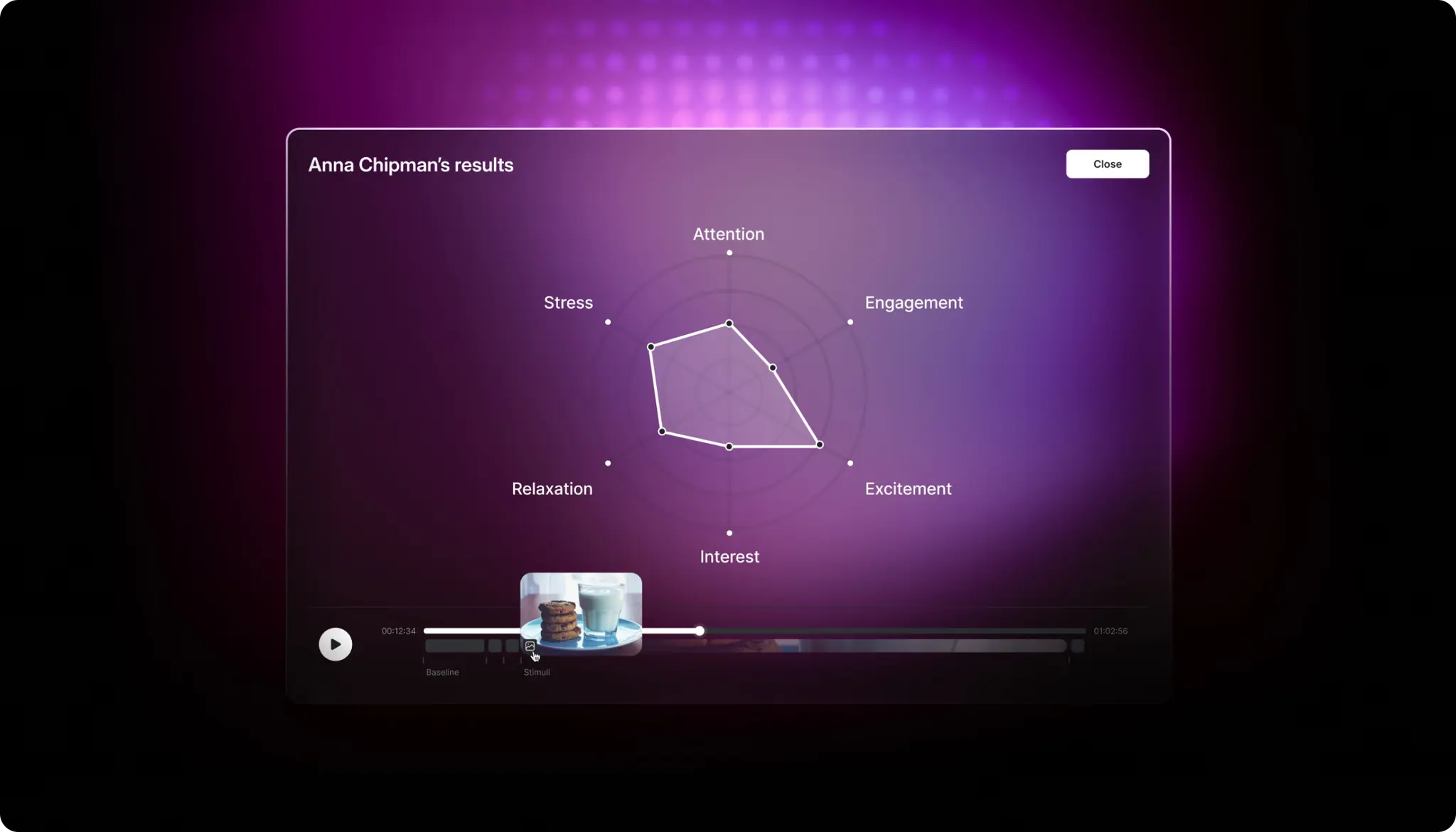
Above: Research participants' mental states are mapped to each moment of the product or experience testing session in Emotiv Studio.
Understanding Cognitive Stress in Consumer Experiences
Cognitive stress is increasingly important in modern digital environments.
Consumers often face overwhelming amounts of information during:
Ecommerce shopping
Subscription signups
Financial onboarding
Product comparisons
SaaS onboarding flows
Mobile app interactions
Consumers may continue interacting behaviorally while mentally disengaging due to overload.
EEG-based testing can help identify where cognitive strain increases and where attention begins to decline.
This allows teams to optimize experiences before friction damages engagement or conversion.
Measuring Emotional Engagement Beyond Self-Reported Feedback
Consumers often struggle to describe emotional reactions accurately.
They may not consciously recognize moments of frustration, excitement, confusion, or disengagement while interacting with digital experiences.
Neuroanalytics can help identify emotional response patterns during:
Video campaigns
Product demos
Website interactions
Advertising creative
UX workflows
Interactive experiences
This helps organizations understand which moments create emotional resonance and which weaken audience engagement.
Why Multimodal Research Is Becoming Standard
No single research method fully explains consumer behavior.
Modern organizations increasingly combine:
Behavioral analytics
UX testing
Eye tracking
EEG-based neuroanalytics
Survey feedback
Qualitative interviews
This multimodal approach provides a more complete understanding of:
Attention quality
Emotional engagement
Cognitive effort
Decision-making friction
User confidence
Experience usability
Instead of replacing focus groups entirely, neuroscience and behavioral methods expand the research toolkit.
How Emotiv Studio Supports Consumer Research Workflows
Emotiv Studio helps organizations integrate EEG-based neuroanalytics into modern consumer research workflows.
Using wireless EEG technology and AI-supported analysis, teams can evaluate audience response across:
Advertising campaigns
Product concepts
Digital experiences
UX prototypes
Video content
Ecommerce interactions
EmotivIQ™ aligns neural responses to moment-by-moment experiences, helping researchers identify attention spikes, engagement decline, stress response, and cognitive overload patterns.
This supports more evidence-based creative, UX, and product decisions.
Applying EEG and Behavioral Research Across Industries
Organizations across industries increasingly use neuroscience-informed research to better understand consumer behavior.
Applications include:
Advertising performance analysis
Retail packaging research
Ecommerce optimization
UX usability testing
Automotive experience design
Gaming engagement analysis
Healthcare communication testing
Media and entertainment research
As digital environments become more competitive and attention becomes harder to sustain, understanding subconscious audience response becomes increasingly valuable.
The Future of Consumer Research
Consumer research is evolving from static opinion gathering toward dynamic behavioral and neuroscience-informed analysis.
Organizations increasingly want to understand:
What captures attention
What sustains engagement
What creates confusion
What reduces trust
What improves confidence and action
Traditional focus groups remain useful for exploratory discussion and qualitative interpretation, but they are no longer sufficient on their own for many modern digital experiences.
Behavioral analytics, eye tracking, and EEG-based neuroanalytics provide additional layers of insight into how consumers cognitively and emotionally process experiences in real time.
Conclusion
Focus groups remain a familiar part of consumer research, but modern organizations increasingly need deeper insight into how audiences actually think, feel, and behave.
By combining behavioral analytics, UX testing, eye tracking, and EEG-based neuroanalytics, teams can move beyond stated preference alone and better understand attention, emotional engagement, cognitive workload, and decision-making behavior.
This multimodal approach supports stronger creative strategy, product design, ecommerce optimization, and audience engagement analysis across increasingly competitive digital environments.
Teams exploring neuroscience-powered consumer research and EEG-based audience analysis can learn more through Emotiv Studio.
For decades, focus groups have been a foundational tool in consumer research. Brands have used them to evaluate products, advertising campaigns, packaging concepts, messaging, and customer sentiment. While focus groups still offer value in certain contexts, modern organizations increasingly recognize their limitations when trying to understand how consumers actually think, feel, and behave in real-world environments.
Today’s audiences interact with brands across fragmented digital ecosystems shaped by algorithms, mobile experiences, short attention windows, and emotionally driven decision-making. In these environments, stated opinions alone often fail to capture the subconscious drivers behind consumer behavior.
As a result, organizations are increasingly exploring behavioral research methods, neuroscience tools, and EEG-based audience analysis to move beyond traditional focus groups and gain deeper insight into attention, engagement, cognitive stress, and emotional response.
Why Traditional Focus Groups Have Limitations
Focus groups can provide useful qualitative feedback, but they are influenced by several structural challenges.
Participants may:
Give socially desirable answers
Be influenced by dominant personalities in the room
Struggle to explain subconscious reactions
Rationalize decisions after the fact
Misremember emotional experiences
In many cases, consumers cannot fully articulate why they responded positively or negatively to a product, advertisement, or digital experience.
This gap matters because many purchasing decisions occur quickly and emotionally before conscious reasoning fully develops.
Consumers may say one thing in a discussion setting while behaving differently in real-world environments.
The Difference Between Stated Preference and Actual Behavior
One of the biggest challenges in traditional consumer research is the disconnect between stated preference and observed behavior.
For example:
A consumer may claim an ad was memorable but fail to recall the brand later
A focus group participant may describe a website as “easy to use” while struggling during navigation
A shopper may say packaging feels premium while visually overlooking it on a crowded shelf
A user may express interest in a product concept while showing low emotional engagement during exposure
Behavioral and neuroscience-based research methods help organizations analyze what audiences actually do and experience during interaction rather than relying entirely on retrospective explanation.
Why Consumer Behavior Is Increasingly Complex
Modern digital environments place significant pressure on consumer attention.
Audiences navigate:
Constant notifications
Algorithmic feeds
Competing advertisements
Dense ecommerce environments
Multi-device experiences
Short-form video ecosystems
As attention becomes more fragmented, understanding cognitive and emotional response becomes increasingly important.
Traditional surveys and focus groups often fail to capture:
Attention sustainability
Cognitive stress
Emotional engagement
Decision fatigue
Subconscious response patterns
This has pushed organizations toward more observational and neuroscience-driven approaches.
Behavioral Research Alternatives to Focus Groups
Modern consumer research increasingly combines multiple methodologies to build a more complete understanding of audience behavior.
Common alternatives and complementary methods include:
Behavioral analytics
Session replay analysis
A/B testing
Eye tracking
UX usability testing
Mobile ethnography
Social listening
EEG-based neuroanalytics
Each method provides different forms of insight into how consumers experience products, content, interfaces, and campaigns.
Using Eye Tracking to Measure Visual Attention
Eye tracking helps researchers evaluate where users look, how long they focus, and which elements attract or lose attention.
This method is valuable for testing:
Landing pages
Advertising creative
Packaging design
Ecommerce interfaces
Product pages
Mobile experiences
Eye tracking can reveal whether consumers actually notice key information or visually ignore critical areas of the experience.
However, eye tracking alone does not fully explain how users cognitively or emotionally process what they see.
This is why organizations increasingly combine eye tracking with EEG-based neuroscience methods.
How EEG Helps Measure Consumer Response
EEG, or electroencephalography, measures electrical brain activity during interaction.
In consumer research environments, EEG-based neuroanalytics can help evaluate:
Attention
Engagement
Cognitive stress
Stress response
Mental fatigue
Emotional activation
These signals provide insight into how consumers experience products, advertisements, and digital environments in real time.
Unlike traditional focus groups, EEG-based testing does not rely entirely on verbal explanation after exposure.
Instead, researchers can evaluate audience response as it happens.
Above: Research participants' mental states are mapped to each moment of the product or experience testing session in Emotiv Studio.
Understanding Cognitive Stress in Consumer Experiences
Cognitive stress is increasingly important in modern digital environments.
Consumers often face overwhelming amounts of information during:
Ecommerce shopping
Subscription signups
Financial onboarding
Product comparisons
SaaS onboarding flows
Mobile app interactions
Consumers may continue interacting behaviorally while mentally disengaging due to overload.
EEG-based testing can help identify where cognitive strain increases and where attention begins to decline.
This allows teams to optimize experiences before friction damages engagement or conversion.
Measuring Emotional Engagement Beyond Self-Reported Feedback
Consumers often struggle to describe emotional reactions accurately.
They may not consciously recognize moments of frustration, excitement, confusion, or disengagement while interacting with digital experiences.
Neuroanalytics can help identify emotional response patterns during:
Video campaigns
Product demos
Website interactions
Advertising creative
UX workflows
Interactive experiences
This helps organizations understand which moments create emotional resonance and which weaken audience engagement.
Why Multimodal Research Is Becoming Standard
No single research method fully explains consumer behavior.
Modern organizations increasingly combine:
Behavioral analytics
UX testing
Eye tracking
EEG-based neuroanalytics
Survey feedback
Qualitative interviews
This multimodal approach provides a more complete understanding of:
Attention quality
Emotional engagement
Cognitive effort
Decision-making friction
User confidence
Experience usability
Instead of replacing focus groups entirely, neuroscience and behavioral methods expand the research toolkit.
How Emotiv Studio Supports Consumer Research Workflows
Emotiv Studio helps organizations integrate EEG-based neuroanalytics into modern consumer research workflows.
Using wireless EEG technology and AI-supported analysis, teams can evaluate audience response across:
Advertising campaigns
Product concepts
Digital experiences
UX prototypes
Video content
Ecommerce interactions
EmotivIQ™ aligns neural responses to moment-by-moment experiences, helping researchers identify attention spikes, engagement decline, stress response, and cognitive overload patterns.
This supports more evidence-based creative, UX, and product decisions.
Applying EEG and Behavioral Research Across Industries
Organizations across industries increasingly use neuroscience-informed research to better understand consumer behavior.
Applications include:
Advertising performance analysis
Retail packaging research
Ecommerce optimization
UX usability testing
Automotive experience design
Gaming engagement analysis
Healthcare communication testing
Media and entertainment research
As digital environments become more competitive and attention becomes harder to sustain, understanding subconscious audience response becomes increasingly valuable.
The Future of Consumer Research
Consumer research is evolving from static opinion gathering toward dynamic behavioral and neuroscience-informed analysis.
Organizations increasingly want to understand:
What captures attention
What sustains engagement
What creates confusion
What reduces trust
What improves confidence and action
Traditional focus groups remain useful for exploratory discussion and qualitative interpretation, but they are no longer sufficient on their own for many modern digital experiences.
Behavioral analytics, eye tracking, and EEG-based neuroanalytics provide additional layers of insight into how consumers cognitively and emotionally process experiences in real time.
Conclusion
Focus groups remain a familiar part of consumer research, but modern organizations increasingly need deeper insight into how audiences actually think, feel, and behave.
By combining behavioral analytics, UX testing, eye tracking, and EEG-based neuroanalytics, teams can move beyond stated preference alone and better understand attention, emotional engagement, cognitive workload, and decision-making behavior.
This multimodal approach supports stronger creative strategy, product design, ecommerce optimization, and audience engagement analysis across increasingly competitive digital environments.
Teams exploring neuroscience-powered consumer research and EEG-based audience analysis can learn more through Emotiv Studio.
For decades, focus groups have been a foundational tool in consumer research. Brands have used them to evaluate products, advertising campaigns, packaging concepts, messaging, and customer sentiment. While focus groups still offer value in certain contexts, modern organizations increasingly recognize their limitations when trying to understand how consumers actually think, feel, and behave in real-world environments.
Today’s audiences interact with brands across fragmented digital ecosystems shaped by algorithms, mobile experiences, short attention windows, and emotionally driven decision-making. In these environments, stated opinions alone often fail to capture the subconscious drivers behind consumer behavior.
As a result, organizations are increasingly exploring behavioral research methods, neuroscience tools, and EEG-based audience analysis to move beyond traditional focus groups and gain deeper insight into attention, engagement, cognitive stress, and emotional response.
Why Traditional Focus Groups Have Limitations
Focus groups can provide useful qualitative feedback, but they are influenced by several structural challenges.
Participants may:
Give socially desirable answers
Be influenced by dominant personalities in the room
Struggle to explain subconscious reactions
Rationalize decisions after the fact
Misremember emotional experiences
In many cases, consumers cannot fully articulate why they responded positively or negatively to a product, advertisement, or digital experience.
This gap matters because many purchasing decisions occur quickly and emotionally before conscious reasoning fully develops.
Consumers may say one thing in a discussion setting while behaving differently in real-world environments.
The Difference Between Stated Preference and Actual Behavior
One of the biggest challenges in traditional consumer research is the disconnect between stated preference and observed behavior.
For example:
A consumer may claim an ad was memorable but fail to recall the brand later
A focus group participant may describe a website as “easy to use” while struggling during navigation
A shopper may say packaging feels premium while visually overlooking it on a crowded shelf
A user may express interest in a product concept while showing low emotional engagement during exposure
Behavioral and neuroscience-based research methods help organizations analyze what audiences actually do and experience during interaction rather than relying entirely on retrospective explanation.
Why Consumer Behavior Is Increasingly Complex
Modern digital environments place significant pressure on consumer attention.
Audiences navigate:
Constant notifications
Algorithmic feeds
Competing advertisements
Dense ecommerce environments
Multi-device experiences
Short-form video ecosystems
As attention becomes more fragmented, understanding cognitive and emotional response becomes increasingly important.
Traditional surveys and focus groups often fail to capture:
Attention sustainability
Cognitive stress
Emotional engagement
Decision fatigue
Subconscious response patterns
This has pushed organizations toward more observational and neuroscience-driven approaches.
Behavioral Research Alternatives to Focus Groups
Modern consumer research increasingly combines multiple methodologies to build a more complete understanding of audience behavior.
Common alternatives and complementary methods include:
Behavioral analytics
Session replay analysis
A/B testing
Eye tracking
UX usability testing
Mobile ethnography
Social listening
EEG-based neuroanalytics
Each method provides different forms of insight into how consumers experience products, content, interfaces, and campaigns.
Using Eye Tracking to Measure Visual Attention
Eye tracking helps researchers evaluate where users look, how long they focus, and which elements attract or lose attention.
This method is valuable for testing:
Landing pages
Advertising creative
Packaging design
Ecommerce interfaces
Product pages
Mobile experiences
Eye tracking can reveal whether consumers actually notice key information or visually ignore critical areas of the experience.
However, eye tracking alone does not fully explain how users cognitively or emotionally process what they see.
This is why organizations increasingly combine eye tracking with EEG-based neuroscience methods.
How EEG Helps Measure Consumer Response
EEG, or electroencephalography, measures electrical brain activity during interaction.
In consumer research environments, EEG-based neuroanalytics can help evaluate:
Attention
Engagement
Cognitive stress
Stress response
Mental fatigue
Emotional activation
These signals provide insight into how consumers experience products, advertisements, and digital environments in real time.
Unlike traditional focus groups, EEG-based testing does not rely entirely on verbal explanation after exposure.
Instead, researchers can evaluate audience response as it happens.
Above: Research participants' mental states are mapped to each moment of the product or experience testing session in Emotiv Studio.
Understanding Cognitive Stress in Consumer Experiences
Cognitive stress is increasingly important in modern digital environments.
Consumers often face overwhelming amounts of information during:
Ecommerce shopping
Subscription signups
Financial onboarding
Product comparisons
SaaS onboarding flows
Mobile app interactions
Consumers may continue interacting behaviorally while mentally disengaging due to overload.
EEG-based testing can help identify where cognitive strain increases and where attention begins to decline.
This allows teams to optimize experiences before friction damages engagement or conversion.
Measuring Emotional Engagement Beyond Self-Reported Feedback
Consumers often struggle to describe emotional reactions accurately.
They may not consciously recognize moments of frustration, excitement, confusion, or disengagement while interacting with digital experiences.
Neuroanalytics can help identify emotional response patterns during:
Video campaigns
Product demos
Website interactions
Advertising creative
UX workflows
Interactive experiences
This helps organizations understand which moments create emotional resonance and which weaken audience engagement.
Why Multimodal Research Is Becoming Standard
No single research method fully explains consumer behavior.
Modern organizations increasingly combine:
Behavioral analytics
UX testing
Eye tracking
EEG-based neuroanalytics
Survey feedback
Qualitative interviews
This multimodal approach provides a more complete understanding of:
Attention quality
Emotional engagement
Cognitive effort
Decision-making friction
User confidence
Experience usability
Instead of replacing focus groups entirely, neuroscience and behavioral methods expand the research toolkit.
How Emotiv Studio Supports Consumer Research Workflows
Emotiv Studio helps organizations integrate EEG-based neuroanalytics into modern consumer research workflows.
Using wireless EEG technology and AI-supported analysis, teams can evaluate audience response across:
Advertising campaigns
Product concepts
Digital experiences
UX prototypes
Video content
Ecommerce interactions
EmotivIQ™ aligns neural responses to moment-by-moment experiences, helping researchers identify attention spikes, engagement decline, stress response, and cognitive overload patterns.
This supports more evidence-based creative, UX, and product decisions.
Applying EEG and Behavioral Research Across Industries
Organizations across industries increasingly use neuroscience-informed research to better understand consumer behavior.
Applications include:
Advertising performance analysis
Retail packaging research
Ecommerce optimization
UX usability testing
Automotive experience design
Gaming engagement analysis
Healthcare communication testing
Media and entertainment research
As digital environments become more competitive and attention becomes harder to sustain, understanding subconscious audience response becomes increasingly valuable.
The Future of Consumer Research
Consumer research is evolving from static opinion gathering toward dynamic behavioral and neuroscience-informed analysis.
Organizations increasingly want to understand:
What captures attention
What sustains engagement
What creates confusion
What reduces trust
What improves confidence and action
Traditional focus groups remain useful for exploratory discussion and qualitative interpretation, but they are no longer sufficient on their own for many modern digital experiences.
Behavioral analytics, eye tracking, and EEG-based neuroanalytics provide additional layers of insight into how consumers cognitively and emotionally process experiences in real time.
Conclusion
Focus groups remain a familiar part of consumer research, but modern organizations increasingly need deeper insight into how audiences actually think, feel, and behave.
By combining behavioral analytics, UX testing, eye tracking, and EEG-based neuroanalytics, teams can move beyond stated preference alone and better understand attention, emotional engagement, cognitive workload, and decision-making behavior.
This multimodal approach supports stronger creative strategy, product design, ecommerce optimization, and audience engagement analysis across increasingly competitive digital environments.
Teams exploring neuroscience-powered consumer research and EEG-based audience analysis can learn more through Emotiv Studio.