Audience Testing for Film and TV: Solving Measurement Challenges with EEG
H.B. Duran
Updated on
Apr 30, 2026
Audience Testing for Film and TV: Solving Measurement Challenges with EEG
H.B. Duran
Updated on
Apr 30, 2026
Audience Testing for Film and TV: Solving Measurement Challenges with EEG
H.B. Duran
Updated on
Apr 30, 2026
Audience testing plays a central role in how film and television content is evaluated before release. From early cuts to final edits, studios and production teams rely on audience feedback to understand engagement, narrative clarity, and overall viewer response.
Most audience testing methods are built around surveys, focus groups, and test screenings. These approaches provide valuable insight, but they primarily capture what viewers report after the experience rather than how they respond in real time.
As expectations for measurable engagement continue to grow, teams are expanding their data collection methods to include real-time cognitive signals. One approach gaining attention is the use of electroencephalography (EEG) to better understand how audiences experience content as it unfolds.
What is audience testing in film and TV?
Audience testing in film and television evaluates how viewers respond to content such as trailers, scenes, episodes, or full-length productions.
Studios and production teams use audience testing to assess:
Engagement and attention
Emotional response
Narrative clarity
Viewer preference
Traditional methods rely on surveys, focus groups, and test screenings. While valuable, these approaches primarily capture feedback after the viewing experience.
They do not always reflect how audiences respond in real time.
Audience testing is evolving toward more advanced data collection methods that capture cognitive responses as they happen during viewing. This approach is often referred to as cognitive audience testing.
Why traditional audience testing has limitations
Audience testing has long been a standard part of the production and distribution process. However, commonly used methods introduce several challenges.
1. Recall bias
Viewers are typically asked to summarize their experience after watching content. This can lead to incomplete or inaccurate feedback.
2. Social influence
Group settings can shape responses, particularly in focus groups or live test screenings. This dynamic can influence how viewers describe their experience.
3. Limited time resolution
Post-viewing surveys cannot identify which specific moments influenced engagement, confusion, or attention.
As a result, teams often rely on generalized feedback rather than precise, moment-by-moment insight.
What EEG adds to audience testing
Electroencephalography (EEG) measures brain activity in real time during content viewing.
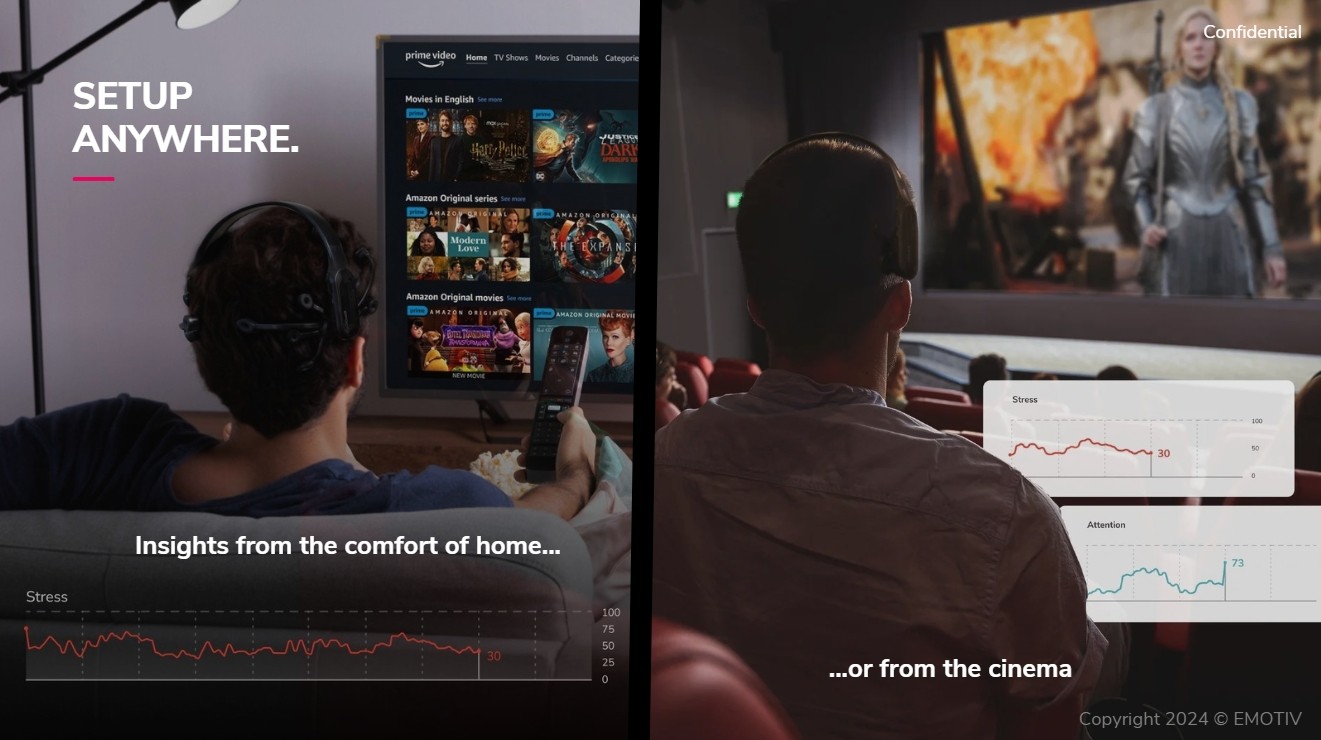
In the context of a film screener or movie screener, EEG can:
Track changes in attention across scenes
Identify patterns associated with engagement
Capture shifts in cognitive effort during complex sequences
Provide continuous data synchronized with video playback
Direct answer:
EEG enables continuous, scene-by-scene measurement of audience engagement, offering a level of detail not available through surveys alone.
Research in film and neuroscience suggests that synchronized neural responses across viewers can indicate strong narrative engagement (Hasson et al., 2008; Dmochowski et al., 2014).
The shift toward real-time audience insight
Audience testing is expanding to include methods that capture responses as they occur.
This supports:
Scene-level and frame-level analysis
Identification of engagement peaks and drop-offs
Comparison between different edits or versions of content
Instead of relying solely on what viewers remember, teams can analyze how audiences responded throughout the viewing experience.
Key challenges in EEG-based audience testing
While EEG provides valuable insight, traditional implementations introduce practical challenges.
1. Controlled testing environments
Many EEG setups require lab conditions, which can limit how naturally audiences experience content.
2. Limited scalability
Complex setup and cost can restrict studies to smaller sample sizes.
3. Data interpretation
EEG data requires processing and analysis before it becomes actionable, which can create barriers for production teams.
4. Fragmented workflows
Audience testing workflows often rely on multiple systems for:
Data collection
Synchronization with video
Analysis and visualization
This fragmentation can slow down decision-making during production and marketing cycles.
How EEG supports modern audience testing workflows
Recent advances in EEG technology have made it easier to integrate cognitive data into audience testing.
A structured workflow typically includes:
Presenting content to participants
Collecting synchronized EEG data during viewing
Aligning data with specific scenes or moments
Analyzing patterns across participants
This approach allows teams to compare:
What audiences experienced in real time
What audiences reported after viewing
The result is a more complete understanding of audience response.
How Emotiv Studio supports audience testing
Emotiv Studio supports audience testing workflows by connecting EEG data collection, synchronization, and analysis within a single environment.
1. Audience testing in real-world environments
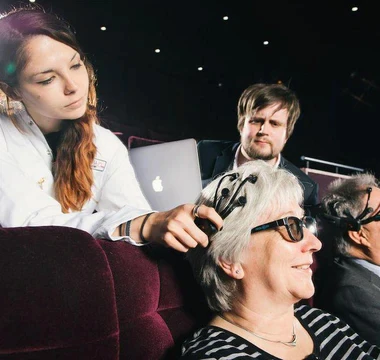
Portable EEG systems enable testing outside traditional lab settings. Viewers can watch content in environments that more closely reflect real viewing conditions.
2. Time-synchronized engagement analysis
EEG data can be aligned with video playback to:
Identify where attention drops
Detect patterns of engagement across scenes
Analyze cognitive response over time
This helps answer questions such as:
Which scenes sustain attention?
Where does engagement decline?
3. Scalable audience studies
Modern workflows support:
Multi-participant testing
Faster setup and deployment
Broader audience sampling
This expands audience testing beyond small, controlled groups.
4. Integrated visualization and export
EEG data can be visualized within the platform and exported for deeper analysis in tools such as MATLAB or EEGLAB.
This reduces reliance on disconnected systems and supports more efficient analysis.
5. Faster creative iteration
Audience testing with EEG supports faster feedback cycles, enabling:
Comparison of different edits
Trailer optimization before release
Data-informed decisions earlier in production
Real-world applications in film and TV
Trailer testing and optimization
EEG can help identify which moments capture attention and sustain engagement, supporting more effective trailer construction.
Research suggests neural data can be used to predict audience preference and content recall (Barnett & Cerf, 2017).
Editing and pacing decisions
EEG data can reveal how audiences respond to:
Scene transitions
Narrative pacing
Visual and audio elements
Studies show that editing styles can influence brain activity patterns during viewing (Dmochowski et al., 2012).
Advertising and content integration
EEG has been used to measure audience responses to advertisements embedded within film and television content, identifying attention-related activity (Vecchiato et al., 2009).
Audience segmentation
Different audience groups may respond differently to the same content.
EEG enables:
Comparison across demographics
Identification of audience alignment
More informed distribution and marketing strategies
Why audience testing is evolving
Several factors are driving changes in audience testing methods.
1. Demand for measurable engagement
Studios increasingly seek objective metrics to complement traditional feedback.
2. Growth of streaming platforms
Content competition has increased the need to understand audience attention at a more detailed level.
3. Advances in EEG technology
Modern systems support:
Portable data collection
Faster setup
Integration with production workflows
The bottom line
Audience testing in film and television is expanding beyond surveys and focus groups.
EEG enables:
Continuous measurement of audience engagement
Scene-level insight into viewer response
Data-informed creative and marketing decisions
By integrating cognitive data into existing workflows, teams can better understand how audiences experience content in real time.
Explore audience testing with EEG
Emotiv Studio supports audience testing workflows for film, television, and media production by enabling structured experiments and synchronized data collection.
Capture real-time audience response
Analyze engagement across scenes
Integrate insights into production and marketing decisions
Explore Emotiv Studio
See how EEG fits into your audience testing workflow
Audience testing plays a central role in how film and television content is evaluated before release. From early cuts to final edits, studios and production teams rely on audience feedback to understand engagement, narrative clarity, and overall viewer response.
Most audience testing methods are built around surveys, focus groups, and test screenings. These approaches provide valuable insight, but they primarily capture what viewers report after the experience rather than how they respond in real time.
As expectations for measurable engagement continue to grow, teams are expanding their data collection methods to include real-time cognitive signals. One approach gaining attention is the use of electroencephalography (EEG) to better understand how audiences experience content as it unfolds.
What is audience testing in film and TV?
Audience testing in film and television evaluates how viewers respond to content such as trailers, scenes, episodes, or full-length productions.
Studios and production teams use audience testing to assess:
Engagement and attention
Emotional response
Narrative clarity
Viewer preference
Traditional methods rely on surveys, focus groups, and test screenings. While valuable, these approaches primarily capture feedback after the viewing experience.
They do not always reflect how audiences respond in real time.
Audience testing is evolving toward more advanced data collection methods that capture cognitive responses as they happen during viewing. This approach is often referred to as cognitive audience testing.
Why traditional audience testing has limitations
Audience testing has long been a standard part of the production and distribution process. However, commonly used methods introduce several challenges.
1. Recall bias
Viewers are typically asked to summarize their experience after watching content. This can lead to incomplete or inaccurate feedback.
2. Social influence
Group settings can shape responses, particularly in focus groups or live test screenings. This dynamic can influence how viewers describe their experience.
3. Limited time resolution
Post-viewing surveys cannot identify which specific moments influenced engagement, confusion, or attention.
As a result, teams often rely on generalized feedback rather than precise, moment-by-moment insight.
What EEG adds to audience testing
Electroencephalography (EEG) measures brain activity in real time during content viewing.
In the context of a film screener or movie screener, EEG can:
Track changes in attention across scenes
Identify patterns associated with engagement
Capture shifts in cognitive effort during complex sequences
Provide continuous data synchronized with video playback
Direct answer:
EEG enables continuous, scene-by-scene measurement of audience engagement, offering a level of detail not available through surveys alone.
Research in film and neuroscience suggests that synchronized neural responses across viewers can indicate strong narrative engagement (Hasson et al., 2008; Dmochowski et al., 2014).
The shift toward real-time audience insight
Audience testing is expanding to include methods that capture responses as they occur.
This supports:
Scene-level and frame-level analysis
Identification of engagement peaks and drop-offs
Comparison between different edits or versions of content
Instead of relying solely on what viewers remember, teams can analyze how audiences responded throughout the viewing experience.
Key challenges in EEG-based audience testing
While EEG provides valuable insight, traditional implementations introduce practical challenges.
1. Controlled testing environments
Many EEG setups require lab conditions, which can limit how naturally audiences experience content.
2. Limited scalability
Complex setup and cost can restrict studies to smaller sample sizes.
3. Data interpretation
EEG data requires processing and analysis before it becomes actionable, which can create barriers for production teams.
4. Fragmented workflows
Audience testing workflows often rely on multiple systems for:
Data collection
Synchronization with video
Analysis and visualization
This fragmentation can slow down decision-making during production and marketing cycles.
How EEG supports modern audience testing workflows
Recent advances in EEG technology have made it easier to integrate cognitive data into audience testing.
A structured workflow typically includes:
Presenting content to participants
Collecting synchronized EEG data during viewing
Aligning data with specific scenes or moments
Analyzing patterns across participants
This approach allows teams to compare:
What audiences experienced in real time
What audiences reported after viewing
The result is a more complete understanding of audience response.
How Emotiv Studio supports audience testing
Emotiv Studio supports audience testing workflows by connecting EEG data collection, synchronization, and analysis within a single environment.
1. Audience testing in real-world environments
Portable EEG systems enable testing outside traditional lab settings. Viewers can watch content in environments that more closely reflect real viewing conditions.
2. Time-synchronized engagement analysis
EEG data can be aligned with video playback to:
Identify where attention drops
Detect patterns of engagement across scenes
Analyze cognitive response over time
This helps answer questions such as:
Which scenes sustain attention?
Where does engagement decline?
3. Scalable audience studies
Modern workflows support:
Multi-participant testing
Faster setup and deployment
Broader audience sampling
This expands audience testing beyond small, controlled groups.
4. Integrated visualization and export
EEG data can be visualized within the platform and exported for deeper analysis in tools such as MATLAB or EEGLAB.
This reduces reliance on disconnected systems and supports more efficient analysis.
5. Faster creative iteration
Audience testing with EEG supports faster feedback cycles, enabling:
Comparison of different edits
Trailer optimization before release
Data-informed decisions earlier in production
Real-world applications in film and TV
Trailer testing and optimization
EEG can help identify which moments capture attention and sustain engagement, supporting more effective trailer construction.
Research suggests neural data can be used to predict audience preference and content recall (Barnett & Cerf, 2017).
Editing and pacing decisions
EEG data can reveal how audiences respond to:
Scene transitions
Narrative pacing
Visual and audio elements
Studies show that editing styles can influence brain activity patterns during viewing (Dmochowski et al., 2012).
Advertising and content integration
EEG has been used to measure audience responses to advertisements embedded within film and television content, identifying attention-related activity (Vecchiato et al., 2009).
Audience segmentation
Different audience groups may respond differently to the same content.
EEG enables:
Comparison across demographics
Identification of audience alignment
More informed distribution and marketing strategies
Why audience testing is evolving
Several factors are driving changes in audience testing methods.
1. Demand for measurable engagement
Studios increasingly seek objective metrics to complement traditional feedback.
2. Growth of streaming platforms
Content competition has increased the need to understand audience attention at a more detailed level.
3. Advances in EEG technology
Modern systems support:
Portable data collection
Faster setup
Integration with production workflows
The bottom line
Audience testing in film and television is expanding beyond surveys and focus groups.
EEG enables:
Continuous measurement of audience engagement
Scene-level insight into viewer response
Data-informed creative and marketing decisions
By integrating cognitive data into existing workflows, teams can better understand how audiences experience content in real time.
Explore audience testing with EEG
Emotiv Studio supports audience testing workflows for film, television, and media production by enabling structured experiments and synchronized data collection.
Capture real-time audience response
Analyze engagement across scenes
Integrate insights into production and marketing decisions
Explore Emotiv Studio
See how EEG fits into your audience testing workflow
Audience testing plays a central role in how film and television content is evaluated before release. From early cuts to final edits, studios and production teams rely on audience feedback to understand engagement, narrative clarity, and overall viewer response.
Most audience testing methods are built around surveys, focus groups, and test screenings. These approaches provide valuable insight, but they primarily capture what viewers report after the experience rather than how they respond in real time.
As expectations for measurable engagement continue to grow, teams are expanding their data collection methods to include real-time cognitive signals. One approach gaining attention is the use of electroencephalography (EEG) to better understand how audiences experience content as it unfolds.
What is audience testing in film and TV?
Audience testing in film and television evaluates how viewers respond to content such as trailers, scenes, episodes, or full-length productions.
Studios and production teams use audience testing to assess:
Engagement and attention
Emotional response
Narrative clarity
Viewer preference
Traditional methods rely on surveys, focus groups, and test screenings. While valuable, these approaches primarily capture feedback after the viewing experience.
They do not always reflect how audiences respond in real time.
Audience testing is evolving toward more advanced data collection methods that capture cognitive responses as they happen during viewing. This approach is often referred to as cognitive audience testing.
Why traditional audience testing has limitations
Audience testing has long been a standard part of the production and distribution process. However, commonly used methods introduce several challenges.
1. Recall bias
Viewers are typically asked to summarize their experience after watching content. This can lead to incomplete or inaccurate feedback.
2. Social influence
Group settings can shape responses, particularly in focus groups or live test screenings. This dynamic can influence how viewers describe their experience.
3. Limited time resolution
Post-viewing surveys cannot identify which specific moments influenced engagement, confusion, or attention.
As a result, teams often rely on generalized feedback rather than precise, moment-by-moment insight.
What EEG adds to audience testing
Electroencephalography (EEG) measures brain activity in real time during content viewing.
In the context of a film screener or movie screener, EEG can:
Track changes in attention across scenes
Identify patterns associated with engagement
Capture shifts in cognitive effort during complex sequences
Provide continuous data synchronized with video playback
Direct answer:
EEG enables continuous, scene-by-scene measurement of audience engagement, offering a level of detail not available through surveys alone.
Research in film and neuroscience suggests that synchronized neural responses across viewers can indicate strong narrative engagement (Hasson et al., 2008; Dmochowski et al., 2014).
The shift toward real-time audience insight
Audience testing is expanding to include methods that capture responses as they occur.
This supports:
Scene-level and frame-level analysis
Identification of engagement peaks and drop-offs
Comparison between different edits or versions of content
Instead of relying solely on what viewers remember, teams can analyze how audiences responded throughout the viewing experience.
Key challenges in EEG-based audience testing
While EEG provides valuable insight, traditional implementations introduce practical challenges.
1. Controlled testing environments
Many EEG setups require lab conditions, which can limit how naturally audiences experience content.
2. Limited scalability
Complex setup and cost can restrict studies to smaller sample sizes.
3. Data interpretation
EEG data requires processing and analysis before it becomes actionable, which can create barriers for production teams.
4. Fragmented workflows
Audience testing workflows often rely on multiple systems for:
Data collection
Synchronization with video
Analysis and visualization
This fragmentation can slow down decision-making during production and marketing cycles.
How EEG supports modern audience testing workflows
Recent advances in EEG technology have made it easier to integrate cognitive data into audience testing.
A structured workflow typically includes:
Presenting content to participants
Collecting synchronized EEG data during viewing
Aligning data with specific scenes or moments
Analyzing patterns across participants
This approach allows teams to compare:
What audiences experienced in real time
What audiences reported after viewing
The result is a more complete understanding of audience response.
How Emotiv Studio supports audience testing
Emotiv Studio supports audience testing workflows by connecting EEG data collection, synchronization, and analysis within a single environment.
1. Audience testing in real-world environments
Portable EEG systems enable testing outside traditional lab settings. Viewers can watch content in environments that more closely reflect real viewing conditions.
2. Time-synchronized engagement analysis
EEG data can be aligned with video playback to:
Identify where attention drops
Detect patterns of engagement across scenes
Analyze cognitive response over time
This helps answer questions such as:
Which scenes sustain attention?
Where does engagement decline?
3. Scalable audience studies
Modern workflows support:
Multi-participant testing
Faster setup and deployment
Broader audience sampling
This expands audience testing beyond small, controlled groups.
4. Integrated visualization and export
EEG data can be visualized within the platform and exported for deeper analysis in tools such as MATLAB or EEGLAB.
This reduces reliance on disconnected systems and supports more efficient analysis.
5. Faster creative iteration
Audience testing with EEG supports faster feedback cycles, enabling:
Comparison of different edits
Trailer optimization before release
Data-informed decisions earlier in production
Real-world applications in film and TV
Trailer testing and optimization
EEG can help identify which moments capture attention and sustain engagement, supporting more effective trailer construction.
Research suggests neural data can be used to predict audience preference and content recall (Barnett & Cerf, 2017).
Editing and pacing decisions
EEG data can reveal how audiences respond to:
Scene transitions
Narrative pacing
Visual and audio elements
Studies show that editing styles can influence brain activity patterns during viewing (Dmochowski et al., 2012).
Advertising and content integration
EEG has been used to measure audience responses to advertisements embedded within film and television content, identifying attention-related activity (Vecchiato et al., 2009).
Audience segmentation
Different audience groups may respond differently to the same content.
EEG enables:
Comparison across demographics
Identification of audience alignment
More informed distribution and marketing strategies
Why audience testing is evolving
Several factors are driving changes in audience testing methods.
1. Demand for measurable engagement
Studios increasingly seek objective metrics to complement traditional feedback.
2. Growth of streaming platforms
Content competition has increased the need to understand audience attention at a more detailed level.
3. Advances in EEG technology
Modern systems support:
Portable data collection
Faster setup
Integration with production workflows
The bottom line
Audience testing in film and television is expanding beyond surveys and focus groups.
EEG enables:
Continuous measurement of audience engagement
Scene-level insight into viewer response
Data-informed creative and marketing decisions
By integrating cognitive data into existing workflows, teams can better understand how audiences experience content in real time.
Explore audience testing with EEG
Emotiv Studio supports audience testing workflows for film, television, and media production by enabling structured experiments and synchronized data collection.
Capture real-time audience response
Analyze engagement across scenes
Integrate insights into production and marketing decisions
Explore Emotiv Studio
See how EEG fits into your audience testing workflow
Continue reading