Attention Metrics for Creative Performance Analysis
H.B. Duran
Updated on
May 19, 2026
Attention Metrics for Creative Performance Analysis
H.B. Duran
Updated on
May 19, 2026
Attention Metrics for Creative Performance Analysis
H.B. Duran
Updated on
May 19, 2026
Creative performance analysis has evolved far beyond click-through rates and impression counts. Modern marketing teams increasingly rely on AI-driven creative performance analysis, neuroanalytics, behavioral testing, and attention metrics to evaluate how audiences cognitively and emotionally respond to advertising before campaigns scale.
In highly competitive digital ecosystems, attention quality has become one of the strongest indicators of creative effectiveness. Brands can buy impressions, but they cannot assume audiences are meaningfully engaged simply because content appeared on a screen.
This shift is changing how organizations evaluate advertising, video content, landing pages, social campaigns, and digital experiences. Rather than focusing exclusively on post-campaign outcomes, teams increasingly seek to understand how audiences experience creative in real time.
Why Attention Metrics Matter
Traditional campaign metrics reveal outcomes after attention has already succeeded or failed. Brands may see impressions, clicks, and conversions without understanding which creative moments generated engagement or where audience attention collapsed.
Consider YouTube's audience-retention reports. Creators can see precisely where viewers stop watching, skip ahead, or abandon content. Netflix uses similar engagement signals to understand viewer behavior across programming. These metrics provide valuable clues about audience interest, but they do not fully explain the cognitive and emotional factors driving those behaviors.
Attention metrics help bridge that gap.
Rather than simply measuring whether content was viewed, organizations can evaluate whether audiences noticed key messages, processed information, maintained engagement, retained content, and emotionally responded to the experience.
This distinction becomes increasingly important as audiences become more effective at filtering advertising and promotional content.
AI-Driven Creative Performance Analysis
AI-driven creative performance analysis combines behavioral data, attention measurement, and machine learning workflows to evaluate campaign effectiveness more efficiently.
Major platforms already use AI extensively to optimize content delivery. TikTok's recommendation engine continuously analyzes engagement patterns to determine which content receives broader distribution. Meta uses machine learning to predict content relevance and advertising performance.
The challenge for marketers is understanding why certain creative assets outperform others.
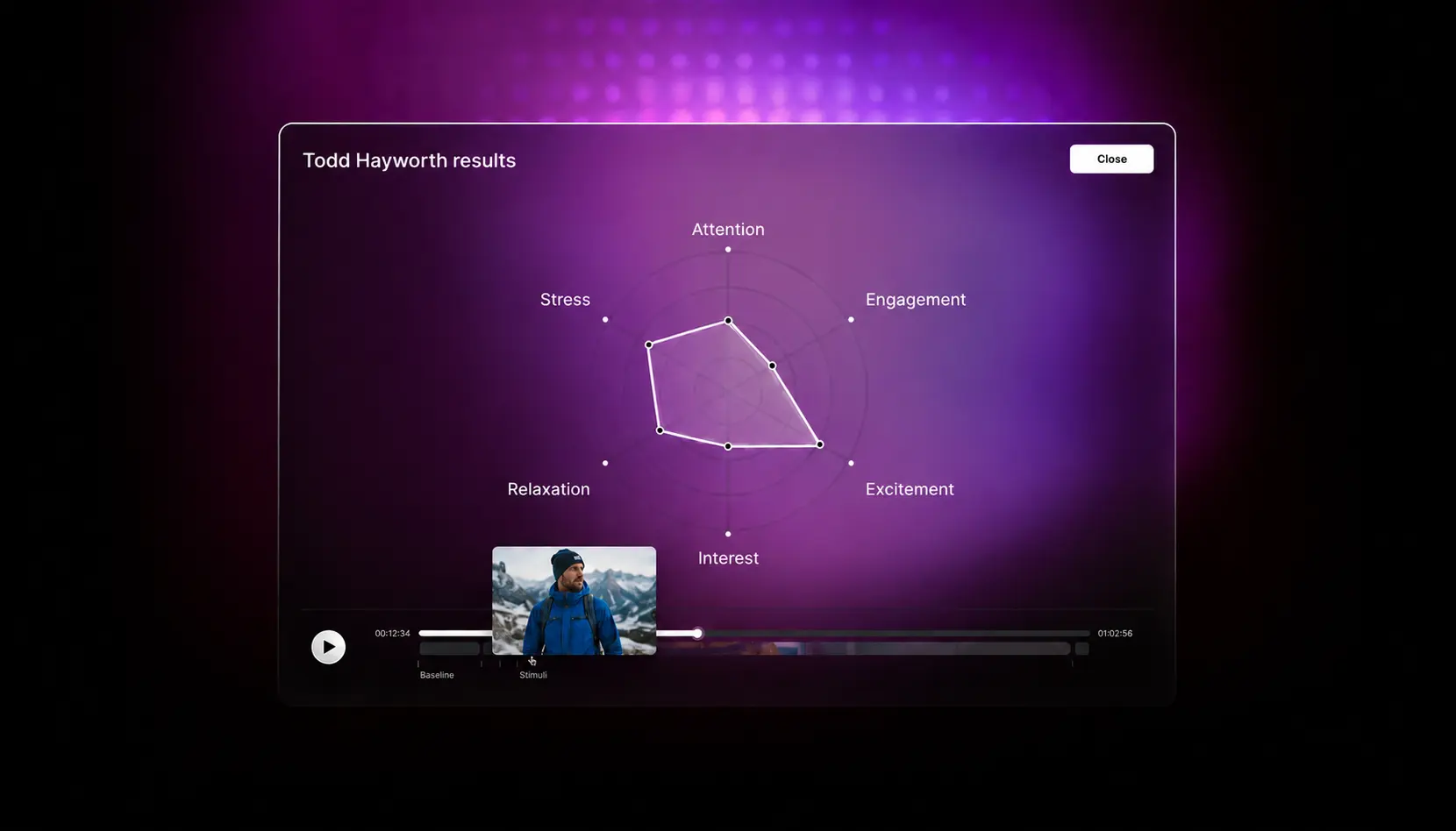
Emotiv Studio, powered by EmotivIQ™ can align brain-response data to moment-by-moment content exposure, helping organizations identify attention spikes, engagement decline, emotional peaks, and sustained audience response throughout a creative experience.
Rather than relying solely on post-launch metrics, teams can evaluate factors such as pacing, message clarity, brand visibility, CTA timing, and emotional engagement before scaling media spend.

Above: a moment-to-moment cognitive measurement inside Emotiv Studio that indicates user attention while viewing ad creative.
Attention Quality vs. Visibility
One of the most important concepts in modern creative analysis is the difference between visibility and meaningful attention.
A consumer may technically see an advertisement without actively processing its message. This phenomenon is closely related to banner blindness, ad fatigue, and selective attention, all of which reduce the effectiveness of digital campaigns.
Research from Nielsen Norman Group has repeatedly demonstrated that users routinely ignore interface elements and advertising placements that resemble promotional content, even when those elements remain fully visible.
This means creative performance cannot be evaluated solely by whether content appeared on screen.
Instead, organizations increasingly focus on attention quality: whether audiences noticed the content, processed the message, maintained engagement, retained information, and formed meaningful emotional connections.
Using EEG for Creative Testing
EEG data supports creative performance analysis by measuring cognitive and emotional responses during content exposure.
Organizations increasingly use neuroscience-based audience research to evaluate attention, engagement, interest, cognitive stress, emotional intensity, and sustained focus throughout advertising experiences.
This helps identify which creative moments resonate and which create fatigue or disengagement.
For example, a product demonstration may generate strong engagement early in a video before attention begins declining during technical explanations. A brand story may create emotional peaks that traditional analytics never reveal.
Rather than relying exclusively on stated preference, teams gain visibility into how audiences respond as the experience unfolds.
Creative Fatigue and Audience Saturation
Creative fatigue occurs when audiences repeatedly encounter similar content patterns. Even successful campaigns eventually experience declining engagement as repetition reduces novelty.
Brands encounter this challenge constantly.
Meta advertisers often see performance decline after prolonged exposure to the same creative assets. Streaming platforms frequently refresh promotional content because audience attention decreases when visual patterns become overly familiar.
Attention metrics help identify when fatigue begins, which creative sequences lose engagement, how pacing affects retention, and whether repetition weakens emotional impact.
This supports faster creative refresh cycles and more efficient media allocation.
Video Attention Analysis
Video content presents unique attention challenges because audience engagement changes continuously throughout playback.
YouTube, Netflix, TikTok, and streaming advertisers all rely heavily on audience-retention analysis to understand where engagement rises and falls.
However, retention curves only reveal behavioral outcomes.
Neuroanalytics adds another layer by helping teams evaluate opening-hook performance, emotional response peaks, attention sustainability, brand visibility timing, drop-off moments, and CTA effectiveness.
This provides a more complete understanding of how audiences experience video content rather than simply whether they completed it.

Comparing Creative Variants
Modern creative testing increasingly compares multiple campaign variants using neuroscience-based measures.
Marketing teams may evaluate different headline treatments, pacing structures, music selections, motion graphics, CTA placements, visual styles, and color systems.
For example, two advertisements may generate similar click-through rates while producing dramatically different attention patterns. One version may sustain engagement consistently throughout the experience, while another experiences significant drop-off before key messaging appears.
Attention metrics help organizations identify these differences before launch.
This supports more confident creative decision-making and reduces uncertainty around campaign investment.
Why Traditional Metrics Aren't Enough
Traditional campaign metrics remain valuable, but they only tell part of the story.
Clicks, conversions, view-through rates, and impressions reveal what audiences did after exposure. They rarely explain how audiences emotionally experienced the content itself.
A campaign may drive conversions while generating cognitive stress. Another may create strong emotional engagement but fail to deliver a clear call to action. Both outcomes require different optimization strategies.
This is why leading organizations increasingly combine behavioral analytics with neuroscience-informed audience research.
Applying Attention Metrics to Next-Generation Creative Research
Attention metrics have become essential for modern creative performance analysis because they help explain the relationship between visibility, engagement, emotional response, and audience behavior.
By combining AI-driven creative performance analysis, neuroanalytics, behavioral research, and attention measurement, organizations can better understand how audiences experience advertising before campaigns scale.
This supports stronger creative optimization, more effective media investment, improved audience engagement, and deeper insight into the cognitive factors that influence campaign performance.
As competition for attention continues to intensify, organizations that understand audience response earlier in the creative process gain a significant strategic advantage.
Conclusion
Attention metrics have become a critical component of modern creative performance analysis. Traditional campaign analytics reveal outcomes, but they rarely explain why audiences emotionally connected, disengaged, or ignored content.
Brands such as Netflix, TikTok, Meta, and YouTube have demonstrated the value of measuring audience attention at increasingly granular levels. The next evolution is understanding the cognitive and emotional response behind those behaviors.
Learn more about how brand marketing leaders use neurotechnology to improve their campaigns.
Creative performance analysis has evolved far beyond click-through rates and impression counts. Modern marketing teams increasingly rely on AI-driven creative performance analysis, neuroanalytics, behavioral testing, and attention metrics to evaluate how audiences cognitively and emotionally respond to advertising before campaigns scale.
In highly competitive digital ecosystems, attention quality has become one of the strongest indicators of creative effectiveness. Brands can buy impressions, but they cannot assume audiences are meaningfully engaged simply because content appeared on a screen.
This shift is changing how organizations evaluate advertising, video content, landing pages, social campaigns, and digital experiences. Rather than focusing exclusively on post-campaign outcomes, teams increasingly seek to understand how audiences experience creative in real time.
Why Attention Metrics Matter
Traditional campaign metrics reveal outcomes after attention has already succeeded or failed. Brands may see impressions, clicks, and conversions without understanding which creative moments generated engagement or where audience attention collapsed.
Consider YouTube's audience-retention reports. Creators can see precisely where viewers stop watching, skip ahead, or abandon content. Netflix uses similar engagement signals to understand viewer behavior across programming. These metrics provide valuable clues about audience interest, but they do not fully explain the cognitive and emotional factors driving those behaviors.
Attention metrics help bridge that gap.
Rather than simply measuring whether content was viewed, organizations can evaluate whether audiences noticed key messages, processed information, maintained engagement, retained content, and emotionally responded to the experience.
This distinction becomes increasingly important as audiences become more effective at filtering advertising and promotional content.
AI-Driven Creative Performance Analysis
AI-driven creative performance analysis combines behavioral data, attention measurement, and machine learning workflows to evaluate campaign effectiveness more efficiently.
Major platforms already use AI extensively to optimize content delivery. TikTok's recommendation engine continuously analyzes engagement patterns to determine which content receives broader distribution. Meta uses machine learning to predict content relevance and advertising performance.
The challenge for marketers is understanding why certain creative assets outperform others.
Emotiv Studio, powered by EmotivIQ™ can align brain-response data to moment-by-moment content exposure, helping organizations identify attention spikes, engagement decline, emotional peaks, and sustained audience response throughout a creative experience.
Rather than relying solely on post-launch metrics, teams can evaluate factors such as pacing, message clarity, brand visibility, CTA timing, and emotional engagement before scaling media spend.
Above: a moment-to-moment cognitive measurement inside Emotiv Studio that indicates user attention while viewing ad creative.
Attention Quality vs. Visibility
One of the most important concepts in modern creative analysis is the difference between visibility and meaningful attention.
A consumer may technically see an advertisement without actively processing its message. This phenomenon is closely related to banner blindness, ad fatigue, and selective attention, all of which reduce the effectiveness of digital campaigns.
Research from Nielsen Norman Group has repeatedly demonstrated that users routinely ignore interface elements and advertising placements that resemble promotional content, even when those elements remain fully visible.
This means creative performance cannot be evaluated solely by whether content appeared on screen.
Instead, organizations increasingly focus on attention quality: whether audiences noticed the content, processed the message, maintained engagement, retained information, and formed meaningful emotional connections.
Using EEG for Creative Testing
EEG data supports creative performance analysis by measuring cognitive and emotional responses during content exposure.
Organizations increasingly use neuroscience-based audience research to evaluate attention, engagement, interest, cognitive stress, emotional intensity, and sustained focus throughout advertising experiences.
This helps identify which creative moments resonate and which create fatigue or disengagement.
For example, a product demonstration may generate strong engagement early in a video before attention begins declining during technical explanations. A brand story may create emotional peaks that traditional analytics never reveal.
Rather than relying exclusively on stated preference, teams gain visibility into how audiences respond as the experience unfolds.
Creative Fatigue and Audience Saturation
Creative fatigue occurs when audiences repeatedly encounter similar content patterns. Even successful campaigns eventually experience declining engagement as repetition reduces novelty.
Brands encounter this challenge constantly.
Meta advertisers often see performance decline after prolonged exposure to the same creative assets. Streaming platforms frequently refresh promotional content because audience attention decreases when visual patterns become overly familiar.
Attention metrics help identify when fatigue begins, which creative sequences lose engagement, how pacing affects retention, and whether repetition weakens emotional impact.
This supports faster creative refresh cycles and more efficient media allocation.
Video Attention Analysis
Video content presents unique attention challenges because audience engagement changes continuously throughout playback.
YouTube, Netflix, TikTok, and streaming advertisers all rely heavily on audience-retention analysis to understand where engagement rises and falls.
However, retention curves only reveal behavioral outcomes.
Neuroanalytics adds another layer by helping teams evaluate opening-hook performance, emotional response peaks, attention sustainability, brand visibility timing, drop-off moments, and CTA effectiveness.
This provides a more complete understanding of how audiences experience video content rather than simply whether they completed it.
Comparing Creative Variants
Modern creative testing increasingly compares multiple campaign variants using neuroscience-based measures.
Marketing teams may evaluate different headline treatments, pacing structures, music selections, motion graphics, CTA placements, visual styles, and color systems.
For example, two advertisements may generate similar click-through rates while producing dramatically different attention patterns. One version may sustain engagement consistently throughout the experience, while another experiences significant drop-off before key messaging appears.
Attention metrics help organizations identify these differences before launch.
This supports more confident creative decision-making and reduces uncertainty around campaign investment.
Why Traditional Metrics Aren't Enough
Traditional campaign metrics remain valuable, but they only tell part of the story.
Clicks, conversions, view-through rates, and impressions reveal what audiences did after exposure. They rarely explain how audiences emotionally experienced the content itself.
A campaign may drive conversions while generating cognitive stress. Another may create strong emotional engagement but fail to deliver a clear call to action. Both outcomes require different optimization strategies.
This is why leading organizations increasingly combine behavioral analytics with neuroscience-informed audience research.
Applying Attention Metrics to Next-Generation Creative Research
Attention metrics have become essential for modern creative performance analysis because they help explain the relationship between visibility, engagement, emotional response, and audience behavior.
By combining AI-driven creative performance analysis, neuroanalytics, behavioral research, and attention measurement, organizations can better understand how audiences experience advertising before campaigns scale.
This supports stronger creative optimization, more effective media investment, improved audience engagement, and deeper insight into the cognitive factors that influence campaign performance.
As competition for attention continues to intensify, organizations that understand audience response earlier in the creative process gain a significant strategic advantage.
Conclusion
Attention metrics have become a critical component of modern creative performance analysis. Traditional campaign analytics reveal outcomes, but they rarely explain why audiences emotionally connected, disengaged, or ignored content.
Brands such as Netflix, TikTok, Meta, and YouTube have demonstrated the value of measuring audience attention at increasingly granular levels. The next evolution is understanding the cognitive and emotional response behind those behaviors.
Learn more about how brand marketing leaders use neurotechnology to improve their campaigns.
Creative performance analysis has evolved far beyond click-through rates and impression counts. Modern marketing teams increasingly rely on AI-driven creative performance analysis, neuroanalytics, behavioral testing, and attention metrics to evaluate how audiences cognitively and emotionally respond to advertising before campaigns scale.
In highly competitive digital ecosystems, attention quality has become one of the strongest indicators of creative effectiveness. Brands can buy impressions, but they cannot assume audiences are meaningfully engaged simply because content appeared on a screen.
This shift is changing how organizations evaluate advertising, video content, landing pages, social campaigns, and digital experiences. Rather than focusing exclusively on post-campaign outcomes, teams increasingly seek to understand how audiences experience creative in real time.
Why Attention Metrics Matter
Traditional campaign metrics reveal outcomes after attention has already succeeded or failed. Brands may see impressions, clicks, and conversions without understanding which creative moments generated engagement or where audience attention collapsed.
Consider YouTube's audience-retention reports. Creators can see precisely where viewers stop watching, skip ahead, or abandon content. Netflix uses similar engagement signals to understand viewer behavior across programming. These metrics provide valuable clues about audience interest, but they do not fully explain the cognitive and emotional factors driving those behaviors.
Attention metrics help bridge that gap.
Rather than simply measuring whether content was viewed, organizations can evaluate whether audiences noticed key messages, processed information, maintained engagement, retained content, and emotionally responded to the experience.
This distinction becomes increasingly important as audiences become more effective at filtering advertising and promotional content.
AI-Driven Creative Performance Analysis
AI-driven creative performance analysis combines behavioral data, attention measurement, and machine learning workflows to evaluate campaign effectiveness more efficiently.
Major platforms already use AI extensively to optimize content delivery. TikTok's recommendation engine continuously analyzes engagement patterns to determine which content receives broader distribution. Meta uses machine learning to predict content relevance and advertising performance.
The challenge for marketers is understanding why certain creative assets outperform others.
Emotiv Studio, powered by EmotivIQ™ can align brain-response data to moment-by-moment content exposure, helping organizations identify attention spikes, engagement decline, emotional peaks, and sustained audience response throughout a creative experience.
Rather than relying solely on post-launch metrics, teams can evaluate factors such as pacing, message clarity, brand visibility, CTA timing, and emotional engagement before scaling media spend.
Above: a moment-to-moment cognitive measurement inside Emotiv Studio that indicates user attention while viewing ad creative.
Attention Quality vs. Visibility
One of the most important concepts in modern creative analysis is the difference between visibility and meaningful attention.
A consumer may technically see an advertisement without actively processing its message. This phenomenon is closely related to banner blindness, ad fatigue, and selective attention, all of which reduce the effectiveness of digital campaigns.
Research from Nielsen Norman Group has repeatedly demonstrated that users routinely ignore interface elements and advertising placements that resemble promotional content, even when those elements remain fully visible.
This means creative performance cannot be evaluated solely by whether content appeared on screen.
Instead, organizations increasingly focus on attention quality: whether audiences noticed the content, processed the message, maintained engagement, retained information, and formed meaningful emotional connections.
Using EEG for Creative Testing
EEG data supports creative performance analysis by measuring cognitive and emotional responses during content exposure.
Organizations increasingly use neuroscience-based audience research to evaluate attention, engagement, interest, cognitive stress, emotional intensity, and sustained focus throughout advertising experiences.
This helps identify which creative moments resonate and which create fatigue or disengagement.
For example, a product demonstration may generate strong engagement early in a video before attention begins declining during technical explanations. A brand story may create emotional peaks that traditional analytics never reveal.
Rather than relying exclusively on stated preference, teams gain visibility into how audiences respond as the experience unfolds.
Creative Fatigue and Audience Saturation
Creative fatigue occurs when audiences repeatedly encounter similar content patterns. Even successful campaigns eventually experience declining engagement as repetition reduces novelty.
Brands encounter this challenge constantly.
Meta advertisers often see performance decline after prolonged exposure to the same creative assets. Streaming platforms frequently refresh promotional content because audience attention decreases when visual patterns become overly familiar.
Attention metrics help identify when fatigue begins, which creative sequences lose engagement, how pacing affects retention, and whether repetition weakens emotional impact.
This supports faster creative refresh cycles and more efficient media allocation.
Video Attention Analysis
Video content presents unique attention challenges because audience engagement changes continuously throughout playback.
YouTube, Netflix, TikTok, and streaming advertisers all rely heavily on audience-retention analysis to understand where engagement rises and falls.
However, retention curves only reveal behavioral outcomes.
Neuroanalytics adds another layer by helping teams evaluate opening-hook performance, emotional response peaks, attention sustainability, brand visibility timing, drop-off moments, and CTA effectiveness.
This provides a more complete understanding of how audiences experience video content rather than simply whether they completed it.
Comparing Creative Variants
Modern creative testing increasingly compares multiple campaign variants using neuroscience-based measures.
Marketing teams may evaluate different headline treatments, pacing structures, music selections, motion graphics, CTA placements, visual styles, and color systems.
For example, two advertisements may generate similar click-through rates while producing dramatically different attention patterns. One version may sustain engagement consistently throughout the experience, while another experiences significant drop-off before key messaging appears.
Attention metrics help organizations identify these differences before launch.
This supports more confident creative decision-making and reduces uncertainty around campaign investment.
Why Traditional Metrics Aren't Enough
Traditional campaign metrics remain valuable, but they only tell part of the story.
Clicks, conversions, view-through rates, and impressions reveal what audiences did after exposure. They rarely explain how audiences emotionally experienced the content itself.
A campaign may drive conversions while generating cognitive stress. Another may create strong emotional engagement but fail to deliver a clear call to action. Both outcomes require different optimization strategies.
This is why leading organizations increasingly combine behavioral analytics with neuroscience-informed audience research.
Applying Attention Metrics to Next-Generation Creative Research
Attention metrics have become essential for modern creative performance analysis because they help explain the relationship between visibility, engagement, emotional response, and audience behavior.
By combining AI-driven creative performance analysis, neuroanalytics, behavioral research, and attention measurement, organizations can better understand how audiences experience advertising before campaigns scale.
This supports stronger creative optimization, more effective media investment, improved audience engagement, and deeper insight into the cognitive factors that influence campaign performance.
As competition for attention continues to intensify, organizations that understand audience response earlier in the creative process gain a significant strategic advantage.
Conclusion
Attention metrics have become a critical component of modern creative performance analysis. Traditional campaign analytics reveal outcomes, but they rarely explain why audiences emotionally connected, disengaged, or ignored content.
Brands such as Netflix, TikTok, Meta, and YouTube have demonstrated the value of measuring audience attention at increasingly granular levels. The next evolution is understanding the cognitive and emotional response behind those behaviors.
Learn more about how brand marketing leaders use neurotechnology to improve their campaigns.