
How EEG Improves Attention Measurement in Podcast Advertising
H.B. Duran
Updated on
Jun 11, 2026
How EEG Improves Attention Measurement in Podcast Advertising
H.B. Duran
Updated on
Jun 11, 2026
How EEG Improves Attention Measurement in Podcast Advertising
H.B. Duran
Updated on
Jun 11, 2026
As podcast advertising budgets increase, agencies and media publishers face growing pressure to demonstrate that audiences are not only hearing advertisements but actively paying attention to them. Traditional campaign metrics such as downloads, impressions, completion rates, and brand recall studies provide valuable post-exposure insights, but they often fail to capture what happens during the listening experience itself.
This measurement gap creates challenges for creative optimization, sponsorship valuation, and campaign planning. Understanding when attention rises, falls, or shifts throughout an audio advertisement can help marketers improve messaging, pacing, host-read integrations, and audience engagement strategies before campaigns go live. EEG-based testing offers a way to measure attention continuously and objectively, providing a deeper layer of context that complements conventional podcast advertising analytics.
For agencies and publishers seeking stronger evidence of creative effectiveness, neuroscience-informed testing can reveal how audiences respond to podcast advertising in real time, helping teams make more confident decisions about content, placement, and optimization.
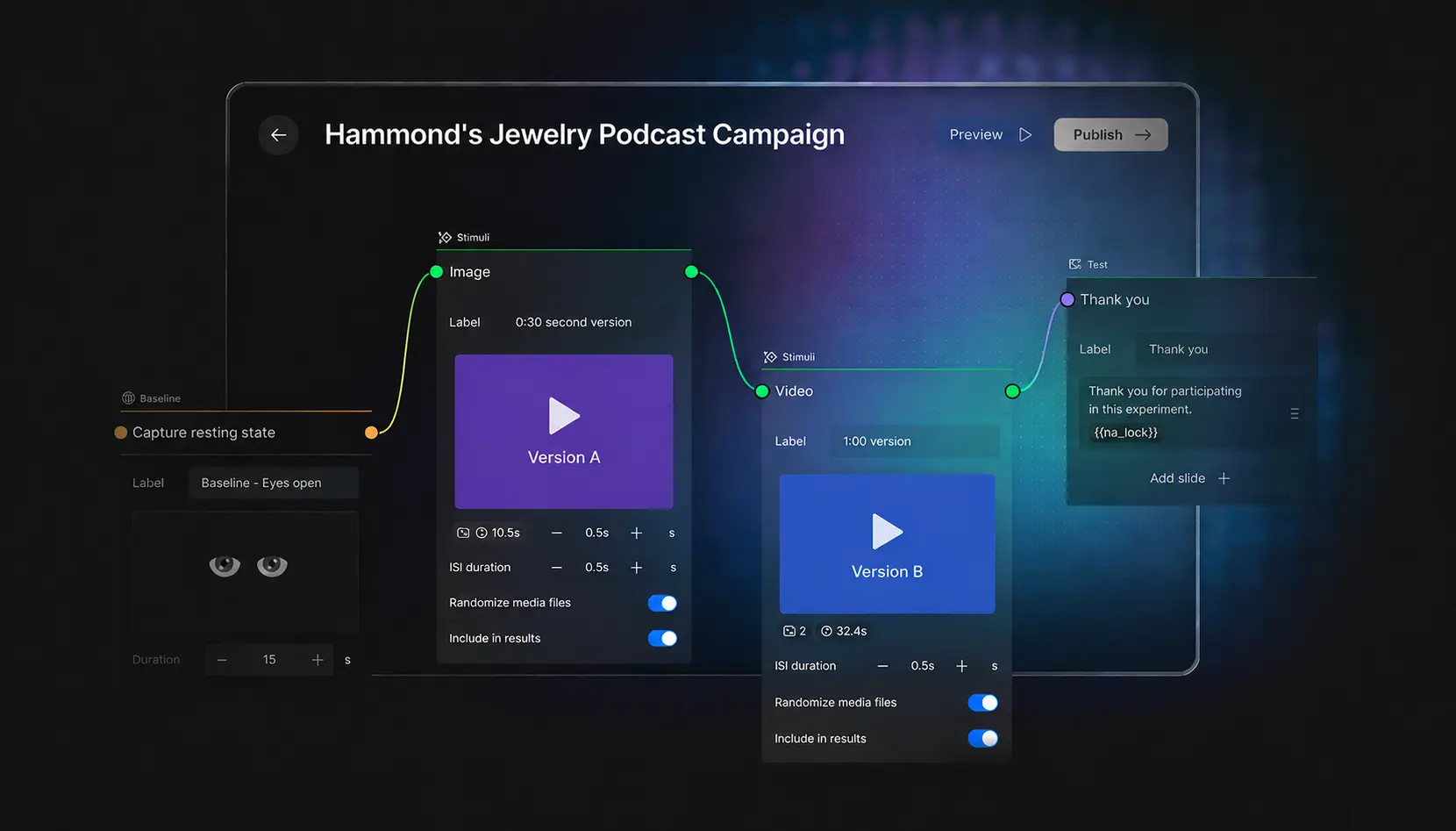
Above: An A/B test for podcast ads is built using a node-based template inside Emotiv Studio.
Key Takeaways
EEG provides continuous attention measurement during podcast advertising exposure.
Real-time audience response data helps optimize creative execution before launch.
Attention patterns can identify moments where listeners disengage or re-engage.
Neuroscience-informed testing complements traditional performance and recall metrics.
Agencies and publishers can use EEG insights to improve campaign effectiveness and sponsorship value.
The Attention Challenge in Podcast Advertising
Podcast audiences are often highly engaged with content, making the channel attractive for advertisers. However, engagement with the podcast itself does not automatically translate into engagement with advertising segments. Listeners may multitask, skip mentally during sponsorship reads, or lose focus during lengthy promotional messages.
Many campaign evaluations rely on post-exposure surveys or attribution metrics. While useful, these approaches measure outcomes after exposure rather than the cognitive processes occurring during exposure. As a result, marketers may know whether an advertisement performed well but not understand why specific moments succeeded or failed.
This limitation becomes particularly important when comparing host-read advertisements, scripted spots, dynamically inserted ads, or branded content segments. Understanding audience attention at a moment-by-moment level can provide actionable guidance for creative optimization.
Organizations exploring neuroscience-based audience testing often combine EEG with broader engagement measurement approaches such as those discussed in Emotiv’s neuromarketing research, helping teams evaluate how consumers respond across multiple media formats.
Why Traditional Metrics Often Miss Critical Signals
Podcast analytics have evolved significantly, but most measurement frameworks still focus on exposure rather than attention. Download counts indicate reach. Completion rates suggest content consumption. Brand lift studies reveal downstream outcomes. None of these metrics directly measure whether listeners were attentive during key moments.
Consider a scenario where two podcast advertisements generate similar recall scores. One advertisement may have sustained attention consistently throughout the message, while another may have experienced substantial attention drops before recovering near the conclusion. Traditional reporting may show comparable results despite fundamentally different audience experiences.
For agencies managing multiple creative variants, this distinction matters. Understanding attention dynamics can support more informed decisions regarding script structure, host delivery style, offer placement, brand mentions, and call-to-action timing.
Teams using EEG-driven audience testing frequently integrate findings alongside broader consumer research methodologies described through neuroscience-informed audience measurement frameworks to create a more complete view of campaign performance.
How EEG Measures Real-Time Attention During Audio Advertising
EEG measures electrical activity generated by the brain through non-invasive sensors placed on the scalp. In marketing research applications, EEG can help identify patterns associated with attention, engagement, cognitive workload, and emotional response during media exposure.
Unlike surveys that rely on memory after the experience has ended, EEG captures responses continuously while listeners are exposed to content. This enables researchers to examine second-by-second changes throughout a podcast advertisement.
For example, attention measurements may reveal:
Whether attention increases when a host begins a sponsorship segment.
How audiences respond to product benefits versus promotional offers.
Which storytelling elements maintain listener focus.
Where attention declines during longer advertisements.
Whether brand mentions occur during high-attention moments.
These insights allow creative teams to identify specific opportunities for optimization rather than relying solely on overall campaign outcomes.
Organizations using platforms such as Emotiv Studio can incorporate EEG data into structured testing workflows that support media evaluation and audience response analysis.
Real-World Examples of EEG-Based Advertising Measurement
EEG research has demonstrated value across a variety of media formats, including audio and advertising environments. For example, research published by Leeuwis et al. (2021) in Frontiers in Neuroscience showed how EEG-derived metrics can provide insights into engagement and attention during media experiences, highlighting opportunities that traditional self-report measures may miss.
Similarly, advertising researchers have increasingly explored neuroscience methods to understand creative effectiveness. According to Kalaganis et al. (2017), EEG measurements can reveal differences in audience responses to audio stimuli that are difficult to detect through conventional survey techniques alone. These findings support the use of continuous attention measurement when evaluating media content and promotional messaging.
Within commercial audience research environments, companies leveraging EEG-based neuromarketing methodologies have used attention and engagement metrics to compare creative executions, identify stronger-performing content variations, and improve decision-making before large-scale media investments are made.
Applying EEG Insights to Podcast Creative Optimization
For marketing agencies and publishers, the value of EEG lies not simply in measurement but in optimization. Attention data becomes most useful when connected directly to creative decisions.
When evaluating podcast advertising, teams can examine:
Host-read versus pre-recorded advertisement performance.
Attention differences across sponsorship lengths.
The impact of storytelling versus direct-response messaging.
Brand mention placement throughout the advertisement.
Audience response to different call-to-action approaches.
Because EEG data is time-synchronized with content exposure, researchers can isolate precise moments where attention changes occur. This level of granularity helps creative teams move beyond assumptions and identify evidence-based improvements.
Publishers can also use these insights to strengthen advertiser relationships. Demonstrating how sponsorship formats influence attention can support premium inventory positioning and more informed campaign recommendations.
Building a More Complete Measurement Framework
EEG should not be viewed as a replacement for existing podcast advertising metrics. Instead, it adds a complementary layer that helps explain audience behavior during exposure.
A comprehensive evaluation framework may combine:
Audience reach and download metrics.
Brand lift and recall studies.
Attribution and conversion data.
Attention and engagement measurements from EEG.
Qualitative audience feedback.
Together, these data sources provide a more complete understanding of creative effectiveness, helping marketers identify both outcomes and the cognitive processes that contribute to those outcomes.
Conclusion
As podcast advertising continues to mature, marketers need measurement approaches that move beyond exposure and recall alone. Real-time attention measurement offers agencies and publishers a deeper understanding of how audiences experience advertising content while it is happening.
By revealing attention fluctuations throughout an advertisement, EEG-based testing helps teams identify opportunities to improve creative execution, optimize sponsorship formats, and make more informed campaign decisions. Rather than relying exclusively on post-campaign outcomes, marketers can gain actionable insights earlier in the process and refine content before significant media investment occurs.
Teams looking to evaluate attention, engagement, and audience response before launch can explore the capabilities of Emotiv Studio as part of a neuroscience-informed testing workflow.
Sources
Leeuwis, N., Pistone, D., Flick, N., & Van Bommel, T. (2021). A sound prediction: EEG-Based neural synchrony predicts online music streams. Frontiers in Psychology, 12, 672980. https://doi.org/10.3389/fpsyg.2021.672980l
Kalaganis, F., Adamos, D. A., & Laskaris, N. (2017, September 4). Musical NeuroPicks: a consumer-grade BCI for on-demand music streaming services. arXiv.org. https://arxiv.org/abs/1709.01116
As podcast advertising budgets increase, agencies and media publishers face growing pressure to demonstrate that audiences are not only hearing advertisements but actively paying attention to them. Traditional campaign metrics such as downloads, impressions, completion rates, and brand recall studies provide valuable post-exposure insights, but they often fail to capture what happens during the listening experience itself.
This measurement gap creates challenges for creative optimization, sponsorship valuation, and campaign planning. Understanding when attention rises, falls, or shifts throughout an audio advertisement can help marketers improve messaging, pacing, host-read integrations, and audience engagement strategies before campaigns go live. EEG-based testing offers a way to measure attention continuously and objectively, providing a deeper layer of context that complements conventional podcast advertising analytics.
For agencies and publishers seeking stronger evidence of creative effectiveness, neuroscience-informed testing can reveal how audiences respond to podcast advertising in real time, helping teams make more confident decisions about content, placement, and optimization.
Above: An A/B test for podcast ads is built using a node-based template inside Emotiv Studio.
Key Takeaways
EEG provides continuous attention measurement during podcast advertising exposure.
Real-time audience response data helps optimize creative execution before launch.
Attention patterns can identify moments where listeners disengage or re-engage.
Neuroscience-informed testing complements traditional performance and recall metrics.
Agencies and publishers can use EEG insights to improve campaign effectiveness and sponsorship value.
The Attention Challenge in Podcast Advertising
Podcast audiences are often highly engaged with content, making the channel attractive for advertisers. However, engagement with the podcast itself does not automatically translate into engagement with advertising segments. Listeners may multitask, skip mentally during sponsorship reads, or lose focus during lengthy promotional messages.
Many campaign evaluations rely on post-exposure surveys or attribution metrics. While useful, these approaches measure outcomes after exposure rather than the cognitive processes occurring during exposure. As a result, marketers may know whether an advertisement performed well but not understand why specific moments succeeded or failed.
This limitation becomes particularly important when comparing host-read advertisements, scripted spots, dynamically inserted ads, or branded content segments. Understanding audience attention at a moment-by-moment level can provide actionable guidance for creative optimization.
Organizations exploring neuroscience-based audience testing often combine EEG with broader engagement measurement approaches such as those discussed in Emotiv’s neuromarketing research, helping teams evaluate how consumers respond across multiple media formats.
Why Traditional Metrics Often Miss Critical Signals
Podcast analytics have evolved significantly, but most measurement frameworks still focus on exposure rather than attention. Download counts indicate reach. Completion rates suggest content consumption. Brand lift studies reveal downstream outcomes. None of these metrics directly measure whether listeners were attentive during key moments.
Consider a scenario where two podcast advertisements generate similar recall scores. One advertisement may have sustained attention consistently throughout the message, while another may have experienced substantial attention drops before recovering near the conclusion. Traditional reporting may show comparable results despite fundamentally different audience experiences.
For agencies managing multiple creative variants, this distinction matters. Understanding attention dynamics can support more informed decisions regarding script structure, host delivery style, offer placement, brand mentions, and call-to-action timing.
Teams using EEG-driven audience testing frequently integrate findings alongside broader consumer research methodologies described through neuroscience-informed audience measurement frameworks to create a more complete view of campaign performance.
How EEG Measures Real-Time Attention During Audio Advertising
EEG measures electrical activity generated by the brain through non-invasive sensors placed on the scalp. In marketing research applications, EEG can help identify patterns associated with attention, engagement, cognitive workload, and emotional response during media exposure.
Unlike surveys that rely on memory after the experience has ended, EEG captures responses continuously while listeners are exposed to content. This enables researchers to examine second-by-second changes throughout a podcast advertisement.
For example, attention measurements may reveal:
Whether attention increases when a host begins a sponsorship segment.
How audiences respond to product benefits versus promotional offers.
Which storytelling elements maintain listener focus.
Where attention declines during longer advertisements.
Whether brand mentions occur during high-attention moments.
These insights allow creative teams to identify specific opportunities for optimization rather than relying solely on overall campaign outcomes.
Organizations using platforms such as Emotiv Studio can incorporate EEG data into structured testing workflows that support media evaluation and audience response analysis.
Real-World Examples of EEG-Based Advertising Measurement
EEG research has demonstrated value across a variety of media formats, including audio and advertising environments. For example, research published by Leeuwis et al. (2021) in Frontiers in Neuroscience showed how EEG-derived metrics can provide insights into engagement and attention during media experiences, highlighting opportunities that traditional self-report measures may miss.
Similarly, advertising researchers have increasingly explored neuroscience methods to understand creative effectiveness. According to Kalaganis et al. (2017), EEG measurements can reveal differences in audience responses to audio stimuli that are difficult to detect through conventional survey techniques alone. These findings support the use of continuous attention measurement when evaluating media content and promotional messaging.
Within commercial audience research environments, companies leveraging EEG-based neuromarketing methodologies have used attention and engagement metrics to compare creative executions, identify stronger-performing content variations, and improve decision-making before large-scale media investments are made.
Applying EEG Insights to Podcast Creative Optimization
For marketing agencies and publishers, the value of EEG lies not simply in measurement but in optimization. Attention data becomes most useful when connected directly to creative decisions.
When evaluating podcast advertising, teams can examine:
Host-read versus pre-recorded advertisement performance.
Attention differences across sponsorship lengths.
The impact of storytelling versus direct-response messaging.
Brand mention placement throughout the advertisement.
Audience response to different call-to-action approaches.
Because EEG data is time-synchronized with content exposure, researchers can isolate precise moments where attention changes occur. This level of granularity helps creative teams move beyond assumptions and identify evidence-based improvements.
Publishers can also use these insights to strengthen advertiser relationships. Demonstrating how sponsorship formats influence attention can support premium inventory positioning and more informed campaign recommendations.
Building a More Complete Measurement Framework
EEG should not be viewed as a replacement for existing podcast advertising metrics. Instead, it adds a complementary layer that helps explain audience behavior during exposure.
A comprehensive evaluation framework may combine:
Audience reach and download metrics.
Brand lift and recall studies.
Attribution and conversion data.
Attention and engagement measurements from EEG.
Qualitative audience feedback.
Together, these data sources provide a more complete understanding of creative effectiveness, helping marketers identify both outcomes and the cognitive processes that contribute to those outcomes.
Conclusion
As podcast advertising continues to mature, marketers need measurement approaches that move beyond exposure and recall alone. Real-time attention measurement offers agencies and publishers a deeper understanding of how audiences experience advertising content while it is happening.
By revealing attention fluctuations throughout an advertisement, EEG-based testing helps teams identify opportunities to improve creative execution, optimize sponsorship formats, and make more informed campaign decisions. Rather than relying exclusively on post-campaign outcomes, marketers can gain actionable insights earlier in the process and refine content before significant media investment occurs.
Teams looking to evaluate attention, engagement, and audience response before launch can explore the capabilities of Emotiv Studio as part of a neuroscience-informed testing workflow.
Sources
Leeuwis, N., Pistone, D., Flick, N., & Van Bommel, T. (2021). A sound prediction: EEG-Based neural synchrony predicts online music streams. Frontiers in Psychology, 12, 672980. https://doi.org/10.3389/fpsyg.2021.672980l
Kalaganis, F., Adamos, D. A., & Laskaris, N. (2017, September 4). Musical NeuroPicks: a consumer-grade BCI for on-demand music streaming services. arXiv.org. https://arxiv.org/abs/1709.01116
As podcast advertising budgets increase, agencies and media publishers face growing pressure to demonstrate that audiences are not only hearing advertisements but actively paying attention to them. Traditional campaign metrics such as downloads, impressions, completion rates, and brand recall studies provide valuable post-exposure insights, but they often fail to capture what happens during the listening experience itself.
This measurement gap creates challenges for creative optimization, sponsorship valuation, and campaign planning. Understanding when attention rises, falls, or shifts throughout an audio advertisement can help marketers improve messaging, pacing, host-read integrations, and audience engagement strategies before campaigns go live. EEG-based testing offers a way to measure attention continuously and objectively, providing a deeper layer of context that complements conventional podcast advertising analytics.
For agencies and publishers seeking stronger evidence of creative effectiveness, neuroscience-informed testing can reveal how audiences respond to podcast advertising in real time, helping teams make more confident decisions about content, placement, and optimization.
Above: An A/B test for podcast ads is built using a node-based template inside Emotiv Studio.
Key Takeaways
EEG provides continuous attention measurement during podcast advertising exposure.
Real-time audience response data helps optimize creative execution before launch.
Attention patterns can identify moments where listeners disengage or re-engage.
Neuroscience-informed testing complements traditional performance and recall metrics.
Agencies and publishers can use EEG insights to improve campaign effectiveness and sponsorship value.
The Attention Challenge in Podcast Advertising
Podcast audiences are often highly engaged with content, making the channel attractive for advertisers. However, engagement with the podcast itself does not automatically translate into engagement with advertising segments. Listeners may multitask, skip mentally during sponsorship reads, or lose focus during lengthy promotional messages.
Many campaign evaluations rely on post-exposure surveys or attribution metrics. While useful, these approaches measure outcomes after exposure rather than the cognitive processes occurring during exposure. As a result, marketers may know whether an advertisement performed well but not understand why specific moments succeeded or failed.
This limitation becomes particularly important when comparing host-read advertisements, scripted spots, dynamically inserted ads, or branded content segments. Understanding audience attention at a moment-by-moment level can provide actionable guidance for creative optimization.
Organizations exploring neuroscience-based audience testing often combine EEG with broader engagement measurement approaches such as those discussed in Emotiv’s neuromarketing research, helping teams evaluate how consumers respond across multiple media formats.
Why Traditional Metrics Often Miss Critical Signals
Podcast analytics have evolved significantly, but most measurement frameworks still focus on exposure rather than attention. Download counts indicate reach. Completion rates suggest content consumption. Brand lift studies reveal downstream outcomes. None of these metrics directly measure whether listeners were attentive during key moments.
Consider a scenario where two podcast advertisements generate similar recall scores. One advertisement may have sustained attention consistently throughout the message, while another may have experienced substantial attention drops before recovering near the conclusion. Traditional reporting may show comparable results despite fundamentally different audience experiences.
For agencies managing multiple creative variants, this distinction matters. Understanding attention dynamics can support more informed decisions regarding script structure, host delivery style, offer placement, brand mentions, and call-to-action timing.
Teams using EEG-driven audience testing frequently integrate findings alongside broader consumer research methodologies described through neuroscience-informed audience measurement frameworks to create a more complete view of campaign performance.
How EEG Measures Real-Time Attention During Audio Advertising
EEG measures electrical activity generated by the brain through non-invasive sensors placed on the scalp. In marketing research applications, EEG can help identify patterns associated with attention, engagement, cognitive workload, and emotional response during media exposure.
Unlike surveys that rely on memory after the experience has ended, EEG captures responses continuously while listeners are exposed to content. This enables researchers to examine second-by-second changes throughout a podcast advertisement.
For example, attention measurements may reveal:
Whether attention increases when a host begins a sponsorship segment.
How audiences respond to product benefits versus promotional offers.
Which storytelling elements maintain listener focus.
Where attention declines during longer advertisements.
Whether brand mentions occur during high-attention moments.
These insights allow creative teams to identify specific opportunities for optimization rather than relying solely on overall campaign outcomes.
Organizations using platforms such as Emotiv Studio can incorporate EEG data into structured testing workflows that support media evaluation and audience response analysis.
Real-World Examples of EEG-Based Advertising Measurement
EEG research has demonstrated value across a variety of media formats, including audio and advertising environments. For example, research published by Leeuwis et al. (2021) in Frontiers in Neuroscience showed how EEG-derived metrics can provide insights into engagement and attention during media experiences, highlighting opportunities that traditional self-report measures may miss.
Similarly, advertising researchers have increasingly explored neuroscience methods to understand creative effectiveness. According to Kalaganis et al. (2017), EEG measurements can reveal differences in audience responses to audio stimuli that are difficult to detect through conventional survey techniques alone. These findings support the use of continuous attention measurement when evaluating media content and promotional messaging.
Within commercial audience research environments, companies leveraging EEG-based neuromarketing methodologies have used attention and engagement metrics to compare creative executions, identify stronger-performing content variations, and improve decision-making before large-scale media investments are made.
Applying EEG Insights to Podcast Creative Optimization
For marketing agencies and publishers, the value of EEG lies not simply in measurement but in optimization. Attention data becomes most useful when connected directly to creative decisions.
When evaluating podcast advertising, teams can examine:
Host-read versus pre-recorded advertisement performance.
Attention differences across sponsorship lengths.
The impact of storytelling versus direct-response messaging.
Brand mention placement throughout the advertisement.
Audience response to different call-to-action approaches.
Because EEG data is time-synchronized with content exposure, researchers can isolate precise moments where attention changes occur. This level of granularity helps creative teams move beyond assumptions and identify evidence-based improvements.
Publishers can also use these insights to strengthen advertiser relationships. Demonstrating how sponsorship formats influence attention can support premium inventory positioning and more informed campaign recommendations.
Building a More Complete Measurement Framework
EEG should not be viewed as a replacement for existing podcast advertising metrics. Instead, it adds a complementary layer that helps explain audience behavior during exposure.
A comprehensive evaluation framework may combine:
Audience reach and download metrics.
Brand lift and recall studies.
Attribution and conversion data.
Attention and engagement measurements from EEG.
Qualitative audience feedback.
Together, these data sources provide a more complete understanding of creative effectiveness, helping marketers identify both outcomes and the cognitive processes that contribute to those outcomes.
Conclusion
As podcast advertising continues to mature, marketers need measurement approaches that move beyond exposure and recall alone. Real-time attention measurement offers agencies and publishers a deeper understanding of how audiences experience advertising content while it is happening.
By revealing attention fluctuations throughout an advertisement, EEG-based testing helps teams identify opportunities to improve creative execution, optimize sponsorship formats, and make more informed campaign decisions. Rather than relying exclusively on post-campaign outcomes, marketers can gain actionable insights earlier in the process and refine content before significant media investment occurs.
Teams looking to evaluate attention, engagement, and audience response before launch can explore the capabilities of Emotiv Studio as part of a neuroscience-informed testing workflow.
Sources
Leeuwis, N., Pistone, D., Flick, N., & Van Bommel, T. (2021). A sound prediction: EEG-Based neural synchrony predicts online music streams. Frontiers in Psychology, 12, 672980. https://doi.org/10.3389/fpsyg.2021.672980l
Kalaganis, F., Adamos, D. A., & Laskaris, N. (2017, September 4). Musical NeuroPicks: a consumer-grade BCI for on-demand music streaming services. arXiv.org. https://arxiv.org/abs/1709.01116

Continue reading