Food Marketing Optimization With EEG Attention Insights
H.B. Duran
Updated on
Jun 17, 2026
Food Marketing Optimization With EEG Attention Insights
H.B. Duran
Updated on
Jun 17, 2026
Food Marketing Optimization With EEG Attention Insights
H.B. Duran
Updated on
Jun 17, 2026
Food marketing success is often determined by subtle moments that traditional research methods struggle to capture. A food commercial may generate strong survey feedback, yet still lose viewer attention at critical scenes. A digital campaign may appear memorable in post-exposure questionnaires while key product visuals are overlooked during the actual viewing experience. For marketing agencies and in-house brand teams, the challenge is not simply understanding what audiences say afterward, but understanding how they respond while the experience is unfolding.
This is particularly important because food is an emotional experience. Consumers react to visual presentation, texture cues, serving moments, sound design, and storytelling long before they articulate opinions in a survey. Traditional research methods typically capture what people remember or what they believe they should say. EEG-based testing provides a different layer of insight by reconstructing the audience experience moment-by-moment, allowing teams to identify fluctuations in attention, engagement, and emotional response while creative assets are still being optimized.
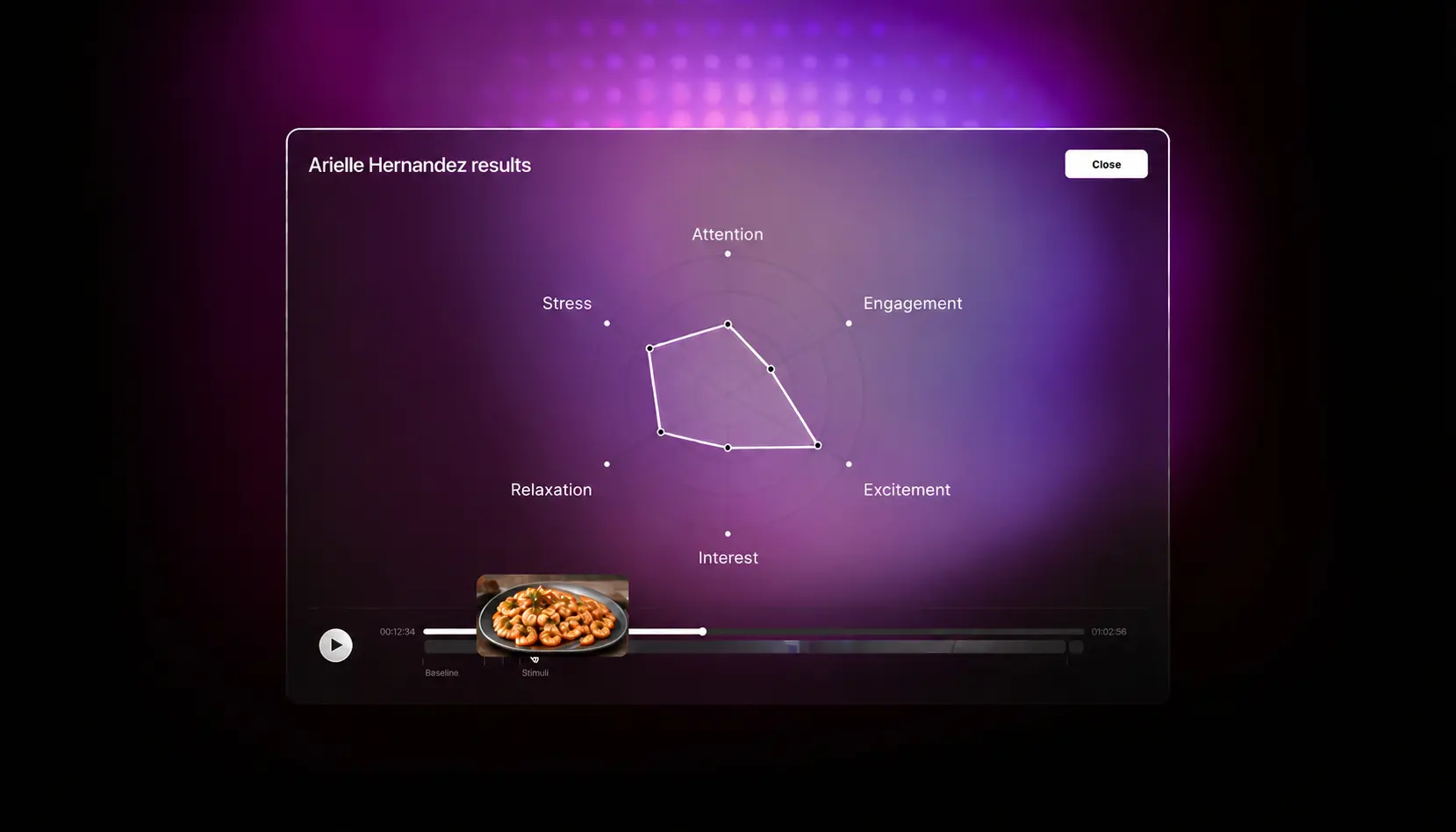
Moment-by-moment EEG measurement helps reveal where food advertising captures or loses audience attention.
Key Takeaways
Surveys capture recalled opinions, while EEG can reveal audience reactions as they occur.
Food advertising often depends on emotional and sensory cues that fluctuate throughout an experience.
Attention measurement can identify specific scenes, visuals, or messages that drive engagement.
EEG-based testing helps optimize creative decisions before campaign launch.
Combining digital marketing testing with neuroscience-informed insights can strengthen campaign evaluation.
The Measurement Gap in Food Advertising
Many food campaigns are evaluated using surveys, interviews, focus groups, and recall-based metrics. These methods remain valuable, but they rely on participants reconstructing an experience after it has already occurred. By that point, memory gaps, social desirability bias, and rationalization can influence responses.
A participant may report that a product shot was compelling because they understand its importance to the brand. However, that same participant may have devoted only limited attention to the scene during viewing. This distinction matters because attention is a prerequisite for processing advertising content. Research by Milosavljevic and Cerf (2008) suggests that attention serves as a critical component in understanding consumer responses to marketing stimuli.
For food marketing teams evaluating multiple creative concepts, understanding where attention rises, drops, or shifts throughout an advertisement can provide actionable context that post-exposure surveys alone cannot deliver.
Why Food Is Different
Food advertising operates within a uniquely emotional category. Consumers often form immediate reactions to presentation, freshness cues, serving rituals, ingredient visuals, and sensory storytelling. These responses occur rapidly and may not be fully reflected in retrospective feedback.
A close-up of melting cheese, a sizzling grill sequence, or a carefully staged plating moment can influence audience engagement in ways that viewers may struggle to articulate afterward. This makes food marketing an ideal environment for moment-by-moment measurement.
Research reviewed by Byrne et al. (2022) notes that neuroscience-based approaches can capture cognitive and emotional responses that consumers may not report or may not consciously recognize during traditional research activities. For marketers, this provides an opportunity to evaluate reactions during exposure rather than relying solely on retrospective interpretation.
How EEG Reconstructs the Audience Experience
Instead of asking participants to summarize an advertisement after viewing, EEG provides continuous measurement throughout the experience. This enables researchers to identify exactly where attention increases, where engagement declines, and where creative elements generate stronger audience responses.
For example, a food brand testing a thirty-second commercial can examine how viewers respond to:
Opening visual sequences
Product reveal moments
Packaging appearances
Brand messaging
Serving and consumption scenes
Calls-to-action
The result is a timeline of audience response that can be compared directly against creative elements. Rather than relying exclusively on a final opinion score, teams gain visibility into the journey that produced that opinion.
This approach aligns with broader consumer neuroscience research. According to Plassmann et al. (2015), neuroscience methods can provide insight into implicit processes that are often difficult to access using traditional research techniques.
Real-World Applications for Marketing Agencies and Brand Teams
Marketing agencies frequently face decisions between multiple creative directions. Survey results may indicate that two concepts perform similarly, making final selection difficult. EEG data can provide additional context by identifying which creative consistently sustains audience attention throughout the experience.
The value of this approach has been demonstrated across media categories. Research by Christoforou et al. (2017) found that neural measurements collected while audiences viewed movie trailers could support prediction of audience responses more effectively than traditional screening methods alone. While film and food advertising differ substantially, both involve evaluating audience reactions before launch, when optimization is still possible.
Another example comes from audience testing research. Kosonogov et al. (2023) demonstrated relationships between physiological measures and audience evaluations of short films, highlighting the value of capturing responses during media exposure rather than relying exclusively on post-viewing feedback.
Food marketers can apply similar principles to digital marketing testing, video advertising, social media creative, packaging evaluations, and branded content.
Combining Surveys and EEG for Better Decision-Making
The goal is not to replace traditional research. Surveys remain useful for understanding perceptions, preferences, and stated opinions. The strongest research programs often combine explicit feedback with behavioral and physiological measures.
When surveys indicate what consumers remember and EEG reveals what occurred during the experience, teams gain a more complete picture of campaign performance. This combination can help identify whether creative issues stem from message clarity, declining attention, visual hierarchy challenges, or inconsistent engagement throughout the content.
For organizations focused on optimizing food marketing performance before launch, integrating neuroscience-informed testing into existing research workflows can provide an additional layer of evidence for creative decision-making. Organizations exploring audience response measurement and consumer research applications can also review examples of neuroscience-informed marketing research in real-world testing environments.
Conclusion
Food advertising succeeds when it captures attention, sustains engagement, and creates meaningful audience experiences. Yet many research programs still rely primarily on what consumers can remember after those experiences have ended.
Because food is inherently emotional, understanding audience reactions as they happen can provide valuable context for creative optimization. EEG-based measurement helps reconstruct the viewing experience moment-by-moment, revealing insights that surveys alone may miss. For agencies and brand teams seeking more confidence in creative decisions, this additional layer of audience intelligence can support stronger evaluation and more informed optimization.
Teams looking to evaluate attention, engagement, and audience response before launch can explore the capabilities of Emotiv Studio as part of a neuroscience-informed testing workflow.
Sources
Byrne, M., et al. (2022). A systematic review of the prediction of consumer preference using EEG measures and machine-learning in neuromarketing research. Brain Informatics. https://doi.org/10.1186/s40708-022-00175-3
Christoforou, C., et al. (2017). Your Brain on the Movies: A Computational Approach for Predicting Box-office Performance from Viewer’s Brain Responses to Movie Trailers. Frontiers in Neuroinformatics. https://doi.org/10.3389/fninf.2017.00072
Kosonogov, V., et al. (2023). EEG and Peripheral Markers of Viewer Ratings: A Study of Short Films. Frontiers in Neuroscience. https://doi.org/10.3389/fnins.2023.1148205
Milosavljevic, M., & Cerf, M. (2008). First Attention Then Intention: Insights from Computational Neuroscience of Vision. International Journal of Advertising. https://doi.org/10.2501/s0265048708080037
Plassmann, H., et al. (2015). Consumer Neuroscience: Applications, Challenges, and Possible Solutions. Journal of Marketing Research. https://doi.org/10.1509/jmr.14.0048
Food marketing success is often determined by subtle moments that traditional research methods struggle to capture. A food commercial may generate strong survey feedback, yet still lose viewer attention at critical scenes. A digital campaign may appear memorable in post-exposure questionnaires while key product visuals are overlooked during the actual viewing experience. For marketing agencies and in-house brand teams, the challenge is not simply understanding what audiences say afterward, but understanding how they respond while the experience is unfolding.
This is particularly important because food is an emotional experience. Consumers react to visual presentation, texture cues, serving moments, sound design, and storytelling long before they articulate opinions in a survey. Traditional research methods typically capture what people remember or what they believe they should say. EEG-based testing provides a different layer of insight by reconstructing the audience experience moment-by-moment, allowing teams to identify fluctuations in attention, engagement, and emotional response while creative assets are still being optimized.
Moment-by-moment EEG measurement helps reveal where food advertising captures or loses audience attention.
Key Takeaways
Surveys capture recalled opinions, while EEG can reveal audience reactions as they occur.
Food advertising often depends on emotional and sensory cues that fluctuate throughout an experience.
Attention measurement can identify specific scenes, visuals, or messages that drive engagement.
EEG-based testing helps optimize creative decisions before campaign launch.
Combining digital marketing testing with neuroscience-informed insights can strengthen campaign evaluation.
The Measurement Gap in Food Advertising
Many food campaigns are evaluated using surveys, interviews, focus groups, and recall-based metrics. These methods remain valuable, but they rely on participants reconstructing an experience after it has already occurred. By that point, memory gaps, social desirability bias, and rationalization can influence responses.
A participant may report that a product shot was compelling because they understand its importance to the brand. However, that same participant may have devoted only limited attention to the scene during viewing. This distinction matters because attention is a prerequisite for processing advertising content. Research by Milosavljevic and Cerf (2008) suggests that attention serves as a critical component in understanding consumer responses to marketing stimuli.
For food marketing teams evaluating multiple creative concepts, understanding where attention rises, drops, or shifts throughout an advertisement can provide actionable context that post-exposure surveys alone cannot deliver.
Why Food Is Different
Food advertising operates within a uniquely emotional category. Consumers often form immediate reactions to presentation, freshness cues, serving rituals, ingredient visuals, and sensory storytelling. These responses occur rapidly and may not be fully reflected in retrospective feedback.
A close-up of melting cheese, a sizzling grill sequence, or a carefully staged plating moment can influence audience engagement in ways that viewers may struggle to articulate afterward. This makes food marketing an ideal environment for moment-by-moment measurement.
Research reviewed by Byrne et al. (2022) notes that neuroscience-based approaches can capture cognitive and emotional responses that consumers may not report or may not consciously recognize during traditional research activities. For marketers, this provides an opportunity to evaluate reactions during exposure rather than relying solely on retrospective interpretation.
How EEG Reconstructs the Audience Experience
Instead of asking participants to summarize an advertisement after viewing, EEG provides continuous measurement throughout the experience. This enables researchers to identify exactly where attention increases, where engagement declines, and where creative elements generate stronger audience responses.
For example, a food brand testing a thirty-second commercial can examine how viewers respond to:
Opening visual sequences
Product reveal moments
Packaging appearances
Brand messaging
Serving and consumption scenes
Calls-to-action
The result is a timeline of audience response that can be compared directly against creative elements. Rather than relying exclusively on a final opinion score, teams gain visibility into the journey that produced that opinion.
This approach aligns with broader consumer neuroscience research. According to Plassmann et al. (2015), neuroscience methods can provide insight into implicit processes that are often difficult to access using traditional research techniques.
Real-World Applications for Marketing Agencies and Brand Teams
Marketing agencies frequently face decisions between multiple creative directions. Survey results may indicate that two concepts perform similarly, making final selection difficult. EEG data can provide additional context by identifying which creative consistently sustains audience attention throughout the experience.
The value of this approach has been demonstrated across media categories. Research by Christoforou et al. (2017) found that neural measurements collected while audiences viewed movie trailers could support prediction of audience responses more effectively than traditional screening methods alone. While film and food advertising differ substantially, both involve evaluating audience reactions before launch, when optimization is still possible.
Another example comes from audience testing research. Kosonogov et al. (2023) demonstrated relationships between physiological measures and audience evaluations of short films, highlighting the value of capturing responses during media exposure rather than relying exclusively on post-viewing feedback.
Food marketers can apply similar principles to digital marketing testing, video advertising, social media creative, packaging evaluations, and branded content.
Combining Surveys and EEG for Better Decision-Making
The goal is not to replace traditional research. Surveys remain useful for understanding perceptions, preferences, and stated opinions. The strongest research programs often combine explicit feedback with behavioral and physiological measures.
When surveys indicate what consumers remember and EEG reveals what occurred during the experience, teams gain a more complete picture of campaign performance. This combination can help identify whether creative issues stem from message clarity, declining attention, visual hierarchy challenges, or inconsistent engagement throughout the content.
For organizations focused on optimizing food marketing performance before launch, integrating neuroscience-informed testing into existing research workflows can provide an additional layer of evidence for creative decision-making. Organizations exploring audience response measurement and consumer research applications can also review examples of neuroscience-informed marketing research in real-world testing environments.
Conclusion
Food advertising succeeds when it captures attention, sustains engagement, and creates meaningful audience experiences. Yet many research programs still rely primarily on what consumers can remember after those experiences have ended.
Because food is inherently emotional, understanding audience reactions as they happen can provide valuable context for creative optimization. EEG-based measurement helps reconstruct the viewing experience moment-by-moment, revealing insights that surveys alone may miss. For agencies and brand teams seeking more confidence in creative decisions, this additional layer of audience intelligence can support stronger evaluation and more informed optimization.
Teams looking to evaluate attention, engagement, and audience response before launch can explore the capabilities of Emotiv Studio as part of a neuroscience-informed testing workflow.
Sources
Byrne, M., et al. (2022). A systematic review of the prediction of consumer preference using EEG measures and machine-learning in neuromarketing research. Brain Informatics. https://doi.org/10.1186/s40708-022-00175-3
Christoforou, C., et al. (2017). Your Brain on the Movies: A Computational Approach for Predicting Box-office Performance from Viewer’s Brain Responses to Movie Trailers. Frontiers in Neuroinformatics. https://doi.org/10.3389/fninf.2017.00072
Kosonogov, V., et al. (2023). EEG and Peripheral Markers of Viewer Ratings: A Study of Short Films. Frontiers in Neuroscience. https://doi.org/10.3389/fnins.2023.1148205
Milosavljevic, M., & Cerf, M. (2008). First Attention Then Intention: Insights from Computational Neuroscience of Vision. International Journal of Advertising. https://doi.org/10.2501/s0265048708080037
Plassmann, H., et al. (2015). Consumer Neuroscience: Applications, Challenges, and Possible Solutions. Journal of Marketing Research. https://doi.org/10.1509/jmr.14.0048
Food marketing success is often determined by subtle moments that traditional research methods struggle to capture. A food commercial may generate strong survey feedback, yet still lose viewer attention at critical scenes. A digital campaign may appear memorable in post-exposure questionnaires while key product visuals are overlooked during the actual viewing experience. For marketing agencies and in-house brand teams, the challenge is not simply understanding what audiences say afterward, but understanding how they respond while the experience is unfolding.
This is particularly important because food is an emotional experience. Consumers react to visual presentation, texture cues, serving moments, sound design, and storytelling long before they articulate opinions in a survey. Traditional research methods typically capture what people remember or what they believe they should say. EEG-based testing provides a different layer of insight by reconstructing the audience experience moment-by-moment, allowing teams to identify fluctuations in attention, engagement, and emotional response while creative assets are still being optimized.
Moment-by-moment EEG measurement helps reveal where food advertising captures or loses audience attention.
Key Takeaways
Surveys capture recalled opinions, while EEG can reveal audience reactions as they occur.
Food advertising often depends on emotional and sensory cues that fluctuate throughout an experience.
Attention measurement can identify specific scenes, visuals, or messages that drive engagement.
EEG-based testing helps optimize creative decisions before campaign launch.
Combining digital marketing testing with neuroscience-informed insights can strengthen campaign evaluation.
The Measurement Gap in Food Advertising
Many food campaigns are evaluated using surveys, interviews, focus groups, and recall-based metrics. These methods remain valuable, but they rely on participants reconstructing an experience after it has already occurred. By that point, memory gaps, social desirability bias, and rationalization can influence responses.
A participant may report that a product shot was compelling because they understand its importance to the brand. However, that same participant may have devoted only limited attention to the scene during viewing. This distinction matters because attention is a prerequisite for processing advertising content. Research by Milosavljevic and Cerf (2008) suggests that attention serves as a critical component in understanding consumer responses to marketing stimuli.
For food marketing teams evaluating multiple creative concepts, understanding where attention rises, drops, or shifts throughout an advertisement can provide actionable context that post-exposure surveys alone cannot deliver.
Why Food Is Different
Food advertising operates within a uniquely emotional category. Consumers often form immediate reactions to presentation, freshness cues, serving rituals, ingredient visuals, and sensory storytelling. These responses occur rapidly and may not be fully reflected in retrospective feedback.
A close-up of melting cheese, a sizzling grill sequence, or a carefully staged plating moment can influence audience engagement in ways that viewers may struggle to articulate afterward. This makes food marketing an ideal environment for moment-by-moment measurement.
Research reviewed by Byrne et al. (2022) notes that neuroscience-based approaches can capture cognitive and emotional responses that consumers may not report or may not consciously recognize during traditional research activities. For marketers, this provides an opportunity to evaluate reactions during exposure rather than relying solely on retrospective interpretation.
How EEG Reconstructs the Audience Experience
Instead of asking participants to summarize an advertisement after viewing, EEG provides continuous measurement throughout the experience. This enables researchers to identify exactly where attention increases, where engagement declines, and where creative elements generate stronger audience responses.
For example, a food brand testing a thirty-second commercial can examine how viewers respond to:
Opening visual sequences
Product reveal moments
Packaging appearances
Brand messaging
Serving and consumption scenes
Calls-to-action
The result is a timeline of audience response that can be compared directly against creative elements. Rather than relying exclusively on a final opinion score, teams gain visibility into the journey that produced that opinion.
This approach aligns with broader consumer neuroscience research. According to Plassmann et al. (2015), neuroscience methods can provide insight into implicit processes that are often difficult to access using traditional research techniques.
Real-World Applications for Marketing Agencies and Brand Teams
Marketing agencies frequently face decisions between multiple creative directions. Survey results may indicate that two concepts perform similarly, making final selection difficult. EEG data can provide additional context by identifying which creative consistently sustains audience attention throughout the experience.
The value of this approach has been demonstrated across media categories. Research by Christoforou et al. (2017) found that neural measurements collected while audiences viewed movie trailers could support prediction of audience responses more effectively than traditional screening methods alone. While film and food advertising differ substantially, both involve evaluating audience reactions before launch, when optimization is still possible.
Another example comes from audience testing research. Kosonogov et al. (2023) demonstrated relationships between physiological measures and audience evaluations of short films, highlighting the value of capturing responses during media exposure rather than relying exclusively on post-viewing feedback.
Food marketers can apply similar principles to digital marketing testing, video advertising, social media creative, packaging evaluations, and branded content.
Combining Surveys and EEG for Better Decision-Making
The goal is not to replace traditional research. Surveys remain useful for understanding perceptions, preferences, and stated opinions. The strongest research programs often combine explicit feedback with behavioral and physiological measures.
When surveys indicate what consumers remember and EEG reveals what occurred during the experience, teams gain a more complete picture of campaign performance. This combination can help identify whether creative issues stem from message clarity, declining attention, visual hierarchy challenges, or inconsistent engagement throughout the content.
For organizations focused on optimizing food marketing performance before launch, integrating neuroscience-informed testing into existing research workflows can provide an additional layer of evidence for creative decision-making. Organizations exploring audience response measurement and consumer research applications can also review examples of neuroscience-informed marketing research in real-world testing environments.
Conclusion
Food advertising succeeds when it captures attention, sustains engagement, and creates meaningful audience experiences. Yet many research programs still rely primarily on what consumers can remember after those experiences have ended.
Because food is inherently emotional, understanding audience reactions as they happen can provide valuable context for creative optimization. EEG-based measurement helps reconstruct the viewing experience moment-by-moment, revealing insights that surveys alone may miss. For agencies and brand teams seeking more confidence in creative decisions, this additional layer of audience intelligence can support stronger evaluation and more informed optimization.
Teams looking to evaluate attention, engagement, and audience response before launch can explore the capabilities of Emotiv Studio as part of a neuroscience-informed testing workflow.
Sources
Byrne, M., et al. (2022). A systematic review of the prediction of consumer preference using EEG measures and machine-learning in neuromarketing research. Brain Informatics. https://doi.org/10.1186/s40708-022-00175-3
Christoforou, C., et al. (2017). Your Brain on the Movies: A Computational Approach for Predicting Box-office Performance from Viewer’s Brain Responses to Movie Trailers. Frontiers in Neuroinformatics. https://doi.org/10.3389/fninf.2017.00072
Kosonogov, V., et al. (2023). EEG and Peripheral Markers of Viewer Ratings: A Study of Short Films. Frontiers in Neuroscience. https://doi.org/10.3389/fnins.2023.1148205
Milosavljevic, M., & Cerf, M. (2008). First Attention Then Intention: Insights from Computational Neuroscience of Vision. International Journal of Advertising. https://doi.org/10.2501/s0265048708080037
Plassmann, H., et al. (2015). Consumer Neuroscience: Applications, Challenges, and Possible Solutions. Journal of Marketing Research. https://doi.org/10.1509/jmr.14.0048
Continue reading