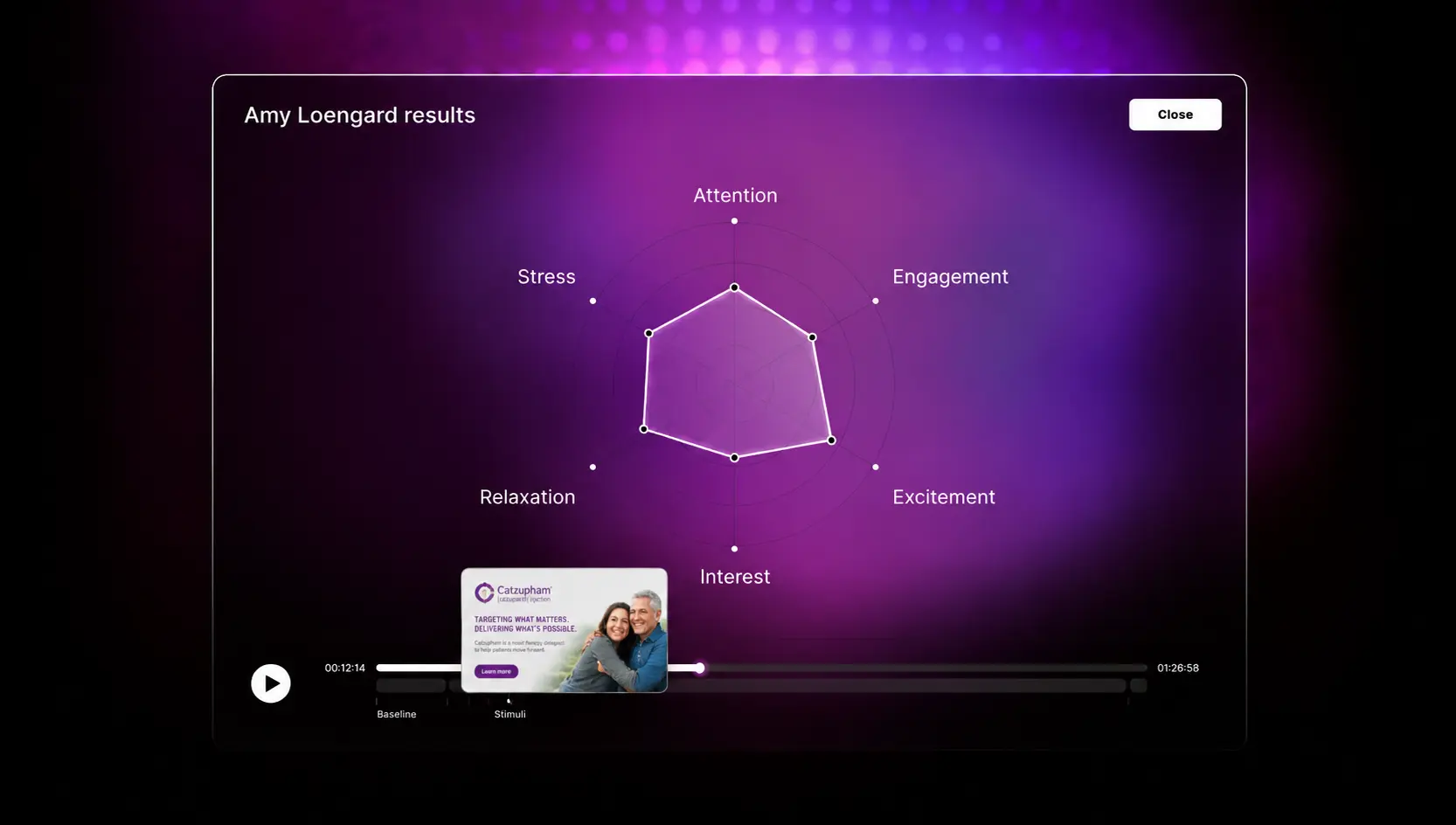
Adding Consumer Neuroscience Services to Your Marketing Agency
H.B. Duran
Updated on
Jun 17, 2026
Adding Consumer Neuroscience Services to Your Marketing Agency
H.B. Duran
Updated on
Jun 17, 2026
Adding Consumer Neuroscience Services to Your Marketing Agency
H.B. Duran
Updated on
Jun 17, 2026
Marketing agencies are under growing pressure to deliver insights that go beyond traditional surveys, interviews, and behavioral analytics. Clients increasingly expect evidence-backed recommendations that reduce uncertainty before launching campaigns, products, and digital experiences. This is where consumer neuroscience is becoming a strategic differentiator.
For agencies looking to expand their capabilities, adding a neuroscience division can transform how audience research is conducted and how recommendations are supported. Rather than replacing existing methodologies, electroencephalography (EEG) adds an additional layer of quantifiable data that helps explain why consumers respond the way they do. Combined with traditional research techniques, EEG-based testing can help agencies uncover attention patterns, engagement levels, emotional responses, and cognitive stress that may not be fully captured through self-reported feedback alone.
As competition among agencies intensifies, the ability to provide objective evidence alongside qualitative and quantitative insights can strengthen client relationships and create new opportunities for premium research services. Consumer neuroscience is increasingly being used to evaluate advertising, digital experiences, packaging, product concepts, and creative assets before launch, helping agencies make more informed recommendations while changes are still possible.
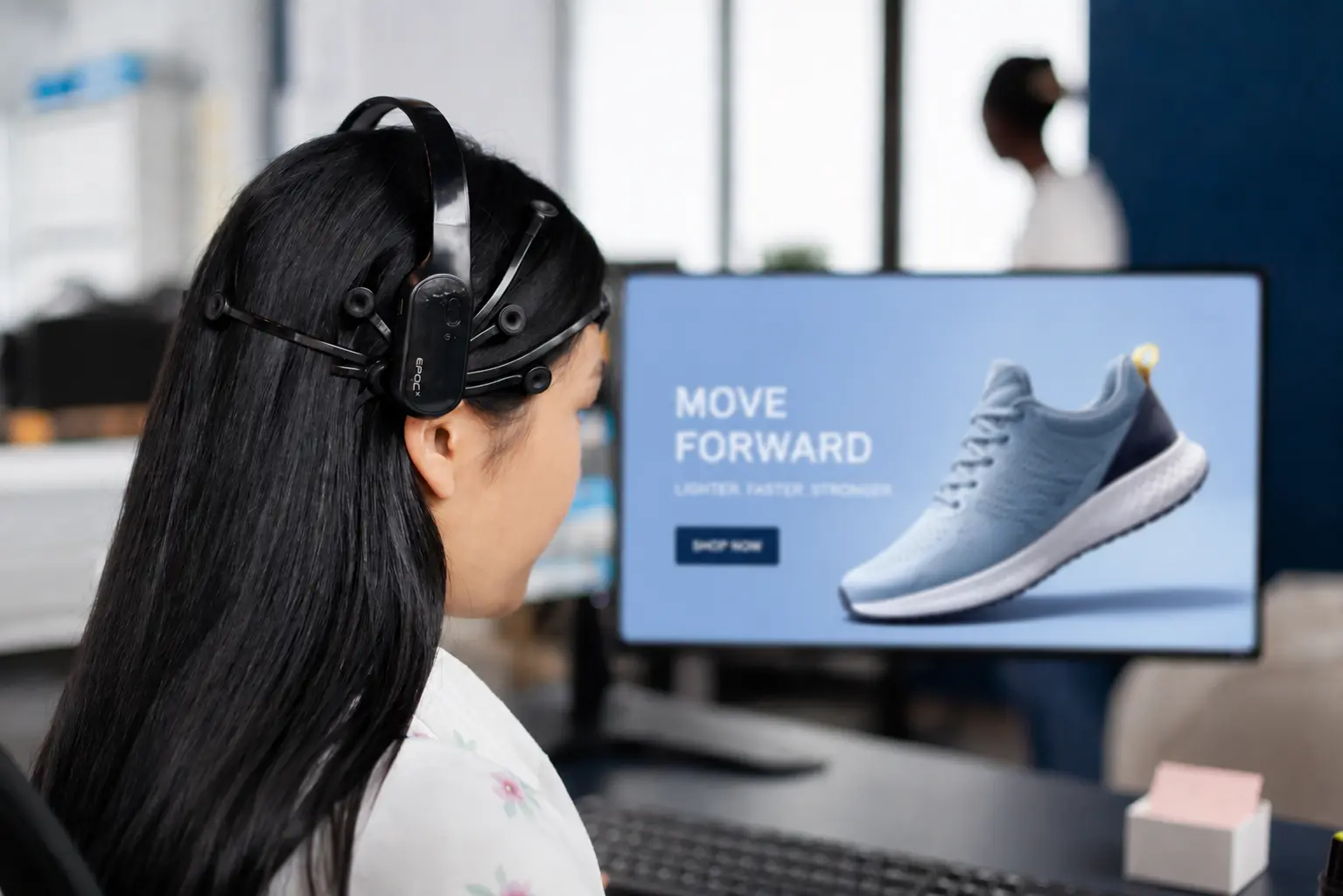
EEG-based testing helps agencies evaluate audience attention and engagement before creative and product launches.
Key Takeaways
Consumer neuroscience can expand agency research capabilities beyond traditional methods.
EEG provides an objective layer of audience-response data alongside surveys and analytics.
Neuroscience-informed testing can improve creative, product, and user experience decisions before launch.
Agencies can use EEG insights to strengthen client recommendations with measurable evidence.
Adding neuroscience services can create new revenue opportunities in research and strategy engagements.
Why Agencies Are Expanding Into Consumer Neuroscience
Many agency research programs rely on a combination of surveys, focus groups, interviews, usability testing, and campaign analytics. While these approaches remain valuable, they often depend heavily on conscious self-reporting. Consumers may struggle to accurately explain their reactions, especially when evaluating complex visual experiences, advertising creative, or product concepts.
Research by Plassmann et al. (2015) suggests that neuroscience methods can provide information about implicit processes that are difficult to access through conventional research techniques. For agencies, this creates an opportunity to supplement existing methodologies with additional evidence that supports strategic decision-making.
Instead of treating neuroscience as a niche offering, many agencies are positioning it as a foundational research capability. EEG makes neuroscience the cornerstone of user and product research by adding an unbiased layer to quantifiable data insights. When combined with behavioral analytics, survey responses, and qualitative feedback, EEG data can help teams better understand how audiences engage with content and experiences in real time.
Moving Beyond Traditional Performance Metrics
Campaign metrics such as click-through rates, conversions, engagement rates, and time-on-page remain important indicators of success. However, they often reveal what happened rather than why it happened.
Consumer neuroscience allows agencies to evaluate audience responses before a campaign reaches the market. This shift from retrospective analysis to predictive optimization can improve decision-making throughout the creative process.
Research by Smidts et al. (2014) notes that consumer neuroscience can support improved understanding of consumer decision-making and contribute to more effective interventions. For agencies, this means having additional data points available when evaluating competing creative concepts, digital experiences, or messaging strategies.
When agencies can identify moments where attention declines, engagement fluctuates, or cognitive stress increases, they gain actionable insights that can be addressed before launch rather than after performance issues emerge.
How EEG Strengthens User and Product Research
Many agencies already conduct UX testing, product evaluations, and audience research programs. EEG enhances these activities by introducing objective physiological measurements that complement traditional feedback mechanisms.
In practical terms, agencies can evaluate:
Advertising creative and video content
Website and application experiences
Packaging concepts
Product prototypes
Retail and e-commerce journeys
Brand and campaign assets
A systematic review by Byrne et al. (2022) found that neuromarketing approaches can capture implicit cognitive and emotional responses that may not be reflected in self-reported feedback. For agencies, these additional insights can help validate creative decisions and reduce reliance on subjective interpretation alone.
This is one reason many organizations are incorporating neuroscience-informed methodologies into broader research programs, including solutions available through Emotiv’s neuromarketing research platform. :contentReference[oaicite:0]{index=0}
Real-World Examples of Neuroscience in Agency Services
Consider the challenge of evaluating advertising creative before a major media investment. Traditional testing may identify stated preferences among audience segments, but EEG can provide additional context around attention and engagement patterns throughout the viewing experience.
For example, Christoforou et al. (2017) found that neural measurements collected while audiences viewed movie trailers were highly predictive of subsequent box-office performance. The researchers demonstrated significantly improved prediction accuracy compared to traditional screening approaches. While marketing campaigns differ from movie launches, the underlying principle remains valuable: objective audience-response data can inform creative decisions while revisions are still possible.
A second example comes from the music industry. Research by Leeuwis et al. (2021) found that neural synchrony carried predictive value for an album’s future popularity on Spotify. This research highlights how EEG-based insights can support decision-making before large-scale investments are finalized, offering agencies an additional source of evidence when advising clients on content and creative strategies.
Building a Competitive Advantage Through Neuroscience
Adding a neuroscience division is not simply about introducing a new research tool. It is about creating a more comprehensive decision-making framework.
Agencies that integrate EEG into their research workflows can:
Provide deeper audience insights.
Support recommendations with objective evidence.
Differentiate their service offerings.
Create premium research engagements.
Help clients optimize campaigns before launch.
As clients seek greater confidence in strategic decisions, the ability to combine behavioral, qualitative, quantitative, and neuroscience data can become a meaningful competitive advantage.
From Consumer Insights to Campaign Execution
Generating neuroscience insights is only one part of a successful marketing strategy. Once agencies identify which creative concepts, messaging, or user experiences capture the strongest attention and engagement, those insights must be translated into real campaigns.
For brands investing in influencer marketing and social commerce, this often means identifying the right creators, managing outreach, coordinating affiliate partnerships, and tracking campaign performance across multiple channels. As creator programs grow, these operational tasks can quickly become complex.
Consumer neuroscience helps agencies understand what resonates with audiences. Execution requires turning those insights into real campaigns. Many brands partner with agencies such as TikAssist to manage creator outreach, influencer partnerships, affiliate recruitment, and TikTok Shop growth, helping transform research-backed creative decisions into measurable campaign performance.
As consumer neuroscience continues to evolve, organizations that integrate research insights with scalable marketing execution will be better positioned to deliver data-driven campaigns that connect with audiences more effectively.
Conclusion
Consumer neuroscience is increasingly moving from specialized research environments into practical business applications. For marketing agencies, EEG provides an opportunity to strengthen user and product research programs with an additional layer of objective, quantifiable insight.
Rather than replacing traditional methodologies, neuroscience-informed testing complements existing approaches by revealing aspects of audience response that may otherwise remain hidden within self-reported data alone. The result is a more complete understanding of attention, engagement, emotional response, and user experience that can improve decision-making across campaigns, products, and digital experiences.
Teams looking to evaluate attention, engagement, and audience response before launch can explore the capabilities of Emotiv Studio.
Sources
Byrne, M., et al. (2022). A systematic review of the prediction of consumer preference using EEG measures and machine-learning in neuromarketing research. Brain Informatics. https://doi.org/10.1186/s40708-022-00175-3
Christoforou, C., et al. (2017). Your Brain on the Movies: A Computational Approach for Predicting Box-office Performance from Viewer’s Brain Responses to Movie Trailers. Frontiers in Neuroinformatics. https://doi.org/10.3389/fninf.2017.00072
Leeuwis, N., et al. (2021). A Sound Prediction: EEG-Based Neural Synchrony Predicts Online Music Streams. Frontiers in Psychology. https://doi.org/10.3389/fpsyg.2021.672980
Plassmann, H., Venkatraman, V., Huettel, S., & Yoon, C. (2015). Consumer Neuroscience: Applications, Challenges, and Possible Solutions. Journal of Marketing Research. https://doi.org/10.1509/jmr.14.0048
Smidts, A., Hsu, M., Sanfey, A., Boksem, M., Ebstein, R., Huettel, S., Kable, J., Plassmann, H., & Yoon, C. (2014). Advancing Consumer Neuroscience. Marketing Letters. https://doi.org/10.1007/s11002-014-9306-1
Marketing agencies are under growing pressure to deliver insights that go beyond traditional surveys, interviews, and behavioral analytics. Clients increasingly expect evidence-backed recommendations that reduce uncertainty before launching campaigns, products, and digital experiences. This is where consumer neuroscience is becoming a strategic differentiator.
For agencies looking to expand their capabilities, adding a neuroscience division can transform how audience research is conducted and how recommendations are supported. Rather than replacing existing methodologies, electroencephalography (EEG) adds an additional layer of quantifiable data that helps explain why consumers respond the way they do. Combined with traditional research techniques, EEG-based testing can help agencies uncover attention patterns, engagement levels, emotional responses, and cognitive stress that may not be fully captured through self-reported feedback alone.
As competition among agencies intensifies, the ability to provide objective evidence alongside qualitative and quantitative insights can strengthen client relationships and create new opportunities for premium research services. Consumer neuroscience is increasingly being used to evaluate advertising, digital experiences, packaging, product concepts, and creative assets before launch, helping agencies make more informed recommendations while changes are still possible.
EEG-based testing helps agencies evaluate audience attention and engagement before creative and product launches.
Key Takeaways
Consumer neuroscience can expand agency research capabilities beyond traditional methods.
EEG provides an objective layer of audience-response data alongside surveys and analytics.
Neuroscience-informed testing can improve creative, product, and user experience decisions before launch.
Agencies can use EEG insights to strengthen client recommendations with measurable evidence.
Adding neuroscience services can create new revenue opportunities in research and strategy engagements.
Why Agencies Are Expanding Into Consumer Neuroscience
Many agency research programs rely on a combination of surveys, focus groups, interviews, usability testing, and campaign analytics. While these approaches remain valuable, they often depend heavily on conscious self-reporting. Consumers may struggle to accurately explain their reactions, especially when evaluating complex visual experiences, advertising creative, or product concepts.
Research by Plassmann et al. (2015) suggests that neuroscience methods can provide information about implicit processes that are difficult to access through conventional research techniques. For agencies, this creates an opportunity to supplement existing methodologies with additional evidence that supports strategic decision-making.
Instead of treating neuroscience as a niche offering, many agencies are positioning it as a foundational research capability. EEG makes neuroscience the cornerstone of user and product research by adding an unbiased layer to quantifiable data insights. When combined with behavioral analytics, survey responses, and qualitative feedback, EEG data can help teams better understand how audiences engage with content and experiences in real time.
Moving Beyond Traditional Performance Metrics
Campaign metrics such as click-through rates, conversions, engagement rates, and time-on-page remain important indicators of success. However, they often reveal what happened rather than why it happened.
Consumer neuroscience allows agencies to evaluate audience responses before a campaign reaches the market. This shift from retrospective analysis to predictive optimization can improve decision-making throughout the creative process.
Research by Smidts et al. (2014) notes that consumer neuroscience can support improved understanding of consumer decision-making and contribute to more effective interventions. For agencies, this means having additional data points available when evaluating competing creative concepts, digital experiences, or messaging strategies.
When agencies can identify moments where attention declines, engagement fluctuates, or cognitive stress increases, they gain actionable insights that can be addressed before launch rather than after performance issues emerge.
How EEG Strengthens User and Product Research
Many agencies already conduct UX testing, product evaluations, and audience research programs. EEG enhances these activities by introducing objective physiological measurements that complement traditional feedback mechanisms.
In practical terms, agencies can evaluate:
Advertising creative and video content
Website and application experiences
Packaging concepts
Product prototypes
Retail and e-commerce journeys
Brand and campaign assets
A systematic review by Byrne et al. (2022) found that neuromarketing approaches can capture implicit cognitive and emotional responses that may not be reflected in self-reported feedback. For agencies, these additional insights can help validate creative decisions and reduce reliance on subjective interpretation alone.
This is one reason many organizations are incorporating neuroscience-informed methodologies into broader research programs, including solutions available through Emotiv’s neuromarketing research platform. :contentReference[oaicite:0]{index=0}
Real-World Examples of Neuroscience in Agency Services
Consider the challenge of evaluating advertising creative before a major media investment. Traditional testing may identify stated preferences among audience segments, but EEG can provide additional context around attention and engagement patterns throughout the viewing experience.
For example, Christoforou et al. (2017) found that neural measurements collected while audiences viewed movie trailers were highly predictive of subsequent box-office performance. The researchers demonstrated significantly improved prediction accuracy compared to traditional screening approaches. While marketing campaigns differ from movie launches, the underlying principle remains valuable: objective audience-response data can inform creative decisions while revisions are still possible.
A second example comes from the music industry. Research by Leeuwis et al. (2021) found that neural synchrony carried predictive value for an album’s future popularity on Spotify. This research highlights how EEG-based insights can support decision-making before large-scale investments are finalized, offering agencies an additional source of evidence when advising clients on content and creative strategies.
Building a Competitive Advantage Through Neuroscience
Adding a neuroscience division is not simply about introducing a new research tool. It is about creating a more comprehensive decision-making framework.
Agencies that integrate EEG into their research workflows can:
Provide deeper audience insights.
Support recommendations with objective evidence.
Differentiate their service offerings.
Create premium research engagements.
Help clients optimize campaigns before launch.
As clients seek greater confidence in strategic decisions, the ability to combine behavioral, qualitative, quantitative, and neuroscience data can become a meaningful competitive advantage.
From Consumer Insights to Campaign Execution
Generating neuroscience insights is only one part of a successful marketing strategy. Once agencies identify which creative concepts, messaging, or user experiences capture the strongest attention and engagement, those insights must be translated into real campaigns.
For brands investing in influencer marketing and social commerce, this often means identifying the right creators, managing outreach, coordinating affiliate partnerships, and tracking campaign performance across multiple channels. As creator programs grow, these operational tasks can quickly become complex.
Consumer neuroscience helps agencies understand what resonates with audiences. Execution requires turning those insights into real campaigns. Many brands partner with agencies such as TikAssist to manage creator outreach, influencer partnerships, affiliate recruitment, and TikTok Shop growth, helping transform research-backed creative decisions into measurable campaign performance.
As consumer neuroscience continues to evolve, organizations that integrate research insights with scalable marketing execution will be better positioned to deliver data-driven campaigns that connect with audiences more effectively.
Conclusion
Consumer neuroscience is increasingly moving from specialized research environments into practical business applications. For marketing agencies, EEG provides an opportunity to strengthen user and product research programs with an additional layer of objective, quantifiable insight.
Rather than replacing traditional methodologies, neuroscience-informed testing complements existing approaches by revealing aspects of audience response that may otherwise remain hidden within self-reported data alone. The result is a more complete understanding of attention, engagement, emotional response, and user experience that can improve decision-making across campaigns, products, and digital experiences.
Teams looking to evaluate attention, engagement, and audience response before launch can explore the capabilities of Emotiv Studio.
Sources
Byrne, M., et al. (2022). A systematic review of the prediction of consumer preference using EEG measures and machine-learning in neuromarketing research. Brain Informatics. https://doi.org/10.1186/s40708-022-00175-3
Christoforou, C., et al. (2017). Your Brain on the Movies: A Computational Approach for Predicting Box-office Performance from Viewer’s Brain Responses to Movie Trailers. Frontiers in Neuroinformatics. https://doi.org/10.3389/fninf.2017.00072
Leeuwis, N., et al. (2021). A Sound Prediction: EEG-Based Neural Synchrony Predicts Online Music Streams. Frontiers in Psychology. https://doi.org/10.3389/fpsyg.2021.672980
Plassmann, H., Venkatraman, V., Huettel, S., & Yoon, C. (2015). Consumer Neuroscience: Applications, Challenges, and Possible Solutions. Journal of Marketing Research. https://doi.org/10.1509/jmr.14.0048
Smidts, A., Hsu, M., Sanfey, A., Boksem, M., Ebstein, R., Huettel, S., Kable, J., Plassmann, H., & Yoon, C. (2014). Advancing Consumer Neuroscience. Marketing Letters. https://doi.org/10.1007/s11002-014-9306-1
Marketing agencies are under growing pressure to deliver insights that go beyond traditional surveys, interviews, and behavioral analytics. Clients increasingly expect evidence-backed recommendations that reduce uncertainty before launching campaigns, products, and digital experiences. This is where consumer neuroscience is becoming a strategic differentiator.
For agencies looking to expand their capabilities, adding a neuroscience division can transform how audience research is conducted and how recommendations are supported. Rather than replacing existing methodologies, electroencephalography (EEG) adds an additional layer of quantifiable data that helps explain why consumers respond the way they do. Combined with traditional research techniques, EEG-based testing can help agencies uncover attention patterns, engagement levels, emotional responses, and cognitive stress that may not be fully captured through self-reported feedback alone.
As competition among agencies intensifies, the ability to provide objective evidence alongside qualitative and quantitative insights can strengthen client relationships and create new opportunities for premium research services. Consumer neuroscience is increasingly being used to evaluate advertising, digital experiences, packaging, product concepts, and creative assets before launch, helping agencies make more informed recommendations while changes are still possible.
EEG-based testing helps agencies evaluate audience attention and engagement before creative and product launches.
Key Takeaways
Consumer neuroscience can expand agency research capabilities beyond traditional methods.
EEG provides an objective layer of audience-response data alongside surveys and analytics.
Neuroscience-informed testing can improve creative, product, and user experience decisions before launch.
Agencies can use EEG insights to strengthen client recommendations with measurable evidence.
Adding neuroscience services can create new revenue opportunities in research and strategy engagements.
Why Agencies Are Expanding Into Consumer Neuroscience
Many agency research programs rely on a combination of surveys, focus groups, interviews, usability testing, and campaign analytics. While these approaches remain valuable, they often depend heavily on conscious self-reporting. Consumers may struggle to accurately explain their reactions, especially when evaluating complex visual experiences, advertising creative, or product concepts.
Research by Plassmann et al. (2015) suggests that neuroscience methods can provide information about implicit processes that are difficult to access through conventional research techniques. For agencies, this creates an opportunity to supplement existing methodologies with additional evidence that supports strategic decision-making.
Instead of treating neuroscience as a niche offering, many agencies are positioning it as a foundational research capability. EEG makes neuroscience the cornerstone of user and product research by adding an unbiased layer to quantifiable data insights. When combined with behavioral analytics, survey responses, and qualitative feedback, EEG data can help teams better understand how audiences engage with content and experiences in real time.
Moving Beyond Traditional Performance Metrics
Campaign metrics such as click-through rates, conversions, engagement rates, and time-on-page remain important indicators of success. However, they often reveal what happened rather than why it happened.
Consumer neuroscience allows agencies to evaluate audience responses before a campaign reaches the market. This shift from retrospective analysis to predictive optimization can improve decision-making throughout the creative process.
Research by Smidts et al. (2014) notes that consumer neuroscience can support improved understanding of consumer decision-making and contribute to more effective interventions. For agencies, this means having additional data points available when evaluating competing creative concepts, digital experiences, or messaging strategies.
When agencies can identify moments where attention declines, engagement fluctuates, or cognitive stress increases, they gain actionable insights that can be addressed before launch rather than after performance issues emerge.
How EEG Strengthens User and Product Research
Many agencies already conduct UX testing, product evaluations, and audience research programs. EEG enhances these activities by introducing objective physiological measurements that complement traditional feedback mechanisms.
In practical terms, agencies can evaluate:
Advertising creative and video content
Website and application experiences
Packaging concepts
Product prototypes
Retail and e-commerce journeys
Brand and campaign assets
A systematic review by Byrne et al. (2022) found that neuromarketing approaches can capture implicit cognitive and emotional responses that may not be reflected in self-reported feedback. For agencies, these additional insights can help validate creative decisions and reduce reliance on subjective interpretation alone.
This is one reason many organizations are incorporating neuroscience-informed methodologies into broader research programs, including solutions available through Emotiv’s neuromarketing research platform. :contentReference[oaicite:0]{index=0}
Real-World Examples of Neuroscience in Agency Services
Consider the challenge of evaluating advertising creative before a major media investment. Traditional testing may identify stated preferences among audience segments, but EEG can provide additional context around attention and engagement patterns throughout the viewing experience.
For example, Christoforou et al. (2017) found that neural measurements collected while audiences viewed movie trailers were highly predictive of subsequent box-office performance. The researchers demonstrated significantly improved prediction accuracy compared to traditional screening approaches. While marketing campaigns differ from movie launches, the underlying principle remains valuable: objective audience-response data can inform creative decisions while revisions are still possible.
A second example comes from the music industry. Research by Leeuwis et al. (2021) found that neural synchrony carried predictive value for an album’s future popularity on Spotify. This research highlights how EEG-based insights can support decision-making before large-scale investments are finalized, offering agencies an additional source of evidence when advising clients on content and creative strategies.
Building a Competitive Advantage Through Neuroscience
Adding a neuroscience division is not simply about introducing a new research tool. It is about creating a more comprehensive decision-making framework.
Agencies that integrate EEG into their research workflows can:
Provide deeper audience insights.
Support recommendations with objective evidence.
Differentiate their service offerings.
Create premium research engagements.
Help clients optimize campaigns before launch.
As clients seek greater confidence in strategic decisions, the ability to combine behavioral, qualitative, quantitative, and neuroscience data can become a meaningful competitive advantage.
From Consumer Insights to Campaign Execution
Generating neuroscience insights is only one part of a successful marketing strategy. Once agencies identify which creative concepts, messaging, or user experiences capture the strongest attention and engagement, those insights must be translated into real campaigns.
For brands investing in influencer marketing and social commerce, this often means identifying the right creators, managing outreach, coordinating affiliate partnerships, and tracking campaign performance across multiple channels. As creator programs grow, these operational tasks can quickly become complex.
Consumer neuroscience helps agencies understand what resonates with audiences. Execution requires turning those insights into real campaigns. Many brands partner with agencies such as TikAssist to manage creator outreach, influencer partnerships, affiliate recruitment, and TikTok Shop growth, helping transform research-backed creative decisions into measurable campaign performance.
As consumer neuroscience continues to evolve, organizations that integrate research insights with scalable marketing execution will be better positioned to deliver data-driven campaigns that connect with audiences more effectively.
Conclusion
Consumer neuroscience is increasingly moving from specialized research environments into practical business applications. For marketing agencies, EEG provides an opportunity to strengthen user and product research programs with an additional layer of objective, quantifiable insight.
Rather than replacing traditional methodologies, neuroscience-informed testing complements existing approaches by revealing aspects of audience response that may otherwise remain hidden within self-reported data alone. The result is a more complete understanding of attention, engagement, emotional response, and user experience that can improve decision-making across campaigns, products, and digital experiences.
Teams looking to evaluate attention, engagement, and audience response before launch can explore the capabilities of Emotiv Studio.
Sources
Byrne, M., et al. (2022). A systematic review of the prediction of consumer preference using EEG measures and machine-learning in neuromarketing research. Brain Informatics. https://doi.org/10.1186/s40708-022-00175-3
Christoforou, C., et al. (2017). Your Brain on the Movies: A Computational Approach for Predicting Box-office Performance from Viewer’s Brain Responses to Movie Trailers. Frontiers in Neuroinformatics. https://doi.org/10.3389/fninf.2017.00072
Leeuwis, N., et al. (2021). A Sound Prediction: EEG-Based Neural Synchrony Predicts Online Music Streams. Frontiers in Psychology. https://doi.org/10.3389/fpsyg.2021.672980
Plassmann, H., Venkatraman, V., Huettel, S., & Yoon, C. (2015). Consumer Neuroscience: Applications, Challenges, and Possible Solutions. Journal of Marketing Research. https://doi.org/10.1509/jmr.14.0048
Smidts, A., Hsu, M., Sanfey, A., Boksem, M., Ebstein, R., Huettel, S., Kable, J., Plassmann, H., & Yoon, C. (2014). Advancing Consumer Neuroscience. Marketing Letters. https://doi.org/10.1007/s11002-014-9306-1

Continue reading