Testing TV Advertising With EEG for Better Creative Decisions
H.B. Duran
Updated on
Jun 15, 2026
Testing TV Advertising With EEG for Better Creative Decisions
H.B. Duran
Updated on
Jun 15, 2026
Testing TV Advertising With EEG for Better Creative Decisions
H.B. Duran
Updated on
Jun 15, 2026
For marketing agencies, the challenge with TV advertising is rarely generating creative concepts. The challenge is determining which version is most likely to maintain audience attention, sustain engagement, and deliver a consistent viewing experience before media budgets are committed. Traditional post-exposure surveys, focus groups, and preference studies can provide valuable feedback, but they often capture what viewers remember or choose to report after the experience has ended.
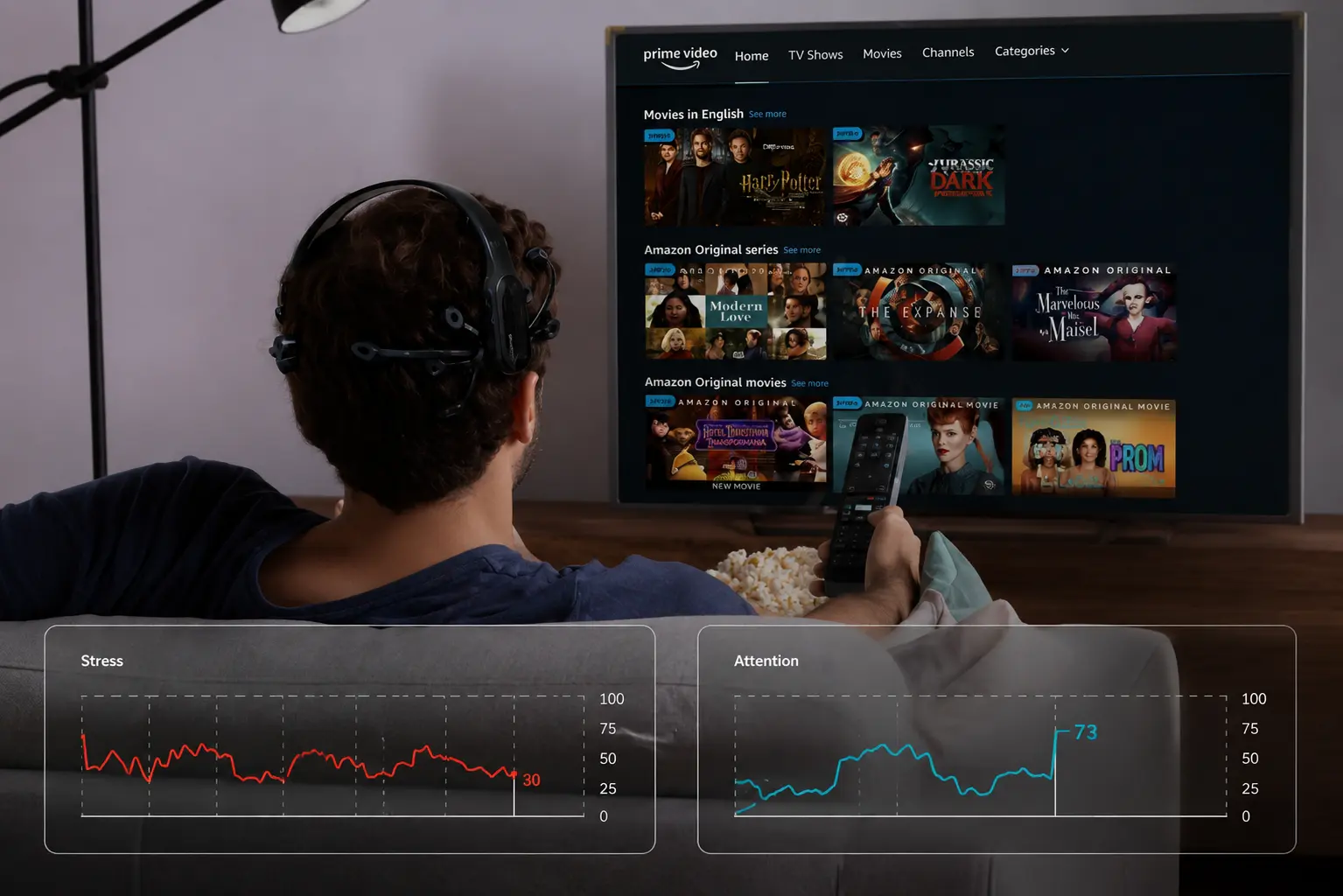
As media costs continue to rise and audience fragmentation increases, agencies need stronger evidence to support creative decisions before launch. EEG-based testing offers an additional layer of insight by measuring audience responses as commercials unfold moment by moment. Rather than replacing traditional research methods, it helps agencies identify where attention drops, engagement fluctuates, or cognitive stress increases, enabling creative teams to refine content while changes are still possible.
For agencies managing multiple campaigns across diverse audiences, this approach can provide a more detailed understanding of how viewers experience TV advertising and help optimize creative effectiveness before airtime.
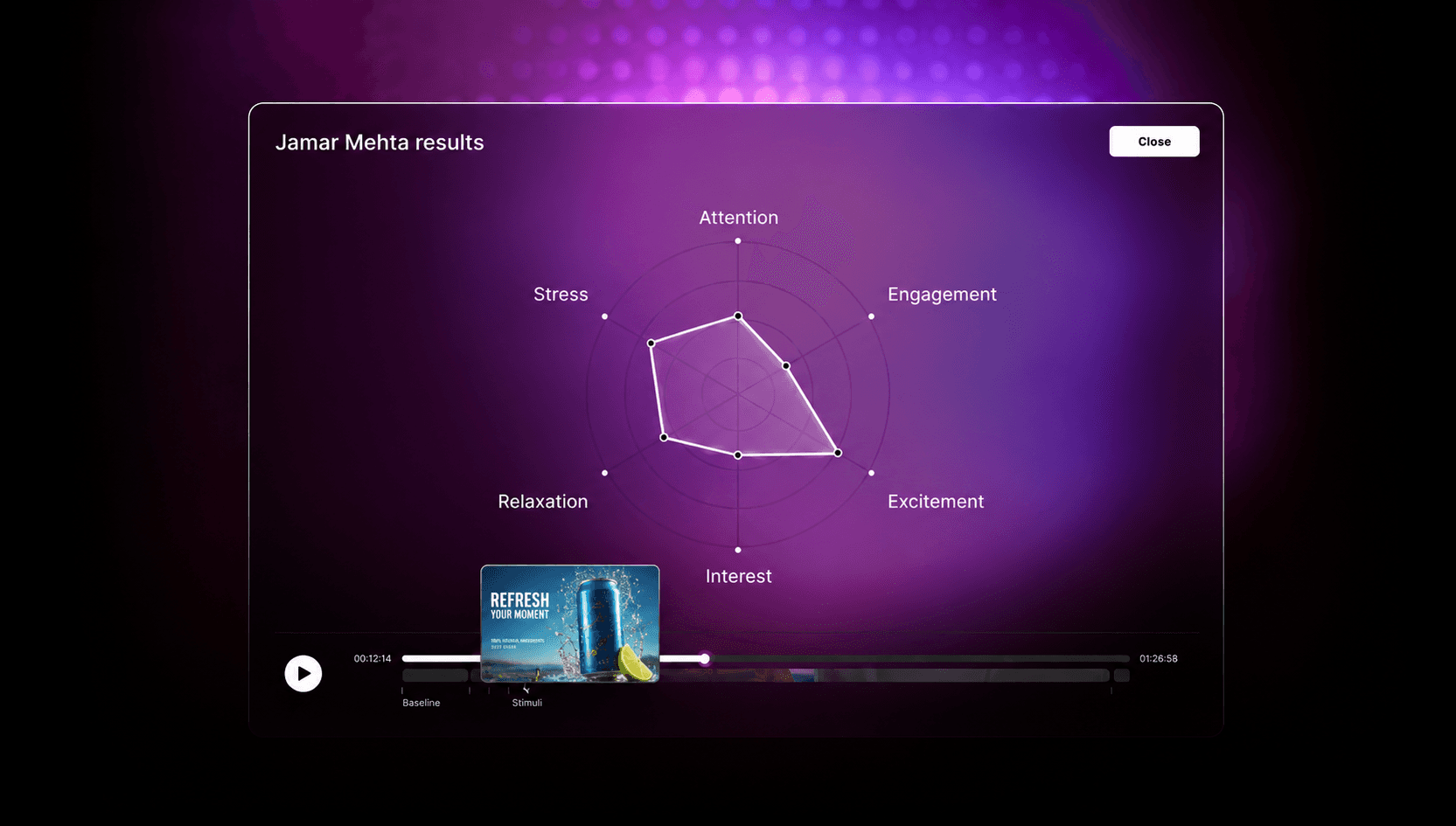
EEG testing helps identify audience response patterns throughout a commercial before final creative decisions are made.
Key Takeaways
EEG provides moment-by-moment audience response data during TV advertising exposure.
Attention and engagement metrics can help identify scenes that strengthen or weaken creative performance.
Neuroscience-informed testing adds context alongside surveys and qualitative research.
Agencies can optimize commercials before launch rather than relying solely on post-campaign results.
EEG-based testing can support audience research across different demographic groups and markets.
Why Creative Evaluation Remains a Challenge
Most agencies already have access to extensive performance metrics. The difficulty is that many of those metrics become available only after a campaign has launched. While focus groups and survey-based evaluations remain important, they can sometimes miss subtle fluctuations in audience attention and emotional response that occur during viewing.
Research suggests that neuroscience methods can provide information about implicit processes that are difficult to access through traditional approaches alone. According to Plassmann et al. (2015), consumer neuroscience methods can help validate and extend understanding of consumer behavior by providing additional insight into how audiences respond to marketing stimuli.
For agencies, this creates an opportunity to evaluate not only what viewers say about a commercial, but also how they respond throughout the viewing experience. Those insights can inform editing decisions, scene sequencing, pacing, visual hierarchy, and creative optimization.
Why Attention Matters in TV Advertising
Attention remains one of the most valuable indicators available during advertising evaluation. Even highly polished creative assets can underperform if key messages appear during moments when audience attention declines.
Research by Milosavljevic and Cerf (2008) highlights the importance of attention as a meaningful metric for advertising research. Understanding where viewers focus their attention allows agencies to assess whether critical brand messages, product visuals, or narrative moments are being delivered at the right time.
Similarly, research by Milosavljevic et al. (2011) found that visual saliency can influence consumer choices and that these effects become more pronounced under cognitive load. For TV advertising, this reinforces the importance of creative design choices, visual hierarchy, and pacing when attempting to maintain audience engagement.
How EEG Adds Context to Traditional Ad Testing
EEG-based testing enables agencies to examine audience responses continuously throughout a commercial. Instead of relying exclusively on end-of-viewing feedback, researchers can observe how engagement changes from scene to scene.
This approach is particularly valuable when evaluating multiple creative executions. Two commercials may receive similar survey scores while producing very different engagement patterns during viewing. EEG data can help identify moments that create sustained interest, moments that generate cognitive stress, and moments where audience attention declines.
Research reviewed by Byrne et al. (2022) suggests that neuroscience-based methods can help reduce subjectivity in marketing research by capturing cognitive and emotional responses that may not always be reflected in self-reported feedback.
For agencies balancing creative intuition with measurable evidence, this additional context can improve confidence in optimization decisions before media investments are finalized.
Real-World Examples of EEG in Audience Testing
One example comes from TV commercial research conducted by Vecchiato et al. (2014). Researchers used EEG to evaluate audience responses to television advertising across Eastern and Western demographic groups. Their findings demonstrated that EEG could track variations in cognitive and emotional processing during commercial viewing, supporting the use of neuroscience methods for TV advertising research across different audiences.
For agencies managing multinational campaigns, these insights can be especially valuable. Creative elements that perform well in one market may generate different audience responses in another. EEG testing can help identify those differences before campaigns are deployed at scale.
A second example comes from entertainment media research. Christoforou et al. (2017) found that neural responses recorded while audiences watched movie trailers could predict substantial variance in box-office performance compared with traditional screening approaches. Although movie trailers and TV commercials serve different purposes, both rely on maintaining audience attention and engagement throughout a short-form video experience. The study demonstrates how neuroscience-informed testing can support creative refinement while content is still being edited.
Organizations conducting audience testing through Emotiv's neuromarketing research solutions apply similar principles when evaluating advertising, creative assets, and viewer experiences to better understand how audiences engage with media content.
Applying EEG Insights to Agency Workflows
EEG-based TV advertising testing is most effective when integrated into existing research workflows rather than treated as a standalone methodology. Agencies can combine neuroscience measures with surveys, interviews, and behavioral data to develop a more complete picture of audience response.
Potential applications include:
Comparing multiple commercial edits before launch.
Evaluating attention during key brand moments.
Assessing audience response across demographic groups.
Identifying scenes associated with increased cognitive stress.
Supporting creative optimization decisions with additional evidence.
This combination of behavioral, qualitative, and neuroscience-informed data helps agencies move beyond simple preference comparisons and toward a deeper understanding of how audiences experience advertising content.
Conclusion
As competition for viewer attention continues to intensify, marketing agencies need more than post-campaign performance metrics to guide creative decisions. EEG-based testing provides an additional layer of audience insight that can help teams evaluate attention, engagement, and response patterns before campaigns reach the market.
When combined with traditional research methods, neuroscience-informed testing can strengthen creative evaluation, reduce uncertainty, and support more informed optimization decisions throughout the production process.
Teams looking to evaluate attention, engagement, and audience response before launch can explore the capabilities of Emotiv Studio.
Sources
Byrne, M., et al. (2022). A systematic review of the prediction of consumer preference using EEG measures and machine-learning in neuromarketing research. Brain Informatics. https://doi.org/10.1186/s40708-022-00175-3
Christoforou, C., et al. (2017). Your Brain on the Movies: A Computational Approach for Predicting Box-office Performance from Viewer’s Brain Responses to Movie Trailers. Frontiers in Neuroinformatics. https://doi.org/10.3389/fninf.2017.00072
Plassmann, H., Ramsøy, T. Z., & Milosavljevic, M. (2015). Consumer neuroscience: Applications, challenges, and possible solutions. Journal of Marketing Research. https://doi.org/10.1509/jmr.14.0048
Milosavljevic, M., & Cerf, M. (2008). First Attention Then Intention: Insights from Computational Neuroscience of Vision. International Journal of Advertising. https://doi.org/10.2501/s0265048708080037
Milosavljevic, M., Navalpakkam, V., Koch, C., & Rangel, A. (2011). Relative visual saliency differences induce sizable bias in consumer choice. Journal of Consumer Psychology. https://doi.org/10.1016/j.jcps.2011.10.002
Vecchiato, G., et al. (2014). Cross-cultural analysis of neuroelectrical cognitive and emotional variables during the appreciation of TV commercials. Neuropsychological Trends. https://doi.org/10.7358/neur-2014-016-vecc
For marketing agencies, the challenge with TV advertising is rarely generating creative concepts. The challenge is determining which version is most likely to maintain audience attention, sustain engagement, and deliver a consistent viewing experience before media budgets are committed. Traditional post-exposure surveys, focus groups, and preference studies can provide valuable feedback, but they often capture what viewers remember or choose to report after the experience has ended.
As media costs continue to rise and audience fragmentation increases, agencies need stronger evidence to support creative decisions before launch. EEG-based testing offers an additional layer of insight by measuring audience responses as commercials unfold moment by moment. Rather than replacing traditional research methods, it helps agencies identify where attention drops, engagement fluctuates, or cognitive stress increases, enabling creative teams to refine content while changes are still possible.
For agencies managing multiple campaigns across diverse audiences, this approach can provide a more detailed understanding of how viewers experience TV advertising and help optimize creative effectiveness before airtime.
EEG testing helps identify audience response patterns throughout a commercial before final creative decisions are made.
Key Takeaways
EEG provides moment-by-moment audience response data during TV advertising exposure.
Attention and engagement metrics can help identify scenes that strengthen or weaken creative performance.
Neuroscience-informed testing adds context alongside surveys and qualitative research.
Agencies can optimize commercials before launch rather than relying solely on post-campaign results.
EEG-based testing can support audience research across different demographic groups and markets.
Why Creative Evaluation Remains a Challenge
Most agencies already have access to extensive performance metrics. The difficulty is that many of those metrics become available only after a campaign has launched. While focus groups and survey-based evaluations remain important, they can sometimes miss subtle fluctuations in audience attention and emotional response that occur during viewing.
Research suggests that neuroscience methods can provide information about implicit processes that are difficult to access through traditional approaches alone. According to Plassmann et al. (2015), consumer neuroscience methods can help validate and extend understanding of consumer behavior by providing additional insight into how audiences respond to marketing stimuli.
For agencies, this creates an opportunity to evaluate not only what viewers say about a commercial, but also how they respond throughout the viewing experience. Those insights can inform editing decisions, scene sequencing, pacing, visual hierarchy, and creative optimization.
Why Attention Matters in TV Advertising
Attention remains one of the most valuable indicators available during advertising evaluation. Even highly polished creative assets can underperform if key messages appear during moments when audience attention declines.
Research by Milosavljevic and Cerf (2008) highlights the importance of attention as a meaningful metric for advertising research. Understanding where viewers focus their attention allows agencies to assess whether critical brand messages, product visuals, or narrative moments are being delivered at the right time.
Similarly, research by Milosavljevic et al. (2011) found that visual saliency can influence consumer choices and that these effects become more pronounced under cognitive load. For TV advertising, this reinforces the importance of creative design choices, visual hierarchy, and pacing when attempting to maintain audience engagement.
How EEG Adds Context to Traditional Ad Testing
EEG-based testing enables agencies to examine audience responses continuously throughout a commercial. Instead of relying exclusively on end-of-viewing feedback, researchers can observe how engagement changes from scene to scene.
This approach is particularly valuable when evaluating multiple creative executions. Two commercials may receive similar survey scores while producing very different engagement patterns during viewing. EEG data can help identify moments that create sustained interest, moments that generate cognitive stress, and moments where audience attention declines.
Research reviewed by Byrne et al. (2022) suggests that neuroscience-based methods can help reduce subjectivity in marketing research by capturing cognitive and emotional responses that may not always be reflected in self-reported feedback.
For agencies balancing creative intuition with measurable evidence, this additional context can improve confidence in optimization decisions before media investments are finalized.
Real-World Examples of EEG in Audience Testing
One example comes from TV commercial research conducted by Vecchiato et al. (2014). Researchers used EEG to evaluate audience responses to television advertising across Eastern and Western demographic groups. Their findings demonstrated that EEG could track variations in cognitive and emotional processing during commercial viewing, supporting the use of neuroscience methods for TV advertising research across different audiences.
For agencies managing multinational campaigns, these insights can be especially valuable. Creative elements that perform well in one market may generate different audience responses in another. EEG testing can help identify those differences before campaigns are deployed at scale.
A second example comes from entertainment media research. Christoforou et al. (2017) found that neural responses recorded while audiences watched movie trailers could predict substantial variance in box-office performance compared with traditional screening approaches. Although movie trailers and TV commercials serve different purposes, both rely on maintaining audience attention and engagement throughout a short-form video experience. The study demonstrates how neuroscience-informed testing can support creative refinement while content is still being edited.
Organizations conducting audience testing through Emotiv's neuromarketing research solutions apply similar principles when evaluating advertising, creative assets, and viewer experiences to better understand how audiences engage with media content.
Applying EEG Insights to Agency Workflows
EEG-based TV advertising testing is most effective when integrated into existing research workflows rather than treated as a standalone methodology. Agencies can combine neuroscience measures with surveys, interviews, and behavioral data to develop a more complete picture of audience response.
Potential applications include:
Comparing multiple commercial edits before launch.
Evaluating attention during key brand moments.
Assessing audience response across demographic groups.
Identifying scenes associated with increased cognitive stress.
Supporting creative optimization decisions with additional evidence.
This combination of behavioral, qualitative, and neuroscience-informed data helps agencies move beyond simple preference comparisons and toward a deeper understanding of how audiences experience advertising content.
Conclusion
As competition for viewer attention continues to intensify, marketing agencies need more than post-campaign performance metrics to guide creative decisions. EEG-based testing provides an additional layer of audience insight that can help teams evaluate attention, engagement, and response patterns before campaigns reach the market.
When combined with traditional research methods, neuroscience-informed testing can strengthen creative evaluation, reduce uncertainty, and support more informed optimization decisions throughout the production process.
Teams looking to evaluate attention, engagement, and audience response before launch can explore the capabilities of Emotiv Studio.
Sources
Byrne, M., et al. (2022). A systematic review of the prediction of consumer preference using EEG measures and machine-learning in neuromarketing research. Brain Informatics. https://doi.org/10.1186/s40708-022-00175-3
Christoforou, C., et al. (2017). Your Brain on the Movies: A Computational Approach for Predicting Box-office Performance from Viewer’s Brain Responses to Movie Trailers. Frontiers in Neuroinformatics. https://doi.org/10.3389/fninf.2017.00072
Plassmann, H., Ramsøy, T. Z., & Milosavljevic, M. (2015). Consumer neuroscience: Applications, challenges, and possible solutions. Journal of Marketing Research. https://doi.org/10.1509/jmr.14.0048
Milosavljevic, M., & Cerf, M. (2008). First Attention Then Intention: Insights from Computational Neuroscience of Vision. International Journal of Advertising. https://doi.org/10.2501/s0265048708080037
Milosavljevic, M., Navalpakkam, V., Koch, C., & Rangel, A. (2011). Relative visual saliency differences induce sizable bias in consumer choice. Journal of Consumer Psychology. https://doi.org/10.1016/j.jcps.2011.10.002
Vecchiato, G., et al. (2014). Cross-cultural analysis of neuroelectrical cognitive and emotional variables during the appreciation of TV commercials. Neuropsychological Trends. https://doi.org/10.7358/neur-2014-016-vecc
For marketing agencies, the challenge with TV advertising is rarely generating creative concepts. The challenge is determining which version is most likely to maintain audience attention, sustain engagement, and deliver a consistent viewing experience before media budgets are committed. Traditional post-exposure surveys, focus groups, and preference studies can provide valuable feedback, but they often capture what viewers remember or choose to report after the experience has ended.
As media costs continue to rise and audience fragmentation increases, agencies need stronger evidence to support creative decisions before launch. EEG-based testing offers an additional layer of insight by measuring audience responses as commercials unfold moment by moment. Rather than replacing traditional research methods, it helps agencies identify where attention drops, engagement fluctuates, or cognitive stress increases, enabling creative teams to refine content while changes are still possible.
For agencies managing multiple campaigns across diverse audiences, this approach can provide a more detailed understanding of how viewers experience TV advertising and help optimize creative effectiveness before airtime.
EEG testing helps identify audience response patterns throughout a commercial before final creative decisions are made.
Key Takeaways
EEG provides moment-by-moment audience response data during TV advertising exposure.
Attention and engagement metrics can help identify scenes that strengthen or weaken creative performance.
Neuroscience-informed testing adds context alongside surveys and qualitative research.
Agencies can optimize commercials before launch rather than relying solely on post-campaign results.
EEG-based testing can support audience research across different demographic groups and markets.
Why Creative Evaluation Remains a Challenge
Most agencies already have access to extensive performance metrics. The difficulty is that many of those metrics become available only after a campaign has launched. While focus groups and survey-based evaluations remain important, they can sometimes miss subtle fluctuations in audience attention and emotional response that occur during viewing.
Research suggests that neuroscience methods can provide information about implicit processes that are difficult to access through traditional approaches alone. According to Plassmann et al. (2015), consumer neuroscience methods can help validate and extend understanding of consumer behavior by providing additional insight into how audiences respond to marketing stimuli.
For agencies, this creates an opportunity to evaluate not only what viewers say about a commercial, but also how they respond throughout the viewing experience. Those insights can inform editing decisions, scene sequencing, pacing, visual hierarchy, and creative optimization.
Why Attention Matters in TV Advertising
Attention remains one of the most valuable indicators available during advertising evaluation. Even highly polished creative assets can underperform if key messages appear during moments when audience attention declines.
Research by Milosavljevic and Cerf (2008) highlights the importance of attention as a meaningful metric for advertising research. Understanding where viewers focus their attention allows agencies to assess whether critical brand messages, product visuals, or narrative moments are being delivered at the right time.
Similarly, research by Milosavljevic et al. (2011) found that visual saliency can influence consumer choices and that these effects become more pronounced under cognitive load. For TV advertising, this reinforces the importance of creative design choices, visual hierarchy, and pacing when attempting to maintain audience engagement.
How EEG Adds Context to Traditional Ad Testing
EEG-based testing enables agencies to examine audience responses continuously throughout a commercial. Instead of relying exclusively on end-of-viewing feedback, researchers can observe how engagement changes from scene to scene.
This approach is particularly valuable when evaluating multiple creative executions. Two commercials may receive similar survey scores while producing very different engagement patterns during viewing. EEG data can help identify moments that create sustained interest, moments that generate cognitive stress, and moments where audience attention declines.
Research reviewed by Byrne et al. (2022) suggests that neuroscience-based methods can help reduce subjectivity in marketing research by capturing cognitive and emotional responses that may not always be reflected in self-reported feedback.
For agencies balancing creative intuition with measurable evidence, this additional context can improve confidence in optimization decisions before media investments are finalized.
Real-World Examples of EEG in Audience Testing
One example comes from TV commercial research conducted by Vecchiato et al. (2014). Researchers used EEG to evaluate audience responses to television advertising across Eastern and Western demographic groups. Their findings demonstrated that EEG could track variations in cognitive and emotional processing during commercial viewing, supporting the use of neuroscience methods for TV advertising research across different audiences.
For agencies managing multinational campaigns, these insights can be especially valuable. Creative elements that perform well in one market may generate different audience responses in another. EEG testing can help identify those differences before campaigns are deployed at scale.
A second example comes from entertainment media research. Christoforou et al. (2017) found that neural responses recorded while audiences watched movie trailers could predict substantial variance in box-office performance compared with traditional screening approaches. Although movie trailers and TV commercials serve different purposes, both rely on maintaining audience attention and engagement throughout a short-form video experience. The study demonstrates how neuroscience-informed testing can support creative refinement while content is still being edited.
Organizations conducting audience testing through Emotiv's neuromarketing research solutions apply similar principles when evaluating advertising, creative assets, and viewer experiences to better understand how audiences engage with media content.
Applying EEG Insights to Agency Workflows
EEG-based TV advertising testing is most effective when integrated into existing research workflows rather than treated as a standalone methodology. Agencies can combine neuroscience measures with surveys, interviews, and behavioral data to develop a more complete picture of audience response.
Potential applications include:
Comparing multiple commercial edits before launch.
Evaluating attention during key brand moments.
Assessing audience response across demographic groups.
Identifying scenes associated with increased cognitive stress.
Supporting creative optimization decisions with additional evidence.
This combination of behavioral, qualitative, and neuroscience-informed data helps agencies move beyond simple preference comparisons and toward a deeper understanding of how audiences experience advertising content.
Conclusion
As competition for viewer attention continues to intensify, marketing agencies need more than post-campaign performance metrics to guide creative decisions. EEG-based testing provides an additional layer of audience insight that can help teams evaluate attention, engagement, and response patterns before campaigns reach the market.
When combined with traditional research methods, neuroscience-informed testing can strengthen creative evaluation, reduce uncertainty, and support more informed optimization decisions throughout the production process.
Teams looking to evaluate attention, engagement, and audience response before launch can explore the capabilities of Emotiv Studio.
Sources
Byrne, M., et al. (2022). A systematic review of the prediction of consumer preference using EEG measures and machine-learning in neuromarketing research. Brain Informatics. https://doi.org/10.1186/s40708-022-00175-3
Christoforou, C., et al. (2017). Your Brain on the Movies: A Computational Approach for Predicting Box-office Performance from Viewer’s Brain Responses to Movie Trailers. Frontiers in Neuroinformatics. https://doi.org/10.3389/fninf.2017.00072
Plassmann, H., Ramsøy, T. Z., & Milosavljevic, M. (2015). Consumer neuroscience: Applications, challenges, and possible solutions. Journal of Marketing Research. https://doi.org/10.1509/jmr.14.0048
Milosavljevic, M., & Cerf, M. (2008). First Attention Then Intention: Insights from Computational Neuroscience of Vision. International Journal of Advertising. https://doi.org/10.2501/s0265048708080037
Milosavljevic, M., Navalpakkam, V., Koch, C., & Rangel, A. (2011). Relative visual saliency differences induce sizable bias in consumer choice. Journal of Consumer Psychology. https://doi.org/10.1016/j.jcps.2011.10.002
Vecchiato, G., et al. (2014). Cross-cultural analysis of neuroelectrical cognitive and emotional variables during the appreciation of TV commercials. Neuropsychological Trends. https://doi.org/10.7358/neur-2014-016-vecc