EEG biofeedback: From roots to brain training
Emotiv
Atualizado em
26 de mai. de 2026
EEG biofeedback: From roots to brain training
Emotiv
Atualizado em
26 de mai. de 2026
EEG biofeedback: From roots to brain training
Emotiv
Atualizado em
26 de mai. de 2026
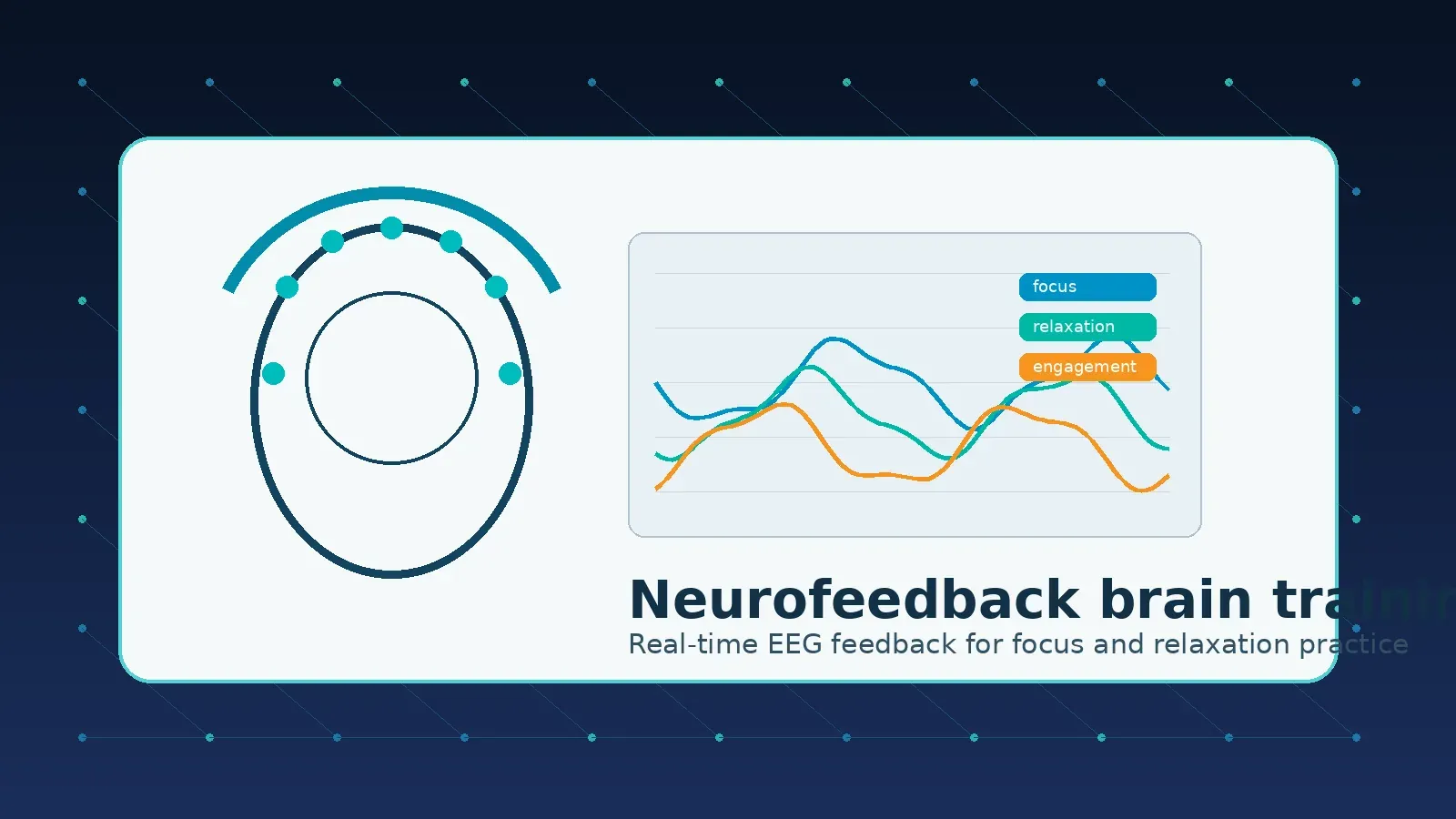
EEG biofeedback is one of the terms people meet when they start researching neurofeedback, brain training, or real-time brain data. The phrase can sound clinical, but the core idea is simple. Sensors capture electrical activity from the scalp, software turns that activity into feedback, and the user or researcher can see how brain states change during a task.
In modern use, EEG biofeedback and neurofeedback often refer to the same brain-focused practice. Biofeedback is the broader field. It can use heart rate, breathing, muscle tension, skin response, or other body signals. EEG biofeedback narrows the signal source to brain activity captured through electroencephalography.
That distinction matters because the category has evolved. Early biofeedback systems were often specialized lab or clinical tools. Today, accessible EEG hardware and software make brain data useful for research, education, BCI development, wellness tools, and human-computer interaction projects.
This guide explains what the term means, how it relates to neurofeedback, and how Emotiv devices fit into modern EEG biofeedback workflows.
EEG biofeedback: what the term means today
EEG biofeedback is feedback based on brain activity measured with EEG sensors. EEG stands for electroencephalography, a method for capturing tiny electrical signals produced by brain activity through sensors placed on or near the scalp. In a feedback workflow, those signals are processed by software and translated into something a person can see, hear, or use in an application.
The term sits inside a larger family called biofeedback. Biofeedback uses real-time information from the body to help people notice patterns that are normally invisible. Traditional examples include breathing rate, heart rate, muscle activity, and skin response. EEG biofeedback applies that same idea to brain signals.
Many people now use the word neurofeedback instead. In everyday search behavior, the terms are often interchangeable. A precise way to understand the relationship is this: neurofeedback is brain-focused biofeedback, and EEG biofeedback is neurofeedback that uses EEG as the signal source.
That does not mean every neurofeedback system is identical. Some workflows use a few sensors. Others use more channels and more complex software. Some are built for research, some for education, some for wellness experiences, and some for clinical research settings. The shared pattern is the feedback loop. Brain activity is measured, interpreted, and reflected back in real time or near real time.
For Emotiv readers, this matters because the value is not only the headset. The full workflow includes EEG hardware, signal quality, software, data access, consent practices, and the goal of the session. A developer building a BCI demo needs different tools than an educator teaching neurotechnology basics. A research team studying attention or workload needs another level of data export and repeatability.
EEG biofeedback is best understood as a method for working with brain data, not as a single device or universal protocol. The method becomes useful when the feedback is matched to a clear goal, reliable data, and an appropriate setting.
How does EEG biofeedback work?
EEG biofeedback works through a loop of measurement, interpretation, feedback, and practice. The loop begins when EEG sensors capture electrical activity from the scalp. Those signals are small and noisy, so software must clean, process, and classify the data before it becomes meaningful feedback.
A session might display simple visual changes, audio changes, game behavior, or performance metrics. For example, a screen might respond when a user maintains a target state. A research interface might show bands, event markers, or cognitive performance measures. A BCI application might translate a learned mental command into a digital action.
The feedback itself is not magic. It is a way to make hidden activity visible. When people receive a signal that changes with their brain state, they can experiment with attention, relaxation, mental imagery, or task focus. Over repeated sessions, the workflow can help them understand how internal states relate to external performance.
The typical feedback loop
Set the goal. The team defines what it wants to observe, such as engagement, attention, workload, meditation, or a specific research task.
Capture EEG data. Sensors collect brain signals from selected scalp locations.
Process the signal. Software filters artifacts, organizes the data, and extracts useful features.
Return feedback. The system presents visual, audio, or application-based feedback that changes with the data.
Review the result. The user, researcher, or developer evaluates whether the workflow produced reliable and useful information.
The design of the loop depends on the use case. A classroom demonstration should be easy to understand. A neuroscience study may need consistent timing, event markers, exports, and documentation. A wellness application may emphasize accessible interaction and user experience. A BCI developer may care most about low-latency data and SDK access.
It is also important to avoid overstating what the loop does. EEG biofeedback can support research, training experiences, education, and wellness tools. It should not be framed as a diagnosis or a guaranteed medical outcome. The responsible question is not, "Can one headset do everything?" The better question is, "Does this setup provide the right data and feedback for this project?"
EEG biofeedback vs neurofeedback: what changes?
The difference between EEG biofeedback and neurofeedback is mostly a difference in terminology and scope. Biofeedback is the widest term. It covers feedback based on signals from the body. Neurofeedback is a specialized form focused on the nervous system, usually brain activity. EEG biofeedback is the EEG-based version of that brain feedback practice.
In many articles, clinics, and product conversations, neurofeedback and EEG biofeedback are used as synonyms. That is reasonable when the system uses EEG signals. The terms start to diverge when a discussion needs more technical precision. Neurofeedback can refer broadly to brain-based feedback, while EEG biofeedback specifies the measurement method.
Term | Signal source | Main use |
|---|---|---|
Biofeedback. | Body signals such as breathing, heart rate, muscle activity, or skin response. | The broad parent category. |
Neurofeedback. | Brain or nervous system activity. | The brain-focused branch of biofeedback. |
EEG biofeedback. | EEG signals captured from the scalp. | Neurofeedback when EEG is the measurement method. |
The practical change is what data you collect and what feedback you can return. If a system uses breathing data, it is biofeedback but not EEG biofeedback. If it uses scalp EEG signals to guide a visual or audio response, the term EEG biofeedback fits.
This matters for buyers and teams because product requirements follow the signal source. EEG workflows raise questions about channel count, sensor fit, data quality, artifact handling, software compatibility, and privacy. A simple physiology biofeedback device may not need the same level of signal processing or data export.
For content and search intent, the overlap is useful. People searching for EEG biofeedback may be trying to understand neurofeedback. People searching for neurofeedback may be trying to understand how EEG sensors are used. A clear explanation should connect the terms without pretending they are always identical in every context.
How brain training evolved from biofeedback roots
Modern brain training did not appear all at once. It grew from the broader biofeedback movement, where researchers and practitioners used sensors to reveal body processes that people could not normally see. When feedback made those processes visible, users could begin to experiment with self-regulation.
EEG added a brain-specific signal to that idea. Early EEG biofeedback protocols often focused on frequency bands such as alpha and theta activity. Research literature describes alpha activity around 8 to 13 Hz and theta activity around 4 to 8 Hz. In older systems, feedback might be auditory and tied to specific brainwave patterns during a structured session.
The field then moved from specialized equipment toward software-driven systems. Better sensors, faster computing, cloud tools, and more accessible interfaces changed what teams could build. Instead of treating feedback as only a lab procedure, modern platforms can connect EEG data to dashboards, games, BCI controls, education modules, and research pipelines.
From signal display to interactive experience
The biggest change is that feedback is now part of an experience. A researcher may use EEG to study workload during a simulated task. A developer may use EEG features to control a prototype. A classroom may use EEG to demonstrate attention, artifacts, and brain-computer interfaces. A wellness team may use EEG data to create experiences that help users explore focus or meditation.
That evolution does not remove the need for rigor. The more accessible the tools become, the more important the workflow becomes. Teams still need clear goals, informed users, careful data handling, and honest communication about what EEG can and cannot show.
Emotiv sits in this modern stage of the category. The company focuses on accessible neurotechnology that connects professional neuroscience workflows with practical applications. That includes EEG headsets, software, and developer tools that make brain data usable for research, education, wellness, and BCI development.
The result is a shift from passive observation to applied brain data. EEG biofeedback is no longer only a term from older lab settings. It is also part of a broader movement toward scalable, interactive neurotechnology.
Where is EEG biofeedback used today?
EEG biofeedback appears in several settings because brain data is useful to different groups for different reasons. The same basic loop can support a classroom demo, a university study, a workplace research project, or a developer prototype. The details change based on the audience and the risk level.
Research and education
Academic researchers use EEG tools to study attention, workload, perception, learning, affective response, and human-computer interaction. In this context, EEG biofeedback can help create controlled tasks where participants receive feedback while researchers collect data. The priority is repeatability, data access, and documentation.
Educators use EEG to make neuroscience visible. Students can see how signals change, why artifacts matter, and how feedback systems are designed. Accessible devices make it easier to demonstrate concepts that once required more specialized lab infrastructure.
BCI development and interactive applications
Brain-computer interface developers use EEG signals to create applications that respond to user states or mental commands. This can include games, accessibility experiments, creative tools, and interface prototypes. For these teams, low-latency access and SDK support are often more important than a finished consumer experience.
Wellness and performance tools
Wellness professionals and product teams may use EEG data to support meditation, focus, stress exploration, or cognitive performance experiences. The safest framing is access to cognitive wellness tools, not a promise to treat or diagnose a condition. EEG feedback can help users explore patterns, but interpretation should match the product's evidence and scope.
Internal resources can help readers go deeper. Emotiv's EEG neurofeedback beginner's guide explains the basics of neurofeedback. The Emotiv neurofeedback knowledge base explains how Emotiv hardware can connect with compatible workflows. Product pages for Epoc X, Insight, and MN8 show how device choices differ by use case.
Choosing Emotiv tools for EEG biofeedback projects
Choosing the right Emotiv setup starts with the project, not the product list. A research team, a wellness product team, and a BCI developer may all use EEG biofeedback. But they usually need different data depth, comfort, software access, and deployment options.
Epoc X is a strong fit when a team needs a 14-channel EEG headset for research, education, and application development. More channels can help teams capture a richer view of scalp activity across tasks. That makes the device useful for labs, HCI teams, and developers who need more than a simple demonstration.
Insight can fit projects that need accessible EEG in a lighter 5-channel form. It is useful for education, wellness experiences, and projects where ease of use matters. It can also support early-stage prototyping before a team moves into a more complex workflow.
MN8 brings EEG into an earbud format. For teams exploring 2-channel EEG in a more familiar wearable design, MN8 can support use cases where comfort, simplicity, and everyday interaction are important. It is especially relevant when a project needs a less lab-like experience.
Hardware is only part of the decision. EmotivPRO helps teams view, record, and work with EEG data. The Cortex SDK supports developers who need access to data streams and BCI features inside custom applications. Together, the hardware and software define what kind of feedback loop a team can build.
A responsible EEG biofeedback project should also define its boundaries. Is the goal research, education, wellness, product testing, or application control? Who will use the system? What data will be stored? What consent language is needed? What claims are appropriate? These questions keep the workflow aligned with the evidence and the audience.
How to evaluate an EEG biofeedback setup
An EEG biofeedback setup should be evaluated as a complete system. The headset matters, but the software, data workflow, environment, user comfort, and project goals matter just as much. Use the following steps before choosing a device or designing a session.
Define the goal. Decide whether the project is for research, education, wellness, BCI development, or product exploration. A vague goal leads to vague feedback.
Choose the right signal depth. Consider channel count, sensor placement, comfort, and session length. More channels may support richer research, while fewer channels may support lighter experiences.
Confirm software compatibility. Check whether the setup supports the dashboards, exports, SDKs, event markers, or application integrations the project needs.
Plan the feedback experience. Decide whether feedback should be visual, auditory, game-like, or data-focused. Match the experience to the user's skill level.
Document data handling. Decide what data is collected, where it is stored, who can access it, and how users consent to the workflow.
Test for reliability. Run pilot sessions to identify artifacts, fit issues, confusing instructions, or feedback delays before scaling the project.
This process is especially important because EEG is sensitive to context. Movement, fit, hair, environment, and task design can affect data quality. A polished interface cannot compensate for unclear goals or poor data practices.
Teams should also match language to evidence. If a workflow is designed for education, call it education. If it is for wellness exploration, avoid clinical promises. If it is part of a formal study, explain the protocol and limitations. Clear language builds trust and prevents users from expecting more than the setup is designed to provide.
The best EEG biofeedback system is not always the most complex system. It is the setup that gives the right people the right feedback, at the right fidelity, for the right purpose.
Frequently asked questions about EEG biofeedback
Is neurofeedback the same as EEG biofeedback?
Often, yes. Neurofeedback is the broader brain-focused term, while EEG biofeedback specifies that EEG signals are used. If a neurofeedback system relies on EEG sensors, the terms usually point to the same kind of workflow.
What is the difference between biofeedback and neurofeedback?
Biofeedback can use many body signals, including breathing, heart rate, muscle activity, and skin response. Neurofeedback focuses on brain activity. EEG biofeedback is a neurofeedback method that uses EEG data from the scalp.
Can Emotiv devices be used for EEG biofeedback projects?
Yes, Emotiv devices can support EEG biofeedback projects when paired with the right software and workflow. The best choice depends on whether the project needs research-grade data, an accessible headset, earbud-based EEG, SDK access, or a classroom-friendly experience.
Is EEG biofeedback only for clinical settings?
No. EEG biofeedback appears in research, education, BCI development, wellness tools, and clinical research contexts. The language and workflow should match the setting. Emotiv products should be described as EEG data and software tools, not as diagnostic devices.
What should I look for in an EEG biofeedback setup?
Look for a clear goal, suitable sensors, reliable software, useful feedback, data access, user comfort, and responsible privacy practices. A strong setup connects the signal, feedback, and use case without making unsupported claims.
Explore Emotiv tools for EEG biofeedback
Ready to build or evaluate an EEG biofeedback workflow? Explore Emotiv EEG headsets, software, and developer tools to choose the setup that fits your research, education, wellness, or BCI project.
EEG biofeedback is one of the terms people meet when they start researching neurofeedback, brain training, or real-time brain data. The phrase can sound clinical, but the core idea is simple. Sensors capture electrical activity from the scalp, software turns that activity into feedback, and the user or researcher can see how brain states change during a task.
In modern use, EEG biofeedback and neurofeedback often refer to the same brain-focused practice. Biofeedback is the broader field. It can use heart rate, breathing, muscle tension, skin response, or other body signals. EEG biofeedback narrows the signal source to brain activity captured through electroencephalography.
That distinction matters because the category has evolved. Early biofeedback systems were often specialized lab or clinical tools. Today, accessible EEG hardware and software make brain data useful for research, education, BCI development, wellness tools, and human-computer interaction projects.
This guide explains what the term means, how it relates to neurofeedback, and how Emotiv devices fit into modern EEG biofeedback workflows.
EEG biofeedback: what the term means today
EEG biofeedback is feedback based on brain activity measured with EEG sensors. EEG stands for electroencephalography, a method for capturing tiny electrical signals produced by brain activity through sensors placed on or near the scalp. In a feedback workflow, those signals are processed by software and translated into something a person can see, hear, or use in an application.
The term sits inside a larger family called biofeedback. Biofeedback uses real-time information from the body to help people notice patterns that are normally invisible. Traditional examples include breathing rate, heart rate, muscle activity, and skin response. EEG biofeedback applies that same idea to brain signals.
Many people now use the word neurofeedback instead. In everyday search behavior, the terms are often interchangeable. A precise way to understand the relationship is this: neurofeedback is brain-focused biofeedback, and EEG biofeedback is neurofeedback that uses EEG as the signal source.
That does not mean every neurofeedback system is identical. Some workflows use a few sensors. Others use more channels and more complex software. Some are built for research, some for education, some for wellness experiences, and some for clinical research settings. The shared pattern is the feedback loop. Brain activity is measured, interpreted, and reflected back in real time or near real time.
For Emotiv readers, this matters because the value is not only the headset. The full workflow includes EEG hardware, signal quality, software, data access, consent practices, and the goal of the session. A developer building a BCI demo needs different tools than an educator teaching neurotechnology basics. A research team studying attention or workload needs another level of data export and repeatability.
EEG biofeedback is best understood as a method for working with brain data, not as a single device or universal protocol. The method becomes useful when the feedback is matched to a clear goal, reliable data, and an appropriate setting.
How does EEG biofeedback work?
EEG biofeedback works through a loop of measurement, interpretation, feedback, and practice. The loop begins when EEG sensors capture electrical activity from the scalp. Those signals are small and noisy, so software must clean, process, and classify the data before it becomes meaningful feedback.
A session might display simple visual changes, audio changes, game behavior, or performance metrics. For example, a screen might respond when a user maintains a target state. A research interface might show bands, event markers, or cognitive performance measures. A BCI application might translate a learned mental command into a digital action.
The feedback itself is not magic. It is a way to make hidden activity visible. When people receive a signal that changes with their brain state, they can experiment with attention, relaxation, mental imagery, or task focus. Over repeated sessions, the workflow can help them understand how internal states relate to external performance.
The typical feedback loop
Set the goal. The team defines what it wants to observe, such as engagement, attention, workload, meditation, or a specific research task.
Capture EEG data. Sensors collect brain signals from selected scalp locations.
Process the signal. Software filters artifacts, organizes the data, and extracts useful features.
Return feedback. The system presents visual, audio, or application-based feedback that changes with the data.
Review the result. The user, researcher, or developer evaluates whether the workflow produced reliable and useful information.
The design of the loop depends on the use case. A classroom demonstration should be easy to understand. A neuroscience study may need consistent timing, event markers, exports, and documentation. A wellness application may emphasize accessible interaction and user experience. A BCI developer may care most about low-latency data and SDK access.
It is also important to avoid overstating what the loop does. EEG biofeedback can support research, training experiences, education, and wellness tools. It should not be framed as a diagnosis or a guaranteed medical outcome. The responsible question is not, "Can one headset do everything?" The better question is, "Does this setup provide the right data and feedback for this project?"
EEG biofeedback vs neurofeedback: what changes?
The difference between EEG biofeedback and neurofeedback is mostly a difference in terminology and scope. Biofeedback is the widest term. It covers feedback based on signals from the body. Neurofeedback is a specialized form focused on the nervous system, usually brain activity. EEG biofeedback is the EEG-based version of that brain feedback practice.
In many articles, clinics, and product conversations, neurofeedback and EEG biofeedback are used as synonyms. That is reasonable when the system uses EEG signals. The terms start to diverge when a discussion needs more technical precision. Neurofeedback can refer broadly to brain-based feedback, while EEG biofeedback specifies the measurement method.
Term | Signal source | Main use |
|---|---|---|
Biofeedback. | Body signals such as breathing, heart rate, muscle activity, or skin response. | The broad parent category. |
Neurofeedback. | Brain or nervous system activity. | The brain-focused branch of biofeedback. |
EEG biofeedback. | EEG signals captured from the scalp. | Neurofeedback when EEG is the measurement method. |
The practical change is what data you collect and what feedback you can return. If a system uses breathing data, it is biofeedback but not EEG biofeedback. If it uses scalp EEG signals to guide a visual or audio response, the term EEG biofeedback fits.
This matters for buyers and teams because product requirements follow the signal source. EEG workflows raise questions about channel count, sensor fit, data quality, artifact handling, software compatibility, and privacy. A simple physiology biofeedback device may not need the same level of signal processing or data export.
For content and search intent, the overlap is useful. People searching for EEG biofeedback may be trying to understand neurofeedback. People searching for neurofeedback may be trying to understand how EEG sensors are used. A clear explanation should connect the terms without pretending they are always identical in every context.
How brain training evolved from biofeedback roots
Modern brain training did not appear all at once. It grew from the broader biofeedback movement, where researchers and practitioners used sensors to reveal body processes that people could not normally see. When feedback made those processes visible, users could begin to experiment with self-regulation.
EEG added a brain-specific signal to that idea. Early EEG biofeedback protocols often focused on frequency bands such as alpha and theta activity. Research literature describes alpha activity around 8 to 13 Hz and theta activity around 4 to 8 Hz. In older systems, feedback might be auditory and tied to specific brainwave patterns during a structured session.
The field then moved from specialized equipment toward software-driven systems. Better sensors, faster computing, cloud tools, and more accessible interfaces changed what teams could build. Instead of treating feedback as only a lab procedure, modern platforms can connect EEG data to dashboards, games, BCI controls, education modules, and research pipelines.
From signal display to interactive experience
The biggest change is that feedback is now part of an experience. A researcher may use EEG to study workload during a simulated task. A developer may use EEG features to control a prototype. A classroom may use EEG to demonstrate attention, artifacts, and brain-computer interfaces. A wellness team may use EEG data to create experiences that help users explore focus or meditation.
That evolution does not remove the need for rigor. The more accessible the tools become, the more important the workflow becomes. Teams still need clear goals, informed users, careful data handling, and honest communication about what EEG can and cannot show.
Emotiv sits in this modern stage of the category. The company focuses on accessible neurotechnology that connects professional neuroscience workflows with practical applications. That includes EEG headsets, software, and developer tools that make brain data usable for research, education, wellness, and BCI development.
The result is a shift from passive observation to applied brain data. EEG biofeedback is no longer only a term from older lab settings. It is also part of a broader movement toward scalable, interactive neurotechnology.
Where is EEG biofeedback used today?
EEG biofeedback appears in several settings because brain data is useful to different groups for different reasons. The same basic loop can support a classroom demo, a university study, a workplace research project, or a developer prototype. The details change based on the audience and the risk level.
Research and education
Academic researchers use EEG tools to study attention, workload, perception, learning, affective response, and human-computer interaction. In this context, EEG biofeedback can help create controlled tasks where participants receive feedback while researchers collect data. The priority is repeatability, data access, and documentation.
Educators use EEG to make neuroscience visible. Students can see how signals change, why artifacts matter, and how feedback systems are designed. Accessible devices make it easier to demonstrate concepts that once required more specialized lab infrastructure.
BCI development and interactive applications
Brain-computer interface developers use EEG signals to create applications that respond to user states or mental commands. This can include games, accessibility experiments, creative tools, and interface prototypes. For these teams, low-latency access and SDK support are often more important than a finished consumer experience.
Wellness and performance tools
Wellness professionals and product teams may use EEG data to support meditation, focus, stress exploration, or cognitive performance experiences. The safest framing is access to cognitive wellness tools, not a promise to treat or diagnose a condition. EEG feedback can help users explore patterns, but interpretation should match the product's evidence and scope.
Internal resources can help readers go deeper. Emotiv's EEG neurofeedback beginner's guide explains the basics of neurofeedback. The Emotiv neurofeedback knowledge base explains how Emotiv hardware can connect with compatible workflows. Product pages for Epoc X, Insight, and MN8 show how device choices differ by use case.
Choosing Emotiv tools for EEG biofeedback projects
Choosing the right Emotiv setup starts with the project, not the product list. A research team, a wellness product team, and a BCI developer may all use EEG biofeedback. But they usually need different data depth, comfort, software access, and deployment options.
Epoc X is a strong fit when a team needs a 14-channel EEG headset for research, education, and application development. More channels can help teams capture a richer view of scalp activity across tasks. That makes the device useful for labs, HCI teams, and developers who need more than a simple demonstration.
Insight can fit projects that need accessible EEG in a lighter 5-channel form. It is useful for education, wellness experiences, and projects where ease of use matters. It can also support early-stage prototyping before a team moves into a more complex workflow.
MN8 brings EEG into an earbud format. For teams exploring 2-channel EEG in a more familiar wearable design, MN8 can support use cases where comfort, simplicity, and everyday interaction are important. It is especially relevant when a project needs a less lab-like experience.
Hardware is only part of the decision. EmotivPRO helps teams view, record, and work with EEG data. The Cortex SDK supports developers who need access to data streams and BCI features inside custom applications. Together, the hardware and software define what kind of feedback loop a team can build.
A responsible EEG biofeedback project should also define its boundaries. Is the goal research, education, wellness, product testing, or application control? Who will use the system? What data will be stored? What consent language is needed? What claims are appropriate? These questions keep the workflow aligned with the evidence and the audience.
How to evaluate an EEG biofeedback setup
An EEG biofeedback setup should be evaluated as a complete system. The headset matters, but the software, data workflow, environment, user comfort, and project goals matter just as much. Use the following steps before choosing a device or designing a session.
Define the goal. Decide whether the project is for research, education, wellness, BCI development, or product exploration. A vague goal leads to vague feedback.
Choose the right signal depth. Consider channel count, sensor placement, comfort, and session length. More channels may support richer research, while fewer channels may support lighter experiences.
Confirm software compatibility. Check whether the setup supports the dashboards, exports, SDKs, event markers, or application integrations the project needs.
Plan the feedback experience. Decide whether feedback should be visual, auditory, game-like, or data-focused. Match the experience to the user's skill level.
Document data handling. Decide what data is collected, where it is stored, who can access it, and how users consent to the workflow.
Test for reliability. Run pilot sessions to identify artifacts, fit issues, confusing instructions, or feedback delays before scaling the project.
This process is especially important because EEG is sensitive to context. Movement, fit, hair, environment, and task design can affect data quality. A polished interface cannot compensate for unclear goals or poor data practices.
Teams should also match language to evidence. If a workflow is designed for education, call it education. If it is for wellness exploration, avoid clinical promises. If it is part of a formal study, explain the protocol and limitations. Clear language builds trust and prevents users from expecting more than the setup is designed to provide.
The best EEG biofeedback system is not always the most complex system. It is the setup that gives the right people the right feedback, at the right fidelity, for the right purpose.
Frequently asked questions about EEG biofeedback
Is neurofeedback the same as EEG biofeedback?
Often, yes. Neurofeedback is the broader brain-focused term, while EEG biofeedback specifies that EEG signals are used. If a neurofeedback system relies on EEG sensors, the terms usually point to the same kind of workflow.
What is the difference between biofeedback and neurofeedback?
Biofeedback can use many body signals, including breathing, heart rate, muscle activity, and skin response. Neurofeedback focuses on brain activity. EEG biofeedback is a neurofeedback method that uses EEG data from the scalp.
Can Emotiv devices be used for EEG biofeedback projects?
Yes, Emotiv devices can support EEG biofeedback projects when paired with the right software and workflow. The best choice depends on whether the project needs research-grade data, an accessible headset, earbud-based EEG, SDK access, or a classroom-friendly experience.
Is EEG biofeedback only for clinical settings?
No. EEG biofeedback appears in research, education, BCI development, wellness tools, and clinical research contexts. The language and workflow should match the setting. Emotiv products should be described as EEG data and software tools, not as diagnostic devices.
What should I look for in an EEG biofeedback setup?
Look for a clear goal, suitable sensors, reliable software, useful feedback, data access, user comfort, and responsible privacy practices. A strong setup connects the signal, feedback, and use case without making unsupported claims.
Explore Emotiv tools for EEG biofeedback
Ready to build or evaluate an EEG biofeedback workflow? Explore Emotiv EEG headsets, software, and developer tools to choose the setup that fits your research, education, wellness, or BCI project.
EEG biofeedback is one of the terms people meet when they start researching neurofeedback, brain training, or real-time brain data. The phrase can sound clinical, but the core idea is simple. Sensors capture electrical activity from the scalp, software turns that activity into feedback, and the user or researcher can see how brain states change during a task.
In modern use, EEG biofeedback and neurofeedback often refer to the same brain-focused practice. Biofeedback is the broader field. It can use heart rate, breathing, muscle tension, skin response, or other body signals. EEG biofeedback narrows the signal source to brain activity captured through electroencephalography.
That distinction matters because the category has evolved. Early biofeedback systems were often specialized lab or clinical tools. Today, accessible EEG hardware and software make brain data useful for research, education, BCI development, wellness tools, and human-computer interaction projects.
This guide explains what the term means, how it relates to neurofeedback, and how Emotiv devices fit into modern EEG biofeedback workflows.
EEG biofeedback: what the term means today
EEG biofeedback is feedback based on brain activity measured with EEG sensors. EEG stands for electroencephalography, a method for capturing tiny electrical signals produced by brain activity through sensors placed on or near the scalp. In a feedback workflow, those signals are processed by software and translated into something a person can see, hear, or use in an application.
The term sits inside a larger family called biofeedback. Biofeedback uses real-time information from the body to help people notice patterns that are normally invisible. Traditional examples include breathing rate, heart rate, muscle activity, and skin response. EEG biofeedback applies that same idea to brain signals.
Many people now use the word neurofeedback instead. In everyday search behavior, the terms are often interchangeable. A precise way to understand the relationship is this: neurofeedback is brain-focused biofeedback, and EEG biofeedback is neurofeedback that uses EEG as the signal source.
That does not mean every neurofeedback system is identical. Some workflows use a few sensors. Others use more channels and more complex software. Some are built for research, some for education, some for wellness experiences, and some for clinical research settings. The shared pattern is the feedback loop. Brain activity is measured, interpreted, and reflected back in real time or near real time.
For Emotiv readers, this matters because the value is not only the headset. The full workflow includes EEG hardware, signal quality, software, data access, consent practices, and the goal of the session. A developer building a BCI demo needs different tools than an educator teaching neurotechnology basics. A research team studying attention or workload needs another level of data export and repeatability.
EEG biofeedback is best understood as a method for working with brain data, not as a single device or universal protocol. The method becomes useful when the feedback is matched to a clear goal, reliable data, and an appropriate setting.
How does EEG biofeedback work?
EEG biofeedback works through a loop of measurement, interpretation, feedback, and practice. The loop begins when EEG sensors capture electrical activity from the scalp. Those signals are small and noisy, so software must clean, process, and classify the data before it becomes meaningful feedback.
A session might display simple visual changes, audio changes, game behavior, or performance metrics. For example, a screen might respond when a user maintains a target state. A research interface might show bands, event markers, or cognitive performance measures. A BCI application might translate a learned mental command into a digital action.
The feedback itself is not magic. It is a way to make hidden activity visible. When people receive a signal that changes with their brain state, they can experiment with attention, relaxation, mental imagery, or task focus. Over repeated sessions, the workflow can help them understand how internal states relate to external performance.
The typical feedback loop
Set the goal. The team defines what it wants to observe, such as engagement, attention, workload, meditation, or a specific research task.
Capture EEG data. Sensors collect brain signals from selected scalp locations.
Process the signal. Software filters artifacts, organizes the data, and extracts useful features.
Return feedback. The system presents visual, audio, or application-based feedback that changes with the data.
Review the result. The user, researcher, or developer evaluates whether the workflow produced reliable and useful information.
The design of the loop depends on the use case. A classroom demonstration should be easy to understand. A neuroscience study may need consistent timing, event markers, exports, and documentation. A wellness application may emphasize accessible interaction and user experience. A BCI developer may care most about low-latency data and SDK access.
It is also important to avoid overstating what the loop does. EEG biofeedback can support research, training experiences, education, and wellness tools. It should not be framed as a diagnosis or a guaranteed medical outcome. The responsible question is not, "Can one headset do everything?" The better question is, "Does this setup provide the right data and feedback for this project?"
EEG biofeedback vs neurofeedback: what changes?
The difference between EEG biofeedback and neurofeedback is mostly a difference in terminology and scope. Biofeedback is the widest term. It covers feedback based on signals from the body. Neurofeedback is a specialized form focused on the nervous system, usually brain activity. EEG biofeedback is the EEG-based version of that brain feedback practice.
In many articles, clinics, and product conversations, neurofeedback and EEG biofeedback are used as synonyms. That is reasonable when the system uses EEG signals. The terms start to diverge when a discussion needs more technical precision. Neurofeedback can refer broadly to brain-based feedback, while EEG biofeedback specifies the measurement method.
Term | Signal source | Main use |
|---|---|---|
Biofeedback. | Body signals such as breathing, heart rate, muscle activity, or skin response. | The broad parent category. |
Neurofeedback. | Brain or nervous system activity. | The brain-focused branch of biofeedback. |
EEG biofeedback. | EEG signals captured from the scalp. | Neurofeedback when EEG is the measurement method. |
The practical change is what data you collect and what feedback you can return. If a system uses breathing data, it is biofeedback but not EEG biofeedback. If it uses scalp EEG signals to guide a visual or audio response, the term EEG biofeedback fits.
This matters for buyers and teams because product requirements follow the signal source. EEG workflows raise questions about channel count, sensor fit, data quality, artifact handling, software compatibility, and privacy. A simple physiology biofeedback device may not need the same level of signal processing or data export.
For content and search intent, the overlap is useful. People searching for EEG biofeedback may be trying to understand neurofeedback. People searching for neurofeedback may be trying to understand how EEG sensors are used. A clear explanation should connect the terms without pretending they are always identical in every context.
How brain training evolved from biofeedback roots
Modern brain training did not appear all at once. It grew from the broader biofeedback movement, where researchers and practitioners used sensors to reveal body processes that people could not normally see. When feedback made those processes visible, users could begin to experiment with self-regulation.
EEG added a brain-specific signal to that idea. Early EEG biofeedback protocols often focused on frequency bands such as alpha and theta activity. Research literature describes alpha activity around 8 to 13 Hz and theta activity around 4 to 8 Hz. In older systems, feedback might be auditory and tied to specific brainwave patterns during a structured session.
The field then moved from specialized equipment toward software-driven systems. Better sensors, faster computing, cloud tools, and more accessible interfaces changed what teams could build. Instead of treating feedback as only a lab procedure, modern platforms can connect EEG data to dashboards, games, BCI controls, education modules, and research pipelines.
From signal display to interactive experience
The biggest change is that feedback is now part of an experience. A researcher may use EEG to study workload during a simulated task. A developer may use EEG features to control a prototype. A classroom may use EEG to demonstrate attention, artifacts, and brain-computer interfaces. A wellness team may use EEG data to create experiences that help users explore focus or meditation.
That evolution does not remove the need for rigor. The more accessible the tools become, the more important the workflow becomes. Teams still need clear goals, informed users, careful data handling, and honest communication about what EEG can and cannot show.
Emotiv sits in this modern stage of the category. The company focuses on accessible neurotechnology that connects professional neuroscience workflows with practical applications. That includes EEG headsets, software, and developer tools that make brain data usable for research, education, wellness, and BCI development.
The result is a shift from passive observation to applied brain data. EEG biofeedback is no longer only a term from older lab settings. It is also part of a broader movement toward scalable, interactive neurotechnology.
Where is EEG biofeedback used today?
EEG biofeedback appears in several settings because brain data is useful to different groups for different reasons. The same basic loop can support a classroom demo, a university study, a workplace research project, or a developer prototype. The details change based on the audience and the risk level.
Research and education
Academic researchers use EEG tools to study attention, workload, perception, learning, affective response, and human-computer interaction. In this context, EEG biofeedback can help create controlled tasks where participants receive feedback while researchers collect data. The priority is repeatability, data access, and documentation.
Educators use EEG to make neuroscience visible. Students can see how signals change, why artifacts matter, and how feedback systems are designed. Accessible devices make it easier to demonstrate concepts that once required more specialized lab infrastructure.
BCI development and interactive applications
Brain-computer interface developers use EEG signals to create applications that respond to user states or mental commands. This can include games, accessibility experiments, creative tools, and interface prototypes. For these teams, low-latency access and SDK support are often more important than a finished consumer experience.
Wellness and performance tools
Wellness professionals and product teams may use EEG data to support meditation, focus, stress exploration, or cognitive performance experiences. The safest framing is access to cognitive wellness tools, not a promise to treat or diagnose a condition. EEG feedback can help users explore patterns, but interpretation should match the product's evidence and scope.
Internal resources can help readers go deeper. Emotiv's EEG neurofeedback beginner's guide explains the basics of neurofeedback. The Emotiv neurofeedback knowledge base explains how Emotiv hardware can connect with compatible workflows. Product pages for Epoc X, Insight, and MN8 show how device choices differ by use case.
Choosing Emotiv tools for EEG biofeedback projects
Choosing the right Emotiv setup starts with the project, not the product list. A research team, a wellness product team, and a BCI developer may all use EEG biofeedback. But they usually need different data depth, comfort, software access, and deployment options.
Epoc X is a strong fit when a team needs a 14-channel EEG headset for research, education, and application development. More channels can help teams capture a richer view of scalp activity across tasks. That makes the device useful for labs, HCI teams, and developers who need more than a simple demonstration.
Insight can fit projects that need accessible EEG in a lighter 5-channel form. It is useful for education, wellness experiences, and projects where ease of use matters. It can also support early-stage prototyping before a team moves into a more complex workflow.
MN8 brings EEG into an earbud format. For teams exploring 2-channel EEG in a more familiar wearable design, MN8 can support use cases where comfort, simplicity, and everyday interaction are important. It is especially relevant when a project needs a less lab-like experience.
Hardware is only part of the decision. EmotivPRO helps teams view, record, and work with EEG data. The Cortex SDK supports developers who need access to data streams and BCI features inside custom applications. Together, the hardware and software define what kind of feedback loop a team can build.
A responsible EEG biofeedback project should also define its boundaries. Is the goal research, education, wellness, product testing, or application control? Who will use the system? What data will be stored? What consent language is needed? What claims are appropriate? These questions keep the workflow aligned with the evidence and the audience.
How to evaluate an EEG biofeedback setup
An EEG biofeedback setup should be evaluated as a complete system. The headset matters, but the software, data workflow, environment, user comfort, and project goals matter just as much. Use the following steps before choosing a device or designing a session.
Define the goal. Decide whether the project is for research, education, wellness, BCI development, or product exploration. A vague goal leads to vague feedback.
Choose the right signal depth. Consider channel count, sensor placement, comfort, and session length. More channels may support richer research, while fewer channels may support lighter experiences.
Confirm software compatibility. Check whether the setup supports the dashboards, exports, SDKs, event markers, or application integrations the project needs.
Plan the feedback experience. Decide whether feedback should be visual, auditory, game-like, or data-focused. Match the experience to the user's skill level.
Document data handling. Decide what data is collected, where it is stored, who can access it, and how users consent to the workflow.
Test for reliability. Run pilot sessions to identify artifacts, fit issues, confusing instructions, or feedback delays before scaling the project.
This process is especially important because EEG is sensitive to context. Movement, fit, hair, environment, and task design can affect data quality. A polished interface cannot compensate for unclear goals or poor data practices.
Teams should also match language to evidence. If a workflow is designed for education, call it education. If it is for wellness exploration, avoid clinical promises. If it is part of a formal study, explain the protocol and limitations. Clear language builds trust and prevents users from expecting more than the setup is designed to provide.
The best EEG biofeedback system is not always the most complex system. It is the setup that gives the right people the right feedback, at the right fidelity, for the right purpose.
Frequently asked questions about EEG biofeedback
Is neurofeedback the same as EEG biofeedback?
Often, yes. Neurofeedback is the broader brain-focused term, while EEG biofeedback specifies that EEG signals are used. If a neurofeedback system relies on EEG sensors, the terms usually point to the same kind of workflow.
What is the difference between biofeedback and neurofeedback?
Biofeedback can use many body signals, including breathing, heart rate, muscle activity, and skin response. Neurofeedback focuses on brain activity. EEG biofeedback is a neurofeedback method that uses EEG data from the scalp.
Can Emotiv devices be used for EEG biofeedback projects?
Yes, Emotiv devices can support EEG biofeedback projects when paired with the right software and workflow. The best choice depends on whether the project needs research-grade data, an accessible headset, earbud-based EEG, SDK access, or a classroom-friendly experience.
Is EEG biofeedback only for clinical settings?
No. EEG biofeedback appears in research, education, BCI development, wellness tools, and clinical research contexts. The language and workflow should match the setting. Emotiv products should be described as EEG data and software tools, not as diagnostic devices.
What should I look for in an EEG biofeedback setup?
Look for a clear goal, suitable sensors, reliable software, useful feedback, data access, user comfort, and responsible privacy practices. A strong setup connects the signal, feedback, and use case without making unsupported claims.
Explore Emotiv tools for EEG biofeedback
Ready to build or evaluate an EEG biofeedback workflow? Explore Emotiv EEG headsets, software, and developer tools to choose the setup that fits your research, education, wellness, or BCI project.