What Is Neurofeedback? A Science-Based Guide
Emotiv
Updated on
May 25, 2026
What Is Neurofeedback? A Science-Based Guide
Emotiv
Updated on
May 25, 2026
What Is Neurofeedback? A Science-Based Guide
Emotiv
Updated on
May 25, 2026
What Is Neurofeedback? A Science-Based Guide to Brain Training
Neurofeedback is a form of brain training that uses real-time information about brain activity to help people learn how their mental state changes during focus, relaxation, or a task. For anyone exploring EEG, cognitive wellness tools, or research-grade brain data, neurofeedback offers a practical way to turn invisible neural signals into feedback that can be seen, heard, and acted on.
Explore Emotiv EEG tools for neurofeedback and brain research, including MN8, Insight, and Epoc X.
What is neurofeedback?
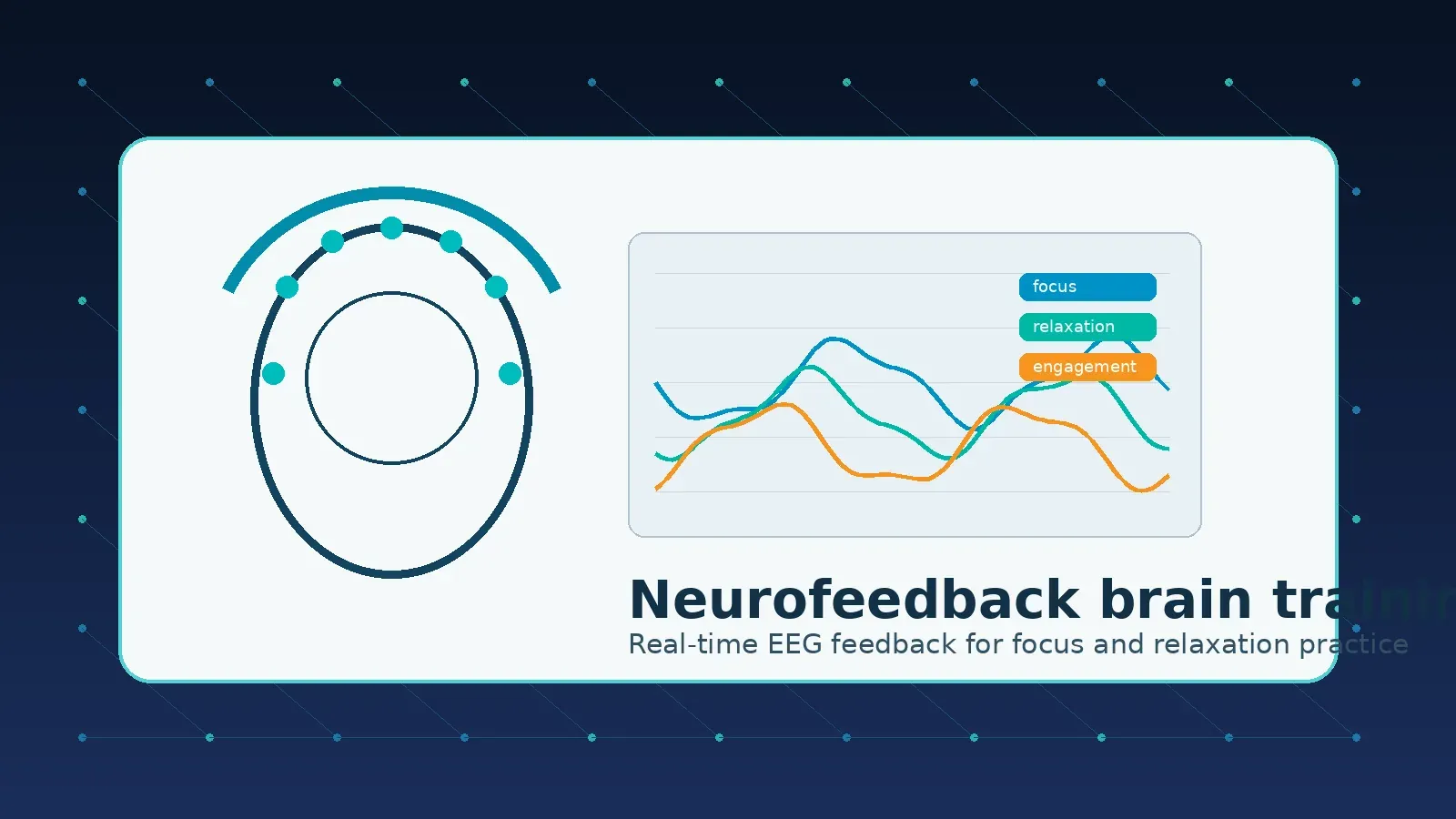
Neurofeedback is a type of biofeedback that measures brain activity and returns that information to the user in real time. The signal is most often captured with electroencephalography, or EEG, which records electrical activity from sensors placed on or near the scalp. The feedback may appear as a moving graph, a tone, a game, a meditation score, or another visual cue.
The core idea is simple: when people can observe changes in brain activity as they happen, they may learn to recognize the mental strategies and conditions associated with those changes. A session might reward a calmer pattern, a more sustained attention pattern, or a target brain rhythm selected by a practitioner, researcher, or software protocol.
Scientific reviews describe neurofeedback as a process where neural activity is measured and presented through one or more sensory channels to support self-regulation. In everyday language, neurofeedback helps make brain state visible enough to practice with. That does not make it a medical cure, and outcomes depend on the protocol, equipment, participant, and use case. It does make neurofeedback a useful framework for exploring how the brain responds during focused work, rest, training, and research tasks.
How neurofeedback works
A neurofeedback system usually has four parts: a sensor, software, a feedback display, and a training protocol. The sensor captures brain activity. The software processes the signal. The display translates the result into something the participant can understand. The protocol defines what pattern is being observed or reinforced.
In an EEG-based workflow, sensors detect small voltage changes produced by groups of neurons. The software filters that signal and may separate it into frequency bands, such as delta, theta, alpha, beta, or gamma. Different protocols use these bands in different ways. Some focus on increasing or decreasing activity in a specific band. Others use ratios, event-related patterns, or proprietary metrics that summarize more complex signal features.
The feedback loop is what makes neurofeedback different from simply recording EEG. A user receives immediate information about the target signal and can experiment with mental strategies, posture, breathing, attention, or task engagement. Over repeated sessions, the goal is to learn which internal states are associated with the desired feedback.
A typical session may include:
Setup: The EEG device is fitted, sensors are checked, and signal quality is confirmed.
Baseline: The software records a short resting or task-based sample to understand the starting pattern.
Training: The user receives real-time feedback while practicing the target mental state or task.
Review: The session data is reviewed for trends, signal quality, and next-step adjustments.
For researchers and product teams, this loop can also support structured experiments. For example, a team may compare attention or engagement patterns while participants interact with different content, user interfaces, or learning experiences. In that setting, neurofeedback concepts overlap with broader EEG-based research workflows.
What brain signals does neurofeedback use?
Most consumer and research neurofeedback systems use EEG because it is non-invasive, portable, and well suited for real-time feedback. EEG does not read thoughts. It records electrical patterns from the brain at the scalp and turns those patterns into data streams that can be analyzed over time.
Common neurofeedback protocols may use:
Alpha activity: Often associated with relaxed wakefulness, especially when the eyes are closed or the person is resting.
Beta activity: Often associated with active thinking, attention, and task engagement, depending on the region and protocol.
Theta activity: Often studied in relation to drowsiness, memory, and meditative states, depending on context.
Sensorimotor rhythm: A rhythm commonly used in some attention and self-regulation protocols.
Composite metrics: Software-derived measures that combine multiple EEG features into easier-to-read indicators.
The meaning of a brain signal depends on context. A single band should not be treated as a universal score for a mental state. Good neurofeedback design starts with a clear question, a reliable signal, and a protocol that matches the use case. That is one reason signal quality, sensor placement, and software interpretation matter so much.
What does the science say about neurofeedback?
The science around neurofeedback is active, promising, and nuanced. Neurofeedback has been studied for decades across neuroscience, psychology, learning science, and neuroengineering. Reviews note that people can learn to regulate certain neural signals under feedback conditions, and researchers continue to study how that learning relates to behavior, attention, emotional regulation, and performance.
At the same time, the evidence is not equally strong for every claim or application. Neurofeedback protocols vary widely. Some studies use clinical equipment and practitioner-led designs. Others use consumer devices or small samples. Some include strong control conditions, while others do not. This variation makes it important to separate three different questions:
Can people learn to change certain brain activity patterns with feedback? Research suggests that many can, depending on the signal and protocol.
Do those learned changes translate into useful outcomes? Evidence varies by outcome, population, and study design.
Is a specific product or protocol appropriate for a specific goal? That requires careful evaluation of the device, software, data quality, and intended use.
For educational, research, wellness, and performance applications, the safest interpretation is that neurofeedback provides a structured way to practice with real-time brain data. It can support exploration of attention, relaxation, and self-regulation, but it should not be presented as a guaranteed treatment or replacement for professional medical care.
Neurofeedback benefits and practical applications
People search for neurofeedback for many reasons. Some want to understand how attention changes during work. Others are interested in meditation, relaxation, sports performance, learning, or brain-computer interface experiments. Enterprise teams may be interested in the same feedback principles for product research, user experience testing, or audience response studies.
Common applications include:
Focus practice: Feedback can help users observe when attention becomes more or less stable during a task.
Relaxation training: Some protocols reward patterns associated with calm wakefulness or reduced arousal.
Meditation support: EEG feedback can provide another lens on how a meditation session changes over time.
Research and education: Students, labs, and instructors can use EEG feedback to demonstrate brain activity in real time.
UX and content testing: Research teams can combine EEG-derived metrics with surveys and behavior data to understand audience response.
For business and research teams, neurofeedback should not be isolated from the rest of the evidence. The strongest workflows combine brain data with task performance, surveys, interviews, analytics, and experimental design. That combination helps teams understand not only what happened, but why people may have responded the way they did.
What happens in a neurofeedback session?
A neurofeedback session should feel structured rather than mysterious. The exact process depends on whether the session is clinical, research-based, educational, or self-guided, but the same broad workflow applies.
1. Define the goal
The session starts with a clear goal. A user may want to practice sustained attention, explore relaxation, compare responses to different tasks, or collect data for a study. The goal should determine the protocol. A vague goal produces vague feedback.
2. Fit the EEG device
The headset or sensors are placed according to the device design and protocol. Signal quality is checked before training begins. Dry, saline, or gel sensors may be used, depending on the hardware. Comfort matters because movement, jaw tension, and poor contact can affect the recording.
3. Establish a baseline
Many sessions include a short baseline with eyes open, eyes closed, or a simple task. This gives the software or practitioner a reference point. Baseline data can help distinguish the participant's normal variation from changes that happen during training.
4. Train with feedback
The participant watches or listens to a feedback signal while practicing. The feedback might become brighter, smoother, quieter, faster, or more rewarding when the target pattern appears. The user does not need to force the brain into a state. In many sessions, the practical skill is noticing what conditions allow the desired signal to occur.
5. Review the data
After training, the practitioner, researcher, or user reviews the session. The review may include signal quality, time spent in a target range, changes across trials, and notes about the user's strategy or task context.
For research and product teams, Emotiv Studio adds real-time brain response data to usability testing, creative testing, and product validation workflows.
Home neurofeedback vs. clinical neurofeedback
Home neurofeedback and clinical neurofeedback can look similar on the surface because both may use EEG and real-time feedback. The difference is in the level of oversight, protocol design, and intended outcome.
Factor | Home neurofeedback | Clinical or practitioner-led neurofeedback |
|---|---|---|
Primary use | Self-guided focus, relaxation, meditation, cognitive wellness tools, education | Practitioner-guided protocols for specific client goals |
Setup | Designed for accessible setup and repeat use | Often includes a more detailed intake and sensor placement process |
Feedback | App-based scores, sounds, visual cues, or games | Protocol-specific feedback selected by a trained professional |
Data review | User-facing summaries and trends | Practitioner review, session notes, and protocol adjustments |
Best fit | General exploration, habit building, research demos, and personal practice | Situations that require professional judgment, structured oversight, or clinical context |
Home tools can be valuable when expectations are clear. They make brain data more accessible and can support regular practice. Clinical settings may be more appropriate when a person needs individualized interpretation, complex protocols, or healthcare guidance. Neurofeedback content should never replace advice from a qualified professional.
Choosing neurofeedback equipment
The right neurofeedback equipment depends on what you want to measure, where you want to use it, and how much structure you need. A meditation app and a research platform are not solving the same problem. A lightweight daily-use device and a multi-channel research headset are also different tools.
When comparing options, consider:
Use case: Are you practicing focus, supporting meditation, teaching EEG, running a study, or testing user experiences?
Number of channels: More channels can provide broader spatial coverage, while fewer channels may be easier to set up.
Sensor type: Dry, saline, and gel sensors have different comfort, preparation, and signal-quality tradeoffs.
Software: The software should match the task, from simple feedback to experiment design and data analysis.
Data access: Researchers and developers may need raw EEG, export options, APIs, or integration with analysis tools.
Fit and repeatability: A device that is easy to wear correctly is more likely to produce consistent sessions.
Emotiv supports several neurofeedback and EEG research needs. MN8 is a 2-channel EEG earbud option designed for accessible, repeatable brain data experiences. Insight offers a 5-channel wireless EEG headset for lightweight cognitive data collection. Epoc X provides 14-channel wireless EEG for research, education, and more advanced experimentation. For teams running structured studies, Emotiv Studio connects EEG hardware with experiment workflows and AI-assisted insight generation.
Neurofeedback for focus and relaxation
Focus and relaxation are two of the most common reasons people explore neurofeedback. Both are understandable goals because they are everyday experiences that can fluctuate dramatically across tasks, environments, and stress levels.
For focus, neurofeedback may help users observe how attention changes during reading, studying, gaming, design work, or a structured cognitive task. The feedback can act like a mirror. Instead of relying only on how focused a person feels, the user sees a real-time data signal related to the training protocol.
For relaxation, neurofeedback may help users practice entering a calmer state without turning the session into guesswork. A feedback tone or visual cue can make it easier to recognize when breathing, posture, reduced effort, or a different mental strategy coincides with the target state.
It is important to keep claims precise. Neurofeedback does not guarantee better focus or relaxation for every person. It provides access to cognitive wellness tools and real-time brain data that can support practice, reflection, and research. The value comes from the feedback loop, the consistency of practice, and the quality of the data.
Neurofeedback in research and business settings
Neurofeedback is not only a personal wellness concept. The same real-time feedback principles can help researchers and organizations study how people respond to experiences. In a business context, EEG can add objective brain response data to traditional methods such as surveys, interviews, focus groups, and analytics.
For example, a product team may test two onboarding flows and compare not only completion rates, but also attention and engagement patterns during key moments. A media team may study how audiences respond to creative variations. A learning team may evaluate whether training content holds attention across a lesson. In these cases, the goal is not to diagnose users. The goal is to make better decisions with richer data.
Emotiv Studio is designed for this kind of work. It supports experiment setup, participant workflows, real-time data collection, signal quality checks, and AI-assisted analysis. By pairing EEG with existing research methods, teams can move beyond self-reported feedback alone and see a more complete picture of audience response.
Limitations and safety considerations
Responsible neurofeedback starts with clear limits. EEG is powerful, but it is not magic. It does not reveal private thoughts, make universal claims about a person, or replace medical care. Brain data should be collected with consent, stored responsibly, and interpreted within the boundaries of the protocol.
Key considerations include:
Evidence varies: The quality of research differs across applications, outcomes, and protocols.
Signal quality matters: Poor sensor contact, movement, or noisy environments can distort feedback.
Context matters: Brain signals should be interpreted alongside behavior, self-report, and task design.
Privacy matters: Brain data is sensitive. Users and organizations should use tools with clear data handling practices.
Medical claims require care: People with health concerns should consult qualified professionals rather than relying on self-guided tools.
These limits do not make neurofeedback less useful. They make it more credible. The best use of neurofeedback is specific, transparent, and matched to the decision or practice goal.
How to get started with neurofeedback
If you are new to neurofeedback, start with the question you want to answer. Are you trying to learn how your focus shifts during work? Explore meditation with real-time feedback? Teach students how EEG works? Run a product research study? Your answer will determine the hardware, software, and protocol you need.
A practical starting path looks like this:
Choose a narrow goal. Focus on one state, task, or research question first.
Select the right EEG device. Match channel count, sensor type, and comfort to the setting.
Use software built for the workflow. Personal practice, education, and enterprise research require different tools.
Protect data quality. Check fit, sensor contact, and session conditions every time.
Review trends, not single moments. One session is a snapshot. Repeated sessions are more useful.
Ready to explore neurofeedback with real EEG? Compare MN8, Insight, and Epoc X, or use Emotiv Studio for structured research workflows.
Frequently asked questions about neurofeedback
Is neurofeedback the same as biofeedback?
Neurofeedback is a specific type of biofeedback. Biofeedback can use signals such as heart rate, breathing, muscle tension, or skin conductance. Neurofeedback focuses on brain activity, most often measured with EEG.
Does neurofeedback read thoughts?
No. EEG-based neurofeedback records electrical activity patterns from the brain. It does not read thoughts, intentions, memories, or private ideas.
How long does neurofeedback take?
Session length and frequency vary by protocol and goal. Some users explore short app-guided sessions, while practitioner-led programs or research studies may use repeated sessions over weeks. Consistency and signal quality are more useful than a single session.
Can I do neurofeedback at home?
Yes, home neurofeedback tools exist for self-guided practice, meditation support, focus exploration, and cognitive wellness tools. Clinical or highly individualized goals should involve a qualified professional.
What equipment do I need for neurofeedback?
You need an EEG device, software that processes brain activity in real time, and a feedback interface. The best device depends on whether your goal is personal practice, education, development, or research.
The bottom line on neurofeedback
Neurofeedback turns brain activity into real-time feedback that people can use for practice, learning, and research. Its value comes from the feedback loop: measure the signal, show it clearly, practice with intention, and review the data with context.
For individuals, neurofeedback can provide access to cognitive wellness tools for focus, relaxation, and meditation support. For researchers and organizations, it can add a neuroscience layer to experiments, product testing, and audience research. The strongest approach is science-based, privacy-conscious, and honest about what EEG can and cannot tell us.
Emotiv makes this work more accessible through EEG hardware and software built for different levels of exploration, from MN8 and Insight to Epoc X and Emotiv Studio.
What Is Neurofeedback? A Science-Based Guide to Brain Training
Neurofeedback is a form of brain training that uses real-time information about brain activity to help people learn how their mental state changes during focus, relaxation, or a task. For anyone exploring EEG, cognitive wellness tools, or research-grade brain data, neurofeedback offers a practical way to turn invisible neural signals into feedback that can be seen, heard, and acted on.
Explore Emotiv EEG tools for neurofeedback and brain research, including MN8, Insight, and Epoc X.
What is neurofeedback?
Neurofeedback is a type of biofeedback that measures brain activity and returns that information to the user in real time. The signal is most often captured with electroencephalography, or EEG, which records electrical activity from sensors placed on or near the scalp. The feedback may appear as a moving graph, a tone, a game, a meditation score, or another visual cue.
The core idea is simple: when people can observe changes in brain activity as they happen, they may learn to recognize the mental strategies and conditions associated with those changes. A session might reward a calmer pattern, a more sustained attention pattern, or a target brain rhythm selected by a practitioner, researcher, or software protocol.
Scientific reviews describe neurofeedback as a process where neural activity is measured and presented through one or more sensory channels to support self-regulation. In everyday language, neurofeedback helps make brain state visible enough to practice with. That does not make it a medical cure, and outcomes depend on the protocol, equipment, participant, and use case. It does make neurofeedback a useful framework for exploring how the brain responds during focused work, rest, training, and research tasks.
How neurofeedback works
A neurofeedback system usually has four parts: a sensor, software, a feedback display, and a training protocol. The sensor captures brain activity. The software processes the signal. The display translates the result into something the participant can understand. The protocol defines what pattern is being observed or reinforced.
In an EEG-based workflow, sensors detect small voltage changes produced by groups of neurons. The software filters that signal and may separate it into frequency bands, such as delta, theta, alpha, beta, or gamma. Different protocols use these bands in different ways. Some focus on increasing or decreasing activity in a specific band. Others use ratios, event-related patterns, or proprietary metrics that summarize more complex signal features.
The feedback loop is what makes neurofeedback different from simply recording EEG. A user receives immediate information about the target signal and can experiment with mental strategies, posture, breathing, attention, or task engagement. Over repeated sessions, the goal is to learn which internal states are associated with the desired feedback.
A typical session may include:
Setup: The EEG device is fitted, sensors are checked, and signal quality is confirmed.
Baseline: The software records a short resting or task-based sample to understand the starting pattern.
Training: The user receives real-time feedback while practicing the target mental state or task.
Review: The session data is reviewed for trends, signal quality, and next-step adjustments.
For researchers and product teams, this loop can also support structured experiments. For example, a team may compare attention or engagement patterns while participants interact with different content, user interfaces, or learning experiences. In that setting, neurofeedback concepts overlap with broader EEG-based research workflows.
What brain signals does neurofeedback use?
Most consumer and research neurofeedback systems use EEG because it is non-invasive, portable, and well suited for real-time feedback. EEG does not read thoughts. It records electrical patterns from the brain at the scalp and turns those patterns into data streams that can be analyzed over time.
Common neurofeedback protocols may use:
Alpha activity: Often associated with relaxed wakefulness, especially when the eyes are closed or the person is resting.
Beta activity: Often associated with active thinking, attention, and task engagement, depending on the region and protocol.
Theta activity: Often studied in relation to drowsiness, memory, and meditative states, depending on context.
Sensorimotor rhythm: A rhythm commonly used in some attention and self-regulation protocols.
Composite metrics: Software-derived measures that combine multiple EEG features into easier-to-read indicators.
The meaning of a brain signal depends on context. A single band should not be treated as a universal score for a mental state. Good neurofeedback design starts with a clear question, a reliable signal, and a protocol that matches the use case. That is one reason signal quality, sensor placement, and software interpretation matter so much.
What does the science say about neurofeedback?
The science around neurofeedback is active, promising, and nuanced. Neurofeedback has been studied for decades across neuroscience, psychology, learning science, and neuroengineering. Reviews note that people can learn to regulate certain neural signals under feedback conditions, and researchers continue to study how that learning relates to behavior, attention, emotional regulation, and performance.
At the same time, the evidence is not equally strong for every claim or application. Neurofeedback protocols vary widely. Some studies use clinical equipment and practitioner-led designs. Others use consumer devices or small samples. Some include strong control conditions, while others do not. This variation makes it important to separate three different questions:
Can people learn to change certain brain activity patterns with feedback? Research suggests that many can, depending on the signal and protocol.
Do those learned changes translate into useful outcomes? Evidence varies by outcome, population, and study design.
Is a specific product or protocol appropriate for a specific goal? That requires careful evaluation of the device, software, data quality, and intended use.
For educational, research, wellness, and performance applications, the safest interpretation is that neurofeedback provides a structured way to practice with real-time brain data. It can support exploration of attention, relaxation, and self-regulation, but it should not be presented as a guaranteed treatment or replacement for professional medical care.
Neurofeedback benefits and practical applications
People search for neurofeedback for many reasons. Some want to understand how attention changes during work. Others are interested in meditation, relaxation, sports performance, learning, or brain-computer interface experiments. Enterprise teams may be interested in the same feedback principles for product research, user experience testing, or audience response studies.
Common applications include:
Focus practice: Feedback can help users observe when attention becomes more or less stable during a task.
Relaxation training: Some protocols reward patterns associated with calm wakefulness or reduced arousal.
Meditation support: EEG feedback can provide another lens on how a meditation session changes over time.
Research and education: Students, labs, and instructors can use EEG feedback to demonstrate brain activity in real time.
UX and content testing: Research teams can combine EEG-derived metrics with surveys and behavior data to understand audience response.
For business and research teams, neurofeedback should not be isolated from the rest of the evidence. The strongest workflows combine brain data with task performance, surveys, interviews, analytics, and experimental design. That combination helps teams understand not only what happened, but why people may have responded the way they did.
What happens in a neurofeedback session?
A neurofeedback session should feel structured rather than mysterious. The exact process depends on whether the session is clinical, research-based, educational, or self-guided, but the same broad workflow applies.
1. Define the goal
The session starts with a clear goal. A user may want to practice sustained attention, explore relaxation, compare responses to different tasks, or collect data for a study. The goal should determine the protocol. A vague goal produces vague feedback.
2. Fit the EEG device
The headset or sensors are placed according to the device design and protocol. Signal quality is checked before training begins. Dry, saline, or gel sensors may be used, depending on the hardware. Comfort matters because movement, jaw tension, and poor contact can affect the recording.
3. Establish a baseline
Many sessions include a short baseline with eyes open, eyes closed, or a simple task. This gives the software or practitioner a reference point. Baseline data can help distinguish the participant's normal variation from changes that happen during training.
4. Train with feedback
The participant watches or listens to a feedback signal while practicing. The feedback might become brighter, smoother, quieter, faster, or more rewarding when the target pattern appears. The user does not need to force the brain into a state. In many sessions, the practical skill is noticing what conditions allow the desired signal to occur.
5. Review the data
After training, the practitioner, researcher, or user reviews the session. The review may include signal quality, time spent in a target range, changes across trials, and notes about the user's strategy or task context.
For research and product teams, Emotiv Studio adds real-time brain response data to usability testing, creative testing, and product validation workflows.
Home neurofeedback vs. clinical neurofeedback
Home neurofeedback and clinical neurofeedback can look similar on the surface because both may use EEG and real-time feedback. The difference is in the level of oversight, protocol design, and intended outcome.
Factor | Home neurofeedback | Clinical or practitioner-led neurofeedback |
|---|---|---|
Primary use | Self-guided focus, relaxation, meditation, cognitive wellness tools, education | Practitioner-guided protocols for specific client goals |
Setup | Designed for accessible setup and repeat use | Often includes a more detailed intake and sensor placement process |
Feedback | App-based scores, sounds, visual cues, or games | Protocol-specific feedback selected by a trained professional |
Data review | User-facing summaries and trends | Practitioner review, session notes, and protocol adjustments |
Best fit | General exploration, habit building, research demos, and personal practice | Situations that require professional judgment, structured oversight, or clinical context |
Home tools can be valuable when expectations are clear. They make brain data more accessible and can support regular practice. Clinical settings may be more appropriate when a person needs individualized interpretation, complex protocols, or healthcare guidance. Neurofeedback content should never replace advice from a qualified professional.
Choosing neurofeedback equipment
The right neurofeedback equipment depends on what you want to measure, where you want to use it, and how much structure you need. A meditation app and a research platform are not solving the same problem. A lightweight daily-use device and a multi-channel research headset are also different tools.
When comparing options, consider:
Use case: Are you practicing focus, supporting meditation, teaching EEG, running a study, or testing user experiences?
Number of channels: More channels can provide broader spatial coverage, while fewer channels may be easier to set up.
Sensor type: Dry, saline, and gel sensors have different comfort, preparation, and signal-quality tradeoffs.
Software: The software should match the task, from simple feedback to experiment design and data analysis.
Data access: Researchers and developers may need raw EEG, export options, APIs, or integration with analysis tools.
Fit and repeatability: A device that is easy to wear correctly is more likely to produce consistent sessions.
Emotiv supports several neurofeedback and EEG research needs. MN8 is a 2-channel EEG earbud option designed for accessible, repeatable brain data experiences. Insight offers a 5-channel wireless EEG headset for lightweight cognitive data collection. Epoc X provides 14-channel wireless EEG for research, education, and more advanced experimentation. For teams running structured studies, Emotiv Studio connects EEG hardware with experiment workflows and AI-assisted insight generation.
Neurofeedback for focus and relaxation
Focus and relaxation are two of the most common reasons people explore neurofeedback. Both are understandable goals because they are everyday experiences that can fluctuate dramatically across tasks, environments, and stress levels.
For focus, neurofeedback may help users observe how attention changes during reading, studying, gaming, design work, or a structured cognitive task. The feedback can act like a mirror. Instead of relying only on how focused a person feels, the user sees a real-time data signal related to the training protocol.
For relaxation, neurofeedback may help users practice entering a calmer state without turning the session into guesswork. A feedback tone or visual cue can make it easier to recognize when breathing, posture, reduced effort, or a different mental strategy coincides with the target state.
It is important to keep claims precise. Neurofeedback does not guarantee better focus or relaxation for every person. It provides access to cognitive wellness tools and real-time brain data that can support practice, reflection, and research. The value comes from the feedback loop, the consistency of practice, and the quality of the data.
Neurofeedback in research and business settings
Neurofeedback is not only a personal wellness concept. The same real-time feedback principles can help researchers and organizations study how people respond to experiences. In a business context, EEG can add objective brain response data to traditional methods such as surveys, interviews, focus groups, and analytics.
For example, a product team may test two onboarding flows and compare not only completion rates, but also attention and engagement patterns during key moments. A media team may study how audiences respond to creative variations. A learning team may evaluate whether training content holds attention across a lesson. In these cases, the goal is not to diagnose users. The goal is to make better decisions with richer data.
Emotiv Studio is designed for this kind of work. It supports experiment setup, participant workflows, real-time data collection, signal quality checks, and AI-assisted analysis. By pairing EEG with existing research methods, teams can move beyond self-reported feedback alone and see a more complete picture of audience response.
Limitations and safety considerations
Responsible neurofeedback starts with clear limits. EEG is powerful, but it is not magic. It does not reveal private thoughts, make universal claims about a person, or replace medical care. Brain data should be collected with consent, stored responsibly, and interpreted within the boundaries of the protocol.
Key considerations include:
Evidence varies: The quality of research differs across applications, outcomes, and protocols.
Signal quality matters: Poor sensor contact, movement, or noisy environments can distort feedback.
Context matters: Brain signals should be interpreted alongside behavior, self-report, and task design.
Privacy matters: Brain data is sensitive. Users and organizations should use tools with clear data handling practices.
Medical claims require care: People with health concerns should consult qualified professionals rather than relying on self-guided tools.
These limits do not make neurofeedback less useful. They make it more credible. The best use of neurofeedback is specific, transparent, and matched to the decision or practice goal.
How to get started with neurofeedback
If you are new to neurofeedback, start with the question you want to answer. Are you trying to learn how your focus shifts during work? Explore meditation with real-time feedback? Teach students how EEG works? Run a product research study? Your answer will determine the hardware, software, and protocol you need.
A practical starting path looks like this:
Choose a narrow goal. Focus on one state, task, or research question first.
Select the right EEG device. Match channel count, sensor type, and comfort to the setting.
Use software built for the workflow. Personal practice, education, and enterprise research require different tools.
Protect data quality. Check fit, sensor contact, and session conditions every time.
Review trends, not single moments. One session is a snapshot. Repeated sessions are more useful.
Ready to explore neurofeedback with real EEG? Compare MN8, Insight, and Epoc X, or use Emotiv Studio for structured research workflows.
Frequently asked questions about neurofeedback
Is neurofeedback the same as biofeedback?
Neurofeedback is a specific type of biofeedback. Biofeedback can use signals such as heart rate, breathing, muscle tension, or skin conductance. Neurofeedback focuses on brain activity, most often measured with EEG.
Does neurofeedback read thoughts?
No. EEG-based neurofeedback records electrical activity patterns from the brain. It does not read thoughts, intentions, memories, or private ideas.
How long does neurofeedback take?
Session length and frequency vary by protocol and goal. Some users explore short app-guided sessions, while practitioner-led programs or research studies may use repeated sessions over weeks. Consistency and signal quality are more useful than a single session.
Can I do neurofeedback at home?
Yes, home neurofeedback tools exist for self-guided practice, meditation support, focus exploration, and cognitive wellness tools. Clinical or highly individualized goals should involve a qualified professional.
What equipment do I need for neurofeedback?
You need an EEG device, software that processes brain activity in real time, and a feedback interface. The best device depends on whether your goal is personal practice, education, development, or research.
The bottom line on neurofeedback
Neurofeedback turns brain activity into real-time feedback that people can use for practice, learning, and research. Its value comes from the feedback loop: measure the signal, show it clearly, practice with intention, and review the data with context.
For individuals, neurofeedback can provide access to cognitive wellness tools for focus, relaxation, and meditation support. For researchers and organizations, it can add a neuroscience layer to experiments, product testing, and audience research. The strongest approach is science-based, privacy-conscious, and honest about what EEG can and cannot tell us.
Emotiv makes this work more accessible through EEG hardware and software built for different levels of exploration, from MN8 and Insight to Epoc X and Emotiv Studio.
What Is Neurofeedback? A Science-Based Guide to Brain Training
Neurofeedback is a form of brain training that uses real-time information about brain activity to help people learn how their mental state changes during focus, relaxation, or a task. For anyone exploring EEG, cognitive wellness tools, or research-grade brain data, neurofeedback offers a practical way to turn invisible neural signals into feedback that can be seen, heard, and acted on.
Explore Emotiv EEG tools for neurofeedback and brain research, including MN8, Insight, and Epoc X.
What is neurofeedback?
Neurofeedback is a type of biofeedback that measures brain activity and returns that information to the user in real time. The signal is most often captured with electroencephalography, or EEG, which records electrical activity from sensors placed on or near the scalp. The feedback may appear as a moving graph, a tone, a game, a meditation score, or another visual cue.
The core idea is simple: when people can observe changes in brain activity as they happen, they may learn to recognize the mental strategies and conditions associated with those changes. A session might reward a calmer pattern, a more sustained attention pattern, or a target brain rhythm selected by a practitioner, researcher, or software protocol.
Scientific reviews describe neurofeedback as a process where neural activity is measured and presented through one or more sensory channels to support self-regulation. In everyday language, neurofeedback helps make brain state visible enough to practice with. That does not make it a medical cure, and outcomes depend on the protocol, equipment, participant, and use case. It does make neurofeedback a useful framework for exploring how the brain responds during focused work, rest, training, and research tasks.
How neurofeedback works
A neurofeedback system usually has four parts: a sensor, software, a feedback display, and a training protocol. The sensor captures brain activity. The software processes the signal. The display translates the result into something the participant can understand. The protocol defines what pattern is being observed or reinforced.
In an EEG-based workflow, sensors detect small voltage changes produced by groups of neurons. The software filters that signal and may separate it into frequency bands, such as delta, theta, alpha, beta, or gamma. Different protocols use these bands in different ways. Some focus on increasing or decreasing activity in a specific band. Others use ratios, event-related patterns, or proprietary metrics that summarize more complex signal features.
The feedback loop is what makes neurofeedback different from simply recording EEG. A user receives immediate information about the target signal and can experiment with mental strategies, posture, breathing, attention, or task engagement. Over repeated sessions, the goal is to learn which internal states are associated with the desired feedback.
A typical session may include:
Setup: The EEG device is fitted, sensors are checked, and signal quality is confirmed.
Baseline: The software records a short resting or task-based sample to understand the starting pattern.
Training: The user receives real-time feedback while practicing the target mental state or task.
Review: The session data is reviewed for trends, signal quality, and next-step adjustments.
For researchers and product teams, this loop can also support structured experiments. For example, a team may compare attention or engagement patterns while participants interact with different content, user interfaces, or learning experiences. In that setting, neurofeedback concepts overlap with broader EEG-based research workflows.
What brain signals does neurofeedback use?
Most consumer and research neurofeedback systems use EEG because it is non-invasive, portable, and well suited for real-time feedback. EEG does not read thoughts. It records electrical patterns from the brain at the scalp and turns those patterns into data streams that can be analyzed over time.
Common neurofeedback protocols may use:
Alpha activity: Often associated with relaxed wakefulness, especially when the eyes are closed or the person is resting.
Beta activity: Often associated with active thinking, attention, and task engagement, depending on the region and protocol.
Theta activity: Often studied in relation to drowsiness, memory, and meditative states, depending on context.
Sensorimotor rhythm: A rhythm commonly used in some attention and self-regulation protocols.
Composite metrics: Software-derived measures that combine multiple EEG features into easier-to-read indicators.
The meaning of a brain signal depends on context. A single band should not be treated as a universal score for a mental state. Good neurofeedback design starts with a clear question, a reliable signal, and a protocol that matches the use case. That is one reason signal quality, sensor placement, and software interpretation matter so much.
What does the science say about neurofeedback?
The science around neurofeedback is active, promising, and nuanced. Neurofeedback has been studied for decades across neuroscience, psychology, learning science, and neuroengineering. Reviews note that people can learn to regulate certain neural signals under feedback conditions, and researchers continue to study how that learning relates to behavior, attention, emotional regulation, and performance.
At the same time, the evidence is not equally strong for every claim or application. Neurofeedback protocols vary widely. Some studies use clinical equipment and practitioner-led designs. Others use consumer devices or small samples. Some include strong control conditions, while others do not. This variation makes it important to separate three different questions:
Can people learn to change certain brain activity patterns with feedback? Research suggests that many can, depending on the signal and protocol.
Do those learned changes translate into useful outcomes? Evidence varies by outcome, population, and study design.
Is a specific product or protocol appropriate for a specific goal? That requires careful evaluation of the device, software, data quality, and intended use.
For educational, research, wellness, and performance applications, the safest interpretation is that neurofeedback provides a structured way to practice with real-time brain data. It can support exploration of attention, relaxation, and self-regulation, but it should not be presented as a guaranteed treatment or replacement for professional medical care.
Neurofeedback benefits and practical applications
People search for neurofeedback for many reasons. Some want to understand how attention changes during work. Others are interested in meditation, relaxation, sports performance, learning, or brain-computer interface experiments. Enterprise teams may be interested in the same feedback principles for product research, user experience testing, or audience response studies.
Common applications include:
Focus practice: Feedback can help users observe when attention becomes more or less stable during a task.
Relaxation training: Some protocols reward patterns associated with calm wakefulness or reduced arousal.
Meditation support: EEG feedback can provide another lens on how a meditation session changes over time.
Research and education: Students, labs, and instructors can use EEG feedback to demonstrate brain activity in real time.
UX and content testing: Research teams can combine EEG-derived metrics with surveys and behavior data to understand audience response.
For business and research teams, neurofeedback should not be isolated from the rest of the evidence. The strongest workflows combine brain data with task performance, surveys, interviews, analytics, and experimental design. That combination helps teams understand not only what happened, but why people may have responded the way they did.
What happens in a neurofeedback session?
A neurofeedback session should feel structured rather than mysterious. The exact process depends on whether the session is clinical, research-based, educational, or self-guided, but the same broad workflow applies.
1. Define the goal
The session starts with a clear goal. A user may want to practice sustained attention, explore relaxation, compare responses to different tasks, or collect data for a study. The goal should determine the protocol. A vague goal produces vague feedback.
2. Fit the EEG device
The headset or sensors are placed according to the device design and protocol. Signal quality is checked before training begins. Dry, saline, or gel sensors may be used, depending on the hardware. Comfort matters because movement, jaw tension, and poor contact can affect the recording.
3. Establish a baseline
Many sessions include a short baseline with eyes open, eyes closed, or a simple task. This gives the software or practitioner a reference point. Baseline data can help distinguish the participant's normal variation from changes that happen during training.
4. Train with feedback
The participant watches or listens to a feedback signal while practicing. The feedback might become brighter, smoother, quieter, faster, or more rewarding when the target pattern appears. The user does not need to force the brain into a state. In many sessions, the practical skill is noticing what conditions allow the desired signal to occur.
5. Review the data
After training, the practitioner, researcher, or user reviews the session. The review may include signal quality, time spent in a target range, changes across trials, and notes about the user's strategy or task context.
For research and product teams, Emotiv Studio adds real-time brain response data to usability testing, creative testing, and product validation workflows.
Home neurofeedback vs. clinical neurofeedback
Home neurofeedback and clinical neurofeedback can look similar on the surface because both may use EEG and real-time feedback. The difference is in the level of oversight, protocol design, and intended outcome.
Factor | Home neurofeedback | Clinical or practitioner-led neurofeedback |
|---|---|---|
Primary use | Self-guided focus, relaxation, meditation, cognitive wellness tools, education | Practitioner-guided protocols for specific client goals |
Setup | Designed for accessible setup and repeat use | Often includes a more detailed intake and sensor placement process |
Feedback | App-based scores, sounds, visual cues, or games | Protocol-specific feedback selected by a trained professional |
Data review | User-facing summaries and trends | Practitioner review, session notes, and protocol adjustments |
Best fit | General exploration, habit building, research demos, and personal practice | Situations that require professional judgment, structured oversight, or clinical context |
Home tools can be valuable when expectations are clear. They make brain data more accessible and can support regular practice. Clinical settings may be more appropriate when a person needs individualized interpretation, complex protocols, or healthcare guidance. Neurofeedback content should never replace advice from a qualified professional.
Choosing neurofeedback equipment
The right neurofeedback equipment depends on what you want to measure, where you want to use it, and how much structure you need. A meditation app and a research platform are not solving the same problem. A lightweight daily-use device and a multi-channel research headset are also different tools.
When comparing options, consider:
Use case: Are you practicing focus, supporting meditation, teaching EEG, running a study, or testing user experiences?
Number of channels: More channels can provide broader spatial coverage, while fewer channels may be easier to set up.
Sensor type: Dry, saline, and gel sensors have different comfort, preparation, and signal-quality tradeoffs.
Software: The software should match the task, from simple feedback to experiment design and data analysis.
Data access: Researchers and developers may need raw EEG, export options, APIs, or integration with analysis tools.
Fit and repeatability: A device that is easy to wear correctly is more likely to produce consistent sessions.
Emotiv supports several neurofeedback and EEG research needs. MN8 is a 2-channel EEG earbud option designed for accessible, repeatable brain data experiences. Insight offers a 5-channel wireless EEG headset for lightweight cognitive data collection. Epoc X provides 14-channel wireless EEG for research, education, and more advanced experimentation. For teams running structured studies, Emotiv Studio connects EEG hardware with experiment workflows and AI-assisted insight generation.
Neurofeedback for focus and relaxation
Focus and relaxation are two of the most common reasons people explore neurofeedback. Both are understandable goals because they are everyday experiences that can fluctuate dramatically across tasks, environments, and stress levels.
For focus, neurofeedback may help users observe how attention changes during reading, studying, gaming, design work, or a structured cognitive task. The feedback can act like a mirror. Instead of relying only on how focused a person feels, the user sees a real-time data signal related to the training protocol.
For relaxation, neurofeedback may help users practice entering a calmer state without turning the session into guesswork. A feedback tone or visual cue can make it easier to recognize when breathing, posture, reduced effort, or a different mental strategy coincides with the target state.
It is important to keep claims precise. Neurofeedback does not guarantee better focus or relaxation for every person. It provides access to cognitive wellness tools and real-time brain data that can support practice, reflection, and research. The value comes from the feedback loop, the consistency of practice, and the quality of the data.
Neurofeedback in research and business settings
Neurofeedback is not only a personal wellness concept. The same real-time feedback principles can help researchers and organizations study how people respond to experiences. In a business context, EEG can add objective brain response data to traditional methods such as surveys, interviews, focus groups, and analytics.
For example, a product team may test two onboarding flows and compare not only completion rates, but also attention and engagement patterns during key moments. A media team may study how audiences respond to creative variations. A learning team may evaluate whether training content holds attention across a lesson. In these cases, the goal is not to diagnose users. The goal is to make better decisions with richer data.
Emotiv Studio is designed for this kind of work. It supports experiment setup, participant workflows, real-time data collection, signal quality checks, and AI-assisted analysis. By pairing EEG with existing research methods, teams can move beyond self-reported feedback alone and see a more complete picture of audience response.
Limitations and safety considerations
Responsible neurofeedback starts with clear limits. EEG is powerful, but it is not magic. It does not reveal private thoughts, make universal claims about a person, or replace medical care. Brain data should be collected with consent, stored responsibly, and interpreted within the boundaries of the protocol.
Key considerations include:
Evidence varies: The quality of research differs across applications, outcomes, and protocols.
Signal quality matters: Poor sensor contact, movement, or noisy environments can distort feedback.
Context matters: Brain signals should be interpreted alongside behavior, self-report, and task design.
Privacy matters: Brain data is sensitive. Users and organizations should use tools with clear data handling practices.
Medical claims require care: People with health concerns should consult qualified professionals rather than relying on self-guided tools.
These limits do not make neurofeedback less useful. They make it more credible. The best use of neurofeedback is specific, transparent, and matched to the decision or practice goal.
How to get started with neurofeedback
If you are new to neurofeedback, start with the question you want to answer. Are you trying to learn how your focus shifts during work? Explore meditation with real-time feedback? Teach students how EEG works? Run a product research study? Your answer will determine the hardware, software, and protocol you need.
A practical starting path looks like this:
Choose a narrow goal. Focus on one state, task, or research question first.
Select the right EEG device. Match channel count, sensor type, and comfort to the setting.
Use software built for the workflow. Personal practice, education, and enterprise research require different tools.
Protect data quality. Check fit, sensor contact, and session conditions every time.
Review trends, not single moments. One session is a snapshot. Repeated sessions are more useful.
Ready to explore neurofeedback with real EEG? Compare MN8, Insight, and Epoc X, or use Emotiv Studio for structured research workflows.
Frequently asked questions about neurofeedback
Is neurofeedback the same as biofeedback?
Neurofeedback is a specific type of biofeedback. Biofeedback can use signals such as heart rate, breathing, muscle tension, or skin conductance. Neurofeedback focuses on brain activity, most often measured with EEG.
Does neurofeedback read thoughts?
No. EEG-based neurofeedback records electrical activity patterns from the brain. It does not read thoughts, intentions, memories, or private ideas.
How long does neurofeedback take?
Session length and frequency vary by protocol and goal. Some users explore short app-guided sessions, while practitioner-led programs or research studies may use repeated sessions over weeks. Consistency and signal quality are more useful than a single session.
Can I do neurofeedback at home?
Yes, home neurofeedback tools exist for self-guided practice, meditation support, focus exploration, and cognitive wellness tools. Clinical or highly individualized goals should involve a qualified professional.
What equipment do I need for neurofeedback?
You need an EEG device, software that processes brain activity in real time, and a feedback interface. The best device depends on whether your goal is personal practice, education, development, or research.
The bottom line on neurofeedback
Neurofeedback turns brain activity into real-time feedback that people can use for practice, learning, and research. Its value comes from the feedback loop: measure the signal, show it clearly, practice with intention, and review the data with context.
For individuals, neurofeedback can provide access to cognitive wellness tools for focus, relaxation, and meditation support. For researchers and organizations, it can add a neuroscience layer to experiments, product testing, and audience research. The strongest approach is science-based, privacy-conscious, and honest about what EEG can and cannot tell us.
Emotiv makes this work more accessible through EEG hardware and software built for different levels of exploration, from MN8 and Insight to Epoc X and Emotiv Studio.