
Landing Page Optimization Beyond Traditional A/B Testing
H.B. Duran
Updated on
May 13, 2026
Landing Page Optimization Beyond Traditional A/B Testing
H.B. Duran
Updated on
May 13, 2026
Landing Page Optimization Beyond Traditional A/B Testing
H.B. Duran
Updated on
May 13, 2026
Landing page optimization is evolving beyond traditional A/B testing strategies as marketing teams seek deeper insight into how users cognitively and emotionally respond to digital experiences. While standard landing page analytics can reveal which layouts convert more effectively, they often fail to explain why users engage, hesitate, or mentally disengage during interaction. As organizations refine conversion strategies, cognitive analysis and neuromarketing research are becoming increasingly valuable additions to modern landing page optimization workflows.
Why Landing Page Optimization Is Becoming More Complex
Modern landing pages compete within an increasingly crowded digital environment.
Users are constantly processing:
Multiple calls-to-action
Competing visual elements
Dense information layouts
Product comparisons
Dynamic personalization systems
AI-driven recommendations
Mobile-first interface constraints
As digital experiences become more sophisticated, landing page optimization requires more than surface-level conversion analysis.
Marketers increasingly want to understand:
Why users hesitate
Where attention weakens
Which elements create cognitive overload
How messaging influences decision-making
What causes engagement deterioration before abandonment occurs
This has expanded the role of neuromarketing and cognitive analysis within conversion optimization strategies.
The Limits of Traditional Landing Page Optimization
Traditional landing page optimization focuses heavily on behavioral metrics.
Common performance indicators include:
Click-through rates
Bounce rates
Scroll depth
Conversion rates
Session duration
CTA interactions
Funnel progression
These metrics remain essential, but they primarily measure outcomes rather than cognitive experience.
For example, a landing page may technically convert while still generating:
Elevated mental effort
Information overload
Decision fatigue
Visual confusion
Attention fragmentation
Traditional analytics often fail to capture these hidden friction points.
Why A/B Testing Landing Pages Has Limits
A/B testing landing pages remains one of the most widely used optimization methods in digital marketing.
Teams commonly test variations of:
Headlines
CTA buttons
Hero images
Color schemes
Page layouts
Form length
Social proof placement
These experiments help identify which versions perform better statistically.
However, A/B testing landing pages does not always explain why one variation outperforms another.
For example:
Did users engage more because the hierarchy was clearer?
Did reduced information density lower cognitive workload?
Did visual simplicity improve attention flow?
Did messaging reduce decision fatigue?
Traditional A/B testing identifies behavioral outcomes, but not necessarily the underlying cognitive mechanisms influencing user response.
The Role of Cognitive Analysis in Landing Page Optimization
Modern neuromarketing and UX research increasingly focus on understanding cognitive experience during digital interaction.
Cognitive analysis helps researchers evaluate:
Attention allocation
Engagement fluctuation
Mental workload
Decision fatigue
Information processing demands
This creates a deeper layer of insight within landing page optimization workflows.
Rather than relying entirely on post-session feedback or conversion metrics, researchers can better understand how users cognitively process landing page experiences in real time.

Why Users Cannot Always Explain Landing Page Friction
One of the biggest challenges in landing page optimization is that users are not always consciously aware of why they disengage.
Users may describe experiences using vague explanations such as:
“The page felt overwhelming.”
“I lost interest.”
“It seemed confusing.”
“There was too much going on.”
While useful, these responses rarely identify the exact source of friction.
In many cases, users cannot accurately explain:
Which design element divided attention
When cognitive overload increased
Why a CTA felt unclear
What caused hesitation before conversion
This creates a gap between behavioral analytics and actual cognitive response.
How Neuromarketing Supports Landing Page Optimization
Neuromarketing combines neuroscience, behavioral analysis, and cognitive research to better understand audience response.
Rather than measuring only clicks and conversions, neuromarketing research helps organizations evaluate how users mentally and emotionally experience landing pages.
This may include analysis of:
Attention patterns
Cognitive workload
Engagement levels
Emotional response
Decision-making behavior
As landing page optimization becomes more competitive, these insights are becoming increasingly valuable.
EEG-Based Analysis in Landing Page Research
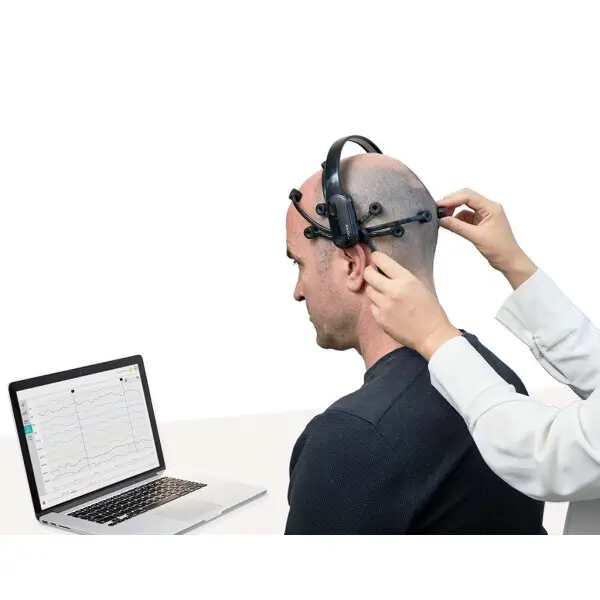
Electroencephalography, commonly called EEG, measures electrical activity associated with cognitive states such as:
Attention
Focus
Engagement
Mental fatigue
Cognitive workload
In landing page optimization workflows, EEG-based analysis helps researchers observe how users cognitively respond during interaction with a page.
For example, EEG research may reveal:
Attention decline during long-form content
Cognitive overload caused by cluttered layouts
Increased mental effort during pricing comparisons
Reduced engagement during onboarding prompts
Fatigue accumulation across multi-step funnels
These insights help researchers identify hidden conversion friction that traditional landing page analytics may overlook.
Common Cognitive Friction Problems in Landing Pages
Information Overload
Landing pages containing excessive information often increase cognitive strain and reduce decision clarity.
Weak Visual Hierarchy
If users cannot quickly identify the primary message or CTA, attention becomes fragmented.
Competing Calls-to-Action
Too many choices can create decision fatigue and reduce conversion confidence.
Dense Layouts
Overly crowded interfaces increase mental processing demands.
Messaging Ambiguity
Unclear value propositions force users to expend additional cognitive effort interpreting meaning.
Landing Page Optimization and Attention Flow
Attention flow refers to how users visually and cognitively move through a page.
Strong landing page optimization strategies help guide attention naturally toward:
Value propositions
Trust indicators
Supporting information
Primary CTAs
Weak attention flow often results in:
Distraction
Hesitation
Reduced engagement
Conversion abandonment
Neuromarketing research helps organizations evaluate whether landing pages support efficient cognitive navigation.
Behavioral Analytics vs. Cognitive Analytics
Behavioral analytics explains what users do.
Cognitive analytics helps explain why they do it.
For example:
Behavioral data may show:
Users stopped scrolling
Users abandoned a form
Users hesitated before conversion
Users clicked secondary navigation
Cognitive analysis may reveal:
Mental overload
Attention fragmentation
Decision fatigue
Cognitive strain accumulation
Together, these insights create a more complete landing page optimization process.
Why Landing Page Optimization Requires More Than Conversion Metrics
Conversion rates alone do not fully measure user experience quality.
A landing page may generate acceptable conversion performance while still creating:
Excessive cognitive workload
Poor information retention
Low engagement quality
Reduced brand trust
Long-term audience fatigue
As competition for attention intensifies, marketers increasingly optimize not only for conversions, but also for cognitive clarity and engagement sustainability.
The Relationship Between Cognitive Load and Conversion
Cognitive load directly affects decision-making performance.
As mental workload increases, users become more likely to:
Delay decisions
Ignore CTAs
Exit workflows
Lose confidence
Abandon purchases
Reducing unnecessary cognitive effort helps improve both usability and conversion performance.
Why A/B Testing Landing Pages Still Matters
Despite its limitations, A/B testing landing pages remains an essential optimization strategy.
A/B testing provides measurable evidence regarding which variations perform better under real-world conditions.
The difference is that organizations increasingly combine A/B testing with cognitive analysis and neuromarketing research.
This creates stronger optimization insight by helping teams understand both:
Which variation won
Why users cognitively responded more positively to it
Combining A/B Testing with Neuromarketing Research
Modern landing page optimization workflows increasingly combine:
A/B testing
Behavioral analytics
Eye tracking
EEG analysis
Session replay tools
Biometric feedback
This layered approach creates a more comprehensive understanding of conversion behavior.
For example:
A/B testing may reveal that one CTA converts better.
Eye tracking may show stronger visual focus.
EEG analysis may reveal reduced cognitive workload.
Together, these insights provide stronger optimization guidance than behavioral metrics alone.
Landing Page Optimization in Enterprise Marketing
Enterprise organizations increasingly use landing page optimization across:
SaaS acquisition funnels
Product launches
Demand generation campaigns
Webinar registration pages
Enterprise lead generation
Product marketing campaigns
As acquisition costs rise, understanding cognitive engagement becomes increasingly important for maximizing conversion efficiency.
Why Neuromarketing Is Becoming More Important
Neuromarketing reflects a broader shift in digital optimization strategy.
Organizations increasingly want to understand:
What users click
Why users hesitate
How interfaces affect attention
Which designs reduce cognitive strain
What messaging improves decision confidence
This deeper level of analysis helps organizations optimize experiences beyond surface-level conversion metrics.
The Future of Landing Page Optimization
The future of landing page optimization will likely combine:
Behavioral analytics
AI-assisted optimization
Cognitive analysis
Predictive engagement modeling
Neuromarketing research
Real-time personalization systems
As digital experiences become more adaptive and competitive, understanding cognitive response will become increasingly valuable for conversion optimization.
Neuromarketing Research for Landing Page Optimization
Organizations exploring advanced landing page optimization and A/B testing landing pages increasingly incorporate neuromarketing and cognitive analysis into conversion workflows.
For teams interested in EEG-based cognitive research for landing page optimization, Emotiv Studio supports workflows focused on attention measurement, engagement analysis, mental workload evaluation, and neuromarketing research.
Landing page optimization is evolving beyond traditional A/B testing strategies as marketing teams seek deeper insight into how users cognitively and emotionally respond to digital experiences. While standard landing page analytics can reveal which layouts convert more effectively, they often fail to explain why users engage, hesitate, or mentally disengage during interaction. As organizations refine conversion strategies, cognitive analysis and neuromarketing research are becoming increasingly valuable additions to modern landing page optimization workflows.
Why Landing Page Optimization Is Becoming More Complex
Modern landing pages compete within an increasingly crowded digital environment.
Users are constantly processing:
Multiple calls-to-action
Competing visual elements
Dense information layouts
Product comparisons
Dynamic personalization systems
AI-driven recommendations
Mobile-first interface constraints
As digital experiences become more sophisticated, landing page optimization requires more than surface-level conversion analysis.
Marketers increasingly want to understand:
Why users hesitate
Where attention weakens
Which elements create cognitive overload
How messaging influences decision-making
What causes engagement deterioration before abandonment occurs
This has expanded the role of neuromarketing and cognitive analysis within conversion optimization strategies.
The Limits of Traditional Landing Page Optimization
Traditional landing page optimization focuses heavily on behavioral metrics.
Common performance indicators include:
Click-through rates
Bounce rates
Scroll depth
Conversion rates
Session duration
CTA interactions
Funnel progression
These metrics remain essential, but they primarily measure outcomes rather than cognitive experience.
For example, a landing page may technically convert while still generating:
Elevated mental effort
Information overload
Decision fatigue
Visual confusion
Attention fragmentation
Traditional analytics often fail to capture these hidden friction points.
Why A/B Testing Landing Pages Has Limits
A/B testing landing pages remains one of the most widely used optimization methods in digital marketing.
Teams commonly test variations of:
Headlines
CTA buttons
Hero images
Color schemes
Page layouts
Form length
Social proof placement
These experiments help identify which versions perform better statistically.
However, A/B testing landing pages does not always explain why one variation outperforms another.
For example:
Did users engage more because the hierarchy was clearer?
Did reduced information density lower cognitive workload?
Did visual simplicity improve attention flow?
Did messaging reduce decision fatigue?
Traditional A/B testing identifies behavioral outcomes, but not necessarily the underlying cognitive mechanisms influencing user response.
The Role of Cognitive Analysis in Landing Page Optimization
Modern neuromarketing and UX research increasingly focus on understanding cognitive experience during digital interaction.
Cognitive analysis helps researchers evaluate:
Attention allocation
Engagement fluctuation
Mental workload
Decision fatigue
Information processing demands
This creates a deeper layer of insight within landing page optimization workflows.
Rather than relying entirely on post-session feedback or conversion metrics, researchers can better understand how users cognitively process landing page experiences in real time.
Why Users Cannot Always Explain Landing Page Friction
One of the biggest challenges in landing page optimization is that users are not always consciously aware of why they disengage.
Users may describe experiences using vague explanations such as:
“The page felt overwhelming.”
“I lost interest.”
“It seemed confusing.”
“There was too much going on.”
While useful, these responses rarely identify the exact source of friction.
In many cases, users cannot accurately explain:
Which design element divided attention
When cognitive overload increased
Why a CTA felt unclear
What caused hesitation before conversion
This creates a gap between behavioral analytics and actual cognitive response.
How Neuromarketing Supports Landing Page Optimization
Neuromarketing combines neuroscience, behavioral analysis, and cognitive research to better understand audience response.
Rather than measuring only clicks and conversions, neuromarketing research helps organizations evaluate how users mentally and emotionally experience landing pages.
This may include analysis of:
Attention patterns
Cognitive workload
Engagement levels
Emotional response
Decision-making behavior
As landing page optimization becomes more competitive, these insights are becoming increasingly valuable.
EEG-Based Analysis in Landing Page Research
Electroencephalography, commonly called EEG, measures electrical activity associated with cognitive states such as:
Attention
Focus
Engagement
Mental fatigue
Cognitive workload
In landing page optimization workflows, EEG-based analysis helps researchers observe how users cognitively respond during interaction with a page.
For example, EEG research may reveal:
Attention decline during long-form content
Cognitive overload caused by cluttered layouts
Increased mental effort during pricing comparisons
Reduced engagement during onboarding prompts
Fatigue accumulation across multi-step funnels
These insights help researchers identify hidden conversion friction that traditional landing page analytics may overlook.
Common Cognitive Friction Problems in Landing Pages
Information Overload
Landing pages containing excessive information often increase cognitive strain and reduce decision clarity.
Weak Visual Hierarchy
If users cannot quickly identify the primary message or CTA, attention becomes fragmented.
Competing Calls-to-Action
Too many choices can create decision fatigue and reduce conversion confidence.
Dense Layouts
Overly crowded interfaces increase mental processing demands.
Messaging Ambiguity
Unclear value propositions force users to expend additional cognitive effort interpreting meaning.
Landing Page Optimization and Attention Flow
Attention flow refers to how users visually and cognitively move through a page.
Strong landing page optimization strategies help guide attention naturally toward:
Value propositions
Trust indicators
Supporting information
Primary CTAs
Weak attention flow often results in:
Distraction
Hesitation
Reduced engagement
Conversion abandonment
Neuromarketing research helps organizations evaluate whether landing pages support efficient cognitive navigation.
Behavioral Analytics vs. Cognitive Analytics
Behavioral analytics explains what users do.
Cognitive analytics helps explain why they do it.
For example:
Behavioral data may show:
Users stopped scrolling
Users abandoned a form
Users hesitated before conversion
Users clicked secondary navigation
Cognitive analysis may reveal:
Mental overload
Attention fragmentation
Decision fatigue
Cognitive strain accumulation
Together, these insights create a more complete landing page optimization process.
Why Landing Page Optimization Requires More Than Conversion Metrics
Conversion rates alone do not fully measure user experience quality.
A landing page may generate acceptable conversion performance while still creating:
Excessive cognitive workload
Poor information retention
Low engagement quality
Reduced brand trust
Long-term audience fatigue
As competition for attention intensifies, marketers increasingly optimize not only for conversions, but also for cognitive clarity and engagement sustainability.
The Relationship Between Cognitive Load and Conversion
Cognitive load directly affects decision-making performance.
As mental workload increases, users become more likely to:
Delay decisions
Ignore CTAs
Exit workflows
Lose confidence
Abandon purchases
Reducing unnecessary cognitive effort helps improve both usability and conversion performance.
Why A/B Testing Landing Pages Still Matters
Despite its limitations, A/B testing landing pages remains an essential optimization strategy.
A/B testing provides measurable evidence regarding which variations perform better under real-world conditions.
The difference is that organizations increasingly combine A/B testing with cognitive analysis and neuromarketing research.
This creates stronger optimization insight by helping teams understand both:
Which variation won
Why users cognitively responded more positively to it
Combining A/B Testing with Neuromarketing Research
Modern landing page optimization workflows increasingly combine:
A/B testing
Behavioral analytics
Eye tracking
EEG analysis
Session replay tools
Biometric feedback
This layered approach creates a more comprehensive understanding of conversion behavior.
For example:
A/B testing may reveal that one CTA converts better.
Eye tracking may show stronger visual focus.
EEG analysis may reveal reduced cognitive workload.
Together, these insights provide stronger optimization guidance than behavioral metrics alone.
Landing Page Optimization in Enterprise Marketing
Enterprise organizations increasingly use landing page optimization across:
SaaS acquisition funnels
Product launches
Demand generation campaigns
Webinar registration pages
Enterprise lead generation
Product marketing campaigns
As acquisition costs rise, understanding cognitive engagement becomes increasingly important for maximizing conversion efficiency.
Why Neuromarketing Is Becoming More Important
Neuromarketing reflects a broader shift in digital optimization strategy.
Organizations increasingly want to understand:
What users click
Why users hesitate
How interfaces affect attention
Which designs reduce cognitive strain
What messaging improves decision confidence
This deeper level of analysis helps organizations optimize experiences beyond surface-level conversion metrics.
The Future of Landing Page Optimization
The future of landing page optimization will likely combine:
Behavioral analytics
AI-assisted optimization
Cognitive analysis
Predictive engagement modeling
Neuromarketing research
Real-time personalization systems
As digital experiences become more adaptive and competitive, understanding cognitive response will become increasingly valuable for conversion optimization.
Neuromarketing Research for Landing Page Optimization
Organizations exploring advanced landing page optimization and A/B testing landing pages increasingly incorporate neuromarketing and cognitive analysis into conversion workflows.
For teams interested in EEG-based cognitive research for landing page optimization, Emotiv Studio supports workflows focused on attention measurement, engagement analysis, mental workload evaluation, and neuromarketing research.
Landing page optimization is evolving beyond traditional A/B testing strategies as marketing teams seek deeper insight into how users cognitively and emotionally respond to digital experiences. While standard landing page analytics can reveal which layouts convert more effectively, they often fail to explain why users engage, hesitate, or mentally disengage during interaction. As organizations refine conversion strategies, cognitive analysis and neuromarketing research are becoming increasingly valuable additions to modern landing page optimization workflows.
Why Landing Page Optimization Is Becoming More Complex
Modern landing pages compete within an increasingly crowded digital environment.
Users are constantly processing:
Multiple calls-to-action
Competing visual elements
Dense information layouts
Product comparisons
Dynamic personalization systems
AI-driven recommendations
Mobile-first interface constraints
As digital experiences become more sophisticated, landing page optimization requires more than surface-level conversion analysis.
Marketers increasingly want to understand:
Why users hesitate
Where attention weakens
Which elements create cognitive overload
How messaging influences decision-making
What causes engagement deterioration before abandonment occurs
This has expanded the role of neuromarketing and cognitive analysis within conversion optimization strategies.
The Limits of Traditional Landing Page Optimization
Traditional landing page optimization focuses heavily on behavioral metrics.
Common performance indicators include:
Click-through rates
Bounce rates
Scroll depth
Conversion rates
Session duration
CTA interactions
Funnel progression
These metrics remain essential, but they primarily measure outcomes rather than cognitive experience.
For example, a landing page may technically convert while still generating:
Elevated mental effort
Information overload
Decision fatigue
Visual confusion
Attention fragmentation
Traditional analytics often fail to capture these hidden friction points.
Why A/B Testing Landing Pages Has Limits
A/B testing landing pages remains one of the most widely used optimization methods in digital marketing.
Teams commonly test variations of:
Headlines
CTA buttons
Hero images
Color schemes
Page layouts
Form length
Social proof placement
These experiments help identify which versions perform better statistically.
However, A/B testing landing pages does not always explain why one variation outperforms another.
For example:
Did users engage more because the hierarchy was clearer?
Did reduced information density lower cognitive workload?
Did visual simplicity improve attention flow?
Did messaging reduce decision fatigue?
Traditional A/B testing identifies behavioral outcomes, but not necessarily the underlying cognitive mechanisms influencing user response.
The Role of Cognitive Analysis in Landing Page Optimization
Modern neuromarketing and UX research increasingly focus on understanding cognitive experience during digital interaction.
Cognitive analysis helps researchers evaluate:
Attention allocation
Engagement fluctuation
Mental workload
Decision fatigue
Information processing demands
This creates a deeper layer of insight within landing page optimization workflows.
Rather than relying entirely on post-session feedback or conversion metrics, researchers can better understand how users cognitively process landing page experiences in real time.
Why Users Cannot Always Explain Landing Page Friction
One of the biggest challenges in landing page optimization is that users are not always consciously aware of why they disengage.
Users may describe experiences using vague explanations such as:
“The page felt overwhelming.”
“I lost interest.”
“It seemed confusing.”
“There was too much going on.”
While useful, these responses rarely identify the exact source of friction.
In many cases, users cannot accurately explain:
Which design element divided attention
When cognitive overload increased
Why a CTA felt unclear
What caused hesitation before conversion
This creates a gap between behavioral analytics and actual cognitive response.
How Neuromarketing Supports Landing Page Optimization
Neuromarketing combines neuroscience, behavioral analysis, and cognitive research to better understand audience response.
Rather than measuring only clicks and conversions, neuromarketing research helps organizations evaluate how users mentally and emotionally experience landing pages.
This may include analysis of:
Attention patterns
Cognitive workload
Engagement levels
Emotional response
Decision-making behavior
As landing page optimization becomes more competitive, these insights are becoming increasingly valuable.
EEG-Based Analysis in Landing Page Research
Electroencephalography, commonly called EEG, measures electrical activity associated with cognitive states such as:
Attention
Focus
Engagement
Mental fatigue
Cognitive workload
In landing page optimization workflows, EEG-based analysis helps researchers observe how users cognitively respond during interaction with a page.
For example, EEG research may reveal:
Attention decline during long-form content
Cognitive overload caused by cluttered layouts
Increased mental effort during pricing comparisons
Reduced engagement during onboarding prompts
Fatigue accumulation across multi-step funnels
These insights help researchers identify hidden conversion friction that traditional landing page analytics may overlook.
Common Cognitive Friction Problems in Landing Pages
Information Overload
Landing pages containing excessive information often increase cognitive strain and reduce decision clarity.
Weak Visual Hierarchy
If users cannot quickly identify the primary message or CTA, attention becomes fragmented.
Competing Calls-to-Action
Too many choices can create decision fatigue and reduce conversion confidence.
Dense Layouts
Overly crowded interfaces increase mental processing demands.
Messaging Ambiguity
Unclear value propositions force users to expend additional cognitive effort interpreting meaning.
Landing Page Optimization and Attention Flow
Attention flow refers to how users visually and cognitively move through a page.
Strong landing page optimization strategies help guide attention naturally toward:
Value propositions
Trust indicators
Supporting information
Primary CTAs
Weak attention flow often results in:
Distraction
Hesitation
Reduced engagement
Conversion abandonment
Neuromarketing research helps organizations evaluate whether landing pages support efficient cognitive navigation.
Behavioral Analytics vs. Cognitive Analytics
Behavioral analytics explains what users do.
Cognitive analytics helps explain why they do it.
For example:
Behavioral data may show:
Users stopped scrolling
Users abandoned a form
Users hesitated before conversion
Users clicked secondary navigation
Cognitive analysis may reveal:
Mental overload
Attention fragmentation
Decision fatigue
Cognitive strain accumulation
Together, these insights create a more complete landing page optimization process.
Why Landing Page Optimization Requires More Than Conversion Metrics
Conversion rates alone do not fully measure user experience quality.
A landing page may generate acceptable conversion performance while still creating:
Excessive cognitive workload
Poor information retention
Low engagement quality
Reduced brand trust
Long-term audience fatigue
As competition for attention intensifies, marketers increasingly optimize not only for conversions, but also for cognitive clarity and engagement sustainability.
The Relationship Between Cognitive Load and Conversion
Cognitive load directly affects decision-making performance.
As mental workload increases, users become more likely to:
Delay decisions
Ignore CTAs
Exit workflows
Lose confidence
Abandon purchases
Reducing unnecessary cognitive effort helps improve both usability and conversion performance.
Why A/B Testing Landing Pages Still Matters
Despite its limitations, A/B testing landing pages remains an essential optimization strategy.
A/B testing provides measurable evidence regarding which variations perform better under real-world conditions.
The difference is that organizations increasingly combine A/B testing with cognitive analysis and neuromarketing research.
This creates stronger optimization insight by helping teams understand both:
Which variation won
Why users cognitively responded more positively to it
Combining A/B Testing with Neuromarketing Research
Modern landing page optimization workflows increasingly combine:
A/B testing
Behavioral analytics
Eye tracking
EEG analysis
Session replay tools
Biometric feedback
This layered approach creates a more comprehensive understanding of conversion behavior.
For example:
A/B testing may reveal that one CTA converts better.
Eye tracking may show stronger visual focus.
EEG analysis may reveal reduced cognitive workload.
Together, these insights provide stronger optimization guidance than behavioral metrics alone.
Landing Page Optimization in Enterprise Marketing
Enterprise organizations increasingly use landing page optimization across:
SaaS acquisition funnels
Product launches
Demand generation campaigns
Webinar registration pages
Enterprise lead generation
Product marketing campaigns
As acquisition costs rise, understanding cognitive engagement becomes increasingly important for maximizing conversion efficiency.
Why Neuromarketing Is Becoming More Important
Neuromarketing reflects a broader shift in digital optimization strategy.
Organizations increasingly want to understand:
What users click
Why users hesitate
How interfaces affect attention
Which designs reduce cognitive strain
What messaging improves decision confidence
This deeper level of analysis helps organizations optimize experiences beyond surface-level conversion metrics.
The Future of Landing Page Optimization
The future of landing page optimization will likely combine:
Behavioral analytics
AI-assisted optimization
Cognitive analysis
Predictive engagement modeling
Neuromarketing research
Real-time personalization systems
As digital experiences become more adaptive and competitive, understanding cognitive response will become increasingly valuable for conversion optimization.
Neuromarketing Research for Landing Page Optimization
Organizations exploring advanced landing page optimization and A/B testing landing pages increasingly incorporate neuromarketing and cognitive analysis into conversion workflows.
For teams interested in EEG-based cognitive research for landing page optimization, Emotiv Studio supports workflows focused on attention measurement, engagement analysis, mental workload evaluation, and neuromarketing research.