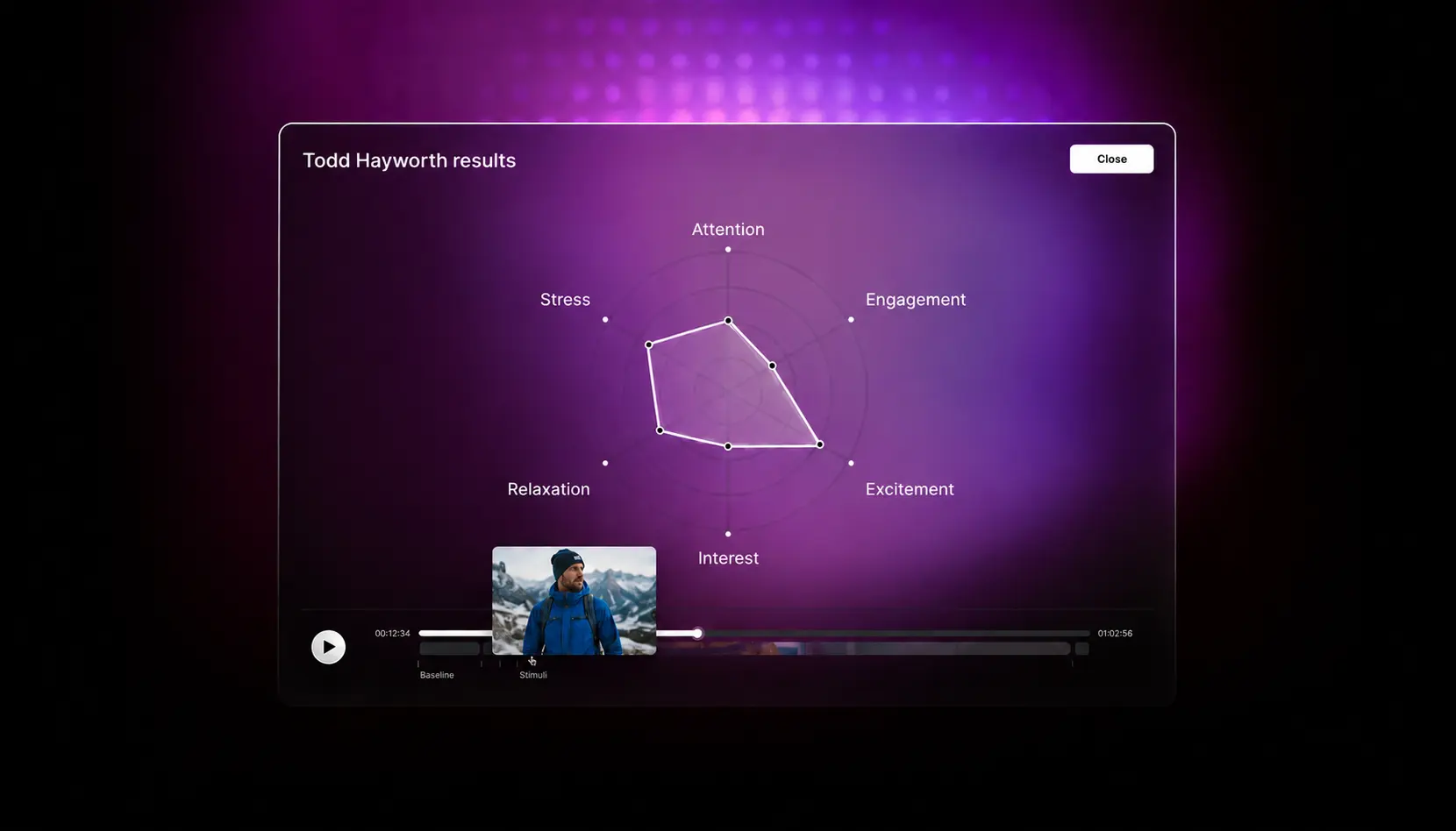
The Ultimate Guide to User Engagement Measurement
H.B. Duran
Updated on
Jun 16, 2026
The Ultimate Guide to User Engagement Measurement
H.B. Duran
Updated on
Jun 16, 2026
The Ultimate Guide to User Engagement Measurement
H.B. Duran
Updated on
Jun 16, 2026
Marketing teams invest significant resources into understanding audience behavior, yet one of the most challenging questions remains deceptively simple: how engaged were people during the experience itself? Whether evaluating digital advertising, branded content, product videos, websites, or campaign concepts, user engagement measurement often relies on metrics collected after exposure or behavioral indicators that provide only part of the story.
Clicks, views, conversions, and survey responses can reveal important outcomes, but they do not always explain how audience attention and engagement evolved throughout an experience. For marketing agencies and in-house teams, this can make it difficult to identify which creative elements contributed to success, which moments lost audience interest, and where optimization opportunities exist.
As competition for attention continues to increase, many organizations are incorporating neuroscience-informed research methods into their evaluation processes. By measuring audience response during content exposure, researchers can gain objective insights into engagement patterns that complement traditional research approaches. This additional layer of evidence helps teams better understand how audiences interact with marketing experiences and supports more informed decision-making before campaigns launch.
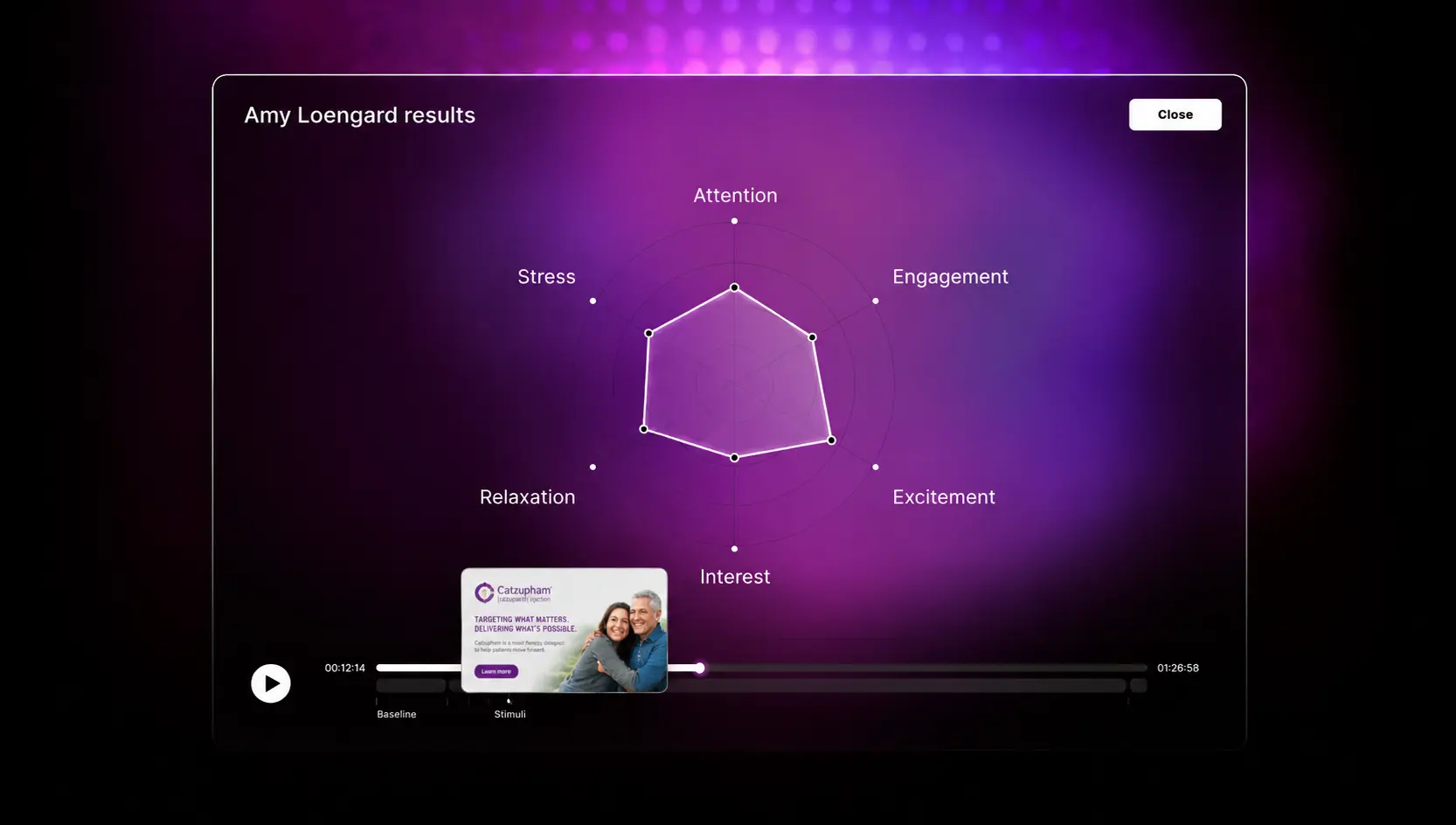
EEG-informed testing can reveal how audience engagement changes throughout a marketing experience.
Key Takeaways
EEG-based user engagement measurement provides objective audience response data during content exposure.
Engagement insights help marketers identify moments that sustain or lose audience interest.
Neuroscience-informed research complements surveys, interviews, and behavioral analytics.
Objective engagement data supports more confident creative optimization decisions.
Marketing teams can evaluate audience response before committing significant media budgets.
Why Measuring Engagement Remains a Marketing Challenge
Audience engagement is often discussed as a critical performance indicator, yet measuring it accurately remains difficult. Traditional metrics frequently focus on outcomes rather than experiences. A completed video view, for example, does not necessarily indicate sustained engagement throughout the content. Likewise, a survey response may reflect a participant’s recollection rather than their real-time experience.
For marketers, understanding engagement requires visibility into how audiences respond as they encounter messaging, visuals, products, and brand experiences. This is particularly important when evaluating creative assets before launch, when adjustments can still be made.
Research by Plassmann et al. (2015) suggests that neuroscience methods can provide information about implicit processes that are difficult to access through traditional research approaches. This capability makes neuroscience-informed methods especially valuable when seeking a deeper understanding of audience response.
Moving Beyond Self-Reported Feedback
Focus groups, interviews, and surveys remain important components of marketing research. They help explain motivations, preferences, and perceptions. However, they also rely on participants accurately describing experiences after they occur.
Audience members may struggle to recall specific moments of engagement or disengagement. They may also rationalize responses after the fact, making it difficult for researchers to understand how reactions unfolded in real time.
According to Byrne et al. (2022), neuroscience-based marketing research can capture implicit cognitive and emotional responses during interaction with marketing content. The authors note that these approaches can help reduce some of the subjectivity commonly associated with traditional marketing research methods.
Rather than replacing qualitative research, objective measurements provide additional context that helps researchers build a more complete picture of audience behavior.
How EEG-Based User Engagement Measurement Works in Marketing Research
Electroencephalography (EEG) has become an increasingly practical tool for evaluating audience response in marketing environments. Modern EEG systems allow researchers to measure brain activity associated with different engagement states while participants interact with content.
Using platforms such as Emotiv Studio, marketing researchers can evaluate metrics associated with engagement, attention, interest, and cognitive workload throughout an experience. These measurements help teams identify how audiences respond moment by moment rather than relying exclusively on retrospective feedback. :contentReference[oaicite:0]{index=0}
This approach is particularly valuable when testing:
Digital advertising campaigns
Video and social media content
Website experiences
Brand messaging concepts
Product launch materials
Marketing presentations and media assets
By identifying fluctuations in engagement, teams can pinpoint where content succeeds and where improvements may be necessary.
What Engagement Data Can Reveal About Marketing Content
One of the advantages of objective user engagement measurement is its ability to uncover patterns that might otherwise remain hidden. A piece of content may receive positive overall feedback while containing sections where engagement consistently declines. Conversely, specific creative elements may generate stronger audience interest than anticipated.
These insights can help marketers answer questions such as:
Which scenes sustain audience attention?
Where does engagement begin to decline?
Does messaging create unnecessary cognitive workload?
Which creative concepts generate stronger audience response?
How do different audience segments respond to the same content?
Because engagement data is tied to specific moments within an experience, marketers gain actionable information that can guide optimization efforts.
Real-World Examples of Engagement Measurement in Media Research
Research across multiple industries demonstrates the value of objective audience response measurement. In entertainment media, Christoforou et al. (2017) found that neural responses collected during movie trailer screenings were associated with future box-office performance. These findings illustrate how audience response measurements can support content evaluation while revisions are still possible.
Similarly, Leeuwis et al. (2021) demonstrated that neural synchrony among listeners carried predictive value for music streaming popularity. The study highlights how engagement-related audience data can contribute to decision-making before significant promotional investments are finalized.
Organizations conducting neuromarketing research increasingly apply similar methodologies to advertising, digital content, and audience testing workflows, helping marketers evaluate engagement and optimize creative assets before launch. :contentReference[oaicite:1]{index=1}
Building Better Marketing Research Programs
The most effective research strategies typically combine multiple methodologies. Behavioral analytics reveal what audiences do. Surveys and interviews explain what audiences say. EEG-informed engagement measurement contributes an additional perspective by capturing objective audience response during the experience itself.
When these methods are used together, marketing teams gain a richer understanding of audience behavior. They can identify discrepancies between reported experiences and measured responses, validate creative decisions with greater confidence, and uncover optimization opportunities that might otherwise remain hidden.
For agencies and in-house marketing teams, this integrated approach supports more informed decision-making across campaign development, content creation, and audience research initiatives.
Conclusion
User engagement measurement is most valuable when it captures how audiences respond in real time rather than relying exclusively on post-experience feedback. As marketing environments become increasingly competitive, objective engagement data provides a valuable complement to traditional research methods.
By incorporating EEG-based measurements into audience testing workflows, organizations can gain deeper insight into attention, engagement, and audience response patterns. These insights help marketers optimize content, improve creative effectiveness, and make more informed decisions before campaigns reach market.
Teams interested in incorporating objective audience engagement insights into their research programs can explore how Emotiv Studio supports neuroscience-informed marketing evaluation.
Sources
Byrne, M., et al. (2022). A Systematic Review of the Prediction of Consumer Preference Using EEG Measures and Machine-Learning in Neuromarketing Research. Brain Informatics. https://doi.org/10.1186/s40708-022-00175-3
Christoforou, C., Constantinidou, F., Shoshilou, P., et al. (2017). Your Brain on the Movies: A Computational Approach for Predicting Box-office Performance from Viewer’s Brain Responses to Movie Trailers. Frontiers in Neuroinformatics. https://doi.org/10.3389/fninf.2017.00072
Leeuwis, N., Nuijten, M., van Dijk, H., & Gerkema, C. (2021). A Sound Prediction: EEG-Based Neural Synchrony Predicts Online Music Streams. Frontiers in Psychology. https://doi.org/10.3389/fpsyg.2021.672980
Plassmann, H., Venkatraman, V., Huettel, S., & Yoon, C. (2015). Consumer Neuroscience: Applications, Challenges, and Possible Solutions. Journal of Marketing Research. https://doi.org/10.1509/jmr.14.0048
Marketing teams invest significant resources into understanding audience behavior, yet one of the most challenging questions remains deceptively simple: how engaged were people during the experience itself? Whether evaluating digital advertising, branded content, product videos, websites, or campaign concepts, user engagement measurement often relies on metrics collected after exposure or behavioral indicators that provide only part of the story.
Clicks, views, conversions, and survey responses can reveal important outcomes, but they do not always explain how audience attention and engagement evolved throughout an experience. For marketing agencies and in-house teams, this can make it difficult to identify which creative elements contributed to success, which moments lost audience interest, and where optimization opportunities exist.
As competition for attention continues to increase, many organizations are incorporating neuroscience-informed research methods into their evaluation processes. By measuring audience response during content exposure, researchers can gain objective insights into engagement patterns that complement traditional research approaches. This additional layer of evidence helps teams better understand how audiences interact with marketing experiences and supports more informed decision-making before campaigns launch.
EEG-informed testing can reveal how audience engagement changes throughout a marketing experience.
Key Takeaways
EEG-based user engagement measurement provides objective audience response data during content exposure.
Engagement insights help marketers identify moments that sustain or lose audience interest.
Neuroscience-informed research complements surveys, interviews, and behavioral analytics.
Objective engagement data supports more confident creative optimization decisions.
Marketing teams can evaluate audience response before committing significant media budgets.
Why Measuring Engagement Remains a Marketing Challenge
Audience engagement is often discussed as a critical performance indicator, yet measuring it accurately remains difficult. Traditional metrics frequently focus on outcomes rather than experiences. A completed video view, for example, does not necessarily indicate sustained engagement throughout the content. Likewise, a survey response may reflect a participant’s recollection rather than their real-time experience.
For marketers, understanding engagement requires visibility into how audiences respond as they encounter messaging, visuals, products, and brand experiences. This is particularly important when evaluating creative assets before launch, when adjustments can still be made.
Research by Plassmann et al. (2015) suggests that neuroscience methods can provide information about implicit processes that are difficult to access through traditional research approaches. This capability makes neuroscience-informed methods especially valuable when seeking a deeper understanding of audience response.
Moving Beyond Self-Reported Feedback
Focus groups, interviews, and surveys remain important components of marketing research. They help explain motivations, preferences, and perceptions. However, they also rely on participants accurately describing experiences after they occur.
Audience members may struggle to recall specific moments of engagement or disengagement. They may also rationalize responses after the fact, making it difficult for researchers to understand how reactions unfolded in real time.
According to Byrne et al. (2022), neuroscience-based marketing research can capture implicit cognitive and emotional responses during interaction with marketing content. The authors note that these approaches can help reduce some of the subjectivity commonly associated with traditional marketing research methods.
Rather than replacing qualitative research, objective measurements provide additional context that helps researchers build a more complete picture of audience behavior.
How EEG-Based User Engagement Measurement Works in Marketing Research
Electroencephalography (EEG) has become an increasingly practical tool for evaluating audience response in marketing environments. Modern EEG systems allow researchers to measure brain activity associated with different engagement states while participants interact with content.
Using platforms such as Emotiv Studio, marketing researchers can evaluate metrics associated with engagement, attention, interest, and cognitive workload throughout an experience. These measurements help teams identify how audiences respond moment by moment rather than relying exclusively on retrospective feedback. :contentReference[oaicite:0]{index=0}
This approach is particularly valuable when testing:
Digital advertising campaigns
Video and social media content
Website experiences
Brand messaging concepts
Product launch materials
Marketing presentations and media assets
By identifying fluctuations in engagement, teams can pinpoint where content succeeds and where improvements may be necessary.
What Engagement Data Can Reveal About Marketing Content
One of the advantages of objective user engagement measurement is its ability to uncover patterns that might otherwise remain hidden. A piece of content may receive positive overall feedback while containing sections where engagement consistently declines. Conversely, specific creative elements may generate stronger audience interest than anticipated.
These insights can help marketers answer questions such as:
Which scenes sustain audience attention?
Where does engagement begin to decline?
Does messaging create unnecessary cognitive workload?
Which creative concepts generate stronger audience response?
How do different audience segments respond to the same content?
Because engagement data is tied to specific moments within an experience, marketers gain actionable information that can guide optimization efforts.
Real-World Examples of Engagement Measurement in Media Research
Research across multiple industries demonstrates the value of objective audience response measurement. In entertainment media, Christoforou et al. (2017) found that neural responses collected during movie trailer screenings were associated with future box-office performance. These findings illustrate how audience response measurements can support content evaluation while revisions are still possible.
Similarly, Leeuwis et al. (2021) demonstrated that neural synchrony among listeners carried predictive value for music streaming popularity. The study highlights how engagement-related audience data can contribute to decision-making before significant promotional investments are finalized.
Organizations conducting neuromarketing research increasingly apply similar methodologies to advertising, digital content, and audience testing workflows, helping marketers evaluate engagement and optimize creative assets before launch. :contentReference[oaicite:1]{index=1}
Building Better Marketing Research Programs
The most effective research strategies typically combine multiple methodologies. Behavioral analytics reveal what audiences do. Surveys and interviews explain what audiences say. EEG-informed engagement measurement contributes an additional perspective by capturing objective audience response during the experience itself.
When these methods are used together, marketing teams gain a richer understanding of audience behavior. They can identify discrepancies between reported experiences and measured responses, validate creative decisions with greater confidence, and uncover optimization opportunities that might otherwise remain hidden.
For agencies and in-house marketing teams, this integrated approach supports more informed decision-making across campaign development, content creation, and audience research initiatives.
Conclusion
User engagement measurement is most valuable when it captures how audiences respond in real time rather than relying exclusively on post-experience feedback. As marketing environments become increasingly competitive, objective engagement data provides a valuable complement to traditional research methods.
By incorporating EEG-based measurements into audience testing workflows, organizations can gain deeper insight into attention, engagement, and audience response patterns. These insights help marketers optimize content, improve creative effectiveness, and make more informed decisions before campaigns reach market.
Teams interested in incorporating objective audience engagement insights into their research programs can explore how Emotiv Studio supports neuroscience-informed marketing evaluation.
Sources
Byrne, M., et al. (2022). A Systematic Review of the Prediction of Consumer Preference Using EEG Measures and Machine-Learning in Neuromarketing Research. Brain Informatics. https://doi.org/10.1186/s40708-022-00175-3
Christoforou, C., Constantinidou, F., Shoshilou, P., et al. (2017). Your Brain on the Movies: A Computational Approach for Predicting Box-office Performance from Viewer’s Brain Responses to Movie Trailers. Frontiers in Neuroinformatics. https://doi.org/10.3389/fninf.2017.00072
Leeuwis, N., Nuijten, M., van Dijk, H., & Gerkema, C. (2021). A Sound Prediction: EEG-Based Neural Synchrony Predicts Online Music Streams. Frontiers in Psychology. https://doi.org/10.3389/fpsyg.2021.672980
Plassmann, H., Venkatraman, V., Huettel, S., & Yoon, C. (2015). Consumer Neuroscience: Applications, Challenges, and Possible Solutions. Journal of Marketing Research. https://doi.org/10.1509/jmr.14.0048
Marketing teams invest significant resources into understanding audience behavior, yet one of the most challenging questions remains deceptively simple: how engaged were people during the experience itself? Whether evaluating digital advertising, branded content, product videos, websites, or campaign concepts, user engagement measurement often relies on metrics collected after exposure or behavioral indicators that provide only part of the story.
Clicks, views, conversions, and survey responses can reveal important outcomes, but they do not always explain how audience attention and engagement evolved throughout an experience. For marketing agencies and in-house teams, this can make it difficult to identify which creative elements contributed to success, which moments lost audience interest, and where optimization opportunities exist.
As competition for attention continues to increase, many organizations are incorporating neuroscience-informed research methods into their evaluation processes. By measuring audience response during content exposure, researchers can gain objective insights into engagement patterns that complement traditional research approaches. This additional layer of evidence helps teams better understand how audiences interact with marketing experiences and supports more informed decision-making before campaigns launch.
EEG-informed testing can reveal how audience engagement changes throughout a marketing experience.
Key Takeaways
EEG-based user engagement measurement provides objective audience response data during content exposure.
Engagement insights help marketers identify moments that sustain or lose audience interest.
Neuroscience-informed research complements surveys, interviews, and behavioral analytics.
Objective engagement data supports more confident creative optimization decisions.
Marketing teams can evaluate audience response before committing significant media budgets.
Why Measuring Engagement Remains a Marketing Challenge
Audience engagement is often discussed as a critical performance indicator, yet measuring it accurately remains difficult. Traditional metrics frequently focus on outcomes rather than experiences. A completed video view, for example, does not necessarily indicate sustained engagement throughout the content. Likewise, a survey response may reflect a participant’s recollection rather than their real-time experience.
For marketers, understanding engagement requires visibility into how audiences respond as they encounter messaging, visuals, products, and brand experiences. This is particularly important when evaluating creative assets before launch, when adjustments can still be made.
Research by Plassmann et al. (2015) suggests that neuroscience methods can provide information about implicit processes that are difficult to access through traditional research approaches. This capability makes neuroscience-informed methods especially valuable when seeking a deeper understanding of audience response.
Moving Beyond Self-Reported Feedback
Focus groups, interviews, and surveys remain important components of marketing research. They help explain motivations, preferences, and perceptions. However, they also rely on participants accurately describing experiences after they occur.
Audience members may struggle to recall specific moments of engagement or disengagement. They may also rationalize responses after the fact, making it difficult for researchers to understand how reactions unfolded in real time.
According to Byrne et al. (2022), neuroscience-based marketing research can capture implicit cognitive and emotional responses during interaction with marketing content. The authors note that these approaches can help reduce some of the subjectivity commonly associated with traditional marketing research methods.
Rather than replacing qualitative research, objective measurements provide additional context that helps researchers build a more complete picture of audience behavior.
How EEG-Based User Engagement Measurement Works in Marketing Research
Electroencephalography (EEG) has become an increasingly practical tool for evaluating audience response in marketing environments. Modern EEG systems allow researchers to measure brain activity associated with different engagement states while participants interact with content.
Using platforms such as Emotiv Studio, marketing researchers can evaluate metrics associated with engagement, attention, interest, and cognitive workload throughout an experience. These measurements help teams identify how audiences respond moment by moment rather than relying exclusively on retrospective feedback. :contentReference[oaicite:0]{index=0}
This approach is particularly valuable when testing:
Digital advertising campaigns
Video and social media content
Website experiences
Brand messaging concepts
Product launch materials
Marketing presentations and media assets
By identifying fluctuations in engagement, teams can pinpoint where content succeeds and where improvements may be necessary.
What Engagement Data Can Reveal About Marketing Content
One of the advantages of objective user engagement measurement is its ability to uncover patterns that might otherwise remain hidden. A piece of content may receive positive overall feedback while containing sections where engagement consistently declines. Conversely, specific creative elements may generate stronger audience interest than anticipated.
These insights can help marketers answer questions such as:
Which scenes sustain audience attention?
Where does engagement begin to decline?
Does messaging create unnecessary cognitive workload?
Which creative concepts generate stronger audience response?
How do different audience segments respond to the same content?
Because engagement data is tied to specific moments within an experience, marketers gain actionable information that can guide optimization efforts.
Real-World Examples of Engagement Measurement in Media Research
Research across multiple industries demonstrates the value of objective audience response measurement. In entertainment media, Christoforou et al. (2017) found that neural responses collected during movie trailer screenings were associated with future box-office performance. These findings illustrate how audience response measurements can support content evaluation while revisions are still possible.
Similarly, Leeuwis et al. (2021) demonstrated that neural synchrony among listeners carried predictive value for music streaming popularity. The study highlights how engagement-related audience data can contribute to decision-making before significant promotional investments are finalized.
Organizations conducting neuromarketing research increasingly apply similar methodologies to advertising, digital content, and audience testing workflows, helping marketers evaluate engagement and optimize creative assets before launch. :contentReference[oaicite:1]{index=1}
Building Better Marketing Research Programs
The most effective research strategies typically combine multiple methodologies. Behavioral analytics reveal what audiences do. Surveys and interviews explain what audiences say. EEG-informed engagement measurement contributes an additional perspective by capturing objective audience response during the experience itself.
When these methods are used together, marketing teams gain a richer understanding of audience behavior. They can identify discrepancies between reported experiences and measured responses, validate creative decisions with greater confidence, and uncover optimization opportunities that might otherwise remain hidden.
For agencies and in-house marketing teams, this integrated approach supports more informed decision-making across campaign development, content creation, and audience research initiatives.
Conclusion
User engagement measurement is most valuable when it captures how audiences respond in real time rather than relying exclusively on post-experience feedback. As marketing environments become increasingly competitive, objective engagement data provides a valuable complement to traditional research methods.
By incorporating EEG-based measurements into audience testing workflows, organizations can gain deeper insight into attention, engagement, and audience response patterns. These insights help marketers optimize content, improve creative effectiveness, and make more informed decisions before campaigns reach market.
Teams interested in incorporating objective audience engagement insights into their research programs can explore how Emotiv Studio supports neuroscience-informed marketing evaluation.
Sources
Byrne, M., et al. (2022). A Systematic Review of the Prediction of Consumer Preference Using EEG Measures and Machine-Learning in Neuromarketing Research. Brain Informatics. https://doi.org/10.1186/s40708-022-00175-3
Christoforou, C., Constantinidou, F., Shoshilou, P., et al. (2017). Your Brain on the Movies: A Computational Approach for Predicting Box-office Performance from Viewer’s Brain Responses to Movie Trailers. Frontiers in Neuroinformatics. https://doi.org/10.3389/fninf.2017.00072
Leeuwis, N., Nuijten, M., van Dijk, H., & Gerkema, C. (2021). A Sound Prediction: EEG-Based Neural Synchrony Predicts Online Music Streams. Frontiers in Psychology. https://doi.org/10.3389/fpsyg.2021.672980
Plassmann, H., Venkatraman, V., Huettel, S., & Yoon, C. (2015). Consumer Neuroscience: Applications, Challenges, and Possible Solutions. Journal of Marketing Research. https://doi.org/10.1509/jmr.14.0048

Continue reading