
How EEG Data Complements Eye-Tracking Research
H.B. Duran
Updated on
Jun 16, 2026
How EEG Data Complements Eye-Tracking Research
H.B. Duran
Updated on
Jun 16, 2026
How EEG Data Complements Eye-Tracking Research
H.B. Duran
Updated on
Jun 16, 2026
For marketing agencies and in-house marketing teams, understanding audience attention is essential to optimizing creative performance. Eye tracking marketing studies have become a popular method for evaluating how consumers interact with advertisements, websites, videos, packaging, and branded experiences. Heat maps, gaze paths, and fixation metrics can reveal where audiences look and which elements attract visual attention.
While these insights are valuable, eye tracking alone does not fully explain how audiences experience content. Looking at an element does not necessarily indicate interest, engagement, or positive response. A viewer may spend significant time looking at a particular area because it is confusing, cognitively demanding, or visually distracting rather than effective.
This distinction is increasingly important as marketing teams seek more reliable ways to evaluate creative effectiveness before launch. By combining eye tracking with neuroscience-informed research methods such as electroencephalography (EEG), marketers can move beyond understanding where audiences look and gain additional insight into how audiences respond during the experience. Together, these methods provide a richer picture of audience behavior that can support more informed creative and strategic decisions.
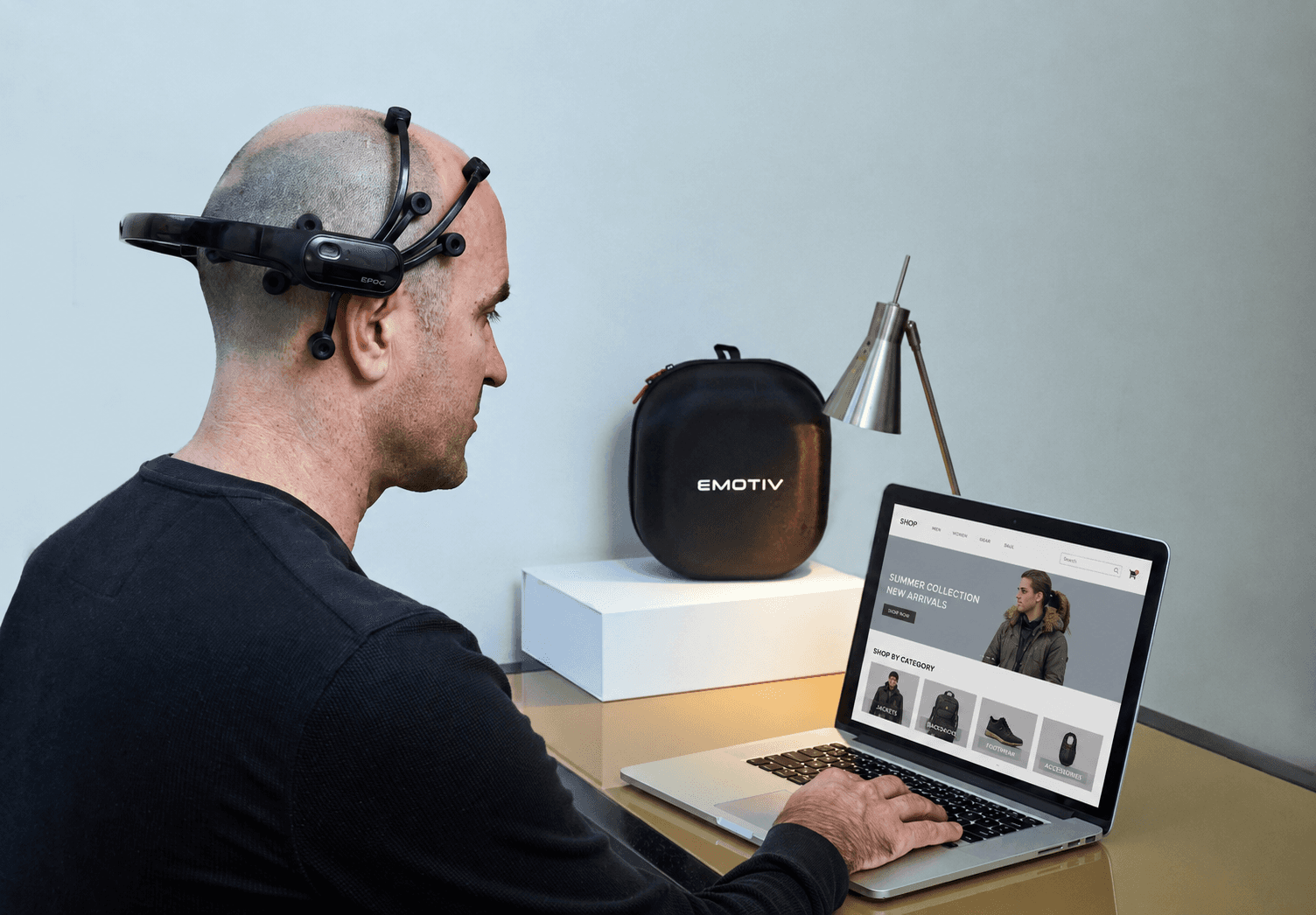
Caption: Combining eye tracking and EEG helps researchers understand both visual attention and audience response throughout the customer journey.
Key Takeaways
Eye tracking reveals where audiences look, while EEG provides additional context about audience response.
Visual attention does not always indicate understanding, engagement, or positive experience.
Cognitive load can influence how consumers interact with advertising, websites, and digital experiences.
Combining methodologies provides a more complete picture of creative effectiveness.
A multimodal research approach supports more informed optimization and decision-making.
What Eye Tracking Marketing Studies Do Well
Eye tracking has become one of the most widely used methods for evaluating visual attention across advertisements, websites, products, and digital experiences. Researchers can observe where viewers focus, how long they maintain attention on specific elements, and how their gaze moves throughout an experience.
For marketers, these insights can help answer practical questions such as:
Are viewers noticing key branding elements?
Which sections of a webpage receive the most visual attention?
Do product images attract more attention than messaging?
Are calls to action positioned effectively?
How do audiences navigate complex creative layouts?
These findings often provide valuable guidance for improving visual hierarchy, layout design, creative composition, and user experience. However, attention allocation alone may not fully explain audience behavior.
Why Eye Tracking Alone Has Limits
Eye tracking is highly effective for understanding visual behavior, but it primarily measures where users look. It does not fully explain whether users cognitively processed the information, how mentally demanding the experience felt, whether users experienced frustration or overload, or how emotionally engaging the content was.
Users may visually fixate on an interface element while feeling confused, cognitively overloaded, emotionally disengaged, or mentally fatigued. This creates an important distinction between visual attention and cognitive engagement.
Research by Milosavljevic et al. (2011) found that visual saliency can strongly influence consumer decision-making, particularly when cognitive load increases. Highly salient elements often attract attention regardless of whether they contribute positively to the overall experience.
This means a consumer may spend considerable time looking at an advertisement, website section, or product image without necessarily finding it engaging or useful. In some cases, prolonged visual attention may indicate uncertainty, confusion, or increased cognitive effort rather than effectiveness.
Without additional context, marketers risk interpreting visual attention as success when it may actually signal a design or messaging issue.
The Difference Between Looking and Processing
One of the most valuable contributions of EEG research is helping distinguish visual exposure from meaningful processing.
Users frequently look at elements without deeply processing them. A visitor may visually fixate on a call to action without understanding the offer. A shopper may spend time reading product information while experiencing cognitive overload. An audience member may watch an advertisement from beginning to end while gradually disengaging from the message.
Eye tracking can reveal visual attention. EEG provides additional context that helps researchers evaluate whether that attention reflects engagement, cognitive effort, confusion, fatigue, or sustained interest.
This distinction becomes particularly important in environments where comprehension and decision-making matter more than visibility alone.
Measuring Cognitive Load Across Interfaces
Cognitive load is one of the most important areas where EEG complements eye-tracking research.
Users may visually navigate an experience successfully while still experiencing excessive mental effort. Common causes of cognitive overload include dense layouts, competing focal points, excessive choices, complex onboarding flows, unclear navigation, and information-heavy experiences.
Eye tracking may reveal extensive scanning behavior, but EEG can help determine whether that scanning reflects productive engagement or cognitive strain.
This is especially important because users often continue interacting behaviorally even while mentally disengaging. By identifying cognitive overload earlier, teams can simplify experiences before fatigue impacts engagement, retention, or conversion.
For marketing teams, this can be particularly valuable when optimizing landing pages, e-commerce experiences, product configurators, onboarding workflows, and other decision-intensive environments.
Understanding Attention Sustainability
Capturing attention and maintaining attention are not the same thing.
Many experiences succeed at attracting initial attention but struggle to sustain engagement throughout the customer journey. A landing page may have an effective hero section but lose audience interest further down the page. A product demonstration may begin clearly but become cognitively exhausting. A video advertisement may capture attention while failing to maintain engagement or message retention.
Eye tracking can show whether users initially notice important content. EEG can help researchers evaluate how attention changes over time and identify moments where engagement begins to decline.
This combination provides a deeper understanding of audience behavior by helping teams optimize not only what gets noticed, but also what keeps audiences engaged.
How EEG Adds Context to Eye Tracking Data
EEG-based research provides a complementary perspective by measuring patterns of brain activity during content exposure. When used alongside eye tracking, EEG helps researchers interpret visual attention data within the broader context of audience experience.
For example, eye tracking may reveal that viewers consistently fixate on a product image. EEG data can provide additional context that helps determine whether that attention corresponds with sustained engagement or increased cognitive effort.
Similarly, researchers can evaluate how audiences respond during website navigation, video consumption, advertising exposure, onboarding experiences, and interactive digital content. This combination enables researchers to distinguish between elements that successfully capture interest and those that may create friction.
Advertising and Creative Performance Testing
Advertising research increasingly combines eye tracking and EEG methodologies to evaluate creative effectiveness before campaign launch.
Researchers can analyze visual attention to branding, audience response to messaging, attention retention during video playback, cognitive effort during complex creative sequences, and reactions to pacing or transitions.
This helps teams identify whether creative assets capture meaningful attention, support message comprehension, create engagement, and maintain cognitive clarity throughout the experience.
Rather than relying exclusively on post-exposure surveys or behavioral outcomes, marketers gain a richer understanding of how audiences experience content in real time.
Why Multimodal Research Matters
No single research method fully explains user behavior.
Behavioral analytics show outcomes. Eye tracking shows visual attention. Surveys reveal conscious feedback. UX testing uncovers observed behavior. EEG provides additional context about cognitive and emotional processing during the experience.
Together, these methods create a multimodal research framework that helps organizations better understand attention quality, cognitive effort, engagement sustainability, decision friction, and overall experience usability.
The result is a more complete understanding of audience behavior and a stronger foundation for optimization decisions.
Applications for Marketing Agencies and In-House Teams
Combining eye tracking and EEG can support a wide variety of marketing and user research initiatives, including:
Digital advertising optimization
Website and landing page evaluation
Video and social content testing
Packaging and shelf-impact studies
Brand messaging assessments
Product onboarding optimization
User experience research
Customer journey evaluation
E-commerce experience testing
Because both methodologies provide complementary perspectives, marketers gain a more complete understanding of audience behavior than either approach can provide independently.
Conclusion
Eye tracking remains one of the most effective methods for understanding visual attention. However, knowing where audiences look is only part of the story.
To optimize creative performance and improve campaign outcomes, marketers also need insight into how audiences respond during those interactions. By combining eye tracking with EEG-based audience measurement, teams can evaluate both attention and audience response, creating a richer foundation for decision-making.
This integrated approach helps identify opportunities for optimization, validate creative choices, and improve confidence in campaign development before launch.
Teams interested in combining objective audience response metrics with traditional research methods can explore how Emotiv Studio supports neuroscience-informed marketing research workflows.
Sources
Milosavljevic, M., Navalpakkam, V., Koch, C., & Rangel, A. (2011). Relative visual saliency differences induce sizable bias in consumer choice. Journal of Consumer Psychology. https://doi.org/10.1016/j.jcps.2011.10.002
Plassmann, H., Venkatraman, V., Huettel, S., & Yoon, C. (2015). Consumer neuroscience: Applications, challenges, and possible solutions. Journal of Marketing Research. https://doi.org/10.1509/jmr.14.0048
For marketing agencies and in-house marketing teams, understanding audience attention is essential to optimizing creative performance. Eye tracking marketing studies have become a popular method for evaluating how consumers interact with advertisements, websites, videos, packaging, and branded experiences. Heat maps, gaze paths, and fixation metrics can reveal where audiences look and which elements attract visual attention.
While these insights are valuable, eye tracking alone does not fully explain how audiences experience content. Looking at an element does not necessarily indicate interest, engagement, or positive response. A viewer may spend significant time looking at a particular area because it is confusing, cognitively demanding, or visually distracting rather than effective.
This distinction is increasingly important as marketing teams seek more reliable ways to evaluate creative effectiveness before launch. By combining eye tracking with neuroscience-informed research methods such as electroencephalography (EEG), marketers can move beyond understanding where audiences look and gain additional insight into how audiences respond during the experience. Together, these methods provide a richer picture of audience behavior that can support more informed creative and strategic decisions.
Caption: Combining eye tracking and EEG helps researchers understand both visual attention and audience response throughout the customer journey.
Key Takeaways
Eye tracking reveals where audiences look, while EEG provides additional context about audience response.
Visual attention does not always indicate understanding, engagement, or positive experience.
Cognitive load can influence how consumers interact with advertising, websites, and digital experiences.
Combining methodologies provides a more complete picture of creative effectiveness.
A multimodal research approach supports more informed optimization and decision-making.
What Eye Tracking Marketing Studies Do Well
Eye tracking has become one of the most widely used methods for evaluating visual attention across advertisements, websites, products, and digital experiences. Researchers can observe where viewers focus, how long they maintain attention on specific elements, and how their gaze moves throughout an experience.
For marketers, these insights can help answer practical questions such as:
Are viewers noticing key branding elements?
Which sections of a webpage receive the most visual attention?
Do product images attract more attention than messaging?
Are calls to action positioned effectively?
How do audiences navigate complex creative layouts?
These findings often provide valuable guidance for improving visual hierarchy, layout design, creative composition, and user experience. However, attention allocation alone may not fully explain audience behavior.
Why Eye Tracking Alone Has Limits
Eye tracking is highly effective for understanding visual behavior, but it primarily measures where users look. It does not fully explain whether users cognitively processed the information, how mentally demanding the experience felt, whether users experienced frustration or overload, or how emotionally engaging the content was.
Users may visually fixate on an interface element while feeling confused, cognitively overloaded, emotionally disengaged, or mentally fatigued. This creates an important distinction between visual attention and cognitive engagement.
Research by Milosavljevic et al. (2011) found that visual saliency can strongly influence consumer decision-making, particularly when cognitive load increases. Highly salient elements often attract attention regardless of whether they contribute positively to the overall experience.
This means a consumer may spend considerable time looking at an advertisement, website section, or product image without necessarily finding it engaging or useful. In some cases, prolonged visual attention may indicate uncertainty, confusion, or increased cognitive effort rather than effectiveness.
Without additional context, marketers risk interpreting visual attention as success when it may actually signal a design or messaging issue.
The Difference Between Looking and Processing
One of the most valuable contributions of EEG research is helping distinguish visual exposure from meaningful processing.
Users frequently look at elements without deeply processing them. A visitor may visually fixate on a call to action without understanding the offer. A shopper may spend time reading product information while experiencing cognitive overload. An audience member may watch an advertisement from beginning to end while gradually disengaging from the message.
Eye tracking can reveal visual attention. EEG provides additional context that helps researchers evaluate whether that attention reflects engagement, cognitive effort, confusion, fatigue, or sustained interest.
This distinction becomes particularly important in environments where comprehension and decision-making matter more than visibility alone.
Measuring Cognitive Load Across Interfaces
Cognitive load is one of the most important areas where EEG complements eye-tracking research.
Users may visually navigate an experience successfully while still experiencing excessive mental effort. Common causes of cognitive overload include dense layouts, competing focal points, excessive choices, complex onboarding flows, unclear navigation, and information-heavy experiences.
Eye tracking may reveal extensive scanning behavior, but EEG can help determine whether that scanning reflects productive engagement or cognitive strain.
This is especially important because users often continue interacting behaviorally even while mentally disengaging. By identifying cognitive overload earlier, teams can simplify experiences before fatigue impacts engagement, retention, or conversion.
For marketing teams, this can be particularly valuable when optimizing landing pages, e-commerce experiences, product configurators, onboarding workflows, and other decision-intensive environments.
Understanding Attention Sustainability
Capturing attention and maintaining attention are not the same thing.
Many experiences succeed at attracting initial attention but struggle to sustain engagement throughout the customer journey. A landing page may have an effective hero section but lose audience interest further down the page. A product demonstration may begin clearly but become cognitively exhausting. A video advertisement may capture attention while failing to maintain engagement or message retention.
Eye tracking can show whether users initially notice important content. EEG can help researchers evaluate how attention changes over time and identify moments where engagement begins to decline.
This combination provides a deeper understanding of audience behavior by helping teams optimize not only what gets noticed, but also what keeps audiences engaged.
How EEG Adds Context to Eye Tracking Data
EEG-based research provides a complementary perspective by measuring patterns of brain activity during content exposure. When used alongside eye tracking, EEG helps researchers interpret visual attention data within the broader context of audience experience.
For example, eye tracking may reveal that viewers consistently fixate on a product image. EEG data can provide additional context that helps determine whether that attention corresponds with sustained engagement or increased cognitive effort.
Similarly, researchers can evaluate how audiences respond during website navigation, video consumption, advertising exposure, onboarding experiences, and interactive digital content. This combination enables researchers to distinguish between elements that successfully capture interest and those that may create friction.
Advertising and Creative Performance Testing
Advertising research increasingly combines eye tracking and EEG methodologies to evaluate creative effectiveness before campaign launch.
Researchers can analyze visual attention to branding, audience response to messaging, attention retention during video playback, cognitive effort during complex creative sequences, and reactions to pacing or transitions.
This helps teams identify whether creative assets capture meaningful attention, support message comprehension, create engagement, and maintain cognitive clarity throughout the experience.
Rather than relying exclusively on post-exposure surveys or behavioral outcomes, marketers gain a richer understanding of how audiences experience content in real time.
Why Multimodal Research Matters
No single research method fully explains user behavior.
Behavioral analytics show outcomes. Eye tracking shows visual attention. Surveys reveal conscious feedback. UX testing uncovers observed behavior. EEG provides additional context about cognitive and emotional processing during the experience.
Together, these methods create a multimodal research framework that helps organizations better understand attention quality, cognitive effort, engagement sustainability, decision friction, and overall experience usability.
The result is a more complete understanding of audience behavior and a stronger foundation for optimization decisions.
Applications for Marketing Agencies and In-House Teams
Combining eye tracking and EEG can support a wide variety of marketing and user research initiatives, including:
Digital advertising optimization
Website and landing page evaluation
Video and social content testing
Packaging and shelf-impact studies
Brand messaging assessments
Product onboarding optimization
User experience research
Customer journey evaluation
E-commerce experience testing
Because both methodologies provide complementary perspectives, marketers gain a more complete understanding of audience behavior than either approach can provide independently.
Conclusion
Eye tracking remains one of the most effective methods for understanding visual attention. However, knowing where audiences look is only part of the story.
To optimize creative performance and improve campaign outcomes, marketers also need insight into how audiences respond during those interactions. By combining eye tracking with EEG-based audience measurement, teams can evaluate both attention and audience response, creating a richer foundation for decision-making.
This integrated approach helps identify opportunities for optimization, validate creative choices, and improve confidence in campaign development before launch.
Teams interested in combining objective audience response metrics with traditional research methods can explore how Emotiv Studio supports neuroscience-informed marketing research workflows.
Sources
Milosavljevic, M., Navalpakkam, V., Koch, C., & Rangel, A. (2011). Relative visual saliency differences induce sizable bias in consumer choice. Journal of Consumer Psychology. https://doi.org/10.1016/j.jcps.2011.10.002
Plassmann, H., Venkatraman, V., Huettel, S., & Yoon, C. (2015). Consumer neuroscience: Applications, challenges, and possible solutions. Journal of Marketing Research. https://doi.org/10.1509/jmr.14.0048
For marketing agencies and in-house marketing teams, understanding audience attention is essential to optimizing creative performance. Eye tracking marketing studies have become a popular method for evaluating how consumers interact with advertisements, websites, videos, packaging, and branded experiences. Heat maps, gaze paths, and fixation metrics can reveal where audiences look and which elements attract visual attention.
While these insights are valuable, eye tracking alone does not fully explain how audiences experience content. Looking at an element does not necessarily indicate interest, engagement, or positive response. A viewer may spend significant time looking at a particular area because it is confusing, cognitively demanding, or visually distracting rather than effective.
This distinction is increasingly important as marketing teams seek more reliable ways to evaluate creative effectiveness before launch. By combining eye tracking with neuroscience-informed research methods such as electroencephalography (EEG), marketers can move beyond understanding where audiences look and gain additional insight into how audiences respond during the experience. Together, these methods provide a richer picture of audience behavior that can support more informed creative and strategic decisions.
Caption: Combining eye tracking and EEG helps researchers understand both visual attention and audience response throughout the customer journey.
Key Takeaways
Eye tracking reveals where audiences look, while EEG provides additional context about audience response.
Visual attention does not always indicate understanding, engagement, or positive experience.
Cognitive load can influence how consumers interact with advertising, websites, and digital experiences.
Combining methodologies provides a more complete picture of creative effectiveness.
A multimodal research approach supports more informed optimization and decision-making.
What Eye Tracking Marketing Studies Do Well
Eye tracking has become one of the most widely used methods for evaluating visual attention across advertisements, websites, products, and digital experiences. Researchers can observe where viewers focus, how long they maintain attention on specific elements, and how their gaze moves throughout an experience.
For marketers, these insights can help answer practical questions such as:
Are viewers noticing key branding elements?
Which sections of a webpage receive the most visual attention?
Do product images attract more attention than messaging?
Are calls to action positioned effectively?
How do audiences navigate complex creative layouts?
These findings often provide valuable guidance for improving visual hierarchy, layout design, creative composition, and user experience. However, attention allocation alone may not fully explain audience behavior.
Why Eye Tracking Alone Has Limits
Eye tracking is highly effective for understanding visual behavior, but it primarily measures where users look. It does not fully explain whether users cognitively processed the information, how mentally demanding the experience felt, whether users experienced frustration or overload, or how emotionally engaging the content was.
Users may visually fixate on an interface element while feeling confused, cognitively overloaded, emotionally disengaged, or mentally fatigued. This creates an important distinction between visual attention and cognitive engagement.
Research by Milosavljevic et al. (2011) found that visual saliency can strongly influence consumer decision-making, particularly when cognitive load increases. Highly salient elements often attract attention regardless of whether they contribute positively to the overall experience.
This means a consumer may spend considerable time looking at an advertisement, website section, or product image without necessarily finding it engaging or useful. In some cases, prolonged visual attention may indicate uncertainty, confusion, or increased cognitive effort rather than effectiveness.
Without additional context, marketers risk interpreting visual attention as success when it may actually signal a design or messaging issue.
The Difference Between Looking and Processing
One of the most valuable contributions of EEG research is helping distinguish visual exposure from meaningful processing.
Users frequently look at elements without deeply processing them. A visitor may visually fixate on a call to action without understanding the offer. A shopper may spend time reading product information while experiencing cognitive overload. An audience member may watch an advertisement from beginning to end while gradually disengaging from the message.
Eye tracking can reveal visual attention. EEG provides additional context that helps researchers evaluate whether that attention reflects engagement, cognitive effort, confusion, fatigue, or sustained interest.
This distinction becomes particularly important in environments where comprehension and decision-making matter more than visibility alone.
Measuring Cognitive Load Across Interfaces
Cognitive load is one of the most important areas where EEG complements eye-tracking research.
Users may visually navigate an experience successfully while still experiencing excessive mental effort. Common causes of cognitive overload include dense layouts, competing focal points, excessive choices, complex onboarding flows, unclear navigation, and information-heavy experiences.
Eye tracking may reveal extensive scanning behavior, but EEG can help determine whether that scanning reflects productive engagement or cognitive strain.
This is especially important because users often continue interacting behaviorally even while mentally disengaging. By identifying cognitive overload earlier, teams can simplify experiences before fatigue impacts engagement, retention, or conversion.
For marketing teams, this can be particularly valuable when optimizing landing pages, e-commerce experiences, product configurators, onboarding workflows, and other decision-intensive environments.
Understanding Attention Sustainability
Capturing attention and maintaining attention are not the same thing.
Many experiences succeed at attracting initial attention but struggle to sustain engagement throughout the customer journey. A landing page may have an effective hero section but lose audience interest further down the page. A product demonstration may begin clearly but become cognitively exhausting. A video advertisement may capture attention while failing to maintain engagement or message retention.
Eye tracking can show whether users initially notice important content. EEG can help researchers evaluate how attention changes over time and identify moments where engagement begins to decline.
This combination provides a deeper understanding of audience behavior by helping teams optimize not only what gets noticed, but also what keeps audiences engaged.
How EEG Adds Context to Eye Tracking Data
EEG-based research provides a complementary perspective by measuring patterns of brain activity during content exposure. When used alongside eye tracking, EEG helps researchers interpret visual attention data within the broader context of audience experience.
For example, eye tracking may reveal that viewers consistently fixate on a product image. EEG data can provide additional context that helps determine whether that attention corresponds with sustained engagement or increased cognitive effort.
Similarly, researchers can evaluate how audiences respond during website navigation, video consumption, advertising exposure, onboarding experiences, and interactive digital content. This combination enables researchers to distinguish between elements that successfully capture interest and those that may create friction.
Advertising and Creative Performance Testing
Advertising research increasingly combines eye tracking and EEG methodologies to evaluate creative effectiveness before campaign launch.
Researchers can analyze visual attention to branding, audience response to messaging, attention retention during video playback, cognitive effort during complex creative sequences, and reactions to pacing or transitions.
This helps teams identify whether creative assets capture meaningful attention, support message comprehension, create engagement, and maintain cognitive clarity throughout the experience.
Rather than relying exclusively on post-exposure surveys or behavioral outcomes, marketers gain a richer understanding of how audiences experience content in real time.
Why Multimodal Research Matters
No single research method fully explains user behavior.
Behavioral analytics show outcomes. Eye tracking shows visual attention. Surveys reveal conscious feedback. UX testing uncovers observed behavior. EEG provides additional context about cognitive and emotional processing during the experience.
Together, these methods create a multimodal research framework that helps organizations better understand attention quality, cognitive effort, engagement sustainability, decision friction, and overall experience usability.
The result is a more complete understanding of audience behavior and a stronger foundation for optimization decisions.
Applications for Marketing Agencies and In-House Teams
Combining eye tracking and EEG can support a wide variety of marketing and user research initiatives, including:
Digital advertising optimization
Website and landing page evaluation
Video and social content testing
Packaging and shelf-impact studies
Brand messaging assessments
Product onboarding optimization
User experience research
Customer journey evaluation
E-commerce experience testing
Because both methodologies provide complementary perspectives, marketers gain a more complete understanding of audience behavior than either approach can provide independently.
Conclusion
Eye tracking remains one of the most effective methods for understanding visual attention. However, knowing where audiences look is only part of the story.
To optimize creative performance and improve campaign outcomes, marketers also need insight into how audiences respond during those interactions. By combining eye tracking with EEG-based audience measurement, teams can evaluate both attention and audience response, creating a richer foundation for decision-making.
This integrated approach helps identify opportunities for optimization, validate creative choices, and improve confidence in campaign development before launch.
Teams interested in combining objective audience response metrics with traditional research methods can explore how Emotiv Studio supports neuroscience-informed marketing research workflows.
Sources
Milosavljevic, M., Navalpakkam, V., Koch, C., & Rangel, A. (2011). Relative visual saliency differences induce sizable bias in consumer choice. Journal of Consumer Psychology. https://doi.org/10.1016/j.jcps.2011.10.002
Plassmann, H., Venkatraman, V., Huettel, S., & Yoon, C. (2015). Consumer neuroscience: Applications, challenges, and possible solutions. Journal of Marketing Research. https://doi.org/10.1509/jmr.14.0048
Continue reading