당신의 기억력을 시험하세요! Emotiv App에서 새로 나온 N-Back 게임을 플레이하세요

  • 당신의 기억력을 시험하세요! Emotiv App에서 새로 나온 N-Back 게임을 플레이하세요

  • 당신의 기억력을 시험하세요! Emotiv App에서 새로 나온 N-Back 게임을 플레이하세요

다른 주제 검색…

다른 주제 검색…

부위별 뇌종양 증상

건강에 무슨 일이 일어나고 있는지 알아내는 것은 정말 혼란스러울 수 있습니다. 특히 뇌처럼 복잡한 문제라면 더욱 그렇습니다. 뇌종양에 대해 듣다 보면 쉽게 압도될 수 있습니다.

하지만 중요한 점은, 종양이 뇌의 어디에 위치하느냐가 실제로 나타날 수 있는 뇌종양 증상의 종류에 큰 차이를 만든다는 것입니다. 이것은 단순히 무작위로 나타나는 문제들의 모음이 아니라, 영향을 받는 뇌의 부위가 어떤 증상이 나타날 수 있는지 알려 주는 지도와 같습니다.

이 가이드는 증상이 어디에서 비롯된 것처럼 보이는지에 따라 이러한 뇌종양 증상을 정리하여, 조금 더 쉽게 이해할 수 있도록 돕기 위해 마련되었습니다.

How Does a Brain Tumor Connect to Its Specific Symptoms?


Why Does Tumor Location Impact Health So Significantly?

When a brain tumor develops, its impact on a person's health isn't just about the tumor itself, but also where it's growing. The brain is organized into different areas, each responsible for specific functions.

The exact spot of a brain tumor significantly influences the symptoms that appear. A tumor in the frontal lobe might cause changes in personality or movement, while one in the occipital lobe could affect vision.

This is because the tumor can press on or damage the brain tissue in that particular region, interfering with its normal job.

In What Ways Does a Tumor Create Symptoms in the Body?

Brain tumors cause problems in a few main ways. First, as a tumor grows, it takes up space inside the skull. Since the skull is a fixed space, this growth can increase pressure on the brain.

This general pressure, known as increased intracranial pressure, can lead to symptoms like headaches, nausea, and vomiting, often worse in the morning. It can also cause general issues like fatigue or confusion.

Second, the tumor can directly damage or disrupt the brain tissue it's growing in or near. This damage interferes with the specific functions that part of the brain controls.

For example, if a tumor is in the area that handles language, a person might have trouble speaking or understanding words. The tumor can also affect nearby blood vessels, potentially leading to bleeding or swelling, which adds to the pressure and damage.

Finally, tumors can sometimes affect the brain's chemical signals or electrical activity. This can lead to things like seizures, which are sudden, uncontrolled bursts of electrical activity in the brain.

The specific symptoms a person experiences are a direct result of which brain functions are being interrupted by the tumor's presence and growth.

Which Symptoms are Linked to the Frontal Lobe?

The frontal lobe, situated at the front of the brain, is a major control center for many of our higher-level functions.

When a tumor develops here, it can significantly alter how a person thinks, behaves, and moves. These changes can sometimes be subtle initially, making them easy to overlook, but they can become more pronounced as the tumor grows.

How Do Frontal Lobe Tumors Change Personality and Judgment?

Tumors in the frontal lobe can disrupt the areas responsible for personality, decision-making, and impulse control. This can lead to noticeable shifts in how an individual acts and interacts with others.

Changes in personality are a key indicator of frontal lobe involvement. People might become uncharacteristically apathetic, showing less interest in activities they once enjoyed, or they could become more irritable or aggressive.

Moreover, judgment can be impaired, leading to poor decision-making or inappropriate social behavior, such as making insensitive comments or laughing at unsuitable times. Difficulty with planning and problem-solving, often referred to as executive function deficits, can also emerge, making it hard to organize tasks or think through consequences.

Can These Tumors Cause Problems With Movement and Motor Skills?

The frontal lobe also plays a role in controlling voluntary movement. Tumors in this region can affect motor pathways, potentially causing weakness or paralysis, often on the side of the body opposite to the tumor.

This can manifest as difficulties with coordination, balance, or performing fine motor tasks like writing or buttoning clothes. In some cases, people might experience changes in their gait or have trouble initiating movements.

Why Does a Tumor Cause Difficulties With Expressive Language?

For many people, the left side of the frontal lobe houses critical areas for speech production, like Broca's area. A tumor in this specific location can lead to expressive aphasia, where a person has trouble forming words or sentences, even though they understand what is being said.

They might speak in short, halting phrases or struggle to find the right words, which can be very frustrating. This difficulty in communicating can impact daily interactions and relationships.

What Signs Originate from the Parietal Lobe?

The parietal lobe is a significant part of the brain, situated behind the frontal lobe. It's like the brain's command center for processing sensory input – think touch, temperature, pain, and pressure. It also plays a big role in how we understand space, navigate our surroundings, and even in language and reading.

When a tumor grows in this area, it can really mess with these functions. You might notice some pretty distinct changes.

How Does This Disrupt Sensation, Touch, and Spatial Awareness?

One of the most common issues is a disruption in how sensory information is processed. This can mean feeling numbness or tingling in parts of the body, often on the side opposite to where the tumor is located. It's not just about touch, either; temperature and pain perception can also be affected.

Beyond just feeling things, the parietal lobe helps us understand where our body is in space. A tumor here can lead to difficulties with spatial awareness, making it harder to judge distances or coordinate movements. This can sometimes result in clumsiness or trouble with tasks requiring fine motor skills, like writing or buttoning a shirt.

Why Is There Difficulty With Reading, Writing, and Calculation?

Because the parietal lobe is involved in processing language and numbers, tumors in this region can cause problems with reading, writing, and arithmetic. Someone might find it hard to recognize words, follow lines of text, or perform simple calculations.

It’s not about losing the ability to see the words, but rather the brain’s capacity to interpret them correctly.

Is Confusion Between Left and Right a Common Symptom?

Another symptom that can arise from parietal lobe tumors is difficulty distinguishing between the left and right sides of the body or in space. This can contribute to disorientation and further complicate navigation and coordination.

What Happens When the Temporal Lobe is Affected?

The temporal lobe, situated on the sides of your head near your ears, plays a big role in how you hear, remember things, and process what you see and feel emotionally. When a tumor grows here, it can really mess with these functions.

It's not uncommon for people to notice changes in their memory or have trouble understanding emotions, either their own or others'.

What Memory and Emotional Regulation Issues May Arise?

Memory problems are a common sign of temporal lobe tumors. This might show up as difficulty recalling recent events or learning new information.

It can be pretty disorienting and affect daily life quite a bit. On top of that, the temporal lobe is involved in processing emotions.

So, a tumor here could lead to mood swings or trouble recognizing facial expressions and emotional cues in others.

Do These Tumors Cause Auditory Hallucinations or Hearing Problems?

Since the temporal lobe handles hearing, tumors in this area can cause a range of auditory issues. Some people report hearing sounds that aren't actually there, which are called auditory hallucinations.

Others might experience changes in their hearing, like difficulty understanding speech or perceiving sounds correctly. It can be quite unsettling to have your sense of hearing altered.

Why are Seizures and "Strange" Sensations Linked to the Temporal Lobe?

Tumors in the temporal lobe are particularly known for causing seizures. These seizures might not always look like the dramatic, full-body convulsions you see on TV. They can sometimes be more subtle, like a brief period of staring blankly, confusion, or experiencing unusual sensations.

These unusual feelings, sometimes described as a strange smell or a sense of déjà vu, can happen just before a seizure starts and are often called an aura. Diagnosing these issues typically involves neuroscience-based imaging tests like MRI scans to see the tumor and neurological exams to assess brain function.

Treatment approaches vary depending on the tumor's type, size, and location, and may include surgery, radiation therapy, or chemotherapy.

How is EEG Used to Understand and Localize Seizure Activity?

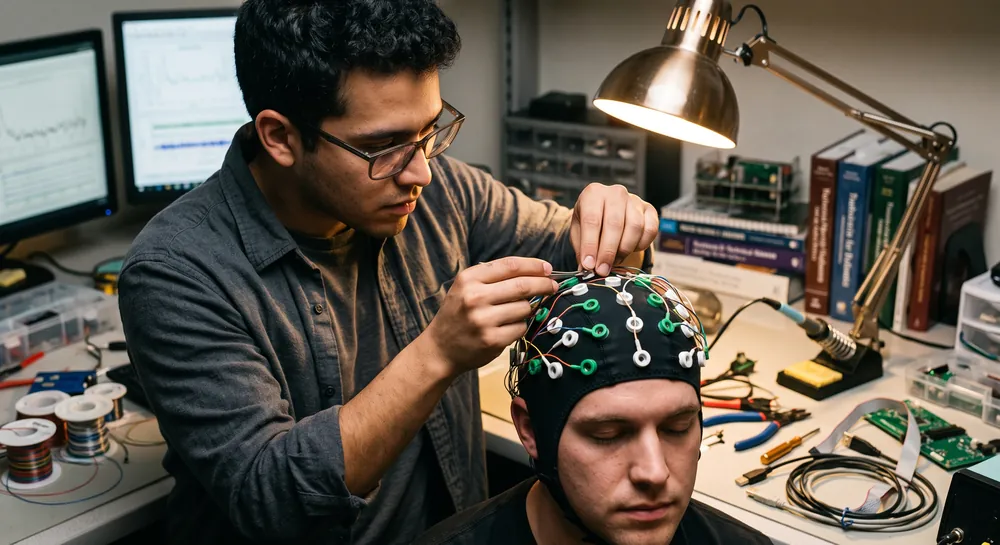
When a patient experiences the unexpected behavioral changes, strange sensory illusions, or physical convulsions characteristic of a temporal lobe seizure, medical professionals frequently rely on an electroencephalogram (EEG) to investigate the cause.

An EEG is a standard, non-invasive test that records the brain's continuous electrical activity, serving as the primary diagnostic tool to confirm that these alarming episodes are genuinely neurological in origin. It is important to note that an EEG is not used to diagnose the brain tumor itself; structural imaging tools like an MRI or CT scan are required to physically see and identify a mass.

Instead, the EEG is utilized specifically to evaluate the secondary electrical symptoms the tumor might be causing.

By capturing real-time electrical signals, the EEG helps neurologists pinpoint the exact origin of the abnormal electrical discharges—known as the seizure focus. When a tumor irritates the surrounding healthy tissue of the temporal lobe, it often triggers these localized electrical storms.

Mapping this functional electrical data alongside the structural images provided by an MRI gives the medical team a complete, comprehensive picture of the situation. It allows them to see not just where the physical mass is located, but exactly how its presence is actively disrupting the brain's delicate functional networks.

Which Vision Changes are Caused by the Occipital Lobe?

The occipital lobe, situated at the very back of your brain, is the primary hub for processing everything you see. When a tumor develops here, it can really mess with your vision in several ways.

Does an Occipital Lobe Tumor Lead to Partial or Complete Vision Loss?

Tumors in the occipital lobe can interfere with the visual pathways that run through this area. This interference can lead to a loss of vision, but it's often not a total blackout.

Instead, you might notice:

  • Visual field deficits: This means losing a portion of your sight. It could be half of your vision in one or both eyes (hemianopia) or a quarter of it (quadrantanopia). Sometimes, it just shows up as blind spots, called scotomas, in your field of vision. These deficits can make it tricky to navigate, like bumping into things you don't see coming.

  • Difficulty recognizing objects: Even if you can see something, you might struggle to identify what it is. This can extend to recognizing familiar faces, which can be quite unsettling.

Can a Brain Tumor Cause Visual Hallucinations or Distortions?

Beyond just losing vision, occipital lobe tumors can also cause you to see things that aren't there or see things in a distorted way. These can range from simple visual disturbances to more complex experiences:

  • Flashes of light: You might see sudden bursts or flickers of light, especially in your peripheral vision.

  • Complex hallucinations: Some people report seeing patterns, shapes, or even full images that have no external source. These are different from illusions, which are misinterpretations of things that are actually present.

  • Distorted perceptions: Straight lines might appear wavy, or objects might seem to change size or shape.

What are the Symptoms from Deeper Brain Structures?

Not all brain tumor symptoms come from the outer lobes of the brain. Some tumors affect deeper or lower brain structures that help control balance, coordination, eye movements, swallowing, breathing, and other basic body functions.

These symptoms can feel especially alarming because they may affect activities that usually happen automatically, such as walking steadily, speaking clearly, or swallowing safely.

Cerebellum: How are Balance, Coordination, and Dizziness Impacted?

The cerebellum sits at the lower back part of the brain and plays a major role in balance, posture, coordination, and smooth movement. When a tumor affects this region, symptoms often show up as problems with movement rather than changes in personality, memory, or vision.

A person might feel unusually unsteady, walk as if they are off balance, stumble more often, or struggle with tasks that require precise hand control, such as writing, typing, buttoning clothes, or brushing teeth.

Cerebellar tumors can also cause dizziness, nausea, vomiting, uncontrolled eye movements, or speech that sounds slow, slurred, or broken into uneven rhythms. These symptoms happen because the cerebellum helps the body adjust movement in real time.

When that system is disrupted, movements can become clumsy, poorly timed, or harder to control. Balance and coordination problems are commonly linked with tumors near the cerebellum, although dizziness alone can also come from many non-tumor causes, including inner ear problems, dehydration, migraine, medication effects, or blood pressure changes.

Brainstem: How are Core Functions Like Breathing and Swallowing Affected?

The brainstem connects the brain to the spinal cord and helps regulate essential functions such as breathing, heart rate, blood pressure, swallowing, facial movement, eye movement, and alertness. Because so many vital pathways pass through this compact area, even a small tumor in the brainstem can cause a wide range of symptoms.

Brainstem tumor symptoms may include:

  • Trouble swallowing

  • Slurred speech

  • Facial weakness or numbness

  • Double vision

  • Abnormal eye movements

  • Weakness or numbness in the arms or legs, balance problems

  • Headaches

  • Nausea

  • Changes in consciousness

In more serious cases, a brainstem tumor can interfere with breathing or swallowing, which is why symptoms in this area should be assessed urgently by a medical professional.

These symptoms do not automatically mean someone has brain cancer. Many brainstem-like symptoms can also happen with stroke, multiple sclerosis, infections, migraine, nerve disorders, or other neurological conditions.

However, new or worsening problems with swallowing, speech, breathing, facial weakness, double vision, or one-sided weakness should be treated as urgent warning signs that need medical evaluation.

Final Thoughts on Brain Tumor Symptoms

So, we've gone over how where a tumor is in the brain can really change the signs you might notice. Knowing these differences is pretty important for doctors trying to figure out what's going on and how to help.

Remember, a lot of these signs can pop up for other reasons too, so don't jump to conclusions. The main thing is, if something feels off or you're seeing symptoms that stick around or get worse, it's always best to get it checked out by a medical professional. They're the ones who can sort it out and get you the right brain health care if you need it.

Frequently Asked Questions

Why is the location of a brain tumor so important?

The brain has different parts that control different things. When a tumor grows in a specific spot, it can mess with the jobs that part of the brain is supposed to do. Knowing where the tumor is helps doctors figure out what symptoms you might have and how best to treat it.

Can a brain tumor cause personality changes?

Yes, sometimes. If a tumor is in the frontal lobe, which is at the front of your brain, it can affect how you act, your moods, and your decision-making. You might notice changes in personality or behavior.

What kind of problems can happen if a tumor is in the parietal lobe?

The parietal lobe helps you understand what you feel, like touch, and how things are arranged around you. A tumor here might make it hard to feel things correctly, understand directions, or even tell your left from your right. It can also affect reading and math skills.

How does a temporal lobe tumor affect someone?

The temporal lobe is important for memory and hearing. If a tumor is there, you might have trouble remembering things, understanding sounds, or even experience hearing things that aren't there. It can also lead to seizures.

What symptoms are linked to the occipital lobe?

The occipital lobe is mostly in charge of your vision. Tumors in this area can cause problems with seeing, like losing vision in part of your eye or seeing things that aren't real, like shapes or colors that aren't there.

Are headaches a common symptom of brain tumors?

Headaches can be a symptom, especially if they are new, severe, or different from headaches you've had before. They often happen because the tumor is putting pressure on the brain. However, many things can cause headaches, so it's important to see a doctor.

Do all brain tumors cause symptoms?

Not always. Very small tumors might not cause any noticeable symptoms at all. Symptoms usually appear as the tumor grows and starts to affect the brain's function or create pressure.

What should I do if I think I have symptoms of a brain tumor?

It's very important to talk to a doctor as soon as possible. They can do tests to figure out what's causing your symptoms and provide the right diagnosis and treatment plan.

Can brain tumors cause problems with movement?

Yes, depending on the location. Tumors in the frontal lobe or parietal lobe can affect the parts of the brain that control movement, leading to weakness or difficulty with coordination.

What are seizures related to brain tumors?

Seizures happen when there's a sudden burst of electrical activity in the brain. Brain tumors can irritate brain cells and trigger these seizures. They can feel different for everyone, from shaking to just a strange feeling.

Are symptoms like nausea and vomiting common with brain tumors?

Yes, nausea and vomiting can occur. This often happens because the tumor is increasing the pressure inside your head, which can affect these functions.

Emotiv는 EEG 및 뇌 데이터 도구를 통해 접근 가능한 신경과학 연구를 발전시키는 데 도움을 주는 신경기술 분야의 선두주자입니다.

Emotiv

최신 소식

뇌암 증상

이 글에서는 뇌암 증상이 어떻게 나타날 수 있는지, 시간이 지나면서 어떻게 변할 수 있는지, 그리고 이제 막 변화를 알아차리기 시작했든 장기적으로 겪고 있든 무엇을 기대할 수 있는지를 살펴봅니다. 이러한 증상의 진행 과정을 단계별로 살펴보며 더 잘 이해할 수 있도록 돕겠습니다.

기사 읽기

뇌암

뇌암을 마주하는 일은 받아들이기 벅차게 느껴질 수 있습니다. 이는 복잡한 주제이며, 명확하고 쉬운 정보를 찾는 것이 중요합니다.

이 글은 뇌암에 대해 알아야 할 내용을 쉽게 풀어 설명하기 위해 마련되었습니다. 뇌암이 무엇인지부터 어떻게 치료하는지까지 다룹니다. 이 질환을 여러분과 사랑하는 이들이 조금 더 쉽게 이해할 수 있도록 돕는 것이 우리의 목표입니다.

기사 읽기

중독은 질병인가요?

오랫동안 사람들은 중독을 어떻게 이해해야 할지 확신하지 못했습니다. 선택일까요? 도덕적 실패일까요? 하지만 과학은 이 질문을 파고들어 왔고, 그 증거는 점점 더 분명한 그림을 그려 주고 있습니다.

이 글은 중독이 질병인지에 대해 과학이 무엇이라고 말하는지 살펴봅니다. 그 의미가 무엇인지, 그리고 연구 결과가 무엇을 보여 주는지 차근차근 살펴보겠습니다.

기사 읽기

베이핑을 끊는 방법

전자담배를 끊기로 결정하는 것은 건강과 웰빙을 되찾기 위한 중요한 단계입니다. 이 습관은 여러 가지 이유로 시작되었을 수 있지만, 신체적·정신적 의존을 수반하는 복잡한 순환으로 빠르게 발전할 수 있습니다.

이 가이드는 전자담배에서 완전히 벗어날 수 있도록 실용적인 조언과 통찰을 제공합니다.

기사 읽기