Tester la publicité numérique avec des Insights en neurosciences
H.B. Duran
Mis à jour le
16 juin 2026
Tester la publicité numérique avec des Insights en neurosciences
H.B. Duran
Mis à jour le
16 juin 2026
Tester la publicité numérique avec des Insights en neurosciences
H.B. Duran
Mis à jour le
16 juin 2026
Pour les agences de marketing et les équipes de marketing internes, créer une publicité numérique efficace ne consiste plus simplement à produire plus de contenu. Le défi est de comprendre si les audiences prêtent réellement attention aux moments qui comptent le plus. Une campagne peut présenter des atouts créatifs solides, un message convaincant et un investissement média important, tout en étant sous-performante si les spectateurs négligent des informations clés ou se désengagent avant que le message prévu ne soit délivré.
Les méthodes d'évaluation traditionnelles telles que les taux de clics, les études de notoriété de la marque, les groupes de discussion et les enquêtes post-campagne fournissent des indicateurs de performance utiles. Cependant, elles révèlent souvent ce qui s'est passé après l'exposition plutôt que ce qui s'est produit pendant l'expérience de visionnage elle-même. Alors que les canaux numériques deviennent plus compétitifs et que l'attention des consommateurs est de plus en plus fragmentée, les spécialistes du marketing ont besoin d'une plus grande visibilité sur la façon dont les audiences réagissent en temps réel.
Comprendre quels éléments attirent l'attention, soutiennent l'engagement et créent une friction cognitive peut aider les équipes à prendre des décisions créatives plus éclairées avant le lancement. En intégrant des tests basés sur les neurosciences dans les flux de travail publicitaires, les spécialistes du marketing peuvent obtenir des informations objectives sur la réponse de l'audience et identifier des opportunités pour améliorer l'efficacité créative tant que des modifications sont encore possibles.

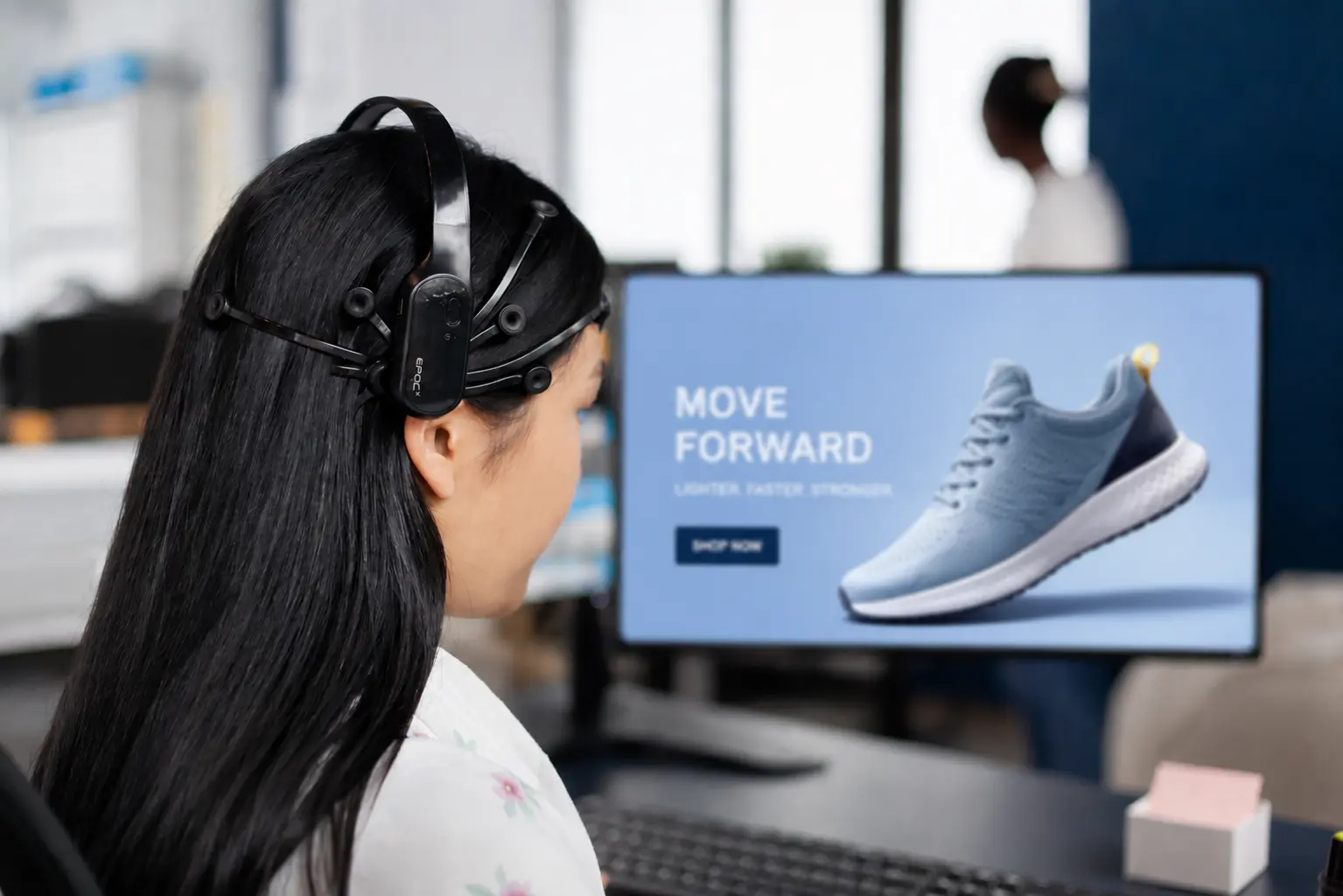
Les tests d'audience peuvent révéler où l'attention augmente, diminue ou se déplace tout au long d'une expérience publicitaire numérique.
Points clés à retenir
Les données d'attention peuvent révéler si les audiences remarquent les éléments les plus importants d'une publicité.
Les tests basés sur l'EEG fournissent un contexte supplémentaire au-delà des enquêtes et des mesures comportementales.
Les équipes créatives peuvent identifier les baisses d'engagement avant le lancement des campagnes.
Les données sur les réponses de l'audience aident à optimiser le message, le rythme et la hiérarchie visuelle.
Les décisions marketing deviennent plus éclairées lorsque les mesures objectives de l'attention complètent la recherche traditionnelle.
Le défi caché dans la performance de la publicité numérique
De nombreuses campagnes publicitaires sont évaluées en fonction de résultats tels que les clics, les conversions et les impressions. Bien que ces mesures restent importantes, elles n'expliquent pas toujours pourquoi un élément créatif particulier a réussi ou échoué. Comprendre le comportement du public nécessite d'avoir un aperçu de ce qui s'est passé pendant l'exposition, et pas seulement après.
Les recherches menées par Milosavljevic and Cerf (2008) suggèrent que l'attention joue un rôle essentiel dans la manière dont les consommateurs traitent les stimuli marketing. Pour les spécialistes du marketing, cela signifie que l'amélioration des performances de la campagne commence souvent par la compréhension de la question de savoir si les spectateurs remarquent les bons éléments aux bons moments.
Même des campagnes bien conçues peuvent contenir des distractions qui rivalisent avec les messages principaux. Les effets visuels, les images de produits, les animations graphiques et les textes de soutien peuvent involontairement détourner l'attention du branding, des propositions de valeur ou des appels à l'action.
Pourquoi les mesures traditionnelles ne racontent qu'une partie de l'histoire
La plupart des équipes marketing s'appuient sur une combinaison d'enquêtes, d'entretiens, de plateformes d'analyse et de tests A/B. Ces approches fournissent des informations précieuses mais peuvent laisser des lacunes lors de l'évaluation des réponses de l'audience, instant après instant.
Selon Plassmann et al. (2015), les méthodes neuroscientifiques peuvent fournir des informations sur les processus implicites qui sont difficiles d'accès par les approches de recherche traditionnelles. Ce niveau de contexte supplémentaire peut aider à expliquer des réactions du public que les participants ne parviendront peut-être pas à décrire avec précision lors d'entretiens ou d'enquêtes.
Par exemple, un participant peut déclarer avoir apprécié une publicité dans son ensemble tout en affichant un engagement réduit lors d'une démonstration de produit clé ou d'un message promotionnel. L'identification de ces moments permet aux équipes créatives de concentrer leurs efforts d'optimisation là où ils sont susceptibles d'avoir le plus grand impact.
Comment Emotiv Studio soutient l'évaluation publicitaire
Emotiv Studio permet aux chercheurs marketing et aux équipes créatives d'intégrer des mesures basées sur l'EEG dans les workflows de test d'audience. Plutôt que de remplacer les méthodes de recherche traditionnelles, la plateforme ajoute des données objectives qui peuvent aider à expliquer comment le public réagit tout au long d'une expérience publicitaire. :contentReference[oaicite:0]{index=0}
Lors de l'évaluation de la publicité numérique, les équipes peuvent examiner les schémas associés à l'attention, à l'engagement, à l'intérêt et à la charge cognitive. Ces mesures peuvent aider à identifier :
Les scènes qui captent ou perdent l'attention du public
Les éléments créatifs qui rivalisent pour la focalisation visuelle
Les sections susceptibles de créer une charge cognitive inutile
Les opportunités d'améliorer le rythme et la diffusion des messages
Les différences de réponse du public selon les variations créatives
Puisque les insights sont générés pendant que les spectateurs font l'expérience du contenu, les spécialistes du marketing peuvent mieux comprendre comment les choix créatifs influencent le comportement de l'audience en temps réel.
Ce que le public remarque n'est pas toujours ce à quoi les spécialistes du marketing s'attendent
L'un des résultats les plus précieux de l'évaluation publicitaire est de relever les écarts entre l'attention visée et l'attention réelle du public. Les spécialistes du marketing supposent souvent qu'une marque visible, des images de produits ou des appels à l'action deviennent naturellement des points focaux. En pratique, l'attention peut être détournée ailleurs.
Des recherches menées par Milosavljevic et al. (2011) ont révélé que la saillance visuelle peut influencer les choix des consommateurs plus fortement que les préférences dans certaines conditions. Leurs conclusions suggèrent également que l'impact de la saillance augmente lorsque la charge cognitive est élevée.
Pour la publicité numérique, cela signifie que des éléments visuels très visibles peuvent involontairement distraire le public des informations critiques. Une animation d'arrière-plan convaincante, par exemple, pourrait attirer plus d'attention qu'un énoncé sur les avantages du produit. Identifier ces conflits avant le lancement peut aider les équipes à améliorer la hiérarchie visuelle et la clarté du message.
Exemples concrets de tests d'audience dans les médias et la publicité
Le test d'audience basé sur les neurosciences a été appliqué dans plusieurs catégories de médias où la compréhension de la réponse des spectateurs est essentielle à la prise de décision.
Dans le marketing du divertissement, Christoforou et al. (2017) ont démontré que les réponses neuronales collectées lors des projections de bandes-annonces de films pouvaient prédire une part substantielle des performances futures au box-office. L'importance pour les spécialistes du marketing réside dans la capacité d'évaluer les réactions du public alors que le contenu promotionnel peut encore être peaufiné.
Un deuxième exemple provient de l'industrie de la musique. Les recherches menées par Leeuwis et al. (2021) ont révélé que la synchronie neuronale parmi les auditeurs avait une valeur prédictive pour la popularité en streaming. Bien que l'étude se soit concentrée sur la consommation de musique, elle illustre comment les mesures des réponses du public peuvent soutenir la prise de décision avant que des investissements importants ne soient finalisés.
Les organisations menant des recherches en neuromarketing appliquent de plus en plus des méthodologies de test similaires à la publicité, aidant les équipes à évaluer l'efficacité créative avant que les campagnes n'entrent sur le marché. :contentReference[oaicite:1]{index=1}
Construire un processus d'évaluation publicitaire plus efficace
Les équipes marketing peuvent tirer le meilleur parti lorsque les tests d'audience s'intègrent au développement créatif plutôt que de servir de simple exercice de validation final. Tester tôt et souvent permet aux équipes de repérer les problèmes avant que les budgets de production et les engagements médias n'augmentent.
Les applications pratiques comprennent la comparaison de concepts créatifs, l'évaluation de contenus vidéo sur les réseaux sociaux, le perfectionnement de la publicité display numérique, l'optimisation du séquençage des campagnes et l'évaluation de la réponse de l'audience à travers différents groupes démographiques.
En combinant les approches de recherche traditionnelles avec des mesures objectives des réponses du public, les spécialistes du marketing peuvent prendre des décisions plus éclairées sur les points sur lesquels concentrer les efforts d'optimisation et sur les actifs créatifs qui méritent un investissement supplémentaire.
Conclusion
Le succès d'une publicité numérique dépend de plus que de sa visibilité et de sa portée. Il dépend de la question de savoir si les audiences remarquent, traitent et s'engagent réellement avec les informations que les spécialistes du marketing considèrent comme les plus importantes.
Bien que les mesures de performance traditionnelles restent essentielles, elles ne fournissent souvent qu'une partie de l'image. Les tests basés sur les neurosciences ajoutent un contexte précieux en aidant les équipes à comprendre la réponse de l'audience tout au long de l'expérience de visionnage. Pour les agences de marketing comme pour les équipes internes, ces données peuvent soutenir des décisions créatives plus confiantes et une optimisation de campagne plus efficace avant le lancement.
Les équipes souhaitant évaluer l'attention, l'engagement et la réponse de l'audience avant le déploiement peuvent découvrir comment Emotiv Studio prend en charge les workflows de test publicitaire basés sur les neurosciences.
Sources
Christoforou, C., Constantinidou, F., Shoshilou, P., et al. (2017). Your Brain on the Movies: A Computational Approach for Predicting Box-office Performance from Viewer’s Brain Responses to Movie Trailers. Frontiers in Neuroinformatics. https://doi.org/10.3389/fninf.2017.00072
Leeuwis, N., Nuijten, M., van Dijk, H., & Gerkema, C. (2021). A Sound Prediction: EEG-Based Neural Synchrony Predicts Online Music Streams. Frontiers in Psychology. https://doi.org/10.3389/fpsyg.2021.672980
Milosavljevic, M., & Cerf, M. (2008). First Attention Then Intention: Insights from Computational Neuroscience of Vision. International Journal of Advertising. https://doi.org/10.2501/s0265048708080037
Milosavljevic, M., Navalpakkam, V., Koch, C., & Rangel, A. (2011). Relative Visual Saliency Differences Induce Sizable Bias in Consumer Choice. Journal of Consumer Psychology. https://doi.org/10.1016/j.jcps.2011.10.002
Plassmann, H., Venkatraman, V., Huettel, S., & Yoon, C. (2015). Consumer Neuroscience: Applications, Challenges, and Possible Solutions. Journal of Marketing Research. https://doi.org/10.1509/jmr.14.0048
Pour les agences de marketing et les équipes de marketing internes, créer une publicité numérique efficace ne consiste plus simplement à produire plus de contenu. Le défi est de comprendre si les audiences prêtent réellement attention aux moments qui comptent le plus. Une campagne peut présenter des atouts créatifs solides, un message convaincant et un investissement média important, tout en étant sous-performante si les spectateurs négligent des informations clés ou se désengagent avant que le message prévu ne soit délivré.
Les méthodes d'évaluation traditionnelles telles que les taux de clics, les études de notoriété de la marque, les groupes de discussion et les enquêtes post-campagne fournissent des indicateurs de performance utiles. Cependant, elles révèlent souvent ce qui s'est passé après l'exposition plutôt que ce qui s'est produit pendant l'expérience de visionnage elle-même. Alors que les canaux numériques deviennent plus compétitifs et que l'attention des consommateurs est de plus en plus fragmentée, les spécialistes du marketing ont besoin d'une plus grande visibilité sur la façon dont les audiences réagissent en temps réel.
Comprendre quels éléments attirent l'attention, soutiennent l'engagement et créent une friction cognitive peut aider les équipes à prendre des décisions créatives plus éclairées avant le lancement. En intégrant des tests basés sur les neurosciences dans les flux de travail publicitaires, les spécialistes du marketing peuvent obtenir des informations objectives sur la réponse de l'audience et identifier des opportunités pour améliorer l'efficacité créative tant que des modifications sont encore possibles.
Les tests d'audience peuvent révéler où l'attention augmente, diminue ou se déplace tout au long d'une expérience publicitaire numérique.
Points clés à retenir
Les données d'attention peuvent révéler si les audiences remarquent les éléments les plus importants d'une publicité.
Les tests basés sur l'EEG fournissent un contexte supplémentaire au-delà des enquêtes et des mesures comportementales.
Les équipes créatives peuvent identifier les baisses d'engagement avant le lancement des campagnes.
Les données sur les réponses de l'audience aident à optimiser le message, le rythme et la hiérarchie visuelle.
Les décisions marketing deviennent plus éclairées lorsque les mesures objectives de l'attention complètent la recherche traditionnelle.
Le défi caché dans la performance de la publicité numérique
De nombreuses campagnes publicitaires sont évaluées en fonction de résultats tels que les clics, les conversions et les impressions. Bien que ces mesures restent importantes, elles n'expliquent pas toujours pourquoi un élément créatif particulier a réussi ou échoué. Comprendre le comportement du public nécessite d'avoir un aperçu de ce qui s'est passé pendant l'exposition, et pas seulement après.
Les recherches menées par Milosavljevic and Cerf (2008) suggèrent que l'attention joue un rôle essentiel dans la manière dont les consommateurs traitent les stimuli marketing. Pour les spécialistes du marketing, cela signifie que l'amélioration des performances de la campagne commence souvent par la compréhension de la question de savoir si les spectateurs remarquent les bons éléments aux bons moments.
Même des campagnes bien conçues peuvent contenir des distractions qui rivalisent avec les messages principaux. Les effets visuels, les images de produits, les animations graphiques et les textes de soutien peuvent involontairement détourner l'attention du branding, des propositions de valeur ou des appels à l'action.
Pourquoi les mesures traditionnelles ne racontent qu'une partie de l'histoire
La plupart des équipes marketing s'appuient sur une combinaison d'enquêtes, d'entretiens, de plateformes d'analyse et de tests A/B. Ces approches fournissent des informations précieuses mais peuvent laisser des lacunes lors de l'évaluation des réponses de l'audience, instant après instant.
Selon Plassmann et al. (2015), les méthodes neuroscientifiques peuvent fournir des informations sur les processus implicites qui sont difficiles d'accès par les approches de recherche traditionnelles. Ce niveau de contexte supplémentaire peut aider à expliquer des réactions du public que les participants ne parviendront peut-être pas à décrire avec précision lors d'entretiens ou d'enquêtes.
Par exemple, un participant peut déclarer avoir apprécié une publicité dans son ensemble tout en affichant un engagement réduit lors d'une démonstration de produit clé ou d'un message promotionnel. L'identification de ces moments permet aux équipes créatives de concentrer leurs efforts d'optimisation là où ils sont susceptibles d'avoir le plus grand impact.
Comment Emotiv Studio soutient l'évaluation publicitaire
Emotiv Studio permet aux chercheurs marketing et aux équipes créatives d'intégrer des mesures basées sur l'EEG dans les workflows de test d'audience. Plutôt que de remplacer les méthodes de recherche traditionnelles, la plateforme ajoute des données objectives qui peuvent aider à expliquer comment le public réagit tout au long d'une expérience publicitaire. :contentReference[oaicite:0]{index=0}
Lors de l'évaluation de la publicité numérique, les équipes peuvent examiner les schémas associés à l'attention, à l'engagement, à l'intérêt et à la charge cognitive. Ces mesures peuvent aider à identifier :
Les scènes qui captent ou perdent l'attention du public
Les éléments créatifs qui rivalisent pour la focalisation visuelle
Les sections susceptibles de créer une charge cognitive inutile
Les opportunités d'améliorer le rythme et la diffusion des messages
Les différences de réponse du public selon les variations créatives
Puisque les insights sont générés pendant que les spectateurs font l'expérience du contenu, les spécialistes du marketing peuvent mieux comprendre comment les choix créatifs influencent le comportement de l'audience en temps réel.
Ce que le public remarque n'est pas toujours ce à quoi les spécialistes du marketing s'attendent
L'un des résultats les plus précieux de l'évaluation publicitaire est de relever les écarts entre l'attention visée et l'attention réelle du public. Les spécialistes du marketing supposent souvent qu'une marque visible, des images de produits ou des appels à l'action deviennent naturellement des points focaux. En pratique, l'attention peut être détournée ailleurs.
Des recherches menées par Milosavljevic et al. (2011) ont révélé que la saillance visuelle peut influencer les choix des consommateurs plus fortement que les préférences dans certaines conditions. Leurs conclusions suggèrent également que l'impact de la saillance augmente lorsque la charge cognitive est élevée.
Pour la publicité numérique, cela signifie que des éléments visuels très visibles peuvent involontairement distraire le public des informations critiques. Une animation d'arrière-plan convaincante, par exemple, pourrait attirer plus d'attention qu'un énoncé sur les avantages du produit. Identifier ces conflits avant le lancement peut aider les équipes à améliorer la hiérarchie visuelle et la clarté du message.
Exemples concrets de tests d'audience dans les médias et la publicité
Le test d'audience basé sur les neurosciences a été appliqué dans plusieurs catégories de médias où la compréhension de la réponse des spectateurs est essentielle à la prise de décision.
Dans le marketing du divertissement, Christoforou et al. (2017) ont démontré que les réponses neuronales collectées lors des projections de bandes-annonces de films pouvaient prédire une part substantielle des performances futures au box-office. L'importance pour les spécialistes du marketing réside dans la capacité d'évaluer les réactions du public alors que le contenu promotionnel peut encore être peaufiné.
Un deuxième exemple provient de l'industrie de la musique. Les recherches menées par Leeuwis et al. (2021) ont révélé que la synchronie neuronale parmi les auditeurs avait une valeur prédictive pour la popularité en streaming. Bien que l'étude se soit concentrée sur la consommation de musique, elle illustre comment les mesures des réponses du public peuvent soutenir la prise de décision avant que des investissements importants ne soient finalisés.
Les organisations menant des recherches en neuromarketing appliquent de plus en plus des méthodologies de test similaires à la publicité, aidant les équipes à évaluer l'efficacité créative avant que les campagnes n'entrent sur le marché. :contentReference[oaicite:1]{index=1}
Construire un processus d'évaluation publicitaire plus efficace
Les équipes marketing peuvent tirer le meilleur parti lorsque les tests d'audience s'intègrent au développement créatif plutôt que de servir de simple exercice de validation final. Tester tôt et souvent permet aux équipes de repérer les problèmes avant que les budgets de production et les engagements médias n'augmentent.
Les applications pratiques comprennent la comparaison de concepts créatifs, l'évaluation de contenus vidéo sur les réseaux sociaux, le perfectionnement de la publicité display numérique, l'optimisation du séquençage des campagnes et l'évaluation de la réponse de l'audience à travers différents groupes démographiques.
En combinant les approches de recherche traditionnelles avec des mesures objectives des réponses du public, les spécialistes du marketing peuvent prendre des décisions plus éclairées sur les points sur lesquels concentrer les efforts d'optimisation et sur les actifs créatifs qui méritent un investissement supplémentaire.
Conclusion
Le succès d'une publicité numérique dépend de plus que de sa visibilité et de sa portée. Il dépend de la question de savoir si les audiences remarquent, traitent et s'engagent réellement avec les informations que les spécialistes du marketing considèrent comme les plus importantes.
Bien que les mesures de performance traditionnelles restent essentielles, elles ne fournissent souvent qu'une partie de l'image. Les tests basés sur les neurosciences ajoutent un contexte précieux en aidant les équipes à comprendre la réponse de l'audience tout au long de l'expérience de visionnage. Pour les agences de marketing comme pour les équipes internes, ces données peuvent soutenir des décisions créatives plus confiantes et une optimisation de campagne plus efficace avant le lancement.
Les équipes souhaitant évaluer l'attention, l'engagement et la réponse de l'audience avant le déploiement peuvent découvrir comment Emotiv Studio prend en charge les workflows de test publicitaire basés sur les neurosciences.
Sources
Christoforou, C., Constantinidou, F., Shoshilou, P., et al. (2017). Your Brain on the Movies: A Computational Approach for Predicting Box-office Performance from Viewer’s Brain Responses to Movie Trailers. Frontiers in Neuroinformatics. https://doi.org/10.3389/fninf.2017.00072
Leeuwis, N., Nuijten, M., van Dijk, H., & Gerkema, C. (2021). A Sound Prediction: EEG-Based Neural Synchrony Predicts Online Music Streams. Frontiers in Psychology. https://doi.org/10.3389/fpsyg.2021.672980
Milosavljevic, M., & Cerf, M. (2008). First Attention Then Intention: Insights from Computational Neuroscience of Vision. International Journal of Advertising. https://doi.org/10.2501/s0265048708080037
Milosavljevic, M., Navalpakkam, V., Koch, C., & Rangel, A. (2011). Relative Visual Saliency Differences Induce Sizable Bias in Consumer Choice. Journal of Consumer Psychology. https://doi.org/10.1016/j.jcps.2011.10.002
Plassmann, H., Venkatraman, V., Huettel, S., & Yoon, C. (2015). Consumer Neuroscience: Applications, Challenges, and Possible Solutions. Journal of Marketing Research. https://doi.org/10.1509/jmr.14.0048
Pour les agences de marketing et les équipes de marketing internes, créer une publicité numérique efficace ne consiste plus simplement à produire plus de contenu. Le défi est de comprendre si les audiences prêtent réellement attention aux moments qui comptent le plus. Une campagne peut présenter des atouts créatifs solides, un message convaincant et un investissement média important, tout en étant sous-performante si les spectateurs négligent des informations clés ou se désengagent avant que le message prévu ne soit délivré.
Les méthodes d'évaluation traditionnelles telles que les taux de clics, les études de notoriété de la marque, les groupes de discussion et les enquêtes post-campagne fournissent des indicateurs de performance utiles. Cependant, elles révèlent souvent ce qui s'est passé après l'exposition plutôt que ce qui s'est produit pendant l'expérience de visionnage elle-même. Alors que les canaux numériques deviennent plus compétitifs et que l'attention des consommateurs est de plus en plus fragmentée, les spécialistes du marketing ont besoin d'une plus grande visibilité sur la façon dont les audiences réagissent en temps réel.
Comprendre quels éléments attirent l'attention, soutiennent l'engagement et créent une friction cognitive peut aider les équipes à prendre des décisions créatives plus éclairées avant le lancement. En intégrant des tests basés sur les neurosciences dans les flux de travail publicitaires, les spécialistes du marketing peuvent obtenir des informations objectives sur la réponse de l'audience et identifier des opportunités pour améliorer l'efficacité créative tant que des modifications sont encore possibles.
Les tests d'audience peuvent révéler où l'attention augmente, diminue ou se déplace tout au long d'une expérience publicitaire numérique.
Points clés à retenir
Les données d'attention peuvent révéler si les audiences remarquent les éléments les plus importants d'une publicité.
Les tests basés sur l'EEG fournissent un contexte supplémentaire au-delà des enquêtes et des mesures comportementales.
Les équipes créatives peuvent identifier les baisses d'engagement avant le lancement des campagnes.
Les données sur les réponses de l'audience aident à optimiser le message, le rythme et la hiérarchie visuelle.
Les décisions marketing deviennent plus éclairées lorsque les mesures objectives de l'attention complètent la recherche traditionnelle.
Le défi caché dans la performance de la publicité numérique
De nombreuses campagnes publicitaires sont évaluées en fonction de résultats tels que les clics, les conversions et les impressions. Bien que ces mesures restent importantes, elles n'expliquent pas toujours pourquoi un élément créatif particulier a réussi ou échoué. Comprendre le comportement du public nécessite d'avoir un aperçu de ce qui s'est passé pendant l'exposition, et pas seulement après.
Les recherches menées par Milosavljevic and Cerf (2008) suggèrent que l'attention joue un rôle essentiel dans la manière dont les consommateurs traitent les stimuli marketing. Pour les spécialistes du marketing, cela signifie que l'amélioration des performances de la campagne commence souvent par la compréhension de la question de savoir si les spectateurs remarquent les bons éléments aux bons moments.
Même des campagnes bien conçues peuvent contenir des distractions qui rivalisent avec les messages principaux. Les effets visuels, les images de produits, les animations graphiques et les textes de soutien peuvent involontairement détourner l'attention du branding, des propositions de valeur ou des appels à l'action.
Pourquoi les mesures traditionnelles ne racontent qu'une partie de l'histoire
La plupart des équipes marketing s'appuient sur une combinaison d'enquêtes, d'entretiens, de plateformes d'analyse et de tests A/B. Ces approches fournissent des informations précieuses mais peuvent laisser des lacunes lors de l'évaluation des réponses de l'audience, instant après instant.
Selon Plassmann et al. (2015), les méthodes neuroscientifiques peuvent fournir des informations sur les processus implicites qui sont difficiles d'accès par les approches de recherche traditionnelles. Ce niveau de contexte supplémentaire peut aider à expliquer des réactions du public que les participants ne parviendront peut-être pas à décrire avec précision lors d'entretiens ou d'enquêtes.
Par exemple, un participant peut déclarer avoir apprécié une publicité dans son ensemble tout en affichant un engagement réduit lors d'une démonstration de produit clé ou d'un message promotionnel. L'identification de ces moments permet aux équipes créatives de concentrer leurs efforts d'optimisation là où ils sont susceptibles d'avoir le plus grand impact.
Comment Emotiv Studio soutient l'évaluation publicitaire
Emotiv Studio permet aux chercheurs marketing et aux équipes créatives d'intégrer des mesures basées sur l'EEG dans les workflows de test d'audience. Plutôt que de remplacer les méthodes de recherche traditionnelles, la plateforme ajoute des données objectives qui peuvent aider à expliquer comment le public réagit tout au long d'une expérience publicitaire. :contentReference[oaicite:0]{index=0}
Lors de l'évaluation de la publicité numérique, les équipes peuvent examiner les schémas associés à l'attention, à l'engagement, à l'intérêt et à la charge cognitive. Ces mesures peuvent aider à identifier :
Les scènes qui captent ou perdent l'attention du public
Les éléments créatifs qui rivalisent pour la focalisation visuelle
Les sections susceptibles de créer une charge cognitive inutile
Les opportunités d'améliorer le rythme et la diffusion des messages
Les différences de réponse du public selon les variations créatives
Puisque les insights sont générés pendant que les spectateurs font l'expérience du contenu, les spécialistes du marketing peuvent mieux comprendre comment les choix créatifs influencent le comportement de l'audience en temps réel.
Ce que le public remarque n'est pas toujours ce à quoi les spécialistes du marketing s'attendent
L'un des résultats les plus précieux de l'évaluation publicitaire est de relever les écarts entre l'attention visée et l'attention réelle du public. Les spécialistes du marketing supposent souvent qu'une marque visible, des images de produits ou des appels à l'action deviennent naturellement des points focaux. En pratique, l'attention peut être détournée ailleurs.
Des recherches menées par Milosavljevic et al. (2011) ont révélé que la saillance visuelle peut influencer les choix des consommateurs plus fortement que les préférences dans certaines conditions. Leurs conclusions suggèrent également que l'impact de la saillance augmente lorsque la charge cognitive est élevée.
Pour la publicité numérique, cela signifie que des éléments visuels très visibles peuvent involontairement distraire le public des informations critiques. Une animation d'arrière-plan convaincante, par exemple, pourrait attirer plus d'attention qu'un énoncé sur les avantages du produit. Identifier ces conflits avant le lancement peut aider les équipes à améliorer la hiérarchie visuelle et la clarté du message.
Exemples concrets de tests d'audience dans les médias et la publicité
Le test d'audience basé sur les neurosciences a été appliqué dans plusieurs catégories de médias où la compréhension de la réponse des spectateurs est essentielle à la prise de décision.
Dans le marketing du divertissement, Christoforou et al. (2017) ont démontré que les réponses neuronales collectées lors des projections de bandes-annonces de films pouvaient prédire une part substantielle des performances futures au box-office. L'importance pour les spécialistes du marketing réside dans la capacité d'évaluer les réactions du public alors que le contenu promotionnel peut encore être peaufiné.
Un deuxième exemple provient de l'industrie de la musique. Les recherches menées par Leeuwis et al. (2021) ont révélé que la synchronie neuronale parmi les auditeurs avait une valeur prédictive pour la popularité en streaming. Bien que l'étude se soit concentrée sur la consommation de musique, elle illustre comment les mesures des réponses du public peuvent soutenir la prise de décision avant que des investissements importants ne soient finalisés.
Les organisations menant des recherches en neuromarketing appliquent de plus en plus des méthodologies de test similaires à la publicité, aidant les équipes à évaluer l'efficacité créative avant que les campagnes n'entrent sur le marché. :contentReference[oaicite:1]{index=1}
Construire un processus d'évaluation publicitaire plus efficace
Les équipes marketing peuvent tirer le meilleur parti lorsque les tests d'audience s'intègrent au développement créatif plutôt que de servir de simple exercice de validation final. Tester tôt et souvent permet aux équipes de repérer les problèmes avant que les budgets de production et les engagements médias n'augmentent.
Les applications pratiques comprennent la comparaison de concepts créatifs, l'évaluation de contenus vidéo sur les réseaux sociaux, le perfectionnement de la publicité display numérique, l'optimisation du séquençage des campagnes et l'évaluation de la réponse de l'audience à travers différents groupes démographiques.
En combinant les approches de recherche traditionnelles avec des mesures objectives des réponses du public, les spécialistes du marketing peuvent prendre des décisions plus éclairées sur les points sur lesquels concentrer les efforts d'optimisation et sur les actifs créatifs qui méritent un investissement supplémentaire.
Conclusion
Le succès d'une publicité numérique dépend de plus que de sa visibilité et de sa portée. Il dépend de la question de savoir si les audiences remarquent, traitent et s'engagent réellement avec les informations que les spécialistes du marketing considèrent comme les plus importantes.
Bien que les mesures de performance traditionnelles restent essentielles, elles ne fournissent souvent qu'une partie de l'image. Les tests basés sur les neurosciences ajoutent un contexte précieux en aidant les équipes à comprendre la réponse de l'audience tout au long de l'expérience de visionnage. Pour les agences de marketing comme pour les équipes internes, ces données peuvent soutenir des décisions créatives plus confiantes et une optimisation de campagne plus efficace avant le lancement.
Les équipes souhaitant évaluer l'attention, l'engagement et la réponse de l'audience avant le déploiement peuvent découvrir comment Emotiv Studio prend en charge les workflows de test publicitaire basés sur les neurosciences.
Sources
Christoforou, C., Constantinidou, F., Shoshilou, P., et al. (2017). Your Brain on the Movies: A Computational Approach for Predicting Box-office Performance from Viewer’s Brain Responses to Movie Trailers. Frontiers in Neuroinformatics. https://doi.org/10.3389/fninf.2017.00072
Leeuwis, N., Nuijten, M., van Dijk, H., & Gerkema, C. (2021). A Sound Prediction: EEG-Based Neural Synchrony Predicts Online Music Streams. Frontiers in Psychology. https://doi.org/10.3389/fpsyg.2021.672980
Milosavljevic, M., & Cerf, M. (2008). First Attention Then Intention: Insights from Computational Neuroscience of Vision. International Journal of Advertising. https://doi.org/10.2501/s0265048708080037
Milosavljevic, M., Navalpakkam, V., Koch, C., & Rangel, A. (2011). Relative Visual Saliency Differences Induce Sizable Bias in Consumer Choice. Journal of Consumer Psychology. https://doi.org/10.1016/j.jcps.2011.10.002
Plassmann, H., Venkatraman, V., Huettel, S., & Yoon, C. (2015). Consumer Neuroscience: Applications, Challenges, and Possible Solutions. Journal of Marketing Research. https://doi.org/10.1509/jmr.14.0048

Continuez à lire