How User Attention Measurement Can Predict Campaign Performance
H.B. Duran
更新於
2026年6月16日

How User Attention Measurement Can Predict Campaign Performance
H.B. Duran
更新於
2026年6月16日

How User Attention Measurement Can Predict Campaign Performance
H.B. Duran
更新於
2026年6月16日
Marketing teams face increasing pressure to predict campaign performance before significant media budgets are committed. While digital analytics provide extensive information about what happens after a campaign launches, they often offer limited insight into how audiences respond during the experience itself. Understanding those real-time reactions can be the difference between a campaign that captures attention and one that gets ignored.
This is why user attention measurement has become an increasingly important component of marketing research. Attention is the gateway to audience engagement. If viewers fail to notice key messages, product benefits, or brand elements, even well-funded campaigns can struggle to achieve their objectives. For marketing agencies and in-house teams, understanding where attention rises, falls, and shifts throughout an experience can provide actionable guidance before campaigns reach market.
By combining traditional research methods with neuroscience-informed measurement techniques, marketers can gain a more complete understanding of audience response. Attention metrics derived from EEG-based testing help identify what audiences actually notice, where engagement is strongest, and which creative elements may influence campaign effectiveness before launch.

Attention metrics can reveal how audiences respond to content long before campaign performance data becomes available.
Key Takeaways
User attention measurement provides objective insight into audience response during content exposure.
Attention patterns can help identify creative strengths and weaknesses before launch.
EEG-informed research complements traditional surveys and behavioral analytics.
Attention metrics can support campaign optimization while changes are still possible.
Marketing teams can make more informed decisions using objective audience data.
Why Attention Is a Leading Indicator of Campaign Effectiveness
Marketing campaigns compete in environments saturated with competing messages, notifications, videos, and advertisements. Before audiences can engage with messaging or evaluate a brand proposition, they must first pay attention.
Research by Milosavljevic and Cerf (2008) highlights the importance of attention as a valuable metric for understanding consumer response. Their work demonstrates how insights from visual attention research can support marketing applications and provide a framework for evaluating audience behavior.
For marketers, this makes attention more than a simple awareness metric. It serves as an early indicator of whether creative assets are likely to connect with audiences. Campaigns that fail to secure attention may never reach the stage where persuasion, consideration, or conversion can occur.
The Limits of Traditional Campaign Evaluation
Most campaign evaluation methods focus on outcomes such as impressions, clicks, conversions, view-through rates, and brand studies. While these metrics remain essential, they are often retrospective. They reveal what happened after exposure rather than how audiences experienced the content.
Similarly, surveys and focus groups provide valuable feedback but depend on participants accurately describing their experiences after the fact. Research by Plassmann et al. (2015) suggests that neuroscience methods can provide information about implicit processes that are difficult to capture through conventional research techniques.
For marketing teams, this means attention measurement can provide context that complements traditional methods and helps explain why specific creative elements perform differently.
How EEG-Based User Attention Measurement Works
Electroencephalography (EEG) enables researchers to measure brain activity associated with attention and engagement while participants interact with content. Rather than relying exclusively on post-exposure feedback, researchers can observe how audience responses evolve throughout an experience.
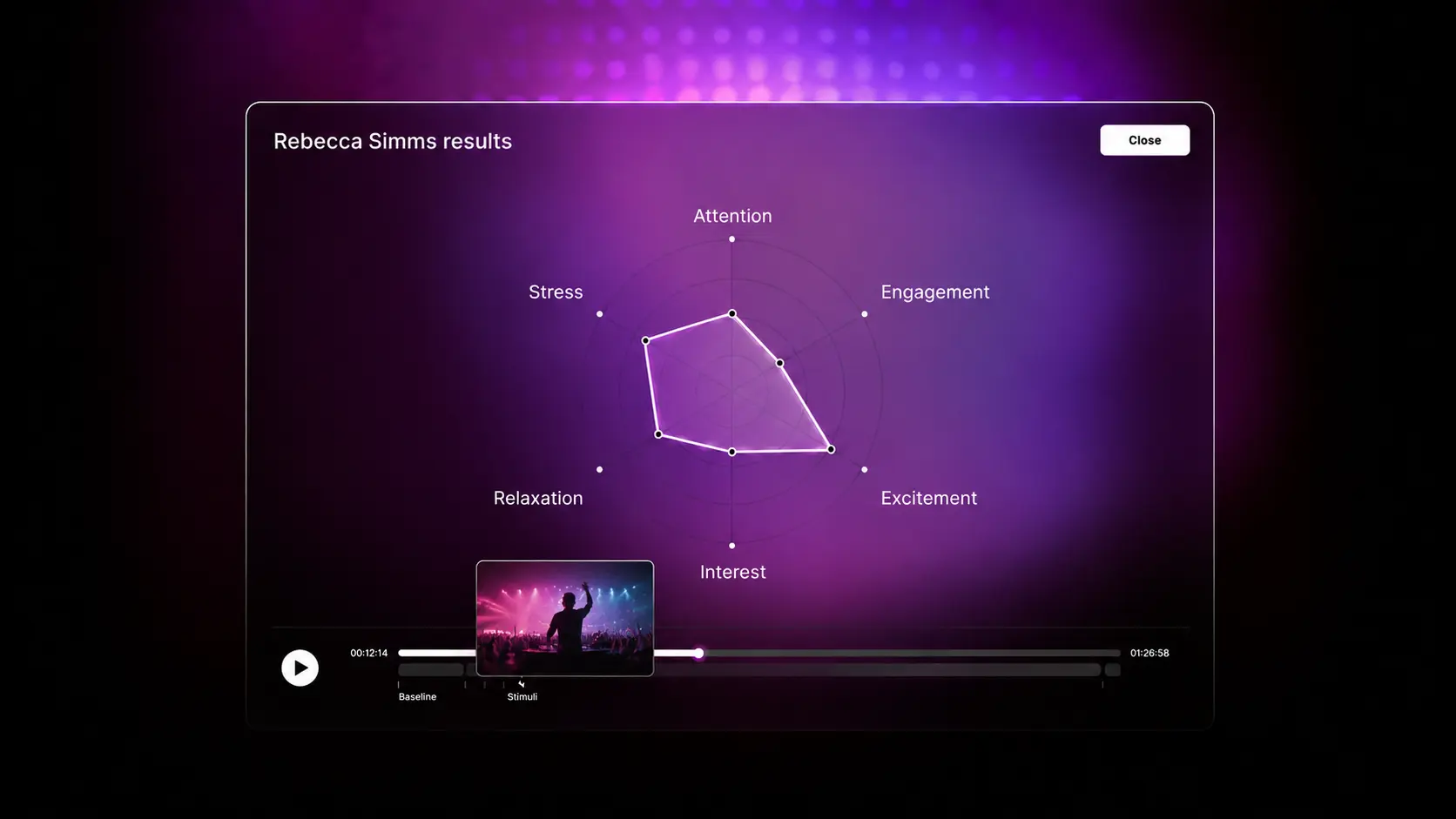
Using platforms such as Emotiv Studio, marketing teams can evaluate metrics associated with attention, engagement, interest, and cognitive workload during exposure to advertisements, videos, websites, and other marketing assets. These objective measures provide additional context that can support creative decision-making and campaign optimization. :contentReference[oaicite:0]{index=0}
Because data is captured during the experience itself, marketers can identify precisely where attention peaks, declines, or shifts between competing elements.
What Attention Metrics Can Reveal About Creative Performance
One of the most valuable aspects of user attention measurement is its ability to uncover patterns that traditional research may miss. Creative teams often have assumptions about which elements attract attention, but audience behavior does not always align with those expectations.
Research by Milosavljevic et al. (2011) found that visual saliency can influence consumer choices more strongly than preferences under certain conditions. Their findings suggest that highly noticeable visual elements may significantly affect audience behavior, particularly when cognitive load increases.
For marketers, these insights can help answer questions such as:
Are viewers noticing the intended message?
Which scenes generate the strongest attention levels?
Do visual elements compete with branding or calls to action?
Where does audience attention begin to decline?
How do different creative concepts compare?
By identifying these patterns before launch, teams can refine creative assets while revisions remain practical and cost-effective.
Real-World Examples of Attention Metrics Supporting Prediction
Research across media and entertainment industries demonstrates how audience response measurements can support predictive decision-making.
In film marketing, Christoforou et al. (2017) found that neural responses collected while audiences viewed movie trailers were associated with future box-office outcomes. These findings suggest that audience attention and engagement data can provide meaningful signals before content reaches broader markets.
A second example comes from the music industry. Research by Leeuwis et al. (2021) demonstrated that neural synchrony among listeners carried predictive value for online music streaming popularity. The study highlights how objective audience response measurements can contribute to forecasting outcomes while content strategies can still be adjusted.
Organizations conducting neuromarketing research increasingly apply similar methodologies to advertising, audience testing, and campaign evaluation workflows, helping marketers assess creative effectiveness before launch. :contentReference[oaicite:1]{index=1}
Applying Attention Metrics Across Campaign Development
User attention measurement can provide value throughout the campaign development process. Rather than serving as a final validation step, attention testing can support decision-making at multiple stages.
Marketing teams commonly apply attention-focused research to:
Digital advertising concept testing
Social media video evaluation
Brand messaging optimization
Website and landing page assessments
Creative comparison studies
Audience segmentation research
Integrating objective attention data into campaign planning enables teams to identify opportunities for improvement before substantial media investments are made.
Conclusion
User attention measurement offers marketers a valuable perspective on how audiences interact with content before performance metrics become available. By understanding what viewers actually notice and how attention fluctuates throughout an experience, teams can make more informed decisions about creative strategy and campaign optimization.
When combined with traditional research approaches, EEG-based attention metrics provide objective insights that help explain audience behavior and support stronger marketing outcomes. For agencies and in-house marketing teams alike, attention measurement can become an important tool for reducing uncertainty and improving campaign effectiveness.
Teams interested in incorporating objective attention metrics into their research workflows can explore how Emotiv Studio supports neuroscience-informed campaign evaluation.
Sources
Christoforou, C., Constantinidou, F., Shoshilou, P., et al. (2017). Your Brain on the Movies: A Computational Approach for Predicting Box-office Performance from Viewer’s Brain Responses to Movie Trailers. Frontiers in Neuroinformatics. https://doi.org/10.3389/fninf.2017.00072
Leeuwis, N., Nuijten, M., van Dijk, H., & Gerkema, C. (2021). A Sound Prediction: EEG-Based Neural Synchrony Predicts Online Music Streams. Frontiers in Psychology. https://doi.org/10.3389/fpsyg.2021.672980
Milosavljevic, M., & Cerf, M. (2008). First Attention Then Intention: Insights from Computational Neuroscience of Vision. International Journal of Advertising. https://doi.org/10.2501/s0265048708080037
Milosavljevic, M., Navalpakkam, V., Koch, C., & Rangel, A. (2011). Relative Visual Saliency Differences Induce Sizable Bias in Consumer Choice. Journal of Consumer Psychology. https://doi.org/10.1016/j.jcps.2011.10.002
Plassmann, H., Venkatraman, V., Huettel, S., & Yoon, C. (2015). Consumer Neuroscience: Applications, Challenges, and Possible Solutions. Journal of Marketing Research. https://doi.org/10.1509/jmr.14.0048

Marketing teams face increasing pressure to predict campaign performance before significant media budgets are committed. While digital analytics provide extensive information about what happens after a campaign launches, they often offer limited insight into how audiences respond during the experience itself. Understanding those real-time reactions can be the difference between a campaign that captures attention and one that gets ignored.
This is why user attention measurement has become an increasingly important component of marketing research. Attention is the gateway to audience engagement. If viewers fail to notice key messages, product benefits, or brand elements, even well-funded campaigns can struggle to achieve their objectives. For marketing agencies and in-house teams, understanding where attention rises, falls, and shifts throughout an experience can provide actionable guidance before campaigns reach market.
By combining traditional research methods with neuroscience-informed measurement techniques, marketers can gain a more complete understanding of audience response. Attention metrics derived from EEG-based testing help identify what audiences actually notice, where engagement is strongest, and which creative elements may influence campaign effectiveness before launch.

Attention metrics can reveal how audiences respond to content long before campaign performance data becomes available.
Key Takeaways
User attention measurement provides objective insight into audience response during content exposure.
Attention patterns can help identify creative strengths and weaknesses before launch.
EEG-informed research complements traditional surveys and behavioral analytics.
Attention metrics can support campaign optimization while changes are still possible.
Marketing teams can make more informed decisions using objective audience data.
Why Attention Is a Leading Indicator of Campaign Effectiveness
Marketing campaigns compete in environments saturated with competing messages, notifications, videos, and advertisements. Before audiences can engage with messaging or evaluate a brand proposition, they must first pay attention.
Research by Milosavljevic and Cerf (2008) highlights the importance of attention as a valuable metric for understanding consumer response. Their work demonstrates how insights from visual attention research can support marketing applications and provide a framework for evaluating audience behavior.
For marketers, this makes attention more than a simple awareness metric. It serves as an early indicator of whether creative assets are likely to connect with audiences. Campaigns that fail to secure attention may never reach the stage where persuasion, consideration, or conversion can occur.
The Limits of Traditional Campaign Evaluation
Most campaign evaluation methods focus on outcomes such as impressions, clicks, conversions, view-through rates, and brand studies. While these metrics remain essential, they are often retrospective. They reveal what happened after exposure rather than how audiences experienced the content.
Similarly, surveys and focus groups provide valuable feedback but depend on participants accurately describing their experiences after the fact. Research by Plassmann et al. (2015) suggests that neuroscience methods can provide information about implicit processes that are difficult to capture through conventional research techniques.
For marketing teams, this means attention measurement can provide context that complements traditional methods and helps explain why specific creative elements perform differently.
How EEG-Based User Attention Measurement Works
Electroencephalography (EEG) enables researchers to measure brain activity associated with attention and engagement while participants interact with content. Rather than relying exclusively on post-exposure feedback, researchers can observe how audience responses evolve throughout an experience.
Using platforms such as Emotiv Studio, marketing teams can evaluate metrics associated with attention, engagement, interest, and cognitive workload during exposure to advertisements, videos, websites, and other marketing assets. These objective measures provide additional context that can support creative decision-making and campaign optimization. :contentReference[oaicite:0]{index=0}
Because data is captured during the experience itself, marketers can identify precisely where attention peaks, declines, or shifts between competing elements.
What Attention Metrics Can Reveal About Creative Performance
One of the most valuable aspects of user attention measurement is its ability to uncover patterns that traditional research may miss. Creative teams often have assumptions about which elements attract attention, but audience behavior does not always align with those expectations.
Research by Milosavljevic et al. (2011) found that visual saliency can influence consumer choices more strongly than preferences under certain conditions. Their findings suggest that highly noticeable visual elements may significantly affect audience behavior, particularly when cognitive load increases.
For marketers, these insights can help answer questions such as:
Are viewers noticing the intended message?
Which scenes generate the strongest attention levels?
Do visual elements compete with branding or calls to action?
Where does audience attention begin to decline?
How do different creative concepts compare?
By identifying these patterns before launch, teams can refine creative assets while revisions remain practical and cost-effective.
Real-World Examples of Attention Metrics Supporting Prediction
Research across media and entertainment industries demonstrates how audience response measurements can support predictive decision-making.
In film marketing, Christoforou et al. (2017) found that neural responses collected while audiences viewed movie trailers were associated with future box-office outcomes. These findings suggest that audience attention and engagement data can provide meaningful signals before content reaches broader markets.
A second example comes from the music industry. Research by Leeuwis et al. (2021) demonstrated that neural synchrony among listeners carried predictive value for online music streaming popularity. The study highlights how objective audience response measurements can contribute to forecasting outcomes while content strategies can still be adjusted.
Organizations conducting neuromarketing research increasingly apply similar methodologies to advertising, audience testing, and campaign evaluation workflows, helping marketers assess creative effectiveness before launch. :contentReference[oaicite:1]{index=1}
Applying Attention Metrics Across Campaign Development
User attention measurement can provide value throughout the campaign development process. Rather than serving as a final validation step, attention testing can support decision-making at multiple stages.
Marketing teams commonly apply attention-focused research to:
Digital advertising concept testing
Social media video evaluation
Brand messaging optimization
Website and landing page assessments
Creative comparison studies
Audience segmentation research
Integrating objective attention data into campaign planning enables teams to identify opportunities for improvement before substantial media investments are made.
Conclusion
User attention measurement offers marketers a valuable perspective on how audiences interact with content before performance metrics become available. By understanding what viewers actually notice and how attention fluctuates throughout an experience, teams can make more informed decisions about creative strategy and campaign optimization.
When combined with traditional research approaches, EEG-based attention metrics provide objective insights that help explain audience behavior and support stronger marketing outcomes. For agencies and in-house marketing teams alike, attention measurement can become an important tool for reducing uncertainty and improving campaign effectiveness.
Teams interested in incorporating objective attention metrics into their research workflows can explore how Emotiv Studio supports neuroscience-informed campaign evaluation.
Sources
Christoforou, C., Constantinidou, F., Shoshilou, P., et al. (2017). Your Brain on the Movies: A Computational Approach for Predicting Box-office Performance from Viewer’s Brain Responses to Movie Trailers. Frontiers in Neuroinformatics. https://doi.org/10.3389/fninf.2017.00072
Leeuwis, N., Nuijten, M., van Dijk, H., & Gerkema, C. (2021). A Sound Prediction: EEG-Based Neural Synchrony Predicts Online Music Streams. Frontiers in Psychology. https://doi.org/10.3389/fpsyg.2021.672980
Milosavljevic, M., & Cerf, M. (2008). First Attention Then Intention: Insights from Computational Neuroscience of Vision. International Journal of Advertising. https://doi.org/10.2501/s0265048708080037
Milosavljevic, M., Navalpakkam, V., Koch, C., & Rangel, A. (2011). Relative Visual Saliency Differences Induce Sizable Bias in Consumer Choice. Journal of Consumer Psychology. https://doi.org/10.1016/j.jcps.2011.10.002
Plassmann, H., Venkatraman, V., Huettel, S., & Yoon, C. (2015). Consumer Neuroscience: Applications, Challenges, and Possible Solutions. Journal of Marketing Research. https://doi.org/10.1509/jmr.14.0048
Marketing teams face increasing pressure to predict campaign performance before significant media budgets are committed. While digital analytics provide extensive information about what happens after a campaign launches, they often offer limited insight into how audiences respond during the experience itself. Understanding those real-time reactions can be the difference between a campaign that captures attention and one that gets ignored.
This is why user attention measurement has become an increasingly important component of marketing research. Attention is the gateway to audience engagement. If viewers fail to notice key messages, product benefits, or brand elements, even well-funded campaigns can struggle to achieve their objectives. For marketing agencies and in-house teams, understanding where attention rises, falls, and shifts throughout an experience can provide actionable guidance before campaigns reach market.
By combining traditional research methods with neuroscience-informed measurement techniques, marketers can gain a more complete understanding of audience response. Attention metrics derived from EEG-based testing help identify what audiences actually notice, where engagement is strongest, and which creative elements may influence campaign effectiveness before launch.

Attention metrics can reveal how audiences respond to content long before campaign performance data becomes available.
Key Takeaways
User attention measurement provides objective insight into audience response during content exposure.
Attention patterns can help identify creative strengths and weaknesses before launch.
EEG-informed research complements traditional surveys and behavioral analytics.
Attention metrics can support campaign optimization while changes are still possible.
Marketing teams can make more informed decisions using objective audience data.
Why Attention Is a Leading Indicator of Campaign Effectiveness
Marketing campaigns compete in environments saturated with competing messages, notifications, videos, and advertisements. Before audiences can engage with messaging or evaluate a brand proposition, they must first pay attention.
Research by Milosavljevic and Cerf (2008) highlights the importance of attention as a valuable metric for understanding consumer response. Their work demonstrates how insights from visual attention research can support marketing applications and provide a framework for evaluating audience behavior.
For marketers, this makes attention more than a simple awareness metric. It serves as an early indicator of whether creative assets are likely to connect with audiences. Campaigns that fail to secure attention may never reach the stage where persuasion, consideration, or conversion can occur.
The Limits of Traditional Campaign Evaluation
Most campaign evaluation methods focus on outcomes such as impressions, clicks, conversions, view-through rates, and brand studies. While these metrics remain essential, they are often retrospective. They reveal what happened after exposure rather than how audiences experienced the content.
Similarly, surveys and focus groups provide valuable feedback but depend on participants accurately describing their experiences after the fact. Research by Plassmann et al. (2015) suggests that neuroscience methods can provide information about implicit processes that are difficult to capture through conventional research techniques.
For marketing teams, this means attention measurement can provide context that complements traditional methods and helps explain why specific creative elements perform differently.
How EEG-Based User Attention Measurement Works
Electroencephalography (EEG) enables researchers to measure brain activity associated with attention and engagement while participants interact with content. Rather than relying exclusively on post-exposure feedback, researchers can observe how audience responses evolve throughout an experience.
Using platforms such as Emotiv Studio, marketing teams can evaluate metrics associated with attention, engagement, interest, and cognitive workload during exposure to advertisements, videos, websites, and other marketing assets. These objective measures provide additional context that can support creative decision-making and campaign optimization. :contentReference[oaicite:0]{index=0}
Because data is captured during the experience itself, marketers can identify precisely where attention peaks, declines, or shifts between competing elements.
What Attention Metrics Can Reveal About Creative Performance
One of the most valuable aspects of user attention measurement is its ability to uncover patterns that traditional research may miss. Creative teams often have assumptions about which elements attract attention, but audience behavior does not always align with those expectations.
Research by Milosavljevic et al. (2011) found that visual saliency can influence consumer choices more strongly than preferences under certain conditions. Their findings suggest that highly noticeable visual elements may significantly affect audience behavior, particularly when cognitive load increases.
For marketers, these insights can help answer questions such as:
Are viewers noticing the intended message?
Which scenes generate the strongest attention levels?
Do visual elements compete with branding or calls to action?
Where does audience attention begin to decline?
How do different creative concepts compare?
By identifying these patterns before launch, teams can refine creative assets while revisions remain practical and cost-effective.
Real-World Examples of Attention Metrics Supporting Prediction
Research across media and entertainment industries demonstrates how audience response measurements can support predictive decision-making.
In film marketing, Christoforou et al. (2017) found that neural responses collected while audiences viewed movie trailers were associated with future box-office outcomes. These findings suggest that audience attention and engagement data can provide meaningful signals before content reaches broader markets.
A second example comes from the music industry. Research by Leeuwis et al. (2021) demonstrated that neural synchrony among listeners carried predictive value for online music streaming popularity. The study highlights how objective audience response measurements can contribute to forecasting outcomes while content strategies can still be adjusted.
Organizations conducting neuromarketing research increasingly apply similar methodologies to advertising, audience testing, and campaign evaluation workflows, helping marketers assess creative effectiveness before launch. :contentReference[oaicite:1]{index=1}
Applying Attention Metrics Across Campaign Development
User attention measurement can provide value throughout the campaign development process. Rather than serving as a final validation step, attention testing can support decision-making at multiple stages.
Marketing teams commonly apply attention-focused research to:
Digital advertising concept testing
Social media video evaluation
Brand messaging optimization
Website and landing page assessments
Creative comparison studies
Audience segmentation research
Integrating objective attention data into campaign planning enables teams to identify opportunities for improvement before substantial media investments are made.
Conclusion
User attention measurement offers marketers a valuable perspective on how audiences interact with content before performance metrics become available. By understanding what viewers actually notice and how attention fluctuates throughout an experience, teams can make more informed decisions about creative strategy and campaign optimization.
When combined with traditional research approaches, EEG-based attention metrics provide objective insights that help explain audience behavior and support stronger marketing outcomes. For agencies and in-house marketing teams alike, attention measurement can become an important tool for reducing uncertainty and improving campaign effectiveness.
Teams interested in incorporating objective attention metrics into their research workflows can explore how Emotiv Studio supports neuroscience-informed campaign evaluation.
Sources
Christoforou, C., Constantinidou, F., Shoshilou, P., et al. (2017). Your Brain on the Movies: A Computational Approach for Predicting Box-office Performance from Viewer’s Brain Responses to Movie Trailers. Frontiers in Neuroinformatics. https://doi.org/10.3389/fninf.2017.00072
Leeuwis, N., Nuijten, M., van Dijk, H., & Gerkema, C. (2021). A Sound Prediction: EEG-Based Neural Synchrony Predicts Online Music Streams. Frontiers in Psychology. https://doi.org/10.3389/fpsyg.2021.672980
Milosavljevic, M., & Cerf, M. (2008). First Attention Then Intention: Insights from Computational Neuroscience of Vision. International Journal of Advertising. https://doi.org/10.2501/s0265048708080037
Milosavljevic, M., Navalpakkam, V., Koch, C., & Rangel, A. (2011). Relative Visual Saliency Differences Induce Sizable Bias in Consumer Choice. Journal of Consumer Psychology. https://doi.org/10.1016/j.jcps.2011.10.002
Plassmann, H., Venkatraman, V., Huettel, S., & Yoon, C. (2015). Consumer Neuroscience: Applications, Challenges, and Possible Solutions. Journal of Marketing Research. https://doi.org/10.1509/jmr.14.0048