অন্যান্য বিষয় অনুসন্ধান করুন…

অন্যান্য বিষয় অনুসন্ধান করুন…

উদ্বেগের চিকিৎসা: কগনিটিভ বিহেভিয়ারাল থেরাপি

উদ্বেগ সব সময়ের একটানা দুশ্চিন্তার মতো মনে হতে পারে, যা দৈনন্দিন জীবনকে একটি চ্যালেঞ্জে পরিণত করে। কিন্তু যদি আপনি সত্যিই আপনার মস্তিষ্ক এই অনুভূতিগুলো কীভাবে সামলায়, তা পরিবর্তন করতে পারেন?

কগনিটিভ বিহেভিয়ারাল থেরাপি, বা CBT, একটি ব্যবহারিক পদ্ধতি যা আপনার মস্তিষ্কের সংযোগগুলো পুনর্গঠনে সাহায্য করে, এবং উদ্বেগ মোকাবিলার একটি বাস্তব উপায় দেয়।

Can CBT Actually Rewire the Brain to Stop Anxiety?


Is Cognitive Behavioral Therapy More Than Just Talk Therapy?

Cognitive Behavioral Therapy (CBT) is often thought of as just talking, but it does more than that. It actually changes how your brain works, physically.

When you have anxiety, certain parts of your brain can become overly active, like an alarm system that's too sensitive. CBT gives you tools to quiet that alarm and build better control.

It's not about pretending everything is fine; it's about learning to think more realistically when things feel tough. By practicing new ways of thinking and behaving, you create new pathways in your brain.

These new pathways help your brain respond differently to stressful situations, making anxiety less powerful over time. This process physically reshapes neural connections, making your brain more resilient to anxiety.


Why Does the Brain's Alarm System Stay On During Anxiety?

Think of your brain as having a built-in alarm system. For people with anxiety, this system can get stuck in the 'on' position. It might go off for things that aren't actually dangerous, leading to feelings of panic or worry.

This overactive alarm is often linked to a part of the brain called the amygdala, which is involved in processing fear. When the amygdala is constantly triggered, it can make everyday situations feel threatening. This can lead to a cycle where you start avoiding things, which then makes the anxiety worse.

CBT aims to retrain this alarm system, teaching it to recognize real threats from imagined ones, and to calm down when there's no danger present.


How Does CBT Strengthen the Brain's Emotional Brake?


What Is the Physical Impact of CBT on Brain Function?

When anxiety is high, certain parts of the brain can get overactive. CBT helps to retrain these systems, making them more balanced.

The "cognitive" part of CBT focuses on your thoughts, and the "behavioral" part focuses on your actions. Together, they work to create lasting changes in how your brain processes stress and threat.


How Do Anxious Brains Respond to Perceived Threats?

In an anxious brain, the amygdala can become overly sensitive. It might sound the alarm for perceived threats that aren't actually dangerous. This constant state of alert can lead to physical symptoms like a racing heart, tense muscles, and difficulty concentrating.

The prefrontal cortex, on the other hand, acts like the brain's "brake" or "executive control center." It's responsible for rational thinking, decision-making, and regulating emotions.

When anxiety is high, the connection between the prefrontal cortex and the amygdala can weaken, making it harder for the "brake" to control the "alarm."

CBT aims to strengthen this connection, allowing the prefrontal cortex to better manage the amygdala's responses.


What Is Top-Down Control in Anxiety Treatment?

Cognitive restructuring is a core technique in CBT. It involves identifying unhelpful or inaccurate thought patterns and then challenging them.

For example, if someone consistently thinks, "I'm going to fail this presentation," cognitive restructuring helps them examine the evidence for and against that thought.

They might realize they've given successful presentations before or that the stakes aren't as high as they feel. By replacing catastrophic thoughts with more balanced and realistic ones, a person learns to exert more "top-down" control.

This means the more rational parts of the brain (like the prefrontal cortex) can better influence the emotional responses driven by areas like the amygdala. This process helps to reduce the intensity and frequency of anxious feelings by changing the underlying interpretations of events.


Can Neuroplasticity Help Create Non-Anxious Neural Pathways?

Neuroplasticity is the brain's remarkable ability to reorganize itself by forming new neural connections throughout life. CBT actively harnesses this capacity.

When you practice CBT skills, like challenging negative thoughts or engaging in behavioral experiments, you are essentially creating and strengthening new neural pathways.

Think of it like forging a new path through a dense forest. Initially, it's difficult and requires effort. However, with repeated use, the path becomes well-worn and easier to travel.

Similarly, by consistently practicing new ways of thinking and behaving, CBT helps to build and reinforce neural circuits associated with calm and rational responses, making them more automatic over time. This process can gradually reduce the brain's reliance on old, anxious patterns.


Can EEG Monitor How the Brain Changes During CBT?

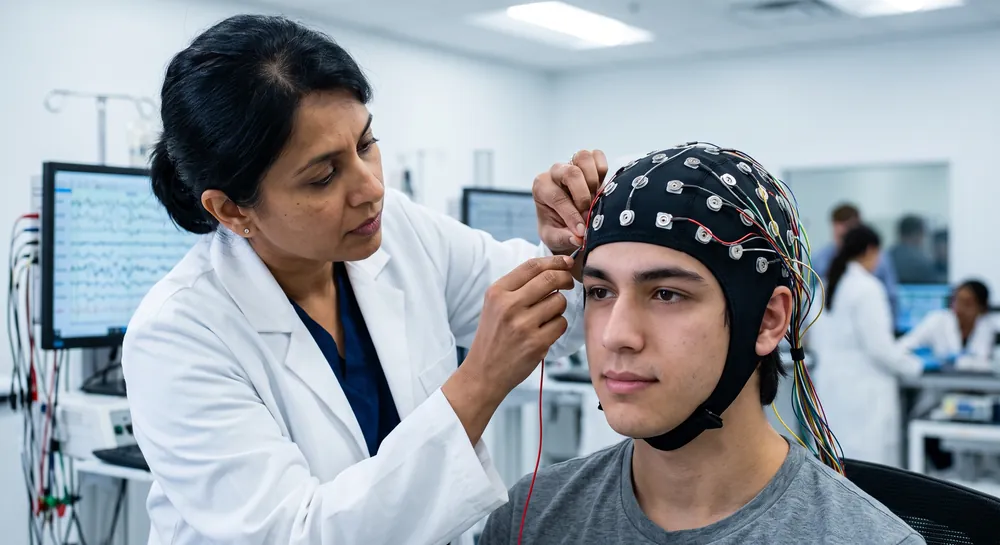
While fMRI is highly effective at mapping the specific regions where brain changes occur, electroencephalography (EEG) offers a unique look at the timing and patterns of electrical activity in real-time. This temporal resolution allows neuroscientists to observe how the prefrontal cortex improves its regulatory "braking" function throughout the course of CBT.

One primary area of focus in EEG research is frontal alpha asymmetry, which refers to the balance of activity between the left and right frontal lobes. Generally, higher activity in the right frontal lobe is associated with withdrawal and anxiety-related states, while higher activity in the left frontal lobe is linked to "approach" behaviors and more effective emotional regulation.

Studies observing individuals after CBT have noted shifts toward greater left-sided activation, suggesting that the prefrontal cortex is becoming better equipped to manage and mitigate anxious signals.

Beyond asymmetry, researchers also measure the relationship between different brain wave frequencies, such as the ratio between theta and beta waves. In research settings, a higher theta-to-beta ratio is often associated with lower executive control and increased difficulty in filtering out emotional distractions.

Reductions in this ratio following treatment may indicate a prefrontal cortex that is more effectively engaged and less easily overwhelmed by subcortical stress responses.

It is important to note that while these electrophysiological markers provide compelling evidence of neuroplasticity at the group level in research, they are currently utilized as tools for understanding treatment mechanisms rather than as standardized clinical diagnostic tests for individual patients.


How Do I Stop Automatic Negative Thoughts with CBT?

Anxiety often involves automatic negative thoughts (ANTs) that pop into your head without conscious effort. These thoughts can feel like facts, even when they are not.

CBT helps to shift this pattern. Initially, identifying and challenging ANTs requires conscious effort and practice. You learn to pause, notice the thought, and then apply cognitive restructuring techniques.

This "effortful" thinking is key to building new habits. As these new patterns are practiced and reinforced through neuroplasticity, they become more ingrained.

Eventually, the ability to think in a more regulated and balanced way becomes less effortful and more automatic. This transition is a significant outcome of CBT, allowing people to manage anxiety more effectively in daily life.


How Does CBT Retrain the Amygdala’s Fear Response?

Does Exposure Therapy Really Reduce the Amygdala's Sensitivity?

Exposure therapy is a cornerstone of CBT for anxiety, directly addressing the amygdala's fear response. The core idea is to gradually and systematically confront feared situations, objects, or sensations in a safe and controlled environment.

By repeatedly facing these triggers without the feared outcome occurring, the brain, including the amygdala, begins to learn that the situation is not as dangerous as it once believed.

This process doesn't involve suppressing fear but rather learning to tolerate the discomfort associated with it. As individuals engage in exposure, they gather new information that contradicts their initial fearful predictions.

This new data helps to update the amygdala's threat assessment, reducing its tendency to sound the alarm unnecessarily.


What Is Extinction Learning in Anxiety Therapy?

When you avoid something that makes you anxious, your brain learns that avoidance is the way to feel safe. This is the opposite of what we want.

Exposure therapy works through a process called extinction learning. This is where the brain learns that a previously feared stimulus or situation is no longer associated with danger.

It's not about forgetting the fear, but rather about forming new, inhibitory memories that override the old fear response. Think of it like adding a new, more accurate file to your brain's filing cabinet. Over time, with consistent exposure, these new safety memories become more robust and accessible, making the old fear response less likely to be activated.


What Do Brain Scans Show After Completing CBT?

Neuroimaging studies provide compelling evidence for how CBT impacts the amygdala. Before treatment, people with anxiety disorders often show heightened amygdala reactivity when presented with threat-related stimuli.

Brain scans might reveal a more intense and prolonged activation of the amygdala in these individuals compared to those without anxiety. Following a course of CBT, particularly with exposure components, these same individuals often exhibit reduced amygdala activation in response to similar stimuli.

This suggests that the therapy has effectively modulated the amygdala's sensitivity, leading to a less reactive threat detection system. The brain essentially learns to downregulate its alarm response, contributing to a significant reduction in anxiety symptoms.


How Does CBT Affect Memory and the Hippocampus?


How Does the Hippocampus Associate Context With Fear?

The hippocampus, a brain structure deep within the temporal lobe, plays a significant role in memory formation and retrieval, particularly in understanding the context of our experiences.

When we encounter a threat, the hippocampus helps to link that threat to the specific environment and circumstances in which it occurred. This is a vital survival mechanism; it teaches us to avoid similar situations in the future.

However, in anxiety disorders, this system can become oversensitive. The hippocampus might incorrectly associate neutral or safe situations with danger, leading to generalized anxiety.


What Are Behavioral Experiments in Cognitive Behavioral Therapy?

Cognitive Behavioral Therapy works with the hippocampus by encouraging the creation of new, more accurate memory traces. This is often achieved through behavioral experiments. These are planned activities designed to test anxious predictions in real-world situations.

For example, someone with social anxiety might predict that attending a party will lead to embarrassment and rejection. A behavioral experiment could involve attending the party for a short period and observing what actually happens.

The hippocampus then records this new experience, which might be neutral or even positive, alongside the old, fear-based memory. Repeatedly engaging in these experiments helps to overwrite or at least contextualize the old, fearful memories with more realistic ones.


How Can I Separate Past Trauma From Current Safety?

CBT techniques aim to help the hippocampus differentiate between past dangers and present safety. By systematically confronting feared situations in a controlled and supportive environment, people learn that the feared outcome does not occur. This process helps to update the hippocampus's contextual memory.

Instead of a broad, generalized fear response, the brain begins to form specific memories of safety associated with previously feared stimuli or situations. This allows for a more nuanced and accurate assessment of threats, reducing the impact of anxiety on daily life.

The goal is to build a more robust and accurate memory archive, where danger signals are correctly filed and not triggered by benign circumstances.


How Does CBT Calm the Body's Physical Stress Response?

Anxiety profoundly affects the body, triggering a cascade of physiological responses. When the brain perceives a threat, it activates the body's stress response system, often referred to as the fight-or-flight response.

This involves the hypothalamic-pituitary-adrenal (HPA) axis, a complex system that regulates stress. Cognitive Behavioral Therapy offers practical strategies to interrupt this cycle and help the body return to a state of calm.


Can CBT Skills Stop the Chronic Stress Response?

The HPA axis, when chronically activated by anxiety, can keep the body in a perpetual state of high alert. CBT equips a person with skills to consciously down-regulate this system.

Techniques such as paced breathing, progressive muscle relaxation, and mindfulness help to signal to the brain that the perceived threat has passed, or is manageable. By practicing these skills, people learn to exert a degree of control over their physiological reactions, rather than being overwhelmed by them.

This conscious effort to calm the body can, over time, retrain the HPA axis to be less reactive.


How Does CBT Reduce Physical Symptoms Like a Racing Heart?

Anxiety often manifests in noticeable physical symptoms, including a racing heart, muscle tension, shortness of breath, and digestive upset. CBT addresses these symptoms not by trying to eliminate the anxiety itself, but by changing the individual's relationship with these sensations.

Through techniques like cognitive restructuring, a person learns to reframe their interpretation of these physical cues. For example, a racing heart might be re-labeled from a sign of impending doom to a normal bodily response to stress that will pass.

Exposure therapy, a component of CBT, also plays a role by gradually confronting feared situations, demonstrating to the brain and body that the feared physical sensations are not dangerous and can be tolerated.

This process helps to weaken the learned association between certain situations and intense physical anxiety responses, leading to a reduction in the frequency and intensity of these symptoms.


Is the Effect of CBT for Anxiety Permanent?

So, what does all this mean for someone struggling with anxiety? It means that Cognitive Behavioral Therapy isn't just a temporary fix. By actively engaging in CBT techniques, you're not just changing how you think or react in the moment; you're actually rewiring your brain.

You're building new neural pathways that make anxious responses less automatic and more manageable. This process helps your brain learn that you can handle difficult situations and that the intense fear you feel isn't always a true reflection of danger.

Over time, this leads to a more resilient mind, capable of navigating life's challenges with greater calm and confidence. It's a powerful, evidence-based approach that offers a tangible way to reshape your brain's response to anxiety, leading to lasting relief.


References

  1. González-Alemañy, E., Ostrosky, F., Lozano, A., Lujan, A., Perez, M., Castañeda, D., ... & Bobes, M. A. (2024). Brain structural change associated with cognitive behavioral therapy in maltreated children. Brain research, 1825, 148702. https://doi.org/10.1016/j.brainres.2023.148702

  2. Moscovitch, D. A., Santesso, D. L., Miskovic, V., McCabe, R. E., Antony, M. M., & Schmidt, L. A. (2011). Frontal EEG asymmetry and symptom response to cognitive behavioral therapy in patients with social anxiety disorder. Biological psychology, 87(3), 379-385. https://doi.org/10.1016/j.biopsycho.2011.04.009

  3. Klumpp, H., Fitzgerald, J. M., Kinney, K. L., Kennedy, A. E., Shankman, S. A., Langenecker, S. A., & Phan, K. L. (2017). Predicting cognitive behavioral therapy response in social anxiety disorder with anterior cingulate cortex and amygdala during emotion regulation. NeuroImage: Clinical, 15, 25-34. https://doi.org/10.1016/j.nicl.2017.04.006


Frequently Asked Questions


How does CBT actually change the brain for anxiety?

CBT works by actually rewiring your brain. When you practice CBT skills, you're strengthening certain brain pathways and weakening others. For example, it helps the part of your brain that controls thinking and decision-making (like the prefrontal cortex) get better at managing the brain's alarm system (the amygdala), which often goes into overdrive with anxiety.


How does CBT help control the 'alarm system' in the brain?

CBT helps retrain your brain's alarm system, the amygdala. Through techniques like exposure therapy, you gradually face feared situations or sensations in a safe way. This teaches your amygdala that these situations are not actually dangerous, helping it to calm down and stop sending false alarms.


How does CBT help with the physical feelings of anxiety?

CBT teaches you skills to manage physical symptoms like a racing heart, tense muscles, or shortness of breath. Techniques like deep breathing and relaxation exercises help calm your body's stress response, making the physical feelings less intense and scary.


What role does 'neuroplasticity' play in CBT?

Neuroplasticity is your brain's amazing ability to change and form new connections throughout your life. CBT takes advantage of this. By consistently practicing CBT skills, you're essentially creating new, stronger pathways in your brain that support calmer, more rational thinking and less anxious reactions.


What are 'safety behaviors' and how does CBT address them?

Safety behaviors are things people do to feel less anxious in the moment, like avoiding certain places or people, or constantly seeking reassurance. While they offer temporary relief, they actually reinforce the fear in the long run. CBT helps you recognize these behaviors and gradually reduce them, showing your brain that you can handle situations without them.


How does CBT help with memory and fear?

The hippocampus is a part of the brain involved in memory. CBT can help update fear-related memories. By facing fears in a controlled way and creating new, positive experiences, CBT helps your brain learn to distinguish between past threats and present safety, so old fears don't trigger anxiety unnecessarily.


Can CBT help if my anxiety feels automatic and overwhelming?

CBT helps you slow down those automatic negative thoughts and responses. It teaches you to pause, assess the situation more realistically, and choose a more helpful response, rather than just reacting out of fear.


How long does CBT typically take to work?

The length of CBT treatment can vary depending on the individual and the severity of the anxiety. It's often a short-term therapy, sometimes lasting a few months, but it can be longer if needed. The key is consistent practice of the skills learned, which leads to lasting changes in how your brain responds to anxiety.

ইমোটিভ একটি নিউরোটেকনোলজি উন্নয়নকর্তা হিসেবে এলিংEEG এবং মস্তিষ্ক ডেটা সরঞ্জামগুলির মাধ্যমে স্নায়ুবিজ্ঞান গবেষণাকে এগিয়ে নিয়ে যেতে সহায়তা করে।

Christian Burgos

আমাদের কাছ থেকে সর্বশেষ

শ্বাসকষ্ট কি উদ্বেগের কারণে হচ্ছে তা কীভাবে বুঝবেন

শ্বাস নিতে কষ্ট হচ্ছে বলে মনে হওয়া সত্যিই অস্বস্তিকর একটি অভিজ্ঞতা হতে পারে। এর কারণ কী হতে পারে তা নিয়ে উদ্বিগ্ন হওয়া স্বাভাবিক। শ্বাসকষ্টের অনেক কারণ থাকতে পারে, তবে কখনও কখনও এর পেছনে থাকে উদ্বেগ।

এই নিবন্ধের উদ্দেশ্য হলো আপনার শ্বাসকষ্টটি উদ্বেগের সঙ্গে সম্পর্কিত হতে পারে কি না তা বুঝতে সাহায্য করা, যেখানে অনুভূতি, সময়কাল এবং অন্যান্য লক্ষণগুলো দেখা হবে যা এর দিকে ইঙ্গিত করতে পারে।

লেখা পড়ুন

ধ্যান

ধ্যান একটি অনুশীলন, যা বহু বছর ধরে প্রচলিত আছে, এবং মূলত এটি আপনার মনকে প্রশিক্ষিত করার বিষয়। আপনি বিভিন্ন কৌশল ব্যবহার করেন আপনার মনোযোগকে কেন্দ্রীভূত করতে এবং আপনার ভেতরে ও চারপাশে কী ঘটছে সে সম্পর্কে আরও সচেতন হতে। এর লক্ষ্য প্রায়ই শান্তি এবং মানসিক স্বচ্ছতার একটি অবস্থায় পৌঁছানো।

অনেক মানুষ নানা কারণে এটি চেষ্টা করছেন, মানসিক চাপ কমানো থেকে শুরু করে তাদের দৈনন্দিন জীবনে আরও উপস্থিত অনুভব করা পর্যন্ত।

লেখা পড়ুন

উদ্বেগের সঙ্গে কীভাবে মোকাবিলা করবেন?

উদ্বেগের সঙ্গে মোকাবিলা করা একটানা যুদ্ধের মতো মনে হতে পারে, বিশেষ করে যখন এটি কোনো সতর্কতা ছাড়াই হঠাৎ দেখা দেয়। উদ্বেগজনক অনুভূতিতে প্রতিক্রিয়া দেখানোর এক চক্রে আটকে পড়া সহজ, যা প্রায়ই সেগুলোকে আরও খারাপ করে তোলে।

কিন্তু যদি আপনি শুধু মানিয়ে নেওয়া থেকে তা সক্রিয়ভাবে নিয়ন্ত্রণে নেওয়ার দিকে সরে যেতে পারেন? এই নির্দেশিকায় দেখানো হয়েছে কীভাবে উদ্বেগ সামলাতে একটি ব্যক্তিগত কৌশল গড়ে তোলা যায়, যা আপনাকে প্রতিক্রিয়াশীল অবস্থা থেকে আরও অগ্রসরমুখী পদ্ধতির দিকে নিয়ে যায়।

আমরা ব্যাখ্যা করব কীভাবে নিজের উদ্বেগকে বোঝা যায়, এর প্রতিক্রিয়া জানানোর একটি ব্যবস্থা তৈরি করা যায়, একটি সহায়ক নেটওয়ার্ক গড়ে তোলা যায়, এবং সবকিছু বাস্তবে প্রয়োগ করা যায়。

লেখা পড়ুন

কুকুরদের মধ্যে বিচ্ছেদজনিত উদ্বেগ

অনেক কুকুর-মালিকের জন্য, বাড়ি থেকে বেরিয়ে যাওয়ার অভিজ্ঞতা অপরাধবোধ ও উদ্বেগে ভরা। যখন একটি কুকুর তার মালিকের চলে যাওয়ায় নেতিবাচকভাবে প্রতিক্রিয়া দেখায়, তখন সেটিকে প্রায়ই বিদ্বেষপূর্ণ আচরণ বা শৃঙ্খলার অভাব হিসেবে ভুলভাবে ব্যাখ্যা করা হয়।

তবে, স্নায়ুবৈজ্ঞানিক দৃষ্টিকোণ থেকে, এই প্রতিক্রিয়াগুলো "দুষ্টুমি" করার বিষয় নয়; এগুলো হলো বিচ্ছেদজনিত উদ্বেগ নামে পরিচিত একটি গভীরভাবে প্রোথিত স্নায়ু-শারীরবৃত্তীয় অবস্থার বাহ্যিক প্রকাশ।

লেখা পড়ুন